Despite widespread fear that the United States would return to double-digit unemployment rates during the reconversion from the Second World War, the economy remained at full employment. The orthodox explanation for this unexpected outcome credits “pent-up demand” from the American consumer. This article highlights the heretofore neglected role played by international trade, specifically a temporary but significant rise in net exports immediately following the war, in helping the United States avoid a postwar unemployment problem. Using an input-output analysis, we find that the export surplus directly accounted for 1.33 million jobs in 1946 and 1.97 million jobs in 1947—figures that account for close to half of the gains to private sector employment during these years. Postwar U.S. aid to Europe (pre-Marshall Plan) was instrumental in financing the export surplus.
FEAR OF UNEMPLOYMENT'S RETURN IN THE POSTWAR RECONVERSION
By the outbreak of war in Europe in September 1939, New Deal economic programs had been in place for over six years with only limited success. Production attributable to the nation's “arsenal of democracy” role prior to Pearl Harbor contributed to a decline in unemployment from 19 percent in 1938 to 9.9 percent in 1941.Footnote 1 The nation's direct entry into World War II further accelerated employment gains and in 1942 the United States reached “full employment” for the first time in 13 years.Footnote 2
At its peak, the war effort supported 45 percent of the U.S. civilian labor supply while another 12 million citizens, representing around 18 percent of the total (military plus civilian) labor force, were employed directly by the military.Footnote 3 Since wartime production coincided with full employment, it was widely feared that the end of the war would bring back Depression-era economic conditions. In August 1945 John Snyder, Director of the Office of War Mobilization and Reconversion, forecasted that 8 million would be unemployed by the spring of 1946—this translates to an unemployment rate of around 12 percent.Footnote 4 The September 1, 1945 issue of Business Week predicted unemployment would approach 9 million or a rate of 14 percent.Footnote 5
In fact, the unemployment rates for both 1946 and 1947 were 3.9 percent.Footnote 6 The smooth transition of labor resources from government-directed to market-directed production was viewed as a miraculous event. Economists in the Truman administration largely attributed the full employment reconversion to “pent-up demand for many goods that have been scarce in recent years” and this would become the consensus view.Footnote 7 However, the administration did note that exports have “been one of the factors accounting for a high level of employment, production, and purchasing power during 1946” and predicted this trend would continue into 1947 given “the incompleteness of reconstruction in war-devastated areas.”Footnote 8
NET EXPORTS AND EMPLOYMENT: 1946 AND 1947
In current dollars, net exports were –$0.8 billion in 1945, $7.1 billion in 1946, $10.8 billion in 1947, and $5.4 billion in 1948. Focusing in on 1946 and 1947, then, net exports during these two years totaled $17.9 billion after being negative the year prior. As a percent of GDP, net exports reached an unprecedented 3.2 and 4.4 percent of production during 1946 and 1947—levels neither seen before nor since in U.S. history.Footnote 9
We employ an input-output (I-O) analysis to calculate the number of jobs attributable to net exports during the reconversion. The I-O analysis examines relationships among industries within an economy where each industry's output is equal to the total demand for its product as an input by all other industries. It is generally used to examine total production in the context of economic planning. An I-O table for the United States was created by Wassily W. Leontief using 1947 data for 38 industry categories.Footnote 10 Leontief's objective was to compare the labor and capital intensity of U.S. exports relative to that of import competing goods. We have used Leontief's I-O table toward a different end—to calculate the employment generated by the export surplus in the two years following the Second World War.
Our analysis involves three steps: (1) Calculate total man years employed to supply $1 million of exports in each of the 38 industry categories; (2) Calculate the employment generated by each industry's export share (on average) of one million dollars of total exports of average composition; and (3) Calculate the man years required to produce the total export surplus in each industry. The details of each step follows.
Step 1: In Leontief's I-O table, each of the 38 broad industries, for exampleIND 4 for industry number 4 (Textile Mill Products), is disaggregated into several component industries—say cind 4A, cind 4B, cind 4C and cind 4D (Spinning, weaving, and dyeing; Special textile products; Jute, linen, cordage, and twine; and Floor coverings). The labor requirements for $1 million worth of output in these four component industries (given by l4A,l4B,l4C, and l4D) are first multiplied by their share of IND 4, to get (cind4A/ IND4) l4A, (cind4B / IND4) l4B, (cind4C / IND4) l4C, and (cind4D / IND4) l4D. We then add (cind4A / IND4) l4A, (cind4B / IND4) l4B, (cind4C / IND4) l4C, and (cind4D / IND4) l4D to get total man years needed to produce one million dollars of exports by industry 4, L 4, in 1947. We do this for each of the 38 broad industries.
Step 2: We multiply each L ii = 1…38, by each industry's share of exports per million dollars of total U.S. exports to get Ei, employment created by one million dollars of total U.S. exports in each of the 38 industries.Footnote 11
Step 3: We multiply each E i by the total export surplus (e.g., $10.8 billion in 1947) to get the total employment attributable to the export surplus in each industry.
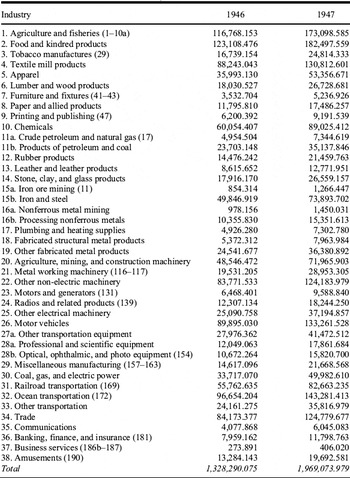
We have followed the same steps for both 1946 and 1947. Since there is no I-O table available for 1946, we have used the parameter values (such as unit labor requirement) from 1947 given by Leontief's input-output table. However, because technological progress may have changed interindustry relation in 1947, we factor this into our calculation.Footnote 12 The employment numbers are shown in Table 1.
Our calculations show that the export surplus was directly responsible for 1.33 million jobs in 1946 and 1.97 million jobs in 1947. Civilian employment rose from 52.82 million in 1945 to 55.25 million in 1946 and 57.81 million in 1947—i.e., employment grew by 2.43 million in 1946 and another 2.56 million in 1947.Footnote 13 Even if we consider possible rounding errors either in the export numbers or in Leontief's unit labor requirements, the export surplus can explain a substantial share of the increase in private sector jobs during the reconversion.Footnote 14 If one subtracts the employment contribution of net exports in the reconversion—and assumes that the size of the labor force was unchanged by said contribution—the unemployment rate would have been 6.3 and 7.2 percent in 1946 and 1947, respectively, instead of 3.9 percent each year.
LABOR REQUIREMENTS (MAN YEARS), BY INDUSTRY AND YEAR, TO PRODUCE EXPORT SURPLUS

Notes:
See “Net Exports and Employment” section of the text for details on how employment numbers were calculated.
Source:
See section “Net Exports and Employment.”
Of course, the calculated employment numbers could change if we were to consider the spending multiplier effect that the U.S. economy may have experienced at that time. Price V. Fishback and Valentina Kachanovskaya document a wide range of multiplier values for the United States as well as for the other countries covering different time periods.Footnote 15 Studies by Robert Barro and Charles Redlick and John F. Cogan et al. suggest multiplier values of less than one, specifically between 0.5 and 0.9.Footnote 16 Other studies by Alan Blinder and Mark Zandi; Cristina Romer and David Romer; Robert J. Gordon and Robert Krenn calculate the multiplier to be between 1.5 and 3.Footnote 17 The multiplier value depends, in part, on a country's propensity to spend. After going through a period of reduced consumption during World War II, U.S. consumers were eager to spend in the immediate postwar years—this suggests a stronger multiplier effect, ceteris paribus. On the other hand, from a “flexible wage” perspective such as that embedded in work by Richard Vedder and Lowell Gallaway, wage rates, when not restricted by government policies, will adjust to the level whereby labor supply equals labor demand.Footnote 18 In this case, the jobs devoted toward the production of exports would have simply crowded out those geared toward domestic production.
In terms of counterfactuals, the net export surplus could have been zero—and hence have accounted for no employment gains—had (1) the United States not engaged in trade during 1946 and 1947 or (2) the country's trade been perfectly balanced during these two years. As we will discuss in the next section, the major factor behind the surge in exports during these years was the need for reconstruction in Europe. Furthermore, U.S. trade policy in the immediate postwar era made a concerted effort to move away from the isolationist view prevalent during the Depression era.Footnote 19 It is also notable that even if trade had been balanced, Leontief's finding that exports were relatively more labor intensive than production from import-competing sectors suggests that this trade would have played a positive role in employment creation.
CONDITIONS IN EUROPE AFTER V-E DAY AND THE ROLE OF AMERICAN AID IN FINANCING THE EXPORT SURPLUS
As hinted at in the 1947 Economic Report of the President quote cited earlier, a driving force behind the U.S. export surplus in the years immediately following the war was the need for reconstruction in Europe. Barry Eichengreen documents the devastation of European capital from the war.Footnote 20 Still, he argues that war's most profound damage was to the economic and social system of Europe as “the future of the price system, the financial system, the trading system, and even the private property rights system was now fundamentally in doubt” (p. 53). The Marshall Plan, which began reconstruction funding in April 1948, addressed the systemic issue by requiring countries who accepted aid to agree to decontrol prices, stabilize exchange rates, and balance budgets.Footnote 21
However, postwar aid from the United States did not begin with the Marshall Plan. In a December 1947 speech to Congress, President Truman noted that the United States had extended $15 billion in grants and loans since the surrender of the Axis powers.Footnote 22 Truman claimed that this aid was provided “to prevent starvation, disease, and suffering; to aid in the restoration of transportation and communications; and to assist in rebuilding war-devastated economies.”Footnote 23 The Marshall Plan program (1948–1952) allocated a total of $13.3 billion in aid, and thus U.S. aid in the two years following the war was of similar magnitude to Marshall Plan itself.Footnote 24
Of course much of this aid—Marshall Plan or prior—was, in effect, given in American goods. A minority of the aid was explicitly tied toward the purchase of U.S. goods—such as credits for the U.S. Export-Import Bank or credits toward the purchase of U.S. government surplus property. But even that aid that was not directly tied was generally used to finance the import of consumer goods, foodstuffs, or capital goods produced in the United States. In June 1947 Secretary of State George Marshall noted that “Europe's requirements for the next three or four years of foreign food and other essential products—principally from America—are so much greater than her present ability to pay that she must have substantial additional help” (emphasis added).Footnote 25 It is notable that the total net export surplus between 1946 and 1947—$17.9 billion—is only around 20 percent higher than the $15 billion Truman estimated the United States had supplied in aid between the end of the war and December 1947. The export surplus, then, appears to have been financed heavily by U.S. aid.
This raises the issue of whether U.S. policymakers deliberately used postwar foreign aid as an economic stimulus via the export channel. In a classified October 1947 report (declassified in 1973) from the European Recovery Program's Objectives Committee, Truman officials asked explicitly “how a program of aid directed to European recovery would fit with the United States economic objectives in general.” The discussion that followed did not mention any short-run economic boost to the United States via promotion of exports, but instead focused upon making Europe a strong economic and strategic partner in the long run.Footnote 26
Incidentally, the boost in exports toward nations in need of reconstruction was unlikely to have been financed by U.S. private foreign investment because according to Luciano Segreto such investment was extremely low during the immediate postwar era.Footnote 27 Despite government encouragement under the Economic Cooperation Act of 1948, Segreto shows that private foreign investment was severely constrained by high domestic demand for capital. Therefore, private foreign investment was unlikely to have been a viable substitute for U.S. government aid in reconstructing the war-devastated areas.
CONCLUSION
This article reexamines the United States' transition from a command-style economy during World War II back to a market-oriented one. The vast majority of economists forecasted that the reduction in war-related government spending and employment would bring the unemployment rate back to the double-digit levels of the 1930s. The actual unemployment rates in 1946 and 1947 were 3.9 percent each year. The orthodox explanation behind the full-employment reconversion is that “pent-up demand” for consumption by American households helped make up for the drop in government purchases. The literature, however, has largely neglected the potential employment effects of the temporary but significant surge in net exports during 1946 and 1947. When viewed in the context of a short-run model, a trade surplus of around 4 percent of GDP during these two years would have had an important effect on labor demand.
Employing Leontief's input-output (I-O) analysis, we calculate the employment created by the export surplus 1946 and 1947 and find that net exports are directly responsible for approximately 1.33 million and 1.97 million jobs in these two years respectively. This accounts for close to half of the civilian employment gains during this time. It appears that U.S. aid (pre-Marshall Plan) contributed greatly to the ability of foreign nations to purchase U.S. goods. Our results by no means suggest the lack of any role for the traditional “pent-up demand” for consumption argument or other explanations involving investment or institutional changes such as the G.I. Bill. However, the analysis carried out here does suggest that a much stronger role was played by the net export boom than the past literature has assigned it.