Introduction
Major depressive disorder (MDD) is an illness characterized by depressed mood and loss of interest and enjoyment in daily activities to the extent that it impairs social, occupational, and educational prospects for a considerable period (Association, Reference Association2013). MDD is heterogeneous (Moussavi et al., Reference Moussavi, Chatterji, Verdes, Tandon, Patel and Ustun2007) and tends to manifest with a chronic and episodic course, which may lead to loss of function or early mortality (Lam et al., Reference Lam, Mcintosh, Wang, Enns, Kolivakis, Michalak, Sareen, Song, Kennedy and Macqueen2016).
Numerous antidepressants are available for the treatment of depression. However, more than 50% of patients with MDD do not achieve remission during initial treatment (Nemeroff, Reference Nemeroff2007). MDD is usually considered to be treatment-resistant depression (TRD) when patients do not exhibit clinically significant improvement in response to two or more adequate trials of various antidepressants (Little, Reference Little2009). Compared with patients who respond to treatment, those with TRD tend to live with more severe clinical symptoms and experience a disproportionately high burden of illness (Nemeroff, Reference Nemeroff2007). A recent guideline recommends repetitive transcranial magnetic stimulation (rTMS) as a first-line treatment option for patients with MDD who have not responded to treatment with at least one antidepressant (Milev et al., Reference Milev, Giacobbe, Kennedy, Blumberger, Daskalakis, Downar, Modirrousta, Patry, Vila-Rodriguez and Lam2016). Therefore, early identification of the features of TRD is of critical concern in clinical practice.
An increasing amount of evidence indicates that cortical inhibition (CI) plays an influential role in the pathophysiology of MDD (Bajbouj et al., Reference Bajbouj, Lisanby, Lang, Danker-Hopfe, Heuser and Neu2006; Rajkowska et al., Reference Rajkowska, O'Dwyer, Teleki, Stockmeier and Miguel-Hidalgo2007; Levinson et al., Reference Levinson, Fitzgerald, Favalli, Blumberger, Daigle and Daskalakis2010; Croarkin et al., Reference Croarkin, Levinson and Daskalakis2011). CI is a neurophysiological process in which GABAergic inhibitory interneurons selectively attenuate the activity of other neurons (e.g. pyramidal neurons) in the cortex (Daskalakis et al., Reference Daskalakis, Fitzgerald and Christensen2007). Specifically, a recent study has suggested that GABA-B-related neurophysiological deficits are closely related to the pathophysiology of MDD and that GABA-A-related neurophysiological deficits are selectively associated with more severe illness (Levinson et al., Reference Levinson, Fitzgerald, Favalli, Blumberger, Daigle and Daskalakis2010). TRD may exhibit more prominent CI than antidepressant-responsive depression (Levinson et al., Reference Levinson, Fitzgerald, Favalli, Blumberger, Daigle and Daskalakis2010). In addition, SSRIs, which are one of the primary recommended antidepressants (Lam et al., Reference Lam, Mcintosh, Wang, Enns, Kolivakis, Michalak, Sareen, Song, Kennedy and Macqueen2016), may increase cortical GABA concentrations (Sanacora et al., Reference Sanacora, Mason, Rothman and Krystal2002) and result in the downregulation of GABA-B-receptor-mediated CI neurons (Cornelisse et al., Reference Cornelisse, Van Der Harst, Lodder, Baarendse, Timmerman, Mansvelder, Spruijt and Brussaard2007; Wang et al., Reference Wang, Kuo, Fu, Chen, Min and Yang2015). The therapeutic effects of SSRIs may be associated with the modulatory role of GABA in the serotonergic system in antidepressant-responsive MDD (Slattery et al., Reference Slattery, Desrayaud and Cryan2005; Croarkin et al., Reference Croarkin, Nakonezny, Husain, Port, Melton, Kennard, Emslie, Kozel and Daskalakis2014; Wang et al., Reference Wang, Kuo, Fu, Chen, Min and Yang2015), but the underlying mechanisms remain unclear.
Abnormal cortical excitatory function, in regard to glutamatergic dysfunction, also plays a pivotal role in the pathophysiology of MDD (Li et al., Reference Li, Yang and Lin2018). A meta-analysis of proton magnetic resonance spectroscopy (1H MRS) studies showed that decreased absolute Glx levels in the prefrontal cortex are associated with treatment severity (i.e. number of failed antidepressant treatments) (Arnone et al., Reference Arnone, Mumuni, Jauhar, Condon and Cavanagh2015; Li et al., Reference Li, Yang and Lin2018). Recently, a finding of prefronto-amygdalar changes in patients with TRD in response to ketamine, as assessed using 18F-FDG-PET, suggests that low-dose ketamine could reverse glutamatergic dysfunction of the mood circuit (Li et al., Reference Li, Chen, Lin, Hong, Yang, Liu, Tu and Su2016). It is plausible that cortical excitatory function is different between non-TRD and TRD.
Paired-pulse transcranial magnetic stimulation (ppTMS) has been used to study cortical excitation and inhibition in antidepressant-responsive (i.e. non-TRD) and antidepressant-resistant (i.e. TRD) patients. ppTMS is a well-established, reliable tool used for measuring aspects of cortical excitability, including cortical excitation and inhibition levels (Kujirai et al., Reference Kujirai, Caramia, Rothwell, Day, Thompson, Ferbert, Wroe, Asselman and Marsden1993). Through manipulation of the strength of the stimulus and the interval between two pulses (Valls-Solé et al., Reference Valls-Solé, Pascual-Leone, Wassermann and Hallett1992; Kujirai et al., Reference Kujirai, Caramia, Rothwell, Day, Thompson, Ferbert, Wroe, Asselman and Marsden1993; Li et al., Reference Li, Lu, Lin, Huang, Juan, Su, Bai, Chen and Lin2017), ppTMS can be used to examine intracortical inhibitory or facilitatory processes in the human motor cortex associated with GABAergic and glutamatergic cortical circuits: short-interval cortical inhibition (SICI), intracortical facilitation (ICF), and long-interval cortical inhibition (LICI) (Sanger et al., Reference Sanger, Garg and Chen2001). Evidence suggests that SICI is predominately influenced by GABA-A-mediated inhibitory interneurons (Ziemann et al., Reference Ziemann, Lnnecker, Steinhoff and Paulus1996; Di Lazzaro et al., Reference Di Lazzaro, Oliviero, Meglio, Cioni, Tamburrini, Tonali and Rothwell2000), LICI by GABA-B-mediated inhibitory interneurons (Valls-Solé et al., Reference Valls-Solé, Pascual-Leone, Wassermann and Hallett1992; Werhahn et al., Reference Werhahn, Kunesch, Noachtar, Benecke and Classen1999; McDonnell et al., Reference Mcdonnell, Orekhov and Ziemann2006), and ICF by glutamatergic neurotransmission (Liepert et al., Reference Liepert, Schwenkreis, Tegenthoff and Malin1997). However, ppTMS-based studies on MDD pathophysiology have reported inconsistent results (Fitzgerald et al., Reference Fitzgerald, Brown, Marston, Daskalakis, De Castella, Bradshaw and Kulkarni2004; Bajbouj et al., Reference Bajbouj, Lisanby, Lang, Danker-Hopfe, Heuser and Neu2006; Lefaucheur et al., Reference Lefaucheur, Lucas, Andraud, Hogrel, Bellivier, Del Cul, Rousseva, Leboyer and Paillere-Martinot2008; Levinson et al., Reference Levinson, Fitzgerald, Favalli, Blumberger, Daigle and Daskalakis2010). The inconsistency among findings may be attributed to the high heterogeneity of MDD.
The present study examined differences in cortical excitability by using ppTMS paradigms among heathy control individuals, non-TRD patients, and TRD patients. We hypothesized that TRD patients have more prominent CI deficits than non-TRD patients. Furthermore, the second aim of our study was to assess the effects of an adequate SSRI trial on the GABAergic system in non-TRD patients. We hypothesized that SSRI treatment results in modulations in the GABAergic system in non-TRD patients.
Materials and methods
Subjects
The study recruited 36 right-handed adult patients (mean age, 44.94 ± 10.63; 17 men and 19 women) with a DSM-IV diagnosis of MDD and 36 right-handed healthy control subjects (mean age, 41.3 ± 1.8; 14 men and 22 women) with no diagnosis of a psychiatric disorder as confirmed by the Mini International Neuropsychiatric Interview (MINI) (American Psychiatric Association, Reference Association1994) based on the Diagnostic and Statistical Manual of Mental Disorders-IV-Text Revision (DSM-IV-TR) criteria (American Psychiatric Association, Reference Association2000). Handedness was confirmed using the Edinburgh Handedness Inventory (Oldfield, Reference Oldfield1971). We excluded patients if they had a history of psychotic disorders; bipolar I or II disorders; substance abuse or dependence; personality disorders (based on DSM-IV criteria); any medical history of major systemic illness or neurological disorders (e.g. seizure, stroke, postbrain surgery, traumatic brain injury); brain implants (neurostimulators) or cardiac pacemakers; or if they were pregnant. All subjects were evaluated, and no contraindication for TMS was noted. The study protocol was in accordance with the Declaration of Helsinki and was approved by the Ethics Review Committee of the Taipei Veterans General Hospital. Written informed consent was given by all participants.
Psychiatric evaluations
In addition to conducting a diagnostic interview by MINI, a detailed psychiatric and medical history of all participants was taken, which included the duration of illness (years), total number of major depressive episodes, treatment course (i.e. the number of failed or successful antidepressant treatments), and symptom ratings for depressive symptoms using the Hamilton Rating Scale for Depression-17 items (HDRS-17) (Hamilton, Reference Hamilton1960).
Twenty subjects who had well-established histories of antidepressant-resistance (e.g. who failed to achieve 50% improvement in depression after an equivalent daily dose of 10–20 mg of escitalopram for at least 8 weeks) were designated as the TRD group (mean age, 42.5 ± 1.3; 9 men and 11 women). Sixteen subjects who were antidepressant responsive (i.e. who had good responses to previous antidepressant trials) were designated as the non-TRD group (mean age, 42.9 ± 2.6; 8 men and 8 women).
Paired-pulse TMS procedures
Surface electromyography (EMG) recordings were taken from the bilateral abductor pollicis brevis (APB) muscles through Ag-AgCl electrodes, with the active electrode over the belly of the APB. Subjects kept their hand muscles relaxed during the experiment. TMS was applied to the hand area of the left and right motor cortices with a 70-mm figure-of-eight coil connected to Magstim-200 magnetic stimulators (Magstim company, Whitland, UK) in two separated sessions on the same day. Two simulators were connected to the same coil through a bistim module (Magstim). The coil was placed at the optimal position for eliciting MEPs from the right APB muscle and was held tangentially on the head with the coil handle pointing backward approximately 45 degrees away from the midsagittal line (Kujirai et al., Reference Kujirai, Caramia, Rothwell, Day, Thompson, Ferbert, Wroe, Asselman and Marsden1993; Lefaucheur et al., Reference Lefaucheur, Lucas, Andraud, Hogrel, Bellivier, Del Cul, Rousseva, Leboyer and Paillere-Martinot2008; Li et al., Reference Li, Lu, Lin, Huang, Juan, Su, Bai, Chen and Lin2017). The resting motor threshold (rMT, expressed as the percentage of maximum stimulator output) was defined as the lowest intensity that produced an MEP greater than or equal to 50 µV in 5 of 10 trials in the relaxed APB muscle (Kujirai et al., Reference Kujirai, Caramia, Rothwell, Day, Thompson, Ferbert, Wroe, Asselman and Marsden1993).
Paired-pulse paradigms: SICI, ICF, LICI
We used the same methodology validated previously (Li et al., Reference Li, Lu, Lin, Huang, Juan, Su, Bai, Chen and Lin2017), detailed information of which is available in the online Supplementary material. SICI (Kujirai et al., Reference Kujirai, Caramia, Rothwell, Day, Thompson, Ferbert, Wroe, Asselman and Marsden1993) and ICF (Kujirai et al., Reference Kujirai, Caramia, Rothwell, Day, Thompson, Ferbert, Wroe, Asselman and Marsden1993; Nakamura et al., Reference Nakamura, Kitagawa, Kawaguchi and Tsuji1997) were tested with a subthreshold conditioning stimulus (CS) at 80% of RMT preceding a suprathreshold testing stimulus (TS) at 120% of RMT at ISIs of 2, 5, 10, and 20 ms (CS2, CS5, CS10, CS20), whereas LICI was tested with a suprathreshold CS at 120% of RMT followed by TS at 120% of RMT at ISIs of 100 and 200 ms (CS100, CS200) (Valls-Solé et al., Reference Valls-Solé, Pascual-Leone, Wassermann and Hallett1992). SICI and LICI attenuate the amplitude of the motor-evoked potential (MEP) and ICF results to facilitate the MEP response.
Each session consisted of eight trials of TS alone (unconditioned responses) and eight trials for each of the six conditioned stimuli (i.e. CS2, CS5, CS10, CS20, CS100, and CS200) in random order. All trials and their stimulus intensities were programmed and automatically adjusted using Signal (Version 6.02, Cambridge Electronic Design Ltd. Cambridge, England) through a control cable (Li et al., Reference Li, Lu, Lin, Huang, Juan, Su, Bai, Chen and Lin2017). Following our previous study (Li et al., Reference Li, Lu, Lin, Huang, Juan, Su, Bai, Chen and Lin2017), SICI (Kujirai et al., Reference Kujirai, Caramia, Rothwell, Day, Thompson, Ferbert, Wroe, Asselman and Marsden1993) was estimated as the average of the conditioned MEP amplitude of CS2 and CS5. The estimates for ICF (Kujirai et al., Reference Kujirai, Caramia, Rothwell, Day, Thompson, Ferbert, Wroe, Asselman and Marsden1993; Nakamura et al., Reference Nakamura, Kitagawa, Kawaguchi and Tsuji1997) and LICI (Valls-Solé et al., Reference Valls-Solé, Pascual-Leone, Wassermann and Hallett1992) were the averages of the conditioned MEP amplitude of CS10 and CS20, and CS100 and CS200, respectively. Higher estimates indicate lower inhibition (SICI and LICI) and greater facilitation (ICF) (Method S1).
Protocol
All subjects were drug free or unmedicated for at least 2 weeks before the experiment (an exception to this was for fluoxetine, which required a drug-free period of 4 weeks). All participants completed ppTMS procedures at baseline. In addition, the same protocols were repeated in the non-TRD group after a 3-month treatment of the SSRI escitalopram in adequate doses (dose range = 10–20 mg/day, judged by clinicians to maximize clinical responses). The Hamilton Depression Rating Scale-17 (HDRS-17) was used to examine depression severity at baseline and after treatment (Hamilton, Reference Hamilton1960) (online Supplementary Fig. S1).
Statistical analysis
Using SPSS 20.0 software (SPSS Inc. Chicago, IL), one-way ANOVA, Fisher's χ2 test, and Yate's correction were used to compare the continuous (e.g. ppTMS parameters) and categorical variables (e.g. sex) among groups. Because we examined three different ppTMS parameters (i.e. SICI, ICF, LICI) for three groups, ppTMS parameters with a p value less than 0.05/9 = 0.0056 were considered to be significant after adjustment for multiple comparisons. The least significant difference (LSD) was used for post hoc analyses. To assess the effects of the 3-month SSRI treatment, paired t tests were applied. Pearson's correlation analysis was used to examine the correlations between depression severity and ppTMS parameters. A p value of <0.0056 (0.05/9 = 0.0056) was considered statistically significant.
Results
Demographic data of HC, non-TRD, and TRD groups
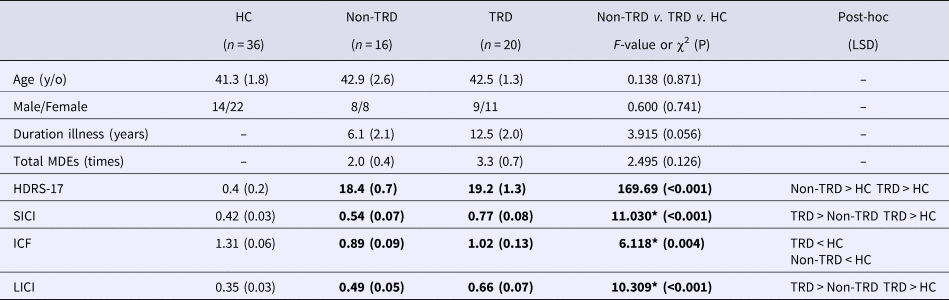
In this study, the age and the sex ratio of patients in the three groups were not significantly different. In addition, no significant differences were evident in the duration of illness (non-TRD v. TRD = 6.1 v. 12.5 years) or the total number of major depressive episodes (non-TRD v. TRD = 2 v. 3.3 episodes) between the TRD and non-TRD groups (Table 1). Finally, mean HDRS-17 scores were not different between patients with TRD (19.2) and those without TRD (18.4; p < 0.001; Table 1).
Demographic data, clinical variables, and paired-pulse TMS results for healthy control group (HC) and major depression group (MDD)

All subjects were unmedicated for at least 1 week before experiment and MDD patients were categorized into two groups, including treatment-resistant depression group (TRD) and non-TRD group.
Note: Data presented as mean (standard errors);higher values of ICF indicate higher cortical excitatory function, while higher values of SICI and LICI indicate worse cortical inhibitory function.
*p < 0.05/9 = 0.0056, corrected for multiple comparisons.
ppTMS results among the HC, non-TRD, and TRD groups
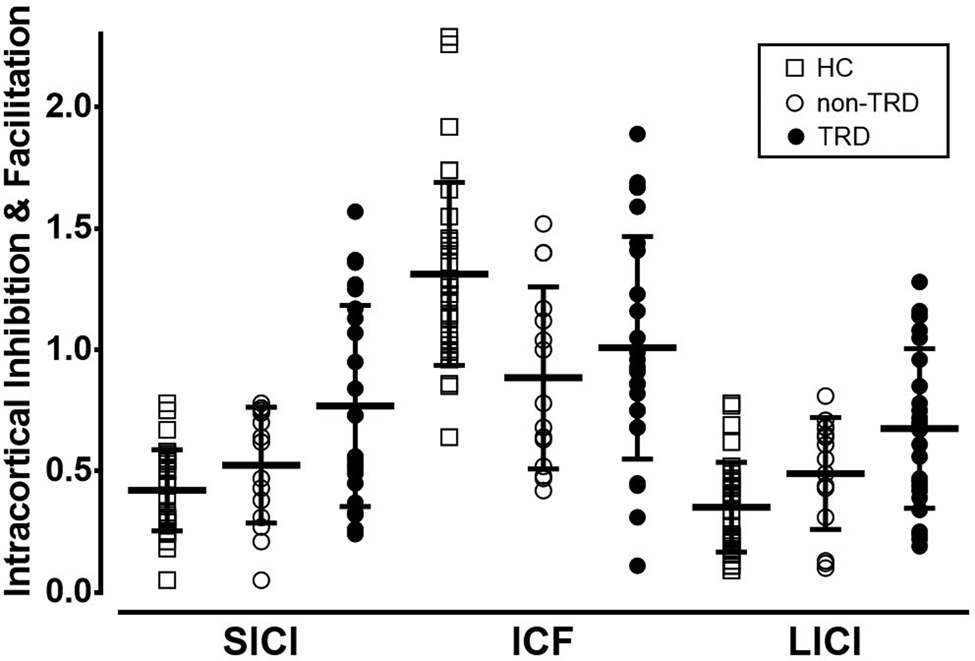
All subjects completed the ppTMS procedures at baseline. Compared with the patients in the HC group, the patients in the MDD groups exhibited significantly lower ICF estimates (HC v. non-TRD v. TRD = 1.31 ± 0.06 v. 0.89 ± 0.09 v. 1.02 ± 0.13; p = 0.004; post hoc: TRD = non-TRD < HC). SICI and LICI estimates were significantly different among the three groups (p < 0.001). Post hoc analyses indicated that the SICI and LICI estimates in the TRD group were significantly higher than those in the non-TRD and HC groups (SICI: non-TRD v. TRD v. HC = 0.54 ± 0.07 v. 077 ± 0.08 v. 0.42 ± 0.03, p < 0.001; LICI: non-TRD v. TRD v. HC = 0.49 ± 0.05 v. 066 ± 0.07 v. 0.35 ± 0.03; p < 0.001; Table 1, Fig. 1), indicating reduced inhibitory function of SICI and LICI in TRD patients.
Scatter plots with mean and standard deviation of short-interval intracortical inhibition (SICI), intracortical facilitation (ICF), and long-interval intracortical inhibition (LICI) measured in patients with treatment-refractory depression (TRD; black dots), patients without TRD (open circles), and healthy control subjects (HC; open squares). Patients in the TRD and non-TRD groups exhibited significantly lower ICF (p = 0.004; post hoc: TRD = non-TRD < HC), whereas SICI and LICI in the TRD group were significantly more reduced than those in the non-TRD and HC group (SICI: p < 0.001, post hoc: TRD > non-TRD = HC; LICI: p < 0.001, post hoc: TRD > non-TRD = HC). Comparisons among three groups were performed using one-way ANOVA and the resulting p values for SICI, ICF, and LICI were statistically significant after correction for multiple comparisons (all p < 0.05/9 = 0.0056). *p < 0.05 (post hoc) **p < 0.005 (post hoc).

Correlation analyses revealed significantly positive correlations between HDRS-17 scores and SICI estimates (r = 0.449, p < 0.001), as well as between HDRS-17 scores and LICI estimates (r = 0.382, p < 0.001) for all subjects (online Supplementary Table S1, Fig. S2). Additionally, a negative correlation was identified between HDRS-17 scores and ICF estimates (r = − 0.278, p = 0.017), but it did not reach statistical significance (p < 0.05/3 = 0.0167) after correction for multiple comparisons. Subsequent analyses of each of the three groups also yielded no significant findings.
Changes in ppTMS parameters before and after SSRI treatment in the non-TRD group
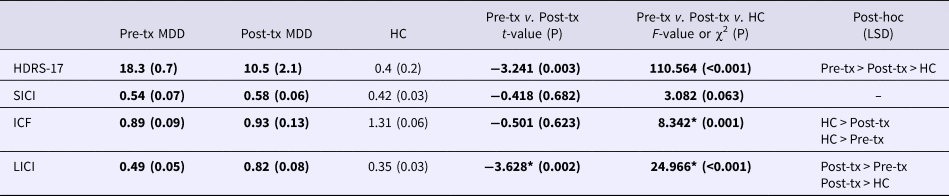
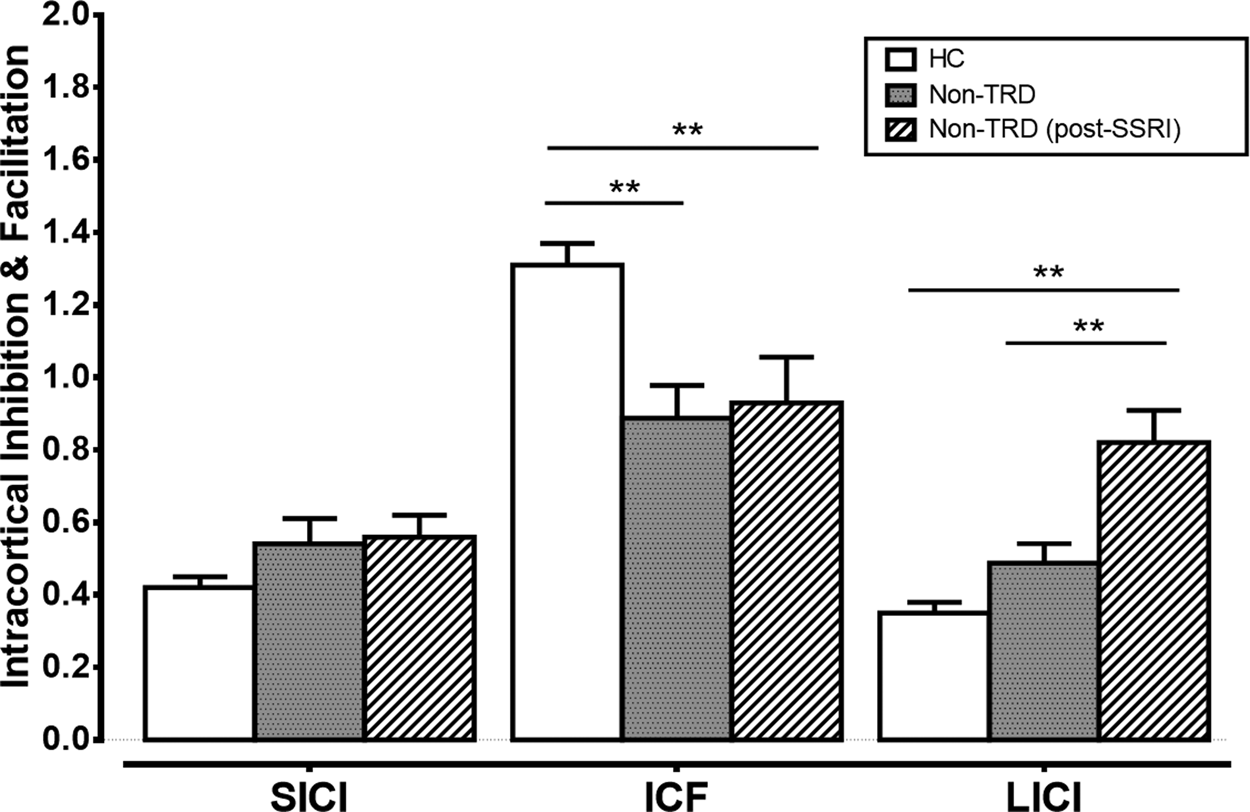
After 3 months of SSRI treatment, the average HDRS-17 score in the non-TRD group improved significantly (t = −3.241, df = 15, p = 0.003; Table 2). To elucidate the possible effects of SSRI treatment on the GABAergic and glutamatergic system in the non-TRD group, the non-TRD group received an additional ppTMS examination 3 months later. The results revealed that the ICF estimates for the non-TRD group remained significantly lower after treatment than did estimates for the HC group (HC v. pretreatment v. posttreatment = 1.31 ± 0.06 v. 0.89 ± 0.09 v. 0.93 ± 0.13; p = 0.001). The paired t test results indicated significantly higher LICI estimates, which in turn indicated more reduced LICI function, after SSRI treatment (pretreatment v. posttreatment = 0.49 ± 0.05 v. 0.82 ± 0.08; p = 0.002; Table 2, Fig. 2), which became significantly different from that measured in the HC group (p < 0.005). No significant difference was observed between pre- and posttreatment SICI. Furthermore, Pearson's correlation analyses indicated no significant correlations between changes in paired-pulse parameters and in HDRS-17 scores.
Demographic data, clinical variables, and paired-pulse TMS results for a group of MDD patients without a well-identified history of treatment resistance

All subjects were unmedicated for at least 1 week before experiment and treated by SSRI (escitalopram, 10 to 20 mg/day for 3 months).
Note: Data presented as mean (standard errors).
*p < 0.05/9 = 0.0056, corrected for multiple comparisons.
Results of paired-pulse TMS measures in non-TRD patients before (dark-gray bars) and after 3-months treatment (light-gray bars) with SSRI (escitalopram, 10 to 20 mg/day) and in healthy controls (HC group; white bars). The ICF in the non-TRD group remained significantly lower after treatment than that in the HC group (one-way ANOVA, p < 0.001). In addition, the paired t test results indicated significantly more reduced LICI after SSRI treatment (p < 0.005). Values represented means ± standard errors. **p < 0.005.

Discussion
Impaired CI and glutamate-related intracortical facilitatory function have been suggested to play an influential role in the pathophysiology of MDD. To the best of our knowledge, the present study is the first to provide direct evidence of the extent of impaired cortical excitatory and inhibitory function in patients with and without TRD by comparing ppTMS measurements (i.e. SICI, ICF, and LICI) between such patient types, as well as by comparing pre- and post-SSRI-treatment levels in non-TRD patients who received an adequate trial with the SSRI escitalopram. We discovered that MDD (both non-TRD and TRD) was associated with reduced ICF function and that TRD was associated with markedly more reduced inhibitory function of SICI and LICI than non-TRD and healthy individuals (Fig. 1).
The most valuable finding of the present study is that patients with TRD exhibited notably reduced cortical inhibitory function. Consistent with previous ppTMS studies (Bajbouj et al., Reference Bajbouj, Lisanby, Lang, Danker-Hopfe, Heuser and Neu2006; Levinson et al., Reference Levinson, Fitzgerald, Favalli, Blumberger, Daigle and Daskalakis2010) (online Supplementary Table S2), our results support the hypothesis that impairment of CI plays a critical role in MDD. Bajbouj et al. reported that patients with depression exhibited notably impaired SICI. Nevertheless, there was a lack of a clear definition of TRD. In the present study, we classified patients according to their history of responsiveness to antidepressant medication in detail. For example, a patient who failed to achieve 50% improvement in depression following an equivalent daily dose of 10 to 20 mg of escitalopram for at least 8 weeks was classified into the TRD group. We thereby increased the clinical applicability of the results. Levinson et al., discovered that patients with TRD exhibited marked reductions in SICI and cortical silent period (CSP) (Levinson et al., Reference Levinson, Fitzgerald, Favalli, Blumberger, Daigle and Daskalakis2010). CSP displays a similar time course as GABA-B-receptor-induced inhibitory postsynaptic potential (IPSP) (Roick et al., Reference Roick, Von Giesen and Benecke1993). By contrast, unmedicated patients with MDD and medicated euthymic patients with MDD demonstrated reduced CSP but not SICI, which suggested that only GABA-B deficits were present in these two patient populations (Levinson et al., Reference Levinson, Fitzgerald, Favalli, Blumberger, Daigle and Daskalakis2010). Instead of CSP, we used LICI to measure the functioning of GABA-B interneurons in the present study. LICI and CSP likely probe different mechanisms underlying GABA-B-related inhibition in the motor cortex (Tremblay et al., Reference Tremblay, Beaul, Proulx, De Beaumont, Marjańska, Doyon, Pascual-Leone, Lassonde and Th Oret2012). Pharmacological studies have indicated that the GABA-B agonist baclofen can enhance LICI but does not affect CSP duration (Ziemann et al., Reference Ziemann, Lnnecker, Steinhoff and Paulus1996). Additionally, the early component of CSP relies on spinal inhibition but not on intra-CI (Inghilleri et al., Reference Inghilleri, Berardelli, Cruccu and Manfredi1993). From the aforementioned reports, we deduced that CSP might not directly depend on GABA-B-mediated inhibitory interneurons. Therefore, we chose LICI as the main parameter by which to illustrate the function of GABA-B-mediated inhibitory interneurons precisely. In general, our results were consistent with those of previous studies (Bajbouj et al., Reference Bajbouj, Lisanby, Lang, Danker-Hopfe, Heuser and Neu2006; Levinson et al., Reference Levinson, Fitzgerald, Favalli, Blumberger, Daigle and Daskalakis2010) and revealed the distinguishable features of cortical excitatory and inhibitory function in antidepressant-resistant and responsive major depression.
1H MRS has been used to investigate regional GABA concentrations in the human brain. TRD is associated with decreased levels of GABA in the anterior cingulate cortex (ACC) (Price et al., Reference Price, Shungu, Mao, Nestadt, Kelly, Collins, Murrough, Charney and Mathew2009). One previous 1H-MRS study compared GABA levels in the ACC between patients with MDD and healthy controls and found that patients with low levels of GABA had markedly reduced hippocampal volume than patients with high GABA and controls (Abdallah et al., Reference Abdallah, Jackowski, Sato, Mao, Kang, Cheema, Coplan, Mathew and Shungu2015). The study also revealed considerably decreased hippocampal volume in patients with TRD than in non-TRD patients and healthy controls. However, MRS-measured GABA levels were summed within regions of interest instead of reflecting either GABA-A or GABA-B function. By contrast, ppTMS allowed us to further investigate inhibitory neurotransmission that was more likely to reflect GABA-A and GABA-B-mediated neurophysiological functions. The results from the present ppTMS study extend our understanding and suggest that patients with TRD have more impaired GABA-A and GABA-B-mediated inhibitory function than non-TRD patients and healthy subjects.
Notably, ICF is believed to be mediated by glutamate neurotransmission. Previous studies (Levinson et al., Reference Levinson, Fitzgerald, Favalli, Blumberger, Daigle and Daskalakis2010; Radhu et al., Reference Radhu, De Jesus, Ravindran, Zanjani, Fitzgerald and Daskalakis2013) revealed no significant difference in ICF between patients with MDD and healthy subjects. In our study, lower ICF estimates were observed in the MDD group but not in the HC group. This inconsistency might be related to heterogeneity of the MDD group. For example, one study that investigated ICF in young adolescents with MDD revealed increased ICF in the MDD group compared with the HC group (Croarkin et al., Reference Croarkin, Nakonezny, Husain, Melton, Buyukdura, Kennard, Emslie, Kozel and Daskalakis2013).
Furthermore, we observed considerable reductions in LICI three months after SSRI treatment in patients without TRD (Table 2), which suggests that one of the main effects of SSRI is modulation of GABA-B interneurons and also that reduced LICI alone is not a core feature of TRD. The mechanisms of escitalopram-induced LICI changes remain unclear, but they may involve changes in GABA-B neurotransmission in local inhibitory networks. SSRI treatment may increase ambient serotonin levels, which in turn may lead to downregulation of the GABA-B receptor–GIRK activity (Innis et al., Reference Innis, Nestler and Aghajanian1988; Serrats et al., Reference Serrats, Artigas, Mengod and Cort2003).
However, such reductions in LICI may be also associated with refractoriness of illness. It is because we found that higher LICI estimates (i.e. more reduced LICI function) were associated with higher HDRS-17 scores and TRD patients had significantly higher LICI estimates than the other groups (Fig. 1). Our findings were in line with those reported by Croarkin et al. (Reference Croarkin, Nakonezny, Husain, Port, Melton, Kennard, Emslie, Kozel and Daskalakis2014), who used ppTMS measurements of 16 medication-naïve children and adolescents with depression. Patients with deficits in pretreatment LICI did not respond to subsequent SSRI treatment. Lewis et al. (Reference Lewis, Nakonezny, Blacker, Voort, Port, Worrell, Jo, Daskalakis and Croarkin2018) discovered that adolescents with depression and a lifetime history of suicidal behaviors exhibited impaired LICI compared with healthy controls and adolescents with depression without any history of suicidal behaviors. These results suggest that GABA-B-receptor-mediated inhibition is distinctly dysregulated in adolescents with depression and a history of suicidal behaviors. Although the relationship between MDD and suicidality remains controversial, suicidal behaviors are associated with severe depression symptoms (Farmer et al., Reference Farmer, Redman, Harris, Webb, Mahmood, Sadler and McGuffin2001; Trivedi et al., Reference Trivedi, Morris, Wisniewski, Nierenberg, Gaynes, Kurian, Warden, Stegman, Shores-Wilson and Rush2013). Another possible interpretation is that the differences in LICI between patients with TRD and other participants are caused by the actions of prior adequate, but failed, courses of antidepressant drugs. The prior use of antidepressant drugs thus modulated GABA-B activity in the patients with TRD but without mood improvement. The exact cause remains to be investigated.
Taken together, the aforementioned studies and our study reveal that reduced LICI in the presence of prominent depression could be also associated with relatively severe types of depression, such as TRD, and patients with these forms of depression often respond poorly to SSRI treatment. In our study, patients who exhibited greater improvement following antidepressant treatment had relatively intact LICI function before the initiation of SSRI (i.e. no significant difference was observed in the LICI levels between control and non-TRD groups). Therefore, the results of reduced LICI in both TRD patients and pre-SSRI non-TRD patients suggest that reduced SICI and LICI, instead of reduced LICI alone, could be characteristic features of TRD.
Some limitations should be considered when interpreting the results of this study. First, MDD is a highly heterogeneous disorder; thus, the results of this study may only be representative of some patients with MDD. Although we recruited patients with and without TRD, other subgroups of patients with MDD, such as those with psychotic tendencies, should be further studied. Furthermore, various antidepressants may lead to different results, including ppTMS results. Previous studies have demonstrated that SSRIs exhibit antidepressant effects through modulation of GABAergic system functioning, including fluoxetine, citalopram, and escitalopram (S-citalopram) (Küçükibrahimoğlu et al., Reference Küçükibrahimoğlu, Saygın, Çalışkan, Kaplan, Ünsal and Gren2009; Croarkin et al., Reference Croarkin, Nakonezny, Husain, Port, Melton, Kennard, Emslie, Kozel and Daskalakis2014; Pehrson and Sanchez, Reference Pehrson and Sanchez2015; Asaoka et al., Reference Asaoka, Nishitani, Kinoshita, Kawai, Shibui, Nagayasu, Shirakawa, Nakagawa and Kaneko2017; Brennan et al., Reference Brennan, Admon, Perriello, Laflamme, Athey, Pizzagalli, Hudson, Pope and Jensen2017). However, whether the therapeutic effects of other antidepressants are the result of their influence on the GABA system has not yet been determined. Furthermore, whether changes in LICI after SSRI treatment may be attributed to symptom improvement or the after effects of SSRI use remains to be investigated. Nevertheless, the present study suggests that changes in GABA-B-mediated CI function are related to the antidepressant effects of escitalopram in non-TRD patients. In addition, the present study used the HDRS-17 score to measure depression, which may not truly reflect the exact severity of depression or treatment responses. Future studies using different scales, such as different versions of the HDRS-17 or Montgomery – Åsberg Depression Rating Scale (Williams and Kobak, Reference Williams and Kobak2008), may be required. Finally, ppTMS measurements are not direct indexes of GABAergic neurotransmitter mechanisms but rather neurophysiological measures closely related to GABAergic receptor-mediated mechanisms, as reflected by their neurophysiological and neuropharmacological response profiles (Levinson et al., Reference Levinson, Fitzgerald, Favalli, Blumberger, Daigle and Daskalakis2010).
Conclusions
In conclusion, our study provides direct evidence that TRD is characterized by reduced cortical inhibitory function and that SSRI treatment modulates LICI in patients without TRD. Pretreatment LICI deficits may predict poor SSRI treatment responses in clinical practice.
Supplementary material
The supplementary material for this article can be found at https://doi.org/10.1017/S0033291719001223
Author ORCIDs
Jia-Shyun Jeng, 0000-0002-7011-0323.
Acknowledgements
We would like to thank all of the patients who kindly participated in this study, as well as all of the research assistants, physicians, and personnel who helped us with this study and imaging procedures.
Financial support
This work was supported by the Taipei Veterans General Hospital (VGHUST104-G4-1-2; V104B-002; V104E9-003) and the Ministry of Science and Technology (MOST 103-2314-B-075-072-MY3; 106-2314-B-075-034-MY3). In addition, this work was supported by the Brain Research Center (107BRC-B504), National Yang-Ming University from The Featured Areas Research Center Program within the framework of the Higher Education Sprout Project by the Ministry of Education (MOE) in Taiwan. The aforementioned organizations had no influence on the study design, data collection, analysis, interpretation of results, writing of the report, or ultimate decision to submit the paper for publication. None of the authors in this study has any conflicts of interest to declaration.