Implications
The volatility of corn prices has caused feedlot operators to search for new, cheaper feedstuffs for ruminant diets. Glycerol has become a major focus for the livestock feeding industry as an alternative energy source. Substituting corn grain with up to 10% of high-purity glycerol in the diets of lambs improved growth performance, digestibility and feed conversion. In the case of a competitive price, glycerol may be effectively used as a partial energy source in lamb diets.
Introduction
Feed is typically the greatest cost associated with livestock production. Corn is an important energy source in most ruminant diets. Inclusion of glycerol as a source of energy replacing corn, may be a viable alternative for the formulation of ruminant diets and can potentially reduce feed costs. Glycerol is a by-product from the biodiesel industry. Glycerol is about 10% weight of vegetable oil or fat by weight (Dasari et al., Reference Dasari, Kiatsimkul, Sutterlin and Suppes2005). It is liquid at room temperature (25°C), hygroscopic, odorless, colorless, viscous, palatable and highly stable under normal storage conditions. Recent growth of biodiesel production in the biofuel industry has resulted in an increase of available quantities of glycerol generated from the transesterification of vegetable oils (Crandall, Reference Crandall2004). The increase in biodiesel production has also reduced price of glycerol making it economical to include it as an energy supplement for ruminants (Avila-Stagno et al., Reference Avila-Stagno, Chaves, He, Harstad, Beauchemin, McGinn and McAllister2013). Schröder and Südekum (Reference Schröder and Südekum1999) have defined the purity of glycerol as low (63%), medium (85%) and high (>99%).
Glycerol has been recognized as safe feed additive for use in animal feed by The Food and Drug Administration (FDA) (2006). It has been used as energy source to replace corn in lamb diets at a level up to 10% of dry matter (DM) (Terré et al., Reference Terré, Nudda, Casado and Bach2011). Schröder and Südekum (Reference Schröder and Südekum1999) also reported that glycerol can be included in ruminant diets up to 10% of the diet DM to replace starch without any negative effects on feed intake and nutrient digestibility. The effects on growth performance of ruminants have been reported with feeding high concentrations of glycerol (Parsons et al., Reference Parsons, Shelor and Drouillard2009; Gunn et al., Reference Gunn, Schultz, Van Emon, Neary, Lemenager, Rusk and Lake2010b; Lage et al., Reference Lage, Paulino, Pereira, Duarte, Valadares Filho, Oliveira, Souza and Lima2014). During the previous studies, different feeding strategies as well as diverse levels and purities of the glycerol product have been used in ruminant diets. The objective of current study was to evaluate the effects of replacing corn with high-purity glycerol (>99%) at concentration up to 10% in the diet of lambs on growth performance, digestion, certain blood metabolites and economic efficiency.
Material and methods
This study was conducted at the sheep farm of the Department of Animal and Poultry Production, South Valley University, Qena, Egypt, during the months of June through September, 2015. Care and handling of the animals and sample collection were approved by the South Valley University Animal Care and Use Committee.
Growth study
Animals and experimental diets
A total of 24 Saidi male lambs (initial BW=33.6±6.0 kg, age=6.75±0.75 months) were allocated by BW and age into three groups of eight lambs. Before initiation of the study, all lambs were adapted to a control diet (0% glycerol) for 2 weeks. The experimental diets were formulated to meet energy requirements according to NRC (2007) and were fed to the animals once daily at 0800 h with free access to water.
The treatment diets were formulated by replacing corn gain for high-purity glycerol (>99%) in the concentrate DM to achieve concentrations of 0%, 5% and 10%, and treatments were named CON, GLY5 and GLY10. The concentrate and straw were weighed daily and fed to the animals. The diets were fed until day 84 of the experiment when lambs reached a final BW of on average 45.8±1.83 kg. According to the supplier (Al-Gomhuria Company, Al-Gomhuria St, Asyut, Egypt), the glycerol supplement contained 0.5% to 1% water, ⩽0.1% ash and no methanol.
All lambs were weighed every 14 days in the morning after fasting (food and water) for 12 h on 2 consecutive days. Feed offering and feed refusals were recorded daily. Feed intake was calculated from the difference between the amounts of feed offered and feed refused. The average daily gain (ADG) was calculated as the difference between the final and initial BW divided by the number of days on feed. Feed conversion ratio (FCR) was calculated as the ratio between DM intake and ADG (kg of DM intake/kg of BW gain).
Measurements, sample collection and laboratory analyses
Representative samples of feed ingredients were collected every 2 weeks and composited by month. The samples were ground in a Wiley mill (Thomas Scientific, Swedesboro NJ, USA) to pass through a 1-mm sieve. Feed samples were subjected to proximate analysis following the standard methods of AOAC (1990). Dry matter was determined by oven drying in a forced air oven at 105°C for 24 h. The organic matter (OM) was calculated as the difference between DM and ash contents. Crude fiber was analyzed using a filter bag technique. Crude protein was determined using the Kjeldahl method, and ether extract (EE) was determined using the Soxhlet procedure.
Blood samples (10 ml) from all lambs were collected from the jugular vein monthly before the morning feeding. One sample was collected in tubes with no additives for determination of total protein, albumin, total lipid and cholesterol, whereas a second blood sample was collected in tubes containing 5 mg of sodium fluoride and 4 mg of potassium oxalate for glucose determination. After collection, samples were put immediately on ice and centrifuged on the same day at 2500×g for 15 min at 4°C to separate serum and plasma, then frozen at −20°C until analyzed. Samples were analyzed using commercial kits. Total protein and albumin were determined according to Kaplan and Szalbo (Reference Kaplan and Szalbo1983) and Doumas et al. (Reference Doumas, Watson and Biggs1971), respectively. Globulin was calculated by the difference between the total protein and albumin. Total lipids and cholesterol were determined according to Schalm et al. (Reference Schalm, Jain and Corroll1975), and glucose was measured according to the procedure outlined by Trinder (Reference Trinder1969).
Economical efficiency
The economical efficiency was calculated as the ratio between income from daily BW gain and the cost of daily feed consumed using the prices in Qena (Egypt) at the time of the experiment: US$ 329.00/ton of concentrate mixture; US$ 66.00/ton of wheat straw; US$ 197.00/ton of glycerol and US$ 5.00/kg of live BW.
Digestibility study
By the end of the growth trial, three lambs (initial BW=44.7±2.2 kg and age=8.44±0.32 months) were randomly selected from each treatment group and placed in individual digestibility cages. Dietary treatments (Table 1) included 0%, 5% and 10% of high-purity glycerol (>99%) as a replacement to corn grain in concentrate DM. The digestion trial consisted of 15 days for diet adaptation and 7 days for fecal collection. During the collection period, fecal samples, taken at 12 h intervals, were weighed and mixed thoroughly by hand. Subsamples representing 10% of daily fecal production were frozen at −18°C until being composited for the complete collection period. Representative samples of feeds, refusals and feces were pre-dried in a ventilated oven at 60°C to 70°C for 48 h and ground through a 1-mm mill screen openings. Samples were analyzed for DM, OM, CP, EE and CF according to AOAC (1990) methods, while nitrogen-free extract (NFE) was calculated by difference. Metabolizable energy (ME) was calculated according to the following equation: ME (Mcal/kg)=total digestible nutrients (TDN)×0.04409×0.82 (NRC, 2007).
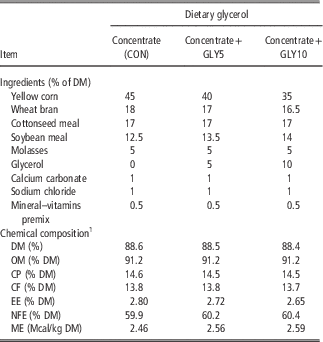
Ingredient and chemical composition of concentrate mixture

1 OM=organic matter; CF=crude fiber; EE=ether extract; NFE=nitrogen-free extract; ME=metabolizable energy.
Chemical composition of wheat straw: DM=93.9%; OM=91.0%; CP=3.7%; EE=1.7%; CF=43.5%; NFE=42.1%.
Statistical analysis
Both experiments were analyzed as a complete randomized design using the PROC MIXED procedure of SAS (2005). The statistical model was: Y ij =µ+T i +C j +E ij , in which Y ij is observed measurement, µ the overall mean, T i the fixed effect of treatments (i=1, 2 and 3), C j the random effect of lamb within treatment and E ij is the residual error. Treatment means were computed with the LSMEANS option.
Results are presented as least square means±SEM. Differences between treatment means were evaluated using orthogonal contrasts to determine linear and quadratic effects of GLY inclusion in the diet. Differences were considered to be significant when P⩽0.05 and tendencies included P>0.05 and ⩽0.10.
Results and discussion
Intake and animal performance
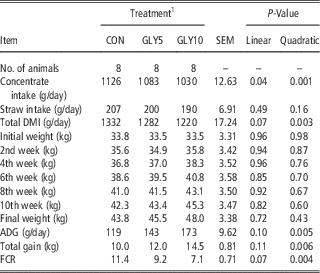
Average BW, ADG, dry matter intake (DMI) and feed conversion ratio of lambs fed the experimental diets are illustrated in Table 2. Concentrate intake linearly decreased (P=0.04) with increasing glycerol in the diet. Straw intake did not differ between treatments. Total DMI was quadratically lower (P=0.003) in lambs fed GLY treatments compared with the CON. Similarly, Orrico Junior et al. (Reference Orrico Junior, Bottini Filho, deVargas Junior, Orrico and da Silveira Osório2015) reported a lower DMI for lambs fed a diet including 7.5% glycerol as substitute for corn as compared with no glycerol (1.01 v. 1.20 kg DMI/day). According to the authors, decreased DMI with glycerol supplementation could be related to the chemical satiety due to the increased energy density of the diet or diet acceptability. In the current study, inclusion of glycerol in the lamb diets increased ME content (Table 1). Benedeti et al. (Reference Benedeti, Paulino, Marcondes, Maciel, da Silva and Faciola2016) estimated ME of glycerol at 3.64 Mcal/kg which is 12% higher than the 3.25 Mcal/kg of corn.
Intake and performance of growing lamb fed diets containing 0%, 5% or 10% glycerol

DMI=dry matter intake; ADG=average daily gain; FCR=feed conversion ratio.
1 Treatments: CON=control diet; GLY5=replacing 5% of diet corn with glycerol; GLY 10=replacing 10% of diet corn with glycerol.
Our results agree with other studies which reported that feeding glycerol had decreased feed intakes in lambs (Gunn et al., Reference Gunn, Schultz, Van Emon, Neary, Lemenager, Rusk and Lake2010b; Avila-Stagno et al., Reference Avila-Stagno, Chaves, He, Harstad, Beauchemin, McGinn and McAllister2013; Lage et al., Reference Lage, Paulino, Pereira, Duarte, Valadares Filho, Oliveira, Souza and Lima2014), in beef heifers (Parsons et al., Reference Parsons, Shelor and Drouillard2009), in finishing beef steers (Pyatt et al., Reference Pyatt, Doane and Cecava2007; Moore et al., Reference Moore, Furman, Erickson, Vasconcelos, Griffin and Milton2011; Hales et al., Reference Hales, Foote, Brown-Brandl and Freetly2015; Chanjula et al., Reference Chanjula, Raungprim, Yimmongkol, Poonko, Majarune and Maitreejet2016), in dairy cows (Paiva et al., Reference Paiva, Del Valle, Jesus, Bettero, Almeida, Bueno, Bradford and Rennó2016), and in dairy buffaloes (Saleem et al., 2017). In most of these studies, glycerol replaced corn grain in the concentrate diets. In contrast, feed intake was not affected when glycerol was fed to finishing lambs (Gunn et al., Reference Gunn, Neary, Lemenager and Lake2010a), goats (Chanjula et al., Reference Chanjula, Pakdeechanuan and Wattanasit2015), Holstein bulls (Mach et al., Reference Mach, Bach and Devant2009) or dairy cows (Omazic et al., Reference Omazic, Traven, Bertilsson and Holtenius2013). The non-consistent effects of glycerol on feed intake can be explained by purity and amount of glycerol used, method of administration as well as composition of the diets (Wang et al., Reference Wang, Liu, Yang, Huo, Dong, Huang, Yang and He2009b; Omazic et al., Reference Omazic, Traven, Bertilsson and Holtenius2013).
Mean initial BW (33.6±1.7 kg) and final BW (45.8±1.8 kg) were not different among treatments (P=0.95, 0.72, respectively). With higher inclusion of glycerol ADG (P=0.005) and total gain (P=0.006) increased quadratically compared with non-glycerol-fed lambs. No difference in the final BW despite a highly significant higher total gain can be explained by the high variation in BW within groups. Similarly, no differences were found in final BW of lambs (Gunn et al., Reference Gunn, Neary, Lemenager and Lake2010a) or beef cattle (Benedeti et al., Reference Benedeti, Paulino, Marcondes, Maciel, da Silva and Faciola2016) when fed up to 15% glycerol.
Improved growth performance by inclusion of glycerol may be explained by the higher ME of the diet. The higher nutrient digestibility when lambs were fed higher concentrations of glycerol offset the lower DMI and as a consequence, lambs fed glycerol showed better performance. Similarly, Moore et al. (Reference Moore, Furman, Erickson, Vasconcelos, Griffin and Milton2011) fed glycerol at 0%, 3%, 6% and 9% (DM basis) in a steam-flaked corn-based diet observed that ADG (P=0.02) and feed efficiency (P<0.01) improved, while DMI was decreased (P=0.04). Similarly, Pyatt et al. (Reference Pyatt, Doane and Cecava2007) observed an improvement in ADG and feed efficiency when glycerol replaced 10% of the corn in high-concentrate diets fed to steers, although DMI was decreased.
Terré et al. (Reference Terré, Nudda, Casado and Bach2011) reported that glycerol could be included in concentrate diets up to 10% of DM without negatively affecting lamb performance. Similarly, Parsons et al. (Reference Parsons, Shelor and Drouillard2009) reported higher ADG and feed efficiency in finishing heifer fed glycerol up to 8% of dietary DM. However, ADG was reduced when heifers (Parsons et al., Reference Parsons, Shelor and Drouillard2009) or lambs (Gunn et al., Reference Gunn, Schultz, Van Emon, Neary, Lemenager, Rusk and Lake2010b; Lage et al., Reference Lage, Paulino, Pereira, Duarte, Valadares Filho, Oliveira, Souza and Lima2014) were fed diets containing 16%, 12% and 45% glycerol, respectively. Moreover, Avila-Stagno et al. (Reference Avila-Stagno, Chaves, He, Harstad, Beauchemin, McGinn and McAllister2013) reported that the inclusion of glycerol up to 21% of the diet DM tended to reduce ADG and final BW of lambs, but did not affect the feed efficiency.
In the current result, FCR was improved from 11.41 for CON, and 9.15 for GLY5 to 7.11 for GLY10. The FCR improved quadratically (P=0.004) with increasing glycerol supplementation in the diets. This agrees with Parsons et al. (Reference Parsons, Shelor and Drouillard2009) who reported that feed efficiency was improved by 10.8%, 10.0%, 7.2% and 3.1% when glycerol was included at 2%, 4%, 8% and 12% in beef heifer diets, respectively. Similarly, Pyatt et al. (Reference Pyatt, Doane and Cecava2007) reported an improvement in feed efficiency by 19.2% with the inclusion of 10% glycerol replacing corn in the cattle diets compared with the diet without glycerol. However, feed efficiency was reduced when heifers (Parsons et al., Reference Parsons, Shelor and Drouillard2009) and lambs (Gunn et al., Reference Gunn, Schultz, Van Emon, Neary, Lemenager, Rusk and Lake2010b) were fed diets containing 16% and 45% glycerol, respectively. Furthermore, Lage et al. (Reference Lage, Paulino, Pereira, Duarte, Valadares Filho, Oliveira, Souza and Lima2014) reported no differences in feed efficiency when including 0%, 3%, 6%, 9% or 12% glycerol in the diets of lambs as corn replacement. The feed cost price per kg BW gain was highest for CON (US$ 3.28), intermediate for GLY5 (US$ 2.50) and lowest for GLY (US$ 1.92).
Blood metabolites
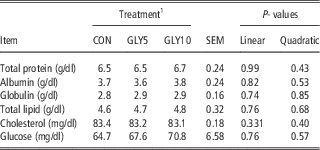
Inclusion of glycerol in the diet did not affect any of the measured blood parameters (Table 3). Clariget et al. (Reference Clariget, Román, Karlen, Álvarez-Oxiley, López-Mazz and Pérez-Clariget2016) reported that plasma concentrations of total protein and albumin were not affected when cows were fed diets supplemented glycerol. Similarly, Terré et al. (Reference Terré, Nudda, Casado and Bach2011) and Mach et al. (Reference Mach, Bach and Devant2009) observed no differences in plasma glucose concentrations when glycerol included up to 10% or 12% DM in high-concentrate diets fed to finishing lambs or Holstein bulls, respectively. However, Gunn et al. (Reference Gunn, Schultz, Van Emon, Neary, Lemenager, Rusk and Lake2010b) observed decreased plasma glucose concentrations in finishing lambs fed increasing amounts of glycerol up to 45% DM.
Blood metabolites of lambs fed diets containing 0%, 5% or 10% glycerol

1 Treatments: CON=control diet; GLY5=replacing 5% of diet corn with glycerol; GLY 10=replacing 10% of diet corn with glycerol.
Digestibility study
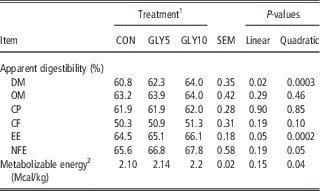
The nutrient digestibility and ME of the experimental diets are presented in Table 4. Increasing glycerol concentration in the lamb diets did not affect (P>0.05) the digestibility of OM and CP, whereas digestibility of DM (P=0.0003), CF (P=0.10), EE (P=0.0002) and NFE (P=0.05) were quadratically improved. The ME was increased quadratically (P=0.04) with increasing concentration of glycerol in the diets. Beck (Reference Beck2011) and Ramos and Kerley (Reference Ramos and Kerley2012) reported that glycerol can be included up to 10% or 12% of the DM, replacing rapidly fermentable starch for beef cattle or finishing lambs without affecting fiber digestibility.
Nutrient digestibility by lambs fed diets containing 0%, 5% or 10% glycerol

CF=crude fiber; EE=ether extract; NFE=nitrogen-free extract.
1 Treatments: CON=control diet; GLY5=replacing 5% of diet corn with glycerol; GLY 10=replacing 10% of diet corn with glycerol.
2 Metabolizable energy=TDN×0.04409×0.82 (NRC, 2007).
Beck (Reference Beck2011) observed that digestibility of DM and OM was not affected by replacing corn with glycerol at levels up to 12% of the diet DM in finishing lamb diets, whereas CP digestibility decreased. Hales et al. (Reference Hales, Foote, Brown-Brandl and Freetly2015) observed that DM digestibility increased with glycerol inclusion at 0%, 5%, 10% and 15% of DM in finishing beef steers with no effect on OM digestibility. Digestibility of DM and EE improved with increasing concentrations of glycerol in steer forage diets (Wang et al., Reference Wang, Liu, Huo, Yang, Dong, Huang and Guo2009a), in mid-lactating dairy cow (Paiva et al., Reference Paiva, Del Valle, Jesus, Bettero, Almeida, Bueno, Bradford and Rennó2016) or in early lactation dairy buffaloes (Saleem et al., Reference Paiva, Del Valle, Jesus, Bettero, Almeida, Bueno, Bradford and Rennó2017) diets. Recently, Benedeti et al. (Reference Benedeti, Paulino, Marcondes, Maciel, da Silva and Faciola2016) reported that digestibility of DM and TDN increased quadratically with increasing glycerol in the diet of finishing beef bulls. Eiras et al. (Reference Eiras, Barbosa, Marques, Araujo, Lima, Zawadzki, Perotto and Prado2014) reported that apparent total tract digestibility of DM, OM and CP increased when glycerol replacing corn in the diet of bulls finished up to 10% of diet DM. On the other hand, Chanjula et al. (Reference Chanjula, Pakdeechanuan and Wattanasit2014) reported that DM, OM, CP and EE digestibility were not significantly different between glycerol and control-fed goats.
Acknowledgments
The authors would like to express their most sincere gratitude and appreciation to the staff at the Animal and Poultry Production Department, Faculty of Agriculture, South Valley University Sheep Farm Unite, Qena, Egypt for their assistance with animal care and sample collection.