


Introduction
Obsessive-compulsive disorder (OCD) is a disabling mental illness that is characterized by recurrent, stereotypical, and annoying intrusive thoughts and behaviour (American Psychiatric Association, 1994). Ranking tenth in the World Health Organization's (WHO) leading causes of disability (Lopez and Murray, Reference Lopez and Murray1998), OCD compromises functioning and well-being in many respects, for example in academic, occupational, and social fields and, thus, deeply impacts on patients’ lives and daily activities (Hollander, Reference Hollander1998; Koran, Thienemann and Davenport, Reference Koran, Thienemann and Davenport1996; Lochner et al., Reference Lochner, Mogotsi, du Toit, Kaminer, Niehaus and Stein2003; Mendlowicz and Stein, Reference Mendlowicz and Stein2000; for a review see Moritz, Reference Moritz2008).
How do OCD patients perceive their quality of life (QoL) and which aspects are the most severely affected by OCD symptoms? These questions have been repeatedly addressed in research over the past decades. Although there is no single universally-accepted definition for QoL, the concept is now consensually acknowledged as an important secondary outcome parameter in treatment, which is related to but not an equivalent of psychopathology (Bystritsky et al., Reference Bystritsky, Saxena, Maidment, Vapnik, Tarlow and Rosen1999; Diefenbach, Abramowitz, Norberg and Tolin, Reference Diefenbach, Abramowitz, Norberg and Tolin2007; Tenney, Denys, van Megen, Glas and Westenberg, Reference Tenney, Denys, van Megen, Glas and Westenberg2003). The WHO comprehensively conceptualized generic (illness-unspecific) subjective QoL as “a multidimensional construct describing an individual's subjective perception of their position in life in the context of the culture and value system in which they live, and in relation to their goals, expectations, standards, and concerns” (The WHOQOL Group, 1996). Most subjective QoL instruments, for example the 36-item Short Form, (SF-36, e.g. Ware and Sherbourne, Reference Ware and Sherbourne1992) capture the individual's perspective on multiple dimensions including functional, social, psychological, and physical aspects. However, QoL measures differ in their emphasis and scope (Nieuwenhuizen, Reference Nieuwenhuizen, Katschnig, Freeman and Sartorius2006; Stengler-Wenzke, Kroll, Riedel-Heller, Matschinger and Angermeyer, Reference Stengler-Wenzke, Kroll, Riedel-Heller, Matschinger and Angermeyer2007). Despite the increasing acceptance of the QoL concept in treatment of patients with mental illnesses (Katschnig, Reference Katschnig2006; Priebe, Reference Priebe, Priebe, Oliver and Kaiser1999), there is still a remarkable dearth of illness-specific instruments (Besiroglu, Cilli and Askin, Reference Besiroglu, Cilli and Askin2004; Bobes et al., Reference Bobes, Gonzalez, Bascaran, Arango, Saiz and Bousono2001).
Quality of life research in OCD
In several studies, generic QoL was investigated in OCD patient samples using the SF-36 which was originally constructed for somatic illnesses, particularly cancer. Results demonstrated diminished scores on various aspects of QoL compared to the general healthy population (e.g. Bobes et al., Reference Bobes, Gonzalez, Bascaran, Arango, Saiz and Bousono2001; Eisen et al., Reference Eisen, Mancebo, Pinto, Coles, Pagano, Stout and Rasmussen2006; Koran et al., Reference Koran, Thienemann and Davenport1996; Moritz et al., Reference Moritz, Rufer, Fricke, Karow, Morfeld, Jelinek and Jacobsen2005; Rodriguez-Salgado et al., Reference Rodriguez-Salgado, Dolengevich-Segal, Arrojo-Romero, Castelli-Candia, Navio-Acosta and Perez-Rodriguez2006). Usually, different measures converge in their inferences regarding compromised QoL in social and emotional domains (e.g. Huppert, Simpson, Nissenson, Liebowitz and Foa, Reference Huppert, Simpson, Nissenson, Liebowitz and Foa2009; Lochner et al., Reference Lochner, Mogotsi, du Toit, Kaminer, Niehaus and Stein2003; Masellis, Rector and Richter, Reference Masellis, Rector and Richter2003; Stengler-Wenzke, Kroll, Matschinger and Angermeyer, Reference Stengler-Wenzke, Kroll, Matschinger and Angermeyer2006; Stengler-Wenzke et al., Reference Stengler-Wenzke, Kroll, Riedel-Heller, Matschinger and Angermeyer2007).
In some of the studies, perceived QoL in OCD was compared across several mental or medical disorders. Lochner and colleagues (Reference Lochner, Mogotsi, du Toit, Kaminer, Niehaus and Stein2003) found the extent of QoL impairment to be similar among anxiety disorders including OCD, whereby different response patterns emerged regarding subdomains: OCD patients showed significantly greater impairments in family life and activities of daily living compared to both social anxiety disorder (SAD) and panic disorder (PD), whereas patients with SAD reported greater problems concerning their social life and leisure time activities than both other groups and PD was associated with the use of unprescribed drugs. Koran and colleagues (Reference Koran, Thienemann and Davenport1996) found better QoL in all SF-36 dimensions except role limitations due to emotional problems (role-emotional) in OCD in comparison with depressed patients. In contrast, results of Bobes and colleagues (Reference Bobes, Gonzalez, Bascaran, Arango, Saiz and Bousono2001) showed that OCD patients attained lower scores than depressive patients or any medical patient group (among them heroin dependents, kidney transplant recipients) on several QoL aspects, namely social functioning, role-emotional, and mental health. Moreover, OCD patients reported worse QoL levels than depressed patients relating to bodily pain and vitality scales. QoL in the OCD sample was as low as for schizophrenia patients on the mental health summary measure of SF-36. In a study by Stengler-Wenzke and colleagues (Reference Stengler-Wenzke, Kroll, Matschinger and Angermeyer2006), OCD patients scored even lower on QoL than schizophrenia patients in social relationships and psychological well-being.
Overall, the existing studies agree that OCD is associated with reduced QoL in various domains, whereby psychosocial aspects seem to be primarily affected. Nevertheless, despite marked decrements in QoL reported by half to three quarters of an OCD sample investigated in a study by Moritz and colleagues (Reference Moritz, Rufer, Fricke, Karow, Morfeld, Jelinek and Jacobsen2005), a large subgroup did not deviate from the norm on QoL. Similarly, among 219 affected members of the Danish OCD Association (Sorensen, Kirkeby and Thomsen, Reference Sorensen, Kirkeby and Thomsen2004), 36% of the sample reported that they were satisfied or even particularly satisfied with life.
Correlates of poor quality of life in OCD
Most studies identified depression as the best predictor of low QoL in OCD (for a review see Moritz, Reference Moritz2008). However, there is inconsistent evidence regarding the impact of sociodemographic variables such as age, gender, or education (e.g. Eisen et al., Reference Eisen, Mancebo, Pinto, Coles, Pagano, Stout and Rasmussen2006; Koran et al., Reference Koran, Thienemann and Davenport1996; Rodriguez-Salgado et al., Reference Rodriguez-Salgado, Dolengevich-Segal, Arrojo-Romero, Castelli-Candia, Navio-Acosta and Perez-Rodriguez2006; Stengler-Wenzke et al., Reference Stengler-Wenzke, Kroll, Matschinger and Angermeyer2006), symptom severity (e.g. Besiroglu et al., Reference Besiroglu, Cilli and Askin2004; Eisen et al., Reference Eisen, Mancebo, Pinto, Coles, Pagano, Stout and Rasmussen2006) as well as the differential impact of compulsions (Moritz et al., Reference Moritz, Rufer, Fricke, Karow, Morfeld, Jelinek and Jacobsen2005; Eisen et al., Reference Eisen, Mancebo, Pinto, Coles, Pagano, Stout and Rasmussen2006; Stengler-Wenzke et al., Reference Stengler-Wenzke, Kroll, Riedel-Heller, Matschinger and Angermeyer2007, but see also Masellis et al., Reference Masellis, Rector and Richter2003) and obsessions (Eisen et al., Reference Eisen, Mancebo, Pinto, Coles, Pagano, Stout and Rasmussen2006; Rodriguez-Salgado et al., Reference Rodriguez-Salgado, Dolengevich-Segal, Arrojo-Romero, Castelli-Candia, Navio-Acosta and Perez-Rodriguez2006; Masellis et al., Reference Masellis, Rector and Richter2003, but see also Stengler-Wenzke et al., Reference Stengler-Wenzke, Kroll, Riedel-Heller, Matschinger and Angermeyer2007) on decreased QoL.
Inconsistent findings may partly stem from different study designs, measures, and samples: while in some studies any psychiatric comorbidity led to exclusion (e.g. Stengler-Wenzke et al., Reference Stengler-Wenzke, Kroll, Matschinger and Angermeyer2006), other studies included patients with “primary OCD” and no exclusion based on comorbid Axis I or II except organic mental disorders (e.g. Eisen et al., Reference Eisen, Mancebo, Pinto, Coles, Pagano, Stout and Rasmussen2006). Yet in other studies, a diagnosis of schizophrenia, bipolar disorder, or substance use disorders but not comorbid depressive symptoms led to exclusion (Masellis et al., Reference Masellis, Rector and Richter2003; Moritz et al., Reference Moritz, Rufer, Fricke, Karow, Morfeld, Jelinek and Jacobsen2005) in order to account for the high comorbidity rates for depression among OCD patients.
Generic versus illness- specific QoL measures
Generic QoL measures allow us to compare QoL profiles across different populations including somatic and psychiatric samples. However, certain problems related to the particular nature of OCD may not be covered by such measures, for example, interpersonal problems due to the involvement of family members into rituals or problems due to the particular impact obsessions and compulsions may have on job/career issues and leisure time activities (e.g. Eisen et al., Reference Eisen, Mancebo, Pinto, Coles, Pagano, Stout and Rasmussen2006; Koran, Reference Koran2000; Moritz, Reference Moritz2008; Stein, Roberts, Hollander, Rowland and Serebro, Reference Stein, Roberts, Hollander, Rowland and Serebro1996). Moreover, many patients report high despair due to feelings of shame or guilt associated with OCD symptoms (Newth and Rachman, Reference Newth and Rachman2001; Rachman, Reference Rachman1997, Reference Rachman1998; Salkovskis, Reference Salkovskis1999). These problems, however, are of clinical relevance. Therefore, it is important to differentiate and quantify impairment in domains particularly affected by OCD symptoms. To meet the strong demand for an OCD-specific QoL measure (e.g. Besiroglu et al., Reference Besiroglu, Cilli and Askin2004; Bobes et al., Reference Bobes, Gonzalez, Bascaran, Arango, Saiz and Bousono2001), our working group developed a novel instrument, the Quality of Life in Obsessive-Compulsive Disorder (QoLOC), aimed at tapping those unique problems from various life-domains that are specifically related to OCD symptomatology (for item examples, see Table 3).
Internet studies
The present study was planned as an internet survey. This recruitment and data collection strategy holds several advantages. For example, this approach is economic, it provides anonymity to participants, and thus reduces social desirability biases. Web-based surveys are increasingly accepted in research and several recent studies have confirmed comparable reliability and validity to paper-and-pencil tests (Jones, Fernyhough, de-Wit and Meins, Reference Jones, Fernyhough, de-Wit and Meins2008; Meyerson and Tryon, Reference Meyerson and Tryon2003; Ritter, Lorig, Laurent and Matthews, Reference Ritter, Lorig, Laurent and Matthews2004; Riva, Teruzzi and Anolli, Reference Riva, Teruzzi and Anolli2003) assessing severely impaired psychiatric patient samples (Chinman, Young, Schell, Hassell and Mintz, Reference Chinman, Young, Schell, Hassell and Mintz2004) and OCD symptomatology in particular (Coles, Cook and Blake, Reference Coles, Cook and Blake2007).
Finally, as a major advantage, internet studies are able to access people who do not approach the health system and thus may not be reached by most clinical trials. As there is evidence for functional and systematic differences between help-seeking and non help-seeking OCD patients (Besiroglu et al., Reference Besiroglu, Cilli and Askin2004), web-based studies could constitute a capable method for investigations regarding comprehensive OCD populations. Importantly, only 40% of people with OCD seek treatment according to a WHO study (Kohn, Saxena, Levav and Saraceno, Reference Kohn, Saxena, Levav and Saraceno2004) so that clinical studies cannot arrive at inferences for the entire population. Shortcomings of this type of investigation will be acknowledged in the discussion.
Aims and hypotheses
The design of the present study addressed three shortcomings in previous QoL research in OCD. First, we tried to meet the strong demand for an OCD-specific instrument (e.g. Besiroglu et al., Reference Besiroglu, Cilli and Askin2004; Bobes et al., Reference Bobes, Gonzalez, Bascaran, Arango, Saiz and Bousono2001) by complementing generic QoL assessment with QoLOC. Second, the present sample comprised health care-seeking and non health care-seeking individuals with OCD. Finally, we investigated the differential impact of OCD symptom dimensions (such as “washing” or “checking” behaviour) on different aspects of QoL.
In line with results from earlier studies, we hypothesized that generic QoL was largely reduced in individuals with OCD, primarily in psychosocial domains. We expected that QoL scores of the present sample did not exceed those attained by a German OCD outpatient sample and that low QoL was associated with OCD symptom severity scores. Further, we were interested in the differential relationship of OCD symptom dimensions (e.g. washing or checking behaviour), depressive symptoms, as well as sociodemographic variables with the QoL domains. We hypothesized that depressive symptoms were most strongly associated with impairments in QoL. Finally, we expected high rates of illness-specific problems (as tapped by QoLOC).
Method
Recruitment strategy
The implementation of the present internet study was supported by the German and Swiss Societies for Obsessive-Compulsive Disorders as well as further self-help forums (e.g. www.zwangserkrankungen.de) dedicated to knowledge translation and exchange among OCD patients. All forums were moderated and required membership. A link was installed on the forum sites, providing information about participation (time, treatment of data, no financial compensation for participation) and directly connecting to the survey. The data reported here were collected between April and June of 2008.
Online assessment/procedure
The software EFS Survey ® was utilized for implementation of the electronic survey. Following previous internet studies (Jelinek, Hottenrott and Moritz, Reference Jelinek, Hottenrott and Moritz2009; Moritz and Jelinek, Reference Moritz and Jelinek2009; Moritz and Pohl, Reference Moritz and Pohl2009; Moritz et al., Reference Moritz, Wahl, Ertle, Jelinek, Hauschildt, Klinge and Hand2009), certain strategies were employed to guard against invalid responses, such as the installation of cookies to prevent multiple entries from the same computer and several redundant questions on psychopathology in different areas of the survey with inconsistent responses resulting in exclusion (see below for further details). The questions were administered in German language. Web-pages could be moved with forward buttons after all mandatory items had been answered. Responses were saved anonymously. Subsequent to a salutation, general instructions, and allocation of our contact address in case of inquiries, participants were asked to provide several sociodemographic details (e.g. age, gender, education). The next section related to mental health. First, participants were asked to actively report current diagnoses, and subsequent items asked for presence of the following disorders: depression, bipolar disorder, anxiety disorder, obsessive-compulsive disorder, post-traumatic stress disorder, schizophrenia, other (to be specified), or no psychiatric diagnosis; multiple endorsements were possible. Further, participants were asked to report any psychiatric and psychological treatment and whether they were currently taking any medication. In case of affirmative answers, type of treatment and/or medication had to be specified. Subsequently, self-rating measures of QoL and psychopathology were administered in the following order: QoLOC, WHOQOL-BREF, Obsessive-Compulsive Inventory-Revised (OCI-R), Yale-Brown Obsessive-Compulsive Scale (Y-BOCS), and Beck Depression Inventory-Short Form (BDI-SF; see below for descriptions and the psychometric properties of these scales). After completion, gratitude for participation was expressed to all subjects.
Participants
A total of 295 participants took part in the survey. Of these, data of 123 individuals with OCD (42% of total) were considered for eventual statistical analyses following multiple selection criteria confirming reliability and validity of data sets blind to results. The main reason for exclusion was incomplete data on QoL measures (52% of total). Participants were included in the sample when they actively reported current OCD symptoms and additionally confirmed a second item asking for the presence of OCD symptoms, while the presence of both schizophrenia and bipolar illness had to be denied. Finally, any unreliable or implausible response patterns (e.g. same values on every item of a particular questionnaire) led to exclusion blind to results.
Instruments
Yale-Brown Obsessive-Compulsive Scale, self-report version (Y-BOCS; Goodman et al., Reference Goodman, Price, Rasmussen, Mazure, Delgado, Heninger and Charney1989). The self-report form is derived from the clinical interview (Goodman et al., Reference Goodman, Price, Rasmussen, Mazure, Delgado, Heninger and Charney1989) and aims to assess the severity of clinical obsessions and compulsions on a 5-point Likert scale ranging from 0 (no symptoms) to 4 (severe symptoms). The self-report form showed strong convergent validity with the interview version (Steketee, Frost and Bogart, Reference Steketee, Frost and Bogart1996).
Obsessive-Compulsive Inventory- Revised (OCI-R; Foa et al., Reference Foa, Huppert, Leiberg, Langner, Kichic, Hajcak and Salkovskis2002). The OCI-R is an 18-item questionnaire measuring the degree to which participants feel bothered or distressed by OCD symptoms on a 5-point scale, ranging from 0 (not at all) to 4 (extremely). Three items tap symptoms across six OCD domains: washing, checking, obsessing, mental neutralizing, ordering, and hoarding. In the present study, a subscore of ≥4 was considered to indicate presence of an OCD symptom dimension (i.e. presence of washing symptoms, etc). Several findings supported the reliability, validity, and clinical utility of the OCI-R total score and subscores (Abramowitz and Deacon, Reference Abramowitz and Deacon2006; Foa et al., Reference Foa, Huppert, Leiberg, Langner, Kichic, Hajcak and Salkovskis2002), which have been asserted by Gönner and colleagues (Reference Gönner, Leonhart and Ecker2007) for the German version. Internet administration of the OCI has been found equivalent to paper-and-pencil administration (Coles et al., Reference Coles, Cook and Blake2007).
Beck Depression Inventory-Short Form (BDI-SF; Beck and Steer, Reference Beck and Steer1993; Furlanetto, Mendlowicz and Romildo Bueno, Reference Furlanetto, Mendlowicz and Romildo Bueno2005). The BDI-SF comprises 13 items designed to measure depressive symptom severity on a 4-point scale. It has repeatedly proven to be a reliable and valid measure of depressive symptomatology (Furlanetto et al., Reference Furlanetto, Mendlowicz and Romildo Bueno2005). Internet administration has been found equivalent to the paper-pencil form of the BDI (Schulenberg and Yutrzenka, Reference Schulenberg and Yutrzenka2001).
WHOQOL-BREF (German version, Angermeyer, Kilian and Matschinger, Reference Angermeyer, Kilian and Matschinger2000; The WHOQOL Group, 1996). The WHOQOL-BREF is the abbreviated 26-item version of the WHOQOL-100. It assesses generic QoL on four domains: 1. Physical health (including pain, sleep, dependence on medical aids); 2. Psychological well-being (including positive/negative feelings, memory, and concentration); 3. Social relationships (including personal relationships, social support, sexual activity); 4. Environment (including financial resources, perceived quality of health, and physical environment). The instrument has shown good discriminant validity, internal consistency, and test-retest reliability (Angermeyer et al., Reference Angermeyer, Kilian and Matschinger2000; Skevington, Lotfy and O'Connell, Reference Skevington, Lotfy and O'Connell2004; The WHOQOL Group, 1996).
The Quality of Life in Obsessive-Compulsive Disorder (QoLOC) was developed by the authors in order to shed more light on disorder-related concerns of OCD patients. Following discussions with experts in the field of common daily problems associated with OCD, 69 items were compiled. These items asked for the presence of a specific problem and its resultant degree of despair (for examples, see Table 3). Possible answers were 0 = No, does not apply to me, 1 = Yes, but it is not distressing, 2 = Yes, it is somewhat distressing, 3 = Yes, it is very distressing, 4 = Yes, it is extremely distressing. Additionally, 13 appendix items were administered that required only a “yes” or “no” (6 items) or a “yes”, “partly”, or “no” (7 items) answer.
Data analyses
In order to compare QoL scores of our sample to those of a clinical OCD patient sample, generic QoL mean scores were submitted to one-sample t tests with mean scores attained in a German outpatient sample (N = 75; for means and standard deviation, description of sample and recruitment see Stengler-Wenzke et al., Reference Stengler-Wenzke, Kroll, Matschinger and Angermeyer2006) serving as reference scores. Pearson product moment correlation and stepwise linear regression analyses were conducted to determine relationships of sociodemographic and clinical variables with generic QoL. Psychometric analyses (internal consistency, split-half reliability) were performed in order to examine psychometric properties of the QoLOC. Additionally, correlations were computed between the QoLOC total score and the other psychopathological measures. A principal component analysis with varimax rotation was conducted to explore the factor structure of the QoLOC and Chi square tests were used to investigate the distribution of answer patterns to illness-specific items among OCD symptom dimensions. Two-tailed p-values were used for all analyses and p values < .05 were considered to be statistically significant.
Results
Sociodemographic and clinical characteristics
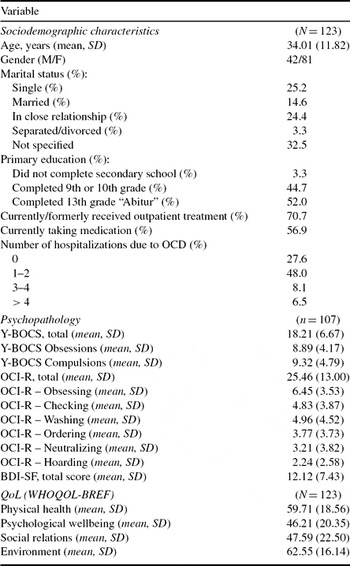
The sample comprised 42 males (34%) and 81 females (66%) with a mean age of 34.01 years (SD = 11.82). Further sociodemographic and clinical characteristics of the sample are presented in Table 1. For 16 participants data on psychopathology was incomplete. Therefore, statistical analyses regarding symptom severity are based on a subsample of 107 participants. The Y-BOCS mean total score of 18.21 (SD = 6.67) equates to mild to moderately severe OCD symptoms (Deacon and Abramowitz, Reference Deacon and Abramowitz2005). The BDI-SF mean total score of 12.12 (SD = 7.43) corresponds to a moderate to severe form of depression (BDI-SF score > 10, cf. Beck and Steer, Reference Beck and Steer1993).
Sociodemographic characteristics, psychopathology, and quality of life measure

WHOQOL-BREF and psychopathology
Mean scores of the QoL domains assessed with WHOQOL-BREF are presented in Table 1. One-sample t tests showed significantly lower mean scores (all p's < .05) in all WHOQOL-BREF domains compared to a German OCD outpatient sample (see Stengler-Wenzke et al., Reference Stengler-Wenzke, Kroll, Matschinger and Angermeyer2006).
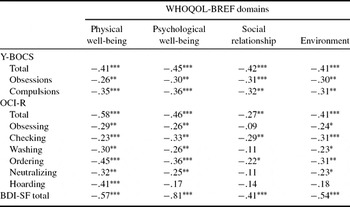
Correlational analyses were conducted to determine the relationship between psychopathology and QoL domains. Results are displayed in Table 2. The Y-BOCS total score correlated significantly and negatively with greater QoL in all domains (r's between −.41 and −.45, all p’s <. 001). Moreover, both Y-BOCS obsession and compulsion scores exhibited a significant relationship with decreased scores in all QoL domains. Similarly, OCI-R total score was associated with low QoL in all domains, with the strongest correlation found for physical health (r = −.58, p < .001) and the lowest for social relationships (r = −.27, p < .01). The latter was not significantly associated with OCI-R obsessing, washing, neutralizing, or hoarding subscales. Hoarding only showed a significant relation with the physical well-being domain. The strongest correlations with QoL were found for the BDI-SF score, ranging from r = −.41 for social relationships to r = −.81 for psychological well-being (all p’s < .001).
Correlations of the WHOQOL-BREF domains with the study measures (N = 107)

Notes: *p < .05, **p < .01, ***p < .001
In order to determine whether sociodemographic or clinical variables had an independent influence on QoL, a series of stepwise regression analyses was conducted. The four domains of WHOQOL-BREF were entered as dependent variables and relevant sociodemographic (age, gender, education) and clinical (Y-BOCS obsessions, Y-BOCS compulsions, OCI-R subscores, BDI-SF) characteristics served as independent variables. Physical well-being was best explained by a model including BDI-SF score, hoarding, and higher education level (R 2 adjusted = .50; p < .001). For psychological well-being, the BDI-SF score alone explained more than 60% of the total variance (R 2 adjusted = .64; p < .001) with no further variable able to enter the equation. BDI-SF score, obsessions, age, and compulsions entered the final model for the social relationship domain, accounting for one fourth of total variance (R 2 adjusted = .25, p < .001). About 30% of the variance of the environment scores were explained by the BDI-SF score and higher educational level (R 2 adjusted = .32, p < .001).
Illness- specific problems and degree of despair and relation to psychopathology
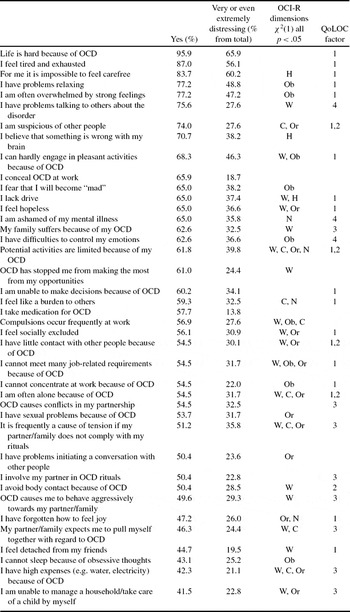
The QoLOC was completed by 123 participants with OCD. Table 3 presents those illness-specific problems reported by at least 40% of the sample together with the overall percentages of participants perceiving the problem as very or extremely distressing. The QoLOC demonstrated excellent internal consistency (α = .96) and split-half reliability (Spearman-Brown coefficient of r = .90). The QoLOC total score (more distress by OCD-specific problems translates into a higher score) was highly correlated with related constructs: WHOQOL-BREF total score (r = −.68) and BDI-SF (r = .77) and moderately associated with the Y-BOCS total score (r = .54).
Results from QoLOC: percentage of illness-specific problems and degree of despair (N = 123)

Notes. Only significant group effects are reported. W = present washing symptoms (OCI-R-Washing ≥ 4). Ob = present obsessing symptoms (OCI-R-Obsessing ≥ 4). C = present checking symptoms (OCI-R-Checking ≥ 4). Or = present ordering symptoms (OCI-Ordering ≥ 4). N = present neutralizing symptoms (OCI-Neutralizing ≥ 4). H = present hoarding symptoms (OCI-R-Hoarding ≥ 4); Factors: (1) Depressiveness in association with OCD, (2) Constraints in activities due to OCD symptoms or avoidance, (3) Problems with partner and/or family due to OCD symptoms or avoidance, (4) Self-concept/coping of own illness. Only factor loads ≥ .4 are presented.
All item responses were submitted to a principal component analysis with varimax rotation. Scree-plot inspection suggested four factors that explained 39% of the entire variance. The Bartlett test of sphericity reached significance (p < .001) and a Kaiser-Meyer-Olkin value of .71 indicated appropriateness of the data for a factor analysis. The first factor (eigenvalue: 11.34, 13% shared variance) tapped “Depressiveness in association with OCD” and was loaded by items on feelings of hopelessness, worries, as well as somatic aspects like exhaustion and lack of energy. The second factor (eigenvalue: 10.11, 11% shared variance) representing “Constraints in activities due to OCD symptoms or avoidance” was loaded by items tapping restrictions or impairments concerning leisure time (e.g. going to movies or concerts, traveling) and daily life activities (e.g. at work, using public transport, food). The third factor (eigenvalue: 8.26, 9% shared variance) represented “Problems with partner and/or family due to OCD symptoms or avoidance”, with items asking for tensions in relationship, involvement of partner/family in rituals, aggressiveness, worries about neglecting own family, or failing as a parent. The final dimension captured “Self-concept/coping of own illness” (eigenvalue: 5.43, 6% shared variance) and mainly comprised items on worries about being rejected or stigmatized by others due to OCD, shame, and problems to talk about one's illness. Table 3 includes factors (factor load ≥ .40) for items above 40% agreement.
A further aim was to investigate associations between illness-specific problems and OCI-R symptom dimensions. Therefore, QoLOC item responses were dichotomized (yes/no) and for each symptom dimension participants were allocated to one of two groups: (1) presence versus (2) no presence of symptom dimension (e.g. “washer” or “non-washer”). A symptom dimension was considered as present if the subject attained a score of equal or above four on the corresponding OCI-R subscale. Thus, allocation to multiple groups was possible (washing: n = 62, checking: n = 50, obsessing: n = 88, neutralizing: n = 42, ordering: n = 50, hoarding: n = 30). In a next step, the dichotomized variables of group and item response were submitted to cross-table statistics. Significant group effects are summarized in Table 3. However, note that only those items affirmed by at least 40% of the entire sample are listed in Table 3. Consequently, some group effects for symptoms that were reported less frequently in the present sample (e.g. hoarding) are not presented (the full table is available from the first author on request). Group differences emerged for most but not all of the illness-specific problems, indicating that different OCD symptom dimensions share some of the impairments while other problems are confined to particular OCD subtypes. Overall, washing behaviour was associated with the most problems (31 of 69 items) across all four dimensions tapped by the QoLOC. Group effects for ordering symptoms reached statistical significance for 17 items, followed by obsessing (13), checking (9), neutralizing (7), and hoarding (4).
Despite these problems, when asked about their overall satisfaction with life in one item (possible answers were “yes”, “partly”, “no”), 24% of the participants noted that they were all in all satisfied with life.
Discussion
Generic QoL in OCD samples
The present study investigated QoL in a large OCD sample including health care-seeking and non health care-seeking individuals using both a generic scale (WHOQOL-BREF) and a newly developed illness-specific instrument (QoLOC). QoL scores across all domains of WHOQOL-BREF (i.e. physical, psychological, social, and environmental aspects) were lower than in an OCD outpatient sample from an earlier study (Stengler-Wenzke et al., Reference Stengler-Wenzke, Kroll, Matschinger and Angermeyer2006). This is in line with Besiroglu and colleagues (Reference Besiroglu, Cilli and Askin2004) who found that non health care-seeking individuals with OCD reported significantly worse levels of QoL in psychological health compared to health care-seekers with OCD. In the present study, the lowest QoL scores were detected for psychological well-being and social relationships. These results were in accordance with earlier studies on QoL in OCD patient samples that consistently demonstrated lower scores in psychological and social domains compared to healthy samples (e.g. Koran et al., Reference Koran, Thienemann and Davenport1996; Moritz et al., Reference Moritz, Rufer, Fricke, Karow, Morfeld, Jelinek and Jacobsen2005). In contrast, for physical health some (Moritz et al., Reference Moritz, Rufer, Fricke, Karow, Morfeld, Jelinek and Jacobsen2005; Stengler-Wenzke et al., Reference Stengler-Wenzke, Kroll, Matschinger and Angermeyer2006) but not all studies (Akdede, Alptekin, Akvardar and Kitis, Reference Akdede, Alptekin, Akvardar and Kitis2005; Koran et al., Reference Koran, Thienemann and Davenport1996) found diminished scores.
As expected, symptom severity scores were correlated with decreased QoL. Using stepwise regression, depression (BDI-SF score) emerged as the strongest predictor for decreased QoL. This was true for all four QoL domains with the strongest effect for psychological well-being. Here, depression was the only significant predictor and explained almost two-thirds of the variance. These results are consistent with the literature (e.g. Huppert et al., Reference Huppert, Simpson, Nissenson, Liebowitz and Foa2009; for a review see Moritz, Reference Moritz2008) and in line with studies accumulating evidence for a complex pathogenic relationship between OCD and depression that manifests, for instance, in high correlations between obsessions and depressive symptoms (Moritz et al., Reference Moritz, Meier, Kloss, Jacobsen, Wein, Fricke and Hand2002) or the relationship of OCD worries and depressive rumination (Grisham and Williams, Reference Grisham and Williams2009). Y-BOCS obsessions and compulsions independently predicted the social domain of QoL.
Additionally, the relationship of particular sociodemographic variables with QoL was investigated in the present study. Contrary to Koran and colleagues (Reference Koran, Thienemann and Davenport1996), who found significantly lower QoL in women with OCD but in line with Rodriguez-Salgado and colleagues (Reference Rodriguez-Salgado, Dolengevich-Segal, Arrojo-Romero, Castelli-Candia, Navio-Acosta and Perez-Rodriguez2006), gender exerted no independent influence on QoL. Age negatively impacted on the social domain, while a higher educational level predicted higher scores on physical well-being and environment domains.
Regarding OCD symptom content, hoarding was the only dimension independently accounting for variance of a QoL domain in regression analyses. There is accumulating evidence that the “compulsive hoarding syndrome” markedly differs from the other OCD dimensions regarding several clinical and biological aspects as well as response to treatment (e.g. Lochner et al., Reference Lochner, Kinnear, Hemmings, Seller, Niehaus, Knowles, Daniels, Moolman-Smook, Seedat and Stein2005; Mataix-Cols, Rosario-Campos and Leckman, Reference Mataix-Cols, Rosario-Campos and Leckman2005; Samuels et al., Reference Samuels, Shugart, Grados, Willour, Bienvenu, Greenberg, Knowles, McCracken, Rauch, Murphy, Wang, Pinto, Fyer, Piacentini, Pauls, Cullen, Rasmussen, Hoehn-Saric, Valle, Liang, Riddle and Nestadt2007) and its status as an OCD subtype has been called into question (Abramowitz, Wheaton and Storch, Reference Abramowitz, Wheaton and Storch2008; Rachman, Elliott, Shafran and Radomsky, Reference Rachman, Elliott, Shafran and Radomsky2009). Above all, hoarding has been associated with greater disability (Frost, Steketee, Williams and Warren, Reference Frost, Steketee, Williams and Warren2000).
Illness- specific problems
While generic instruments are important to picture QoL across different populations, they do not allow for a specific insight into the particular living situation of OCD patients. To fill this gap, we complemented the present study with a new illness-specific instrument, the QoLOC, which demonstrated high internal consistency in the present sample. Especially regarding its construct validity, further analyses will be necessary. However, the correlations with the study measures (WHOQOL-BREF, BDI-SF, Y-BOCS) are promising, seeing that the different correlational strengths (see Results section) reflect the different degrees of conceptual similarity of these scales with the QoLOC. High correlations with WHOQOL-BREF and BDI-SF and a medium correlation with the Y-BOCS score indicate that the QoLOC meets its aim to tap illness-specific problems of well-being beyond symptom severity.
Overall, participants reported various problems specifically related to OCD symptomatology. An exploratory factor analysis suggested four domains of QoLOC: (i) Depressiveness in association with OCD; (ii) Constraints in activities due to OCD symptoms or avoidance; (iii) Problems with partner and/or family due to OCD symptoms or avoidance; (iv) Self-concept/coping of own illness. Consistent with earlier findings illustrating that OCD patients mainly suffer from the disruption of their careers and relationships with friends and family (Hollander, Reference Hollander1997; Hollander et al., Reference Hollander, Kwon, Stein, Broatch, Rowland and Himelein1996; Stein et al., Reference Stein, Roberts, Hollander, Rowland and Serebro1996), many participants reported problems concerning intimate relationships/family life or daily life/job-related activities (factors 2,3). Additionally, QoLOC revealed the specific nature of social problems associated with OCD, such as the frequent occurrence of aggressive feelings and tensions in intimate relationships, the involvement of partner/family in OCD rituals, or tensions if partner/family refuses to participate. Respective results of the present study are consistent with recent findings by Moritz and colleagues (Reference Moritz, Wahl, Ertle, Jelinek, Hauschildt, Klinge and Hand2009) who found increased rates of latent aggression in OCD patients compared to healthy controls. In addition, more than half of the present sample reported the avoidance of body contact (50.4%) and sexual problems (53.7%) due to OCD, which was experienced as very or extremely distressing by 28.5% and 31.7%, respectively. Previous research indicated that both men and women with OCD often report sexual dissatisfaction (Aksaray, Yelken, Kaptanoglu, Oflu and Ozaltin, Reference Aksaray, Yelken, Kaptanoglu, Oflu and Ozaltin2001) and that specific symptoms may differentially affect sexual functioning in OCD (Abbey, Clopton and Humphreys, Reference Abbey, Clopton and Humphreys2007).
High endorsement for items on problems concerning work and career issues demonstrates their impact of OCD symptoms in this field. While, typically, primary education was rather high in the present sample (more than 50% completed 13th grade), participants often perceived an inability to fulfil job-related activities (54.5%) or their not being able to make the most from their opportunities (61%; e.g. due to obsessional slowness or ordering compulsion). Efforts to conceal compulsions at work, as reported by about 66%, may take up a lot of time and energy. In fact, the problems most often reported in our sample related to the constant strain OCD burdens on the individual. About 96% of the participants stated that they perceived their life as hard due to OCD. Items asking for the experience of extensive worries and hopelessness as well as strong emotions and exhaustion related to OCD symptoms loaded factor 1, “Depressiveness in association with OCD”, which accounted for the highest percentage of shared variance in the factor analysis, consistent with the fact that depression severity was the strongest predictor for low QoL in this and previous studies. The fourth dimension, “Self-concept/coping of own illness”, comprised items on being ashamed to be mentally ill (65%) or problems talking to others about one's illness (75.6%) due to fear of rejection (41%), shame (33%), being considered “mad” (37%) or dangerous (13%). These results confirm that feelings of shame or embarrassment leading to the concealment of symptoms are particularly eminent in OCD (Newth and Rachman, Reference Newth and Rachman2001; Rachman, Reference Rachman1997, Reference Rachman1998; Salkovskis, Reference Salkovskis1999). In line with this, OCD has been labelled the “hidden disease” (Grabe and Ettelt, Reference Grabe and Ettelt2006; Welkowitz, Struening, Pittman, Guardino and Welkowitz, Reference Welkowitz, Struening, Pittman, Guardino and Welkowitz2000) and being embarrassed and secretive about one's OCD symptoms may be one possible reason why a large proportion of individuals with OCD does not seek treatment despite low QoL.
Analyses of the relation of illness-specific problems with symptom contents implied that different OCD subtypes share several of the illness-specific problems (e.g. high strain and exhaustion, tensions in relationships, concealing OCD at work), while other impairments are primarily characteristic for certain OCD types, such as the avoidance of body contact in “washers” or disturbed sleep and concentration due to obsessions. Across all dimensions, washing behaviour was associated with the most QoL problems. This is consistent with results of Moritz and colleagues (Reference Moritz, Rufer, Fricke, Karow, Morfeld, Jelinek and Jacobsen2005) who found washers to have poorer QoL relative to non-washers in several QoL domains. Possibly, these findings of a particular impact of washing symptoms on the perceived QoL may reflect that washing (e.g. compared to checking) demands greater physical effort, is more difficult to conceal, and is associated with financial costs (e.g. from taking long showers several times a day).
Clinical implications
First of all, heterogeneous findings of several studies assessing the impact of therapy on QoL suggested that QoL improves somewhat over the course of treatment (Bystritsky et al., Reference Bystritsky, Liberman, Hwang, Wallace, Vapnik, Maindment and Saxena2001, Reference Bystritsky, Saxena, Maidment, Vapnik, Tarlow and Rosen1999; Moritz et al., Reference Moritz, Rufer, Fricke, Karow, Morfeld, Jelinek and Jacobsen2005; Tenney et al., Reference Tenney, Denys, van Megen, Glas and Westenberg2003), but may not be directly tied to OCD symptom reduction. Cordiolia and colleagues (Reference Cordiolia, Heldt, Bochia, Margisb, de Sousab, Tonellob, Manfrob and Kapczinskia2003) even reported a decline of QoL despite continued symptom reduction at follow-up. Thus, clinical research should try to explicitly target QoL apart from mere symptom reduction (Diefenbach et al., Reference Diefenbach, Abramowitz, Norberg and Tolin2007). As an example, QoL goals could be incorporated into the exposure hierarchy or into motivational work (Diefenbach et al., Reference Diefenbach, Abramowitz, Norberg and Tolin2007; Hannan and Tolin, Reference Hannan, Tolin, Orsillo and Roemer2005).
In the present study, the lowest perceived QoL emerged for psychological well-being, which was strongly associated with depression in this and previous studies (e.g. Stengler-Wenzke et al., Reference Stengler-Wenzke, Kroll, Riedel-Heller, Matschinger and Angermeyer2007, for a review see Moritz, Reference Moritz2008). Consequently, addressing worries and depressive rumination is of high importance in OCD treatment. Our findings also converged with previous studies demonstrating the strong impact of OCD symptoms on social interaction. According to our results from the QoLOC, the carrying out and the reactions to OCD symptoms are often associated particularly with aggressive feelings and tensions in intimate relationships or family life. Therefore, elements of treatment should aim at improving the interaction between partners and family members when dealing with OCD symptoms. Further, results of the present study imply that particular OCD dimensions (e.g. washing or checking) may be associated with distinctive problems in various domains of function. Thus, additional specifically tailored interventions are desirable in order to optimally address idiosyncratic impairments in QoL associated with each symptom dimension.
It should be emphasized, however, that in this and earlier studies (Moritz et al., Reference Moritz, Rufer, Fricke, Karow, Morfeld, Jelinek and Jacobsen2005; Sorensen et al., Reference Sorensen, Kirkeby and Thomsen2004), considerable subgroups of OCD samples have expressed their overall satisfaction with life. Consequently, when aiming to improve QoL for OCD patients in therapy, focusing on resources and aspects of life that are less affected by OCD symptoms may be fruitful, while, at the same time, the individual's urge for change needs to be taken into account (Moritz, Reference Moritz2008).
Limitations
Several limitations of the present study need to be acknowledged. First, although multiple criteria served to assure reliable and valid OCD diagnoses, it cannot be ruled out that the degree of validity may fall behind that of clinician-based diagnoses, as for the present study diagnoses were solely based on self-report and no minimum score on Y-BOCS and/or OCI-R was required for study inclusion. However, mean scores corresponded to those of acute patient samples investigated in other QoL studies (e.g. Masellis et al., Reference Masellis, Rector and Richter2003; Stengler-Wenzke et al., Reference Stengler-Wenzke, Kroll, Riedel-Heller, Matschinger and Angermeyer2007). Moreover, the acceptance of web-based studies as a complementary research tool has recently increased (Holmes, Lang, Moulds and Steele, Reference Holmes, Lang, Moulds and Steele2008; Lange, van de Ven and Schrieken, Reference Lange, van de Ven and Schrieken2003; Moritz and Jelinek, Reference Moritz and Jelinek2009; Shusterman, Feld, Baer and Keuthen, Reference Shusterman, Feld, Baer and Keuthen2009; Tolin, Frost, Steketee and Fitch, Reference Tolin, Frost, Steketee and Fitch2008) and the reliability of the assessment of obsessive compulsive symptoms via internet surveys has been successfully demonstrated (Coles et al., Reference Coles, Cook and Blake2007; Moritz, Jelinek, Hauschildt and Naber, in press). An internet study circumvents the problem of selected in- or outpatient samples that are not representative for the overall population since only a minority of patients seeks psychological help (Kohn et al., Reference Kohn, Saxena, Levav and Saraceno2004). Still, participants are self-selecting from online sources. Second, we did not exclude subjects with comorbid depression. As depression has repeatedly been shown to be the best predictor for low QoL in OCD samples, it may be argued that it ultimately remains unclear to what extent low QoL is specific for OCD symptomatology or attributable to comorbid depression. Nevertheless, we deliberately included depressive comorbidity due to the fact that between one-third (Angst et al., Reference Angst, Gamma, Endrass, Goodwin, Ajdacic, Eich and Rossler2004; Demal, Lenz, Mayrhofer, Zapotoczky and Zitterl, Reference Demal, Lenz, Mayrhofer, Zapotoczky and Zitterl1993) and two-thirds (Sasson et al., Reference Sasson, Zohar, Chopra, Lustig, Iancu and Hendler1997) of OCD patients are clinically depressed, and affective problems are the norm rather than the exception in OCD. Thus, exclusion may produce highly selective samples and yet, in this study, we were interested in QoL issues relevant for a representative OCD sample. Third, a sample size of N = 123 may be criticized as too small for a principal component analysis following rules suggesting that sample size be determined as a function of the number of variables (N:p ratio, e.g. Cattell, Reference Cattell1987; Gorsuch, Reference Gorsuch1983). However, based on empirical analyses, several authors pointed out that considering the minimal sample size or N:p ratio as invariant across studies is a fundamental misconception; rather, if communalities are high, the effect of the sample size and other aspects of design are greatly reduced (Guadagnoli and Velicer, Reference Guadagnoli and Velicer1988; MacCallum, Widaman, Zhang and Hong, Reference MacCallum, Widaman, Zhang and Hong1999). The present component pattern meets the requirements for adequate interpretation as formulated by Guadanogli and Felicer (Reference Guadagnoli and Velicer1988) with four or more variables with loadings ≥ .60 on each component.
Finally, the cross-sectional nature of the study design does not allow for causal conclusions and it cannot be ruled out that ratings on QoL, as well as clinical measures, may be state dependent, as in OCD a waxing and waning of symptoms is particularly common.
Conclusions
Results of the present study complement previous research by demonstrating decreased generic QoL in OCD and confirming medium to strong relationships to symptom severity in a large OCD sample beyond the clinical setting. Moreover, our findings added insight about problems specifically relating to OCD and its symptom dimensions.
In conclusion, low generic QoL was associated with more severe psychopathology, primarily depression severity. Additionally, responses to QoLOC revealed high relevance of several OCD-specific problems on the four domains: depressiveness in association with OCD, problems with partner/family, work/leisure time activities, and coping with the own illness.
As generic QoL measures are increasingly applied as outcome parameter in treatment but do not sufficiently represent relevant OCD-specific problems, a quality of life scale that is specific to OCD has been suggested by numerous clinicians and researchers for several years. In the present study, we made a first attempt to develop such an instrument and our preliminary results regarding its psychometric properties are promising. However, further steps need to be taken in order to improve the scale, and independent studies are necessary to investigate its applicability and psychometric properties. For example, in a subsequent study (manuscript in preparation), we have shortened the instrument according to the results of the principal component analysis and administered it to an OCD sample in a treatment trial in order to explore its sensitivity to change.
Acknowledgements
We owe thanks to the German and Swiss Societies for Obsessive-Compulsive Disorders for their support with the recruitment over the internet survey.



Comments
No Comments have been published for this article.