Introduction
Differences in the acquisition and processing of nouns and verbs have been extensively studied in monolingual children and adults (e.g., Bates, Dale & Thal, Reference Bates, Dale, Thal, Fletcher and MacWhinney1995; Kauschke & Stenneken, Reference Kauschke and Stenneken2008; Masterson, Druks & Gallienne, Reference Masterson, Druks and Gallienne2008). Some studies have shown that differences in the semantic-conceptual and syntactic complexity of prototypical nouns and verbs lead to a noun advantage in spontaneous speech in early monolingual acquisition (e.g., Bates et al., Reference Bates, Dale, Thal, Fletcher and MacWhinney1995; Gentner, Reference Gentner and Kuczaj1982; Kauschke & Hofmeister, Reference Kauschke and Hofmeister2002) as well as in naming tasks at later stages of acquisition (e.g., Kauschke, Lee & Pae, Reference Kauschke2007; Masterson et al., Reference Masterson, Druks and Gallienne2008; Kambanaros, Grohmann & Michaelides, in press). Furthermore it has been shown that structural features of a particular language are related to differences in the saliency and frequency of nouns and verbs in the input, which in turn modifies the degree of the noun advantage (e.g., Gentner, Reference Gentner, Hirsh-Pasek and Golinkoff2006; Gopnik & Choi, Reference Gopnik, Choi, Tomasello and Merriman1995). It is still an open question whether a noun bias exists in bilingual language acquisition and to what extent monolingual and bilingual children differ with respect to their naming abilities for nouns and verbs (Jeuk, Reference Jeuk2003; Snedeker, Geren & Shafto, in press). In this study, these questions will be investigated in three populations: bilingual children acquiring Russian as their home language (L1) and German as their environment language (L2) compared to monolingual children acquiring Russian or German.
Object and action naming in monolingual children
Research on object and action naming has shown that monolingual children in different languages show higher accuracy and shorter reaction times for nouns than for verbs (Davidoff & Masterson, Reference Davidoff and Masterson1996, for three-to-five-year-old English children; Kauschke et al., Reference Kauschke, Lee and Pae2007, for two-to-eight-year-old children learning German, Korean, and Turkish; Masterson et al., Reference Masterson, Druks and Gallienne2008, for three- and five-year-old English children, Kambanaros et al., in press, for Greek Cypriot preschoolers and first-graders). This noun bias in naming is attributed to differences in the semantic-conceptual complexity of nouns and verbs. Prototypical nouns refer to objects, which are stable, cohesive entities and have closely defined sensory properties. Prototypical verbs on the other hand refer to actions and events and therefore denote relations between objects. These relations are temporal and “less exhaustively defined by semantic properties” (Black & Chiat, Reference Black and Chiat2003, p. 240; see also Gentner, Reference Gentner and Kuczaj1982; Gentner & Boroditsky, Reference Gentner, Boroditsky, Bowerman and Levinson2001). It is assumed that the higher semantic-conceptual complexity of verbs leads to higher processing demands in the activation of an action concept than of an object concept (Kauschke & Stenneken, Reference Kauschke and Stenneken2008; Kauschke & von Frankenberg, Reference Kauschke and von Frankenberg2008). Furthermore, the differences in semantic-conceptual complexity reflect various cognitive complexities, because there is a more direct relation between semantic representations and sensory features for nouns than for verbs (Masterson et al., Reference Masterson, Druks and Gallienne2008; Sheng & McGregor, Reference Sheng and McGregor2010). Thus, the task of picture naming itself may lead to an advantage for nouns because objects are easier to depict than dynamic actions (Mätzig, Druks, Masterson & Vigliocco, Reference Mätzig, Druks, Masterson and Vigliocco2009). Since age of acquisition is an important predictor for naming (Morrison & Ellis, Reference Morrison and Ellis1995), it has been suggested that it is easier to name nouns because they are acquired earlier. Additionally, some studies have found that the noun–verb gap becomes smaller with increasing age (Kambanaros et al., in press; Masterson et al., Reference Masterson, Druks and Gallienne2008). The authors assume that the older children “begin to resolve processing dilemmas related to the underlying semantic and conceptual differences between nouns and verbs” (Kambanaros et al., in press, p. 16).
The noun–verb discrepancy seems to vary across languages. Kauschke et al. (Reference Kauschke, Lee and Pae2007) investigated noun and verb naming in monolingual preschool children acquiring German, Korean and Turkish. The results showed that children of all three languages were better at processing nouns than verbs, but the extent of the discrepancy differed across languages, i.e., the noun–verb difference was less pronounced in Turkish and Korean children. The authors suggested that typological features of the language, which contribute to the frequency and saliency of nouns and verbs, have an impact on children's naming abilities for nouns and verbs. German is considered a “noun-friendly” language with a clear-cut noun–verb distinction: Nouns are consistently used with articles, and subjects cannot be omitted. Verbs appear in various positions: verb-second in main clauses and verb-final in subordinate clauses. In contrast, the “verb-friendly” languages Korean and Turkish allow subject or even object omission (Korean) and verbs appear consistently in the salient sentence-final position due to the canonical SOV word order. In monolingual acquisition of Russian, noun–verb patterns in naming have never been systematically investigated. Russian has a clear morphological differentiation of nouns and verbs as two distinct parts of speech. Although subjects and objects can be omitted, nouns are marked for case, number and gender in a word final position. Given such typological features like the rich and relatively transparent noun morphology, the optional omissions of verbs in spoken speech (Franks, Reference Franks1995; Zolotova, Onipenko & Sidorova, Reference Zolotova, Onipenko and Sidorova2004), Russian can be considered as a “noun-friendly” language. Additionally, in Russian, nouns are not only more frequent than verbs in child-directed speech, they are also acquired earlier (Ceytlin, Reference Ceytlin2009; Eliseeva, Reference Eliseeva2008; Gagarina, Reference Gagarina2008).
Nouns and verbs in bilingual language acquisition
As far as bilingual lexical acquisition is concerned, a number of studies have demonstrated that bilingual children show a reduced productive vocabulary in each of their languages in comparison to monolingual children of the same age (Cobo-Lewis, Pearson, Eilers & Umbel, Reference Cobo-Lewis, Pearson, Eilers and Umbel2002a, Reference Cobo-Lewis, Pearson, Eilers and Umbelb; Golberg, Paradis & Crago, Reference Golberg, Paradis and Crago2008; Yan & Nicoladis, Reference Yan and Nicoladis2009).
The question of whether lexical limitations of bilingual children affect nouns and verbs equally has rarely been addressed in previous research. Furthermore, it is still unclear whether the relation between nouns and verbs in bilingual acquisition is similar to the patterns found for monolingual children. Due to the absence of naming studies concerning these issues, we briefly summarize findings from other experimental designs. David and Wei (Reference David, Cohen, McAlister, Rolstad and MacSwan2005) compared the lexical development in English–French-speaking children (aged 1;0–3;0) with a balanced, simultaneous acquisition to that of monolingual English and French children. They used the CDI (Fenson, Dale, Reznick, Thal, Bates, Hartung, Pethick & Reilly, Reference Fenson, Dale, Reznick, Thal, Bates, Hartung, Pethick and Reilly1993) and its French version, the FCDI (Kern, Reference Kern1998). The results showed that the proportion of nouns and verbs was similar in both bilinguals and monolinguals. Likewise, Snedeker, Geren and Shafto (Reference Snedeker, Geren and Shafto2007) found a similar proportional development of nouns and verbs in adopted preschoolers from China (mean age 4;0, mean length of acquisition 3–18 months) in comparison to English monolingual children matched for vocabulary size. In contrast, some studies have found differences between bi- and monolingual speakers with respect to the dominance of word categories (Jeuk, Reference Jeuk2003; Polinsky, Reference Polinsky and Ravid2004; Snedeker et al., in press). Jeuk (Reference Jeuk2003) reported a higher proportion of noun types in the spontaneous speech of Turkish–German preschoolers than in monolingual German children. Snedeker et al. (in press), using the CDI-questionnaire, found that internationally adopted preschoolers from Russia and China (mean age 4;10) had a higher proportion of verbs and a lower proportion of nouns in their L2 (English) than monolingual children matched for vocabulary size, whereas a younger bilingual group with the same time of exposure to English (mean age 2;11) showed the same distribution of word categories as the monolingual control group. The authors attribute the decreasing effect of word category to growing cognitive and linguistic skills.
In sum, empirical findings concerning the effect of word category and the existence of a noun bias in bilingual populations using parental questionnaires and spontaneous speech data lead to contradictory results. While some studies have found an equal proportion of nouns and verbs in bi- and monolingual acquisition, other studies have found a higher proportion of nouns in bilingual than in monolingual children or a higher proportion of verbs. This heterogeneity is not surprising given the considerable differences in the bilingual data. The conditions of bilingual acquisition in the reported studies comprised diverse settings: the one parent – one language context, the context of adoption with an interruption of the first language, and the context of immigration with successive acquisition. Therefore, the present study investigates lexical development in a larger, homogeneous sample of Russian–German bilingual children with a focus on nouns and verbs. The study aims, first, to examine whether a noun bias exists in picture naming of bilingual children and second, to inspect naming limitations in bilingual children.
Factors influencing the course of bilingual lexical acquisition
One factor that may influence lexical acquisition in a bilingual setting is the (im-)balance between the two languages. It has been shown that there is a shift to the environment language with increasing age (Reich, Reference Reich and Ehlich2007, for bilingual children in Germany): First of all the home language (L1) often experiences little support and appreciation in everyday life out-of-home. In addition, the environment language (L2) receives more support and appreciation in the community and in the educational system. As a consequence, use of the home language often decreases in favor of an increasing use of the environment language once the children attend preschool. Such a shift of language dominance affects all linguistic domains, including vocabulary. A faster lexical development at preschool and elementary school age for the environment language is a robust finding for several home languages with different status in their respective environments (children of Spanish-speaking immigrants in the US: Cobo-Lewis et al., Reference Cobo-Lewis, Pearson, Eilers and Umbel2002a, Reference Cobo-Lewis, Pearson, Eilers and Umbelb; L1 Hmong L2 English: Kan & Kohnert, Reference Kan and Kohnert2005; children of Turkish immigrants in Germany: Karasu, Reference Karasu1995). In light of these results, a similar shift of vocabulary skills is expected in the present study, namely a shift towards German with increasing age in bilingual Russian-German learners.
In addition, we expand this issue by addressing the question of whether the development of nouns and verbs might be differentially affected. A tentative hypothesis is that the shift in language dominance may affect action and object naming differently due to differential effects of input frequency. Since it is a crucial characteristic of bilingual language acquisition that linguistic input is distributed over two languages (Hoff, Core, Place, Rumiche, Señor & Parra, Reference Hoff, Core, Place, Rumiche, Señor and Parra2012; Pearson, Fernández, Lewedeg & Oller, Reference Pearson, Fernández, Lewedeg and Oller1997), bilingual children have less contact with each of their languages than monolingual children, i.e., they are exposed to one language less often than monolinguals. As a consequence, words have a lower frequency in bilingual input in comparison to monolingual input. For the naming of objects in bilingual population it has been shown, that the reduced frequency not only causes a reduced lexical size but also problems in lexical access (Yan & Nicoladis, Reference Yan and Nicoladis2009).
For monolingual children, Goodman, Dale and Li (Reference Goodman, Dale and Li2008) found that the effect of input frequency on the age of acquisition of words varies across lexical categories and developmental stages. The strongest effect of input frequency was found for nouns in later acquisition stages (after the first 100 words). For verbs, no relationship between input frequency and age of acquisition was found, neither for early (first 100 words) nor for later stages (after the first 100 words). The authors attribute these findings to differences in the semantic-syntactic diversity of nouns and verbs. Semantic-syntactic diversity concerns variables like perceptibility of the referent of the word and diversity of syntactic frames. Concrete and basic-level nouns have a much smaller semantic-syntactic diversity than verbs. For this reason, frequency plays a major role in their acquisition, whereas the factors listed above weaken the influence of verb frequency. Sandhofer, Smith and Luo (Reference Sandhofer, Smith and Luo2000) describe how nouns and verbs follow a different distribution in monolingual parental input: Common nouns have a flat distribution in the input. The majority of nouns are represented with equal frequency in child-directed speech, i.e., most of the nouns are in a mid-frequency range. For verbs a steep frequency distribution has been reported: While a small set of verbs is highly frequent, the majority of verbs are infrequent.
With respect to bilingual acquisition, it can be assumed that the frequency of highly frequent verbs is reduced less due to the abridged input, because there are much fewer competitors in this frequency range for verbs than for nouns. This kind of input effect could lead to an easier availability of this subset of verbs as compared to nouns (see Polinsky, Reference Polinsky and Ravid2004, on heritage learners). Following this reasoning for monolingual acquisition, the reduced input in bilingual acquisition might affect nouns more strongly than verbs, so that lexical limitations of bilingual children might be more evident for nouns than for verbs. There are two reasons to expect that verbs are more robust against the reduction of input in bilingual acquisition. First, in monolingual acquisition verb production is less tied to frequency than is noun production (Goodman et al., Reference Goodman, Dale and Li2008). Second, the distribution of nouns and verbs in the input is different (Sandhofer et al., Reference Sandhofer, Smith and Luo2000). Against this background, the present study investigates whether nouns are more vulnerable in bilingual acquisition than verbs.
The conceptual vocabulary in bilingual children
Studying lexical development in bilingual children raises the methodological question of how to adequately assess vocabulary skills. Researchers (Genesee & Nicoladis, Reference Genesee, Nicoladis, Garcia and McLaughlin1995; Patterson, Reference Patterson1998; Pearson, Fernández & Oller, Reference Pearson, Fernández and Oller1993) have raised questions about the appropriateness of using monolingual vocabulary norms in order to evaluate the lexical skills of bilinguals. An important characteristic of bilingual language acquisition is that children with an immigration background often use both languages in different contexts. The L1, the language of the parents, is mostly used at home. The dominant language of the environment (L2) is used in everyday life out-of-home. Therefore, the lexicon is distributed over both languages: Some concepts can be named in only one of the languages, while for others translational equivalents exist (Oller, Cobo-Lewis & Pearson, Reference Oller, Cobo-Lewis and Pearson2004; Pearson et al., Reference Pearson, Fernández and Oller1993; Umbel, Pearson, Fernández & Oller, Reference Umbel, Pearson, Fernández and Oller1992).
For a valid assessment of the size of the bilingual lexicon, it is crucial to examine both languages and account for this overlap (Oller, Reference Oller2005). In some studies the so-called “Conceptual Vocabulary” has been used (Allman, Reference Allman2005; Pearson et al., Reference Pearson, Fernández and Oller1993). This measure “is a combination of vocabulary scores in both languages considering words describing the same concept as one word” (Allman, Reference Allman2005, p. 58). Bilingual toddlers (aged 8–30 months) were comparable to their monolingual peers with respect to conceptual vocabulary as measured by checklists (Pearson et al., Reference Pearson, Fernández and Oller1993), whereas bilingual preschoolers (aged 28–78 months) scored below English monolinguals in a naming test (Allman, Reference Allman2005).
Although these studies included various word categories, they did not analyze effects of word categories. So far, only one study has examined the category-specific abilities of bilingual children in both languages. Sheng, McGregor & Marian (Reference Sheng, McGregor and Marian2006) showed that bilingual children (aged 5–8 years) had a slight advantage in producing paradigmatic responses to verbs (taking both their languages together) in comparison to monolinguals. For nouns, both groups showed similar abilities. Comparisons between nouns and verbs in naming using conceptual vocabulary provide an insight into semantic-conceptual abilities of bi- and monolingual children, because of the differences in the semantic-conceptual complexity of both word categories.
The present study
Research questions and hypotheses
The present study explores the production of nouns and verbs in a picture-naming task in four-, five- and six-year-old Russian–German bilingual children in their two languages and compares it to that of monolingual Russian- and German-speaking children. Naming abilities are investigated for each individual language as well as for conceptual vocabulary, the composite score of both languages. We address the following questions and formulate the respective hypotheses:
1. What are the effects of word category in naming, if any, in bilinguals as compared to monolinguals? Do bilingual children show any noun advantage and, if yes, is it equally pronounced in both languages? Considering the language-specific features of German and Russian, we expect to find a word category effect – a noun advantage – in all populations we investigate; this effect is expected to be stronger in monolinguals as compared to bilinguals.
- 2.
(a) Do naming abilities of bilingual children differ from those of monolinguals when the single languages are considered? We predict that naming abilities in bilingual children will be limited compared to age-matched monolingual peers, since lexical limitations in bilingual children are well documented.
(b) Are the naming abilities of the bilingual children in each language limited to the same extent for nouns and for verbs? Since the reduced input in bilingual acquisition might have a different impact on the acquisition of nouns and verbs, we expect the lexical limitations of bilingual children to be more evident for nouns than for verbs.
3. Is there any shift in language dominance with increasing age? The bilingual children are expected to show better naming performance in the environment language (German) than in the home language (Russian) with increasing age. Again, we assume that nouns will be affected more strongly by these age effects than verbs.
4. How can lexical abilities in bilingual children be described when the conceptual vocabulary is taken into account? Is there a noun advantage in bilingual children in naming using this combinatory measure? How do bilingual children perform in comparison to monolingual children for nouns and verbs separately? Based on the results of Sheng et al. (Reference Sheng, McGregor and Marian2006) and peculiarities of the languages investigated we predict that there will be a bilingual advantage for verbs.
Method
Participants
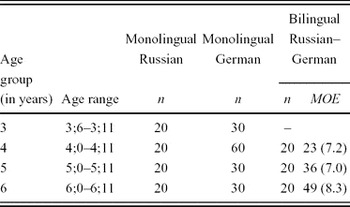
Sixty Russian–German bilingual children between 4;0 and 6;11 participated in the study. They were distributed over three age groups (4;0–4;11, 5;0–5;11 and 6;0–6;11), each group comprising 20 children.
The bilingual participants were recruited in kindergartens and primary schools in Berlin, Germany. In all cases, both parents were first-generation immigrants from Russia, who speak predominantly standard colloquial Russian with their children. All children acquired Russian as their first language from birth. Regular exposure to German as the second language started in a monolingual kindergarten, which all children attended at the latest around their third birthday. The mean onset of acquisition of the L2 was 29.37 months (range = 12–39, SD = 6.53). Because there were virtually no individual differences with respect to the age of onset of L2-exposure, the length of exposure generally increased with age. The group of the four-year-olds had acquired the L2 on average for 23.4 months (range = 13–35, SD = 7.2), the five-year-olds had a mean length of exposure of 36.4 months and the six-year-olds of 49.3 months (range = 37–65, SD = 8.3).
Additionally, 80 monolingual Russian-speaking children between 3;6 and 6;11 participated in this study. This sample was split over four age groups with 20 children each: 3;6–3;11, 4;0–4;11, 5;0–5;11 and 6;0–6;11. These children were recruited in kindergartens in St. Petersburg, Russia.
The data of the monolingual German-speaking children were part of the pool of Kauschke (Reference Kauschke2007). This sample comprises 240 children aged between 2;6 and 7;11. For the purpose of a comparison with the bilingual children in the present study, the data in the age groups of interest (n = 150) were taken out of the original sample: children aged 3;6–3;11 (n = 30), 4;0–4;11 (n = 60), children aged 5;0–5;11 (n = 30) and children aged 6;0—6;11 (n = 30). The youngest age group was included in order to compare the bilinguals’ performance with younger monolingual children. For an overview of all participants, see Table 1.
Subjects of the study, number per age group, months of exposure to German (MOE) for bilinguals (standard deviations in parentheses).

The t-test for independent samples did not reveal differences with respect to age between the monolingual Russian and the monolingual German children as well as between the bilingual children and both samples of monolingual children (for these comparisons only the age groups 4–6 years were considered).
According to a detailed parental questionnaire, all children were without reported cognitive, perceptual and language developmental delays.
Materials
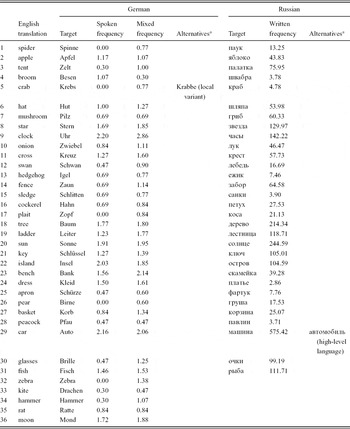
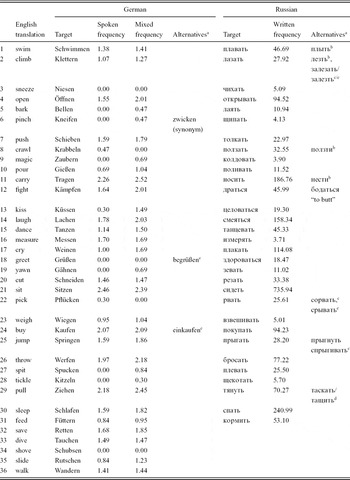
The material for the German test was a picture-naming task comprising pictures of objects and actions (see De Bleser & Kauschke, Reference De Bleser and Kauschke2003; Kauschke, Reference Kauschke2007). The stimulus items were controlled for the following lexical parameters: All items were mono- or bisyllabic and monomorphemic, i.e., there were no compounds or derivatives. The noun set included concrete object labels referring to whole objects; the verb set included action or state terms with an agentive subject. Thus, all items were typical members of their respective category. All stimuli were matched for the age of spontaneous acquisition, frequency, and name agreement. In order to assess age of acquisition, the reports of 80 caretakers were obtained about the age at which their child produced the target words (see De Bleser & Kauschke, Reference De Bleser and Kauschke2003). Nouns and verbs were matched in a pairwise manner for age of spontaneous production. For frequency matching, data on mixed (i.e., spoken and written) and on spoken frequency were obtained from the Celex Database for German (Baayen, Piepenbrock & Gulikers, Reference Baayen, Piepenbrock and Gulikers1995). Although the verbs were of higher frequency than the nouns, there were no significant category differences in terms of frequency. For each noun and verb, a black-and-white line drawing was created depicting the object or action respectively. To assess name agreement, 78 German adults (64 female, mean age 30 years, range 19–45 years) participated in a written naming task. The proportion of participants producing the target item for each picture had to be 80% or more, otherwise the picture was excluded. For some items a near-synonym had to be accepted to reach the sufficient naming agreement. This was the case with one object picture and three action pictures. Name-agreement scores did not differ significantly between nouns and verbs. The final German material consisted of a set of 36 nouns and 36 verbs.
The adaptation of the material to Russian included several steps. First, for all 36 pictures for nouns and verbs each naming agreement in adults was assessed in a written naming task with 30 monolingual adult speakers (25 female, mean age 29 years, range 17–70 years), all students and teachers of the Herzen State Pedagogical University of Russia, St. Petersburg. Five action pictures and three object pictures had to be excluded because they did not reach a sufficient naming agreement. For some items (one object and eight action pictures) alternative reactions had to be accepted. It turned out that the pictures for some actions were ambiguous with respect to language-specific properties of verbs in Russian. For some verbs various counterparts for aspect (perfective vs. imperfective) had to be accepted, as in the picture for to pick: rvat’-inf-imperfective/sorvat’-inf-perfective. Also for the verbs of motion, which are specified for directionality in Russian, both counterparts (unidirectional vs. multidirectional) had to be considered as legitimate, because the feature “directionality” was not clearly depicted in the drawing (e.g., for to pull there are two Russian words taščit’-inf-unidirectional and taskat’-inf-multidirectional). Finally, the noun and verb sets were matched by frequency, which was taken from the online Frequency Dictionary for Russian (Sharoff). In order to obtain a frequency matching and an equal number of nouns and verbs, four nouns were excluded. The final set for Russian comprised 31 nouns and 31 verbs, balanced for frequency and naming agreement between the word categories. The noun and verb sets in Russian and German (analyzed for the identical 31 items in both languages) did not differ with respect to naming agreement, as evaluated with an unpaired t-test. Examples of the pictures are given in Figures 1 and 2.
Example of an object picture.

Example of an action picture.

The full list of the German and Russian item sets with frequency information is given in the appendices. A direct comparison of frequency between both language sets was not possible because of the differences in the frequency values. The Frequency Dictionary for Russian is a corpus of modern written Russian with a corpus size of more than 26 million word tokens (Sharoff). The German corpus in the Celex Database comprises 5.4 million word tokens from written texts and 600,000 tokens from transcribed speech (Brysbaert, Buchmeier, Conrad, Jacobs, Bölte & Böhl, Reference Brysbaert, Buchmeier, Conrad, Jacobs, Bölte and Böhl2011). Thus, lemma frequencies for translational equivalents differ significantly between languages (for instance, for the counterpart of the English word spider the German lemma Spinne has a mixed frequency of 0.77 instances per million (ipm), while the Russian lemma pauk has a written frequency of 13.25 ipm). Furthermore, the available frequency corpora are inadequate for use in studies with children because none of the corpora is based on child-directed speech or children's literature. In fact, the input of the children may differ a great deal from the frequency values.
Procedure
In an off-line oral naming test, nouns and verbs were presented in separate sets within one test session. The experimental design included warming up, two training items and the naming test itself. If necessary, responses were elicited by questions like “What is this?” or “What is he/she doing?”.
The bilingual children were tested by native speakers separately in each language, i.e., the experimenters for Russian and German were different persons. The Russian and the German naming tests were administered in different sessions at least one week apart from each other.
It has to be kept in mind that picture naming is a complex task that involves different components (see McGregor, Friedman, Reilly & Newman, Reference McGregor, Friedman, Reilly and Newman2002): a visual representation of the picture, the activation of the semantic system, access to the phonological form of the target word, and the articulation of the word. Therefore, difficulties in naming can be caused by problems at different levels of the naming process. In particular, a naming error may arise because of a lack of semantic knowledge about the concept, because the word form has not been acquired in the target language, or because of a failure in word form retrieval. The off-line naming task used in the present study allows drawing conclusions about vocabulary competencies, but it does not permit to distinguish between different levels of word processing.
Data analyses
The responses were tape-recorded, transcribed and stored in a database, allowing quantitative statistical analysis of correct and incorrect responses. The responses were counted as correct or false according to their agreement with the target word (the dominant response(s) given in the name-agreement assessment). Self-corrections were scored as correct as well as phonetically or phonologically incorrect responses, as long as the target word was unambiguously identifiable. Finite and non-finite verb forms were accepted, regardless of their morphological correctness, as well as inflected forms of the target nouns.
Two scores were calculated in each language tested: (i) number of correctly named nouns, and (ii) number of correctly named verbs.
For the bilingual children, conceptual vocabulary was determined in addition to the individual language scores. Every picture named correctly in one of the languages or in both was counted as one acquired concept. Based on this measure the two scores (i) number of correctly named noun concepts, and (ii) number of correctly named verb concepts were calculated for each subject. In sum, for each bilingual subject the two different scores (number of nouns, number of verbs) are available for German words, Russian words and for conceptual vocabulary.
In order to explore the effects of word category (noun – verb), language (German – Russian), or type of acquisition (monolingual – bilingual), analyses of variance were performed. Effects of word category and language (for bilingual children) as well as effects of word category and type of acquisition were examined with multivariate analyses of variance, with age, language and type of acquisition serving as between-subject factors and word category serving as a within-subject factor (with nouns and verbs as levels).
Based on the results of the analyses of variance, post-hoc tests were applied for a comparison of means (independent or paired t-tests). The Bonferroni correction was employed in cases of multiple t-tests used to explore age-specific differences between different datasets (α* = .05/2 = .025 for between age group comparisons, α* = .05/3 = .016 for within age group comparisons).
Results
The results are presented in two parts. First, the languages under investigation are analyzed separately in two steps:
(a) effects of word category, i.e., comparison of naming abilities for nouns versus verbs in German and Russian;
(b) comparison between bilingual and monolingual children with respect to naming abilities for nouns and verbs.
Secondly, the conceptual vocabulary is analyzed in the same way:
(a) category effects on conceptual vocabulary;
(b) comparison between bilingual and monolingual children with respect to naming abilities for nouns and verbs on the basis of the conceptual vocabulary.
In all comparisons, the influence of age is considered.
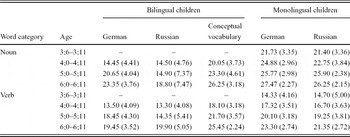
As the sizes of the German and the Russian item sets were not equal, only those items which overlapped in the data sets were included in the analyses. Table 2 shows the performance of the bilingual and the monolingual children based on the reduced item set of 31 items per word category.
Overall descriptive statistics (means) for noun (n = 31) and verb (n = 31) naming (standard deviations in parentheses).

Category effects in bilingual children (based on individual language scores)
The descriptive statistics of the naming performance of the bilingual children in both languages are given in Table 2. To explore the effects of age, language and word category in bilingual children, a repeated measures ANOVA was performed with age (with the three age groups 4;0–4;11, 5;0–5;11 and 6;0–6;11 as levels) and language (with the two levels Russian and German) as between-subject factors, and word category as a within-subject factor (with nouns and verbs as levels).
The results revealed main effects for word category (F(1,57) = 17.85, p < .001), language (F(1,57) = 7.40, p = .008) and age (F(2,57) = 18.53, p < .001). There were significant interactions between word category and language (F(1,57) = 12.33, p = .001), indicating a language-specific influence of word category, and between word category, language and age (F(2,57) = 6.38, p = .002), demonstrating that this language-specific effect of word category is modified by age.
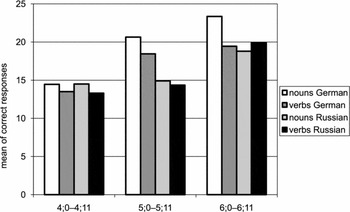
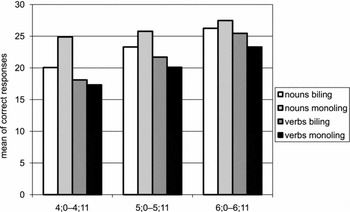
Post-hoc paired t-tests between the naming scores for nouns and verbs in Russian and German in individual age groups clarified these interactions. In Russian, there were no differences between noun and verb naming in any age group, whereas in German the bilingual children showed an advantage in noun naming in the older age groups (5;0–5;11: t = 3.30, df = 19, p = .004; 6;0–6;11: t = 6.09, df = 19, p < .001). These patterns are illustrated in Figure 3.
Naming patterns of bilingual children in Russian and German.

The interactions found in the ANOVA also imply that differences in the naming abilities for Russian and German emerge in specific age groups for specific categories. T-tests revealed that five- and six-year-old bilingual children named German nouns better than Russian nouns (5;0–5;11: t = –4.29, df = 19, p < .001; 6;0–6;11: t = –3.30, df = 19, p = .004), while verb naming abilities were balanced between both languages in all three age groups.
In sum, the investigation of noun–verb naming abilities in both languages of the bilingual children revealed a language- and age-specific influence of word category on naming. A noun advantage existed only in German and only for older children. The increasing noun–verb discrepancy in German is related to a stronger growth in noun naming abilities in German than in Russian. Verb naming develops at a similar rate in the two languages of the bilingual children.
Comparison between monolingual and bilingual children (based on individual language scores)
In order to compare the performance of the monolingual and the bilingual children in German, an ANOVA was performed with age (with the three age groups 4;0–4;11, 5;0–5;11 and 6;0–6;11 as levels) and type of acquisition (with the two levels bilingual and monolingual) as between-subject factors, and word category as a within-subject factor (with nouns and verbs as levels). The full item set of 36 items was used. The results revealed a main effect for type of acquisition (F(1,174) = 95.47, p < .001), age (F(2,174) = 49.6, p < .001) and word category (F(1,174) = 401.16, p < .001). Significant interactions were found for type of acquisition × word category (F(1,174) = 48.82, p < .001), type of acquisition × age (F(2,174) = 5.91, p = .003) and type of acquisition × word category × age (F(2,174) = 15.99, p < .001).
In noun naming, the monolingual children outperformed the bilingual children in every age group (all ps < .001), but were better at verb naming only in age groups 4;0–4;11 (t = 4.53, df = 78, p < .001) and 6;0–6;11 (t = 3.95, df = 48, p < .001).
Next, it was investigated whether naming abilities for nouns and verbs in the bilingual children are comparable with the level of younger monolingual children. A series of t-tests was performed between bilingual children and monolingual children who are one year younger. The younger monolingual children were better at noun naming than bilingual peers who are one year older (4;0–4;11 bilingual vs. 3;6–3;11 monolingual: t = 6.43, df = 48, p < .001; 5;0–5;11 bilingual vs. 4;0–4;11 monolingual: t = 4.69, df = 78, p < .001; 6;0–6;11 bilingual vs. 5;0–5;11 monolingual: t = 2.65, df = 48, p = .011). In contrast, there were no differences between the bilingual children and the younger monolingual children in verb naming.
Paired t-tests showed better naming of nouns than verbs in all age groups of the monolingual German children (4;0–4;11: t = 21.67, df = 59, p < .001; 5;0–5;11: t = 12.09, df = 29, p < .001 and 6;0–6;11: t = 11.85, df = 29, p < .001). In contrast, the bilingual children only showed a significant noun advantage in the older age groups, after applying the Bonferroni correction (4;0–4;11: t = 2.51, df = 19, p = .021; 5;0–5;11: t = 4.26, df = 19, p < .001 and 6;0–6;11: t = 6.45, df = 19, p < .001). This pattern had already been shown for the set of 31 items (see the previous section).
Taken together, the results of the comparison between the bi- and monolingual children's naming abilities in German showed an advantage of the monolingual over the bilingual children of the same age. Whereas for nouns this pattern holds for all age groups, it is only evident in the four- and six-year-olds with respect to verbs. Compared to younger monolingual children, the bilingual children were still behind them in noun naming, but performed on a similar level in verb naming. So the gap between both groups is more marked with respect to noun naming than to verb naming. In addition, the noun–verb discrepancy was again smaller in the bilingual children than in the monolingual children.
Next, the performance of the monolingual and the bilingual children was compared for Russian. The naming performance of both groups is presented in Figure 4. The descriptive statistics of the naming patterns in the bi- and monolingual children in Russian are given in Table 2.
Comparison of noun and verb naming in bi- and monolingual Russian children.

The ANOVA with age (with the three age groups 4;0–4;11, 5;0–5;11 and 6;0–6;11 as levels) and type of acquisition (with the two levels bilingual and monolingual) as between-subject factors, and word category as a within-subject factor (with nouns and verbs as levels) revealed significant main effects for word category (F(1,114) = 100.35, p < .001), type of acquisition (F(1,114) = 57.48, p < .001) and age (F(2,114) = 12.02, p < .001). Significant interactions were found for word category × type of acquisition (F(1,114) = 86.56, p < .001) and word category × age (F(2,114) = 3.54, p = .032), but not for type of acquisition × age and word category × type of acquisition × age.
T-tests between the bilingual and the monolingual children revealed better naming of nouns in monolingual than in bilingual children in all age groups (all ps < .001), whereas for verbs an advantage of the monolinguals was evident only in the younger age groups (4;0–4;11: t = 2.79, df = 38, p = .008; 5,0–5,11: t = 3.31, df = 38, p = .002) and not for the six-year-olds (t = 1.13, df = 38, p = .265).
Again, the naming performance of the bilingual children was compared to younger monolingual children. Independent t-tests showed that the monolingual children were better at noun naming than the bilingual children who are one year older (4;0–4;11 bilingual vs. 3;6–3;11 monolingual: t = 5.29, df = 38, p < .001; 5;0–5;11 bilingual vs. 4;0–4;11 monolingual: t = 4.23, df = 38, p < .001; 6;0–6;11 bilingual vs. 5;0–5;11 monolingual: t = 4.05, df = 38, p = .011). However, the bilingual children did not differ from younger monolingual children in verb naming.
The assumption that word category affects naming in bi- and monolingual children in Russian differently is confirmed by post-hoc paired t-tests between noun and verb naming in the individual age groups. In contrast to the bilingual children, who never showed significant differences between nouns and verbs (see above), the monolingual children named nouns significantly better than verbs in all age groups (all ps < .001).
In sum, the bilingual children are also weaker at naming Russian words than monolingual children. Similar to the pattern reported for German, we find this pattern in all age groups for nouns, but only in two of the three age groups for verbs. Also in Russian the comparison with younger monolingual children revealed a more severe gap in noun naming abilities. The bilinguals are weaker at noun naming, but on a par with the younger monolinguals at naming verbs. This corresponds to the fact that there is no effect of word category in the bilingual children in contrast to a clear noun advantage in naming of the monolingual children. This picture is stable across all age groups.
Category effects in bilingual children (based on conceptual vocabulary)
An ANOVA based on the concepts named by the bilingual children, with age as a between-subject factor, and word category as a within-subject factor (with noun concepts and verb concepts as levels), revealed a significant main effect for age (F(2,57) = 23.59, p < .001) and word category (F(2,57) = 12.82, p < .001) without an interaction. The number of acquired concepts increases significantly with age and differs between the word categories. Post-hoc paired t-tests between noun and verb concepts revealed a significant noun advantage only for the four-year-olds (t = 2.57, df = 19, p = .019) and not for the older children. Thus, there is no general noun advantage in the conceptual vocabulary of the bilingual children, but rather a balanced knowledge of nouns and verbs.
Comparison between monolingual and bilingual children (based on conceptual vocabulary)
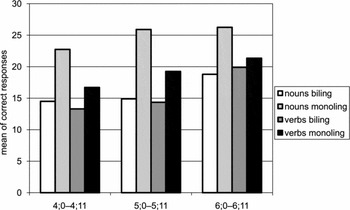
Further analyses compare the conceptual vocabulary of the bilingual children to the performance in naming of the monolingual German children. An overview of the data is given in the descriptive statistics in Table 2. A repeated measures ANOVA showed significant main effects for word category (F(1,174) = 254.43, p < .001) and age group (F(2,174) = 49.7, p < .001) but not for type of acquisition, and significant interactions for word category × type of acquisition (F(1,174) = 91.59, p < .001) and word category × age (F(2,174) = 8.69, p < .001). Independent t-tests between the bi- and monolingual children in individual age groups confirmed that differences between the mono- and bilingual children vary with word category: The monolingual children were better at noun naming in the youngest age group (4;0–4;11: t = 5.92, df = 78, p < .001), and on the same level as the bilinguals in the two older age groups. In contrast, in verb naming the bilingual children were comparable to the monolingual children at ages four and five, and even outperformed the monolingual children in the oldest age group (6;0–6;11: t = –2.92, df = 48, p = .005). These patterns are illustrated in Figure 5.
Comparison of conceptual vocabulary of bilingual children for nouns and verbs to naming performance of monolingual German children.

The comparison of the conceptual vocabulary of the bilingual children to the performance of the monolingual Russian children revealed significant main effects for word category (F(1,114) = 168.86, p < .001) and age group (F(2,114) = 34.0, p < .001), but not for type of acquisition, and significant interactions for word category × type of acquisition (F(1,114) = 61.53, p < .001). Post-hoc independent t-tests clarified the interaction: The bilingual children outperformed the monolingual children in verb naming in the oldest age group (6;0–6;11: t = –5.21, df = 38, p < .001); all other comparisons for noun and verb naming did not reveal differences.
In sum, with respect to conceptual vocabulary, the bi- and monolingual children show a similar naming performance. There is no general noun advantage in the conceptual vocabulary of the bilingual children. There are some age-specific differences between the conceptual vocabulary in the bilingual children and the naming performance in the monolingual German and Russian children: The six-year-old bilingual children show a better performance in verb naming than the monolingual children in their respective language. In contrast, the four-year-old monolingual German children outperform bilingual peers in their conceptual vocabulary in noun naming. The effect of word category in bilinguals’ conceptual vocabulary is evident only in the youngest age group. So the noun advantage in the conceptual vocabulary of the bilingual children is less pronounced than in the monolingual German or Russian children, who show better noun than verb naming in all age groups.
Discussion
The aim of this study was to investigate the influence of word category (noun vs. verb) on the picture-naming abilities of bilingual children speaking Russian as L1 and German as L2. In particular, the study first examined whether monolingual and bilingual children exhibit a noun advantage in naming. Both groups of monolingual children showed a clear noun bias. The “noun-friendly” linguistic properties of Russian and German may be one factor that may have contributed to this pattern. In line with our predictions, the results showed that the effect of word category was more strongly pronounced in monolinguals as compared to bilinguals: The bilingual children showed no effect or a weak effect of word category, whereas the monolingual Russian- and German-speaking children showed a clear noun bias. Thus, the results suggest that the bilingual acquisition context has an impact on the degree of the noun–verb discrepancy in the naming task. Possible reasons for this finding will be discussed below in conjunction with the direct comparison of the category-specific performance of the bilingual and monolingual participants.
Secondly, the study explored the extent of naming limitations in bilingual children and clearly confirmed findings (e.g., Cobo-Lewis et al., Reference Cobo-Lewis, Pearson, Eilers and Umbel2002a, Reference Cobo-Lewis, Pearson, Eilers and Umbelb; Golberg et al., Reference Golberg, Paradis and Crago2008; Yan & Nicoladis, Reference Yan and Nicoladis2009) that bilingual children are limited in naming compared to monolingual peers. The present study extends these findings by comparing noun and verb naming separately between both groups. Bilingual children in all three age groups named significantly fewer nouns correctly than monolingual Russian and German peers. In verb naming, the bilingual children showed limited performance in comparison to monolingual peers in only two of the three age groups. Thus, the naming deficit for nouns seems to be more stable across age groups. The observation that in both languages of the bilingual children noun naming was more limited than verb naming became especially evident in the comparison to monolingual children who were one year younger. The results showed that the bilingual children reached the level of the younger monolingual children in both languages in verb naming. However, the bilingual children performed consistently below the younger monolingual children in noun naming.
This pattern of a more severe deficit in noun naming than in verb naming fits our predictions. Following the literature review, it was hypothesized that the reduced input in the single languages of bilingual children might have a differential influence on nouns and verbs. The results of the present study strengthen this hypothesis. Two findings from monolingual acquisition may offer an explanation of the results. First, the lower sensitivity of verbs to word frequency as reported by Goodman et al. (Reference Goodman, Dale and Li2008) for monolingual lexical acquisition might account for the present findings for bilingual acquisition. In their line of argumentation, the higher semantic-syntactic diversity of verbs lowers the influence of frequency on verbs. The picture that emerges from the present data adds further support to the proposal of Goodman et al. Obviously problems in acquiring the semantic-syntactic features of a lexical entry are not the source of the naming deficit in bilingual children.
Second, the higher vulnerability of nouns in bilingual children might be due to the different distributions of nouns and verbs in the input as described by Sandhofer et al. (Reference Sandhofer, Smith and Luo2000): the flat distribution of nouns (with the majority of nouns in a mid-frequency range) and the steep distribution of verbs (with a small set of verbs occurring highly frequently and other verbs infrequently). The items used in this study are all common representatives of their word category. Although the items of the present study were controlled for frequency (i.e., there were no significant differences between the frequency of the nouns and verbs), the availability of nouns and verbs in the input of bilingual children in everyday communication might not be mirrored in these frequency values. The selected nouns must compete with a larger number of other nouns in the input, especially in the mid-frequency range group. The number of high- and mid-frequency verbs in the input is smaller, lowering the degree of “competition” and potentially accounting for higher occurrence in the input (see Polinsky, Reference Polinsky and Ravid2004, p. 430, for similar argumentation). A detailed analysis of the input frequencies of test items would be necessary to support this line of argumentation in future research. As already noted, the frequency values used for the item selection in this study may differ a great deal from the input of the children, because none of the corpora is based on child-directed speech or children's literature. Only representative corpora of the input of bilingual and monolingual children would allow the direct analysis of differences in the distribution of nouns and verbs in bi- and monolingual children.
The third question concerned a shift in language dominance in the naming performance of the bilingual children. The results of the present study partially confirm findings on lexical development in L1 and L2 that have shown a faster development at preschool and elementary school age in the environment language than in the home language (Cobo-Lewis et al., Reference Cobo-Lewis, Pearson, Eilers and Umbel2002a, Reference Cobo-Lewis, Pearson, Eilers and Umbelb; L1 Hmong L2 English: Kan & Kohnert, Reference Kan and Kohnert2005; children of Turkish immigrants in Germany: Karasu, Reference Karasu1995). In line with these findings, a faster development of noun naming in German than in Russian was found in the present study (with balanced performance in the four-year-old and significantly better performance in German in the five- and six-year-old bilingual children), while verb naming was constantly balanced for German and Russian. As expected, the present results point to an increasing dominance of the environment language (German), but only for nouns, not for verbs. As this shift in language dominance is accompanied by an increase in input and increasing use of the environment language as opposed to a decrease in input and decreasing use of the home language, this finding gives additional support to the notion of a higher susceptibility of nouns to input frequency.
The fourth and last question of the present study focused on the conceptual vocabulary of bilingual children. This measure allows a deeper insight into the semantic-conceptual abilities of bilingual children, because it captures the total number of words for acquired concepts. Again, the bilingual children displayed rather balanced abilities in naming nouns and verbs. Objects were named better than actions only by the four-year-old bilinguals. In contrast, the monolingual Russian and German children showed a clear noun advantage that was evident across all age groups. Thus, the language-independent measure of conceptual vocabulary again revealed a differential influence of word category on bi- and monolingual language acquisition. As the noun bias in naming is usually explained by the higher semantic-conceptual complexity of verbs, leading to higher processing demands in the activation of an action concept and to a higher cognitive demand in the naming task (Kauschke & von Frankenberg, Reference Kauschke and von Frankenberg2008; Mätzig et al., Reference Mätzig, Druks, Masterson and Vigliocco2009), it can be concluded that this factor is less crucial in bilingual language acquisition.
The present results, based on conceptual vocabulary, are in line with the findings of Pearson et al. (Reference Pearson, Fernández and Oller1993): Neither study found general differences between the conceptual vocabulary of bilingual children and the vocabulary of monolingual children. In the present study, however, post-hoc tests revealed an age-specific word category effect between bi- and monolingual children. The six-year-old bilingual children named more action pictures correctly than their Russian and German monolingual peers. This finding corresponds to the study of Sheng et al. (Reference Sheng, McGregor and Marian2006), who found that bilingual children had an advantage over monolingual children in producing paradigmatic responses to verbs, taking both languages together. Sheng et al. (Reference Sheng, McGregor and Marian2006) assumed an advantage in the semantic development of bilingual children. Our data for the six-year-old children confirm this conclusion. Taken together, the semantic-conceptual complexity of verbs does not pose a severe problem for bilingual children. In verb learning they are at least as good as the monolingual children when both languages are considered.
Conclusion
The present study confirmed findings showing that bilingual children have reduced productive lexical abilities in their individual languages in comparison to monolingual peers (Cobo-Lewis et al., Reference Cobo-Lewis, Pearson, Eilers and Umbel2002a, Reference Cobo-Lewis, Pearson, Eilers and Umbelb; Golberg et al., Reference Golberg, Paradis and Crago2008; Yan & Nicoladis, Reference Yan and Nicoladis2009). A new finding that arises from the present study is that these difficulties do not reflect a general limitation, but rather are different for nouns and verbs. In particular, noun naming turned out to be more limited than verb naming. Since verbs are more complex on a semantic-conceptual level than nouns, bilingual acquisition does not seem to impose an additional cognitive load on this aspect of lexical acquisition.
A tentative explanation of the higher vulnerability of nouns refers to the reduced input of bilingual children in their two languages. The different distributions of nouns and verbs in the input as well as differences in the sensitivity to frequency effects in lexical acquisition might lead to the observed vulnerability of nouns in bilingual language acquisition. Future research should focus on the comparison of the distribution and frequency of nouns and verbs in bi- and monolingual input. Moreover, future research should design studies that are able to disentangle effects of word category on lexical access and on lexical acquisition, respectively.
German and Russian test items with frequency information – nouns

German and Russian test items with frequency information – verbs