Introduction
Braille is a system of haptic reading for blind persons in which raised dots represent the letters of the alphabet in a particular language. Braille enables blind people to review and study the written word and provides access to a wide range of reading materials such as music scores, cardboard signs and public directions. The Braille system was accepted from among various methods intended to help blind people read because it represents a symbolic system designed for fingertip reading, rather than imitating letters devised for visual reading. In this way, Braille can be detected and typed for any notation that follows the rules of the symbolic system, such as numerals, musical notes or chemical tables.
Louis Braille, the inventor of literary Braille, also invented Braille music to help blind students learn to read and play music. Without Braille music, blind students touch a tactile music staff with various textures for notes and are provided with verbal explanations about the format of the printed music, the shapes of printed notes and symbols, and the linear motion of the notes. With Braille music, they do not have to rely only on recorded materials or on rote memorisation; they can interpret the music independently.
Currently, Braille music is highly valued as a useful medium in music education for the blind and a large amount of print or standard music is being translated into Braille music. Taking advantage of existing music resources by translating more standard music into Braille for blind musicians to learn and read music has been suggested. However, according to the American Printing House for the Blind (2008), among the 57696 legally blind school-aged children in the USA, only 10% use Braille as their primary reading medium, thus one can presume that the rate for Braille music literacy is much lower. The dilemma lies in the fact that Braille music is considered indispensable for blind musicians, but in reality it is not easy to learn, nor is it convenient to use.
This paper focuses on three questions related to this dilemma in the context of the term ‘affordance’.
(i) How do MVI learn and utilise Braille music?
(ii) How does the affordance of Braille music suit the needs of MVI?
(iii) What are the conditions that make Braille music more affordable than now?
That is, the main focus of this paper is the affordance of Braille music as a mediational means to learning in addition to its effectiveness and limitations.
This paper analyses the results of interviews with music teachers and students at a school for the blind to determine how they perceive the affordance, the significance and limitations of Braille music. Based on this discussion, this paper suggests three conditions and criteria for promoting more affordable Braille music for blind musicians.
Literature review
The origin and characteristics of Braille music
Literary Braille was conceived by Louis Braille (1809–1852) who revised the ‘night writing’ system, which was originally devised by Captain Barbier of the French Army to help soldiers on the battlefield to read signals without light. This ‘night writing’ system inspired Louis Braille to adapt it to help the blind to communicate (Farrell, Reference FARRELL1956). The Braille code was published in 1824, having a more simplified form and maximised efficiency than the previous system. For example, Braille's smaller cells enabled the blind to recognise them as letters with a single touch of their fingers (Olstrom, Reference OLSTROM2010).
As a cellist and an organist, in 1829 Braille extended his system to music notation (Freedman, Reference FREEDMAN1997) He intended to devise a system ‘flexible enough to meet the unique requirements of any instrument’ (Mellor, Reference MELLOR2006, p. 82). Braille music is a specialisation of literary Braille, which uses six-dot-positioning Braille cells. Thus, standard music notation is represented through a series of such Braille cells in which several combinations of dots are used to represent all of the music symbols and concepts. Since Braille music notation is a completely independent and well-developed notation system with its own conventions and syntax, it can be used to represent any symbols written in standard printed music. In this way, the information in a music score (chord, pitch, beat, rhythm, etc.) is written character by character in linear format, leading to a long passage to be read and interpreted sequentially.
To understand how MVI perceive Braille music, it is first necessary to discuss the characteristics of Braille music. First of all, there is a structural difference between standard music and Braille music. To decode and understand the signs of Braille music clearly, the data encoded in Braille music notation must be contextualised. In this respect, a more efficient translation system must be developed by reducing the amount of written characters in order to popularise Braille music (Bortolazzi et al., Reference BORTOLAZZI, BAPTISTE-JESSEL and BERTONI2008). Key strategies include doubling and repetition, which could reduce the amount of information and pages used without impeding comprehension of the music.
Second, Braille music is a symbolic system as a language, i.e. it is not iconic (it does not resemble the shapes or sounds of music notes and music signs), nor indexical (the combination of dots in a cell, which is the signifier, is not directly connected to the shapes or sounds of music notes), but symbolic. The term symbolic means that the relationship between Braille dots and music notation is arbitrary and conventional, similar to the Morse code, although Braille dots are far more complex and systematic. Furthermore, the perception of Braille music rests only on the haptic sense (Ramstein, Reference RAMSTEIN1996) while that of other symbolic systems are based on visual (e.g. linguistic or mathematic symbols) or auditory (e.g. Morse symbols) signs.
Third, the fact that Braille music is a symbolic system resorting only to haptic input makes both the translation and learning of Braille music difficult and time-consuming (Goto et al., Reference GOTO, GOTOH, MINAMIKAWA-TACHINO and TAMURA2007; Homenda & Sitarek, Reference HOMENDA and SITAREK2011). To translate the complex sets of music notation into Braille music successfully, formal and systematic rules and conventions are required. These requirements also apply to learning or interpreting Braille music.
In short, Braille music, though it has been a very useful medium of communication, is considered complicated and difficult to learn, especially when it denotes more sophisticated music notation. Herein we discuss this issue further with respect to the affordance of Braille music.
Affordance of Braille music for MVI
Affordance is a seminal term in appreciating the adaptability and usefulness of Braille music. The term affordance ‘refers to the perceived and actual properties of the thing, primarily those fundamental properties that determine just how the thing could possibly be used. [. . .] Affordances provide strong clues to the operation of things’ (Norman, Reference NORMAN1988, p. 9). That is, affordance refers to how the design of objects suggests their function. The term affordance was originally coined by Gibson (Reference GIBSON1979), who argued that people tend to perceive what the combination of media, surfaces and substances of everyday things offer them, and that the dominant medium of direct perception is sight.
While Gibson focused on visual perception, which is a direct form of perception that does not require mediation or internal processing by people, Norman (Reference NORMAN1999) claimed that affordances apply to all types of perceptual modalities.Footnote 1 That is, Norman's conception of affordance is based on indirect or mediational perception and it is not restricted to visual perception. Since MVI cannot depend on their sight, they have to use alternative tools and senses. To evaluate the affordances of Braille music for MVI, we have to be open to other channels of input, and consider concepts such as ‘learned affordances’ (i.e. the consequences of trial or learning; Gibson, 2000) from experience or ‘designed affordances’ (i.e. the outcome of a conceived plan; Murphy, 1999).
There are three channels through which MVI can communicate with Braille notation: haptic, symbolic and auditory. Through these three channels MVI can gain access to the Braille code, and the affordance of Braille music vis-à-vis MVI is evaluated with regard to how these three communication channels work together to make sense out of Braille code. These relationships are briefly illustrated in Fig. 1.
Three channels of communication and their affordances

The MVI acts as an agent listening to music or reading embossed Braille dots to figure out the flow of the music. Braille code is a representation of texts or standard music in a form comprehensible to the MVI. The affordance of Braille music can be appreciated by how effectively Braille music enables the perception and interpretation of music literature. Since Braille music as a medium provides three different channels for communication (haptic, symbolic and auditory), the affordance of Braille music can be determined by how the three types of mediation collaborate with each other to help the MVI effectively interpret Braille music notation.
Braille music: Mediational means, mastery and appropriation
The affordance of Braille music can be discussed in terms of three conditions of Braille music related to its effectiveness, mediational means, mastery and appropriation, which are briefly discussed in this section. The relationship between a musician (an agent) and the musical instrument (a medium) can be called a mediational relationship, which is comprised of mediated actions. All musicians are indeed ‘individuals operating with mediational means’, and their instruments, such as strings, percussion, keyboards, wind instruments and even vocals, are media (Moss, Reference MOSS2009, p. 245). Musicians may or may not rely on their vision in the task of learning, rehearsing and playing music. However, the MVI, who cannot utilise his or her vision, has to develop and use other senses, capacities and utilities, i.e. mediational means. In this way, MVI as the agents play a piece of music with a musical instrument or their voice, which is a mediated action, with the help of Braille music or tape-recording, which is the mediational means.
Using a variety of mediational means to accomplish the task of musical performance, MVI have to resort to enlarged printed notation, Braille music, recorded music for repetition, various digitalised devices, or simply, their memory. Among these, the most popular medium of assistance for music practice is tape or digital recordings, which can serve as substitutes for seeing the printed notation on paper (Smaligo, Reference SMALIGO1998). Additionally, MVI invariably rely on their auditory memories. For the MVI, in fact, learning by ear is indispensable for memorising a piece of music because it is much easier than relying on Braille music or other assistance.
Even though Braille music is a cultural tool (Wertsch, Reference WERTSCH, Cole, Engeström and Vasquez1997) that supports the MVI, it does not seem to be considered spontaneous and convenient. In fact, many MVI regard Braille music as troublesome and avoid learning and using it (Englebretson, Reference ENGLEBRETSON2009), which devalues Braille music as a mediational means for the MVI. Therefore the appropriateness of Braille music needs to be evaluated in terms of affordance, its usefulness as a meditational means and the feasibility of mastery.
Mastery of Braille music is a more critical issue than its learnability because the degree of mastery is the point of judgement for accomplishment of an action or a task (Wertsch, Reference WERTSCH and Wertsch1998). Mastery is defined as ‘demonstrated proficiency in the use of a tool’ (Wertsch, Reference WERTSCH and Wertsch1998, p. 25), which is the result of a mediated action that is present in the connection between agents and mediational means. The data processed in the memorisation of music notation is acoustic. This acoustic input of music has a limit because it is hard to examine and confirm the details of the great amount of music notation. Therefore, for the mastery of a music piece, the MVI should not rely only on such acoustic input, but instead inspect, integrate and interpret all the musical signs embedded in the music piece. To master a piece of music, pitch (governs melody and harmony), rhythm (consists of tempo, meter and articulation), dynamics and the sonic qualities of timbre and texture should be interpreted. That is, there is a complex set of musical signs that musicians need to memorise, and this is why Braille music is valuable.
Even though the crucial goal of the MVI is the mastery of a music piece for a successful performance, during this process they tend to rely highly on their memory, rather than on Braille music. One of the reasons why MVI prefer to employ memorisation is that memorisation is easier for appropriation than Braille music. Wertsch (Reference WERTSCH and Wertsch1998) defined appropriation as a sense of ownership over the tools, tasks or processes associated with mediated action. Memory seems to play an important role in the facilitation of appropriation for effective performance of a music piece, especially for the MVI, who cannot get instant feedback from their sight. This means that the strategy of employing Braille music is inferior for appropriation of music compared with memorisation. This is true for most MVI until having mastered Braille music.
For the MVI, mastery of a music piece is not just reproducing or mimicking the sound they hear on a tape-recording, but figuring out detailed notations and reinterpreting every single sign in the music notation. For this, the MVI has to refer to Braille music as a mediational means that serves as a surrogate for visual input, even though it is not the best medium for representing musical signals for the blind. In this context, the affordance of Braille music can be determined by whether Braille music is a good mediational means and its ease of learning or mastery, and whether or not it is apt to be used by MVI. These are the three conditions for affordable Braille music, which are discussed in subsequent sections.
The study
Setting
The research site was one of nine special schools for the visually impaired (VI) in Seoul, Korea. This school provides special education programmes for kindergarteners to post-secondary students. There were 120 registered students in 2012, 40 of whom were enrolled in the post-secondary programme. The two main fields of study for these students are the chiropractic and music fields. This school runs a professional music performance group, which was established in 2004 as the first professional music performance group for the VI. This group is comprised of students who finished the music programme and others who auditioned for admission. Since there are only two professional music performance groups in Korea, many VIs who want to become professional musicians audition to join this group. This group, consisting of 20 VI musicians, organises, practices and performs a brass ensemble, chamber orchestra, percussion ensemble and choir for the public.
Participants
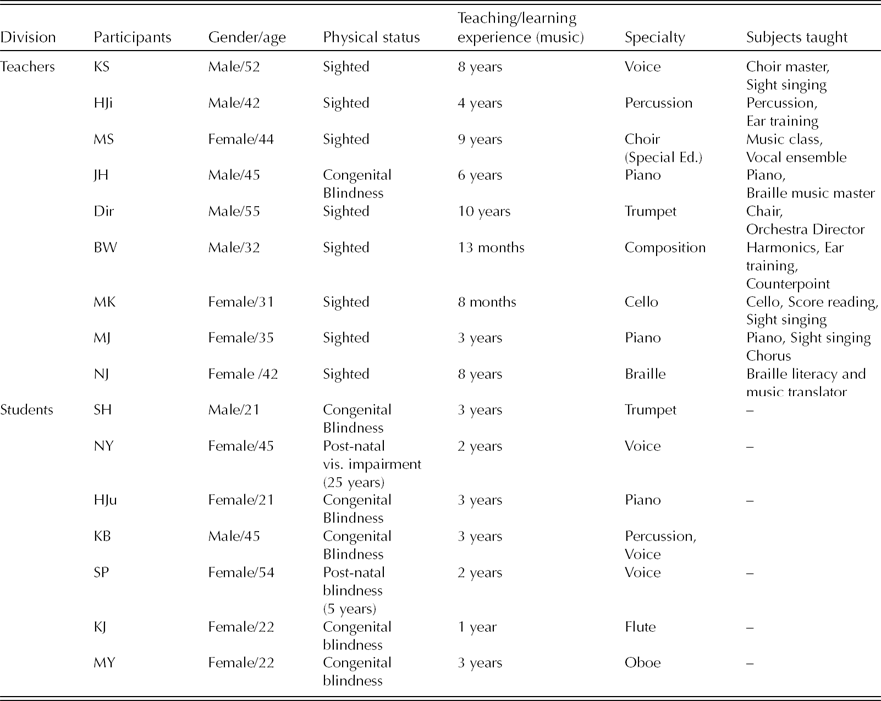
The participants in this study consisted of nine teachers and seven students in the school. The teachers provide instruction for the school's music programme and also train the music group for performances. The students were recruited from among those who were both registered in the music programme and joined the performance group. MJ, the piano teacher, is one of the co-authors of this study. Table 1 shows the profiles of the participants.
Participant profiles
Data collection
As a team project based on participant action research, the two authors collaborated with each other in planning, literature review, data-gathering and analysis, and writing of this paper. The first author, who is majoring in special education, was in charge of the literature review and the conceptual framework. The second author, who is a music teacher, was responsible for data-gathering and analysis. The second author has taught piano at the school for three years and has served as an accompanist for the music performance group. Since the second author of this paper is a teacher herself, she was able to provide detailed explanation and deep insight with regard to the use of Braille music in music education. Including the work of planning, data analysis, and the writing of this paper, the two authors met on a weekly basis over the course of eight months.
Interviews with participants were scheduled in advance with each taking about 40 minutes to administer. As a semi-structured interview, the second author asked each question one-by-one, but left the interviewing rubric often and improvised various questions depending on the participants’ responses. The major interview questions are provided in Appendices A and B for the teacher and student interviews, respectively. All interviews were recorded with a voice-recorder and then transcribed. Informed consent forms for interview subjects were presented to, signed by and collected from all of the participants.
Analysis and discussion
The significance and learnability of Braille music for MVI
In the field of music education for MVI, Braille music is considered a requisite. In fact, most music teachers and students in schools for the blind think that Braille music should be taught and learned in order to improve their interpretation and performance of music. Some of the interviewees responded with regard to the significance of Braille music, as in the following excerpts:
People believe that blind people have a keen sense of hearing and it is the only sense they resort to. But I think listening has limits. We should learn and use Braille music. (HJu, piano student)
They just sing the song, not consulting with the score or referring to the exact pitch; this makes them face considerable difficulties. (BW, composition teacher)
Mastering Braille music will make it easier to verify fuzzy and confusing notes when the music source is heard. (KJ, flute student)
Playing by ear is not accurate, to be honest. Since we cannot refer to the lyrics, score, rhythm, beat, tone, etc. [when we hear music only by ear], not everything is certain. We just listen to the music roughly and then practice. That is what I feel is unsatisfactory. (SP, voice student)
According to the above responses, consulting Braille music enables MVI to take note of the exact pitch, verify fuzzy or confusing notes, and to understand the delicate intention of the composer. In fact, referring to Braille music is a beginning point from where the MVI can start to feel, interpret and create their own music rather than mimic the consecutive running of sounds. Nonetheless, the problem is that it is difficult to learn and become accustomed to Braille music. In fact, Braille literacy itself, not to mention Braille music, is often implicated in higher levels of employment, financial security, education and greater personal independence (Eldridge, Reference ELDRIDGE1979; Stephens, Reference STEPHENS1989; Ryles, Reference RYLES2000).
According to a participant (Kim, piano teacher, sighted) in this study, there are five major reasons why Braille music is difficult to learn. The first reason is code duplicity. Braille music uses the same six-dot cell system to represent music notation for both text and arithmetic. The second is code integration. A single Braille cell can show both the name of the note and its rhythmic value. The third is the serial coding system. One reads Braille music sequentially and horizontally from left to right. To read one's part, since there is no vertical component as in print notation, the reader has to wait until the Braille coding for the next line shows up. The fourth is differential speed of reading. In decoding Braille music, the speed and comprehension of the score is highly dependent on the precedent and contextual knowledge of the reader. That is, competence in reading Braille music is not only determined by the speed of reading, but also by the reader's comprehensive knowledge of music. The fifth is polyphonic score. There are notes containing polyphonic melodies and harmonic codes in string or keyboard scores. Furthermore, the coding styles for polyphonic scores are different from one translator to another. For example, some translate both the right and left hand scores measure-by-measure while others translate the whole line of scores for the right hand and, then, for the left hand. There is no fixed rule about this, and it is the reader's job to figure out which is which. A musician's ability to comprehend Braille music is affected by the density and the complexity of the Braille music score itself.
For most MVI, due to the differences between Braille music and standard music, Braille music is considered hard to learn and cumbersome to utilise. It is hardly possible to comprehend the whole volume of a music piece by only resorting to the Braille music score. Instead, MVI usually listen to recordings or what other musicians play and then estimate what the actual scores would be like. As such, Braille music is normally used as a supplementary measure.
The learnability of Braille music remains controversial. Some argue that the rudiments of Braille music notation can be easily learned and that MVI can learn to read Braille music at about the time they have achieved reasonable competence reading Grade 2 literary Braille (Daniels & Bright, Reference DANIELS and BRIGHT1996).Footnote 2 Meanwhile, others insist that it is not that simple when it comes to the more complicated and higher level music pieces, and reading Braille music is a specialised skill that not all MVI can achieve (Crombie et al., Reference CROMBIE, DIJKSTRA, SCHUT and LINDSAY2002). The following excerpts are responses from the interviewees regarding the learnability of Braille music:
There are many difficulties. We depend on literary Braille first of all. Since the Braille system uses the same symbols for letters, musical signals, and numbers, it is always confusing which is which. (. . .) We cannot recognise Braille music until the teachers tell us it is Braille music. (SP, voice student)
The school teaches Braille music to all students; nonetheless, it takes too much time and few master it. If possible, I also want to learn this system because it's so different, hearing by ear and reading it directly [by Braille music]. (Dir, trumpet teacher)
Sighted people can become aware of their errors by referring to the score at a glance, but it is not possible to do this with Braille music. It takes time to become accustomed to it. When I make mistakes over time, I put a mark on the marginal space near the error position. (HJu, piano student)
By analysing these responses regarding the learnability of Braille music, we find that there are four major difficulties. First of all, MVI have to learn literary Braille first because Braille music is a more advanced and complicated form of embedded literary Braille. Second, it is a time-consuming and elaborate process to become accustomed to Braille music. Considering their backgrounds and lifestyles, it is not surprising that only a few MVI master Braille music. Third, for people not blind from birth, the task of learning Braille music is difficult because they find detecting tactile signs with their fingertips cumbersome. Since the Braille system uses tactile perception instead of visual perception, Braille readers must develop new skills to create smooth and even pressure when running their fingers along the words. In the beginning, regardless of whether they are sighted or blind, becoming a proficient Braille reader is incredibly difficult. Fourth, there is a difference between the sighted and the blind in terms of strategies for learning and practicing with Braille music. For MVI, when rehearsing a music piece with Braille music, receiving instant feedback by ‘watching’ the score and noticing what is wrong is not possible. They have to stop playing or handling their musical instrument and check the Braille music signs with their fingertips for every event.
In short, it is strongly recommended that MVI utilise Braille music to refer to the exact notation in order to fully understand the target music piece. Even though some believe it is necessary, learning Braille music is not an easy task for MVI. How can the drawbacks of Braille music be overcome?
Employment of Braille music: Necessary or sufficient?
Even though Braille music plays a critical role in interpreting music, MVI cannot rely entirely on Braille music because it works as a supplementary medium. To investigate the extent of the role of Braille music for the MVI, this paper analyses the routine processes of MVI in their practice of a music piece. The following routines are what the interviewees normally do when they practice a repertoire:
(1) Listen to the target music to perform either played by the principle player or original recorded media.
(2) Interpret the music by checking the Braille score to determine the overall flow of the music.
(3) Select main or theme passages and start to practice them one by one.
(4) Confirm the playing of each passage by referring to the source music to correct mistakes.
(5) Consult the Braille score to recheck the playing, especially to verify unclear parts or detailed music notation.
(6) Practice as often as possible to memorise melodic passages.
(7) Integrate melodic passages and make them flow until a satisfactory level of automaticity is achieved in playing.
These routines are depicted in Fig. 2.
Routines utilised by MVI when rehearsing a musical piece
As shown in Fig. 2, MVI do not rely on Braille music alone, but also on other strategies such as auditory, tactile and media input that are indispensable for practicing a piece of music. They listen to the target music played by other musicians (i.e. auditory input) or recordings such as an mp3 file (i.e. technical support), receive instruction from the conductor who provides a new interpretation and intuition of the music piece (i.e. language communication), and manage to get the notes and rhythms ‘under their fingers’ (i.e. physical training). They also dissect the pieces note-by-note to improve the scale accuracy and try to memorise them to achieve fluency and automaticity. Even though Braille music is a critical medium for the MVI to figure out the detailed and minute variations in music notation, it is not utilised alone in practice. That is, for the MVI Braille music is necessary but not sufficient. The question remains then, what would make Braille music useful?
Three conditions for improving the affordance of Braille music
Braille music has been dominantly employed in the field of music education for MVI because it allows non-visual access to music notation, and currently Braille music is the most popularised mediational means for blind musicians (Kersten, Reference KERSTEN1997). Nonetheless, it has some noteworthy defects. To enhance the affordance of Braille, we need to consider at least three limitations of Braille music.
First, reading Braille music notation is very tiresome and not enjoyable:
I had to figure out the score by touching and repeating every single note, which diverted my interest away from actually enjoying the music. I envy the sighted players who can try out diverse and interesting pieces of music. Such an adventurous experience could ameliorate the stress we experience while practicing. (JH, piano teacher, congenital blindness)
This interviewee is a congenitally blind professional pianist who teaches piano to MVI in the institute's orchestra. He is also the top nominated Braille music specialist who is in charge of the official exam for accrediting Braille music translators in Korea. Even for him, reading Braille music is a tiresome experience. The process of learning Braille music is long and tedious and it diminishes the MVI's passion for and interest in music.
Second, Braille music does not allow concurrent reading and performing a music piece:
For MVI, it is not possible to handle a musical instrument while reading Braille music. MVI have to use both hands to read Braille music, and then they have to grasp their musical instruments again. It isn't efficient! Another problem arises when the [sighted] teachers use a literary music score while the VI students use Braille music; they cannot be ‘on the same page’ when they are referring to a certain part of the music. We need teachers who can read Braille music or those who are specially trained for them. (MK, cello teacher)
In practicing a music repertoire, MVI have to repeat the routine of practicing a passage and checking it via Braille music by shuttling their hands between the musical instrument and the Braille notation. Furthermore, since most of the teachers are sighted and not capable of reading Braille music, teachers and students are not referring to the same textbook when they give and receive instruction.
Third, Braille music is a supplementary not a solitary channel of music input and medium of music education for MVI.
The feeling or sense of the VI is different from the sighted. Even sighted people don't know what their postures are like. In fact, it is difficult to tell even when they look at themselves in the mirror. For the violin, the VI hardly recognises what his/her posture is like; there is no other way but to touch them and physically correct their posture. Continuous checking and spontaneous correction are expected, and it is not too late to correct ill postures, whenever they are noticed. (JH, piano teacher, congenital blindness)
To increase the affordance of Braille music for the MVI, we must first understand the potential and limitations of Braille music. Even though music teachers have to utilise Braille music, they cannot rely solely upon it. There are other means and strategies of music instruction for MVI that music teachers have to consider and develop.
In the analysis of the interview data, the following three criteria emerged with regard to the affordance of Braille music: (1) adaptability (i.e. how can the MVI easily appropriate the forms and functions of Braille music as a mediational means?); (2) learnability/usability (i.e. how can the MVI learn Braille music to the level of mastery and use as wished?); and (3) availability (i.e. how can the MVI access Braille music for any music literature as often as wanted?). These three criteria of judgement – adaptability, learnability/usability and availability – are interconnected with the three aforementioned conditions of Braille music: effectiveness-mediational means, mastery and appropriation. That is, adaptability is about whether Braille music is an optimal mediational means and how it suited to the MVI's maximum appropriation of it. Learnability/usability refers to how the forms and functions of Braille music can contribute to mastery of it by MVI and its likelihood of being used. Availability refers to how sufficiently Braille music is supplied in music literature and how available it is for the MVI to achieve mastery. The relationships between the three conditions of Braille music and the judgment criteria for affordance are depicted in Fig. 3.
Conditions of Braille music and the judgement criteria for affordance
Most of the interviewees in this study voiced concerns with regard to hardships and burdens in learning and utilising Braille music. One potential reason for this is that Braille was not initially conceived for music notation (Mellor, Reference MELLOR2006). This fact calls into question the adaptability of Braille music and suggests an alternative system of music notation for MVI. The more ideal system needs to meet the qualifications for the adaptability and learnability issues.
Learning Braille music is a really challenging task for post-natally blind individuals since they have had few chances to train their haptic sense. Furthermore, even for those who have learned Braille music, reading Braille music remains difficult.
Because I became blind post-natally, I’m so slow at reading Braille music. I have never tried to feel and differentiate such minute stimuli in my life. It's really strange . . . I’m still learning [the Braille dots for] Do, Re, Mi, Pa, Sol . . . (NY, voice student)
Reading Braille music requires that your hands touch the signs. It is not possible to grasp the score ‘at a glance’ and it is difficult to quickly locate the part you are playing in the score. It takes more time to search and read the score than it does to interpret it, which exhausts the VI sooner or later. (KJ, flute student)
The fact that learning and reading Braille music is laborious implies that there should be alternatives to Braille music. As discussed in the literature review, technical support from advanced digital devices may be the future direction for musical education of the VI.
The availability of Braille music refers to how the MVI can gain easy access to Braille music literature, education and assistance (Ferati et al., Reference FERATI, MANNHEIMER and BOLCHINI2011). The interviewees mentioned that there are not enough Braille music scores for reference, nor are they systematically indexed for easy searching. Additionally, there are few institutes and programmes for Braille music training, and not many teachers and translators are trained in Braille music instruction.
There are some Braille music textbooks, but they are not organised well for students to look up what they need. And Braille music materials are not properly managed such that they are ready for use in class. Teachers have to spend a considerable amount of time to prepare these materials for use in class. (BH, composition teacher)
I hope I can practice Braille music while I’m in this programme. There are only two institutions in Korea that teach Braille music. From the perspective of the blind, if I want to continue my music career, I have to learn Braille music from the basics and master it, and I need to be accustomed to reading Braille music rather than just listening to the music. (NY, voice student)
In fact, there are only a few official Braille music translators licensed in Korea. One reason for this is that, even though it is very difficult to learn Braille music and to be licensed in Braille music instruction/translation, the salary for the profession is relatively low and there are only a few regular positions for licensed translators in Korea.
In sum, it is not enough to just urge MVI to learn and utilise Braille music. It is strongly recommended that these learners be provided Braille music that is more adaptable, learnable and available. Steps must be taken in order to make Braille music the most effective mediational means possible, to encourage MVI to achieve a level of mastery, and for the appropriation of Braille music.
Conclusion
It is indisputable that Braille music is a useful channel of communication for the MVI. Without Braille music, MVI cannot access the original music score, but instead have to rely on auditory input from played or recorded music and memorise it in order to become proficient. Since every instrumental music piece is a version of the player's own interpretation of the composer's intention, it is the job of the player to check the original score before she or he begins to practice the music piece. For MVI, Braille music is the only means of determining the detailed dynamics of music notation. Nonetheless, Braille music has some limitations to overcome before its popularisation. This paper discussed these limitations in terms of the concept of affordance.
The affordance of Braille music can be discussed in the context of three conditions: meditational means, mastery and appropriation. For Braille music to be effective, it should be a useful mediational means, easy to learn and master, and be easily accessible. Three criteria for judging the affordance of Braille music emerged from the interview data: adaptability, learnability/usability and availability. In short, Braille music should be adaptable to the physical conditions of MVI, easy to learn and master, and available whenever wanted. For instance, to improve the availability of Braille music, Braille music resources should be increased, additional professional institutions for Braille music education should be established, and more qualified Braille music teachers and translators should be educated. The affordance of Braille music will provide MVI an enjoyable experience, handy reading and easy coordination with other channels of technical help.
However, the data indicate that the current level of development, diffusion and employment of Braille music is not satisfactory in Korea. In fact, the interviews revealed that Braille music is not an optimal form for musical recognition by the visually impaired since Braille music was not originally conceived for translation of standard music, but a derivative invention from literary Braille. Consequently, learning and mastering Braille music is difficult both for the post-natally and congenitally visually impaired. We also found that MVI tend to depend more on auditory input and memorisation than on Braille music.
How can we resolve this dilemma surrounding Braille music? To promote the availability of Braille music for classroom instruction, a standardised grade level should be achieved in Braille music textbooks, Braille music reading readiness should be determined, students should be given assistance in applying Braille to their own musical compositions, active support should be provided by Braille music transcribers and educators and translators should act on behalf of the student's needs (Smaligo, Reference SMALIGO1998). In addition, to shift their reliance on memory and improve the affordance of Braille music, effective methods for Braille music instruction and additional technical support tools need to be developed. For instance, computer-based musical formats, such as MusicXML, or a scanning and converting program, such as GOODFEEL, could be used to transcribe music scores automatically to Braille music notation, which then could be transferred to an embosser for the creation of printed Braille (Bortolazzi et al., Reference BORTOLAZZI, BAPTISTE-JESSEL and BERTONI2008). MVI can also use CakeTalking for SONAR (a music editor for the blind), LIME LOUD (a Braille music code editor), or such Braille music outlets as HANSONE (a Korean embosser) or Refreshable Braille Display (Rose et al., 2004). These computerised technical aids will allow music teachers to efficiently handle music literature in a customised way for use by MVI.
Appendix A. Questionnaire for students with visual impairment

Please respond to the following questions and provide me your own experience or episodes.
1. What are the problems or difficulties in taking music lessons as the VIMP?
2. What are the problems or difficulties in performing music and career development as the VIMP?
3. What do you think were the most successful learning experiences as a VI student?
4. What do you think were the least successful or hard experiences in learning music?
5. What do you think are the potentials or merits of Braille music?
6. What do you think are the limitations or demerits of Braille music?
7. What would you suggest for the effective strategies of music instruction for the VIMP?
8. What do you think should be changed or improved in terms of the instructional support for the VIMP?
9. What do you think should be changed or improved in terms of the school environment for the VIMP?
10. Please suggest or provide me with any ideas about the music education for the VIMP.
Appendix B. Questionnaire for the teachers in the institute

1. What are the problems or difficulties in teaching music for the VIMP?
2. What do you think are the original causes of such problems of difficulties?
3. What do you think were the most successful teaching experiences as a teacher for the VI?
4. What do you think were the most effective teaching strategies for the VI?
5. What do you think is the potentials or merits of Braille music?
6. What do you think is the limitations or demerits of Braille music?
7. What would you suggest for improving music lessons for the VIMP?
8. What do you think should be improved in terms of the technical support or school environment for the VIMP?
9. What do you think the qualifications of being good music teachers for the VI?
10. Please suggest or provide me with any ideas about improving music education for the VIMP.
Hyu-Yong Park is an Associate Professor at the Department of Education, Chonbuk National University, South Korea. His major field of research includes curriculum and instruction, multicultural education and bilingual education. Currently, he is interested in studying instructional designs for diverse learners with multicultural backgrounds and in the field of special education.
Mi-Jung Kim is a Piano and the Music Education teacher at the Professional Music Programme in Hanvit Blind School in Seoul, Korea. She has been teaching piano performance and music theory in this program for four years. She is interested in developing different educational methodologies for the students’ with visual impairment, especially in practising piano.