The popularity of direct democratic instruments is growing, but the criticism that ordinary voters lack the necessary expertise and competence to make policy decisions persists tenaciously. Critics can now rely on a wide body of research documenting the low levels of political knowledge and sophistication of the general public.Footnote 1 Such a ‘minimalist’ view of ballot voters has been questioned from different perspectives, however, and the debate over citizen competence in direct democracy is far from settled.
Several open questions remain: what is the best way to conceptualize and measure citizens’ direct democratic competence? And which factors are associated with citizen competence? Since direct democracy is on the rise throughout the democratic world, answering these questions has become ever more important.Footnote 2 This study contributes to this debate in two ways. First, I suggest a conceptualization and measurement of citizen competence in direct democracy, which is based on policy-related justifications. More specifically, a justification, in this study, is an answer given ex-post by voters when asked for the reasons why they decided to vote as they did. In this definition, ‘justification’ is not directly equal to ‘reasoning’ or ‘competence’. However, by measuring the voters’ level of justification, I hope to come closer to a concept of ‘considered opinion’ and to grasp the deliberative potential of direct democratic electorates. Secondly, I present a multilevel analysis of the correlates of voters’ justification levels, based on data from thirty-four ballot decisions in Switzerland, using a unique and original dataset which contains voters’ justifications for their ballot decisions. I find, first, that most voters understand policy-related arguments – a finding which casts some doubt on minimalist assumptions. Secondly, I find that individual resources, as well as the political context, are important factors in determining voters’ competence. With regard to individual resources, I find the effect of education to be substantively small when controlling for political interest.
The article proceeds as follows: I start by discussing theoretical considerations and presenting my hypotheses. Next, I describe the conceptualization and measurement of the level of justification. Then I proceed to present the data and the empirical research design, as well as the results of the multilevel analyses. Finally, I discuss the results and point out the conclusions and limitations of the study.
Theoretical Considerations and Hypotheses
Justifications and Citizen Competence
Direct democratic instruments, such as referendums and popular initiatives, where citizens decide on policy through the ballot box, enjoy increasing popularity throughout the democratic world.Footnote 3 Not only in the United States and in Switzerland, where the use of such initiatives has continuously accelerated over the last thirty years, but also in other parts of the world, where such initiatives and referendums have more recently gained currency as political decision-making devices. The referendum on Scottish independence in 2014, the Irish referendum on gay marriage in 2015 and the current discussion about a British referendum on European Union membership are some recent examples. Correspondingly, empirical research on various aspects of direct democracy is becoming more important in order to understand its functioning.
Admittedly, direct democracy has always been criticized. Probably the most prominent criticism is that voters are not competent to take policy decisions. As Magleby put it:Footnote 4
The majority of ballot measures are decided by voters who cannot comprehend the printed description, who have only heard about the measure from a single source, and who are ignorant about the measure except at the highly emotional level of television advertising … . The absence of straightforward, understandable, rational argumentation in initiative campaigns, combined with what has been discovered about voting decision making in these situations, raises serious questions about the integrity of the direct legislation process.
Indeed empirical studies on voters’ knowledge throughout the last century, mainly based on American data, have repeatedly shown exceedingly low levels of political knowledge.Footnote 5 Consequently, ‘minimalism’, that is to say, the image of a politically ignorant citizenry, was for a long time the predominant account of public opinion – a worrying perspective with regard to direct democratic decision making. Footnote 6 However, there are at least three objections to the minimalist criticism of citizen participation.
First, ‘low information rationality’ allows citizens to make reasonable political decisions in an efficient way by using information shortcuts, such as following the positions of parties and other elite actors.Footnote 7 This research introduces a more optimistic perspective, concluding that voters use the incomplete information they have at hand to reach informed decisions efficiently.
Secondly, there is increasing evidence for the positive effect of citizens’ direct participation on various measures of political sophistication and civic engagement, such as voter turnout,Footnote 8 internal and external efficacy,Footnote 9 as well as political knowledge and interest.Footnote 10 These studies reverse the logic of the minimalist critics and put forward the hypothesis that citizens become more politically competent once they are given the opportunity to participate in political decisions.
Thirdly, the measures that are commonly used to assess political sophistication are not necessarily the most appropriate measures of voter competence in direct democracy. Surveys usually ask respondents factual political-knowledge questions on generic aspects of national politics, such as the names of certain officeholders.Footnote 11 Whether such questions constitute an appropriate measure of citizen competence has been debated.Footnote 12 Possible alternatives are to employ issue-specificFootnote 13 or local-levelFootnote 14 knowledge questions in survey research. As Gilens points out, ‘most of the political facts in typical information scales are unlikely to contribute directly to such judgments as vote choice or policy preferences’.Footnote 15 This finding is particularly relevant for direct democracy, where citizens’ preferences are directly turned into policy decisions.
Here, I propose to consider the capacity to justify political decisions with policy-related arguments as a possible conceptualization of citizen competence in direct democracy. This approach comes closer to a concept of considered opinion or enlightened understanding. Footnote 16 Holding considered opinions in this sense means engaging in deliberative thinking on different aspects of a topic, considering dissenting arguments, and grounding one’s own opinions on arguments and justifications.Footnote 17
Why are well-justified opinions a better indicator of citizen competence in direct democracy than general political knowledge? First of all, such a measure captures more accurately what citizens know about the proposition at hand. As has been previously shown, general and policy-specific knowledge are not necessarily correlated in every case.Footnote 18 There may be voters with a high level of general political knowledge, who simply failed to inform themselves properly on a specific proposition. For the democratic quality of the vote, this is much more problematic than having voters who can justify their position on the vote, but fail to name the members of the cabinet. As Gilens puts it: ‘much of what separates actual political preferences from hypothetical “enlightened preferences” is due to ignorance of specific policy-relevant facts, not a lack of general political knowledge or the cognitive skills or orientations that measures of general political information reflect’.Footnote 19 Furthermore, he shows that policy-specific knowledge is more likely to affect citizens’ preferences and to influence how citizens vote than general political knowledge.
Finally, the ability to justify political decisions is key for the legitimacy of these decisions. This is true in particular from the perspective of deliberative models of democracy, which have traditionally placed a high value on justifications. Deliberative theorists have always criticized direct democratic procedures for lacking a need for justification and exchange of arguments.Footnote 20 Thompson defines ‘mutual justification’ or the ability to explain one’s opinion with reference to certain reasons, as ‘the primary conceptual criterion for legitimacy, and the most important distinguishing characteristic of deliberation’.Footnote 21 Naturally, measuring individual voters’ justification levels does not say anything about the amount of actual deliberative political talk going on in public. And, what is more, we ought to be aware of the possibility that reasons may be post-hoc rationalizations of predetermined preferences, and not necessarily their causes.Footnote 22 I argue, however, that measuring the capacity to give reasons captures at least the ‘deliberative potential’ present in the electorate.Footnote 23 Voters equipped with good arguments are potentially capable of engaging ‘in high-quality deliberation with effect’.Footnote 24
Individual Resources and the Decision Context
In examining the predictors of voters’ justification levels, I start from the ability–motivation–opportunity framework. In their classic work on political knowledge, Delli Carpini and Keeter have pointed to three factors correlated to knowledge: ability (the possession of appropriate cognitive skills), motivation (the desire to learn) and opportunity (the availability of information and its presentation).Footnote 25 While ability and motivation operate at the individual level, opportunity is determined by the context in which the decision takes place: that is the elite, the institutional setting and the information environment. A similar framework has since been employed by many studies,Footnote 26 and has been shown to apply also to the direct democratic setting.Footnote 27
Individual Level – Ability and Motivation
Characteristics of the individual have traditionally been treated as the best predictors of political knowledge. With regard to ability, education is the standard variable employed to predict political knowledge. Delli Carpini and Keeter found education to be the strongest single predictor of political knowledge, as have many other studies.Footnote 28 Following these findings, I expect that education will have a positive relationship with voters’ justification level (Hypothesis 1a). While higher education levels are expected to enhance citizens’ capacity to understand and process political information, political interest is assumed to support their motivation to do so. Thus, political interest is used as a proxy for motivation. The motivational aspect of political competence has been overlooked for a long time. Recently though, Lavine, Johnston and Steenbergen convincingly showed that motivation is key for considered political judgement.Footnote 29 Therefore, I expect political interest to have a positive relationship with a voter’s justification level (Hypothesis 1b).
Context Level – Opportunity
Besides the internal psychological attributes of the voters, it is important to consider external factors structuring the decision task. Here I focus on two context-level factors which have been found to predict political sophistication. First, the information environment to which citizens are exposed matters.Footnote 30 I expect more intensive referendum campaigns to be positively related with higher justification levels (Hypothesis 2a). Secondly, the complexity of the issue is expected to play a role.Footnote 31 More complex issues may restrict the average citizen’s possibility to inform herself thoroughly. Thus I expect a negative relationship between issue complexity and justification levels (Hypothesis 2b).
Finally, there might be cross-level interactions between these variables. In particular, the disadvantages in individual resources might be compensated to a certain extent by intensive campaigns, which enable even the least educated and the least motivated to acquire arguments. Considering this possibility, I expect a negative cross-level interaction between political interest and campaign intensity (Hypothesis 3a) and another negative cross-level interaction between campaign intensity and education (Hypothesis 3b). In other words, with more intensive campaigns, I expect the association between individual-level resources and justification levels to be weaker.
Research Design, Data and Measurement
Data
The present study is based on a combination of two datasets.Footnote 32 At the individual level, I rely on a dataset collected from cross-sectional post-ballot surveysFootnote 33 conducted within one week after federal-level popular votes in Switzerland using computer-assisted telephone interviewing.Footnote 34 The surveys are based on representative samples of Swiss citizens which are drawn through stratified random sampling from the population of all Swiss citizens (eligible to vote). The samples are representative of the Swiss citizen population in all relevant socio-demographic respects, except for the participation rate, which is higher than actual average turnout (61.6 per cent v. 44.4 per cent). In the present study, however, I analyse only the data of respondents who participated in the vote. The reason is that these are the people who eventually decide over policy propositions, and furthermore only these respondents are asked to justify their vote decision in the survey.
The dataset is unique and interesting, because it contains data on voters’ justifications for all thirty-four federal-level votes which took place between 2008 and 2012, covering all relevant policy domains. It also contains information on all individual-level variables employed in the study. More specifically, it contains two types of data: first, respondent-related data, mainly on socio-demographic variables and general political predispositions. Secondly, proposition-related data, such as acceptance v. rejection of the proposition, perceived difficulty of the decision and – most importantly – an open-ended question asking the respondents to justify their vote decision. The unit of analysis thus constitutes a response given by a respondent on a specific proposition. The individual-level dataset contains 26,621 observations on thirty-four votes. Finally, for the purpose of a multilevel-analysis, this individual-level dataset is combined with a second, context-level dataset, containing information on the form of the vote (referendum/initiative), as well as the elite- and campaign-related variables.
Measures
Dependent variable: level of justification (LOJ)
This study’s main outcome variable is a voters’ justification level with regard to a specific proposition. It is based on a quantitative content analysis of an open-ended survey question, which asks respondents for the two most important reasons of their vote decision. This question is posed only to the respondents who participated in the vote. The question is phrased as follows: ‘Which are your main reasons for accepting/rejecting the proposal XY?’Footnote 35
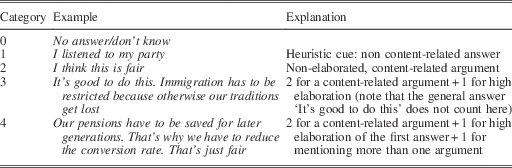
A respondent’s Level of justification (LOJ) for a specific proposition consists of three components which build upon each other, stepwise. The first component of the LOJ-index is the content of the answer. I draw a threefold distinction between non-answers, heuristic cues, and content-related arguments.Footnote 36 A content-related answer contains an argument referring to the issue at stake, while a heuristic cue is defined as an answer not referring to the content of the vote.Footnote 37 Therefore, non-answers are scored 0, cues and heuristics are scored 1, and arguments are scored 2. If a respondent gave more than one justification, the one belonging to the highest category counts.
In a second step, the elaboration rating (0 or 1) is added. If a respondent mentions one or more content-related arguments, at least one of these has to be well elaborated in order to be rated as 1. When the answer contains at least one reason as to why X should be done or not, the score is1. When the speaker only says that X should or should not be done (simple claim), but no reason is given, the score is 0.Footnote 38 This elaboration rating is adopted from Steiner et al.’s Discourse Quality Index, which also contains a component capturing the ‘level of justification’.Footnote 39
In a third step, I assign 1 to respondents mentioning more than one content-related argument and 0 to all other respondents. The two arguments have to be clearly distinct, mentioning the same argument twice, in other words, does not count, nor does mentioning an additional heuristic cue. This component tries to capture the complexity of the justification.
In total, a scale ranging from 0 (for someone who mentions only a non-answer) to 4 (for someone who mentions at least two different arguments and at least one of them is well elaborated). Table 1 shows examples. I treat this scale as ordinal because, from a theoretical point of view – in particular taking the perspective of deliberative democracy – a policy-related argument is more desirable than a heuristic cue, while providing no answer at all is the least desirable. Furthermore, policy-related arguments which provide reasons are ‘better’ than simple claims.Footnote 40 Finally, having considered at least two distinct arguments is ‘better’ than only one single argument.Footnote 41
Coding Examples for Level of Justification

Coding reliability
Intercoder-agreement was established by randomly choosing 100 examples of open-ended answers from ten different propositions. These 100 answers were separately coded by the author and by an independent second rater, who had been trained to be familiar with the coding procedure. I report Cohen’s Kappa (κ), which is the most widely used statistical measure of intercoder agreement. The agreement between coders reaches 83 per cent (κ=0.801), which is classified as almost perfect agreement.
Independent Variables: Individual Level
Education
To measure education, following previous studies in the Swiss context,Footnote 42 I use a dummy variable separating below-secondary level from secondary-level and higher educational attainment.
Political interest
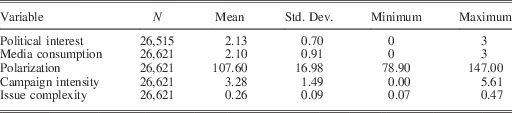
Political interest is measured by the standard question: ‘In general, how interested are you in politics’, with answers ranging from 0 (not at all interested) to 3 (very interested). Tables A1 and A2 in the online appendix provide summary statistics for the variables of interest.
Independent Variables: Context Level – Characteristics of the Issue
Elite polarization
Before popular votes take place, the major parties publish their position on the proposition. From these positions the ‘ballot vote coalitions’ are inferred. The degree of polarization of a given ballot proposition is calculated as: 100 per cent minus [50 minus the vote share in the last national election of the party coalition, which won the popular vote]. The assumption here is that, if the vote share of the ‘winning ballot coalition’ is around 50 per cent, the polarization of the elite is highest, while with very broad or very small winning coalitions polarization is lower. High values on this measure thus represent high elite polarization on an issue.
Campaign intensity
The intensity of the campaign preceding the popular vote is measured by a systematic analysis of the advertisements in six Swiss newspapers during the four weeks preceding the vote.Footnote 43 The sample contained four quality papers, and nine tabloid papers, both from the German-speaking and the French-speaking part of the country. Since the distribution of this indicator is skewed at the upper end, I use the logarithm of the total number of advertisements for the analysis, which is more normally distributed.
Issue complexity
The indicator for issue complexity is drawn from a question asking respondents how difficult it was for them to get an idea of what the outcome of the vote would mean for them personally. Answers ranged from 0 (not at all difficult) to 3 (very difficult). Following previous studies using Swiss Vox-data,Footnote 44 I used the share of respondents who answered ‘difficult’ or ‘very difficult’ as an aggregate measure. The higher this share, the more complex an issue was deemed to be. Note that this question was asked also to non-participants, the aggregate complexity-measure thus includes also non-voters’ assessment of complexity. This helps to avoid endogeneity in the estimation of LOJ.
Furthermore, I include a set of standard control variables commonly used in studies on direct democracy.Footnote 45 First, at the individual level, I include whether a respondent accepts a proposition or rejects it (and thus votes for the status quo). In addition, I include age, gender, language (German vs. non-German), media use (number of different media used during the campaign). At the issue level, I control for the form of the vote (initiative, optional referendum, mandatory referendum), as well as for the policy domain.
Empirical Results: Multilevel Analysis
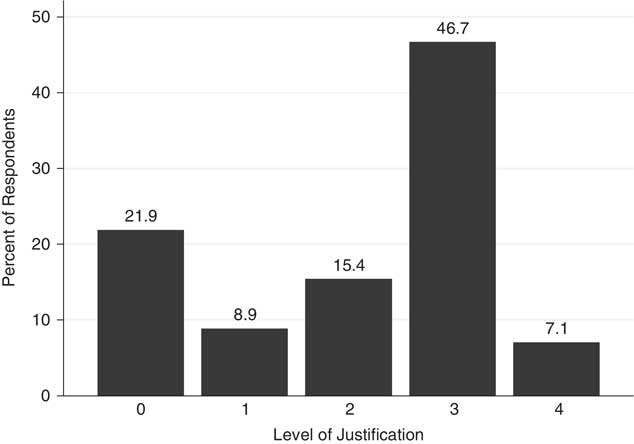
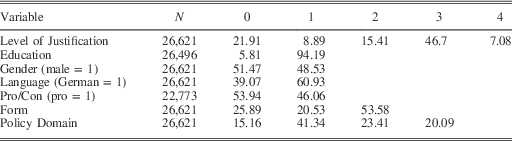
Before the presentation of the results of the multilevel analysis, it is instructive to look at the distribution of the levels of justification in the sample. Figure 1 shows the percentage of respondents for every category of LOJ. A substantial proportion of respondents cannot provide any answer (21.9 per cent), while another 8.9 per cent mention justifications which do not relate to the content of the proposition. Nevertheless, this leaves us with 70 per cent of the voters able to provide a content-related justification for their vote decision. Among these latter respondents, 15.4 per cent gave a single but not well-elaborated answer, while another 46.7 per cent provided more complex answers, either elaborating their claim with reasons or naming more than one argument. Finally, the voters giving a highly-elaborated answer which at the same time contained more than one argument make up a minority of only 7.1 per cent.
Distribution of LOJ over the sample of respondents: higher numbers mean higher levels of justification

Determinants of the Level of Justification
The unit of analysis is a person’s level of justification (LOJ) for a certain proposition. While individuals differ in the quality of their justifications, it is important to note that different propositions might also be more or less difficult to justify. To the extent that different respondents justify their decision for a particular proposition in a similar way, there is clustering at the proposition level. In order to account for this complex data structure, two-level models are used. In these models, the level of justification y for a given person and a given proposition j is represented as a function of individual-level and proposition-level characteristics.
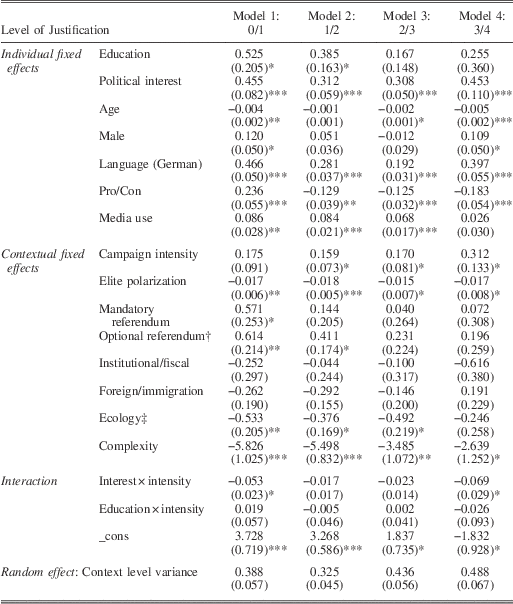
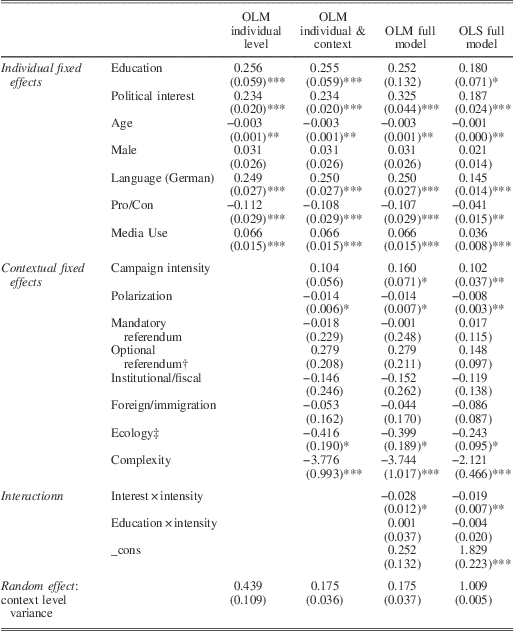
In addition to this complex data structure, I need to account for the ordinal nature of my dependent variable, which violates the assumptions underlying standard regression procedures. In order to satisfy the ordinal character of the dependent variable, I calculated a series of binary logistic regressions with random-intercept for every category of LOJ (calculated with xtlogit in STATA), i.e. estimating the effects of the covariates at the four thresholds of LOJ. For this purpose, I collapsed the sample into a binary variable at every cut-off point of the LOJ scale (Models 1–4 in Table 2). This analysis strategy exploits the ranking information of the dependent variable and, at the same time, it accounts for the clustering of the data at the proposition level. It allows me to introduce covariates on the individual as well as on the context level of the proposition. In addition, the models contain two cross-level interaction terms. The results can be interpreted as follows: at every threshold of LOJ, positive coefficients indicate that the probability of having a higher level of justification increases.Footnote 46
Binary Logit Regression Results

Note: Cells report logit coefficients and standard errors in parentheses; *p<0.05; **p<0.01; ***p<0.001.
Binary logit models of the single thresholds of LOJ (calculated with xtlogit). For creating the dependent variables, the sample was collapsed into the four different thresholds of LOJ. N=22,597 in each model.
† Reference category for form of vote: popular initiatives.
‡ Reference category for policy domain: social/cultural issues.
Let us first look at the similarities between the four models. For the most part, the estimation results for the four threshold models show the expected statistically significant effects of the main explanatory variables at the individual as well as at the context level. The only exceptions are education and campaign intensity, which affect the different thresholds differently and will be discussed below. At the individual level, as stated in Hypothesis 1b regarding the individual-level determinants of citizen competence, more politically interested voters provide better justifications.
At the context level, elite polarization has a negative, statistically significant effect on LOJ, meaning that, for votes with a more polarized elite, voters’ arguments are less sophisticated. Furthermore, Hypothesis 2b is confirmed as well, with more complex issues being associated with lower LOJ.
The effects of education, campaign intensity, and complexity vary along the ordinal scale. The effect of education decreases for higher LOJ, as does the effect of complexity. Comparing the lowest (0/1) threshold with the highest (3/4) one, the coefficient of education decreases by half and loses statistical significance, only partly confirming Hypothesis 1a. This means that education is relevant mainly in determining the step from not having a meaningful answer at all to having at least some answer to justify one’s vote decision, but much less in determining differences between highly elaborated and complex answers. Similarly, the coefficient of complexity, though still statistically significant, is less than half as large for the highest threshold as for the lowest one.
While education and complexity are more strongly associated with the lower thresholds, the opposite goes for campaign intensity. The effect of campaign intensity almost doubles for the highest threshold (3/4) as compared to the three lower ones, controlling for all other variables. This partly confirms Hypothesis 2a. Thus intense campaigns mainly make a difference for the highest levels of justification. The threshold between category 3 and 4 differentiates between those content-related answers which are well-elaborated or contain more than one argument and those answers which are well-elaborated and at the same time contain more than one argument. This suggests that media campaigns are important mainly in providing citizens with more than the basic information on a proposition. In sum, low levels of education, as well as complex initiatives, appear to constitute a sort of ‘entrance barrier’ to justifying political decisions in a meaningful way. Media campaigns, by contrast, are most important when it comes to highly elaborated and complex justifications.
Finally, in order to check Hypotheses 3a and 3b we need to look at the interaction effects. The hypotheses suggested that intensive media campaigns might substitute for the lack of either education or political interest at the individual level. In fact, there is a significant negative interaction of campaign intensity and political interest at the lowest and at the highest threshold, thus confirming Hypothesis 3a at least in part. The interaction of education with campaign intensity is not statistically significant in contrast. This means that intensive campaigns reduce the effect of political interest on justification levels for the lowest and the highest levels of justification.
Some of the control variables also show statistically significant associations with LOJ. People who consume more media during the campaign have higher justification levels. Furthermore, contra-voters, who reject some new proposed legislation, are better at justifying their position than pro voters. The differences are substantively small, however. Language is the control variable which shows the strongest association with LOJ, with German speakers providing significantly better justifications. This might have to do with differences in the media of the different language regions.
In addition, as Stadelmann-Steffen and Vatter have noticed, in the Swiss context the language indicator captures a variety of cultural, political and societal-structural aspects, which are difficult to disentangle.Footnote 47 When looking at the context level control variables, voters are more competent with optional referendums as compared to popular initiatives and they are less competent with ecological issues as compared to social-cultural issues. Overall, the regression thus seems reliable, and the dependent variable obviously captures more than just random differences in citizens’ justification levels.
Substantively, individual-level as well as context-level variables have a significant impact. Looking at the substantive effects (rather than the statistical coefficients), this means, for example, that a person with higher education is 4.8 per cent more likely to show a higher level of LOJ than a person with below-secondary education. This is true for every level of LOJ.Footnote 48 This is a surprisingly small effect given that education has traditionally been treated as the principal determinant of political knowledge. In contrast, the total shift in the probability of showing a higher LOJ attributed to political interest is approximately 10.6 per cent, which is substantive. This means that a highly interested person is almost 11 per cent more likely to provide better justifications than a person not interested in politics.
On the context level, the average probability of showing a higher LOJ increases by 20.9 per cent if we compare the least polarized with the most polarized issue and by 14.8 per cent if we compare the least intensive with the most intensive campaign. If we look at issue complexity, the probability of higher levels of LOJ increases even by 25 per cent from the most complex to the least complex issue.
Low versus High-Complexity Issues
Issue complexity appears to be the strongest single determinant of LOJ. Therefore, it is interesting to take a closer look at this relationship between issue complexity and justification levels. Generally, regarding the type of topics, issues which are ‘closer’ to people’s everyday life are judged to be less complex (see online appendix Table O–1).
Among the least complex issues are an initiative to ban the construction of minarets; an initiative demanding six weeks of regular holidays (instead of five); a vote on support for youth musical education; as well as an initiative to introduce a cantonal animal protection lawyer. The most complex issues, in contrast, include a vote on the constitutional act ‘for quality and economic efficiency of health insurance policy’; a referendum on the renunciation of introducing a ‘general popular initiative’; a vote on creating a special public fund in support of air traffic; as well as an initiative to restrict private associations’ rights of public appeal.
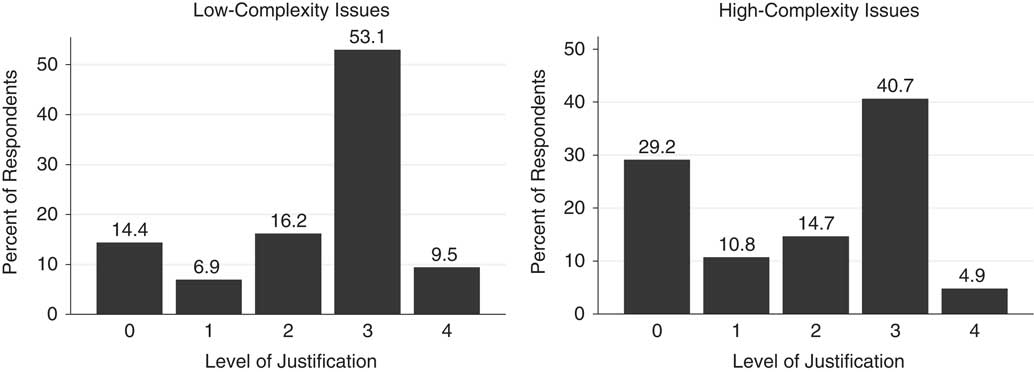
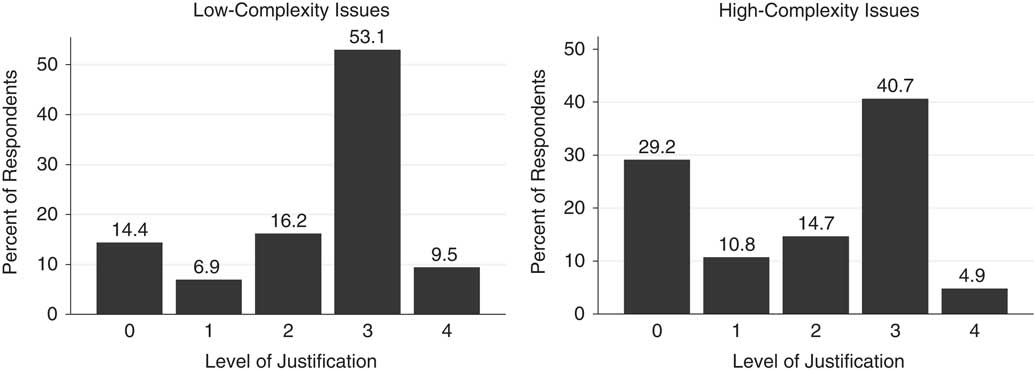
Figure 2 displays the distribution of LOJ separately for high- and for low-complexity issues (where the median issue complexity provides the division between the two groups). The most striking difference is found in the lowest category: the number of respondents not providing any justification almost doubles when it comes to complex issues as compared to easy issues. This confirms the result reported in the previous section of complexity as an ‘entrance barrier’ to argument in direct democracy. Furthermore, with regard to the covariates, campaign intensity is more strongly associated with justification levels for low-complexity issues (see Tables O–2 and O–3 in the online appendix for details). Thus, people seem to be better able to learn arguments through the campaign for easy than for difficult issues. Elite polarization, in contrast, has a stronger effect for high-complexity issues. This is probably because, when an issue is complex, people tend to rely more on their party’s position, as postulated by low-information rationality.
Distribution of LOJ shown separately for low-complexity issues (left-hand panel) and high-complexity issues (right-hand panel) Note: The issues were split at the median of the complexity distribution.
Discussion
This article began with the question ‘What is a competent citizen in a direct democracy?’ A competent citizen was defined as one who holds well-justified opinions. The analysis of citizens’ levels of justification yielded three main results. First, almost 70 per cent of the respondents justified their decision with reference to substantive, content-related arguments. Is this number high or low? Earlier studies in the context of Swiss direct democracy have come to similar conclusions, classifying about 70 per cent of the voters as medium or highly competent.Footnote 49 Compared to studies on citizens’ knowledge in the American context, the result seems rather optimistic, however. Converse classified about 85 per cent of his respondents (in the context of candidate elections) as holding no meaningful policy-related opinions.Footnote 50 Delli Carpini and Keeter found in a comprehensive study, reviewing over 2,000 political knowledge questions, that on average only four in ten of these questions were answered correctly by more than 50 per cent of those surveyed.Footnote 51 More recently, Somin, analysing data from the 2000 US National Election Study, classified one third of the voters as ‘know-nothings’, who possessed little or no political knowledge.Footnote 52
This first result suggests that arguments play an important role in the vote choices of Swiss citizens in direct democratic decisions. Citizens, at least in the context studied here, seem not to be so minimalist after all. In this opinion I echo Kriesi, who found arguments to be the main determinants of direct democratic vote choices in Switzerland.Footnote 53 This finding casts a positive light on the deliberative potential of the citizenry in Swiss direct democracy. Naturally, this study does not measure the deliberation going on between citizens, but at least it confirms that most citizens have arguments available to them if they wish to engage in such a deliberation.
As Hirschman and also Frey fittingly pointed out some years ago, holding opinions which are formed in an autonomous manner, based on arguments, is a public good and an important element of well-being – in particular in a direct democratic context.Footnote 54 This is well in line with recent findings about direct democracy in the United States. An experimental study by Boudreau and MacKenzie in the context of Californian direct democracy, for example, found that citizens shift their opinions away from their party’s positions ‘when policy information provides a compelling reason for doing so’.Footnote 55
A second main result concerns the individual-level effects of ability and motivation. For our policy-specific measure of citizen competence, education is less relevant than earlier studies had suggested.Footnote 56 This finding fits well with the study by Barabas et al., which analysed the effect of education on different types of knowledge questions and found that education was mainly associated with general political knowledge, and much less with policy-specific information.Footnote 57 Lavine, Johnston and Steenbergen, in their comprehensive study on ambivalence and citizen competence, have shown more generally that: ‘Contrary to conventional wisdom, poor citizen performance is not inextricably linked to a lack of formal education or political knowledge. In fact the results quite clearly indicate that cognitive capability is not the primary problem. Instead, what is at issue is motivation.’Footnote 58
However, if we look more closely at the differential effects of education, we see that it seems to represent a sort of ‘entrance barrier’ to argumentative discourse in direct democracy. This suggests that low education might prevent people from acquiring arguments in the first place. And indeed it has always been a major concern of critics of deliberative democracy that some citizens lack the necessary resources to take part in a deliberative discourse and are thus excluded from this form of democratic decision-making.Footnote 59 This concern is accentuated if we add issue complexity to the picture. With complex issues, many people are not able to provide any arguments at all.Footnote 60
Finally, the decision context – that is the opportunity factor – proves to be important. First, regarding issue complexity, meaningful deliberation is more likely to take place over easy issues which are close to people’s everyday life. Secondly, a polarized issue, where the elite actors disagree and split into two factions of comparable size, appears to decrease the quality of public discussion and the ability of voters to justify their position as compared to an issue on which most parties agree. This confirms the finding from deliberation research within parliamentary debates that polarized elites hamper high-quality deliberation.Footnote 61 For the public’s level of justification, a polarized elite seems to be detrimental as well.
Furthermore, intense campaigns enhance justification levels, as expected. Intense campaigns can even substitute to a certain extent for the lack of motivation as we learn from the negative interaction between these two factors. However, if we again look more closely at the threshold effects, we find that media coverage is not the engine that ‘lifts’ citizens into the debate. Rather, intensive campaigns are associated with changes in higher levels of justification. This means that citizens can learn more sophisticated arguments in the debate but intensive campaigns alone do not help them to enter the debate in the first place.
One limitation of the present data is that it cannot answer the question whether arguments really change minds or simply serve as post-hoc rationalizations. Following the work of Zajonc, we know that ‘preferences need no inferences’, or in other words that individuals can hold preferences without prior cognitions.Footnote 62 From the perspective of motivated reasoning theory, one could argue that all arguments are nothing other than subsequent rationalizations of intuitively acquired opinions and therefore do not matter in decision making.Footnote 63 In fact, this line of reasoning has been advanced in several recent contributions to political psychology.Footnote 64 However, first, this perspective is contested, and, secondly, certainly from the perspective of deliberative democracy, it is essential that citizens are able to justify their vote decisions in direct democracy. Only citizens who possess arguments can engage in a deliberative debate in the first place.
As to further limitations of the present study, first, the results are based on observational data and, therefore, causal claims are difficult to make. Nevertheless, observing associations between variables while controlling for relevant covariates allows us to gain valuable insights into the relationships between individual- and context-characteristics and citizen competence. In particular, this is so because the analysis uses a unique and extensive dataset containing voters’ justifications over representative samples of Swiss citizens for as many as thirty-four popular votes, covering all relevant policy domains.
Another concern is the generalizability of the results beyond the Swiss context. I argue, following Kriesi, that Switzerland should be considered as a ‘laboratory of direct democracy’.Footnote 65 Of course, in other countries, the institutional as well as the individual-level factors may change, though not necessarily the basic mechanisms of opinion formation and voting. In any case, the Swiss data provides a starting point for further comparative analysis. Finally, it would have been desirable to have a better measure for issue complexity, particularly because this proved to be the strongest predictor of LOJ. However, for lack of alternative measures and following previous studies, I decided to use the complexity measure that is based on voters’ self-reported decision-making difficulty.Footnote 66 The results concerning the strong effect of issue complexity, though intuitively plausible, should therefore be treated with some caution.
Conclusion
In sum, while citizens dispose of substantive arguments which allow them to hold considered opinions, the elite plays a key role in sending signals and informing the public in direct democratic votes. In direct democracy, citizens are only as competent or incompetent as is their elite. If we worry about incompetent citizens taking policy decisions, we should worry just as much about the competence of the elite to lead the public discussion. In this respect, direct democracy does not differ as much from representative forms of democracy as is often assumed. The results also resonate with a recent American field-experiment, which shows that the motivation to deliberate combined with an opportunity to do so are crucial for citizens’ willingness to become informed about politics.Footnote 67
This study makes several contributions. First, I propose a measure of citizen competence in direct democracy, which is based on citizens’ ability to justify their decision with policy-related arguments. This measure gives a clearer and more valid picture of citizens’ practical democratic competence than general factual measures of political knowledge. By analysing citizens’ justification levels in Swiss direct democracy, I find that voters are surprisingly well able to provide policy-related arguments for their decisions. This should be of interest to scholars who want to test empirically the premises of deliberative and direct democracy theory. This study finds that a deliberative discourse can take place between citizens during direct democratic campaigns. To what extent citizens eventually confront their views and exchange arguments in a deliberative manner is a different question, which remains to be tested. One essential prerequisite for such deliberation has been shown to have been fulfilled, however.
This emphasis on the importance of arguments somewhat contradicts one current strand of research in political psychology which depicts voters as unaware, led by unconscious, evolutionary inherited intuitions and manipulated by cues from elite figures.Footnote 68 Lining up with some more optimistic findings on voter competence and reasoning,Footnote 69 I conclude with the claim that the role of policy information and arguments in the formation of citizens’ political opinions requires more scholarly attention in future research.
APPENDIX
Summary Statistics: Continuous Variables

Summary Statistics: Categorical Variables

Coefficients for Random-Intercept Logit Regression Models