On February 26, 2014, comedian Seth Rogen shared before a US Senate Appropriations subcommittee a personal story about living with a family member who had been diagnosed with Alzheimer’s disease. After his testimony, Rogen took to Twitter to shame absent subcommittee members: “Not sure why only two senators were at the hearing. Very symbolic of how the Government views Alzheimer’s. Seems to be a low priority” (Rogen Reference Rogen2014).
Mr. Rogen had reason to be surprised. Scholars, journalists, and political insiders agree that celebrity activists exercise political influence because they have special access to Members of Congress (MCs); and they use their influence to focus legislator attention on their pet issues, thereby turning ordinary events like congressional hearings into high-profile affairs (Busby Reference Busby2007; Demaine Reference Demaine2009; Drezner Reference Drezner2007; Heitshusen Reference Heitshusen2012; Larkin Reference Larkin2009; Marsh, ‘t Hart, and Tindall Reference Marsh, Hart and Tindall2010; Meyer and Gamson Reference Meyer and Gamson1995; Strine Reference Strine2004; Warren Reference Warren1986; West and Orman Reference West and Orman2003). Consistent with this conventional wisdom, MSNBC’s Chris Matthews asked Rogen: “You are a movie star. Usually the senators at least show up when the cameras are there. Why weren’t they there?” (Matthews Reference Matthews2014).
Does Seth Rogen—an actor famous for his roles in “stoner” films—lack the gravitas and political appeal required to draw a crowd of senators? Or, perhaps, the conventional wisdom is inaccurate and the paltry attendance for Rogen’s testimony is in line with the typical senatorial response to celebrities on Capitol Hill? This article argues against the conventional wisdom and instead posits that MCs lack incentives to listen to celebrity testimony. Drawing on an original dataset of hearing participation, we found that a typical celebrity witness does not increase member attendance at committee hearings. Consequently, our data suggest that advocacy organizations seeking congressional attention would be better served by adhering to the regular practice of scheduling expert witnesses.
Does Seth Rogen—an actor famous for his roles in “stoner” films—lack the gravitas and political appeal required to draw a crowd of senators? Or, perhaps, the conventional wisdom is inaccurate and the paltry attendance for Rogen’s testimony is in line with the typical senatorial response to celebrities on Capitol Hill?
CELEBRITY WITNESSES AND CONGRESSIONAL BEHAVIOR
Committee chairs run the hearing process: they select hearing topics, allocate time, and shape witness lists. Witnesses consist of government officials, academics, interest-group representatives, and celebrities who have expert knowledge or strong communication skills (Leyden Reference Leyden1995). Footnote 1 At a hearing, witnesses help to build a public record on an issue by reading a prepared statement and engaging in discussion with committee members. Congressional scholars report that hearings are an important venue for exerting political influence because they draw media attention to and shape how issues are addressed at the bill-writing stage (Jones, Baumgartner, and Talbert Reference Jones, Baumgartner and Talbert1993). Thus, hearings are an excellent venue for empirically evaluating celebrity influence over politics.
Why would an MC be more likely to attend a hearing featuring a celebrity? Actor Christopher Reeve posited: “[we] have access to politicians who, in fact, need us for their own recognizability” (Bernstein Reference Bernstein1991). Reeve’s argument is consistent with political science theory regarding the motives and incentives of MCs. Politicians seek opportunities to communicate with the public; in political circles, it is widely presumed that interaction with celebrities can increase a politician’s profile (Strine Reference Strine2004; Warren Reference Warren1986; West and Orman Reference West and Orman2003). In particular, MCs could exploit celebrity-fueled media coverage to advertise their names (Mayhew Reference Mayhew1974), explain their Washington activities (Fenno Reference Fenno1978), and reach politically disengaged constituents.
Yet, MCs are busy people. With dozens of daily hearings, an MC often is scheduled to attend multiple hearings simultaneously—even before accounting for other meetings, receptions, and visiting delegations (Price Reference Price2004). For instance, when Seth Rogen tweeted missing subcommittee member Mark Kirk that “it hurts the cause to see that many empty seats,” the senator responded that his absence was due to a meeting with Jim Lovell to discuss veterans’ health care.
Furthermore, congressional scholars argue that MCs care about policy (Fenno Reference Fenno1973) and committees hold hearings to acquire policy expertise—that is, to learn about a policy problem and assess the political consequences of alternative courses of action (Diermeier and Feddersen Reference Diermeier and Feddersen2000; Gilligan and Krehbiel Reference Gilligan and Krehbiel1990; Talbert, Jones, and Baumgartner Reference Talbert, Jones and Baumgartner1995). Footnote 2 Because celebrities do not command much substantive knowledge (in perception if not reality), MCs discount the policy-making value of celebrity testimony compared to that of other expert witnesses (Strine Reference Strine2004).
If congressional scholars are correct, then why is it common to assume that “legislators’ attendance at hearings involving celebrity entertainer witnesses is substantially higher than usual” (Demaine Reference Demaine2009, 98)? We suspect that the conventional wisdom is due to media-coverage patterns and the incentives that shape political narratives in the media. To attract a large audience, journalists favor political events with entertainment value—those featuring dogs, celebrities, scandals, and negativity (Atkinson, Deam, and Uscinski Reference Atkinson, Deam and Uscinski2014; Dagnes Reference Dagnes2011; Zaller Reference Zaller2005). Furthermore, journalists usually are disinclined to take seriously the policy-making functions of politicians (Patterson Reference Patterson2013; Pew Research Center for the People & the Press 2004). Celebrities are a means by which journalists can attract readers and paint politicians in a simple-minded light. This narrative is readily perpetuated by opportunities for confirmation bias.
First, even if most politicians are not especially drawn to famous people, there always will be anecdotal examples. For instance, Representative Jason Chaffetz tweets frequently about celebrity encounters, including instances of mere proximity: “Rob Lowe in the House watching us vote on school lunches” (Chaffetz Reference Chaffetz2009). If the media focuses on these anecdotal cases that serve their preferred narrative, it shapes public perceptions of all MCs.
Second, it is easy to find cases in which MCs flatter celebrities. When actor Jason Zimbler spoke to a House committee, Chairwoman Patricia Schroeder noted: “Very rarely does anyone get an audience of congressmen like this…This doesn’t happen in congressional hearings. So, I think people really wanted to hear what you say” (quoted in Demaine Reference Demaine2009, 98). Similarly, after Ian Somerhalder discussed elephant poaching, Representative Adam Schiff used his Facebook page to thank the actor for using his “star power to end this horrible practice.” However, these instances should not obscure the fact that MCs flatter everyone from movie stars to ordinary Joes. For instance, in a hearing on juvenile diabetes with Mary Tyler Moore and Tony Bennett, Senator Arlen Specter referred to children with type 1 diabetes as the “real stars of the show” (Juvenile Diabetes 2000).
Third, journalists are more likely to report well-attended celebrity hearings and ignore empty celebrity hearings because this conforms to their negative preconceptions of politicians. Celebrity witnesses could counter this selection effect by informing the public about poor hearing turnout, but we suspect that few celebrities are inclined to do so.
In summary, confirmation bias is easy to achieve. If the public’s view of how the world works depends on media portrayals, then it is not surprising that conventional wisdom is that a celebrity witness boosts hearing attendance. However, by offering a more comprehensive view of congressional motives and accounting for severe time constraints, we argue that, in general, MCs prefer to attend hearings without celebrities in which they are more likely to acquire policy-relevant information.
If the public’s view of how the world works depends on media portrayals, then it is not surprising that conventional wisdom is that a celebrity witness boosts hearing attendance.
DATA
To test the question of whether MCs are more likely to attend hearings featuring a celebrity, we created a hearings-attendance dataset by compiling all hearings transcripts posted online by the US Government Publishing Office (GPO). Footnote 3 Our dataset begins with the 104th Congress (1995–1997), when posting transcripts became a regular practice, and ends with the 113th Congress (2013–2014). Footnote 4 From each transcript, we noted the committee (or subcommittee); hearing type (e.g., general, authorization, or appropriation) Footnote 5 ; names of MCs on the committee Footnote 6 ; names of committee members in attendance Footnote 7 ; and file size.
To identify celebrity witnesses, we searched through full-text hearing records in ProQuest’s Congressional Publications database, in which each witness is identified by name and affiliation. To illustrate, Seth Rogen’s affiliation is listed as “Stand-Up Comedian, Actor, Producer, Director, Screenwriter, Voice Actor” and Danielle Steel’s affiliation is “best-selling novelist and author of ‘His Bright Light.’” We searched ProQuest hearings reports for 34 celebrity affiliations. Footnote 8 We identified 126 House and 106 Senate hearings that featured a celebrity witness; metadata and a transcript with attendance information were available from the GPO for 77 and 71 hearings, respectively. Footnote 9 At these hearings, celebrities joined a larger witness list that always included some issue experts.
Although the majority of celebrities in our dataset are high-profile entertainers, they varied in name recognition. For every superstar such as Julia Roberts, our dataset contained a lesser-known celebrity such as Billy Corgan. If MCs use celebrity witnesses to gain access to media coverage, then they are more likely to attend a hearing that features a superstar. To account for this, we created a measure of star power by counting the number of mentions that celebrities received in the New York Times in the 365 days before their testimony. Because some hearings feature multiple celebrities, star power was the total number of mentions in the New York Times for all celebrities at a hearing.
Finally, to identify the issue content of hearings, we used Policy Agendas Project data to assign major topic codes to each hearing in our dataset. Footnote 10 Although celebrities testify on a broad range of issues, they most frequently appear on issues that comprise the bulk of the hearing agenda: health, domestic commerce, science and technology, international affairs, and the environment.
EXPLAINING HEARING ATTENDANCE
This section presents our analysis of hearing attendance. We used the congressional hearing as our unit of observation and we analyzed the percentage of committee (or subcommittee) members who attended a particular hearing. Footnote 11
To study the relationship between celebrity witnesses and hearing attendance, we categorized hearings into three types: (1) hearings with no celebrity witnesses, (2) hearings with a typical celebrity witness, and (3) hearings with a superstar celebrity witness. We modeled this by including an indicator variable for hearings featuring a typical celebrity (i.e., witnesses with fewer than 10 mentions in the New York Times) and another variable for those featuring a superstar (i.e., witnesses with 10 or more New York Times mentions).
Our analysis included several controls that capture variation in baseline attendance rates across hearings. First, we used standardized transcript length to control for hearing significance; we standardized this variable such that the coefficient can be interpreted as the effect of increasing file size by one standard deviation. A larger file size indicated that the chair allocated more time to a subject and invited more witnesses and that committee members took the opportunity to contribute to debate. Because time is a precious commodity for MCs, hearings that are less consequential are allocated less time and therefore produce fewer lines of text. Second, we included committee fixed effects because MCs value certain committee assignments more than others. Third, we included hearing-type fixed effects because some hearing types confer greater rewards: for example, MCs claim more credit with constituents for attending Appropriations hearings than Oversight hearings. Fourth, we included an indicator variable for subcommittee hearings. Fifth, we included an indicator variable for whether the hearing was held on a Monday or Friday, when many MCs are traveling between their district and the Capitol. With these controls, we can be more confident that any celebrity effects were not the result of committees systematically inviting celebrities to especially consequential (or inconsequential) hearings.
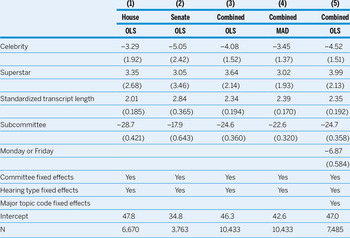
In general, we found that celebrity witnesses have little impact on hearing attendance, but there are nuances worth discussing. Table 1 presents results of the OLS regression models for the House and the Senate (models 1 and 2). The intercept captures the typical attendance rate for our baseline committee, Appropriations. On average, 48% of House committee members and 35% of Senate committee members attended a full Appropriations hearing. Footnote 12 The typical celebrity depresses the House and Senate attendance rates by 3.3 and 5.1 percentage points, respectively (the p-value is 0.0870 in the House and 0.0372 in the Senate). By contrast, we found that superstar celebrities are associated with a small positive effect on attendance: 3.4 and 3.1 percentage points in the House and the Senate, respectively. However, this effect is not statistically significant in either case.
Analysis of Hearing Attendance, 1995–2014

Note: The dependent variable is the percentage of committee (or subcommittee) members attending a hearing. All models include committee and hearing type fixed effects. Our baseline model is set to a general hearing type, a meeting of a full Appropriations committee (or Senate Appropriations in our combined models), and, when major topic codes are included, a hearing about macroeconomics.
To find support for the conventional wisdom that celebrity witnesses improve hearing attendance, we fit our model to the combined House and Senate data (see table 1, model 3). This analysis has the benefit of a greatly increased number of superstar cases, thereby providing the conventional wisdom its most sympathetic evaluation. Footnote 13 The results of this model suggest—with a level of confidence approaching statistical significance—that superstar witnesses increase attendance by 3.6 percentage points, which is a trivial effect relative to the substantial impact anticipated by the conventional wisdom. For instance, in the 113th Congress, the median committee had 39 MCs in the House and 20 in the Senate. If the superstar coefficient represents the true effect, then the appearance of, for example, Ben Affleck will result in approximately one less empty seat.
At best, superstars may lure one more MC to attend. At worst, less famous celebrities speak to a room with an additional empty seat.
To ensure that our analysis was robust to a small number of important and extremely well-attended hearings that are unlikely to include celebrity witnesses, Footnote 14 we analyzed our combined House and Senate data using a median absolute deviation (MAD) regression analysis. This produced coefficient estimates that are not sensitive to outlier cases (see table 1, model 4). Consistent with our previous models, the celebrity indicator has a small, negative, and statistically significant coefficient, whereas the superstar indicator has a small, positive, and statistically insignificant effect. Thus, the finding of a negative or small effect for the typical celebrity is not driven by our celebrity cases being differentiated from a few high-profile and high-attendance hearings.
Finally, we included a robustness check for issue type. If committee chairs consistently invite celebrities to speak on less-compelling issues, then the celebrity-attendance rates reported previously could be impressive. To control for each issue’s basic level of salience, we included major-topic-codes fixed effects in our stacked OLS regression model (see table 1, model 5). The estimated celebrity coefficients were in line with previous analyses.
In summary, we found that celebrities are not particularly adept at commanding congressional attention in committee hearings. At best, superstars may lure one more MC to attend. At worst, less famous celebrities speak to a room with an additional empty seat. Either way, this evidence falls far short of the conventional wisdom that celebrities readily command legislators’ attention. Our models predict that even a star such as Seth Rogen should not be surprised by poor turnout at a Senate Appropriations subcommittee because that is the typical senatorial response to celebrity visits to Capitol Hill. Footnote 15
DISCUSSION
As much as MCs may love celebrity contact, celebrity witnesses do not significantly increase hearing attendance. Our finding has implications for policy-demanding groups, which often recruit celebrity political activists to advocate on their behalf because they believe that celebrities command the scarce resource of congressional attention (Demaine Reference Demaine2009). Our analysis suggests that MCs are more conscientious of their policy-making roles than they are of meeting celebrities. Therefore, intense policy demanders are more likely to command MC attention by furnishing high-quality expert witnesses that address member’s policy interests. Our result complements the work of Thrall et al. (Reference Thrall, Lollio-Fakhreddine, Berent, Donnelly, Herrin and Paquette2008), who showed that celebrity political activity fails to capture the attention of the mainstream news media.
Whereas the literature assumes that MCs seek out the celebrity spotlight, we think that most celebrities have more to gain from a hearing than the typical MC. Consider Seth Rogen: his testimony secured significant public attention. The next day, his number of Google searches was one of the highest in his career. Therefore, in reality—and contrary to popular belief—celebrities have more reason to seek invitations to Capitol Hill than MCs have to proffer them.