




No CrossRef data available.
Article contents
Perceptual restoration in children versus adults
Published online by Cambridge University Press: 01 October 2004
Abstract
Children often listen to speech in noisy environments, where they must use prior knowledge to help them interpret the intended signal. The present experiment compares school-aged children's and adults' use of one such form of prior knowledge, as demonstrated in the perceptual restoration effect. Children, like adults, perform better when speech is intermittently replaced with noise than when it is replaced with silence, suggesting that children are able to make use of prior knowledge to help them restore interrupted signals. Despite this fact, children appear to be more affected by acoustic signal disruptions than are adult listeners, suggesting they will experience greater difficulty in noisy environments.
Information
- Type
- Articles
- Information
- Copyright
- © 2004 Cambridge University Press
Children often listen to speech in situations that are not perfectly quiet. School is no exception: the sounds of rattling papers, moving chairs, and even biological noises such as coughs and stomach gurgles can mask a teacher's speech temporarily. Yet even when an outside noise masks part of the incoming speech signal, adults generally have little difficulty interpreting the intended message. Our prior knowledge of the language allows us to determine what the speaker intended to produce, even when part of the perceptual information is blocked. It is less clear whether children are as adept at this skill.
One example of this use of prior knowledge has been demonstrated in the perceptual restoration effect (Samuel, 1996; Warren, 1970; Warren & Obusek, 1971; Warren & Warren, 1970). Warren (1970) presented adult listeners with the sentence “The state governors met with their respective legislatures convening in the capital city,” but he replaced the first s in legislatures with an extraneous noise (a cough). He found that listeners not only reported hearing the word legislatures but also could not accurately report the location of the noise in the sentence. That is, the listeners actually heard the interrupted word as continuing “behind” the noise. This is in stark contrast to the results when a phoneme is replaced with silence: although listeners can tell what the word should have been in this case, they do not have the illusion of the word being complete (Warren & Obusek, 1971). Whereas noise provides an explanation for why the expected sound was not actually heard (it was masked), silence does not, and thus illusory restoration does not occur.
Subsequent work has compared listener's perception of noise-replaced stimuli (where the phoneme in question is excised before noise is added) with the perception of noise-added stimuli (where the noise is superimposed on the existing phoneme). With this procedure, Samuel (1981a) was able to distinguish between subjects' biases and their discrimination abilities (in a signal-detection analysis). He demonstrated that the restoration effect involves more than simply a bias in responding. Rather, prior knowledge about words changes the listener's perception (that is, listeners actually hear real words as being intact more often than nonwords; see also Samuel, 1996, 1997). In contrast, information in the sentence that makes a particular word predictable in context does not alter perception, although it does lead to greater reports of restoration. Sentential information appears to bias the listener toward reporting an intact word; lexical information causes the listener to hear an intact word.
There are clear limits on the generality of this finding of perceptual restoration. It occurs only when the noise is sufficiently similar to the acoustic signal of the missing speech sound as to provide a reasonable explanation for why the speech sound was not heard. That is, restoration can only occur when an extraneous sound is capable of masking a signal. In Warren's original example, the phoneme /s/ contains energy at a wide range of frequencies; a cough contains energy at many of these same frequencies, and thus logically can be a masker. Phoneme restoration is thus contingent on both the class of the phoneme being masked and the acoustic properties of the masker (Samuel, 1981b); only when these are somewhat similar does the effect take place.
Despite the fragile nature of the effect, the fact that it occurs at all suggests that top-down cognitive knowledge can influence speech perception, at least in some situations. Moreover, this restoration effect is not limited to speech, nor to single phonemes. Restoration has been reported for other domains, such as music (DeWitt & Samuel, 1990; Sasaki, 1980); other modalities, such as American Sign Language (Schultz–Westre, 1985); and other species, such as starlings (Braaten & Leary, 1999). It appears to be one example of a more general class of restorative events known as auditory induction (Bashford & Warren, 1987).
Far less work has examined children's perceptual restoration abilities. Although children may often be faced with noisy environments (Manlove, Frank, & Vernon–Feagans, 2001), they do not have the same degree of lexical knowledge that adults have, and thus may not be able to rely on this information to help them perceive more difficult linguistic stimuli. The average number of words in the total vocabulary of a first-grade child has been estimated as being between 14,000 and 20,000 words; that of an adult is three times as high (Carey, 1978; Smith, 1941). Moreover, many of the words a child knows may have only weak representations early in development (McGregor, Friedman, Reilly, & Newman, 2002); only as the child acquires more knowledge are those representations fleshed out. The relative weakness of children's vocabularies may prevent them from using their lexical knowledge to help them interpret partially masked speech.
Surprisingly, Koroleva and colleagues (1991) found a much higher degree of phonemic restoration in 5- to 6-year-old children than in adults. Listeners were presented with three-syllable words that were either intact or had a phoneme replaced with noise. They were asked to decide whether the word was fully intact. Children were far more likely to claim that an item with a phoneme replaced with noise was intact than were adults. However, it is unclear whether this is a perceptual difference or a difference in response bias, as the authors did not provide any means of distinguishing between hits and false alarms. This is particularly a concern as adults' responses depended on the class and position of the replaced sound (they were more likely to restore consonants than vowels and to restore later consonants than earlier ones), whereas children's responses appeared to be independent of these factors. Children were also less likely to detect which phoneme had been replaced than were adults, although this, too, may be for nonperceptual reasons: rather than mislocalizing the noise (by identifying the wrong phoneme as missing), children seemed unable to name any phoneme at all. Thus, these results may be more indicative of a difference in response ability or task comprehension than a difference in perceptual mechanisms.
In direct contrast to Koroleva et al.'s results, Walley (1987) reported that 5-year-old children demonstrated less perceptual restoration than did adults. She presented listeners with intact, noise-replaced, and noise-added versions of words and asked the listeners to identify the intended target. This identification task is far more similar to normal perceptual tasks than are the explicit judgments that Koroleva's participants were asked to provide. But Walley found that noisy stimuli were particularly disruptive to the children's comprehension. Children were less likely to accurately identify words that had had a phoneme replaced by noise than were the adults, suggesting that they did not mishear the word as being intact. Moreover, regardless of whether a phoneme was replaced with noise or noise was added to a stimulus, children appeared to require more intact acoustic–phonetic input to identify even familiar words.
These results suggest that children are more affected by signal disruptions than are adults; when noise was present, children were less able to rely on other forms of lexical knowledge to fill in the missing information. Yet the variation in results across studies is problematic. Moreover, perceptual restoration refers to the finding that adult listeners are more likely to hear an interrupted signal as complete when there is a secondary signal that could logically have masked it. Thus, what is at issue in terms of perceptual restoration is not only whether children are more influenced by disruptions than are adults, but also whether they can use their knowledge of the signal to help them interpret a disrupted signal correctly. To examine this effect, it is necessary to compare performance on noise-replaced stimuli with performance on silence-replaced stimuli, in addition to comparing performance on noise-replaced stimuli with intact stimuli. The present experiment compares this form of restoration in school-aged children to that of adults. We predict that if children do show restoration, they should demonstrate better performance at identifying an intended word when a phoneme is replaced by noise than when it is simply missing. The critical comparison is between the situation in which a sound is missing but there is no potential masker present and the condition in which a noise serves as a potential masker for the missing sound. If children perform better in the noise condition than in the silence condition, this would be an indication that noise enhances the intelligibility of the signal. If there is no difference, it would suggest that children are not using their prior knowledge of the language and of potential maskers to fill in missing information.
We also wish to compare performance in both of these conditions with performance when the signal is fully intact. This will serve as an indication of the extent to which children are able to compensate for signal disruptions in general. If children experience a greater decrement from signal disruption than do adults, it would be an indication that they are more likely to be affected by temporary loud noises in their vicinity. Although a great deal of research has examined children's susceptibility to noise, particularly in school settings (see, e.g., Hétu, Truchon–Gagnon, & Bilodeau, 1990; Picard & Bradley, 2001), most of this work has focused on the levels of continuous background noise, rather than on sudden, brief noises of greater intensity. For example, Hétu and colleagues (1990) found that only one of six schools they tested had background noise levels within recommended limits. Yet these measurements were taken when children were not in the classroom. Indeed, most such measures of classroom ambient noise are taken in unoccupied classrooms, even though occupied ones are the ones of greatest concern (Picard & Bradley, 2001). Even in situations in which these unoccupied background noise levels are quite low, there may still be brief noises caused by the presence of other children (such as coughs, laughter, and dropped books) that can mask a teacher's voice temporarily. The extent to which this type of noise affects children's perception is the focus of the present research.
EXPERIMENT
The present experiment was designed to compare perceptual restoration in children and adults. We wanted a task that could be used by individuals of a range of ages and that did not require making explicit decisions about the nature of the stimuli (such as whether noise replaced a sound). To this end, we selected a sentence task described by Bashford and Warren (1987). In this study, sentence-length stimuli were periodically interrupted by either silence or noise. The authors found that listeners were better able to identify the sentence when the gaps were filled with noise rather than with silence.
This task does not test the auditory illusion of restoration; that is, we are not directly examining whether individuals have the illusion that the sentence continues behind the noise. Rather, we are exploring whether the existence of a potential masker enhances intelligibility of the signal. This noise advantage can occur even without the cognitive illusion that the signal is fully intact (Powers & Wilcox, 1977). Thus, we wish to examine whether children, like adults, show improved identification when noise (a potential masker) is present as compared to when it is absent.
In our version of the task, high-cloze sentences from the Speech Perception in Noise (SPIN) task were selected as test sentences (Kalikow, Stevens, & Elliott, 1977). These were recorded by a female speaker, and the original recordings served as the “clear” stimuli. These were then edited by periodically replacing portions of the sentence with either noise or silence. We then asked both 5-year-old and adult listeners to identify the sentence as a whole.
We would expect on the basis of prior research (Bashford & Warren, 1987) that adults will identify more words correctly when the gaps in the sentence are filled with noise than when they remain unfilled. If children experience restoration in the same manner as do adults, we would expect them to show a similar improvement in the noise condition as compared to the silence condition. This would suggest that children are able to “fill in” missing information when a signal is temporarily masked.
We included a set of clear sentences as a measure of the optimum performance an individual would be likely to obtain. These clear-condition sentences also made the task more enjoyable for child participants, because there were some sentences for which the task (repeating aloud) was quite easy. Although we do not necessarily expect children to do as well as adults at identifying the speech even in the clear condition, this serves as a measure of the extent to which they were capable of performing this laboratory task and their attention level in general.
METHOD
Participants
Twenty-four adults and 24 children participated in this experiment. The adult listeners participated in exchange for course credit or a cash payment. Data from one additional adult participant were excluded from the analysis as a result of equipment failure. The children (12 boys, 12 girls) averaged 64.9 months of age (range=63.3–66.1). Children's hearing and language skills were not explicitly tested, but parents were asked a number of questions about their children's language history; any child whose parents reported an expressive language delay or attention deficit disorder was excluded from the study; this accounted for a total of 3 children. An additional 8 children participated but their data were excluded for the following reasons: experimenter error or equipment failure (3) or failure to complete the test session (5).
Stimuli
Our goal was to create a set of stimuli that could be used with both adult and child participants. Ninety-six sentences from the SPIN test (Kalikow et al., 1977) were selected for use in this study. Only high-predictability sentences were used. Sentences were selected on the basis of their perceived appropriateness for children of this age (we avoided sentences containing words we felt were unlikely to be known to young listeners), and sentences ranged in length from five to eight words.
A female native speaker of English recorded each sentence. The recordings were made in a noise-reducing chamber at a 44.1-kHz sampling rate and 16-bit resolution and were amplified and stored on computer disk.
Three versions of each sentence were then made. The clear version consisted of the original recording. In the noise version, periodic portions of the sentence were replaced with pink noise (the amplitude was constant across sentences and was chosen to match the average amplitude of the sentences themselves). In the silence versions, these same portions were replaced with silence.
This is somewhat different than the procedure used by Bashford and Warren (1987), as they subjected their stimuli to a narrowband filter prior to the interruptions. By reducing the frequency range of the clear speech signal, they were able to ensure that their noise stimulus contained energy at the same frequencies as their speech stimulus. This would presumably enhance the illusion of continuity, which was a significant goal of their experimental design. In contrast, we were less concerned with the illusion of restoration and more concerned with the effects of noise on intelligibility in something approaching the situation of listening to speech in a noisy environment. Moreover, we were concerned that using narrowband speech would have made the task too difficult for young children. We therefore used the entire frequency range for the clear portions of our speech signal.
In order to ensure both that children would not be at floor performance and that adults would not be at ceiling performance, we decided to include stimuli at several different signal–noise alternation rates. (The alternation rate refers to the rate of the periodic alternations between intact signal and replaced portions.) Previous research suggests that the increase in intelligibility with noise is dependent upon the alternation rate, but not necessarily in a linear fashion (Bashford & Warren, 1987; Powers & Wilcox, 1977). Because the effect of alternation rate had not been tested on children, we could not be sure that the alternation rates found to work best for adults would necessarily work best for children; we thus used four different rates. One-quarter of the sentences were altered at 250-ms intervals. This means that the initial 250 ms of the stimuli were untouched, whereas the next 250 ms of the sentence was replaced by either noise or silence. The next 250 ms of the sentence was presented unaltered, followed by another 250 ms of noise or silence. This continued until the end of the sentence. The other sentences were altered in the same way, but with different intervals. One-quarter of the sentences were created with 200-ms alternation rates; one-quarter with 150-ms alternation rates; and one-quarter with 100-ms alternation rates.
Three versions of the experiment were then created, such that each listener heard each sentence in only one of the three conditions (clear, noise, or silence). Each participant heard the complete set of 96 sentences, with one-third occurring in the clear condition, one-third in the noise condition, and one-third in the silence condition.
Procedure
Stimuli were presented over Audiotechnica ATH M40fs headphones at a level judged to be a comfortable listening level in pilot testing; the same listening level was used for all participants of both ages. Participants received two practice blocks prior to the test session: the first practice block was to introduce them to the task more generally, and involved six clear-condition sentences. The second practice block was designed to introduce participants to the range of stimulus types they would experience; it included the identical sentences as in the first practice block, but each was presented in both noise and silence versions.
Adult participants then heard the 96 test sentences in a single block in randomized order. After each sentence, they were instructed to type what they thought they heard into the computer keyboard. An experimenter examined these transcripts and counted the number of words correct in each sentence; this was divided by the total number of words to get a measure of accuracy. Obvious misspellings were counted as correct. This method of responding was chosen because prior work in the lab suggested that adult participants often mumbled in speech repetition tasks, making them difficult to comprehend. Typewritten responses were therefore judged to be a more accurate method of coding.
The procedure was slightly different for child participants. First, as children of this age are unable to type, they simply repeated the sentences back into a Shure SM58 microphone. These recordings were then transcribed by an experimenter and analyzed in the same manner as the adult sentences. Although this method of transcription may result in different numbers of errors overall for children as compared to adults, it is unlikely to differentially affect the three trial types (clear, noise, and silence).
Rather than hear all 96 items as a single block, the children heard 8 blocks of 12 sentences each. Each block included 4 sentences of each condition (noise, silence, and clear); the order of sentences within each block and the order of the blocks themselves were randomized across children.
When children first entered the laboratory, they were given a card with their name on it, which was decorated with drawings. After completion of each block, they were given a sticker to place on their card and were then asked if they wished to do another block. Providing stickers for each block was quite motivating for the children, and most children eagerly indicated a willingness to continue with the experiment. Any child that did not complete at least six of the eight test blocks was excluded from the experiment.
Results
As there was no effect of gender and no interactions involving gender in either age group, we collapsed across this factor in all analyses. We then performed a 2×3 analysis of variance (ANOVA), with the between-subject factor of age and the within-subject factor of condition (noise, silence, or clear). Not surprisingly, there was an overall effect of age, with adults responding correctly to more words than children (average accuracies of 86 and 57%, respectively); F1 (1, 46)=98.09, p<.0001; F2 (1, 95)=790.71, p<.0001. Despite this overall difference, there was overlap between the groups for all three trial types; minimum adult accuracies were 93.5% for the clear condition, 63.6% for the noise condition, and 51.6% for the silence condition. Maximum child accuracies were 99.5% for the clear condition, 68.2% for the noise condition, and 59.8% for the silence condition.
There was also a significant effect of condition, F1 (2, 92)=302.66, p<.0001; F2 (2, 190)=426.51, p<.0001, and an age by condition interaction, F1 (2, 92)= 62.46, p<.0001; F2 (2, 190)=139.72, p<.0001.1
Alternation rate (250 vs. 200 vs. 150 vs. 100 ms) was not included as a factor in this analysis, because it only affects the noise and silence conditions, not the clear condition.
The critical comparison, however, is in the difference between the noise and silence conditions. We performed a 2×4 ×2 ANOVA, with the repeated measures of condition (noise vs. silence), alternation rate (250, 200, 150, or 100 ms), and 2 levels of age (child vs. adult). Here we found an overall effect of age, F1 (1, 46)=112.05, p<.0001; F2 (1, 92)=722.72, p<.0001, with adults performing better than children (80 vs. 40%), an overall effect of condition, F1 (1, 46)=20.06, p<.0001; F2 (1, 92)=31.16, p<.0001, with accuracies of 63% for noise items and 57% for silence, and an overall effect of the alternation rate, F1 (3, 138)=42.68, p<.0001; F2 (3, 92)=5.75, p<.005, with increasing accuracy at faster alternation rates (250 ms, 52%; 200 ms, 59%; 150 ms, 62%; and 100 ms, 67%).
There was an interaction between age and alternation rate, F1 (3, 138)=8.26, p<.0001; F2 (3, 92)=2.80, p<.05, with the effect of alternation rate being larger in adults than in children, as shown in Figure 1. But critically for the investigation of phoneme restoration, there was no interaction between age and condition (both F<1) and no three-way interaction, F<1 (3, 138)=1.85, p>.05; F<2 (3, 92)=1.19, p>.05. Adults had 82% accuracy in the noise condition but only 77% in the silence condition; children had 43% accuracy in the noise condition, but only 36% in the silence. The effect of noise was nearly identical for the two age groups, as shown in Figure 2.
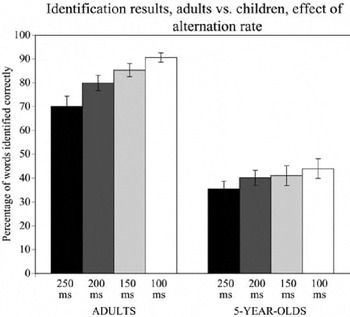
The percentage of words identified correctly (standard errors) across the four different alternation rates for the noise and silence conditions combined. Results from adult listeners are shown on the left; results from children are shown on the right
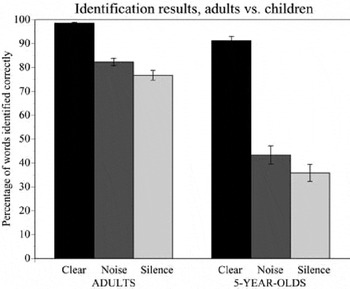
The percentage of words identified correctly in clear, noise, and silence conditions, along with standard errors. Results from adult listeners are shown on the left; results from children are shown on the right
Discussion
These results suggest that by the time children reach 5 years of age, they show restoration comparable to adults. Although children were more affected by signal disruptions than are adults, the advantage for the noise condition over the silence condition was nearly identical in the two groups.
This suggests that children are able to make use of prior lexical knowledge to aid in their interpretations of the speech stream. Despite the fact that children's lexical representations are likely to be less fully developed than those of adults (McGregor et al., 2002), this apparently does not prevent them from using prior knowledge to help them interpret partially masked speech.
Yet phonemic restoration is not merely an effect of top-down knowledge (Samuel, 1981a); such top-down knowledge would allow listeners to restore missing information in both the noise and silence conditions. The fact that identification performance is improved in noise demonstrates the interaction between top-down lexical information and bottom-up acoustic information in the signal. One could easily imagine that such complex interactions between sources of information would require time to develop, occurring only in a more mature organism. The fact that children showed the same-size advantage for the noise-replaced stimuli over the silence-replaced stimuli suggests that the ability to combine different sources of information is also well developed by the time children reach school age.
Samuel (1987) found greater effects of restoration when there were multiple legitimate candidates for a partially masked word. Assuming that children do have smaller vocabularies than adults, one might have expected adults to show greater effects of restoration as a result of having more possible interpretations for any given sentence. The lack of such a difference is likely the result of the particular types of stimuli employed in this task. The high-cloze sentences contained words that were related to one another, thus limiting the number of likely interpretations of the sentence. Had we used lists of individual words, or sentences that were less predictable, we might have been more likely to detect differences between ages as a result of changes in the size of the lexicon.
Children and adults showed more similar performance in the clear condition than in the other two conditions. This suggests that interruptions in the signal were more disruptive to the younger children and that children may be less adept at using existing lexical knowledge to fill in missing information more generally. This has important implications for the classroom, as well as for the home environment. Short, transient noises that temporarily mask a target signal are not likely to be particularly disruptive to adult listeners. For that reason, we often discount them as being potentially problematic for young children. Yet the present results suggest that children may experience difficulty understanding a target sentence when these transient noises are present. As an example, if another child in a classroom were to cough or drop a book at the same time that the teacher is talking, a child is far less likely to be able to figure out what the teacher intended to say than is an adult listener. Because these noises are likely to be quite common in some classrooms, children may have a difficult time understanding a teacher's instructions. This is more likely to be the case for children in the back of the room, for whom the teacher's voice is less intense (and thus more easily masked by other noises). Even in situations in which children perform quite well in good listening conditions, children will show marked decrements relative to adults in more difficult listening conditions.
However, the laboratory task differs in a number of ways from the task facing children in an educational setting. The rate of interruptions presented here was quite high; most classrooms are unlikely to have interruptions at the rate of two per second, as was the case for the slowest alternation rate presented here. This may have made the laboratory task more difficult than is listening in a classroom setting. By contrast, the disruptions in this task were highly predictable; not only were children expecting disruptions in general, but the disruptions themselves occurred at a constant pace. This would have allowed the children to predict which portions of the signal would be present and which would not, and thus to focus their attention selectively on the clear portions of the signal. This predictability is unlikely to be present in the classroom setting, where noises occur intermittently and unpredictably, and may serve to counteract the high rate of interruptions. Yet despite the obvious differences between the laboratory task and the classroom setting, the fact that children in this task tended to have difficulty with signal disruptions raises the concern that they would similarly have difficulties with disruptions outside the laboratory as well.
This requirement for additional acoustic input in order to interpret items correctly has been demonstrated in other types of tasks as well, strengthening this concern. For example, children apparently require larger acoustic differences to discriminate sounds than do older children or adults (Elliott, Busse, Partridge, Rupert, & DeGraaff, 1986; Elliott, Hammer, Scholl, & Wasowicz, 1989). They also require larger amplitude differences (Elliott, Clifton, & Servi, 1983) and larger signal–noise ratios (Elliott et al., 1979) in order to identify individual words. These prior studies used very different methodologies than the present study, and were focused on different types of information (size of acoustic difference, rather than proportion of the word presented). However, the similarities among the results suggest that they may all be examples of a more global phenomenon, whereby young children simply require more information before making any speech decisions.
Children showed a smaller effect of the alternation rate than did adult listeners. Although both ages performed better with faster alternation rates, the difference was larger for older listeners. While adults showed a 21% increase between their performance in the 250-ms condition and that in the 100-ms condition, children showed only an 8% increase. This may be another indication of differences in the ability to use prior knowledge. With a 250-ms alternation rate, entire syllables are missing from the sentence; with a 100-ms alternation rate, parts of syllables remain present. Adults appeared better able to make use of this partial information to determine the nature of the missing phonemes than did children.
Despite children's sensitivity to signal disruption, however, the benefits of a potential masker were quite comparable to that found for adult listeners. Restoration abilities appear to be quite adultlike by the time children reach school age. This suggests that children are able to use their knowledge about potential maskers to help them interpret the signal.
Thus, although many aspects of language continue to develop after age 5, the mechanisms of language processing appear to remain quite stable. Young children have smaller vocabularies than do adults and are more vulnerable to signal disruptions. Yet the means by which they interpret linguistic stimuli, and the way in which they combine different sources of information, appears to have developed fully by this point in development.
Given the role of prior knowledge in restoration effects, one possibility is that performance in these tasks would depend critically on lexical knowledge, in addition to hearing ability. This would suggest that children with language impairments, who may have poorer semantic representations of words or poorer access to that stored knowledge than the typically developing children tested here, would also show particular difficulty understanding speech in the context of noise. Most work on the issue of classroom noise has focused on either typically developing children or on children with hearing impairments. In general, children with hearing impairments tend to experience greater difficulties when faced with noisy environments than do children without such hearing losses (Finitzo–Hieber & Tillman, 1978). Future work will be needed to examine whether children with language impairments would show similarly poor performance in noise as compared to their typically developing peers.
Although the present paper has focused on children just reaching school age, children in preschools may also face noisy environments on a regular basis (Manlove et al., 2001). Unfortunately, the present task of repeating sentences is unlikely to be suitable for testing a younger population. In particular, the sentence-length stimuli place a significant memory load on children, making the task overly difficult for toddlers. Future work will be needed to explore how the ability to perceptually restore interrupted speech develops in these younger children.
In conclusion, children aged 5.5 years appear to be more sensitive to acoustic disruptions of a speech signal than are adult listeners. Despite this difference, however, children appear equally likely to show perceptual restoration. That is, even though children are generally more affected by disruptions in the signal, the effect of the type of this disruption is comparable in children and adults. Thus, children appear to be able to use prior knowledge of both the speech signal and of prior maskers to help them fill in information masked by outside noises.
ACKNOWLEDGMENTS
The author thanks Jennifer Bucklin, Rachael Dolezal, Anthony Herring, Isma Hussain, Michelle Mack, Phillippe Taborga, Susan Timm, Andrea Tuttle, and Brooke Werner for assistance in subject running and coding. This work was supported by Research Grant HD37822-01 from the NICHD and Research Grant BCS 99-07849 from the NSF to the University of Iowa and by a CIFRE research grant from the University of Iowa.
References
Bashford J. A., &
Warren R. M.
1987
Multiple phonemic restorations follow the rules for auditory induction.
Perception & Psychophysics,
42,
114–
121.Google Scholar
Braaten R. F., &
Leary J. C.
1999
Temporal induction of missing birdsong segments in European starlings.
Psychological Science,
10,
162–
166.Google Scholar
Carey S.
1978
The child as word learner.
In M. Halle,
J. Bresnan, &
G. A. Miller (Eds.),
Linguistic theory and psychological reality.
Cambridge, MA:
MIT Press.
DeWitt L. A., &
Samuel A. G.
1990
The role of knowledge-based expectations in music perception: Evidence from musical restoration.
Journal of Experimental Psychology: General,
119,
123–
144.Google Scholar
Elliott L. L.,
Busse L. A.,
Partridge R.,
Rupert J., &
DeGraaff R.
1986
Adult and child discrimination of CV syllables differing in voicing onset time.
Child Development,
57,
628–
635.Google Scholar
Elliott L. L.,
Clifton L. A. B., &
Servi D. G.
1983
Word frequency effects for a closed-set word identification task.
Audiology,
22,
229–
240.Google Scholar
Elliott L. L.,
Connors S.,
Kille E.,
Levin S.,
Ball K., &
Katz D.
1979
Children's understanding of monosyllabic nouns in quiet and in noise.
Journal of the Acoustical Society of America,
66,
12–
21.Google Scholar
Elliott L. L.,
Hammer M. A.,
Scholl M. E., &
Wasowicz J. M.
1989
Age differences in discrimination of simulated single-formant frequency transitions.
Perception & Psychophysics,
46,
181–
186.Google Scholar
Finitzo–Hieber T., &
Tillman T. W.
1978
Room acoustics effects on monosyllabic word discrimination ability for normal and hearing-impaired children.
Journal of Speech and Hearing Research,
21,
440–
458.Google Scholar
Hétu R.,
Truchon–Gagnon C., &
Bilodeau S. A.
1990
Problems of noise in school settings: A review of literature and the results of an exploratory study.
Journal of Speech–Language Pathology and Audiology,
14,
31–
39.Google Scholar
Kalikow D. N.,
Stevens K. N., &
Elliott L. L.
1977
Development of a test of speech intelligibility in noise using sentence materials with controlled word predictability.
Journal of the Acoustical Society of America,
61,
1337–
1351.Google Scholar
Koroleva I. V.,
Kashina I. A.,
Sakhnovskaya O. S., &
Shurgaya G. G.
1991
Perceptual restoration of a missing phoneme: New data on speech perception in children.
Sensory Systems,
5,
191–
199.Google Scholar
Manlove E. E.,
Frank T., &
Vernon–Feagans L.
2001
Why should we care about noise in classrooms and child care settings?
Child & Youth Care Forum,
30,
55–
64.Google Scholar
McGregor K. K.,
Friedman R. M.,
Reilly R. M., &
Newman R. M.
2002
Semantic representation and naming in young children.
Journal of Speech, Language, and Hearing Research,
45,
332–
346.Google Scholar
Picard M., &
Bradley J. S.
2001
Revisiting speech interference in classrooms.
Audiology,
40,
221–
244.Google Scholar
Powers G. L., &
Wilcox J. C.
1977
Intelligibility of temporally interrupted speech with and without intervening noise.
Journal of the Acoustical Society of America,
61,
195–
199.Google Scholar
Samuel A. G.
1981a
Phonemic restoration: Insights from a new methodology.
Journal of Experimental Psychology: General,
110,
474–
494.Google Scholar
Samuel A. G.
1981b
The role of bottom-up confirmation in the phonemic restoration illusion.
Journal of Experimental Psychology: Human Perception & Performance,
7,
1124–
1131.Google Scholar
Samuel A. G.
1987
Lexical uniqueness effects in phonemic restoration.
Journal of Memory & Language,
26,
36–
56.Google Scholar
Samuel A. G.
1996
Does lexical information influence the perceptual restoration of phonemes?
Journal of Experimental Psychology: General,
125,
28–
51.Google Scholar
Samuel A. G.
1997
Lexical activation produces potent phonemic percepts.
Cognitive Psychology,
32,
97–
127.Google Scholar
Sasaki T.
1980
Sound restoration and temporal localization of noise in speech and music sounds.
Tohoku Psychologica Folia,
39,
79–
88.Google Scholar
Schultz–Westre C.
1985
A visual analog of phonemic restorations: Sign restoration in American Sign Language.
Milwaukee, WI:
University of Wisconsin–Milwaukee.
Smith M. K.
1941
Measurement of the size of general English vocabulary through the elementary grades and high school.
Genetic Psychology Monographs,
24,
311–
345.Google Scholar
Walley A. C.
1987
Young children's detections of word-initial and -final mispronunciations in constrained and unconstrained contexts.
Cognitive Development,
2,
145–
167.Google Scholar
Warren R. M.
1970
Perceptual restoration of missing speech sounds.
Science,
167,
392–
393.Google Scholar
Warren R. M., &
Obusek C. J.
1971
Speech perception and phonemic restorations.
Perception & Psychophysics,
9,
358–
362.Google Scholar
Warren R. M., &
Warren R. P.
1970
Auditory illusions and confusions.
Scientific American,
223,
30–
36.Google Scholar
The percentage of words identified correctly (standard errors) across the four different alternation rates for the noise and silence conditions combined. Results from adult listeners are shown on the left; results from children are shown on the right
The percentage of words identified correctly in clear, noise, and silence conditions, along with standard errors. Results from adult listeners are shown on the left; results from children are shown on the right
 You have
Access
- 15
- Cited by