INTRODUCTION
In the dry areas, sheep farming is an ancestral and still the principal activity of rural population as it represents the main source of income, an indicator of wealth, and a key tool to build resilience of the marginal ecosystems. North Africa is already experiencing the impact of climate change on different domains particularly agriculture. Therefore, producing more with minimum inputs and preserving natural resources are among the main challenges to be addressed in development strategies. Sheep husbandry mainly in central and southern Tunisia plays important socio-economic and ecological roles, and despite the changes in production systems it is still the main activity of small farmers (Ben Salem, Reference Ben Salem, Khlij, Ben Hamouda and Gabiña2011) and contribute to the food security (Mohamed-Brahim et al. Reference Mohamed-Brahim, Khaldi and Khaldi2010). The prices volatility of feedstuffs, mainly concentrate feeds, during the last decade coupled with frequent and extended drought periods are threatening livestock sector (Zaibet et al. Reference Zaibet, Hammami and Jabbar2008). Small ruminant health, particularly, infestation with the gastrointestinal nematodes (GIN) is another constraint compromising the productivity of these animals. Since long time, a wide range of chemical anthelmintic drugs is used in livestock farming. The frequent use of these products had built and disseminated resistance to anthelmintics in worm populations all over the world (Jackson and Coop, Reference Jackson and Coop2000; Kaplan, Reference Kaplan2004). To overcome this problem, and with the increasing concern of consumers about risk of drug residues in food, other safe alternatives have been suggested for the control of GIN. There is an increasing interest to the use of bioactive plants (Alonso-Diaz et al. Reference Alonso-Diaz, Torres-Acosta, Sandoval-Castro, Capetillo-Leal, Brunet and Hoste2008a , Reference Alonso-Diaz, Torres-Acosta, Sandoval-Castro, Aguilar-Caballero and Hoste b ), especially those containing condensed tannins (CT) to treat animals against GIN. Many international studies showed the anthelmintic (AH) activity of some tannin-containing plants such as birdsfoot trefoil (Lotus cornicalutus), big trefoil (Lotus pedunculatus), sulla (Hedysarum coronarium), sainfoin (Onobrychis viciifolia) (Min and Hart, Reference Min and Hart2003; Hoste et al. Reference Hoste, Jackson, Athanasiadou, Thamsborg and Hoskin2006), sericea lespedeza (Lespedeza cuneata) (Shaik et al. Reference Shaik, Terrill, Miller, Kouakou, Kannan, Kaplan, Burke and Mosjidis2006) and some woody plants (Acacia pennatula, Lysiloma latisiliquum and Leucaena leucocephala) (Alonso-Diaz et al. Reference Alonso-Diaz, Torres-Acosta, Sandoval-Castro, Capetillo-Leal, Brunet and Hoste2008a , Reference Alonso-Diaz, Torres-Acosta, Sandoval-Castro, Aguilar-Caballero and Hoste b ) against different species of GIN. In Tunisia, Akkari et al. (Reference Akkari, Ben Salem, Gharbi, Abidi and Darghouth2008) found that the consumption of leaves of Acacia cyanophylla, a tanniniferous shrub species, drastically reduced egg load in Barbarine lambs. According to Ben Fadhel et al. (Reference Ben Fadhel, Zaouali, Boussaid and Sulas2000), Hedysarum carnosum Desf is a pastoral spontaneous legume growing in semiarid and arid areas (Central and Southern Tunisia) and is adapted to some abiotic stressors (heat, salinity and cold) (Tibaoui, Reference Tibaoui2008). This plant is staggered seeds germination allowing a continuous repopulation of pasture especially during favourable years (Ben Fadhel et al. Reference Ben Fadhel, Zaouali, Boussaid and Sulas2000). In a previous study (Aïssa et al. Reference Aïssa, Manolaraki, Ben Salem, Kraiem and Hoste2015) the AH activity of the common sulla (Hedysarum coronarium) was demonstrated through an in vitro experiment. A question arose as to whether another species of sulla (H. carnosum) growing in dry areas could have also such AH property. The objective of the current study was to evaluate the in vitro AH effects of extracts of H. carnosum from six locations at different phenological stages, using an artificial larval exsheathment assay (LEA) against Haemonchus contortus third-stage infective larve (L3), and to test the implication of tannins from this sulla in the AH activity.
Geographical coordinates of the studied locations of Hedysarum carnosum Desf.

MATERIALS AND METHODS
Plant materials
Hedysarum carnosum Desf. was collected from six locations (Loc) based on phytoecological map of Tunisia in spring 2012 (Le Houérou, Reference Le Houérou1969). The six locations were selected based on their characteristics of soil, climate and topography (Table 1). For each location, samples were taken at time intervals which gave us different phenological stages (PS): budding (B), early bloom (EB), bloom (BM), pod formation (PF), seeds formation (seeds in the green pod: S). In every location, samples of representative plants (10 kg) were taken using the diagonal methods. Whole plants were collected at 5 cm from the ground. The total number of samples was 19. After collection, the plant samples were placed in coolers and were taken immediately to the laboratory.
Chemical analyses
Samples were oven-dried at 50 °C for 72 h, and subsequently ground at 1 mm screen. Dry matter (DM), ash and crude protein (CP) contents were measured according to AOAC (2000). Neutral and acid detergent fibre (NDF and ADF) and acid detergent lignin (ADL) were determined as described by Van soest and Wine (Reference Van Soest and Wine1967). All feed analyses were done in duplicates.
Infective larvae
The infective third-stage larvae (L3) of Haemonchus contortus (INRA goat strain, France) was obtained from donor goats infected with a pure strain of nematode. Batches of 1–2-month-old larvae were used in the assays (MAFF, 1986).
Preparation of plant extracts
After freeze-drying and grinding at 1 mm screen, 10 g of each plant sample were shaked in 70:30 acetone:water (v/v) solution for 1 h in a water bath (32 < T < 35 °C). The acetone was removed under low pressure at a temperature <35 °C and the aqueous solution was washed three times with 100 mL of dichloromethane to remove chrolophyll and lipids. The remaining fraction was frozen then freeze-dried for 24 h and kept at 4 °C in air-tight containers until use in the in vitro biological assay.
Quantification of polyphenolic compounds and biological activity of plants extracts
Folin-Ciocalteu method
This method (Makkar, Reference Makkar2003) was used to determine the concentration of total polyphenols (TP) and total tannins (TT) in the plant samples. For each sample, we measured polyphenols without and with addition of polyvinylpolypyrrolidone (PVPP; Sigma Aldrich Ltd.), and then we determined TT by difference between TP measured with and without PVPP. The quantification of TP and TT was done in three replicates, made at 725 nm using an UV–visible spectrophotometer (Spectronic Unicum, Genesys 8). A tannic acid standard curve was performed and tannins were expressed as g-equivalent of tannic acid/100 g of DM (g-equiTA).
Radial diffusion method
The biological activity (BA) of tannins was quantified using the radial diffusion method (Hagerman and Bulter, Reference Hagerman and Bulter1978). This technique is based on the property of tannins to form insoluble complexes with protein. We used bovine serum albumin (BSA; Sigma Aldrich Ltd.) and tannic acid (Sigma Aldrich Ltd.) as standards. The activity was expressed as g-equiTA.
Butanol–HCl assay
The concentration of CTs in each plant samples were determined by the butanol–HCl method (Makkar, Reference Makkar2003). An aliquot of 0·05 mL of tannin extract, 0·45 mL of 70:30 acetone:water (v/v) solution, 3 mL of butanol–HCl and 0·1 mL of ferric reagent were placed in test tubes. After covering their open sides, the tubes were boiled for 60 min. A blank containing the reagents without extract was used as control. They were then cooled and absorbances at 550 nm was read against blank on an UV–visible spectrophotometer (Spectronic Unicum, Genesys 8). CT was quantified by the formula: A 550 nm ( 78·26 × Dilution factor)/(% DM) according to Makkar (Reference Makkar2003). Results were expressed as g – equivalent of leucocyanidin/100 g of DM.
Larval exsheathment assay
The LEA was artificially performed (Bahuaud et al. Reference Bahuaud, Martinez-Ortiz De Montellano, Chauveau, Prevot, Torres-Acosta, Fouraste and Hoste2006) on the infective stage larve (L3) of Haemonchus contortus with extracts of each plant at different concentrations (1200, 600, 300, 150 µg mL−1). One thousand ensheathed L3 were incubated for 3 h at 20 °C. After incubation, the larvae were washed and centrifuged (2500 g/3 min/20 °C) three times in phosphate buffer saline solution (PBS: 0·1 m phosphate, 0·05 m NaCl, pH 7·2). Then, the larvae were subjected to an artificial exsheathment process by contact with a solution of sodium hypochloride (2%, w/v) and sodium chloride (16·5%, w/v) diluted 1–400 in PBS. The kinetics of larvae exsheathment were measured at 20 min intervals for 60 min under microscopic observation at a magnification of ×100. PBS was used as a negative control. Four replicates were run for each plant extract. In order to verify the role of tannins in the anthelmintic effects of extracts, an inhibitor of tannins, PVPP was used.
Statistical analyses
Data of secondary compounds (TP, TT, BA, CT) were analysed using GLM procedure (SAS, 2000). The main factor ‘location’ was considered in the model and the Duncan test was used to compare the means.
Data of larval exsheathment was analysed using the GLM procedure of the statistical analyses system (SAS, 2000). Three main factors (location, phenological stage, concentration of extract) and their interactions were included in the model. When differences were detected (P < 0·05), treatment means were compared using the t-test.
In addition, a multivariate analysis [principal component analysis (PCA)] was performed to obtain a synthetic description of the relationships between the effects of the extracts tested on the larval exsheathment of H. contortus and their chemical characteristics. A biplot was used to assess the relationship between the different locations of H. carnosum.
The effective concentration for 50% inhibition (EC50) ratios for each plant extract for the LEA was calculated with the PoloPLUS software 2002–2003 (Probit and Logit Analysis). EC50 was calculated by non-linear regression analysis of 4 replicates for each of the 5 concentrations. For each location, a comparison of EC50 was made for the PS.
RESULTS
Chemical composition
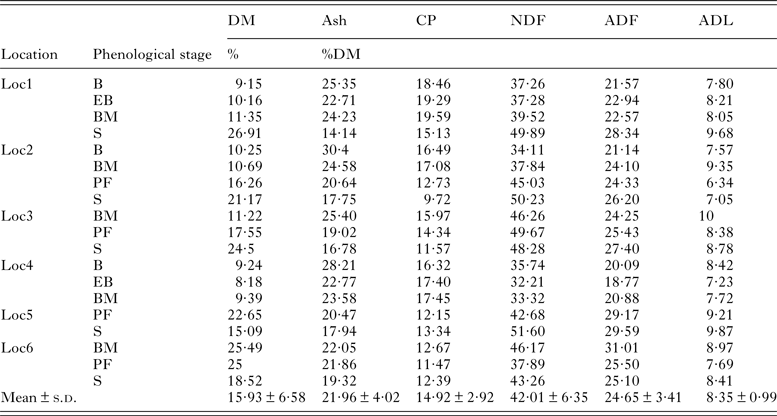
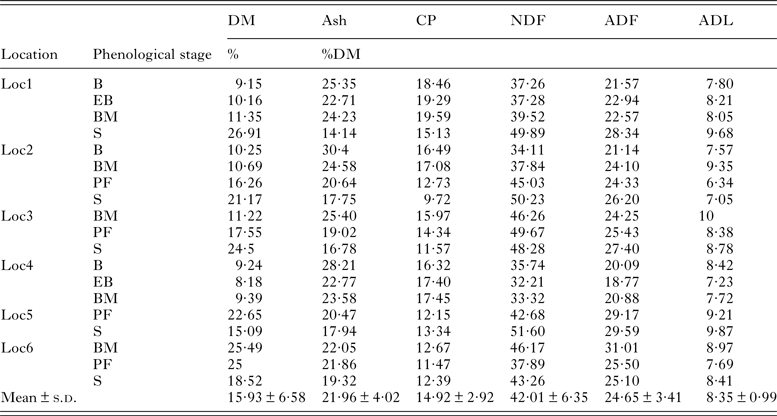
Nutritional contents varied among locations and with the progress of the phenological stage of H. carnosum. The DM content of each location increased with the advancing PS. At BM stage, DM varied from 9·39% for Loc4 to 25·49% for Loc6. Ash was high in all locations but it decreased with the advancing of the PS. CP was relatively high between B and BM stage (15·67–19·59%DM) for Loc1, Loc2, Loc3 and Loc4. However, it decreased in the grain maturity stage (S). The concentrations of NDF and ADF increased with the advancing of the PS for Loc1, Loc2, Loc3 and Loc5. ADL ranged between 7·72 and 10%DM at BM stage for Loc1, Loc2, Loc3 and Loc4 (Table 2).
Nutriment contents of six location of Hedysarum carnosum Desf. samples
Secondary compounds
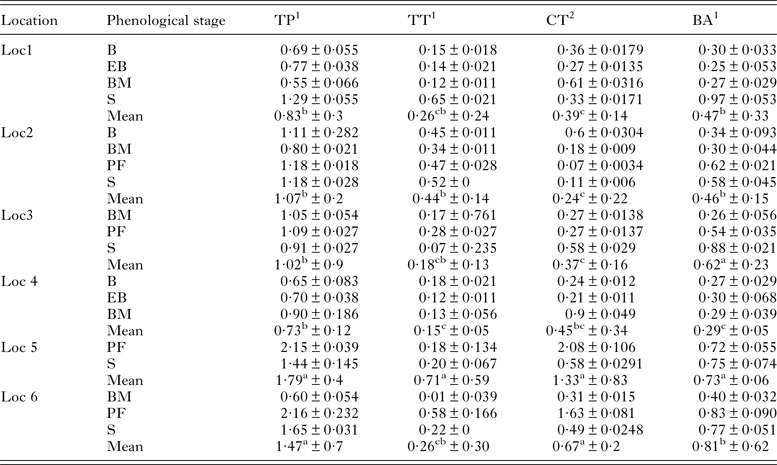
Secondary compounds in the plant samples are presented in (Table 3). Contents of TP, TT and CT and BA varied between locations and PS. Loc5 and Loc6 had highest TP content. TP ranged between 0·55 and 2·16 g-equiTA/100 g DM. The highest value of TP varied simultaneously between PF stage for Loc2, Loc3, Loc5 and Loc6 and S stage for Loc1. The highest TT content was founded in Loc 5. TT ranged between 0·01 and 0·65 g-equiTA/100 g DM. The highest values of TT varied between S stage for Loc1, Loc2, Loc5 and PF stage for Loc3 and Loc6. Loc5 and Loc6 had highest CT content. CT contents ranged between 0·07 and 2·08 as g – equivalent of leucocyanidin/100 g of DM. The highest concentration of CT was obtained in samples harvested at the following four PS: B stage for Loc2, BM stage for loc1 and Loc4, SF stage for Loc5 and Loc6 and S stage for Loc3. The highest BA was registered in Loc3, Loc5 and Loc6. The BA, related to CT, ranged between 0·25 and 0·97 g-equiTA/100 g DM. BA was higher at three PS: at PF stage for Loc2 and Loc 6, at S stage for Loc1, Loc3 and Loc5 and at EB stage for Loc4 (Table 3).
Mean measurements (±s.d.) of total phenols, total tannins, condensed tannins and biological activity for 6 locations of Hedysarum carnosum Desf. at different phenological stages

1 Expressed as g-equivalent tannic acid/100 g DM.
2 Expressed as g-equivalent leucocyanidin/100 g DM.
Larval exsheathment assay
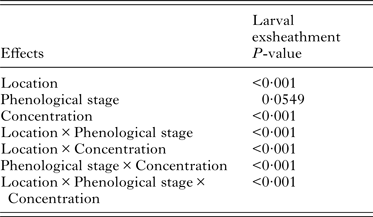
Table 4 presents the results of the statistical analyses of larval exsheathment at 60 minutes. The main effects of location and concentration were significant (P < 0·001) for larval exsheathment. All interactions were also significant (P < 0·001).
Results of the statistical analysis of the Larval exsheathment

Location effect
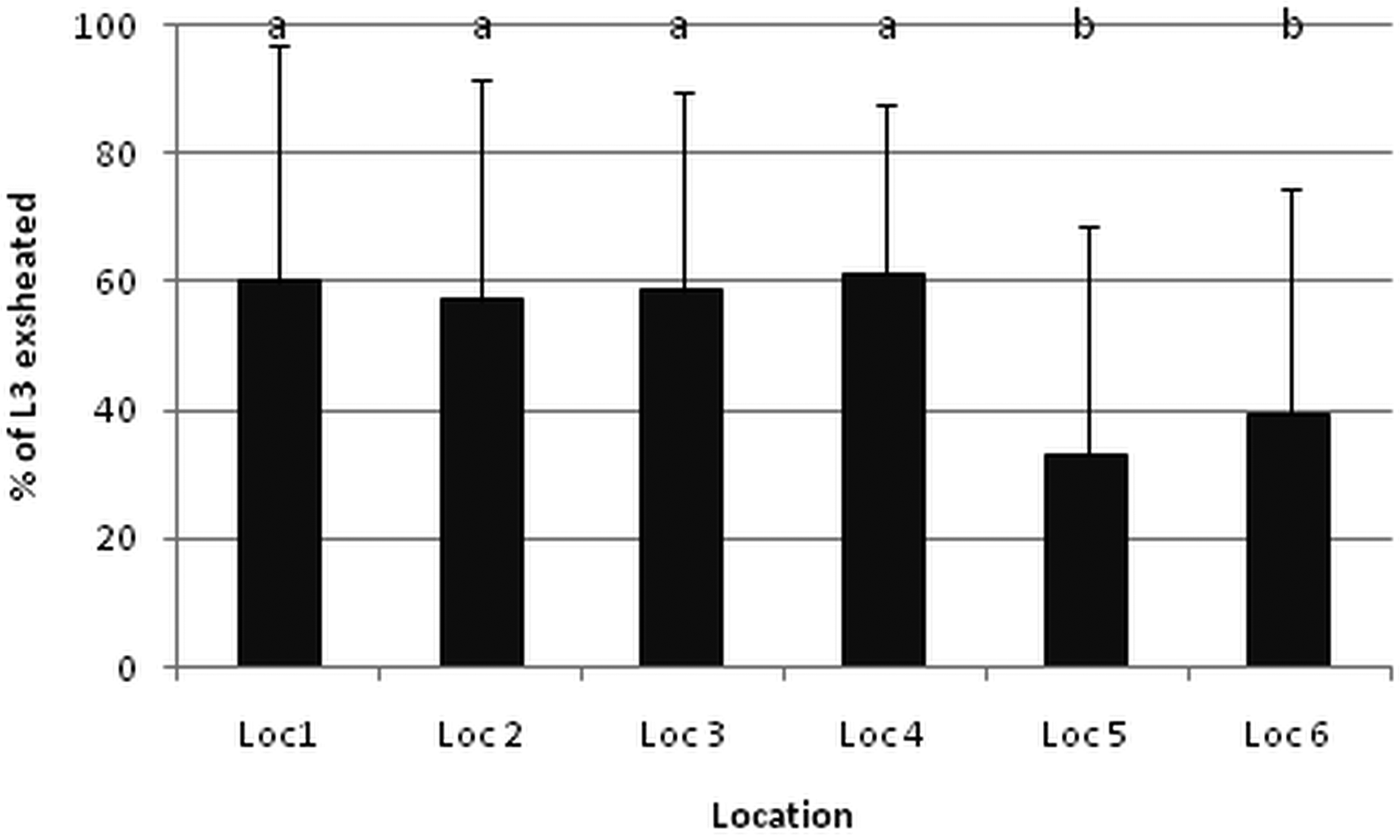
All plant extracts reduced (P < 0·001) the L3 exsheathment. Loc1, Loc2, Loc3 and Loc4 had higher (P < 0·001) larval exsheathment than Loc5 and Loc6 (Fig. 1).
Comparison of the exsheathment LS-means of infective third-stage larvae of Haemonchus contortus for the different Locations. a,bLS-means in the same line with different superscripts differ (P < 0·001).

Phenological stage effect
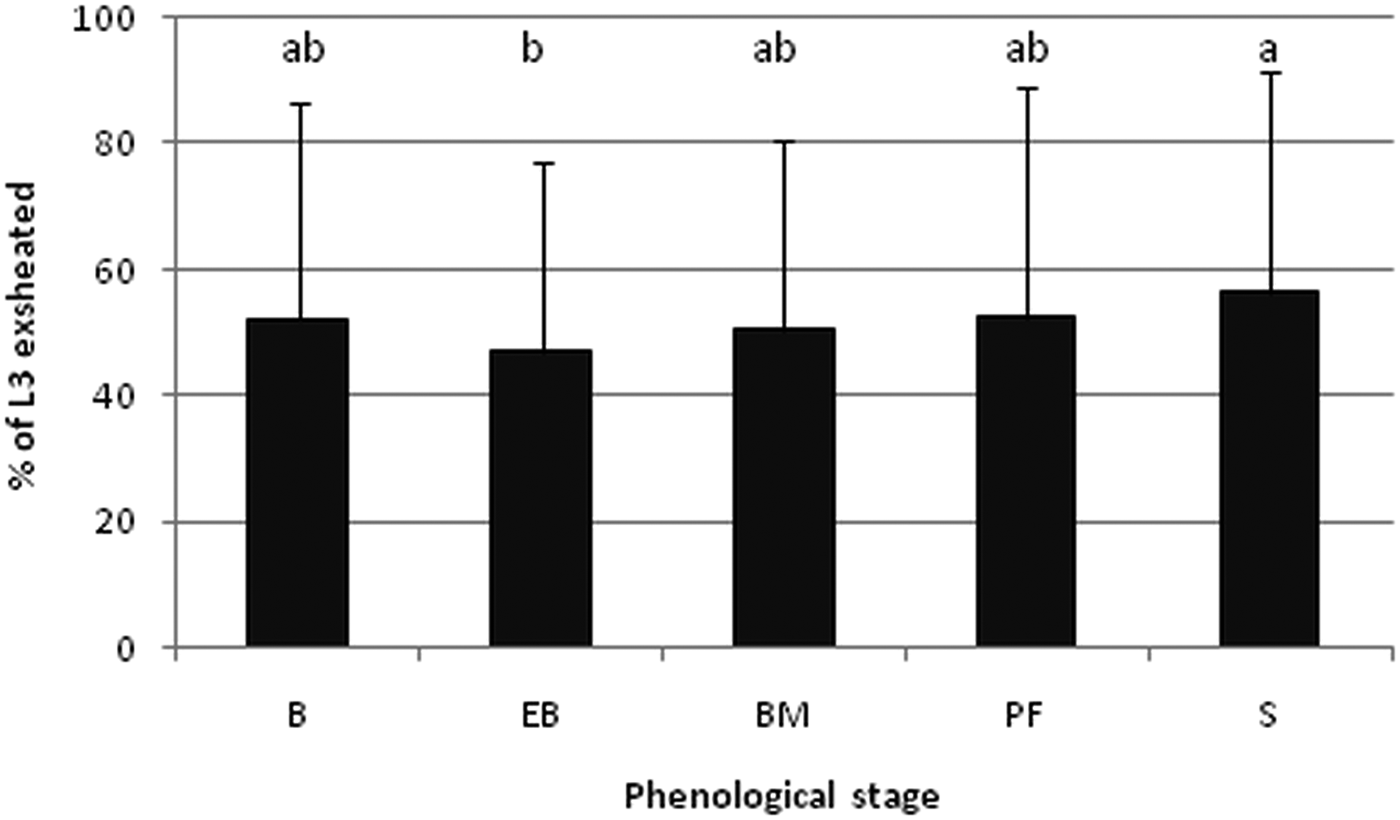
Although the PS effect was not significant, the larval exsheathment showed a tendency (P = 0·0549) (Table 4). However, the % of exsheathment for the S stage tended to be higher than that of stage EB (Fig. 2).
Comparison of the exsheathment LS-means of infective third-stage larvae of Haemonchus contortus for the different phenological stages. a,bLS-means in the same line with different superscripts differ (P < 0·05).

Concentration effect
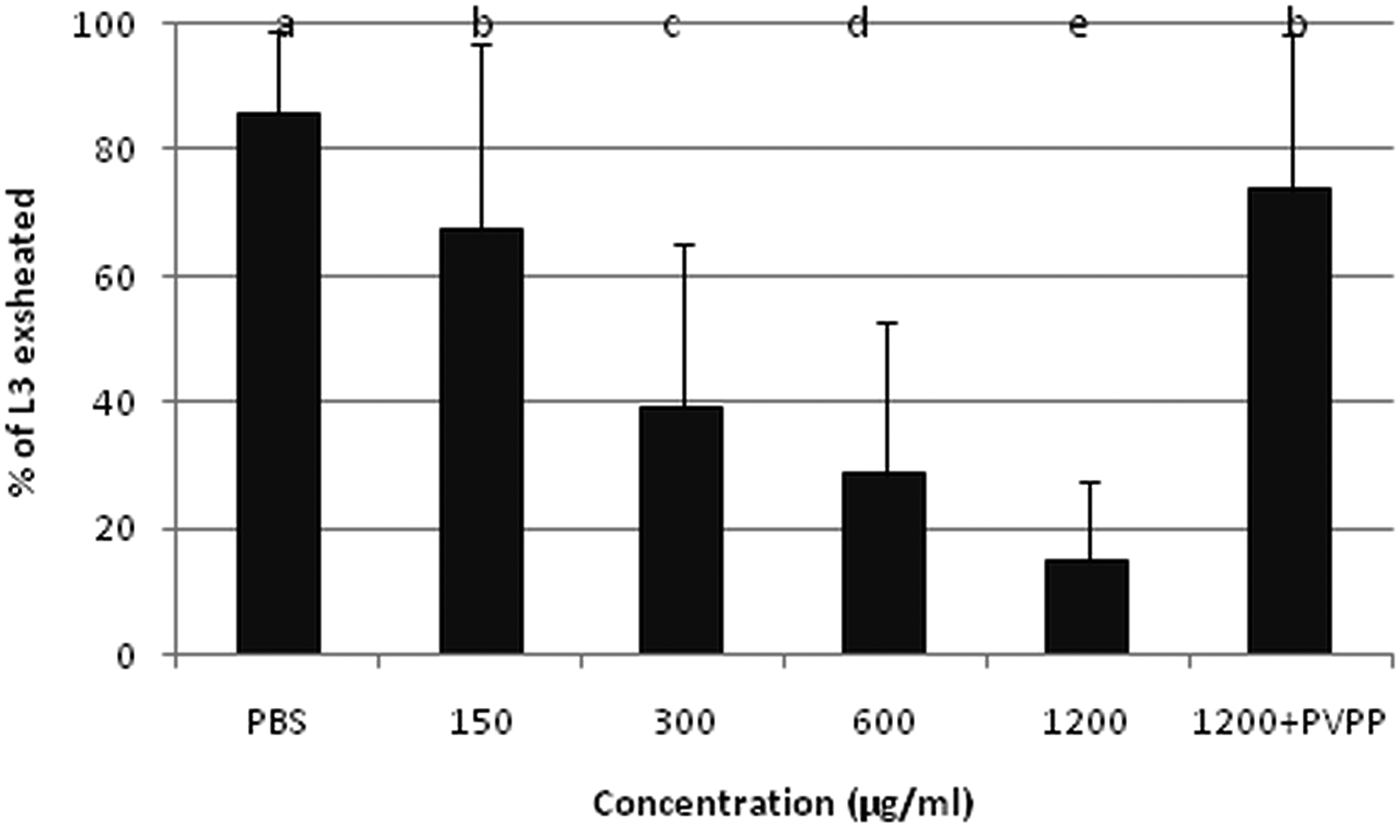
The exsheathment was concentration-dependent (Fig. 3). For PBS, the mean value was 85·87% of L3 H. contortus exsheathed 60 min after contact with the sodium hypochlorite solution. As the concentration increased, the % of exsheathment dropped to 67·52, 39·32, 28·62 and 14·87% for the concentrations 150, 300, 600 and 1200 µg mL−1, respectively. After the addition of PVPP, the % of exsheathment was markedly higher than that of the concentration 1200 µg mL−1, similar to that of the low concentration (150 µg mL−1) and was close to that of PBS.
Comparison of the exsheathment LS-means of infective third-stage larvae of Haemonchus contortus for the different concentrations. a–eLS-means in the same line with different superscripts differ (P < 0·001).

Interactions effects
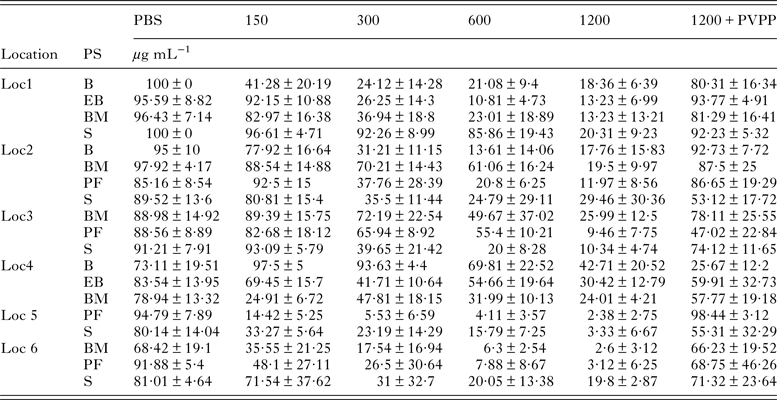
Data from the LEA are summarized in Table 5. The exsheathment values for PBS varied from 68·42% for Loc6(BM) to 100% for Loc1(B). At the highest concentration, the percentage of exsheathed H. contortus ranged from 2·38 for Loc5(PF) to 42·71% for Loc4 (B). Moreover, the extract of Loc1(EB), Loc2(PF), Loc3(PF), Loc4(BM), Loc5(PF) and Loc6(BM) applied at the higher concentration inhibited the process, as almost all the larvae were ensheathed (13·23, 11·97, 9·46, 24·01, 2·38, and 2·6% exsheathed, respectively). In fact, they showed the highest inhibition as compared to the PBS. In contrast, the addition of PVPP to the highest concentration of CT completely reversed the inhibitory effect. The % of exsheathment of PVPP groups were close to PBS and similar to the lowest concentration (150 µg mL−1). For the extracts of Loc1(EB), Loc2(PF) and Loc5(PF), the exsheathment values with PVPP were 93·77, 86·65 and 98·44%, respectively.
Larval Exsheathment values of infective third-stage larvae of Haemonchus contortus of six locations of Hedysarum carnosum extracts at different phenological stage and at different concentrations (mean ± s.d.)

Effective concentration for 50% inhibition
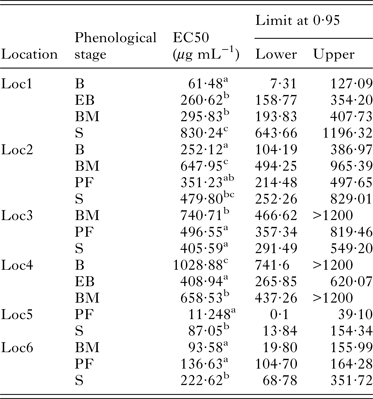
The statistical analyses showed significant (P < 0·05) effects of the PS on EC50 (Table 6). EC50 differed among PS (P < 0·05). The lowest values of EC50 were obtained at the B stage for Loc1 and Loc2, the EB stage for Loc4, the BM stage for Loc6, the PF stage for Loc3 and Loc5 and the S stage for Loc3. EC50 differed among locations. It varied from 93·582 µg mL−1 for Loc6 to 740·714 µg mL−1 for Loc3 at stage BM. For S stage, EC50 values are different but varied from 87·050 µg mL−1 for Loc5 to 830·24 µg mL−1 for Loc1. As EC50 increased, the inhibition of larval exsheathment was less effective.
Effective concentration for 50% inhibition (EC50) of Haemonchus contortus in the Larval exsheathment assay

a–c Means in the same line with different superscripts differ (P < 0·05).
Principal component analysis
The result of the PCA are reflected in Fig. 4. PCA was used as an unsupervised method to assess the relationship between secondary compounds and larval exsheathment at different concentrations among the H. carnosum locations. The first three principal components took into account 79·3% of the total variance. The first component, PC1 representing 43·25% of total variance was positively correlated with EC50, 300, 600 and 1200 µg mL−1 concentration and inversely with CT and TP. PC2 accounted for 21·72% of the total variance. It was positively contributed by TT and PBS. As expected, a close relationship was found between TP and BA. The main results showed a close relationship between 300, 600, 150 and EC50 µg mL−1 values but opposite to 1200 + PVPP μg mL−1, PBS and CT. In addition, the exsheathment values at 1200 µg mL−1 were positively correlated to 300, 600, 150 and EC50 µg mL−1 values (Fig. 4).
(A) Principal plane of interactions obtained from the PCA analysis applied on a matrix of 11 columns (variables) describing the biochemical composition of the plants samples as well as their biological and anthelmintic activities and (B) the biplot of the different plant samples.

The biplot showed that almost all plant samples were in the same scores of the X-axis (PC1) and were relatively close to each other and were clustered in one large group. Some plant samples were isolated from others: Loc1(S) which had the highest TT, Loc4(B) which had the highest values of exsheathment of L3 larvae at 1200 µg mL−1 concentration and Loc6(PF) and Loc5(PF) presented the highest value of CT content.
DISCUSSION
In the current study, the chemical composition of H. carnosum is similar to that reported in other studies. The content of DM at BM stage reported by Tibaoui (Reference Tibaoui2008) differed among ecotypes and could be the result of the variation of climate condition, particularly rainfalls. Our ash content was high and similar to that (24·6%DM) reported by Floret and Pontanier (Reference Floret and Pontanier1982) and Ben M'hamed (Reference Ben M'hamed1990). CP contents of H. carnosum were similar to those reported in previous studies (Ben M'hamed, Reference Ben M'hamed1990; Boussaid et al. Reference Boussaid, Ben Fadhel, Zaouali, Ben Salah, Abdelkefi, Ferchichi and Ferchichi2004; Tibaoui, Reference Tibaoui2008). In comparison to H. coronarium, CP values reported by Martiniello et al. (Reference Martiniello, Laudadio, Pinto and Ciruzzi2000), Niezen et al. (Reference Niezen, Charleston, Robertson, Shelton, Waghorn and Green2002) and Cabiddu et al. (Reference Cabiddu, Molle, Decandia, Spada, Fiori, Piredda and Addis2009) were similar to those in H. carnosum. The high nutritive value of this forage legume boost the capacity of small ruminants to resist to the GIN infection and to enhance the immune response of these animals (Hoste and Torres-Acosta, Reference Hoste and Torres-Acosta2011). In conformity to our findings, Molle et al. (Reference Molle, Decandia, Fois, Ligios, Cabiddu and Sitizia2003) and Cabiddu et al. (Reference Cabiddu, Molle, Decandia, Spada, Fiori, Piredda and Addis2009) reported that NDF, ADF and ADL in H. coronarium increased with the maturity level (i.e. PS progress). These results are in line with the conclusion of Jarrige et al. (Reference Jarrige, Ruckebusch, Demarquilly, Farce and Journet1995) showing that fibre content increases and nitrogen content decreases with the maturity of the plant.
Literature data on the secondary compounds in H. carnosum are lacking. Priolo et al. (Reference Priolo, Bella, Lanza, Galofaro, Biondi, Barbagallo, Ben Salem and Pennisi2005) reported a higher TP content for H. coronarium and similar CT concentrations (1·8 g-equivalent leucocyanidin/100 g DM) than the values obtained on the Location 6 of H. carnosum at PF stage. However, the CT values for H. coronarium reported in other studies in Italy (Molle et al. Reference Molle, Decandia, Fois, Ligios, Cabiddu and Sitizia2003; Cabiddu et al. Reference Cabiddu, Molle, Decandia, Spada, Fiori, Piredda and Addis2009), France (Aufrère et al. Reference Aufrère, Theodoridou and Baumont2012) and New Zealand (Niezen et al. Reference Niezen, Charleston, Robertson, Shelton, Waghorn and Green2002) were higher than the values obtained on H. carnosum. In fact, our values were very low in certain locations. Aufrère et al. (Reference Aufrère, Theodoridou and Baumont2012) reported that the PS of the plant and the environmental conditions, e.g. temperature, rainfall and soil quality, can affect the CT content and the BA. Our observation that CT contents were highest at BM stage, are supported by the findings of Iason et al. (Reference Iason, Hartley and Duncan1993) who affirmed that during the growth phase, the plant produces an important quantity of biomass, and the synthesis of the phenolic compounds is low while during the blooming, the growth is slowed down and the carbon would be available for the synthesis of the CT. But the high values for CT and BA for PF and S stage were in line with the results of Lees et al. (Reference Lees, Gruber and Suttill1995) and Frutos et al. (Reference Frutos, Hervas, Ramos, Giraldez and Mantecon2002). Moreover, water stress (Anuraga et al. Reference Anuraga, Duarsa, Hill and Lovett1993) and light intensity (Mole and Waterman, Reference Mole and Waterman1987) are in general associated with an increase of the synthesis of phenolic compounds by the plant.
Our results showed that (i) H. carnosum extracts had a direct effect on the exsheathment of third-stage larvae, (ii) this effect was location-dependent, phenological stage-dependent and concentration-dependent; (iii) CTs are mainly responsible for this effect.
Brunet et al. (Reference Brunet, Aufrere, El Babili, Fouraste and Hoste2007) reported that the extract of sainfoin showed a concentration-dependent effect on the LEA of L3 larvae, this is in line with our findings. For PBS, the mean percentage of H. contortus exsheated larvae was lower than the value reported by Brunet et al. (Reference Brunet, Aufrere, El Babili, Fouraste and Hoste2007), Alonso-Diaz et al. (Reference Alonso-Diaz, Torres-Acosta, Sandoval-Castro, Capetillo-Leal, Brunet and Hoste2008), Manolaraki (Reference Manolaraki2011) and Oliveira et al. (Reference Oliveira, Bevilaqua, Macedo, Morais, Machado, Campello and De Auino Mesquita2011a , Reference Oliveira, Bevilaqua, Macedo, Morais, Monteiro, Campello, Ribeiro and Batista b ). The exsheathment values at concentrations 150, 300, 600 µg mL−1 were similar to those found by Brunet et al. (Reference Brunet, Aufrere, El Babili, Fouraste and Hoste2007). All plant extracts showed a significant inhibitory effect over 50% at concentration 1200 µg mL−1 supporting the results reported by Manolaraki (Reference Manolaraki2011) with sainfoin. The use of PVPP in our study, suggested that CT present in the plant were responsible for the AH activity. Alonso-Diaz et al. (Reference Alonso-Diaz, Torres-Acosta, Sandoval-Castro, Aguilar-Caballero and Hoste2008b ), Oliveira et al. (Reference Oliveira, Bevilaqua, Macedo, Morais, Machado, Campello and De Auino Mesquita2011a , Reference Oliveira, Bevilaqua, Macedo, Morais, Monteiro, Campello, Ribeiro and Batista b ), and Novobilsky et al. (Reference Novobilsky, Mueller-Harvey and Thamsborg2011) came up to the same conclusion.
The EC50 values obtained on LEA of H. carnosum were higher than EC50 of cattle GIN in the larval feeding inhibition assay of sainfoin, Lotus pedunculatus and Lotus corniculatus (Novobilsky et al. Reference Novobilsky, Mueller-Harvey and Thamsborg2011) and EC50 in ovicidal tests of Myracrodruon urundeuva (Oliveira et al. Reference Oliveira, Bevilaqua, Macedo, Morais, Machado, Campello and De Auino Mesquita2011a ). Many factors could be responsible for these differences, but this is mainly related to the different types of in vitro assays.
The PCA highlighted, the strong relationship between BA of tannins and TP and TT contents rather than CT contents. In addition, the exsheathment values at different concentrations were negatively more related to BA, TP and CT. However, Manolaraki (Reference Manolaraki2011) concluded that AH activity was not significantly related to TT, TP but it is positively correlated to BA. Our in vitro results emphasized that as the concentration of extracts increased the % of exsheathment decreased. Hence, the tannin content of different plant samples caused a variation of the intensity of inhibition of the exsheathment. This delay can be explained by the ability of tannins to bind with the sheath proteins of the nematode larvae (Hoste et al. Reference Hoste, Jackson, Athanasiadou, Thamsborg and Hoskin2006; Brunet et al. Reference Brunet, Aufrere, El Babili, Fouraste and Hoste2007). Indeed, it is suspected that not only CT but also other polyphenols and/or flavonoid glycosides could be involved in the AH activity (Alonso-Diaz et al. Reference Alonso-Diaz, Torres-Acosta, Sandoval-Castro, Capetillo-Leal, Brunet and Hoste2008) and the chemical structure of CT could be one of the factors modulating this antiparasitic efficacy (Hoste et al. Reference Hoste, Jackson, Athanasiadou, Thamsborg and Hoskin2006).
To our knowledge the current study is the first one assessing the AH activity of H. carnosum. The extracts of different locations of this lesser-known legume forage, at different phenological stage have different chemical composition and in vitro anthelmintic activity against H. contortus. These first result should be confirmed in in vivo studies to decide on the potential use of H. carnosum as a promising alternative approach to control GIN infection of sheep.
ACKNOWLEDGEMENTS
Authors are grateful to Dr Tibaoui Gouider from the High School of Agriculture of Mateur (Tunisia) for his advice and support to this study. They extend their thanks to the technical staff of Livestock and Pasture Agency in Monastir and Mahdia governorates who contributed to the identification of the different locations of H. carnosum.
FINANCIAL SUPPORT
This research received no specific grant from any funding agency, commercial or not-for-profit sectors.