Introduction
Patients whose symptoms are regarded as ‘unexplained by disease’ are frequently encountered in all medical settings (Gureje et al. Reference Gureje, Simon, Ustun and Goldberg1997). Synonyms for such symptoms include ‘medically unexplained’, ‘somatoform’ and ‘functional’ (Sharpe, Reference Sharpe2002). Symptoms that are considered by the assessing doctors to be ‘not at all’ or only ‘somewhat’ explained by disease account for about a third of new out-patient visits to secondary medical care services, such as neurology out-patient clinics. They often do not improve after the specialist consultation (Carson et al. Reference Carson, Best, Postma, Stone, Warlow and Sharpe2003) and may become associated with chronic disability (Carson et al. Reference Carson, Ringbauer, Stone, McKenzie, Warlow and Sharpe2000; Kroenke, Reference Kroenke2003). However, we know relatively little about which patient characteristics predict a poor post-consultation outcome for these patients.
Our aim was therefore to determine the patient characteristics that predicted a poor patient-reported 1-year outcome for patients newly referred to neurology out-patient clinics with symptoms that were rated by the assessing neurologist as ‘not at all’ or only ‘somewhat’ explained by disease. Based on previous reports of predictors of subjective outcome in other similar symptomatic conditions, we hypothesized that the following variables would predict poor outcome: greater number of physical symptoms (Speckens et al. Reference Speckens, Van Hemert, Bolk, Rooijmans and Hengeveld1996b); poorer physical functioning (Carson et al. Reference Carson, Best, Postma, Stone, Warlow and Sharpe2003); greater emotional distress (Bombardier & Buchwald, Reference Bombardier and Buchwald1995); general worry about health (Kroenke & Jackson, Reference Kroenke and Jackson1998); the belief that they would not recover (Mondloch et al. Reference Mondloch, Cole and Frank2001); the belief that the symptoms were not affected by psychological factors (Vercoulen et al. Reference Vercoulen, Swanink, Fennis, Galama, Van der Meer and Bleijenberg1996); and being in receipt of illness-related financial benefits (Atlas et al. Reference Atlas, Chang, Keller, Singer, Wu and Deyo2006).
Method
The study was part of the Scottish Neurological Symptom Survey, a prospective, multi-centre, Scottish national study of a representative cohort of newly referred neurology out-patients.
Participating clinics
Of the 38 consultant neurologists working in the four Scottish National Health Service (NHS) neurology centres, 36 participated. Patients were recruited from their general neurology clinics (including their supervised trainee clinics) in the main Scottish neurological centres (at Aberdeen, Dundee, Edinburgh and Glasgow, all in the UK) and some of their associated peripheral clinics (at Airdrie, East Kilbride, Falkirk, Inverness, Perth, Stirling, Vale of Leven and Wishaw, all in the UK) between December 2002 and February 2004. All the clinics sampled took mainly general practice referrals, with patients allocated by medical records staff according to availability of appointment. Specialist clinics, where patients required a suspected specific diagnosis to attend (such as acute neurovascular and multiple sclerosis clinics), were excluded as were ‘urgent case’ emergency clinics.
Patients
All patients newly referred to the participating neurology out-patient clinics were potentially eligible for inclusion. The exclusion criteria were: age <16 years, cognitive impairment of a degree that precluded informed consent, inability to read English, or if the neurologist identified the patient as unsuitable for the study (for example, too distressed or terminally ill). New patients included patients with existing neurological diagnoses who had been re-referred from primary care. Patients gave informed consent to be included in the study. We studied patients whom the neurologist had rated as having symptoms ‘not at all’ or only ‘somewhat’ explained by disease (see below).
Procedure
Patients were sent information about the study prior to their appointment with the neurologist. After the consultation the patients were invited by their neurologist to speak to a research assistant. Written consent was obtained from those patients willing to participate. A rating of how explained the symptoms were by disease was obtained from the assessing neurologist (see below). Baseline data were collected from the patients immediately after the initial consultation using a questionnaire. At 1 year after the initial consultation, outcome data were sought from the patients by questionnaires posted to their homes. Patients who failed to respond were sent another copy of the questionnaire and those who still failed to respond were contacted by telephone and reminded. Questionnaires were completed by telephone interview if necessary.
Measures
Completed by neurologists
The neurologists completed a questionnaire for each patient which asked, ‘To what extent do you think this patient's clinical symptoms are explained by organic disease?’ Responses were made on a four-point Likert-type scale: ‘not at all’, ‘somewhat’, ‘largely’ or ‘completely’ (Carson et al. Reference Carson, Ringbauer, Stone, McKenzie, Warlow and Sharpe2000). Operational criteria were provided to guide these ratings (see Appendix). Patients whose symptoms were rated as ‘not at all’ or only ‘somewhat’ explained were combined to make a category of ‘symptoms unexplained by disease’.
Completed by patients
The measures listed below were collected from the patient by questionnaire immediately after the initial consultation:
(1) Demographics: age, sex and marital status.
(2) Number of physical symptoms. This was measured using the Patient Health Questionnaire checklist of the 15 commonest physical symptoms presenting to primary care (excluding upper respiratory tract infections) and with the sexual and menstrual items removed to leave 13 items (Kroenke et al. Reference Kroenke, Spitzer and Williams2002). In order to see if the inclusion of neurological symptoms made a difference we created a longer symptom score by supplementing these items with nine symptoms common in neurology patients judged to have symptoms unexplained by disease (Lempert et al. Reference Lempert, Dieterich, Huppert and Brandt1990) to make a 22-item scale. The total number of symptoms endorsed on each scale was calculated for each patient.
(3) Physical function. This was measured using the physical function subscale of the Medical Outcomes Study Short-Form 12-item Scale (SF12) (Ware et al. Reference Ware, Kosinski and Keller1996).
(4) Emotional distress. This was measured by the total score on the Hospital Anxiety and Depression Scale (HADS) (Zigmond & Snaith, Reference Zigmond and Snaith1983).
(5) Illness beliefs. Two categories of belief were assessed:
(a) patients' beliefs about outcome were measured using an item from the Illness Perceptions Questionnaire (IPQ; Weinman et al. Reference Weinman, Petrie, Moss-Morris and Horne1996): ‘My symptoms are likely to be permanent rather than temporary’. Responses were made on a five-point Likert scale (‘strongly agree’, ‘agree’, ‘neither agree nor disagree’, ‘disagree’, ‘strongly disagree’). The responses ‘agree’ and ‘strongly agree’ were combined to indicate an expectation of poor outcome.
(b) patients' attribution of symptoms to psychological factors was measured using two other items from the IPQ. These were: ‘Possible causes of my symptoms are stress or worry’ and possible causes of my symptoms are ‘My emotional state e.g. feeling down, lonely, anxious or empty’. Responses were on a similar five-point Likert scale and those who recorded ‘agree’ and ‘strongly agree’ on either item were coded as having made a psychological attribution.
Patients' worry about health was assessed using the three items from the Whiteley Index (Speckens et al. Reference Speckens, Spinhoven, Sloekers, Bolk and Van Hemert1996a): ‘Do you worry a lot about your health?’, ‘Do you often worry about the possibility you have a serious illness?’ and ‘If a disease is brought to your attention (e.g. on television, radio, newspapers, or by someone you know), do you worry about getting it yourself?’. Each item was scored as present or absent and a total score (0–3) calculated with a greater score indicating more worry.
Receipt of health-related financial benefits (incapacity benefit or disability living allowance) was recorded from patients' self-report.
At follow-up, patients were asked to complete a five-point self-rated scale of Clinical Global Improvement (CGI) which asked the patients to compare their current ‘general health’ with that when they first attended the neurology clinic on a five-point scale (‘much worse’; ‘worse’; ‘not changed’; ‘better’; ‘much better’) (Guy, Reference Guy1976). They were also asked to make the same rating for improvement in their presenting symptoms (IPS).
Analysis
First we computed the mean baseline symptoms score, SF12 physical function score and total HADS score for the full sample and compared the whole baseline sample with those on whom we had follow-up data using t tests and χ2 tests as appropriate. We then described outcome on the CGI and IPS scales. The CGI health score was used to define two groups: good outcome (CGI: ‘much better’ or ‘somewhat better’) and poor outcome (CGI: ‘just the same’, ‘somewhat worse’, ‘much worse’).
We determined predictors of poor outcome using logistic regression models to describe the relationship between the baseline covariates and outcome. This was done by calculating both univariate and fully adjusted multivariate odds ratios, and the corresponding 95% confidence intervals. Continuous and ordinal variables were grouped rather than making the strong assumption of linear relationships between the measure and the log odds of poor outcome. When the grouped odds ratios did clearly show a linear effect, we ran sensitivity analyses taking the corresponding variables as continuous. We quantified the proportion of the variability in outcome explained by the regression models using Nagelkerke's R 2, an analogue for logistic regression of R 2, the coefficient of determination.
Ethical approval
Ethical approval for the study was granted by a Multi-centre Research Ethics Committee.
Results
Recruitment and follow-up
Recruitment is described in Fig. 1. A total of 3781 patients participated in the study representing 91% (3781 out of 4161) of those attending the designated clinics. Neurologists rated 1144 of these patients (30% of the total) as having symptoms that were unexplained by disease [446 out of 3781 (12%) were ‘not at all explained’ and 698 out of 3781 (18%) were ‘somewhat explained’ by disease].
Study flow chart.

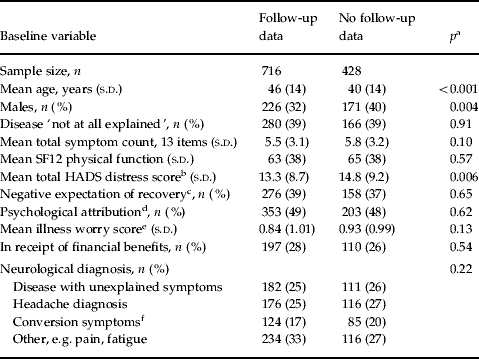
The 12-month outcome data were available on 716 (63%) out of the 1144 of the recruited sample. This analysed sample was similar to the initial sample on most measured variables but had fewer males and a lower average HADS score (see Table 1). Although statistically significant, the differences on these variables were not substantial.
Description of baseline variables of patients with symptoms unexplained by disease, on which 12-month data were available, compared with those patients on whom these data were missing

s.d., Standard deviation; HADS, Hospital Anxiety and Depression Scale; SF12, Medical Outcomes Study Short-Form 12-item Scale.
a Means were compared using t tests and the other variables were compared using χ2 tests.
b Total HADS is the sum of the depression and anxiety scales.
c Negative expectation of recovery was defined as ‘agree’ and ‘strongly agree’ with the statement ‘My symptoms are likely to be permanent rather than temporary’.
d Psychological attribution was defined as ‘agree’ and ‘strongly agree’ to at least one of the following statements: ‘Possible causes of my symptoms are stress or worry’ or ‘My emotional state e.g. feeling down, lonely, anxious or empty’.
e On scale of 0 to 3, with a greater score indicating more worry.
f Weakness, sensory symptoms, attacks resembling epilepsy or movement disorders considered unexplained by disease.
Outcome
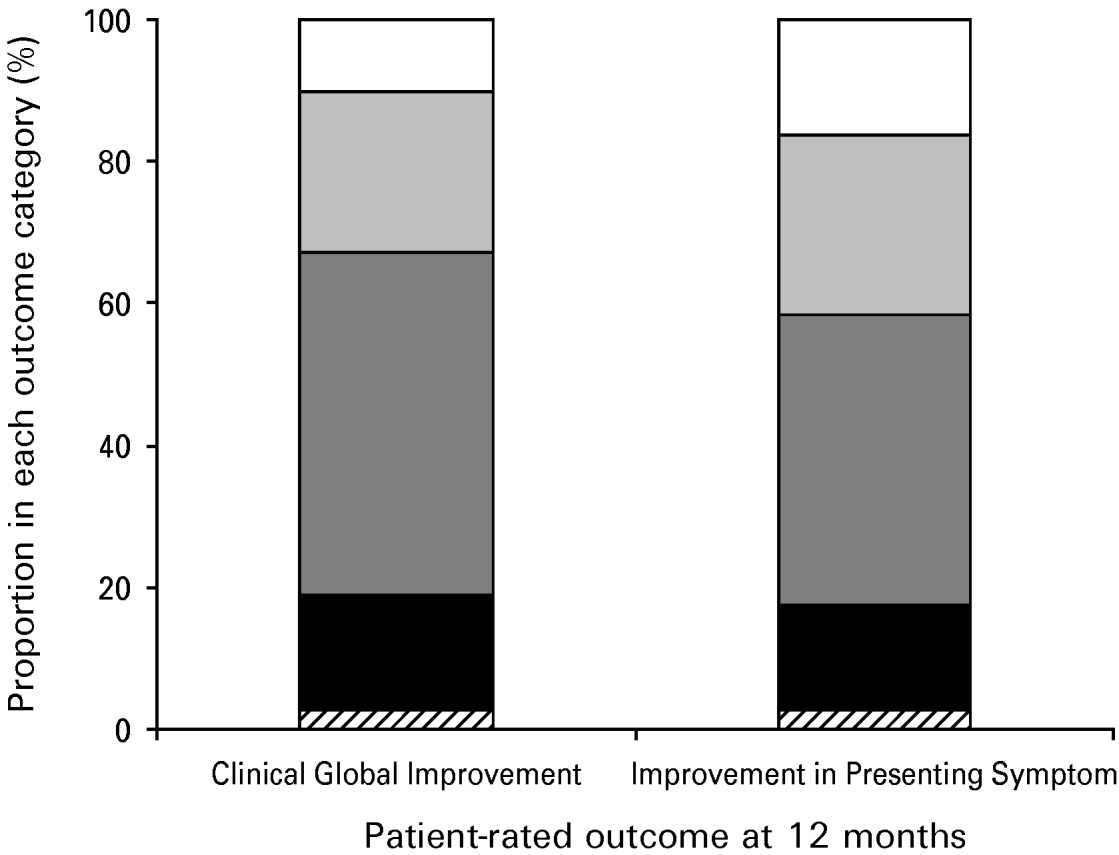
At follow-up, poor outcome (‘unchanged’, ‘worse’ or ‘much worse’) was reported by 482 (67%) out of 716 patients on the CGI and by 422 (59%) out of 714 patients on the IPS. All categories of outcome are shown in Table 2 and Fig. 2.
Patient-rated outcome (□, much better;  , better;
 , no change; ▪, worse;
 , much worse) at 12 months on ‘Clinical Global Improvement’ and ‘Improvement in Presenting Symptom’ Likert scales.

Outcome at 12 months on Clinical Global Improvement scale (n=716) and on Improvement in Presenting Symptom scale (n=714)

Predictors of poor outcome
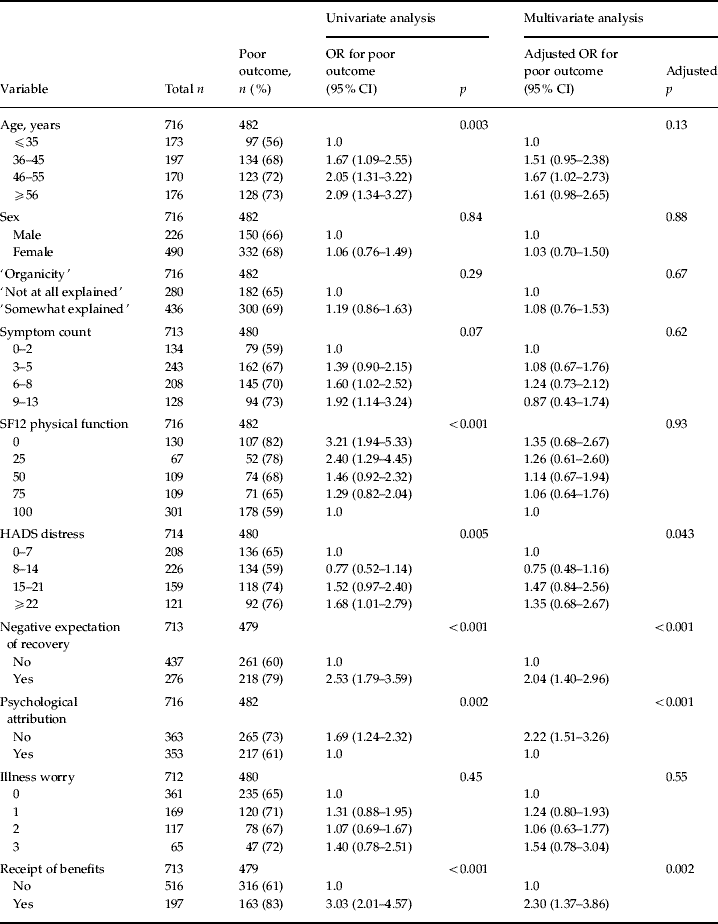
In the univariate analysis (see Table 3) poor outcome, as measured by the CGI health score, was predicted by older age, poorer physical functioning, greater symptom count, greater emotional distress, an expectation of non-recovery, not attributing symptoms to psychological factors and the receipt of health-related financial benefits measured at the initial assessment. Sex and worry about health did not predict outcome. (In a sensitivity analysis treating the grouped variables as continuous the only substantive change was for symptom count, where the p value decreased from 0.07 to 0.002.)
Univariate and multivariate analysis of predictors of poor outcomeFootnote a at 12 months

OR, Odds ratio; CI, confidence interval; SF12, Medical Outcomes Study Short-Form 12-item Scale; HADS, Hospital Anxiety and Depression Scale.
a Global Clinical Improvement rated as ‘just the same’, ‘somewhat worse’ or ‘much worse’.
In the multivariate analysis (see Table 3) the only strong independent predictors of a poor outcome were the patients' beliefs in expectation of non-recovery, non-attribution of symptoms to psychological factors, and the receipt of health-related financial benefits at the time of the initial consultation. Each of these three factors was associated with approximately a doubling of the odds of a poor outcome. The HADS emotional distress score was of only borderline statistical significance (p=0.043) and without a clear ‘dose–response’ effect. When the grouped variables were included in the model as being continuous, the p value for the HADS distress score changed to 0.14, and the p value for age to 0.045. Substituting the 22-item symptom score (with additional neurological symptoms) for the 13-item score made no substantial difference to the model, indicating that adding common neurological symptoms to the score made no difference.
Nagelkerke's R 2 was 13% for the model including only the three strong independent predictors and was 16% for the full multivariate model including all of the 10 variables listed in Table 3. Thus, although each of the three highlighted variables were independently associated with approximately a doubling of the odds of a poor outcome, they collectively accounted for only a small proportion of the variability in outcome. The remaining seven variables added very little predictive power. This also demonstrates that the lack of statistical significance of the additional variables in the multivariate model was not due to correlated covariates masking the effects of each other.
Discussion
This is, to our knowledge, the first large prospective multi-centre study of predictors of outcome for neurology out-patients with symptoms rated as unexplained by disease. We found that the outcome for these patients was surprisingly poor; only a third rated themselves as improved in health 1 year after the initial neurology consultation. Poor outcome was best predicted by the patients' own beliefs (about the likely outcome of their symptoms, and the role of psychological factors in causing them), and by the reported receipt of health-related financial benefits. Contrary to our initial hypotheses, outcome was not independently predicted by the baseline number of physical symptoms that patients reported, the reported severity of their disability, the degree of emotional distress or by their reported general worry about health. Nor was it explained by the degree to which the neurologist regarded the symptoms to be unexplained by disease.
The main strength of this study is that it included a large representative sample of new neurology out-patients. All four Scottish neurology centres (serving a population of five million people), almost every Scottish neurologist and most (91%) of the eligible patients participated. The initial sample can therefore be regarded as representative of out-patient general neurological practice, at least in the UK NHS.
The study also had limitations: First, we did not achieve complete follow-up; despite our best efforts we were unable to obtain outcome data from 37% of the sample. There were, however, no substantial baseline differences between those on whom we did have outcome data and those with missing data (not surprisingly those with missing data included a greater proportion of younger persons and males). Furthermore, selection bias with respect to the covariates is less of a limitation for regression modelling than it is for estimating event rates. Second, it might be argued that poor outcome may in some cases have been due to the development of disease. This was not the case, however (data reported elsewhere). Furthermore, the degree to which symptoms were explained by disease at baseline did not predict outcome. Third, we did not obtain a systematic description of treatment given by neurologists or others in the interval between baseline and follow-up. However, the study represents the naturalistic outcome for such patients in NHS practice and the evidence we do have suggests that few specific treatments were given. Fourth, although each of the three main variables in our multivariate model was associated with doubling the odds for poor outcome, together they only accounted for a modest amount of variance in outcome. This probably reflects the complexity of factors that determine outcome for patients with this diagnosis. Fifth, there are other potential predictors of outcome that we did not measure. For example, recently published studies of symptom outcome have included a wider range of patient illness beliefs (Frostholm et al. Reference Frostholm, Oernboel, Christensen, Toft, Olesen, Weinman and Fink2007; Foster et al. Reference Foster, Bishop, Thomas, Main, Horne, Weinman and Hay2008), whereas others have highlighted the role of duration of symptoms, patient personality, or changes in personal relationships, family problems and social circumstances in predicting outcome (Craig et al. Reference Craig, Drake, Mills and Boardman1994; Crimlisk et al. Reference Crimlisk, Bhatia, Cope, David, Marsden and Ron1998; Reuber et al. 2007 b), none of which we measured. Sixth, we measured the outcome with a global self-rated measure of improvement. Whilst the patients' rating of improvement in their main symptoms was similar, it was not identical and other more specific measures such as that of other symptoms or disability may have given different results (Reuber et al. Reference Reuber, Mitchell, Howlett and Elger2005). In addition, ratings by persons other than the patient, such as the physician or a family member, or more ‘objective’ outcomes such as return to work may also have produced different results.
Other studies have reported a poor outcome for patients who present with symptoms unexplained by disease (Speckens et al. Reference Speckens, Van Hemert, Bolk, Rooijmans and Hengeveld1996b). This has especially been the case for patients who have been referred to specialist medical services (Couprie et al. Reference Couprie, Wijdicks, Rooijmans and van Gijn1995; Barsky et al. Reference Barsky, Ahern, Bailey and Delamater1996; Vercoulen et al. Reference Vercoulen, Swanink, Fennis, Galama, Van der Meer and Bleijenberg1996; Crimlisk et al. Reference Crimlisk, Bhatia, Cope, David, Marsden and Ron1998; Carson et al. Reference Carson, Best, Postma, Stone, Warlow and Sharpe2003). However, we know little about what patient characteristics predict poor outcome. The finding that patients' beliefs about their symptoms were strong independent predictors of outcome, whereas variables such as number of reported symptoms and self-rated disability was not, surprised us. There is, however, evidence from studies of other conditions that patients' beliefs about their illness can predict outcome (Petrie et al. Reference Petrie, Jago and Devcich2007). The belief that one will not recover has been found to predict poor subjective outcome for patients suffering from pain and patients who have had surgery, a myocardial infarction or a major injury (Mondloch et al. Reference Mondloch, Cole and Frank2001; Cole et al. Reference Cole, Mondloch and Hogg-Johnson2002; Holm et al. Reference Holm, Carroll, Cassidy, Skillgate and Ahlbom2008). Whilst this association might simply reflect patients repeating the prognostication given to them by their doctors, this seems an unlikely explanation for symptoms unexplained by disease. These predictions are therefore likely to be the patients' own. The power of the patients' own prediction might mean that they are able to predict their outcome because of personal knowledge. It is also possible that such a belief plays a causal role in shaping outcome by acting as a self-fulfilling prophecy; that is if a person starts to think and behave as if they have a permanent illness, that is what they actually get.
The other belief that predicted outcome in our study was non-attribution of symptoms to psychological causes. This has been previously reported to predict outcome for patients with the chronic fatigue syndrome (Joyce et al. Reference Joyce, Hotopf and Wessely1997) and also for patients with non-epileptic attack disorder (Ettinger et al. Reference Ettinger, Devinsky, Weisbrot, Ramakrishna and Goyal1999). The failure of patients to agree with the doctor in attributing somatic symptoms to psychological causes is the essence of the idea of somatization (Lipowski, Reference Lipowski1987). The concept is, however, now widely regarded as overly simplistic, as chronic somatic symptoms, whether associated with disease or not, are all likely to have multiple biological, psychological and social perpetuating factors (Sharpe et al. Reference Sharpe, Mayou and Walker2006). A tendency not to make a link between symptoms and stress or emotional problems could, however, contribute to a poor outcome by leading to a failure to address relevant psychological and social problems.
The finding that being in receipt of financial benefits at the time of the initial consultation also predicted poor outcome will perhaps not come as a surprise to many clinicians. The receipt of such benefits has been reported to predict a poorer outcome in patients with a wide range of conditions both unexplained and explained by disease. They include back pain associated with a herniated lumbar disc (Atlas et al. Reference Atlas, Chang, Keller, Singer, Wu and Deyo2006), closed head injury (Binder & Rohling, Reference Binder and Rohling1996) and neck pain (Landers et al. Reference Landers, Cheung, Miller, Summons, Wallmann, McWhorter and Druse2007). Whilst the explanation for this association remains uncertain, a causal relationship is supported by a study of whiplash injury which found that absence of compensation was associated with quicker subjective recovery (Cassidy et al. Reference Cassidy, Carroll, Cote, Lemstra, Berglund and Nygren2000), and a pilot study of psychotherapy for neurological symptoms unexplained by disease found that financial benefits predicted poorer outcome from treatment (Reuber et al. 2007 a). Hence, it is possible that payment consequent on having symptoms and disability acts to perpetuate them.
We also found that some of our hypothesized predictors did not independently predict poor outcome. The number of somatic symptoms that the patient reports has been a key variable in differentiating somatoform disorders from simple symptoms problems (Mayou et al. Reference Mayou, Kirmayer, Simon, Kroenke and Sharpe2005) and has previously been found to predict outcome in medical patients (Jackson & Passamonti, Reference Jackson and Passamonti2005; Jackson et al. Reference Jackson, Fiddler, Kapur, Wells, Tomenson and Creed2006). We found it to be a predictor of outcome but only in the univariate analysis (and if entered as a continuous variable); it dropped out of the multivariate model. Similarly, poorer physical functioning and greater emotional distress were predictors in the univariate analysis but did not contribute to the multivariate model (HADS did but only in a minor and non-linear fashion). General worry about health predicted in neither model. Hence, specific patient-reported illness beliefs and receipt of benefits proved to be better predictors of patients' outcome than these more general patient characteristics of symptoms, distress and functioning which are more commonly recorded at assessment.
The finding of an association of poor subjective outcome with specific beliefs and being in receipt of health-related financial benefits in patients with symptoms unexplained by disease has important implications. First, asking about these factors may assist the assessing clinician in predicting poor outcome 1 year later. Second, they may point the way to a greater understanding of the psychological and social mechanisms that determine poor outcome. Third, they lend support to the idea that interventions which change these variables may improve the outcome for this patient group. As well as providing theoretical underpinning for the application of cognitive behaviour therapy (Kroenke & Swindle, Reference Kroenke and Swindle2000) they suggest that doctors should take time to discuss their patients' own beliefs about their illness. Similarly they emphasize that those policies that determine health-related financial benefits may need to be amended if we are to maximize the chance of recovery (Waddell et al. Reference Waddell, Burton and Aylward2007).
Conclusion
A large proportion of patients assessed by a neurologist as having symptoms not at all or only somewhat explained by disease had a poor self-rated outcome a year after the initial specialist consultation and this was predicted by the patients' beliefs and receipt of financial benefits.
Appendix
Guidance given to doctors on ‘What we mean by organic disease’
The following is meant as a guide for this study and we are aware that any divisions like this are imperfect. Many patients have a mixture of symptoms, syndromes or disease and the final coding is your decision based on these guidelines.
‘Not organic disease’
For the purpose of this study this includes: tension headache; aetiologically controversial symptom ‘syndromes’ (e.g. fibromyalgia, irritable bowel syndrome); physiologically explained processes which are thought to be linked to emotional symptoms (e.g. hyperventilation); emotional disorders (e.g. depression, anxiety, panic disorder).
‘Organic disease’
For the purpose of this study this includes: migraine; any neurological disorder with a known pathological basis; neurological disorders with defined and characteristic features but without a clear pathological basis (e.g. Gilles de la Tourette syndrome, idiopathic focal dystonia); physiological explained processes NOT linked to emotional symptoms (e.g. micturition syncope); psychotic disorder.
Acknowledgements
We thank the staff and patients of the participating clinics and all the neurologists and general practitioners who took part in this study: S. Tennant, L. Alder, J. Sim, M. Selkirk, D. McConachie – the researchers who administered the questionnaires.
Declaration of Interest
This work was supported by the Scottish Chief Scientist Office and NHS Quality Improvement Scotland (QIS). None of the authors has any relevant financial interests.