1. Introduction
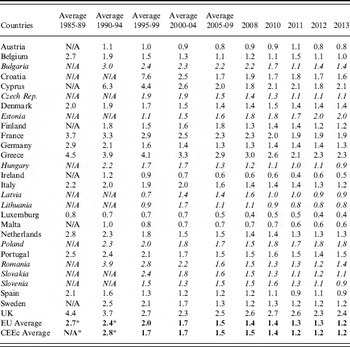
With the end of the Cold War, countries that were actively involved in it reduced their military expenditures. Similarly, the armies were downsized and military industries were mostly converted to civilian production. It is also well known that at the end of the Cold War European countries cut, sometimes radically, their military budgets, as did the rest of the world. Liberti argues that the leaders of these countries thought they could reallocate precious resources to other areas of public expenditure, which were electorally more promising.Reference Liberti 1 The share of military expenditures in GDP for the average of the European Union (EU, hereafter) countries 2 had been 2.7% over the periods 1985–1989. This figure fell to 1.2% in 2013. The share of military expenditures in GDP for the average of Central and Eastern European countries 3 (CEEc, hereafter) had been 2.8% over the period 1990–1994, the oldest period for which data are available. It fell to 1.2% in 2013 (see Table 1).
Military spending as a share of GDP in EU.

Source: Financial and Economic Data Relating to NATO Defence, 24 February 2014, p. 6 (available at http://www.nato.int/nato_static/assets/pdf/pdf_topics/20140224_140224-PR2014-028-Defence-exp.pdf); Financial and Economic Data Relating to NATO Defence, 13 April 2012, p. 6 (available at http://www.nato.int/nato_static/assets/pdf/pdf_2012_04/20120413_PR_CP_2012_047_rev1.pdf); SIPRI, Military Expenditures Database (available at http://milexdata.sipri.org/).
* These figures are calculated despite some data being unavailable. The italic figures denote the CEEc while the bold figures denote the panel averages.
Note: The reason why 2008 is included in the table is to compare the periods by using a date that was before the budgetary crisis hit European countries. It is seen in the table that the military expenditures/GDP ratio had been declining even before the 2009 crisis in Europe.
Military expenditure–economic growth literature includes a large number of studies on single countries (for example: Iran, China, Spain, etc.) as well as on multi-country cases (for example: OECD, Sub-Saharan Africa, the EU, etc). To the best of our knowledge, however, there is no empirical study on this issue covering CEEc. FontanelReference Fontanel 4 is of the opinion that the evolution of military expenditures in CEEc is difficult to estimate and to compare, due to the lack of available data for these states. Nonetheless, for the post-Cold War period it is possible to gather relevant data. Therefore, the aim of this paper is to investigate the empirical relationship between military expenditures and economic growth in the case of CEEc for the post-Cold War era.
Following the introduction, the rest of the paper is organized as follows: related literature will be reviewed in the second part, the econometric model and the data will be described in the third part, the methodology and the findings will be presented in the fourth part, and we finish with a general conclusion.
2. Review of Literature
Two papers by Benoit are considered to be the first in the military expenditure–economic growth literature using different countries or groups of countries as case studies.Reference Benoit 5 Since then, there have been some studies based on theoretical discussion (see, for example: Deger and Sen,Reference Deger and Sen 6 Joerding,Reference Joerding 7 Lidström et al. Reference Lidström, Lyttkens and Vedovato 8 ). These studies use various time periods and methodologies, and arrive at extensive policy implications. Our review of the existing literature will fall into three parts.
First, the military expenditure–economic growth relationships have been studied for countries or groups of countries. Dicle and Dicle,Reference Dicle and Dicle 9 covering 65 countries, Chang et al.,Reference Chang, Huang and Yang 10 covering 90 countries, and Topcu and Aras,Reference Topcu and Aras 11 covering 15 superpowers of the world, use extensive samples. Pan et al.,Reference Pan, Chang and Wolde-Rufael 12 Ahmed,Reference Ahmed 13 Al-Yousif,Reference Al-Yousif 14 and Wijeweera and Webb,Reference Wijeweera and Webb 15 have studied the Middle East, Sub-Saharan Africa, the Arab Gulf, and South Asia. Examples of studies that have taken international organizations as their starting point are Cappelen et al. Reference Cappelen, Gleditsch and Bjerkholt 16 for the OECD, Hassan et al. Reference Hassan, Waheeduzzaman and Rahman 17 for SAARC, Hirnissa and BaharomReference Hirnissa, Habibullah and Baharom 18 for ASEAN 5, and Chang et al. Reference Chang, Lee, Hung and Lee 19 for China and the G7.
Second, there exist a great number of studies focusing on the EU. Kollias et al. examine the relationship between military budgets and growth among EU15 members employing cointegration and causality tests over the period 1961–2000.Reference Kollias, Manolas and Paleologou 20 The direction of causality is from economic growth to military expenditure. Dunne and Nikolaidou analyse the relationship between military expenditures and economic growth over the period 1960–2002 for Greece, Portugal and Spain – all of them peripheral economies of Europe – using the VAR model.Reference Dunne and Nikolaidou 21 Findings indicate that no general empirical conclusions can be drawn for these countries due to their heterogeneous structures. Kollias et al. examine the link between growth and military budgets in the EU15 using panel data techniques for the period from 1961 to 2000.Reference Kollias, Mylonidis and Paleologou 22 Findings show a positive feedback between the variables in the long run, and that military expenditures have a positive effect on economic growth in the short run. Using panel data analysis over the period 1960–2000 Mylonidis finds that military spending has an overall negative effect on growth and that the magnitude of this negative impact tends to rise over time.Reference Mylonidis 23 Nikolaidou tries to investigate the dynamics of military expenditures in the EU15 over the period 1961–2005 applying an ARDL approach.Reference Nikolaidou 24 She found there to be very little uniformity in the factors that determine each country’s demand of military burden, something that needs to be borne in mind by policy makers when burden-sharing issues are regarded in the development of the Common European Security and Military Policy. Kollias and Paleologou investigate the nexus among growth, investment and military expenditures in the EU15 over the period 1961–2002 by using panel models and a trivariate VAR model.Reference Kollias and Paleologou 25 The results did not seem to point to any consistent quantitative relation between military spending and either growth or investment. Dunne and Nikolaidou examine the relationship between military spending and economic growth in EU15 over the period 1961–2007 by applying an augmented Solow–Swan model.Reference Dunne and Nikolaidou 26 Their findings indicate that military spending does not have a positive effect on member states; hence, military expenditures do not stimulate growth in the region. Topcu and Aras using cointegration and causality analyses, investigate the nexus between military expenditures and economic growth in the EU21, so including Bulgaria, Hungary, Poland and Romania.Reference Topcu and Aras 27 Their findings indicate that the end of the Cold War had a significant negative impact on military spending of these East-European countries. Topcu et al. investigated the relationship between military expenditures and economic growth in the context of the new and old members of the EU.Reference Topcu, Aras and Erdogan 28 This study, the only one to cover the entire EU28, finds that a growth detriment hypothesis is valid in the short run both for the old and the new members. As to the long run, from the feedback already available for the old members, a growth detriment hypothesis is likewise valid in the case of the new members.
Third, it is possible to find a limited set of data on CEEc. Crane examined the military expenditures in the national income accounts of Czechoslovakia, Hungary and Poland and compared these with the estimated expenditures for those countries.Reference Crane 29 He found that the estimated expenditures are roughly equal to the published budgets, suggesting that relevant military spending may reflect nearly all actual expenditures. Fontanel concluded that the disarmament process needs a special analysis of the arms industryReference Fontanel 4 when it comes to military expenditures in CEEc. Bojnec presented an analysis of the characteristics of the macroeconomic vision of the Slovenian military market on the micro-level Slovenian military enterprise market outlets.Reference Bojnec 30 The results show that the Slovenian military technological and industrial base enterprises are strongly associated with the domestic market in primary production, supply-in-return and subcontracting activities.
3. Model and Data
Based on the discussions above, economic growth is described as a function of military expenditures. The empirical model in the log-log form is accordingly specified as follows:
 $${\rm ln}\,EG_{it}\,{\equals}\,\alpha _{0i}{\plus}\alpha _{1i}\,{\rm ln}\,milex_{t}{\plus}{\varepsilon}_{it}$$
where the left-hand-side variable (EG i ) is economic growth (i=1,…,10) and the right-hand-variable (milex) is the military expenditure. Economic growth is represented by GDP per capita in current prices in US$. On the other hand, military expenditures are military expenditures per capita in current prices in US$. The general impact of military expenditures on economic growth is expected to be positive because of a Keynesian multiplier effect, the development of infrastructure, etc. In some empirical applications, however, military expenditures are found to have a negative effect because of their crowding-out effect. From this, the defence economics literature concludes that the net influence of military expenditures on economic growth is ambiguous.
The data used in what follows span the years 1993 to 2013. Our source for military data is the Stockholm International Peace Research Institute (SIPRI) military database. Growth data have been gathered from the World Bank World Development Indicators. 31
4. Methodology and Empirical Findings
This paper employs panel unit root, cointegration and causality approaches to investigate the nexus between military expenditures and economic growth. The literature on panel data econometrics has rapidly developed since the 1990s. As mentioned by Banerjee and Silvestre, the underlying reason for this is that the power of unit root and cointegration tests may be increased by combining the information that comes from the cross-section (i=1,…,N) and the time (i=1,…,T) dimensions.Reference Banerjee and Silvestre 32
The empirical framework consists of three steps. First, stationary investigations are tested by applying panel unit roots. Second, the cointegration relationship is investigated employing panel cointegration methods. Finally, the causal running between the variables in question is examined based on the panel causality methodology, which takes heterogeneity into account.
4.1. Panel Unit Root Tests
Since the regression analysis would not be consistent and a spurious regression problem would occur if non-stationary data are used, determining the order of integration of the variables in the system is a necessary step. In this sense, we implement the Im et al.Reference Im, Pesaran and Shin 33 (IPS, hereafter) test that is widely employed in panel data studies.
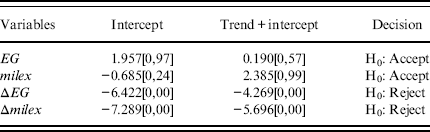
Table 2 reports unit root test results for questioned variables using IPS tests. We reported two test equations including only intercept and intercept+trend. Test results indicate that while the hypothesis of a unit root in both variables cannot be rejected in their levels, they can be rejected in the first differences. As a result, IPS tests confirm that all data series are integrated of order one, I(1).
Results of unit root test.

Note: Δ is the first difference operator.
Maximum lag lengths are set to 2 and Schwarz Bayesian Criterion is used to determine optimal lag length.
Probability values of t-statistics are in brackets.
4.2. Panel Cointegration Test
Once the existence of a panel unit root has been established, the issue arises of whether there exists a long term equilibrium relationship between the variables. Given that each variable is integrated of I(1), we investigate panel cointegration employing the Westerlund test.Reference Westerlund 34 Westerlund developed four panel cointegration tests for this examination. The main idea is to test the absence of cointegration via specifying if there exists error correction for individual panel units or the full panel. Compared with other panel cointegration tests, Westerlund can be described as flexible and allowing for a heterogeneous specification.
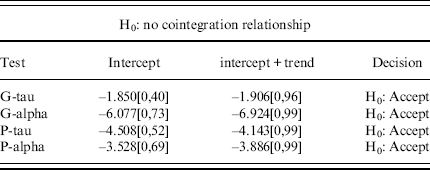
Table 3 presents the results of Westerlund’s panel cointegration tests where the null hypothesis indicates no cointegration while the alternative hypothesis indicates that economic growth and military expenditures are cointegrated. The tests were performed for intercept as well as intercept and trend. All the test statistics fail to reject the null of no cointegration hypothesis, which implies that economic growth does not converge to its long run equilibrium.
Results of Westerlund cointegration test.

Note: The tests are carried out with one lead and one lag.
Probability values of t-statistics are in brackets.
4.3. Panel Causality Test
As previous steps show that variables under question do not move together in the long run, the cause and effect relationship between the variables has to be examined in the short run. One common way to investigate the direction of causality is to adopt panel Granger causality.
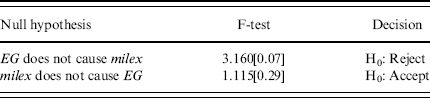
Table 4 shows the results of the panel Granger causality test. For the causal running from military expenditures to economic growth, the null hypothesis of no causal running cannot be rejected at a 10% significance level. For the causal running from economic growth to military expenditures, the null hypothesis is rejected at the 10% significance level. Panel causality, then, indicates unidirectional causal running from economic growth to military expenditures.
Results of panel causality test.

Note: Test is carried out one lag.
Probability values of t-statistics are in brackets.
5. Discussions and Policy Implications
The amount of military expenditure of a country is directly associated with that country’s economic capacity, its place in international politics, and its threat perception. In addition, military expenditures are also regarded as an economic tool in terms of export and import amounts. Once the military issue is investigated in the context of Europe, it can be seen that Western European countries such as the UK and France are typical military economies compared with Eastern European countries.
It is clear that military expenditures were regarded as an effective factor for CEEc during the Cold War when compared with the post-Cold War period. CEEc were directly or indirectly affected by the arms race going on at the time. Since the early 1990s, these countries have developed different economic and political structures. This period spells independence, EU membership, democracy, liberalism, political and economic transformation, etc., for CEEc.
Findings obtained from empirical analyses indicate that there is no long-term relationship between military expenditures and economic growth. Panel causality results reveal that there exists a unidirectional causality running from economic growth to military expenditures in the CEEc.
Two major policy implications stand out. The potential of becoming economic or political powers, and thus developing defence economies of their own, is very limited for these countries. Thus, targets such as economic development, the EU membership process, etc. have become privileged since the end of the Cold War. In other words, military expenditures are not a primary matter for these countries. Enlivening the economy is more important than privileging military expenditures since the latter depend on their economic performance. Second, when the Cold War and post-Cold War eras are compared, the term defence economics should be interpreted differently, and partially, for each era as far as the CEEc are concerned. While ‘defence’ refers to the Cold War era, ‘economics’ refers to the post-Cold War era. The EU has planned the process of enlargement from the EU15 in two stages, involving two different regions, namely CEEc and the Western Balkans. In parallel to what happened with the 2004 and 2007 CEEc enlargements, the causality for the Western Balkan countries would probably run from economic growth to military expenditures as well.
6. Conclusion
TreddenickReference Treddenick 35 maintained that economists could make a significant contribution to the literature by understanding the interaction of military developments and economics for the post-Cold War period. From this viewpoint, the aim of this paper is to analyse the nexus between military expenditures and economic growth in CEEc after the end of the Cold War. The data of the study concern annual observations ranging from 1993 to 2013. Cointegration results indicate no long-term relationship between the variables in question. Causality results, on the other hand, show unidirectional causality running from economic growth to military expenditures for the panel group.
Since the existing empirical literature so far has usually covered only the EU15, and there is no earlier study on CEEc, it is difficult to compare the results of this study with others. Consistent with Topcu et al.,Reference Topcu, Aras and Erdogan 28 this paper finds that for transition economies the direction of causality runs from economic growth to military expenditures.
Mert Topcu is an Assistant Professor of Economics at Nevşehir Hacı Bektaş Veli University. He has a PhD in economics. His main research interests are applied macroeconomics, energy economics and defence economics. He has published several articles in a range of journals including Energy, Energy Economics and Defence & Peace Economics. He worked as a visiting scholar at the J. Whitney Bunting College of Business at Georgia College & State University, USA.
İlhan Aras graduated from the Department of International Relations at Canakkale Onsekiz Mart University in 2008. He received his master’s degree from the Department of International Relations at Canakkale Onsekiz Mart University in 2010 and completed his PhD at the Department of European Union Studies at Istanbul University in 2014. He currently works at the Department of International Relations at Nevsehir Haci Bektas Veli University. He has written numerous articles and chapters on topics relevant to the European Union.