Introduction
The sheep was one of the first animals to be domesticated by man (Yilmaz, Reference Yilmaz1995) and ancient Turkey played a major role in the domestication process (Zeder, Reference Zeder2008). Sheep have been an important element in Turkey's household and national economies for some 10 000 years from the Neolithic to the present time (Arbuckle et al., Reference Arbuckle, Oztan and Gulcur2009). In 2010, the country had a population of 21.8 million sheep and it is one of the world's most important producers of sheep in spite of the fact that this number is less than half of the sheep population of the early 1980s (Turkstat, 2011). Over the millennia many breeds have been differentiated, but morphologically Turkish breeds are clearly divided into two groups, one being fat tailed and the other thin tailed (Anon., 1987). Recent phylogenetic analyses based on genetic distance estimates have shown the close relationships among the Akkaraman, Morkaraman and Tuj breeds (which are all fat tailed) and a clear separation between the fat-tailed group and those belonging to the thin tailed one (Uzun et al., Reference Uzun, Gutiérrez-Gil, Arranz, Primitivo, Saatci, Kaya and Bayón2006).
Sources differ in the numbers they consider to be the types or breeds of Turkish livestock and there is considerable confusion in the nomenclature not only outside but also within the country. Many native or indigenous and exotic types and various crosses between these (although some of the crosses have had limited utility and an ephemeral life) are listed by various sources. Thus, according to one authority domestic sheep comprise 13 varieties, but none are identified individually (MARA/FAO, 2001). An earlier publication on Turkish biological diversity identifies and names 14 types and several subtypes of sheep (Anon., 1987). A search of one authoritative source (Mason, Reference Mason1996) brings to light several to many more breeds and types of sheep to provide a total of 27 breeds. The Domestic Animal Diversity Information System of the Food and Agriculture Organization lists 35 sheep types although 15 of these are given as extinct (DAD-IS, 2010).
In spite of the importance of sheep in Turkey there have been relatively few recent publications on the species in the international literature. Those that have been published include ones on short-term fattening experiments (Macit, Reference Macit2002; Macit et al., Reference Macit, Esenbuga and Karaoglu2002; Oflaz et al., Reference Oflaz, Soydan, Onder and Ocak2010), health and disease (Yilmaz et al., Reference Yilmaz, Cripps, Turan, Ozgur, Green, Anil, Ilgaz and Morgan2002), reproduction (Ekiz et al., Reference Ekiz, Kocaka, Ozcana and Yilmaz2007; Oflaz et al., Reference Oflaz, Soydan, Onder and Ocak2010) and production economics (Atsan et al., Reference Atsan, Emsen, Yaprak, Dagdemir and Gimenez Diaz2009; Keskin et al., Reference Keskin, Dagdemir and Demir2010). The current paper aims to provide information on some of the main native and cross-bred sheep populations of Turkey, some perceptions of their production and current conservation activities and is one of a series (Wilson et al., Reference Wilson, Yilmaz and Ertugrul2011; Yilmaz et al., Reference Yilmaz, Ertugrul and Wilson2011a, Reference Yilmaz, Ertugrul and Wilson2011b, Reference Yilmaz, Akin, Yener, Ertugrul and Wilson2012) that will eventually cover all the nation's domestic animal species.
Production systems
Turkish sheep are produced under four distinct husbandry systems and in two of them production is generally secondary to crop production. The first system is the “small household” one common in western and northwestern Turkey. A family has an average of 3–5 sheep with a maximum holding of 10–15 per head. The second type is a “settled village flock” system common all over Turkey. Family flock sizes range from 8–10 to as many as 100 sheep. In this system, sheep are released by their owners early in the morning and a village flock is constituted. This flock is managed by a shepherd who is assisted in protecting them with several dogs. In both, the first two systems, sheep are grazed on common land in the spring and recover much of the body condition they have lost during the winter when they have been fed on cereal straws and brans. By the end of June, the grass has matured but the cereal harvest takes place in July and stubbles become available. Animals now reach peak condition and lay down fat under the skin, around the intestines and kidneys and, classically in the fat-tailed breeds, in the tail. The third system is denominated as “highland” and is common in northeastern, eastern and southern Turkey. Sheep are kept in the villages during the winter season and in the early spring. As the grass matures and dries in late spring and early summer the flocks are taken to the highlands whence they return, after 3–5 months when the feed is exhausted and cold sets in, to their villages for the winter. The “nomadic” system is found in eastern and southeastern Turkey. Some traditional nomadic tribes have as many as 100 000 to 200 000 sheep. Sheep stay and graze during the cold season in the lower lands of the southeastern plains of Turkey. During the hot season, the tribes migrate to the higher lands of eastern Turkey. Members of nomadic tribes always live in goat hair tents when they are with their flocks (Sonmez, Reference Sonmez1978; Ertugrul et al., Reference Ertugrul, Akman, Askin, Cengiz, Firatli, Turkoglu and Yener1993).
Sheep breeds and types
Fat-tailed
Turkey has 12 recognized breeds of fat-tailed sheep with several subtypes or varieties. Fat-tailed sheep are found over much of Turkey. Only four of the breeds are not at risk, four are at some risk and four are at severe risk. Other than the fat tail, the breeds vary in morphology and colour and in production characteristics and as may be expected in animals that have adapted through millennia to survival performance and especially reproductive performance is low (Table 1).
Conservation status, areas of distribution, morphological characteristics and some production traits of Turkish fat-tailed native sheep.

Source: Sonmez (Reference Sonmez1975, Reference Sonmez1978), Ertugrul et al. (Reference Ertugrul, Akman, Askin, Cengiz, Firatli, Turkoglu and Yener1993), Anon. (2009).
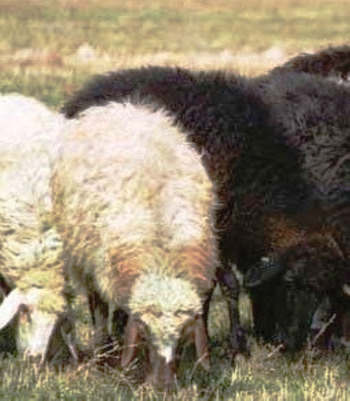
The White Karaman (Turkish = Akkaraman, Figure 1) is a rather small breed of central Anatolia and is a dual purpose meat and milk type that also produces a small amount of coarse wool (Table 1). Kangal, Karakas (which is classed as at severe risk (Sonmez, Reference Sonmez1978)) and Southern are varieties of this type (Mason, Reference Mason1996). Similar breeds are the Barazi in Syria and the Makui in Iran. The dominant breed of East Anatolia is the Red Karaman (Morkaraman, Figure 2) which is somewhat larger than the White variety and also a producer of meat and milk (in slightly large amounts than its white counterpart) with a subsidiary output of coarse wool (Table 1) (Anon., 2009). The Karacadag of Diyarbakir Province (the Appendix map at the end of this paper provides an outline of Turkey showing the locations of all the Provinces mentioned throughout this paper) is a local variety of the Red Karaman (Mason, 1996). In Turkey, the Awassi (Ivesi, Figure 3) is found mainly in the southeastern part of the country but this animal is part of the widespread and important breed that is found throughout the Arab Middle East and Israel as well as Turkey (Mason, Reference Mason1996). The Turkish type (Table 1) is a medium-sized animal with a good milk yield over a long lactation, a rapid growth rate for meat production and a medium-heavy fleece of coarse wool (Ertugrul et al., Reference Ertugrul, Dellal, Soysal, Elmaci, Akin, Arat, Baritci, Pehlivan and Yilmaz2009). Usually considered as a local variety of the White Karaman, the Kangal Karaman (Table 1) is localized in Sivas and Malatya provinces of central Anatolia (Mason, Reference Mason1996), but a peculiarity is that only a small proportion of males are horned (Anon., 2009).
White Karaman.

Red Karaman.

Awassi.

An endangered but extremely local breed is the Norduz, which is found in only a small area of Van Province in eastern Turkey. The medium-sized sheep has good growth rates, produces good quantity of milk and is unusual in that 50 percent of females are horned. A group of 11 farmers maintain 200 sheep for conservation purposes (Anon., 2009; Ertugrul et al., Reference Ertugrul, Dellal, Soysal, Elmaci, Akin, Arat, Baritci, Pehlivan and Yilmaz2009). An often-coloured variety of the White Karaman is the medium-sized South Karaman (Guneykaraman, Figure 4), which is found, as indicated by its name in the provinces of southern Anatolia (Mason, Reference Mason1996). It is mainly a meat type with poor milk production but yields moderate coarse wool (Table 1). The government's International Bahri Dagdas Agricultural Research Institute maintains a small conservation flock which numbered 24 rams and 22 females in 2009 (Ertugrul et al., Reference Ertugrul, Dellal, Soysal, Elmaci, Akin, Arat, Baritci, Pehlivan and Yilmaz2009). Another endangered breed is the Hem in (Figure 5) which is a variety of Red Karaman found in northeastern Turkey (Mason, Reference Mason1996). The tall but medium-weight breed has a moderate growth rate for meat, produces a fair mount of milk and provides a moderate clip of coarse wool (Table 1). One farmer in Ardanuc County of Artvin Province was maintaining a conservation flock of 200 sheep in 2009 (Ertugrul et al., Reference Ertugrul, Dellal, Soysal, Elmaci, Akin, Arat, Baritci, Pehlivan and Yilmaz2009). A fourth endangered fat-tailed breed is the Herik (Figure 6) of north Anatolia is similar to the Daglic but has a rather shorter tail than most others in the group (Mason, Reference Mason1996). It is classed as a meat type but produces a fair to heavy clip of coarse wool (Table 1). Some 200 sheep were in conservation herds maintained by three farmers in its home tract in Amasya Province in 2009 (Ertugrul et al., Reference Ertugrul, Dellal, Soysal, Elmaci, Akin, Arat, Baritci, Pehlivan and Yilmaz2009).
South Karaman.

Hem in.

Herik.

Severely at risk is the Daglic (Figure 7) of western Anatolia. This medium-sized coarse wool and meat type is limited in its distribution to central-western Anatolia (Table 1). In 2009, three farmers had about 200 sheep in conservation flocks in Bolvadin County in Afyon Province (Ertugrul et al., Reference Ertugrul, Dellal, Soysal, Elmaci, Akin, Arat, Baritci, Pehlivan and Yilmaz2009). Reputed to be resistant to disease the small-sized Cine Capari (Figure 8) from Aydin Province has only a moderate growth rate and produces small quantities of milk and coarse carpet wool (Table 1, Mason, Reference Mason1996). Some 120 animals were being maintained by two farmers in Aydin Province in 2009 (Ertugrul et al., Reference Ertugrul, Dellal, Soysal, Elmaci, Akin, Arat, Baritci, Pehlivan and Yilmaz2009). Classed as at high risk in Turkey the local Karakul (Karagul, Figure 9) is part of the larger Central Asia type of fat-tailed sheep and in common with them a proportion of the females carry horns (Mason, Reference Mason1996; Anon., 2009). Similar in size to other Turkish fat-tailed sheep, the local variety is commonly black but there are also some brown, grey or white animals (Table 1). In addition to meat and milk the Karakul produces skins (pelts) of various colour and type. Some 200 sheep were in conservation flocks managed by two farmers in Tokat Province in 2009 (Ertugrul et al., Reference Ertugrul, Dellal, Soysal, Elmaci, Akin, Arat, Baritci, Pehlivan and Yilmaz2009). The Tushin breed of Georgia is known as Tuj (Figure 10) in Turkey and is mainly confined to Cildir County in Kars Province with other populations in other parts of the extreme northeast of the country (Table 1). This rather small sheep with a small fat tail or even a fat rump (Mason, Reference Mason1996; Anon., 2009) produces moderate amounts of wool and milk and is at very high risk (Ertugrul et al., Reference Ertugrul, Dellal, Soysal, Elmaci, Akin, Arat, Baritci, Pehlivan and Yilmaz2009).
Daglic.

Cine Capari.

Karakul.

Tushin.

Thin-tailed
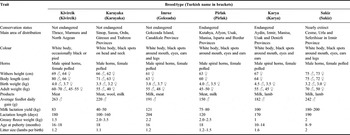
There are six recognized breeds of thin-tailed sheep in Turkey. These are largely confined to the western part of the country including the southern shore of the Black Sea. It is considered that three of the breeds are not endangered, two are at some risk and one, which is confined to three counties in Izmir Province, is at severe risk. Among them the breeds have a thin tail in common but otherwise vary in morphology and in production characteristics (Table 2).
Conservation status, areas of distribution, morphological characteristics and some production traits of Turkish thin-tailed native sheep.

Source: Sonmez (Reference Sonmez1975, Reference Sonmez1978), Ertugrul et al. (Reference Ertugrul, Akman, Askin, Cengiz, Firatli, Turkoglu and Yener1993), Anon. (2009).
The rather large Kivircik (Figure 11) is common in northwest Turkey. This triple purpose meat, milk and medium/coarse wool type is similar to the Karnmobat of Bulgaria and the Tsigai of southeast Europe in general and may have originated from them (Koban, Reference Koban2004). The breed is a constituent member of the Ruda (Balkans) breed group but has more uniform and slightly less coarse wool than the Zackel type (Mason, Reference Mason1996). One of the bigger and heavier of Turkey's thin-tailed breeds the Kivircik shows good feedlot performance, produces a moderate amount of milk in a long lactation, matures sexually somewhat late and has a small litter size (Table 2). The Kivircik is the origin of the Karacabey Merino and has also been crossed with the Daglic to produce the Kamakuyruk (=wedge tail) (Mason, Reference Mason1996). Some 286 sheep (15 rams and 271 females) are in a conservation flock at the government's Marmara Agricultural Research Institute (MARI) and 200 sheep are under protection by a farmer in Kirklareli (Ertugrul et al., Reference Ertugrul, Dellal, Soysal, Elmaci, Akin, Arat, Baritci, Pehlivan and Yilmaz2009). Largely confined to northern Anatolia, the Karayaka (Figure 12) is a triple purpose breed producing meat, wool and milk (Mason, Reference Mason1996; Arat, Reference Arat2011). This animal falls in the medium-size and weight in the thin-tailed group. Late maturing and with a small litter size, the breed's milk yield is low but is compensated for to some extent by the heaviest fleece weight of all thin-tailed sheep (Table 2). Similar to the Greek Zackel breed, the Imroz (Gokceada, Figure 13) is a milk, meat and coarse wool type (Table 2). A synonym for this breed is Gokceada (Mason, Reference Mason1996). In 2009, a total of 94 sheep (18 rams and 76 females) were under protection by the government at MARI with 200 sheep in farmer flocks in Gokceada and Canakkale being conserved (Ertugrul et al., Reference Ertugrul, Dellal, Soysal, Elmaci, Akin, Arat, Baritci, Pehlivan and Yilmaz2009).
Kivircik.

Karakaya.

Imroz (Gockeada).

The Pirlak (Pirlack) of Afyon, Burdur, Isparta, Kutahya, Manisa and Usak Provinces is considered to be at some risk (Ertugrul et al., Reference Ertugrul, Dellal, Soysal, Elmaci, Akin, Arat, Baritci, Pehlivan and Yilmaz2009). This mid-sized coarse wool sheep also produces meat and milk (Table 2) and has a long tail with some fat at the base (Anon., 2009). Also endangered (Ertugrul et al., Reference Ertugrul, Dellal, Soysal, Elmaci, Akin, Arat, Baritci, Pehlivan and Yilmaz2009) is the Karya of Aydin, Izmir, Manisa, Usak and Denizli. This small breed produces coarse wool, meat and milk (Table 2) and terminates in a long thin tail (Anon., 2009). The most critically at risk of the thin-tailed types is the Sakiz (Figure 14), which is confined to a small area around Izmir and was originally bred from the Chios (Mason, Reference Mason1996). A producer of coarse wool, milk and meat (Table 2) the breed has a long thin tail with fat at the base. A total of 130 sheep (35 rams and 95 females) were under protection by the government at MARI and 113 sheep were in conservation flocks managed by four farmers in Cesme in Izmir Province in 2009 (Ertugrul et al., Reference Ertugrul, Dellal, Soysal, Elmaci, Akin, Arat, Baritci, Pehlivan and Yilmaz2009).
Sakiz.

Cross-breeds
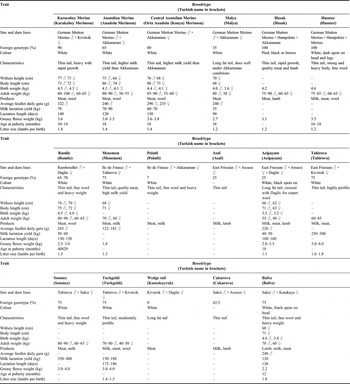
Attempts to increase the output of the sheep subsector by cross-breeding started in 1928 (Ertugrul et al., Reference Ertugrul, Dellal, Soysal, Elmaci, Akin, Arat, Baritci, Pehlivan and Yilmaz2009, Reference Ertugrul, Dellal, Elmaci, Akin, Pehlivan, Soysal and Arat2010). Cross-breeding programmes – which have often been somewhat unstructured and over the years have produced an enormous variety of animals (Table 3) – had three objectives: increased wool production for the textile industry; increased meat production to feed people and support the food industry; and increased milk production for the food industry. Four principal cross-breeding strategies have been followed: use of exotic sires on native females and then breeding inter se from the F1 generation; backcrossing the new cross-bred to the same or another exotic breed; using the new cross-bred for further crosses on native breeds; and simple crossing of two native breeds. Various exotic breeds with the supposedly required traits to achieve these objectives have been used in Turkey for more than 80 years. Principal in the early days were German Mutton Merino and Ile de France to improve growth rates and fleshing and the East Friesian for milk, which is still an important output of sheep. Under programmes aimed at increasing milk production, however, native sheep were also targeted either by selection within a single breed or by crossing two native breeds (Ertugrul et al., Reference Ertugrul, Akman, Askin, Cengiz, Firatli, Turkoglu and Yener1993). In addition, all new breeds were also expected to improve both the quantity and quality of wool over the native breeds. All Turkish cross-bred sheep – there are, or have been, at least 17 named varieties – with the exception of Acipayam, Wedge tail or Kamakuyruk and Malya, which have long tails with fat at the base, have thin tails.
Genetic make up, morphological characteristics and some production traits of Turkish cross-bred sheep.

Source: Sonmez (Reference Sonmez1975, Reference Sonmez1978), Ertugrul et al. (Reference Ertugrul, Akman, Askin, Cengiz, Firatli, Turkoglu and Yener1993), Anon. (2009).
The first German Wool-Mutton Merino imports by the Ministry of Agriculture in 1928 were crossed on native Kivircik sheep at Karacabey State Farm in western Anatolia to produce the Karacabey Merino (Karakabey Merinosu, Figure 15). The large, heavy and early maturing, both physically and sexually, Karacabey Merino (Table 3) has 90–95 percent Merino blood and is mainly a meat-medium wool type with a rapid growth rate, a good yield of carpet wool and of good prolificacy (Mason, Reference Mason1996; Kaymakci, Reference Kaymakci2008). In a manner analogous to the Karacabey Merino, the German Mutton Merino was used to produce the Anatolian Merino (Figure 16) by crossing with the White Karaman at Konya State Farm (Sonmez, Reference Sonmez1978; Anon., 2009). This is a mid-sized, sheep that is heavier than its native progenitor and produces more milk and a good crop of finer wool (Table 3). Of similar provenance to the Anatolian Marino but with a greater proportion of German blood is the Central Anatolian Merino (Orta Anadolu (Konya) Merinosu, Figure 17). Development was started in 1952 at the Konya State Farm (Mason, Reference Mason1996; Anon., 2009) and has resulted in a sheep somewhat larger than the Anatolian Merino, with a more rapid growth rate, slightly heavier wool clip but a reduced milk yield (Table 3).
Karacabey Merino.

Anatolian Merino.

Central Anatolian Merino.

Originating in the 1970s at Malya State Farm in central Anatolia the homonymous Malya (Figure 18, Table 3) is a fine wool, meat and milk type derived from the German Mutton Merino (35 percent) and the Akkaraman (Yilmaz, Reference Yilmaz1984; Ertugrul et al., Reference Ertugrul, Akman, Askin, Cengiz, Firatli, Turkoglu and Yener1993; Anon., 2009). The low proportion of exotic blood enables this animal to do well under less than optimum husbandry and has left it with a fat tail. The International Bahri Dagdas Agricultural Research Institute (IBDARI) in Konya Province south of Ankara bred the Hasak (Figure 19) via a three-way descent German Mutton Merino and Hampshire sire lines and an Akkaraman dam line. This is a strong, heavy mid-sized and coloured sheep with a rapid growth rate and a good carcass yield that is often used for early lamb production (Table 3). It has a long tail that is fat at the base (Kaymakci, Reference Kaymakci2008; Sonmez Reference Sonmez2009; bdutae.gov.tr 2011). Also bred at IBDARI and unusual in Turkish cross-breeding programmes because there is no Native Turkish sheep blood is the Hasmer (Figure 20), which is a milk, meat and wool type with a strong mid-sized body, a rapid growth rate and good carcass yield (Table 3). Unlike the previous cross-bred this type has a thin tail (Kaymakci, Reference Kaymakci2008; Sonmez, Reference Sonmez2009; bdutae.gov.tr 2011).
Malya.

Hasak.

Hasmer.

Developed at Istanbul University from 1969 onwards with American Rambouillet (65–70 percent) sire and Daglic (30–35 percent) dam lines the Ramlic is a heavy meat breed with a rapid growth rate that also carries a rather fine fleece (Table 3, Anon., 2009). Two cross-breds are of mainly Ile de France parentage. The Menemen is a medium heavy type developed in the Izmir area and is a cross of Ile de France (75 percent) and Tahirova (25 percent). It has a rather slow growth rate, but produces quality lamb and a low yield of wool, but is reputed to have a good milk yield (Table 3). It is considered that there is further need for selection and breeding before this cross achieves its potential (Sonmez, Reference Sonmez2009). The Polatli (Figure 21) has been developed since 1998 at Bafra State Farm in central Anatolia from the Ile de France and Akkaraman (www.tigem.gov.tr 2011; Anon., 2009). This medium-heavy sheep is bred as a triple purpose fine wool, meat and milk type (Table 3).
Polatli.

The East Friesian has been used in several cross-breeding programmes. In cooperation with Hohenheim University, the Faculty of Agriculture at Cukurova University has produced the Asaf from the East Friesian and the Awassi (Table 3). The Asaf has been developed through inter se crossing of the F1 to produce the F2 (Kaymakci, Reference Kaymakci2008; Sonmez, Reference Sonmez2009). The Acipayam (Table 3) is a fat-tailed cross-bred of the southern provinces of Denizli, Afyon, Isparta and Antalya, and is a light weight milk, meat and wool type bred from East Friesian rams on Awassi ewes with some Daglic blood introduced to improve wool quality. Originating from East Friesian sire and Kivircik dam lines the Tahirova (Figure 22) was developed at the Tahirova State Farm (Mason, Reference Mason1996) and was bred for the lowlands of Izmir Province on Turkey's Mediterranean coast. This medium-heavy breed is among the most prolific of Turkey's sheep, produces a considerable amount of milk and clips a heavy fleece (Table 3, Anon., 2009). The Tahirova has been used within Turkey as a sire line in the production of further cross-breds.
Tahirova.

Bred at Ege University in western Anatolia by a team led by a scientist whose name is synonymous with the type the Sonmez (Figure 23) is a backcross of the Sakiz to the Tahirova (Ertugrul et al., Reference Ertugrul, Akman, Askin, Cengiz, Firatli, Turkoglu and Yener1993). This is an animal with a high milk yield, a heavy clip of fine wool and a medium-heavy producer of meat (Table 3). Originating at Turkgeldi State Farm in Thrace in the European part of Turkey from Tahirova (75 percent) and Kivircik (25 percent) the Turkgeldiis a medium heavy and reasonably prolific meat, milk and wool type (Table 3, Kaymakci, Reference Kaymakci2008).
Sonmez.

Three named cross-breds derive directly from other Turkish native breeds with no admixture of exotic blood. The Wedge tail – so-called because of the fat at the base of the otherwise thin tail – or Kamakuyruk originates from two local breeds, in this case the Kivircik and Daglic (Sonmez, Reference Sonmez1978; Mason, Reference Mason1996). This is a breed of Balikesir, Izmir, Bursa and Canakkale Provinces in the extreme west of Asian Turkey and is mainly a meat type (Table 3). Bred at the Faculty of Agriculture at Cukurova University is the Cukurova, which is a composite of Sakiz and Awassi sheep (Table 3). This is a milk and early lamb type (Kaymakci, Reference Kaymakci2008; Sonmez, Reference Sonmez2009). The Bafra (Figure 24) originated in 1998 at Bafra State Farm in Samsun Province in the north of Anatolia and on the Black Sea from Sakiz (75 percent) and Karayaka (25 percent) (www.tigem.gov.tr 2011). This medium-heavy fast growing sheep is highly prolific and also produces a moderate amount of milk and a light fleece (Table 3).
Bafra.

The Candir is a cross of Daglic and White Karaman found in western Anatolia with the synonym Kesber sometimes also being used (Sonmez, Reference Sonmez1978).
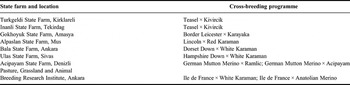
Attempts to achieve the three original objectives of cross-breeding continue to the present day. At least eight State Farms continue to pursue programmes to produce new types of sheep, often using exotic breeds that have not been used in earlier programmes (Table 4).
Sheep cross-breeding programmes being carried out on Turkish state farms in the 21st century.

Source: Sonmez (Reference Sonmez2009).
Extinct breeds
Three breeds of sheep considered to be indigenous Turkish types are known to have become extinct. The first is the Halkali about which very little is known (Ertugrul et al., Reference Ertugrul, Dellal, Soysal, Elmaci, Akin, Arat, Baritci, Pehlivan and Yilmaz2009). The Karakachan (Figure 25) is a widespread Balkans breed of the Zackel type (Mason, Reference Mason1996) that has disappeared from Turkey (Kaymakci, Reference Kaymakci2008; Ertugrul et al., Reference Ertugrul, Dellal, Soysal, Elmaci, Akin, Arat, Baritci, Pehlivan and Yilmaz2009; Sonmez, Reference Sonmez2009). The Odemis (Figure 26), a triple purpose meat-milk-wool fat-tailed breed (Figure 27) that was largely confined to the small Menderes Valley of west Turkey (Mason, Reference Mason1996; Anon., 2009) is now also thought to be extinct (Ertugrul et al., Reference Ertugrul, Dellal, Soysal, Elmaci, Akin, Arat, Baritci, Pehlivan and Yilmaz2009).
Karakachan.

Odemis.

Odemis showing fat tail.

Conservation measures
The number of sheep in Turkey has fallen steadily since the middle of the 20th century. Concomitant to the loss in numbers has been a reduction in the genetic resource with the result that at least three Turkish native breeds are known to have become extinct and several others are of such low numbers or of such limited geographic distribution that they are considered to be endangered and at possible risk of extinction in the future. Alarmed, perhaps belatedly, by this situation the Turkish government began to apply conservation policies in an attempt to prevent further decline and to preserve Turkish indigenous sheep breeds.
The Genetic Engineering and Biotechnical Institute (GEBI), Marmara Research Centre (MRC), the Scientific and Technological Research Council of Turkey (STRCT) Gebze, Kocaeli, prepared a project entitled the “In Vitro Conservation and Preliminary Molecular identification of some Turkish Domestic Animal Genetic Resources (TURKHAYGEN-I)” in 2005 (Arat, 2011). Consequent to several iterations the project was approved by the STRCT in March 2007 with a budget of 9.1 million Turkish Lira (about US$5.0 million). The implementation period was 4.5 years with the project expected to be completed by the end of 2011 (Arat, 2011).
As indicated in the project document its expected outcomes were:
-
• Establishment of DNA and viable cell banks (gametes, embryos, somatic cells and tissue samples) of animal genetic resources through cryopreservation at GEBI and at Lalahan Livestock Central Research Institute (LLCRI);
-
• Genetic characterization and registration of valuable species and breeds; and
-
• Enhancement of the competitiveness of national human resources in the area of animal husbandry and the building of a critical mass of researcher capacity.
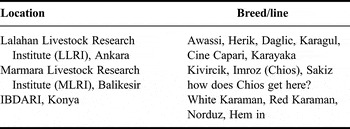
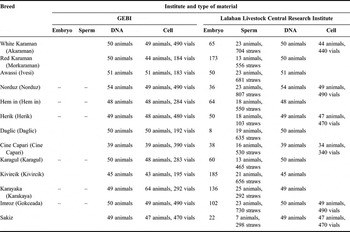
Collection of genetic material for cattle had begun in 2006 and sheep were included in the programme in 2007. Some 14 conservation flocks of sheep have been established at various research stations (Table 5) and an extensive bank of genetic material has been established for 13 breeds as a result of the project (Table 6). It is expected that this resource will be expanded for preservation, conservation and use of Turkey's native genetic resources in the future.
Locations and breeds of sheep under conservation activities at government centres.

Source: Anon. (2009).
Genetic material conservation status of Turkish sheep breeds in May 2011.

Source: www.turkhaygen.gov.tr 2011.
Discussion
Sheep numbers decreased steadily from more than 48 million head in 1980 to a little over 21.6 million head in 2009 (Turkstat, 2010). Among the manifold reasons for the reduction are changes in the structure of agriculture, smallholder farmers turning to other products or other employment, low output from sheep, changing market conditions and a move away from red meat by consumers and lack of government support. Unlike the cattle subsector where reduced numbers have been compensated for by higher individual performance (Yilmaz et al., Reference Yilmaz, Akin, Yener, Ertugrul and Wilson2012), there has been no increase in output per head of sheep production because of poor performance. Much of the market for meat has been taken over by the enormous increase in the numbers of poultry and structural changes in poultry production from low input extensive to high input very intensive systems.
In spite of many years of effort by the government and universities to produce new genetics that would give higher output for similar input there has been little success. The new cross-breds are in many cases only marginally better than the breeds they are meant to replace. After more than 80 years of effort there is little evidence of improvement in the sheep industry. In recent years, and in spite of the effort of both government and universities only 20 percent of targets to produce cross-bred progeny have been achieved. Programmes have been started and then terminated for a variety of reasons including unstructured programmes serving the interests of individual scientists rather than the industry as a whole, failure of the cross-breds to perform as expected, susceptibility to disease, inadequate funding and a distinct lack of enthusiasm by farmers to make use of the new genetic material. In 2010, only 4 percent of the national sheep population was cross-bred. A major reason for this is the inappropriateness and unadapted nature of the cross-breds to local conditions. Some 90 percent of native Turkish sheep, for example, are fat-tailed types. Native breed are capable of lifting the female tail to mate but foreign thin-tailed rams do not have this ability. On government or university farms handlers are present to assist the foreign thin tails to mate but under small farm conditions the owners are unwilling to do this. Hence, the cross-bred is not the right animal in the right place (Wilson, Reference Wilson2009).
Locally developed species are a pool of irreplaceable genetic material of unacknowledged merit and value that must not be lost but must be conserved for possible unknown and unseen future use (Wilson, Reference Wilson2009). Impoverishment of the nation's natural capital is not acceptable under any circumstances but the modest start of conservation measures by government augurs well for the future and for safeguarding of the country's heritage. Livestock production will not remain sustainable if the nation's gene pool is not fully characterized and preserved for use by future generations who will face as yet unforeseen circumstances.
Turkey is a country that is still on the road of development. Livestock production remains an important economic activity, but its product is inadequate to supply the nutritional requirements of its people. Native sheep are generally of low output but still constitute the vast majority of the national flock. Efforts should continue to characterize and improve their productive traits alongside the use of exotic breeds with possibly and potentially superior productivity but lower adaptability. Government, universities and the mass of livestock producers and ancillary industries should work together to conserve and improve the native sheep breeds of Turkey.
Appendix: Outline map of Turkey showing locations of Provinces