Perioperative hand hygiene is one of the most critical factors affecting the risk of surgical site infection (SSI) as well as safety of medical staff.Reference Rotter 1 Traditional surgical hand antiseptic methods involve scrubbing the hands, nails, and subungual areas with brushes and antimicrobial solutions for 5 minutes. 2 , Reference Rotter 3 In contrast, the use of hand rub includes a 1-minute hand wash with a nonantiseptic soap and tap water, followed by 2 minutes of hand rubbing with only an aqueous alcoholic solution.Reference Marchand, Theorate, Dion and Pellerin 4 The use of waterless agents makes hand preparation easier without compromising patient safety.Reference Parienti, Thibon and Heller 5 , Reference Hobson, Woller, Anderson and Guthery 6
To our knowledge, 7 randomized controlled trials (RCTs) have evaluated the effectiveness of traditional surgical scrubbing and waterless hand rubbing; they reported that the hand rubbing procedure significantly reduced hand microorganisms.Reference Parienti, Thibon and Heller 5 , Reference Hajipour, Longstaff, Cleeve, Brewster, Bint and Henman 7 – Reference Pereira, Lee and Wade 12 However, some of these studies have combined participants who used 10% povidone–iodine and those who used 4% chlorhexidine gluconate into a single group.Reference Parienti, Thibon and Heller 5 , Reference Chen, Han, Kan, Chen and Hung 10 This potentially biased the analysis because 4% chlorhexidine gluconate is a more effective antiseptic than povidone–iodine.Reference Hsieh, Chiu and Lee 13 Moreover, 4 of these RCTs evaluated the effectiveness of alcohol gel, which is not a hand rub solution (alcohol and chlorhexidine gel), used worldwide.Reference Parienti, Thibon and Heller 5 , Reference Hajipour, Longstaff, Cleeve, Brewster, Bint and Henman 7 – Reference Pietsch 9 In this RCT, we investigated the effectiveness of 3 antiseptic methods among surgical staff. The participants were divided into the following 3 antiseptic groups: (1) a conventional povidone scrub group, in which participants performed traditional hand scrubbing with 10% povidone–iodine product (Sindine surgical scrub; Sinphar Pharmaceutical Co., Yilan, Taiwan); (2) conventional chlorhexidine scrub group, in which participants performed hand scrubbing with 4% chlorhexidine gluconate product (Antigerm; Panion & BF Biotech Inc., Taipei, Taiwan); and (3) waterless hand rub group, in which participants used a waterless hand rub solution of 1% chlorhexidine gluconate and 61% ethyl alcohol (Avagard; 3M, Maplewood, MN, USA).
MATERIALS AND METHODS
This study was a single-center, single-blind, randomized trial. Participants were recruited from the surgical staff members of Taipei Medical University—Shuang Ho Hospital between December 1, 2014, and January 31, 2015. This trial was approved by the institutional review boards of Taipei Medical University and was registered with ClinicalTrials.gov (identifier NCT02294604).
Study Design and Procedures
Inclusion and exclusion criteria
Practicing surgeons and scrub nurses who had previous experience with conventional surgical scrub and waterless hand rub protocols in an operating environment were randomly recruited and assigned to the 3 antiseptic groups (n=80 per group). Participants were excluded if they did not provide samples for culture prior to the operation and after the operation or if they contaminated their hands during surgical procedures. In addition, participants having incomplete data on baseline characteristics were excluded. Medical and nursing students were ineligible for the study.
Experimental procedures
The participants were randomly assigned through computer-based blocked randomization (1:1:1) with concealed allocation to the 3 antiseptic groups by a central, independent randomization facility. Before surgical hand disinfection, the group assignment was revealed to the participants. Samples were imprinted from the hands onto Mueller–Hinton II agar, which is recommended for the antimicrobial disc diffusion susceptibility testing of common, rapidly growing bacteria using the Bauer–Kirby method.Reference Bauer, Kirby, Sherris and Turck 14 – 16 The samples were obtained at the following 3 time points: before surgical hand disinfection, immediately after disinfection, and immediately after operation. The culture plates were maintained in an incubator at 35°C±2°C under a 5% CO2 atmosphere for 48 hours. The colony-forming unit (CFU) count per plate was determined by a bacteriologist who was blinded to the method of hand disinfection using a dissection microscope. Surgery type, surgical wound classification, scrubbing time, operation duration, and duration of glove wearing were recorded.
Hand Preparation
Conventional scrub
After removing all jewelry, the participants in the conventional surgical scrub group followed standard disinfection procedures. Those in the conventional povidone group used a 10% povidone–iodine product and those in the conventional chlorhexidine group used a 4% chlorhexidine product. The 5-minute standard conventional surgical scrub procedure was as follows: (1) 3 full squirts of povidone or chlorhexidine product (6 mL) were placed into the cupped hands; (2) the hands were scrubbed for 5 minutes just up to the elbow by using a sterile scrub brush; and (3) the antiseptic was rinsed away with tap water and the hands were dried with sterile towels.
Waterless hand rub
The waterless hand rub was an alcohol-based solution containing 1% chlorhexidine gluconate and 61% ethyl alcohol. The standard hand rub protocol was as follows: (1) 1 pump of the solution (2 mL) was dispensed into the palm of the left hand; (2) the fingertips of the right hand were dipped into the solution to decontaminate the area under the nails; (3) the remaining solution was spread over the right hand and up to just above the elbow; and (4) a second pump of the solution (2 mL) was then placed into the palm of the right hand. This process was repeated by dipping the fingertips of the left hand into the solution, followed by spreading it over the left hand and up to just below the elbow. Another 2 mL of the solution was finally placed into cupped hands and was reapplied to all aspects of the hands up to the wrists. This solution was then allowed to dry. The 3-step application of the waterless hand rub was completed within 2 minutes.
Outcomes and Statistical Analysis
Required sample size was calculated based on an intermediate effect size of 0.25, power of 80%, and 2-sided test with type I error of 5%. G*Power was conducted to carry out the calculation.Reference Faul, Erdfelder, Buchner and Lang 17 Based on the aforementioned parameters, the estimated sample size was 231.
The primary outcome of this study was the CFU count per plate of each participant before surgical hand disinfection, after surgical hand disinfection, and immediately after surgery. The centrality of continuous variables was expressed as the mean, whereas the degree of variations was presented as the standard error of the mean. Analysis of variance (ANOVA) was used to examine the group difference in the antiseptic effect at specific time points and for specific surgery durations. Within-group comparisons of CFU count between time points were performed using the paired t test. To adjust for CFU count before disinfection, analysis of covariance (ANCOVA) was used to compare the effectiveness of the antiseptic methods. Multiple linear regression was used to adjust for potential risk factors to determine the effectiveness of the antiseptic methods. The Statistical Analysis System (SAS) version 9.4 (SAS Institute, Cary, NC, USA) was used for all statistical analyses.
RESULTS
From the conventional povidone group, we excluded 1 participant who did not provide imprinting samples at the 3 time points and 2 participants whose culture plates were contaminated. From the waterless hand rub group, we excluded 1 participant whose culture plate was contaminated. Finally, 77, 80, and 79 participants were recruited in the conventional povidone, conventional chlorhexidine, and waterless hand rub groups, respectively. The sampling flowchart of this study is presented in Supplementary Figure S1.
Baseline Characteristics and Duration of Antiseptic Procedures and Surgery
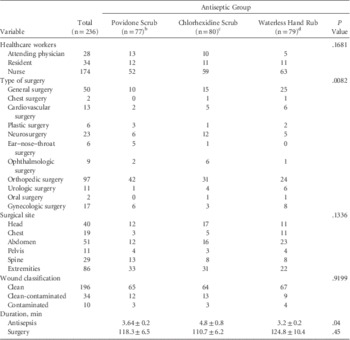
The baseline characteristics of the participants in the 3 antiseptic groups are listed in the upper part of Table 1. The study cohort was composed of 3 healthcare professional types: attending physicians, residents, and nurses. In total, 11 types of surgery were conducted during this research period; the 3 most common types were orthopedic surgery (n=97), general surgery (n=50), and neurosurgery (n=23).
Baseline Characteristics of the Participants in the 3 Antiseptic GroupsFootnote a

a Statistical method: simple statistics were used for basic characteristics and analysis of variance was used for duration (data are expressed as the mean±standard error).
b Povidone: hand scrubbing with 10% povidone–iodine product.
c Chlorhexidine: hand scrubbing with 4% chlorhexidine gluconate product.
d Waterless hand rub: hand rubbing with 1% chlorhexidine gluconate and 61% ethyl alcohol products.
The antisepsis and surgery durations in the 3 antiseptic groups are summarized in Table 1. We observed a significant difference in the antisepsis duration among the groups (P=.04). Compared with the conventional povidone group (3.6±0.2 minutes) and the waterless hand rub group (3.2±0.2 minutes), the conventional chlorhexidine group required more time for hand cleaning (4.8±0.8 minutes). Surgery duration did not significantly differ among the 3 groups (P=.45).
Antimicrobial Effectiveness
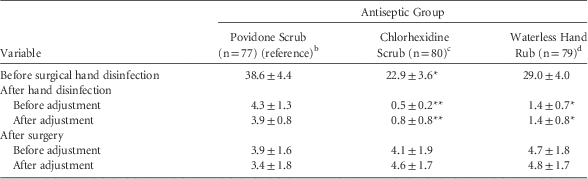
The results of the comparison of antimicrobial effectiveness among the 3 antiseptic groups are summarized in Table 2. The within-group comparisons revealed decrement in the mean CFU count after surgical hand disinfection (P<.01) and immediately after surgery (P<.01) in all the groups (P values are not marked in Table 2). Before hand disinfection, the mean CFU count was higher in the conventional povidone group than in the conventional chlorhexidine group (38.6±4.4 vs 22.9±3.6; P<.05) but did not differ between the conventional povidone group and the waterless hand rub group (38.6±4.4 vs 29.0±4.0; P>.05).
Efficacy of Bacterial Inhibition Indexed by the Mean Colony Forming Unit Count Among the Antiseptic GroupsFootnote a

a Between-group comparisons: ANCOVA, with the value before surgical hand disinfection as reference; P value: *P<.05, **P<.01. Data are expressed as the mean ± standard error.
b Povidone scrub: hand scrubbing with 10% povidone–iodine product.
c Chlorhexidine scrub: hand scrubbing with 4% chlorhexidine gluconate product.
d Waterless hand rub: hand rubbing with 1% chlorhexidine gluconate and 61% ethyl alcohol products.
After hand disinfection
The mean CFU count was significantly lower in the conventional chlorhexidine group (0.5±0.2; P<.01) and waterless hand rub group (1.4±0.7; P<.05) than in the conventional povidone group (4.3±1.3) after hand disinfection. To resolve the problem of preexisting differences, we used ANCOVA and treated the mean CFU count determined before surgical hand disinfection as the covariate. The immediate effect remained after adjustment. The mean CFU count was significantly lower in the conventional chlorhexidine group (0.8±0.8; P<.01) and the waterless hand rub group (1.4±0.8; P<.05) than in the conventional povidone group (3.9±0.8).
After surgery
After surgery, the mean CFU count did not differ between the conventional povidone group (3.9±1.6) and the conventional chlorhexidine group (4.1±1.9; P>.05) or the waterless hand rub group (4.72±1.77; P>.05) before adjustment. Similarly, no long-term difference was observed in the mean CFU count between the conventional povidone group (3.4±1.8) and conventional chlorhexidine group (4.6±1.7; P>.05) or the waterless hand rub group (4.8±1.7; P>.05) after adjustment.
Variables Attributable to CFUs
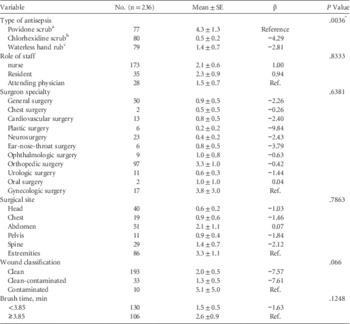
We conducted a multivariate regression analysis to examine whether the antiseptic method, staff profession, surgeon specialty, surgical site, wound classification, and brush time predicted the mean CFU count. The results revealed that only the antiseptic method (P=.0036) in the model predicted the mean CFU count. Using the conventional povidone group as the reference, the β coefficient of the conventional chlorhexidine and waterless hand rub groups were −4.29 and −2.81, respectively (Table 3).
Examination of Variables Attributable to Colony-Forming Unit After Hand Disinfection Using Multivariate Regression Analysis

a Povidone scrub: hand scrubbing with 10% povidone–iodine product.
b Chlorhexidine scrub: hand scrubbing with 4% chlorhexidine gluconate product.
c Waterless hand rub: hand rubbing with 1% chlorhexidine gluconate and 61% ethyl alcohol products.
DISCUSSION
Several studies have examined and compared the effectiveness of antiseptic methods for perioperative hand sterilization, but only a few non-RCT studies that adopted the fingertip imprinting method for bacteria sampling are comparable with our study. Lai et alReference Lai, Foo, Low and Naidu 18 compared the antimicrobial effectiveness of a waterless hand rub with that of a conventional 7.5% povidone-iodine product and found that the waterless hand rub significantly reduced CFU count. Chen et alReference Chen, Han, Kan, Chen and Hung 10 compared data on the antimicrobial effectiveness of a waterless hand rub with the pooled data of 2 conventional methods, namely 4% chlorhexidine gluconate in isopropyl alcohol and a 10% povidone iodine product. They reported that the waterless hand rub is as effective as the traditional hand scrub methods in removing microorganisms on the hands. Shen et alReference Shen, Pan and Sheng 19 compared data on the antimicrobial effectiveness of a waterless hand rub with the combined data of 4% chlorhexidine and 7.5% povidone–iodine products. Their statistical evidence supported the superiority of the waterless hand rub over conventional scrubbing methods. However, merging the antimicrobial effectiveness data of conventional povidone–iodine and chlorhexidine groups might have increased overall bacterial count and confounded the results in the aforementioned studies.Reference Chen, Han, Kan, Chen and Hung 10 , Reference Shen, Pan and Sheng 19
In addition to the antimicrobial effectiveness of antiseptic methods for perioperative hand disinfection, several studies have compared the antimicrobial effectiveness of antiseptic methods in the prevention of SSI. In brief, for preventing SSI, chlorhexidine-alcohol was superior to skin cleansing with povidone–iodine product in clean-contaminated surgery,Reference Darouiche, Wall and Itani 20 and chlorhexidine-alcohol product was superior to iodine–alcohol product for preoperative skin antisepsis in cesarean delivery.Reference Tuuli, Liu and Stout 21 These results indicated that compared with a povidone-iodine product, a chlorhexidine product is a more effective antiseptic solution.
The major determinants for selecting an antiseptic agent are its antimicrobial profile, ease of use and user acceptance, and cost. Regarding ease of use and user acceptance, waterless hand rubbing products are easy to use, require a shorter time to exert effects, and cause less irritation and fewer allergic reactions. 22 , Reference Widmer 23 These characteristics lead to greater compliance among surgical staff. However, waterless hand rubbing products are more expensive than conventional scrubbing products. According to the prices provided by our pharmacy department, the costs of 10% povidone–iodine product per milliliter is NT$0.15 (US$0.47); the 4% chlorhexidine product costs NT$0.36 (US$0.01) per milliliter; and our experimental waterless hand rubbing product costs NT$3.11 (US$0.10) per milliliter. In practice, 5–10 mL of 4% chlorhexidine product, which costs NT$1.8–3.6 (US$0.06–0.11), is required to complete the scrubbing protocol. Furthermore, 6 mL of waterless hand rubbing solution, which costs NT$18.7 (US$0.58), is required to complete the rubbing protocol. Although the substitution of the conventional povidone–iodine scrub product with the chlorhexidine scrub product is beneficial, the benefits may be compromised by the increased costs. In addition, the 2 minutes saved to complete the waterless hand rubbing protocol does not seem to affect the overall performance of a surgery except in the emergency room. Decision makers should thoroughly consider the costs and benefits of using the waterless hand rub for each surgery type.
Our study has some limitations. First, we did not collect additional information regarding the SSIs of the patients. Therefore, we could not evaluate the correlation of the antimicrobial effectiveness of the antiseptic methods with the SSIs of the patients. Second, the antimicrobial effectiveness of these methods against other microorganisms such as fungi and viruses was not evaluated. Third, although on-site researchers ensured that each participant followed standard antiseptic procedures and those who did not were excluded from the statistical analysis, information related to irritation and allergy was not collected. Thus, the comfort factor of using the antiseptic methods could not be evaluated.
In conclusion, our data showed that all 3 methods effectively decreased bacterial burden on the hands and that the decrease was maintained for the duration of the operative procedure. However, the conventional chlorhexidine scrub and waterless hand rub provided better antiseptic effectiveness than conventional povidone–iodine scrub product after hand disinfection. Although chlorhexidine exerted the highest antimicrobial effect among the 3 methods, the waterless hand rub may be a favorable choice for surgical staff for its comfort factor. A balance between costs and benefits should be considered when choosing a general antiseptic method in surgical departments.
ACKNOWLEDGMENTS
Financial support: This work was supported by a research grant from Taipei Medical University, Shuang Ho Hospital (grant no. 103HCP002). The sponsoring organization was not involved in the study design, data analysis, or interpretation.
Potential conflicts of interest. All authors have no conflicts of interest or financial ties to disclose.
SUPPLEMENTARY MATERIAL
To view supplementary material for this article, please visit https://doi.org/10.1017/ice.2016.296