1. Introduction
In communication we want to convey a message to an addressee. To that end, speakers structure the information that they want to transfer to the addressee, and adjust the packaging of the information to the current state of mind of the addressee. This arranging of information within a sentenceFootnote 2 is called ‘information structure’ (IS), in a very general definition (see Lambrecht Reference Lambrecht1994, Krifka Reference Krifka, Féry, Fanselow and Krifka2007). Human languages differ in the linguistic means they employ to express this information structure, varying from word order flexibility to prosodic boundaries to morphological particles. These markers of information structure in a sentence can indicate which information the speaker presumes the addressee to know, which information is new to the hearer, and also which information should be contrasted with alternatives. Intuitively speaking, then, the way of presenting information can reflect what the speaker wants to contrast, which one might think of as subjective, and it takes into account the mental state of the addressee with respect to what is new or given information, which can be seen as intersubjective.
This is in a nutshell the line of thought that formed the inspiration for the current paper. The validity of this reasoning can be questioned in the face of current varying definitions and discussions of subjectivity and intersubjectivity, and therefore it will be examined by addressing the following three research questions:
1. Is information structure an (inter)subjective concept?
2. Are linguistic means used to express information structure (inter)subjective?
3. If so, can the development of linguistic elements expressing information structure be characterised as (inter)subjectification?
The data on which I draw to illustrate the discussion are mostly from African languages, not only because those are the languages I am most familiar with as a researcher, but also because there exist many interesting phenomena involving information structure in African languages, and, most importantly, these have been described in some detail.
I start with the first question, viewing information structure from the point of view of three definitions of (inter)subjectivity (Section 2). After discussing the distinctions and fuzzy boundaries between semantics and pragmatics in the area of subjectivity (Section 3), I continue by examining morphological markers of information structure with respect to (inter)subjectivity, concluding that their developments are initially characterised by subjectification and later objectification (Section 4). Section 5 discusses the (inter)subjectivity of non-morphological markers of information structure, indicating the problematic issues that arise in the relation between information structure, (inter)subjectivity and the linguistic means of word order and prosody. Section 6 concludes.
The paper thus sheds a new light on different definitions of (inter)subjectivity by looking from the perspective of information structure; it pinpoints difficulties in the relation between information structure and (inter)subjectivity; and it shows how a diachronic view of information structure illustrates that both (inter)subjectification and objectification are involved in (secondary) grammaticalisation.
2. Information structure as an (inter)subjective concept
In order to ascertain whether information structure is an (inter)subjective notion, we should first define the terms information structure and (inter)subjectivity. Both concepts have been described in various ways, but there is an essential difference: the question of whether information structure is (inter)subjective is independent of existing definitions of information structure, but receives different answers depending on the definition of (inter)subjectivity. In this section I introduce the notions used in information structure and three views on (inter)subjectivity, namely those proposed by Traugott (Reference Traugott and Davidse2010), Breban (Reference Breban2010) and Verhagen (Reference Verhagen2005), highlighting the differences between these definitions in identifying (inter)subjectivity. I do not discuss the views of Langacker (Reference Langacker1990) and Nuyts (Reference Nuyts2001), as they do not seem particularly relevant in this debate, being linked to the implicit/explicit presence of the conceptualiser and to evidentiality, respectively.Footnote 3, Footnote 4
2.1 Information structure
Information structure is not primarily concerned with the propositional content of the message itself, but rather with how that message is communicated. It is ‘common ground management’ rather than ‘common ground content’, the common ground being the information that is shared between the speaker and the hearer (Chafe Reference Chafe1976, Krifka Reference Krifka, Féry, Fanselow and Krifka2007). It concerns the packaging or presentation of information to facilitate the addressee's processing of this information. In order to successfully communicate the information, speakers accommodate their speech to (their hypothesis about) the temporary state of the addressee's mind (Chafe Reference Chafe1976). This involves the presentation of information as known or as new to the conversation: if a piece of information is already active in the hearer's mind, it is highly accessible and can easily be referred to by the speaker, whereas new information needs to be presented and activated in the hearer's mind. Information structure also involves the highlighting of information that the speaker wants to come back to, or wants to contrast with other, implicit or explicit information.Footnote 5
The current state of mind of the addressee is in part dependent on the previous discourse. For instance, if a referent (i.e. a real-world entity that a linguistic expression refers to) was mentioned in a preceding sentence, it is activated and can hence be referred to as known information. It is important to see that information structure is concerned with the organisation of a sentence within the discourse, not with the organisation of discourse itself (Lambrecht Reference Lambrecht1994: 7). Within the sentence, two divisions can be made: between topic and comment, and, within the comment, between focus and background. The topic of a sentence is usually defined as ‘what the sentence is about’ (Strawson Reference Strawson1964: 97). This aboutness can be the frame for the rest of the proposition (Chafe Reference Chafe1976), or the referent to which the information in the comment should be applied (Reinhart Reference Reinhart1981). Speakers use the topic to help the hearer process the information, firstly in choosing a (pragmatic) topic that is more accessible for the hearer, and secondly in linguistically encoding/marking which referent is the topic of the sentence. As an example, consider the English sentence Maud made PANcakes,Footnote 6 in which Maud is the topic on which we comment that she made pancakes. Maud is identifiable for the hearer, so the sentence is not The pancakes, MAUD made them, where the pancakes would be a topic. Being presented as a topic, Maud is unstressed (compare MAUD made pancakes). This illustrates the idea that both these messages provide the hearer with not only the propositional content (of Maud being involved in a pancake-making event), but also clues on how to process and store that information.
With respect to focus, for the current paper the following definition by Dik (Reference Dik and Hengeveld1997: 326) is most relevant: ‘The focal information in a linguistic expression is that information which is relatively the most important or salient in the given communicative setting, and considered by S(peaker) to be most essential for A(ddressee) to integrate into his pragmatic information’. This is often the new information in the sentence, typically the answer to a wh-question: ‘Who made pancakes?’ ‘MAUD made pancakes’ (see Roberts Reference Roberts, Yoon and Kathol1996, Beaver & Clark Reference Beaver and Clark2008). This definition of focus is wider than, for example, the semantic definitions of focus by Rooth (Reference Rooth1985, Reference Rooth1992, Reference Rooth1996) and Krifka (Reference Krifka, Molnár and Winkler2006, Reference Krifka, Féry, Fanselow and Krifka2007), who define focus as triggering alternatives, but the two definitions are not incompatible.
A third notion in information structure, which can be combined with both topic and focus, is that of contrast (e.g. Vallduví & Vilkuna Reference Vallduví, Vilkuna, Culicover and McNally1998, Molnár Reference Molnár, Hasselgård, Johansson, Behrens and Fabricius-Hansen2002, Neeleman & Vermeulen Reference Vermeulen, Neeleman and Vermeulen2012, see also discussion in Repp Reference Repp2010). A contrasted element carries the additional meaning that there is a referent other than the one indicated by the topic or focus expression for which another proposition is true, and/or for which the current proposition is not true. To illustrate, in a sentence like Theresa ate watermelon and Adam ate ice cream, Theresa and Adam are contrastive topics by being part of different propositions (eating watermelon and eating ice cream). In a sentence like Theresa ate watermelon, not ice cream, the watermelon is contrastively focused because the proposition of Theresa eating something is true for the watermelon and not for the ice cream.
By linguistically marking focus or contrast in the sentence, for example by word stress or word order, the speaker can indicate which information the hearer should consider most important, and/or which part possibly contrasts with earlier representations the hearer may be entertaining. It is important to distinguish between the abstract notions of information structure, topic, focus and contrast on the one hand, and the linguistic means of expressing these notions on the other hand. Although different languages will have different linguistic means of expressing information structure, ‘the need to encode IS is a language universal’ (Foley Reference Foley and Asher1994: 1678). Assuming that topic, focus and contrast are universal notions (see Molnár Reference Molnár, Hasselgård, Johansson, Behrens and Fabricius-Hansen2002, Neeleman et al. Reference Neeleman, Titov, van de Koot, Vermeulen and van Craenenbroeck2009, Zimmermann & Onea Reference Zimmermann and Onea2011, but see the thoughtful caution in Matić & Wedgwood Reference Matić and Wedgwood2012), we can study not only the language-specific ways in which information structure is expressed (see further Section 3 below), but also the notion of information structure in a more abstract sense. In the next sections I examine this general concept of information structure with respect to its (inter)subjective properties.
2.2 (Inter)subjectivity à la Traugott (Reference Traugott and Davidse2010)
In her 2010 article, Traugott very clearly states how she defines subjectivity and intersubjectivity, and the related diachronic notions subjectification and intersubjectification. Compared to earlier definitions (see Section 2.3), the definition that she proposes is more restricted. Her starting point is Lyons (Reference Lyons, Jarvella and Klein1982):
The term subjectivity refers to the way in which natural languages, in their structure and their normal manner of operation, provide for the locutionary agent's expression of himself and his own attitudes and beliefs. (Lyons Reference Lyons, Jarvella and Klein1982: 102)
Traugott (Reference Traugott and Davidse2010) discusses subjectivity as involving instances where aspects of meaning are grounded in the speaker's knowledge and beliefs, and focuses particularly on the social and attitudinal aspects of subjectivity, that is, the attitudes and beliefs, rather than for example the text-organising function of the speaker that may also be reflected in an utterance.Footnote 7 Importantly, this also holds for her definition of intersubjectivity, which is concerned with the speaker's ‘awareness of the addressee's attitudes and beliefs, most especially their “face” or “self-image”’ (Traugott Reference Traugott and Hickey2003, in Traugott Reference Traugott and Davidse2010: 33). Examples of intersubjectivity include the use of mitigating particles with imperatives (so as to ‘save’ the addressee's face), such as print this article, if you don't mind (Aikhenvald Reference Aikhenvald2010: 98) and the well-known Japanese addressee honorifics (Traugott Reference Traugott and Davidse2010).
Is information structure subjective in this definition? It is not, in the sense that the packaging of information is not dependent on the speaker having a certain opinion or belief. For example, whether some referent is (presented as) given or new has no bearing on whether the speaker has a negative attitude. The notions of topic and focus are therefore not subjective. On the other hand, the marking of a referent as contrasting with possible alternatives can be seen as subjective because this contrast is rooted solely in the mind of the speaker: as with the focus particle only (see Brinton Reference Brinton, Borgmeier, Grabes and Jucker1998), linguistic means of encoding contrast can express the exclusion of alternatives (only X, not Y). Traugott (Reference Traugott and Davidse2010: 33) furthermore mentions the focus particle even as an example, because the scalar ordering and identification of a referent at the least likely end of the scale are only present in the mind of the speaker.
With respect to intersubjectivity, since the self-image of the addressee is such a basic factor in Traugott's (Reference Traugott and Davidse2010) definition, it does not allow for a characterisation of information structure as intersubjective. Although the speaker takes into account the hearer in structuring the information, this does not concern the hearer as a social human being with beliefs and opinions and a self-image, but rather as an information-processing receiver. The structuring of the information in the message does not depend on how offensive or respectful a speaker thinks the message may be taken to be by the addressee and, in that sense, information structure is not intersubjective.
2.3 (Inter)subjectivity à la Breban (Reference Breban2010)
Breban (Reference Breban2010) points out that in earlier work Traugott (Reference Traugott, Lehmann and Malkiel1982, Reference Traugott, Stein and Wright1995) included a textual aspect within the notion of (inter)subjectivity, and Breban argues that (inter)subjectivity should not be restricted to the attitudinal or social domain as in Traugott (Reference Traugott and Davidse2010). Instead, the speaker should not only be seen as a person with attitudes (Traugott) or as a conceptualiser (Langacker), but also as a creator of text and organiser of the discourse. The language/text shows ‘signs of the presence of the speaker’, both as a social being and as discourse organiser (Breban Reference Breban2010: 115). Traugott (Reference Traugott, Stein and Wright1995: 39) mentions that subjectified elements have ‘a metalinguistic function of creating text and signalling information flow’, and in her 1982 article she explains that the textual component has to do with the resources available for creating a cohesive discourse, including ‘topicalizers’ (Traugott Reference Traugott, Lehmann and Malkiel1982: 248). This, of course, is precisely what is understood by information structure. If subjectivity is taken to be defined not only by the attitudinal component but also by the textual – that is, the view that the speaker plays an active role in organising and structuring sentences – information structure is certainly subjective.
In the same way, Breban proposes that intersubjectivity should be defined as ‘meanings that are “hearer or addressee centred”, in the sense of pertaining to the hearer's attitudes and beliefs, i.e. the social relation between speaker and hearer, as well as in the sense of being concerned with the hearer as “decoding/interpreting text”’ (Breban Reference Breban2010: 114). Information structure, defined as structuring the information so as to meet the hearer's needs in ‘decoding’, is always centred on the hearer and hence by this definition intersubjective.
2.4 Intersubjectivity à la Verhagen (Reference Verhagen2005)
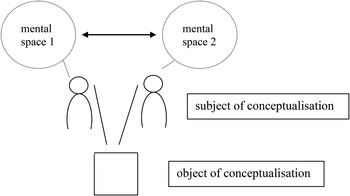
Verhagen (Reference Verhagen2005) presents a cognitive view of intersubjectivity, and does not discuss it as a pair with or in opposition to subjectivity. Verhagen takes as a starting point the idea that language is not used just to describe the outside world, but also to manage the relations between people and between their thoughts. Communication is concerned with ‘connecting, differentiating, and “tailoring” the contents of points of view with respect to each other (rather than organizing a connection to the world)’ (Verhagen Reference Verhagen2005: 4). Two human beings will most likely experience and conceptualise the world around them differently, even if there is a joint attention to the object of conceptualisation, and thus they will have different mental spaces. Language can both manage and reflect the relation between the two mental spaces of these two conceptualisers. Intersubjectivity, then, pertains to how language is used with the purpose of coordinating the mental spaces of two conceptualising subjects (indicated by the left–right arrow in Figure 1). Some utterances or speech acts are almost completely objective (counting, naming) because they pertain to the object of conceptualisation, and some are almost completely intersubjective (commanding, greeting) because they only concern the relation between the subjects of conceptualisation (usually the speaker and hearer).
Verhagen's (Reference Verhagen2005) construal configuration.

Adjusting the packaging of a message to the hearer's mental state, that is, information structuring, can clearly be seen as a prototypical example of intersubjectivity in Verhagen's definition. The purpose of structuring the information in a sentence is precisely to manage the relation between the speaker's mental space and the hearer's (distinct) mental space: speakers can imagine a second mental space of other conceptualisers – the ‘evoked mental space’ – that is distinct from their own and anticipate or act on the differences between the two. I illustrate this with examples for the notions of topic and contrast.
With respect to topic, imagine that a speaker already knows that he wants to add information with respect to a certain referent, say, they want to add the information of eating pancakes to the referent Jim. They can picture this referent being active in the mind, i.e. the mental space, of the hearer, for example, because Jim has been under discussion in the conversation. This evoked mental space, i.e. the hypothesis about the mental space of the hearer, influences the way in which the speaker will ‘tailor’ the message, choosing and marking the active referent as the topic of the sentence, therefore saying Jim ate pancakes rather than JIM ate pancakes.
If, on the other hand, the referent that the speaker wants to comment on is not present as the current topic in the evoked mental space, the speaker takes this into account, and marks it as a shifted or new topic, instead of simply coding the inactive referent as a familiar topic. By guiding the hearer's cognitive processes in this way, the speaker coordinates the relation between the two mental spaces and the flow of information between them.
A similar reasoning can be offered for contrast. By marking some referent as contrasted, the speaker tries to establish a certain way of processing in the mental space of the hearer. By presenting a sentence like They ate PANCAKES, not only does the speaker convey information about a certain referent, e.g. about people involved in a pancake-eating event, but they also instruct the hearer to form a set of relevant alternatives for this focal contrasted item pancakes, e.g. bread, broccoli, bananas, etc. This set of alternatives may also already be present in the evoked mental space, for example, in the context of an alternative question (Did they eat bananas or pancakes?) or when the speaker wants to correct the hearer. As an example of corrective focus, consider the situation in which the speaker thinks/knows that the hearer has the referent bananas in mind (i.e. the hearer thinks They ate bananas), which should be corrected to pancakes. The speaker takes this state of mind of the addressee into account and not only provides information on the object of conceptualisation (pancakes instead of bananas) but also presents it in such a way that it is clear how the hearer should process the information, namely as the asserted referent (pancakes) replacing the previous referent (bananas), which manages the intersubjective relation (see Zimmermann Reference Zimmermann2008 on hearer expectation and the status of contrast).
This is what information structure does. As mentioned above, the relation with the object of conceptualisation is of no concern in information structure: the propositional content of the message is not affected by the way in which it is packaged.Footnote 8 Information structure thus relates in a very natural way to Verhagen's (Reference Verhagen2005) intersubjective aspect of conceptualisation and communication.
2.5 Conclusion
In summary, and in answer to research question 1 formulated in the introduction (Is information structure an (inter)subjective concept?), only the notion of contrast can be taken to be subjective in Traugott's (Reference Traugott and Davidse2010) definition, whereas information structure as a whole is subjective in Breban's (Reference Breban2010) definition. Information structure is not intersubjective for Traugott (Reference Traugott and Davidse2010), but it is typically intersubjective for Breban (Reference Breban2010) and Verhagen (Reference Verhagen2005). So far, subjectivity and intersubjectivity have been discussed separately. In the remainder of the paper I write ‘(inter)subjectivity’ and ‘(inter)subjective’ when intending both notions.Footnote 9
Having answered question 1, on the relation between information structure and (inter)subjectivity, I want to emphasise that the abstract notion of information structure needs to be distinguished from the linguistic means of expressing information structure, such as stress, particles or word order variation. These means are the subject of research question 2: If the more abstract notion of information structure can be seen as (inter)subjective, can the linguistic means that mark and express information structure also be (inter)subjective? In other words: Do markers of information structure function on the (inter)subjective level? Lyons’ (Reference Lyons, Jarvella and Klein1982: 102) definition of subjectivity explicitly refers to the structure and ‘manner of operation’ in which languages reflect speakers' expression of themselves. The most straightforward answer is, then, that if a linguistic strategy encodes an (inter)subjective notion, it functions (inter)subjectively.
However, it is not quite so simple to see whether a given means encodes information structure, for example, whether a particle encodes topic or focus. Before examining the morphological means of encoding information structure to assess their (inter)subjectivity (Section 4), it is necessary to discuss the distinction between the use of an expression in an (inter)subjective way, e.g. only implying a topic or focus reading (pragmatics) and (inter)subjectivity being inherent in an expression, e.g. encoding a topic or focus reading (semantics). The next section discusses this pragmatic–semantic divide.
3. Pragmatics and semantics
If we want to study the (inter)subjective functions of linguistic means marking information structure, we must first know what counts as ‘having an (inter)subjective function’. A certain linguistic means is only (inter)subjective if the (inter)subjectivity is inherent in its meaning, not if it is merely implied. This is an important distinction made by De Smet & Verstraete (Reference De Smet and Verstraete2006), who call one ‘semantic subjectivity’ and the other ‘pragmatic subjectivity’. They show that it is important to establish whether or not the intersubjective function is inherent in the linguistic means that is said to express it. In our case we find morphemes or constructions that contribute to the sentence having a certain information structure. The fact that the speaker chooses a certain morpheme or construction to package the message can be seen as subjective, and it is also intersubjective in adjusting the packaging to the hearer's needs. In this way, the markers of information structure are – at least – pragmatically (inter)subjective. However, only when a certain linguistic means encodes the organisation of discourse and information, that is, when it has this structuring as an inherent (part of its) meaning, does it fall under semantic (inter)subjectivity.Footnote 10
The distinction can be illustrated with an example of topic markers. In the Kwa languages, topics are indicated by occupying a position in the left periphery of the sentence and a following topic marker. In (1) the topic mí ‘me’ is sentence-initial and followed by the morpheme έ. This morpheme has no function other than to mark the referent of the preceding element (mí) as the topic of the sentence. As such, it identifies for the hearer the topic relation between referent and sentence and can be said to fall under semantic (inter)subjectivity. (Abbreviations used in glosses are listed in a list just before References. The examples are reproduced as in the sources cited in the annotations with minor adjustments.)
(1) Ga (Dakubu Reference Dakubu2005, cited in Ameka Reference Ameka, Aboh and Essegbey2010: 143)
mí !έ, shiká ni e-h
 !mí
1sgtop money foc3sg-give 1sg
‘as for me, they gave me money’

More difficult are cases where the historical origin is transparent, as in (2) and the French variants in (3).
(2) As regards X, …
(3) En ce qui concerne X, …/ Quant à X, …
The fact that these are fixed expressions which are limited in their distribution (Prévost Reference Prévost2008) suggests that marking a (contrastive) topic is an inherent part of their meaning, and that they are dedicated constructions to mark information structure, hence a case of semantic subjectivity. On the other hand, an ad-hoc periphrastic ‘topic marker’ as in (4) is a case of pragmatic subjectivity.
(4) Now that she mentions X, …
Although continuing or introducing a topic in this way does structure the information, it is ‘non-coded subjectivity, or subjectivity not conventionalized as a form-meaning pair’ (Davidse, Vandelanotte & Cuyckens Reference Davidse, Vandelanotte, Cuyckens, Davidse, Vandelanotte and Cuyckens2010: 9).
To further complicate matters, the grey area between pragmatic and semantic subjectivity is indeterminate due to the fact that pragmatic uses may over time be strengthened and become semanticised (Traugott Reference Traugott1988). The pragmatic subjective use of an expression can become conventionalised and hence ‘get stuck’ as an inherent semantic part of the meaning (see also Ariel Reference Ariel2008 on the entrenchment of frequent discourse patterns). When a marker changes in its degree of (inter)subjectivity, we speak of (inter)subjectification and objectification, as discussed in Sections 4.2 and 4.3 below.
In conclusion, although the distinction between encoding (semantic) and use (pragmatic) is not always obvious and clear-cut, it is important to be aware of it, and it is useful in the analysis of (inter)subjectivity and its diachronic development, as we shall see below.
4. Morphological topic and focus markers
It is not only the more abstract notion of information structure that can be characterised as (inter)subjective (depending on the definition, see Section 2 above); specific morphological topic and focus markers too can be shown to encode information structure and thereby function (inter)subjectively. We thus answer research question 2 (‘Are linguistic means used to express information structure (inter)subjective?’) in the affirmative. This section first discusses the (inter)subjective properties in the development of morphological topic and focus markers (Section 4.1) and their (inter)subjectification (Section 4.2). It then describes further grammaticalisation processes, which are argued to evolve in the opposite direction (desubjectification, or objectification) (Section 4.3). It is beyond the scope and aim of this paper to prove for each marker that it is semantically specified for information-structural and hence (inter)subjective meaning, but I have chosen examples where, given analyses in the literature, it is relatively clear that the marker concerned is specialised for an information-structural function. I refer to instances of this inherently specified morphology as ‘dedicated’ topic/contrast/focus markers.
4.1 Subjectivity of topic, contrast and focus markers
As mentioned in the previous section, dedicated topic markers can be said to have an inherently (inter)subjective aspect. Considering the various definitions of (inter)subjectivity, the question is whether a marker such as έ in Ga in (1) above, or lá in Ewe, in (5), is subjective and/or intersubjective under all three definitions.
(5) Ewe (Ameka Reference Ameka, Aboh and Essegbey2010: 143)
émegbé lá, mía-ƒo nu le e-ŋú-a
afterwards top1pl-strike mouth loc3sg-side-q
‘afterwards, shall we talk about it?’
Dedicated topic markers clearly function at the intersubjective level between conceptualisers (speaker and hearer) according to Verhagen's (Reference Verhagen2005) definition. In Breban's (Reference Breban2010) definition they are both subjective and intersubjective, as they are a mark of the speaker's organisation of the discourse with the aim of aiding the hearer. However, it is doubtful whether topic markers fit Traugott's (Reference Traugott and Davidse2010) definition. A topic marker is not intersubjective, as it does not take into account the hearer as a person with a self-image. Nevertheless, as the expressed topic–comment division only exists in the speaker's mind (at least before the utterance is made), it may be seen as subjective in Traugott's definition.
A dedicated morphological marker of contrast can likewise be seen as (inter)subjective. It is subjective in the sense that the contrasted alternative may not always be explicitly mentioned and hence present only in the mind of the speaker (Traugott Reference Traugott and Davidse2010), and also in structuring the text (Breban Reference Breban2010). This is illustrated for the contrastive marker -kka in Gawwada, which marks a topic shift in (6).
(6) Gawwada (Tosco Reference Tosco, Fiedler and Schwarz2010: 332)
ye-okaay-ú-ppa karm-o-kka saʕa-k-o kat-a
neg.3sg-come-perf.neg.3sg-link lion-m-contr heart-sing-mdown-out
ʔí-ʔʔassap-aɗ-i
spec-think-mid-perf.3sg.m
‘(the Monkey only) did not come; therefore, the Lion thought in his heart …’
The contrast markers are again not intersubjective under Traugott's definition, since contrast does not concern the hearer's ‘self’. Conversely, they are intersubjective in Breban's (Reference Breban2010) and Verhagen's (Reference Verhagen2005) definitions because they manipulate the hearer's construction of the information, taking into account the fact that the hearer may have a different referent in mind. This alternative referent is either to be changed as the topic, or is to be replaced by a corrective focus as in (7) and (8).
(7) Gawwada (Tosco Reference Tosco, Fiedler and Schwarz2010: 337)
qayná-kkaʔan-ʔašši-n-a ʕanɗ-e ʕuk-á
tomorrow-contr1sg.subj-go-fut-ipfv.1sg water-pl drink-cons.1sg
‘TOMORROW I'll go and drink water’
In order to understand the contrastive focal reading in example (7), Tosco (Reference Tosco, Fiedler and Schwarz2010) provides the following description of the context: ‘the Elephant, informed by the other animals that the Frog is planning to kill him the next time he will approach the river, tells he is going to take a nap, and that tomorrow only – not today – he will go to the river’ (Tosco Reference Tosco, Fiedler and Schwarz2010: 336–337, italics in original). The combined markers -kka and the specificity affix -í function as the contrastive focus marker -kkí, as in (8).
(8) Gawwada (Tosco Reference Tosco, Fiedler and Schwarz2010: 337)
ʔano so-ʔakk-o ʕant-í-kka-ma
1sg.idp magic-sing-m be-ipfv.neg.1sg-contr-diff
ʔato-kk-i soʔ-akk-o
2sg.idp-contr-spec magic-sing-m
‘I am not a sorcerer; YOU are!’
I conclude that this contrast marker, whether combined with topic or focus, is inherently subjective, and under Verhagen and Breban's definitions also intersubjective.
The same applies to dedicated morphological markers of focus, exemplified in(9). In Nupe, there is a separate marker á which precedes the verb phrase and indicates predicate focus.
(9) Nupe (George Reference George, Chin-Wu and Stahlke1971: 95, cited in Heine & Reh Reference Heine and Reh1983: 18)
(a) mí lo-tũ
1sg did-work
‘I worked.'
(b) mî á etũ lo.
1sgpf work did
'I WORKED.'
Taking focus to be the highlighted or most salient piece of information, focus is a subjective concept in all three definitions, as the saliency is grounded in the speaker's subjective construal of the information.Footnote 11 Like topic and contrast markers, focus markers are not intersubjective in Traugott's definitions, as they do not concern the face or beliefs of the addressee. However, for Verhagen and Breban they are clearly intersubjective: focus markers do not refer to the object of conceptualisation but help the addressee in identifying the referent (sometimes as exclusive from a set) and manipulate the addressee's mental space (i.e. their conceptualisation of the referent as highlighted or exclusive). By exclusivity I mean that there is at least some other referent in the set of alternatives to which the predicate does not apply.
Focus can also be expressed by less transparent morphology, for example, when it is interwoven with conjugations. Such is the case in Wolof, where verbal inflection depends on which element is in focus. In addition to the affirmative conjugations, Wolof has three so-called emphatic conjugations, indicating focus on the subject, the complement, or the verb, respectively, see (10).
(10) Wolof (Robert Reference Robert and Caron2000: 234)
(a) Peer lekk na
Pierre eat perf.3sg
‘Pierre has eaten’(neutral)
(b) Peer moo ko lekk
Pierre e.s.3sg om eat
‘It's Pierre who has eaten it’(subject focus)
(c) Mburu laa lekk
bread e.c.1sg eat
‘It's bread that I've eaten’(complement focus)
(d) Peer dafa ko lekk
Pierre e.v.3sgom eat
‘Pierre has eaten it’(verb focus)
In this case, it is not the presence of a particular separate morpheme that brings about the focused reading. It is rather the use of a certain emphatic conjugation instead of a neutral one that indicates the speaker's view of what the most important or contrastive information is in the sentence. The conjugations (possibly in combination with sentence position) are the linguistic means used to encode this view in the language and manage the hearer's processing of the information. The emphatic conjugations can thus be said to function (inter)subjectively.
In summary, if the distribution of a certain morphological marker can only or best be captured in terms of information structure, for instance when there is an unambiguous relation between its presence and a focus interpretation and the marker hence encodes focus, then this morphology marks the speaker's effort to structure the information, which under any of our three definitions counts as subjective. The markers are not intersubjective in Traugott's (Reference Traugott and Davidse2010) definition, as their information-structural meaning does not concern the hearer's beliefs or self-image, but in Verhagen's (Reference Verhagen2005) or Breban's (Reference Breban2010) definitions these markers of topic, contrast or focus are inherently intersubjective because they concern manipulation of the mental space of the addressee (Verhagen) or show that the speaker takes into account the hearer as an information-processing interlocutor (Breban).
4.2 Subjectification towards topic and focus markers
Having answered the second research question in concluding that morphological markers of information structure function at the (inter)subjective level, the third question is whether their diachronic development can be characterised as (inter)subjectification. In this subsection and the next it becomes clear that the development towards functioning as a dedicated topic, contrast or focus marker can be characterised as (inter)subjectification, but their further development involves a decrease in (inter)subjectivity.
If a speaker wants to structure the information in a certain way, the only means available are in the language as it is at that moment in time. Hence, in addition to the usage of pre-existing IS markers, it may be expected that less (inter)subjective elements are pressed into service for more (inter)subjective functions such as the marking of a topic. This is indeed attested for topic, contrast and focus, as illustrated in turn below.
Topic markers can originate, for example, in pronouns or definite articles. Heine & Reh (Reference Heine and Reh1984) claim that the original definite marker lá in Ewe, as in (11a), was reanalysed and specialised to a topic marker lá illustrated in (11b) (see Ameka Reference Ameka1991: 148 for an alternative analysis).
(11) Ewe (Heine & Reh Reference Heine and Reh1984: 65)
(a) ny
nu lá kp ewoman def see 3sg
‘the woman saw her’
(b) ny
nu lá é kp ewoman top3sg see 3sg
‘as for the woman, he saw her’

The definiteness marker simply indicates definite reference, and the function of a pronoun is to fill a syntactic argument position. In these original functions, these markers do not structure the information. As a topic marker, however, they do reflect the point of view of the speaker, or the state of mind of the addressee, thus functioning (inter)subjectively, as argued in Section 4.1. Therefore, we can conclude that the development from pronoun or definite marker to dedicated topic marker involves (inter)subjectification.
The same applies for markers of contrast, such as the contrastive marker -nun in Korean, illustrated in (12), which originates from a copula according to Lee (Reference Lee and Di Sciullo2003).Footnote 12
(12) Korean (Lee Reference Lee and Di Sciullo2003: 351)
Jeonja jepum-un Samsung jeonja-ka choiko-i-ya
electronic products-contr Samsung Electronics-nom best-be-dec
‘As for electronic products, Samsung Electronics is the best.’
The copula originally fulfils a purely syntactic function as establishing predication, whereas contrastive marker functions (inter)subjectively, as argued in the previous section. Hence, the development from copula to contrast marker is another example of (inter)subjectification.
The origin of the previously mentioned contrastive marker -kka in Gawwada is to be found in its use as an additive marker ‘too, also’. Tosco (Reference Tosco, Fiedler and Schwarz2010: 330) argues: ‘Some degree of contrast is evident in [(13)] (“but there is …”): the “additive” meaning of -kka, which is the most evident to speakers, is probably the starting point of a grammaticalization process leading eventually to the (textually far more common) use of -kka as a full marker of contrast’.
(13) Gawwada (Tosco Reference Tosco, Fiedler and Schwarz2010: 330)
minn-aɗɗ-ete ʔol-h-o h-o ʔa-yiʔ-n-i
house-plur-assoc.pl thing-sing-mm-mgen-eat-fut-perf.3sg.m
hoq~q-aš-e-ma ʔol-okk-o h-o kor-o
full~int-caus-vn-diff thing-sing-mm-m people-m
poɠ~ɠ-a-kkaʔí-ʕʕak-a-pa
kill~sem-ipfv.3sg.m-contrspec-be_there-ipfv.3sg.m-link
‘in the houses there are plenty of things one can eat;
there is also something which kills people’
This development in Gawwada is perhaps a less clear instance of (inter)subjectification because there is already an (inter)subjective aspect to the original additive meaning, which indicates that there is information in addition to what the hearer had in mind up to that point in the conversation.
Morphological markers for focus too can arise from less (inter)subjective elements. A common source for focus markers is a cleft construction.Footnote 13 In the development from a biclausal cleft to a monoclausal construction with a focus marker, one element is reanalysed as the focus marker (Givón Reference Givón1979; Heine & Reh Reference Heine and Reh1983, 1984; Harris & Campbell Reference Harris and Campbell1995). The resulting focus marker is in many cases derived from the copula, as, for example, in Kikuyu (see (22) below; Bergvall Reference Bergvall1987, Schwarz Reference Schwarz and Aboh2007). In the diachronic process from cleft to focus marker, the focus reading which is first associated with the whole cleft construction is eventually reanalysed as pertaining to the presence of one element, which becomes the focus marker. This grammaticalisation process is known as hypoanalysis (Croft Reference Croft2000). As an example of hypoanalysis, consider the ongoing process from a cleft to a focus construction in Lingala and surrounding languages (Van der Wal & Maniacky, to appear). The word moto ‘person’, as in (14), first functioned as the head noun of a relative clause in a biclausal cleft, as in it was the neighbour, the person who ate the fish. It was then reanalysed as the focus marker, as in (15), which illustrates that it is a monoclausal focus construction and no longer a biclausal cleft. This hypoanalysis is schematically represented in (16), from Lingala.
(14) Namóní moto m
k1sg.see.perfasg.person one
‘I have seen one person/I have seen someone.’
(15) Nyáu moto azalí kolía mbísi
9.cat focasg.be.perf 15.eat 9.fish
‘It's the cat that is eating the fish.’
(16) [copula NP+human] [moto V-relative] > [[(copula) NP moto] V]
(it) is NP person who.V

The element from which a focus marker develops thus fulfils a purely syntactic function in the original cleft construction, very often as a copula, or, in the case of moto ‘person’, as the head noun of the relative clause in a cleft. At this initial stage, the whole construction can be said to express a subjective function (the encoding of focus), but the copula and head noun in this original construction still only have their syntactic function as predicator or head of the independent relative DP. In the grammaticalisation process towards reanalysis as a focus marker, the element is increasingly associated with its new function as a focus marker, and hence the development from copula or head noun to focus marker can be characterised as (inter)subjectification.
Finally, the predicate focus marker á in Nupe is suggested to derive from an auxiliary verb lá/á ‘take’, which had a nominalised verbal complement (thus also explaining the deviant OV order in the presence of the predicate focus marker á). Heine & Reh (Reference Heine and Reh1983) suggest that, historically, Nupe required clauses to be transitive. Thus, the periphrastic construction with the auxiliary was a way for intransitive predicates to comply with this restriction. In its use with intransitive predicates – a purely syntactic function – it ‘served to lay emphasis on the verbal action, and it came to be interpreted as a marker of assertion/new information. When its use was extended from intransitive to transitive verbs it assumed the role of a focus marker’ (Heine & Reh Reference Heine and Reh1983: 21). This scenario illustrates once again the semantic change of an initially objective piece of morphology which subjectivises as it develops its function as a dedicated focus marker.
We have seen that the morphological markers of topic, contrast and focus develop from lexical and grammatical sources. They are said to more often develop from the latter because the grammatical means to mark information structure are ‘more subtle from the beginning. They are seldom recruited from among lexical items' (Lehmann Reference Lehmann, Seoane and Lopez-Couso2008: 211). It was argued that the development to topic, contrast and focus markers is an instance of (inter)subjectification, thereby answering research question 3 (Can the development of linguistic elements expressing information structure be characterised as (inter)subjectification?). However, this is only a partial answer, as these markers are known to develop further. Although this further development results in (more?) grammatical functions too, it does not involve further subjectification. This is shown in the next section.
4.3 Objectification from topic and focus markers
Lehmann (Reference Lehmann, Seoane and Lopez-Couso2008) shows that markers of information structure are themselves part of grammar and as such they also undergo (secondary) grammaticalisation. In this process they develop into markers of purely syntactic functions and hence, in the grammaticalisation from topic and focus markers, I argue that the meaning is decreasingly subjective and intersubjective. This process of objectification or desubjectification is defined by Kranich (Reference Kranich, Stathi, Gehweiler and König2010: 102, 103) as ‘the loss of subjective meanings and the acquisition of more objective meanings', that is, ‘meanings become less based in the speaker's belief state/attitude towards the situation, and more based on objectively verifiable properties of the situation’. It is important to note that the term objectification does not imply a change to completely objective meaning, but it indicates the reverse movement on an imaginary scale of subjectivity, just as the terms subjectification and intersubjectification do not indicate that something becomes fully subjective or intersubjective, but rather more subjective or more intersubjective. As such, the term is used to indicate the process of desubjectification as well as de-intersubjectification, under any of the given definitions.
Kranich (Reference Kranich, Stathi, Gehweiler and König2010) claims that objectification tends to characterise secondary grammaticalisation rather than primary. The distinction between primary and secondary grammaticalisation was first made by Kuryłowicz (Reference Kuryłowicz and Kuryłowicz1975 [1965]) and is described as follows: primary grammaticalisation (Traugott Reference Traugott, Minkova and Stockwell2002) involves the development from a lexical to a grammatical item (e.g. English go ‘move from here’ > ‘future tense’), whereas secondary grammaticalisation (Givón Reference Givón, Traugott and Heine1991) takes an already grammatical item as its source (e.g. demonstrative pronoun > article). Since markers of information structure are grammatical (not lexical), the changes to be described in this section are instances of secondary grammaticalisation. Indeed, we will see that these cooccur with objectification (although this is not the whole story). For the purposes of examining the relation between information structure and (inter)subjectivity, the process of objectification is argued for and illustrated below with examples of the grammaticalisation of topic, contrast and focus markers into purely syntactic functions.
As for the further development of topic markers, Li & Thompson (Reference Li, Thompson and Li1976) refer to the grammaticalisation from topic to subject. In the same book, Givón (Reference Givón and Li1976) argues furthermore that pronouns that first refer to topics can be reanalysed as markers of subject agreement, formulated as in (17).
(17) Topic-shift structure Neutral/reanalysed
The man, he came > The man he-came
topprosubjagr
(Givón Reference Givón and Li1976:155)
This is what Givón suggests has happened in many of the Bantu languages, where we find a prefix for subject agreement on the verb. In (18), the subject and topic ńkongu ‘tree’ is coreferenced on the verb by the prefix gu-, and it can be interpreted either as a mere subject (which is familiar and therefore can still be said to pragmatically have a topic relation in this sentence), or alternatively as a frame or shift topic, as indicated by the two translations. This is similar to the use of a pronoun to indicate the topic in spoken French, as with il in (19).Footnote 14
(18) Matengo (Yoneda Reference Yoneda2011: 756 and personal communication)
Ńkongu gu-hábwǐ:ke
3.tree 3sm-fall.perf
‘the tree has fallen down’
‘as for the tree, it has fallen down’
(19) French
Obélix il mange de sangliers
Obelix he/top eats cl wild.boars
‘Obelix eats wild boars’
The use of such a (resumptive) pronoun can become more obligatory in the grammaticalisation from topic marker to subject marker. As Givón (Reference Givón and Li1976: 151) explains, ‘when a language reanalyzes the topic constituent as the normal subject … of the neutral, non-topicalized sentence pattern, it perforce also has reanalyzed … topic agreement as subject agreement’. This is presumably what happened in the Bantu languages, such as Matengo, where the subject prefix was originally an (independent or clitic) pronoun referring to the dislocated topic – a state we can still imagine for sentences like (18) – and it has now become an obligatory agreement prefix (see Morimoto Reference Yukiko, Downing, Zerbian and Marten2006, Reference Morimoto, de Hoop and de Swart2009 for this process in other Bantu languages). Its status as an agreement marker is clearly visible in inversion constructions, where the subject occurs postverbally and is not the topic, but the subject marker on the verb still needs to agree with this (logical) subject. This is illustrated in (20), where the topic is ílasí ‘potatoes’, but the subject marker on the verb ju- agrees in noun class 1 with the postverbal subject Kinûnda.
(20) Matengo (Yoneda Reference Yoneda2011: 756)Footnote 15
Ílasí ju-a-hémála Kinû:nda.
8.potatoes 1sm-past-buy 1.Kinunda
(Talking about potatoes) ‘(These) potatoes, Mr. Kinunda bought (them).’
The same analysis as grammatical agreement markers has been proposed for colloquial ‘advanced French’, where the pronoun has become obligatory and even occurs with non-referential (and hence non-topical) noun phrases, as in (21).
(21) Français avancé (Zribi-Hertz Reference Zribi-Hertz, Cinque, Koster, Pollock, Rizzi and Zanuttini1994: 462)
Personne il m’ aime
nobody 3sg1sg love
‘Nobody loves me.’
Although word order and intonation also play a role in the original marking of the topic, e.g. being sentence-initial and followed by a pause are common for left dislocations, the presence of the pronoun in the earlier dislocation constructions (Noëlle, she is very kind) is very much related to the marking as topicalisation, and hence is one of the indicators of the topic relation. This is particularly the case if the pronoun has been reanalysed as a dedicated topic marker. At the other end of the grammaticalisation chain from topic marker to subject marker, the original pronoun/topic marker only has a syntactic function as an agreement marker. It has, then, become an obligatory marker of a syntactic relation and can no longer be used to explicitly mark a topic. If something is obligatory, it cannot easily be used to express an attitude or to explicitly structure the discourse because ‘in order to enrich a form with subjective meaning, the speaker must be free to choose whether or not to use it’ (Kranich Reference Kranich, Stathi, Gehweiler and König2010: 102). Because using the subject marker is at this grammaticalised stage simply a matter of complying with the rules of grammar, it is no longer one of the means to package the information for the hearer, and thus this development forms an example of objectification.
Topic markers are also known as a source for case markers. Tosco (Reference Tosco and Brugnatelli1994) argues that the nominative marker in Highland East Cushitic languages developed or is developing from a previous topic marker. One indication of this origin is the fact that in some languages the nominative can only be used for definite nouns (which is a typical topical property). König (Reference König2008) also mentions the marker ma in the Khoisan language !Xun, which is obligatory on subjects in some contexts and hence may (come to) express nominative case. Case marking indicates syntactic argument relations, so when the topic marker grammaticalises to take on a new function of (obligatorily) marking case relations, it is no longer connected to (inter)subjective properties like topicality. Hence, these developments again illustrate the cooccurrence of secondary grammaticalisation, obligatorification and objectification.
With respect to the Gawwada marker of contrast -kka, Tosco (Reference Tosco, Fiedler and Schwarz2010: 339) notes, citing Savà (Reference Savà2005: 162), that further grammaticalisation of the marker has occurred in the neighbouring language Ts'amakko, where ‘all the negative verbal forms in main clauses are obligatorily followed by -kka, which has apparently lost any residual pragmatic value [i.e. information-structural meaning, JW]’. In Ts'amakko, then, we find the same combination of secondary grammaticalisation, obligatorification and objectification.
Another example is the development from focus marker to perfective marker. This development is described by Güldemann (Reference Güldemann2003) for several eastern Bantu languages. I will first present the data and then argue how this, too, involves objectification. Some Bantu languages have a marker ni-/ne- as identificational copula and as focus marker (which developed from the copula in a cleft), as illustrated in (22a, b).
(22) Kikuyu (Schwarz Reference Schwarz and Aboh2007: 141, 140, adjusted)
(a) Abdul ne morutani
Abdul cop teacher
‘Abdul is a teacher’
(b) Ne mae abdul a-ra-nuy-irε
cop/foc 6.water Abdul sm-t-drink-perf
‘Abdul drank WATER’
(c) Abdul ne-a-ra-nuy-irε mae
Abdul foc-sm-t-drink-perf 6.water
‘Abdul drank water.’ (‘focus on entire sentence’; Schwarz 2003: 141)
This marker ni- can in some Bantu languages also be used as a proclitic on the verb, resulting in predication focus, as in (22c) above and (23).
(23) Kîîtharaka (Abels & Muriungi Reference Abels and Muriungi2008: 690)
Maria n-a-gûr-ire î-buku
1.Maria foc-1sm-buy-perf 5-book
‘Maria bought a book.’
In Kikuyu and Kîîtharaka the ongoing grammaticalisation of ni- is clearly visible because the verb occurs with ni- in many more environments than just predicate focus. Abels & Muriungi (Reference Abels and Muriungi2008) analyse n(i)- in Kîîtharaka as a focus marker, but remark that ‘sentences with the focus marker adjacent to the verb … allow a wide range of interpretations: they are felicitous, for example, in all-new contexts, as answers to VP questions, but infelicitous as answers to narrow object questions' (Abels & Muriungi Reference Abels and Muriungi2008: 690).
This preverbal focus marker ni- can develop into a progressive marker, as argued for Haya by Güldemann (Reference Güldemann2003). The same copular function as in Kikuyu can be observed in Haya in (24a), and ni- is also used in clefts or as term focus marker in (24b). However, as a preverbal clitic, ni- no longer functions as a predicate focus marker, but now distinguishes a progressive from a non-progressive reading, as seen in (25).Footnote 16
(24) Haya (Hyman & Watters Reference Hyman and Watters1984: 261; Bennett Reference Bennett, Byarushengo, Duranti and Hyman1977: 182, quoted in Güldemann Reference Güldemann2003)
(a) Ni Káto.
cop Kato
‘It's Kato.’
(b) Ni ḿbwá ky’ éy’ ómusháíj’ a-hail’ éŋkoni.
cop/foc 9.dog which 9.rel 1.man 1.past-give stick
‘Which dog did the man give a stick to?’
(25) Haya (Hyman & Watters Reference Hyman and Watters1984: 260, quoted in Güldemann Reference Güldemann2003: 324)
(a) Ba-mu-kóma.
2sm-1om-tie
‘They tie him up.’
(b) Ni-ba-mu-kóma.
prog-2sm-1om-tie
‘They are tying him up.’
As argued above, the development from copula to focus marker involves an increase in (inter)subjectivity, but the development from focus marker to progressive marker involves a decrease in (inter)subjectivity. This is because describing an action as progressive is certainly less dependent on the view of the speaker than identifying a referent (term focus) or an action (predication focus) as the most salient information, and is therefore less subjective in both Traugott's (Reference Traugott and Davidse2010) and Breban's (Reference Breban2010) definitions. It could also be argued that the progressive meaning is more concerned with the conceptualisation of an event in the outside world than with the manipulation of the speaker–hearer relationship, which is less intersubjective in Verhagen's (Reference Verhagen2005) definition of intersubjectivity. The later development of the preverbal marker ni- can thus be analysed as a case of objectification.
Heine (Reference Heine, Vossen and Keuthmann1986) presents another interesting example of the complete process of increase and decrease in subjectivity along the path of grammaticalisation, which is outlined only briefly here. Heine analyses the history of a synchronic object marker or case marker in the Khoe languages (Khoisan) in terms of the grammaticalisation chain in (26) (from König Reference König2008: 278). Just as in the case of the development copula > focus marker > progressive marker discussed above, the first part of this chain arguably involves subjectification, whereas the second part shows objectification.
(26) copula > focus marker > object marker
Summing up so far, I have shown that dedicated morphological topic, contrast and focus markers carry an (inter)subjective function, and that the acquisition of their topical, constrastive or focal meaning can be characterised as (inter)subjectification. Hence, the first part of the grammaticalisation process, leading from lexical or grammatical elements to topic and focus markers, is accompanied by an increase in (inter)subjectivity, i.e. (inter)subjectification. However, the second part of the grammaticalisation process, from topic, contrast or focus marker to syntactic markers of, for example, agreement or case, shows a decrease in (inter)subjectivity, which we call objectification.
This conclusion can be linked to Kranich's (Reference Kranich, Stathi, Gehweiler and König2010) hypothesis that subjectification is predominant in primary grammaticalisation – from lexical item to grammatical element – and that objectification is favoured in secondary grammaticalisation – ‘from a grammatical to a more grammatical status’ (Kuryłowicz Reference Kuryłowicz and Kuryłowicz1975 [1965]: 52). Although in the processes described above we find an increase followed by a decrease in (inter)subjectivity, the first grammaticalisation process, which has the IS marker as the end result, does not fall under the definition of primary grammaticalisation as the development from a lexical to a grammatical item. Linguistic forms such as a copula or a pronoun cannot straightforwardly be called lexical items, and therefore the changes occurring in their use would be instances of secondary grammaticalisation, where the source item is already grammatical.Footnote 17
Two issues ermerge from this observation. First, we conclude that secondary grammaticalisation can involve (inter)subjectification as well as objectification (although obviously not at the same time), a conclusion in line with Norde's (Reference Norde, van der Auwera and Nuyts2012: 59) findings on the relation between (de)subjectification and secondary grammaticalisation. Second, if secondary grammaticalisation is the evolution from ‘less grammatical to more grammatical’, we may wonder in what way topic and focus are more grammatical than, for example, a copula, and subsequently, in what way subject or progressive is more grammatical than topic and focus. This of course depends on the definition of grammar and grammatical, which is an issue that is far beyond the scope of this paper.
5. Other markers of information structure
The previous section discussed morphemes used to mark information structure, specifically topic, contrast and focus relations and how these morphemes can undergo an increase or a decrease in (inter)subjectivity. However, we know that morphological markers are not the only indicators of information structure. Since information structure is like a web between syntax, morphology, phonology and prosody, it can be expressed by a wide range of linguistic means, which are frequently combined. Now the question arises how strategies other than morphological markers relate to (inter)subjectivity. As mentioned above, the most straightforward answer is that if a linguistic means encodes an (inter)subjective notion, it functions (inter)subjectively. It is difficult to show, though, whether any of the non-morphological means to express information structure have that function as an inherent part of their meaning. In this section I discuss in turn three other linguistic means to mark information structure: the cleft construction, word order, and prosody.Footnote 18 As we will see, there are no clear answers, but I intend to indicate a way to think about these issues and to identify the difficulties.
5.1 Cleft construction
Clefts and pseudoclefts are well-known constructions to express focus, consisting of a predicative noun and a relative clause. The result, as illustrated in (27), is a periphrastic construction where the focus interpretation derives from the combination of the relative clause (what the children broke) and the predicative NP (is the stick) that identifies the referent of the NP as the exclusive referent for which the predicate holds. The focus is expressed by the whole construction, and hence the whole construction carries an (inter)subjective meaning.
(27) Lubukusu (Diercks Reference Diercks2011: 708)
Lw-á-bá lú-u-saala ní-lwó bá-bá-ana bá-a-lu-funa.
11sm-past-be 11-11-stick comp-11 2-2-child 2sm-past-7om-break
‘It was the stick that the children broke.’
The emergence of such a transparent periphrastic cleft construction has two important characteristics: it is newly created by combining a relative and a predicative clause, and it is created precisely in order to express focus.Footnote 19 This implies that there was never a process of (inter)subjectification, but that it was (inter)subjective from the beginning. More interestingly for our current discussion, further evolution of cleft constructions shows objectification. Lehmann (Reference Lehmann, Seoane and Lopez-Couso2008) suggests that a construction starts to express a certain information structure, which over time can only become more neutral and ‘wear out’. Indeed, there are many examples of clefts and pseudoclefts that come to express an array of information-structural functions broader than exclusive focus, which eventually become pragmatically neutral morphological markers or word orders.
The objectification of clefts happens in two ways. First, putting a referent in focus is a means to emphasise, and emphasis tends to wear out quickly (Dahl Reference Dahl2001). The more an emphatic term is used, the less powerful it will feel. Hence, with extensive use, cleft constructions cease to convey the strong focus they originally did (it is really X and nobody else).Footnote 20 As an example, Lehmann (Reference Lehmann, Seoane and Lopez-Couso2008: 221) describes the development of the Latin ‘maximally emphatic’ cleft sentence (28), which, through the historic development from Latin to Modern Romance languages, has in French become the ‘neutral’ way to form an interrogative (29).
(28) Latin (Lehmann Reference Lehmann, Seoane and Lopez-Couso2008: 221, citing Cic. de orat.2, 45, 4)
Quis est qui nesciat …
who cop who ignores
‘Who does not know …?’
(29) French
Qu'est-ce qu'il veut?
‘What does he want?’
Second, the relative clause in the original cleft contains presupposed material, forming the background for the identification of the focus. Lambrecht (Reference Lambrecht1994) explains that speakers can exploit this when aiming for pragmatic accommodation: the hearer is required to accommodate the information as though it were presupposed, as is the case in the first phrase of a lecture in (30).
(30) It was George Orwell who said that the best books are those which tell you what you already know
(Lambrecht Reference Lambrecht1994: 71)
As this accommodation becomes conventionalised over time, the syntactic construction can more easily be used for non-presupposed information as well. Patten (Reference Patten, Traugott and Trousdale2010: 237) agrees with Lambrecht and suggests a ‘gradual progression in the it-cleft construction from expressing only given information in the relative clause, to expressing shared but non-salient information, to the inclusion of information that is factual’. See Koops & Hilpert (Reference Koops, Hilpert, Gívon and Shibatani2009) for a similar development in English pseudoclefts.
These developments from a cleft construction start with a highly subjective exclusive focus interpretation of the referent in the copular clause, and lose this strong focus in grammaticalisation, illustrating a process of objectification.
5.2 Word order
Word order can also be used as the main or an additional means to mark the status of information. In the framework of generative syntax, the cartographic approach proposes specific topic and focus projections and hence dedicated structural positions in the syntactic structure of a sentence (most influentially Rizzi Reference Rizzi and Haegeman1997). In a more cognitive view, it has been proposed that iconic word order devices are used, resulting in universal tendencies such as an initial position for focus (Givón Reference Givón2001), or a Given-Before-New-Principle (Gundel Reference Gundel, Hammond, Moravcsik and Wirth1988). Both approaches suggest that a certain position can become specialised for a particular kind of information, eventually being restricted to that type of information-structural function and effectively encoding it.
For instance, the preverbal domain can be restricted to topical elements, which is the case in many southern and eastern Bantu languages (see, among others, Zerbian Reference Zerbian2006, Van der Wal Reference Van der Wal2009, Yoneda Reference Yoneda2011). This can be taken to mean that the preverbal position indicates the topical status of the referents occuring there, in other words, that it is an inherent property of that position to indicate topic. In the same way, the Immediate After Verb (IAV) position is used only for focused referents in some languages (Watters Reference Watters and Hyman1979; Buell Reference Buell, Matondo, Laughlin and Potsdam2009; Van der Wal Reference Van der Wal2009, 2011; Yoneda Reference Yoneda2011), so this IAV position can be said to encode focus. That these positions are inherently bound to the functions of topic and focus is evident in the fact that it is not merely inappropriate but actually ungrammatical to have a referent with a divergent information structure. For example, a focused element is ungrammatical in preverbal position, as illustrated by the NP modified by focus particle ‘only’ in (31) and the inherently focal wh-element in (32a), or the consistent focus interpretation of the element in IAV position in (32b,c).
(31) Makhuwa
Ekanétá y-oóríipa (*paáhi) yoo-mór-éla vathí.
9.pen 9-black only 9.perf.dj-fall-appl 16-down
Intended: ‘Only the black pen fell down’
(32) Aghem (Watters Reference Watters and Hyman1979: 144)
(a) *Ndúgh
m ñŋ (nô)?who P2 run foc
(b) À m
ñŋ ndúgh?expl P2 run who
‘Who ran?’
(c) À m
ñŋ énáʔexpl P2 run Inah
‘Inah ran’ (as an answer to (32b))


There are, however, various difficulties in the analysis of a certain position as a marker of information structure. First, in many cases where word order plays a role in topic or focus marking, prosody and/or morphology are also present. For example, the Italian preverbal focus position goes together with a pitch-accent (Frascarelli Reference Frascarelli1999), and the IAV focus effect in Makhuwa is only present when the element immediately follows the so-called conjoint verb form, which functions as a morphologically marked pair with a disjoint verb form (Van der Wal Reference Van der Wal2009, Reference Van der Wal2011). This difficulty of various linguistic means cooccurring to express a certain information structure also surfaces with morphological markers (as in Section 3 above), but it is more feasible to prove how a morphological marker encodes topic or focus than a (relative) sentence position, or word order in general.
A second difficulty, which relates to this first point, is the question of the systematic one-to-one correlation between position and information structure. In order to convincingly claim that a position encodes an interpretation, (ideally) we need to show that the relation always exists. That is, the structure–meaning correspondence should be there for all tenses, for declarative and subjunctive sentences, in both main and dependent clauses. It remains to be seen whether such a system exists among the world's languages. Alternatively, one could take a more local view and say that in this particular sentence this (IAV, initial, …) position is the sole indicator of focus and therefore functions (inter)subjectively.
Third, the link between sentence position and information-structural interpretation may be indirect, meaning that there is another linguistic mechanism that triggers a certain interpretation of an element. For instance, in Hungarian, an NP in the position immediately before the verb has a focused reading, which has inspired analyses of this position as a dedicated focus position (M. Brody Reference Brody1995, Kenesei Reference Kenesei, Molnár and Winkler2006). Conversely, É. Kiss (Reference É. Kiss, Molnár and Winkler2006) and Wedgwood (Reference Wedgwood, Schwabe and Winkler2007, Reference Wedgwood2009) have argued that the focused interpretation is not inherent in the position before the verb, but instead this position hosts predication, and the focused interpretation is due to the identification resulting from the predicative process being applied to a referential noun phrase. In other words, although there seems to be a direct form–function relation, the association between the preverbal position and the focus interpretation can also be analysed by reference to predication. If the predication analysis holds, this makes the relation between position and focus interpretation an indirect one, and hence the focus cannot be said to be an inherent property of the preverbal position.Footnote 21
Fourth, we may question what we mean when we say that ‘a certain position’ encodes focus or topic. In the cartographic approach, this is linked to a certain hierarchical projection, but the descriptive data only show us a linear order, and this may in fact be of more impact than the structural position. Buell (Reference Buell2011) provides an example of a case where structural and linear positions vary, and the linear position seems to determine what counts as immediately after the verb. Buell shows that, in Zulu, wh-words (which are inherently focused) must appear in IAV position. Most focused phrases appear inside the VP and are in IAV position because other non-focal elements are dislocated. However, Buell shows that ngani ‘why’ is in a structurally higher position, but must still appear linearly directly after the verb. Hence it seems that the subjective focused interpretation is linked to the linear position following the verb. Defining the structural or the relative linear position has consequences for syntactic theory and for the relation between a position and an interpretation.
If these difficulties could somehow be resolved, a position can perform an (inter)subjective function if putting an element in a certain position is the main or only indicator/marker of topic or focus. If each element in that position receives the same specific interpretation, and if this interpretation is not due to other markers or a more basic linguistic operation (see Matić & Wedgwood Reference Matić and Wedgwood2012), then we have to say that (topic/focus) interpretation has been reanalysed as being inherent in that position.Footnote 22
If furthermore the position first encoded a syntactic function like object or a semantic function like patient and was reanalysed to encode focus (see Czypionka Reference Czypionka2007),Footnote 23 this would surely count as subjectification, since syntactic functions are objective (there is nothing about the argument structure of the verb that expresses the speaker's beliefs) and focus is subjective, as argued in Section 1. The other way around, a position could first be used only for topics and develop to simply mark the syntactic role of subject (see Vennemann Reference Vennemann, Anderson and Jones1974 on an initial topic position in Germanic), which would be a case of objectification: marking the topic of the sentence is subjective, whereas marking the subject is an objective, purely syntactic function. Therefore, a position in the sentence could in theory be (inter)subjective, but because word order is often complex and multifunctional, the question remains whether this is possible in practice.
This issue in turn leads to a more profound discussion. I have so far used the terms positions and word order interchangeably. A position can always be determined or described relative to the other elements in a sentence, and the interpretation therefore depends on the entire word order of the sentence. If it is the entire (changed) word order, then, that expresses or carries the information structure (rather than ‘a position’), how could one word order be more subjective than another? Every sentence has a certain information structure and is in that sense (inter)subjective because the concept of information structure is inherently interpersonal and (inter)subjective (depending on the definition, see Section 2 above).Footnote 24 This means that to not mark an element as topic or focus also results in information structuring and can hence be just as informative and (inter)subjective. In contrast with modality, for example, there is no equivalent of modal vs. non-modal sentences, that is, there are no sentences without information structure (or word order, for that matter).
This comparison brings to light an essential feature of grammaticalisation studies: the necessity of a paradigm. According to Heltoft (Reference Heltoft, Engberg-Pedersen, Fortescue, Harder, Heltoft and Jakobsen1996), most paradigms are expression-based, with a morphological paradigm of expressions in the same syntagmatic context as the prototype. In addition to that, he claims, we need content-based paradigms, where substitution is not in a stable syntagmatic context, but with respect to a stable content. Instead of studying the development of one form in relation to others, we should also study (changes in) the various forms with which one function can be expressed. This allows us to examine not just morphemes or clauses, but the meaning of word order. To continue the discussion on word order and information structure, if we say that word order expresses a certain information structure, it is actually the paradigmatic opposition between word orders that indicates the different information structures. If we can independently define a neutral information structure (following Heltoft's suggestion), this then allows us to see which word order is treated as neutral. And only in the presence of a neutral, basic or canonical word order in the paradigm can we also speak of a more subjective word order.
What counts as a ‘basic word order’ is an unresolved question (see e.g. J. Brody Reference Brody1984, Mithun Reference Mithun and Tomlin1987, Dryer Reference Dryer and Shopen2007). Leaving aside strict definitions based on frequency or typological considerations, I start from the intuitive view that in most acts of communication one cannot merely talk about familiar old things (since there would be no point in talking) and in the same way one cannot only mention new information (since the hearer would certainly get lost). This means that a canonical sentence has some known referent (the topic) about which new information is contributed (the comment); which is essentially the same as Lambrecht's (Reference Lambrecht1994) predicate focus.Footnote 25 If this is the default information structure, and there is a word order associated with it, this order can be said to be the least (inter)subjective one because neither the speaker nor the hearer has to put in any effort into formulating or interpreting it, as they can rely on a default. Any deviation from this canonical word order tells the hearer that the speaker has put some effort in the structuring, which may be seen as (inter)subjective traces of the speaker. In conclusion, only if we assume and define a paradigm which includes a certain ‘neutral’ order that is not (inter)subjective is it logically possible that word order can have a truly (inter)subjective function.
Having discussed word order as an alternative means to express information structure, we now turn to yet another means: prosody.
5.3 Prosody
It is beyond doubt that prosody can be the main indicator of a certain information structure, as is the case, for example, in the familiar English sentences with stress on the subject to indicate subject focus: DAVID got his Ph.D. A particularly clear example is the marking of contrastive topics, as illustrated in Büring's (Reference Büring1997, Reference Büring2003) work on English and German. English contrastive topics are always marked with a fall-rise pattern (indicated by \/ in (33) below), and German sentences with contrastive (or implicational) topics are recognisable by a so-called hat pattern, illustrated in (33): a rising pitch (/) on the subject meine Frau and a falling pitch (\) on the negation keine (Féry Reference Féry, Schwabe and Winkler2007). The English example in (33) contrasts the female pop stars with the male ones, and in the German example (34) the speaker contrasts ‘my wife’ with someone else's wife.
(33) A: What did the pop stars wear?
B: The \/FEmale pop stars wore \CAFtans.
B′: #The female pop stars wore \CAFtans.
(Büring Reference Büring2003: 524)
(34) German (Féry Reference Féry, Schwabe and Winkler2007: 75, referring to Büring Reference Büring1997)
Meine/ Frau hat Keine\ fremden Männer geküsst.
‘My wife hasn't kissed strangers.’
Even though these sentences do not explicitly indicate the existence or relevance of other referents, the sentences certainly have the strong implication that the male pop stars did not wear caftans (for (33)), and that someone else's wife did kiss strangers (for (34)). These implications are not present in the neutral prosody counterparts of these sentences. Hence, the contrastive interpretation is attributable to the prosodic pattern. As the suggested contrast is purely based in the speaker's mind, it is subjective, and in influencing the mental space of the addressee it is also intersubjective. Combining these observations leads us to the conclusion that the prosodic pattern fulfils an (inter)subjective function (again, depending on the definition).
However, as in the case of word order, there are difficulties in the relation between prosody, information structure and subjectivity. A first question is whether a certain prosodic marking can be related unambiguously to a certain interpretation, and if so, how this can be shown. For example, is a fall-rise pattern unique for the interpretation of an element as contrastive topic? If it is not, then it would have to either be analysed as a case of homomorphy (taking a prosodic mark to be a morpheme, i.e. a minimal form–meaning mapping, see Wakefield Reference Wakefield2010) or be regarded as a case of pragmatic subjectivity: as Féry (Reference Féry2008: 162) argues, ‘all features accompanying focus or topics also have roles which have nothing to do with information structure’.
As an illustration of the pragmatic (inter)subjective use of prosody, consider Chichewa. Kanerva (Reference Kanerva1990) shows that focus in Chichewa is indicated by changes in the phonological phrasing because a focused noun must always be followed by a right p(honological)-phrase boundary (see Féry Reference Féry2013 for a recent overview and proposal on the mapping of focus and prosodic phrases). Under wide focus, all elements are phrased in one phonological phrase, as in (35a). When the focus is narrower, the phonological phrasing breaks up, inserting a right boundary after the focused element, as in (35b, c).
(35) Chichewa (Kanerva Reference Kanerva1990: 98)
(a) What did he do?
(A-na-mény-á nyumbá ndí mwáála)
1subj-recpast-hit 9.house with 3.rock
‘He hit the house with a rock.’
(b) What did he hit with the rock?
(A-na-mény-á nyuúmbaf) (ndí mwáála)
(c) What did he do to the house with the rock?
(A-na-méeny-af) (nyuúmba) (ndí mwáála)
Although there seems to be a direct relation between p-phrasing and focus, it is not bidirectional: focus must be followed by a right boundary, but it is certainly not the case that a right p-phrase boundary indicates focus. So, on the one hand, the way in which a speaker chooses to divide the sentence into p-phrases influences the information structure of the sentence, which can be seen as (inter)subjective. On the other hand, the division of the sentence into phonological phrases is only partly determined by focus or emphasis, but is also determined (and perhaps primarily) by syntax, e.g. if p-phrases map onto syntactic phrases.Footnote 26 This suggests that p-phrasing is not inherently specified to indicate information structure, but that this would be a case of subjective use of linguistic means, that is, pragmatic subjectivity.
The second issue is more theoretically profound: Is prosody an independent module interfacing directly with IS, or is it the pronounceable result of the syntactic and semantic input? If we take prosody to be derived from or mapped onto a syntactic derivation (Cheng & Downing Reference Cheng and Downing2009, Reference Cheng and Downing2012 for Zulu; see also Selkirk Reference Selkirk1986, 2008; Truckenbrodt Reference Truckenbrodt1999; Seidl Reference Seidl2001), the relation between information structure and prosody is an indirect one: the information structure influences the syntactic structure of a sentence, which in turn combines with the prosody. This implies that any relation between prosody and information structure is mediated by the syntax, and hence that there could not be a direct form–meaning correspondence, i.e. no encoding of information structure by prosody (see Hyman Reference Hyman, Rebuschi and Tuller1999: 173).
Finally, prosody runs into the same issueas word order: the absence of a certain prosodic contour does not mean the absence of prosody, but just a different prosody, which is still associated with a certain IS. Again, it is in the paradigmatic variation that a certain prosody can be meaningful, and hence, as in the case of word order, there must be a neutral information structure and default prosody used with that meaning in order for a deviant prosody to be (inter)subjective.
5.4 Summary
We established in Section 4 that morphological markers of information structure can provide a way to express the speaker's views and manage the relation with the addressee, and that they can be the result of (inter)subjectification and be subject to objectification, i.e. they can over time increase and decrease in (inter)subjectivity. This section has examined three further linguistic means often used to express information structure: the cleft construction, word order, and prosody. While it was possible to determine that a cleft construction starts out as an (inter)subjective construction, it turned out to be much more difficult to provide clear answers on the relation with (inter)subjectivity for the other two ways of marking information structure. This is due to their different nature: whereas morphological marking is either present or absent, word order and prosody are always present, only in different forms. Therefore, a paradigmatic opposition with a neutral variant is required, and it is very hard to establish a one-to-one relation between linguistic marking and information structure, and hence to argue for an inherently (inter)subjective function.
6. Conclusion
The goal of this paper was to explore the relation between information structure and (inter)subjectivity, and in diachrony also (inter)subjectification. The discussion has centered around three research questions:
1. Is information structure an (inter)subjective concept?
2. Are linguistic means used to express information structure (inter)subjective?
3. If so, can the development of linguistic elements expressing information structure be characterised as (inter)subjectification?
Section 2 answered the first question partly affirmatively, arguing that the abstract notion of information structure is subjective in Traugott's (Reference Traugott, Stein and Wright1995) and Breban's (Reference Breban2010) definitions, and in part also under Traugott's (Reference Traugott and Davidse2010) definition. In the latter definition, information structure is not intersubjective; on the other hand, I claim that it is necessarily intersubjective under Breban's (Reference Breban2010) and Verhagen's (Reference Verhagen2005) definitions of intersubjectivity.
Addressing question 2, I suggested that when a morphological marker can be shown to encode an information-structural function like topic, contrast or focus, that is, when the marking of this function is inherent in the morpheme, then this marker fulfils an (inter)subjective function, depending on the definition of subjectivity and intersubjectivity.
In answer to question 3, it was shown that these markers often derive from linguistic (usually grammatical rather than lexical) elements that are less (inter)subjective. If topic and focus markers are (inter)subjective, as per the answer to question 2, this entails that the formation of topic, contrast and focus markers involves (inter)subjectification. In further developments from a topic or focus marker to a marker with a purely syntactic function (such as argument indexing), the opposite process of objectification takes place. This also happens in further grammaticalisation of cleft constructions. The marking of information structure by word order and prosody was shown to give rise to further intricacies because word order and prosody are not simply present or absent like morphology.
This exposition raises questions on the dependence of (inter)subjectification and grammaticalisation. Kranich (Reference Kranich, Stathi, Gehweiler and König2010) and Norde (Reference Norde, van der Auwera and Nuyts2012) show that (inter)subjectification and objectification cooccur with both grammaticalisation and degrammaticalistion, and should thus be seen as an independent process. This independence is confirmed in the current paper. With respect to primary and secondary grammaticalisation, the data examined in this paper modify Kranich's (Reference Kranich, Stathi, Gehweiler and König2010) claim that secondary grammaticalisation tends to lead to objectification, as both (inter)subjectification and objectification have been shown to occur in the development of markers of information structure. The development towards a marker of information structure, as well as its further development from such a marker to other functions tend to start from a grammatical rather than lexical source (Lehmann Reference Lehmann, Seoane and Lopez-Couso2008); therefore, both of these developments fall under secondary grammaticalisation. Thus, we conclude that in the area of information structure, secondary grammaticalisation does not conform to Kranich's hypothesis, as both objectification and (inter)subjectification are found.
Furthermore, the definition of ‘grammar’ and of ‘more grammatical’ becomes relevant in this debate as well. In the development of topic and focus markers, we find the same processes as those associated with grammaticalisation (e.g. Heine, Claudi & Hünnemeyer Reference Heine, Claudi and Hünnemeyer1991, Lehmann Reference Lehmann1995, Hopper & Traugott Reference Traugott and Hickey2003). Nevertheless, the resulting linguistic item does not belong to a traditional grammatical category (which raises questions about the interface between information structure and the grammar). At the same time, it cannot be properly subsumed under pragmaticalisation either, as pragmaticalisation is concerned with the development of pragmatic markers, which ‘organize, structure, and contextualize discourse with respect to discourse-pragmatic concerns and not with respect to sentence-grammatical concerns’ (Günthner & Mutz Reference Günthner, Mutz, Bisang, Himmelmann and Wiemer2004: 98). Information structure is indeed concerned with the discourse, but only as far as it affects the relationships within the sentence, not between sentences or utterances or parts of discourse.Footnote 27 I leave this bigger issue for further research.
As Lehmann (Reference Lehmann, Seoane and Lopez-Couso2008) argues, information structure is involved in grammaticalisation, and grammaticalisation happens to information structure. This paper shows that there is also reason to view information structure as (inter)subjective, and that the development of markers of information structure can be accompanied by (inter)subjectification as well as objectification.
ABBREVIATIONS
Numbers refer to noun classes, or to persons when followed by sg or pl.
- agr
agreement
- appl
applicative
- asg
animate singular
- assoc
associative
- caus
causative
- cl
clitic
- comp
complementiser
- cons
consecutive
- contr
contrastive
- cop
copula
- dec
declarative
- def
definite
- diff
diffusive
- dj
disjoint
- e.c.
emphase complement (complement focus)
- e.s.
emphase sujet (subject focus)
- e.v.
emphase verbe (verb focus)
- expl
expletive
- foc
focus
- fut
future tense
- gen
generic
- idp
independent
- int
intensive
- ipfv
imperfective
- link
linker
- loc
locative
- m
masculine
- mid
middle
- neg
negation
- nom
nominative
- om
object marker
- out
centrifugal
- p2
past
- past
past
- perf
perfective
- pf
predicate focus
- pl
plural
- plur
plurative
- pro
pronominal/pronoun
- prog
progressive
- q
question marker
- recpast
recent past
- rel
relative
- sem
semelfactive
- sg
singular
- sing
singulative
- sm
subject marker
- spec
specific
- subj
subject
- t
tense
- top
topic
- vn
verbal noun