Implications
An important aspect in the improvement of dairy cattle management systems with respect to animal welfare and production is the evaluation of stress. Non-invasive methods of assessing stress include the monitoring of the autonomic nervous system activity by measuring changes in heart rate (HR) and heart rate variability (HRV). In the present work, restlessness behaviour and parasympathetic tone activity reflected to stress after milking (i.e. after removal of the last teat cup before animals were released from the milking stall). No evidence for stress was found during udder preparation and milking.
Introduction
In the last decade, it have been shown that effects of milking technology on animal welfare can be assessed using a combination of behavioural and physiological responses. Non-invasive assessment of the autonomic nervous system regulation by HRV provides more detailed information regarding the cardiac responses in animals compared with when measuring HR alone (von Borell et al., Reference von Borell, Langbein, Després, Hansen, Leterrier, Marchant-Forde, Marchant-Forde, Minero, Mohr, Prunier, Valance and Veissier2007). HRV is referred to as the variability in the time interval between consecutive heartbeats (interbeat interval, IBI). For a recent review of HRV for stress assessment in dairy cattle, see Kovács et al. (Reference Kovács, Jurkovich, Bakony, Póti, Szenci and Tőzsér2014).
Changes in HR and HRV have previously been used to assess stress in dairy cows during milking for the comparison of automatic and conventional milking systems in terms of animal welfare. Some studies found higher levels of stress in automatic milking systems than in an auto-tandem milking parlour (Wenzel et al., Reference Wenzel, Schonreiter-Fischer and Unshelm2003; Gygax et al., Reference Gygax, Neuffer, Kaufmann, Hauser and Wechsler2008), whereas others found no such differences (Hopster et al., Reference Hopster, Bruckmaier, Werf van der, Korte, Macuhova, Korte-Bouws and Renen van2002), or even noted less restlessness than in a herringbone parlour (Hagen et al., Reference Hagen, Lexer, Palme, Troxler and Waiblinger2004 and Reference Hagen, Langbein, Schmied, Lexer and Waiblinger2005). In most experiments, only HR was measured (Hopster et al., Reference Hopster, Joop, Werf van der and Blokhuis1998 and Reference Hopster, Bruckmaier, Werf van der, Korte, Macuhova, Korte-Bouws and Renen van2002; Wenzel et al., Reference Wenzel, Schonreiter-Fischer and Unshelm2003) and only two studies separated the different phases of milking during analysis (Wenzel et al., Reference Wenzel, Schonreiter-Fischer and Unshelm2003; Gygax et al., Reference Gygax, Neuffer, Kaufmann, Hauser and Wechsler2008).
We investigated step behaviour, HR, parasympathetic tone index (high frequency component, HF) of HRV and sympathovagal index LF/HF ratio (the ratio between low frequency (LF) component and HF) for stress assessment in dairy cows milked in a conventional herringbone milking system. Each parameter has been studied extensively in dairy cattle welfare research (Kovács et al., Reference Kovács, Jurkovich, Bakony, Póti, Szenci and Tőzsér2014). To our knowledge, no reports are available on cardiac activity and behaviour after milking when animals are waiting in the milking stall for being released. Therefore, the aim of this study was to evaluate cow’s stress responses investigating all phases of the milking process (between the beginning of the udder preparation and leaving the milking stall).
Material and methods
Animals and housing
Measurements were carried out between 0630 and 2130 h during a 6-day period in September 2013 in a commercial dairy farm with 70 lactating Holstein–Friesian cows. In all, 24 healthy multiparous cows (means±s.d.; age: 4.6±0.8 years; parity: 2.7±0.5 lactations; milk production: 27±3.5 kg; days in milk: 142±41 days) were selected from the herd. Cows in oestrous were excluded from the study. Animals were housed in a modern freestall barn bedded with straw. Total mixed ration was fed twice a day at 0600 and 1600 h, and animals had free access to water.
Data recording
HR was recorded with the Polar Equine RS800 CX monitoring system (Polar Electro Oy, Helsinki, Finland) for about 48 h continuously. Focal animals wore an electrode belt behind the forelimbs. Electrodes were positioned on the left side of the chest with one electrode placed close to the sternum and the other over the right scapula. Transmitters and electrodes were attached to a girth and fitted to cows. This procedure was done 12 h before the start of recordings to allow enough time for the animals to get acclimatised to wearing the equipment.
IBIs were analysed over three phases of the evening milking: (1) in the milking stall during udder preparation, (2) during milking and (3) waiting after milking, before leaving the milking stall. Two video cameras were installed at the milking parlour (2×4 stall herringbone system), allowing for later matching of the phases of the milking process and HR recordings. Baseline levels of HR, HF and LF/HF were calculated from IBI data collected within 2 h before milking, whereas animals were standing calm. Body posture was recorded by direct visual observation, using a watch, synchronised with the HR receivers. Continuous undisturbed bouts of standing was defined as starting 5 min after a cow had changed posture, and at least 2 min after a change of activity (walking, feeding) or any kinds of disturbance (group mates, stockmen or sudden noise) happened. We also collected data within 2 h after milking when animals were standing in the barn.
Recordings of step behaviour were done also by direct human observation. Step behaviour was defined as a cow shifting its weight from one hind foot to the other while standing in the milking stall. The number of steps were calculated per minute as described in the study by Wenzel et al. (Reference Wenzel, Schonreiter-Fischer and Unshelm2003) for the three phases of the milking process (udder preparation, milking and waiting after milking).
HRV analysis
Following data collection, IBI data were downloaded via a Polar USB interface to a computer (Polar Electro Oy). IBIs were analysed using the Kubios 2.1 HRV analysis software. We calculated HR and HF in equal length of 5 min time windows for baseline and for 2 h after milking (two samples per animal in both cases); 3 min length was chosen for milking phases as all phases exceeded 3 min, but did not reach 4 min (udder preparation: 3.4±0.2 min, milking: 4.3±0.6 min, waiting after milking: 3.7±0.5 min). The HF component was presented in normalised units and calculated with fast Fourier transformation as recommended in the study by von Borell et al. (Reference von Borell, Langbein, Després, Hansen, Leterrier, Marchant-Forde, Marchant-Forde, Minero, Mohr, Prunier, Valance and Veissier2007). The recommendations in the study of von Borell et al. (Reference von Borell, Langbein, Després, Hansen, Leterrier, Marchant-Forde, Marchant-Forde, Minero, Mohr, Prunier, Valance and Veissier2007) were considered by setting the limits of the spectral components as follows: LF: 0.05 to 0.20 Hz and HF: 0.20 to 0.58 Hz. To remove trend components, data were detrended. For artefact correction, the custom filter of the programme was used. R–R intervals differing from the previous R–R interval by more than 30% were identified as artefacts. In addition, a visual inspection of the corrected data was performed to edit any artefact still existing.
Statistics
We used the GLM mixed-effects model procedure in SPSS 18 (SPSS Inc., Chicago, IL, USA) to determine the effects of milking on HR, HF and LF/HF parameters. The residuals of the model were inspected graphically and tested for deviation from the normal distribution with the Shapiro–Wilk test. Milking phases (factors) were included in the models as main explanatory variables. Parity, age and body condition score were added to the model as possible confounding effects, whereas daily milk yield was added as continuous variables. The model included HR, HF and LF/HF as dependent variables. Pairwise differences between the milking stages were tested by the Bonferroni post hoc test (P<0.05).
Levene’s test for equality of variances was performed before the analysis of behavioural data to check homogeneity. Because of non-normality of data, stepping rates performed during the three phases of milking were analysed with the Friedman rank sum test. The Nemenyi test was used for post hoc comparisons between the phases. Significance was set at the level of 0.05.
Results
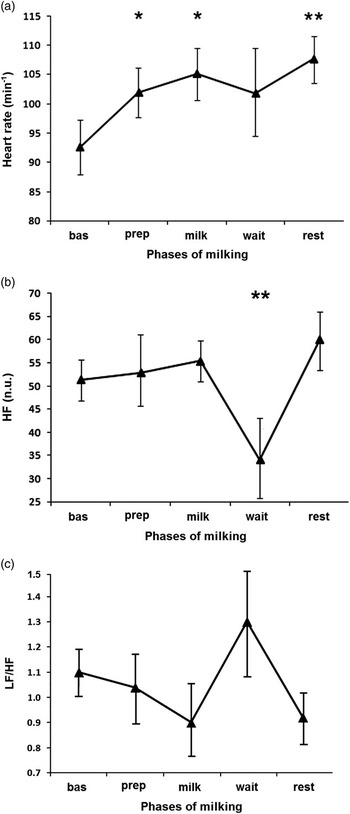
HR was higher during udder preparation, milking and 2 h after milking compared with baseline levels (P=0.03, 0.027 and 0.003, respectively). HR during udder preparation and during waiting after milking as well as 2 h after milking did not differ (Figure 1a).
Changes in heart rate (a) in the high frequency (HF) parameter of heart rate variability (b) and in the ratio between the low frequency (LF) component and HF (LF/HF) (c) during milking. Statistics are based on the output of the GLM method. Results are presented as means±s.e.m. Statistical significances for the change from baseline are presented as *P<0.05 and **P<0.01. n.u.=normalised unit; bas=baseline period; prep=udder preparation (between stepping in the milking stall and attaching the first teat cup); milk=milking (between attaching the first teat cup and removal of the last one); wait=waiting after milking (before leaving the milking stall after removal of the last teat cup); rest=2 h after milking.

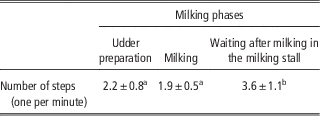
HF was lower during waiting in the milking stall after milking compared with baseline levels (P=0.009) and compared with any other phases of the milking process (P=0.012; 0.007; 0.005; Figure 1b). No significant differences were found between baseline levels, udder preparation, milking and 2 h after milking. LF/HF was higher during waiting after milking than every other phases of the measurement (Figure 1c), however, differed neither from baseline (P=0.145) nor from the other phases (udder preparation: P=0.120, milking: P=0.078, 2 h after milking: P=0.094). Post hoc comparisons showed that less stepping was performed during both udder preparation and milking than during waiting after milking (Table 1).
Step behaviour recorded during the three phases of the milking process

Results are means±s.d. of behavioural data. Statistics are based on the output of the Friedman rank sum test and the Nemenyi post hoc comparisons. Values with different superscripts are significantly (P<0.05) different.
Discussion
Effects of machine milking on animal welfare have been studied increasingly from several aspects. The few studies that have investigated cow’s behavioural and physiological responses to technology have shown varied results. We found higher HR values during standing (baseline period, 92.8±7.6) compared with earlier results reported on 67.3 bpm in Brown Swiss and Simmental cows (Hagen et al., Reference Hagen, Lexer, Palme, Troxler and Waiblinger2004), which could be indicative of a breed difference related to differences in metabolic activity or temperament (Hagen et al., Reference Hagen, Lexer, Palme, Troxler and Waiblinger2004). Wenzel et al. (Reference Wenzel, Schonreiter-Fischer and Unshelm2003) measured 83 bpm in Holstein–Friesian cows, however, authors recorded baseline HR while animals were in lying posture instead of standing (which was chosen for baseline in the present study). Season (autumn) could also affect HR in our study, as lower HR was found in winter (Hagen et al., Reference Hagen, Langbein, Schmied, Lexer and Waiblinger2005) or in summer (Hopster et al., Reference Hopster, Joop, Werf van der and Blokhuis1998).
Although HR was higher than baseline during the phase of milking in contrast with earlier observations (Hopster et al., Reference Hopster, Bruckmaier, Werf van der, Korte, Macuhova, Korte-Bouws and Renen van2002; Hagen et al., Reference Hagen, Langbein, Schmied, Lexer and Waiblinger2005; Gygax et al., Reference Gygax, Neuffer, Kaufmann, Hauser and Wechsler2008), the increase in HR was relatively minor therefore no serious impairment of cows milked in the investigated farm can be assumed. Nevertheless, the comparison of our results with previous reports is complicated by the facts that the latter were carried out mostly in farms worked with automatic milking systems or other types of milking parlours.
In our experiment, the phases milking and udder preparation had no effect on HRV itself. The fact that parasympathetic tone did not differ from baseline during milking might be caused by the release of oxytocin during udder preparation (Bruckmaier, Reference Bruckmaier2005) concealing the effects of milking technology on cardiac activity.
In accordance with earlier reports on cow’s restlessness behaviour during milking (Wenzel et al., Reference Wenzel, Schonreiter-Fischer and Unshelm2003; Gygax et al., Reference Gygax, Neuffer, Kaufmann, Hauser and Wechsler2008), we found no differences in stepping rates between udder preparation and milking phases. However, higher stepping rate was exhibited when animals were waiting after the removal of the last teat cup than occurred during udder preparation or milking (Table 1). The decrease in vagal tone (lower HF) during waiting was significant from baseline and from the previous phases of milking. Both behavioural and cardiac responses can be a result of restlessness suggesting that waiting for leaving the milking stall was stressful for animals in our study.
Although HF decreased following milking, no increase in HR was observed during waiting after milking relative to baseline levels. With this strong reduction of parasympathetic tone, a parallel increase in HR would expect at the same time, however, this was the only phase during which HR was not statistically higher compared with baseline (Figure 1a). The reason for this might be that the complex interplay of the two branches of the autonomic nervous system is not always turn out when measuring only HR (Porges, Reference Porges1995). Another explanation of a relatively low HR during waiting can be that during udder preparation and milking a prolonged effect of physical activity (moving to the milking parlour) on HR is supposed to exist, which eliminated only following teat cup removal. In our study, LF/HF increased during this phase suggesting a shift in the sympathovagal balance towards the sympathetic tone. As this increase was not significant, a more prominent response to stress of the vagal regulatory activity during waiting can be assumed.
Although our results suggests that there was no stress during the phases udder preparation and milking that reflected on the cardiovascular system, it should be mentioned that these findings might be specific to the investigation farm as many factors would influence the behavioural and physiological responses of cows to milking (e.g. experience of the animals (Bremner, Reference Bremner1997), stockmanship (Rushen et al., Reference Rushen, Passillé de and Munksgaard1999) or milking system (Gygax et al., Reference Gygax, Neuffer, Kaufmann, Hauser and Wechsler2008)). Based on our results, further research on larger number of animals producing on farms with different housing and milking systems is required, taking into account some technological factors (e.g. habituation to human contact, time to be released following cup detachment) likely affecting restlessness behaviour and autonomic nervous system activity of cows during the entire milking process.
Acknowledgements
The authors would like to thank László Szautner (Nóráp, Hungary), the owner of the farm, for taking care of the animals during the experiment. This work was supported by Research Centre of Excellence – 8526-5/2014/TUDPOL project.