Creativity literature considers an individual's mood or emotional state as an important determinant and powerful engine of creative behavior (e.g., Averill, Chon & Hahn, Reference Averill, Chon and Hahn2001; Kaufmann, Reference Kaufmann2003). Researchers have identified various emotional mechanisms leading to creativity, and there appear to be many dimensions that need to be examined when assessing the influence of emotion on creativity. One of these dimensions that has been overlooked in the literature is language. Can linguistic context elicit particular mood states and consequently have an impact on one's creative performance? This question becomes especially interesting when it is presented in a bilingual context. This work takes a broader perspective on the phenomenon of bilingualism and considers bilingual individuals as those who are fluent in all their languages, but also individuals who actively use, or attempt to use more than one language, even if they have not achieved high proficiency in all of them (Kroll & de Groot, Reference Kroll, de Groot, de Groot and Kroll1997). Indeed, extensive literature demonstrates that bilinguals’ emotions are realized differently in different languages and that bilingual individuals have particular preferences for one or another language when it comes to the expression of their emotions (see Pavlenko, Reference Pavlenko2006, for an overview). At the same time, a growing body of literature has delivered evidence favoring bilingual creative performance, as compared to monolingual performance (see Kharkhurin, Reference Kharkhurin2012, for an overview). Therefore, the experience of different emotions in different linguistic contexts can lead to a variation in creative performance, and this is the focus of present study. Specifically, we look at the interactive effect of mood states and linguistic contexts on bilinguals’ creative performance.
The relationship between bilingualism and creativity
In the psychometric tradition, creative thinking is perceived as an ability to initiate multiple cycles of divergent and convergent thinking (Guilford, Reference Guilford1967). The combined effort of these two types of thinking creates an active, attention-demanding process that allows generation of ideas satisfying the defining characteristics of a creative product: novelty (i.e., original or unexpected) and utility (i.e., useful or meeting task constraints) (see Sternberg, Reference Sternberg1999, for an overviewFootnote 1 ). Over the last half century, numerous studies have provided evidence for the ability of divergent thinking tests to predict certain aspects of creative problem-solving performance and real world creative achievement. Although as Runco (Reference Runco1991) argued, “Divergent thinking is not synonymous with creative thinking” (p. ix), many researchers believe that divergent thinking is a defining component of the creative process (Lubart, Reference Lubart2000). Guilford associated the properties of divergent thinking with four main characteristics: fluency (the ability to rapidly produce a large number of ideas or solutions to a problem); flexibility (the capacity to consider a variety of approaches to a problem simultaneously); elaboration (the ability to think through the details of an idea and carry it out); and originality (the tendency to produce ideas different from those of most other people).
Empirical research provides evidence favoring bilingual creative performance, as compared to monolingual creative performance (review in Kharkhurin, Reference Kharkhurin2012, forthcoming; Ricciardelli, Reference Ricciardelli1992b). These studies demonstrated a positive effect of bilingualism on various verbal and nonverbal traits of divergent thinking such as fluency (e.g., Carringer, Reference Carringer1974; Jacobs & Pierce, Reference Jacobs and Pierce1966; Kharkhurin, Reference Kharkhurin2008; Ricciardelli, Reference Ricciardelli1992a), flexibility (e.g., Carringer, Reference Carringer1974; Kharkhurin, Reference Kharkhurin2008; Konaka, Reference Konaka1997), elaboration (e.g., Kharkhurin, Reference Kharkhurin2008; Srivastava & Khatoon, Reference Srivastava, Khatoon and Annamalai1980; Torrance, Gowan, Wu & Aliotti, Reference Torrance, Gowan, Wu and Aliotti1970), and originality (e.g., Cummins & Gulutsan, Reference Cummins, Gulutsan and Carey1974; Kharkhurin, Reference Kharkhurin2009; Konaka, Reference Konaka1997; Okoh, Reference Okoh1980), and on an ability to violate standard category boundaries (Kharkhurin, Reference Kharkhurin2009). In addition, bilingual developmental factors such as degree of language proficiency, age of second language acquisition, and the circumstances under which this language was acquired were presented as influential determinants of bilingual creativity (Kharkhurin, Reference Kharkhurin2008).
The latter findings suggested that bilinguals with different levels of linguistic competence may demonstrate different patterns of creative thinking. Indeed, Kharkhurin (Reference Kharkhurin2011) reported that more linguistically advanced bilinguals showed greater originality and greater violation of standard category properties as compared to their less advanced counterparts. These findings were explained in terms of cognitive mechanisms of selective attention underlying creative thinking. The study revealed that an inhibition mechanism seemed to enhance originality, whereas a facilitation mechanism was likely to boost fluency. Bilinguals with different levels of linguistic skills appeared to utilize these mechanisms differently and thereby demonstrated different patterns of creative performance. These creative performance differences could also be explained in terms of the intensity of lexical access in bilingual memory. Greater language skills may result in establishing stronger and more elaborate links between lexical and conceptual systems (Kharkhurin, Reference Kharkhurin2008). As a result, more concepts become readily available for simultaneous processing, which in turn may stimulate creative thinking.
Conceptualizing these findings, one can expect that bilinguals may show different patterns of creative performance when tested in their stronger or weaker language. Although there is no direct evidence supporting this hypothesis, we can infer it from the studies showing that bilinguals indeed demonstrated different cognitive abilities when tested in their stronger vs. weaker language. For example, studies in bilinguals’ arithmetic abilities showed that participants tested in their stronger language outperformed their counterparts tested in their weaker language (e.g., Bernardo, Reference Bernardo2001; Campbell & Epp, Reference Campbell and Epp2004; Frenck-Mestre & Vaid, Reference Frenck-Mestre and Vaid1993; Marsh & Maki, Reference Marsh and Maki1976; McClain & Huang, Reference McClain and Huang1982). The studies of bilinguals’ processing of emotion-related words across cognitive tasks reported in a later section also described the performance differences as a function of stronger vs. weaker language with regards to emotion-related stimuli (e.g., Altarriba, Reference Altarriba2003; Altarriba & Basnight-Brown, Reference Altarriba and Basnight-Brown2011; Altarriba & Canary, Reference Altarriba and Canary2004; Anooshian & Hertel, Reference Anooshian and Hertel1994).
Testing in stronger vs. weaker language may also stipulate bilinguals’ performance on verbal and nonverbal creativity. The indirect evidence for this prediction comes from a study showing divergent thinking performance differences of bilinguals and monolinguals in verbal and nonverbal domains (Kharkhurin, Reference Kharkhurin2010a). In this study, Russian–English bilingual college students outperformed their English monolingual counterparts on the nonverbal part of divergent thinking test, whereas monolinguals showed greater performance on the verbal part. Monolinguals’ advantages in the verbal domain were explained by their greater linguistic skills. Creative problem solving that takes place in the linguistic context might be enriched by greater ability to manipulate with linguistic units. By analogy, testing in bilinguals’ stronger language (in which they have greater linguistic skills) may facilitate their performance if a creative problem solving task is framed in a verbal context, whereas testing in weaker language (with limited linguistic skills) may cause a deficiency in this domain.
The relationship between mood and creativity
Various researchers have claimed that emotions can either help or hurt creative endeavors (e.g., Montgomery, Hodges & Kaufman, Reference Montgomery, Hodges and Kaufman2004; Russ, Reference Russ1999). Many of them found that positive moods tend to facilitate creative performance. In their seminal work, Baas, De Dreu and Nijstad (Reference Baas, De Dreu and Nijstad2008) performed a meta-analysis of over 25 years of mood-creativity research and found that in an overwhelming majority of cases (i.e., 102 effect sizes were investigated), positive moods were shown to produce more creative outcomes than both negative and neutral moods, with the latter two not showing significant differences from each other. These findings appeared to generalize across a broad range of tasks and participants and reflected some of the basic factors associated with creativity, in general – fluency, flexibility, originality, and insight. For example, Greene and Noice (Reference Greene and Noice1988) revealed that positive mood facilitated fluency and originality. Isen, Daubman and Nowicki (Reference Isen, Daubman and Nowicki1987) found that participants in a positive emotional state produced significantly more creative solutions than individuals in a neutral and negative emotional states. Additionally, a positive mood has been shown to increase performance on tasks that measure fluency in divergent thinking (e.g., Abele-Brehm, Reference Abele-Brehm1992). In tests of the production of new ideas on a given topic, Vosburg (Reference Vosburg1998) found that being in a positive mood helped participants generate ideas more fluidly, as compared to participants in a negative mood state. Finally, positive mood was found encouraging for the use of heuristics in problem solving (Mitchell & Madigan, Reference Mitchell and Madigan1984).
However, not all researchers came to the same conclusion. For example, Anderson, Arieti and Tarrant (Reference Anderson, Arieti, Tarrant, Kaufmann, Helstrup and Teigen1995) tested mood's influence on the mental synthesis task where participants were asked to combine and recombine random sets of letters into words. Researchers reported that positive moods negatively affected participants’ performance, as compared to neutral moods. Kaufmann and Vosburg (Reference Kaufmann and Vosburg1997) and Vosburg (Reference Vosburg1998) also observed that positive mood may inhibit creativity whereas negative mood may stimulate it. Indeed, a growing body of literature highlights that negative mood states can enhance individual creative capacities (e.g., Abele-Brehm, Reference Abele-Brehm1992; Baas et al., Reference Baas, De Dreu and Nijstad2008; George & Zhou, Reference George and Zhou2002). For example, artistic creativity was occasionally reported to prosper from intensely negative emotions (e.g., Akinola & Mendes, Reference Akinola and Mendes2008; De Dreu, Baas & Nijstad, Reference De Dreu, Baas and Nijstad2008; Kaufman & Baer, Reference Kaufman and Baer2002). In the same fashion, cross-cultural research (e.g., Cheng, Leung & Wu, Reference Cheng, Leung and Wu2011) proposed that increased negative affect associated with the perception of cultural discrepancies may inspire creativity.
The reviewed studies provide evidence that both positive and negative mood states can instigate individual creativity. Nijstad, De Dreu, Rietzschel and Baas (Reference Nijstad, De Dreu, Rietzschel and Baas2010) explained this notion with the dual pathway to creativity model arguing that creativity can be enhanced either by activating positive mood states, which stimulate cognitive flexibility, or by activating negative mood states, which stimulate persistence.
Nijstad et al. (Reference Nijstad, De Dreu, Rietzschel and Baas2010) found that positive mood states activate a large number of content categories surveyed (i.e., approaches to analyze the task content), which was operationalized as cognitive flexibility, and the latter directly related to originality. Isen and colleagues (e.g., Isen et al., Reference Isen, Daubman and Nowicki1987; Isen, Johnson, Mertz & Robinson, Reference Isen, Johnson, Mertz and Robinson1985) also found that positive mood induction enhances individuals’ attention and facilitates perception of the relatedness of seemingly unrelated elements and combinations of these elements, which was operationalized as cognitive flexibility, and the latter stimulates production of unusual solutions to creative problems. In the same vein, Zenasni and Lubart (Reference Zenasni and Lubart2008) proposed that “Creativity is the consequence of a process of self-development in which free associations may be facilitated during serene or happy states” (p. 165). Free associations in this case refer to an ability to relate elements from different conceptual categories; that is, cognitive flexibility. Other studies, in non-creative domains, also reported that individuals in a positive mood state, as compared to controls, were able to generate and use broader categories, demonstrate more flexibility when categorizing objects, and were better able to shift to narrower categories, as they focused on the differences between objects (e.g., Showers & Cantor, Reference Showers and Cantor1985). Physiological data supported this hypothesis under the assumption that dopamine released in the positive mood states deploys attention and facilitates multiple perspectives, which together enhance cognitive flexibility (Ashby, Isen & Turken, Reference Ashby, Isen and Turken1999).
At the same time, Nijstad et al. (Reference Nijstad, De Dreu, Rietzschel and Baas2010) claimed that negative mood states encourage exploration of a smaller number of content categories in great depth, which may lead to greater originality in thinking. Gohm and Clore (Reference Gohm and Clore2002) also observed that experiencing negative emotions is positively correlated with a tendency to concentrate on details. In turn, Cheng et al. (Reference Cheng, Leung and Wu2011) proposed that dealing with contradictory cultural stimuli could lower positive affect or increase negative affect, which may trigger a more comprehensive cognitive processing of cultural discrepancies and consequently inspire creativity. A similar idea was articulated by Kaufmann and Vosburg (Reference Kaufmann and Vosburg1997) who found that positive mood induction significantly hampered creative problem-solving relative to negative mood induction. They explained this finding as follows: negative mood state informs a person that the current situation is problematic, which consequently motivates him or her to exert more effort to return to a neutral situation. Other researchers came to a similar conclusion: individuals in a negative emotional state are motivated to use strategies to ‘repair’ their mood and return to a neutral emotional state (e.g., Abele-Brehm, Reference Abele-Brehm1992; Adaman & Blaney, Reference Adaman and Blaney1995). Similarly, for Zenasni and Lubart (Reference Zenasni and Lubart2008), creativity is partially stimulated by the process of supression of a tension or an emotional problem. Thus, in a negative mood state, individuals are encouraged to exercise more cognitive effort to compensate for negative emotions by thoroughly investigating the problem until they find the most effective solution.
Thus, it is plausible to assume that positive and negative mood states activate different cognitive mechanisms underlying creative thinking. Positive mood states seem to enhance cognitive flexibility, whereas negative mood states are likely to stimulate persistence.
The relationship between mood and bilingualism
So far, we have identified that bilingualism and mood states may independently influence creativity. Following the logic of the present work, we turn to explore whether mood states may interact with language backgrounds. A search of the extant literature on bilingualism and mood reveals only one known work in this area that appears in the form of a doctoral dissertation (Horenstein, Reference Horenstein2010). In this study, Spanish–English bilinguals were induced into either a sad or happy state using film clips and recall-of-events procedures. They were tested in either English or Spanish, and their emotional states were subsequently checked in terms of positive or negative affect. One particular finding of this study is interesting for the present work: a significant interaction between language group and affect. Participants who were tested in English expressed significantly more emotional affect, for both levels of valence, than those who were tested in Spanish. That is, English was found to be the language of greater emotional expression.
These results indicate that mood can interact with language background and the latter can accentuate the affect experienced in a particular mood state. However, it is difficult to draw generalizable conclusions based on a single study. Related work in this area has focused on the processing of emotion-related words in bilinguals (e.g., happy, sad, joy), and the ways in which these words are processed across a number of cognitive tasks such as word rating tasks (Altarriba & Canary, Reference Altarriba and Canary2004), word priming tasks (Altarriba, Reference Altarriba2003), and tasks involving the Affective Simon Task (categorization of words with positive or negative valence; Altarriba & Basnight-Brown, Reference Altarriba and Basnight-Brown2011). These studies reported that Spanish–English bilinguals who learned both of their languages early in life, or who acquired Spanish first and English later, revealed richer and more frequent expressions of emotion in Spanish (the stronger language), as compared to English (the weaker language). Tasks that have involved measuring physiological reactions to emotion words in different languages (e.g., galvanic skin response) have reported similar findings (e.g., Harris, Ayçiçeĝi & Gleason, Reference Harris, Ayçiçeĝi and Gleason2003). Santiago-Rivera, Altarriba, Poll, Gonzalez-Miller and Cragun (Reference Santiago-Rivera, Altarriba, Poll, Gonzalez-Miller and Cragun2009) also showed that in clinical settings, Spanish–English bilingual patients tended to code-switch between languages on the basis of the emotional content of the current discussion, using English, the weaker language, to ‘distance’ themselves from painful emotions, or Spanish to emphasize the emotional context of their recall of earlier life experiences. Similarly, Chinese–English speakers felt more comfortable describing emotional events in English, rather than in their native language, Chinese, as the use of English again served to distance themselves from the emotional impact of such language in their native tongue (Gonzalez-Reigosa, Reference Gonzalez-Reigosa, S. C. D. and Diaz-Guerrero1976).
Some other studies however, have failed to show emotional effects of the first language. For example, Experiment 4 in Altarriba and Basnight-Brown's (Reference Altarriba and Basnight-Brown2011) study revealed that in the Affective Simon Task Spanish–English bilinguals (who rated themselves as significantly better in all three skill areas in their second language, English as compared to their first language, Spanish) responded to negative words with negative responses significantly faster than with positive responses, and that was the case in both languages. Guttfreund (Reference Guttfreund1990) also reported that English–Spanish coordinate bilinguals demonstrated more affect in their second language (Spanish) than in their first language (English).
Overall, it appears that the use of a particular language (stronger vs. weaker) may reflect bilingual speakers’ responses to and perceptions of emotional context. Does this interaction also moderate levels of creativity for these individuals? This question becomes the major focus of the present study.
The present study
The findings reviewed above advance two hypotheses. First, bilinguals show different patterns of verbal creative performance when tested in their stronger vs. weaker language. Second, bilinguals’ momentary mood state (positive vs. negative) and linguistic context (stronger vs. weaker) have an interactive impact on creativity. To test both hypotheses, Arabic–English bilingual participants were induced into either a positive or a negative mood state via the use of short videos. They then engaged in cognitive and creativity tests using one of their languages while in a given mood state.
To investigate the interaction of these two factors, we brought them to a single denominator. Specifically, we proposed that momentary mood state and linguistic context may affect participants’ level of anxiety, which in turn may moderate their creative performance. Foreign language learning literature considers language anxiety as an important affective variable (e.g., Gardner & MacIntyre, Reference Gardner and MacIntyre1993; Horwitz, Horwitz & Cope, Reference Horwitz, Horwitz and Cope1986). Individuals may experience discomfort, worry, apprehension and nervousness when learning or using a second or foreign language. The studies investigating the impact of emotions on creativity suggest that the momentary mood state can affect relative level of anxiety. Sánchez-Ruiz (Reference Sánchez-Ruiz, Mark and Steven2011) argued that a high level of anxiety (stress) leads to increase in cortical arousal. A cluster of studies demonstrated that the level of anxiety (arousal) may moderate the impact of emotion on creativity (e.g., Filipowicz, Reference Filipowicz2006; Martindale, Reference Martindale and Sternberg1999). For example, Zenasni and Lubart (Reference Zenasni and Lubart2002) found that the more participants experienced an unpleasant emotional state, the more they were in a high state of arousal, and the fewer ideas they produced in a nonverbal creativity test. Zenasni and Lubart (Reference Zenasni and Lubart2008) and Martindale and Greenough (Reference Martindale and Greenough1973) reported a negative correlation between participants’ arousal level and their performance on divergent thinking tasks. Baas et al. (Reference Baas, De Dreu and Nijstad2008) demonstrated that lower creativity was associated with motivation to avoid anxiety provoking stimuli. Thus, in the context of our study, it is plausible to assume that a positive mood induction mitigates anxiety, whereas negative mood induction increases anxiety.
In light of the first hypothesis, we anticipated that testing in the stronger language may stimulate lexical access and provide greater opportunity for successful activation of cognitive mechanisms underlying creative thinking, and as a result may enhance bilinguals’ verbal creative performance. According to the second hypothesis, testing in the stronger language may increase participants’ comfort, which intensifies the effect of positive induction. Together, this may reduce participants’ level of anxiety, which in turn may facilitate their cognitive flexibility and consequently enhance their creative performance. On the other hand, testing in the weaker language may increase the level of anxiety, which intensifies the effect of negative induction. A high level of anxiety may stimulate persistence, which in turn also results in greater creative performance. Thus, induction to a positive mood state when tested in the stronger language as well as induction to a negative mood state when tested in the weaker language was expected to enhance participants’ creative performance.
Method
Participants
The participants were 119 American University of Sharjah (United Arab Emirates, UAE) Arabic–English bilingual students (51 male and 68 female; aged between 18 and 26 years, M = 20.12, SD = 1.32) who were recruited from the General Psychology subject pool. All of them indicated that their first language (L1) was Arabic and their second language (L2) was English. Relatively young age of onset of English learning (see Results section) suggested that they were early L2 learners.
Procedure
Participants completed an online biographical questionnaire prior to the offline testing in the laboratory setting. At the onset of offline testing, participants were randomly assigned to a group that received all test instructions in English or to the one that received all test instructions in Arabic. This measure was taken to activate participants’ target language (English or Arabic), in which all tests were administered. In the beginning of the experiment, participants were presented with a language proficiency test in the target language. Then, their momentary emotional state, their intensity of emotions, and the extent to which they outwardly displayed their emotions were assessed by respective scales. Subsequently, participants underwent a phase of induction that aimed at inducing them to either a positive or a negative mood state. The assignment to either positive or negative mood induction took place at random. To determine the effect of induction, this phase was followed by a repeated assessment of their momentary mood state. Next, participants received a creativity assessment. Finally, their proficiency in the non-target language (Arabic or English) was assessed.
Instruments
Biographical questionnaire
An internet-based multilingual and multicultural experience questionnaire (http://surveys.harhur.com/index.php?r=survey/index/sid/782753) was administered to determine participants’ linguistic and cultural background. They received a questionnaire that, among other questions, obtained data on languages participants spoke, their assessment of linguistic skills in each of these languages, and length of usage of these languages. The self assessment of linguistic skills was administered in the form of four 7-point Likert-type scales where participants had to indicate their speaking, listening, reading, and writing proficiency, respectively. The composite self-rating score for each language was computed as an average of these scores.
Language proficiency assessment
Participants’ proficiency in English and in Arabic was evaluated by a test of productive vocabulary, the Picture Naming Test (PNT; Kharkhurin, Reference Kharkhurin2008). Language proficiency was assessed by the accuracy of the participants’ written responses to 120 pictures of simple objects, a technique similar to the Boston Naming Test (Kaplan, Goodglass & Weintraub, Reference Kaplan, Goodglass and Weintraub1983) and that used by Lemmon and Goggin (Reference Lemmon and Goggin1989). This technique was shown to be a reliable measure of language proficiency that highly correlated with participants’ self-rating of linguistic skills and their self-assessment of degree of bilingualism (Kharkhurin, Reference Kharkhurin2008). Each response was scored either 1 or 0, so that the maximum number of points for picture naming was 120. Participants had eight minutes to complete this test.
Induction
The induction phase included three types of activities. First, participants viewed a video that was supposed to induce them to either a positive or negative mood state. The positive video was clipped out of Charlie Chaplin's Circus (from 3΄10΄΄ to 10΄38΄΄) produced by The Roy Export Company Establishment; the negative one was clipped out of Sergei Eisenstein's Battleship Potemkin (from 46΄03΄΄ to 52΄02΄΄) restored by Deutsche Kinemathek, Museum für Film and Fernsehen (German Cinematheque, Museum for Film and Television). Both movies were silent, black and white, and clipped videos contained the original soundtrack. To avoid any language bias, the intertitles contained in the original movies were eliminated. The final length of the positive video was 6΄19΄΄ and the one of the negative video was 5΄53΄΄. The video editing procedure was performed using Microsoft Windows Movie Maker 5.1. The videos were presented to participants on the 19΄΄ DELL LCD monitor with VLS Media Player 1.1.7 using full-screen mode and through headphones.
After the end of the video, participants were asked to describe the story presented in the video. Then, they were asked to recall any event similar to this video from their lives and write a paragraph describing it. They were given seven minutes to perform each of these activities and were reminded to use the target language (English or Arabic). Overall, the entire induction procedure lasted for approximately 20 minutes, during which participants had to deal with materials that elicited either a positive or a negative mood state.
To see whether the induction procedure had an effect, participants’ momentary mood state was assessed in terms of their momentary level of anxiety before and after the induction. Positive induction was supposed to decrease level of anxiety, negative induction to increase it. Level of anxiety was assessed by a 20-item scale extracted from the State-Trait Anxiety Inventory (Spielberger, Gorsuch & Lushene, Reference Spielberger, Gorsuch and Lushene1970) used to measure anxiety in adult populations. The Inventory consists of two 20-item subscales, which measure the temporary condition of state anxiety and the more general and long-standing quality of trait anxiety, respectively. The Inventory demonstrated convergent and concurrent validity (Spielberger, Reheiser, Ritterband, Sydeman & Unger, Reference Spielberger, Reheiser, Ritterband, Sydeman, Unger and Butcher1995), test-retest reliability (Rule & Traver, Reference Rule and Traver1983; Spielberger et al., Reference Spielberger, Gorsuch and Lushene1970), and culture and gender fairness.
The present study was concerned with participants’ momentary mood state and therefore employed the State Anxiety Inventory (SAI) subscale. It presented participants with 20 statements, which people use to describe themselves (e.g., “I feel calm”, “I feel tense”). Participants had to indicate how they felt about each statement at the present moment. Ten statements represented a low anxiety state (e.g., “I feel calm”); ten other statements represented a high anxiety state (e.g., “I feel tense”). Each statement received a score from 1 to 4 (not at all; somewhat; moderately so; and very much so), and the statements representing high anxiety state were reverse scored. So, a total SAI score ranged from -30 to 30; a higher score indicated a lower level of anxiety.
To ensure that individual differences in intensity of emotions and an ability to express emotions did not mask the effect of induction, two additional measures were introduced as covariates. Participants’ intensity of emotions was assessed by the Affect Intensity Measure (AIM; Larsen, Diener & Emmons, Reference Larsen, Diener and Emmons1986) that measures the intensity with which an individual typically experiences his or her emotions. On the 40-item scale, participants were asked to indicate how they reacted to typical life-events (e.g., “When I solve a small personal problem, I feel euphoric”) by selecting one out of six possible answers (never, almost never, occasionally, usually, almost always, and always). The AIM score was calculated as a sum of participants’ responses to all 40 questions so that a higher score indicated a stronger intensity of emotions.
An ability to outwardly express emotions was assessed by the Emotional Expressivity Scale (EES; Kring, Smith & Neale, Reference Kring, Smith and Neale1994) that measures the extent to which individuals express different emotions across various channels. Participants were asked to indicate on a 6-point Likert scale the extent to which each item applies to them (1 is never true and 6 is always true). The EES score was calculated as a sum of participants’ responses to 17 items on the scale so that a higher score indicated a greater ability to express emotions.
Creativity assessment
Participants’ creative abilities were assessed using the Abbreviated Torrance Test for Adults (ATTA; Goff & Torrance, Reference Goff and Torrance2002). The ATTA was developed on the basis of the Torrance Tests of Creative Thinking (Torrance, Reference Torrance1966). It consists of activities utilizing the same rationale as activities in the original test, but in abbreviated form and requires considerably less testing time, which is particularly beneficial when administering it to adults. The ATTA was employed in a series of studies of bilingual creativity (Kharkhurin, Reference Kharkhurin2008, Reference Kharkhurin2009, Reference Kharkhurin2010a, Reference Kharkhurin2010b, Reference Kharkhurin2011; Kharkhurin & Li Wei, Reference Kharkhurin and Li Wei2014) and demonstrated good assessment of bilinguals’ creative behavior.
The standard ATTA has three 3-minute paper and pencil activities preceded by a written instruction that explains general guidelines and encourages participants to use their imagination and thinking abilities. In Activity 1, participants were asked to suppose that they could walk on air or fly, and then to identify the troubles that they might encounter. This activity provided verbal fluency and originality scores. In Activity 2, participants were presented with two incomplete figures and were asked to draw pictures with these figures and to attempt to make these pictures as unusual as possible. This activity provided nonverbal fluency, originality, and elaboration scores. In Activity 3, the participants were presented with a group of nine triangles arranged in a 3x3 matrix and were asked to draw as many pictures or objects as they could using those triangles. This activity provided nonverbal fluency, originality, elaboration, and flexibility scores.
The standard ATTA assessment consists of four divergent thinking traits: fluency, originality, elaboration, and flexibility. Fluency measures the ability to produce quantities of ideas, which are relevant to the task instructions. The fluency score in Activity 1 provided a verbal fluency score; a sum of fluency scores in Activities 2 and 3 provided a nonverbal fluency score. Originality measures the ability to produce uncommon ideas, or ideas that are totally new or unique. The originality score in Activity 1 provided a verbal originality score; a sum of originality scores in Activities 2 and 3 provided a nonverbal originality score. Elaboration measures the ability to embellish ideas with details. The sum of elaboration scores in Activities 2 and 3 provided a nonverbal elaboration score. Finally, flexibility measures the ability to process information or objects in different ways, given the same stimulus. A nonverbal flexibility score was obtained from Activity 3.
In addition, the scores for five verbal criterion-referenced creativity indicators were obtained from responses in Activity 1 (richness and colorfulness of imagery, expressions of feelings and emotions, future orientation, humor/conceptual incongruity, and provocative questions), and ten nonverbal criterion-referenced creativity indicators were obtained from responses in Activities 2 and 3 (openness/resistance to premature closure, unusual visualization, movement and/or sound, richness and colorfulness of imagery, abstractness of title, environment for objects/articulateness in telling story, combination/synthesis of two or more figures, internal visual perspective, expressions of feelings and emotions, and fantasy). Each of these 15 scores was 0 if the indicator does not occur, 1 if the indicator appears once, or 2 if the indicator appears more than once.
Two independent raters assessed participants’ divergent thinking abilities using the standard ATTA assessment procedure (Goff & Torrance, Reference Goff and Torrance2002). To ensure that both raters used the same rationale, the following procedure was applied. The verbal and nonverbal scores for fluency, originality, elaboration, and flexibility obtained in the test were subsequently transformed into scaled norm-referenced scores by the recommended procedure (Goff & Torrance, Reference Goff and Torrance2002) which took age-related norms into account. The ATTA manual reports the Kuder-Richardson (KR21) reliability coefficient for the total raw score for the four traits measured by the ATTA as .84. Then, a creativity index was computed as a sum of four norm-referenced scores, and five verbal and 10 nonverbal criterion-referenced creativity indicators. The index represented a composite measure of overall creativity. The significantly high inter-rater correlation between the composite creativity indexes produced by both raters (r = .82, p < .001) indicated that the raters used the same rationale, and their ratings were comparable. Note that the composite creativity index was not used in any further analysis. Instead, respective scores produced by both raters were averaged and used in subsequent analyses: verbal and nonverbal fluency and originality, nonverbal elaboration and flexibility, and verbal and nonverbal criterion-referenced creativity indicators.
Results
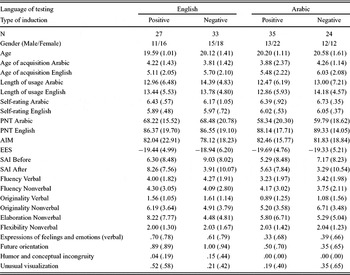
In line with the procedure described above, participants were divided into four groups according to the language in which they were tested (English or Arabic) and the induced mood state (positive or negative). The number of participants in each group, their gender, age, age of acquisition and length of usage of Arabic and English, composite self-rating and language proficiency scores of Arabic and English, AIM, EES, and SAI before and after induction, and verbal and nonverbal creativity scores are presented in Table 1. We found no significant difference between these groups on demographic, and language acquisition and use variables.
Participants were divided into four groups according to the language in which they were tested (English or Arabic) and the induction to mood state (positive or negative). The table presents the number of participants in each group, their gender, mean (with standard deviation) age, age of acquisition and length of usage of Arabic and English, composite self-rating and language proficiency (PNT) scores of Arabic and English, and scores on intensity of emotions (AIM), ability to express emotions (EES), momentary mood state (SAI) before and after the induction, and verbal and nonverbal creativity scores.

The effect of induction
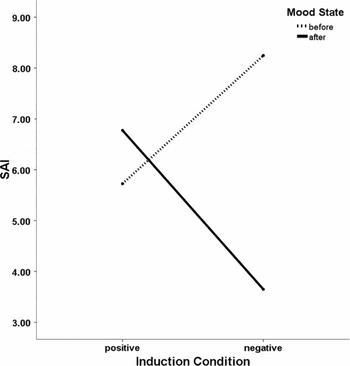
Foremost, we looked at whether induction had an effect on the change of participants’ mood state. We reasoned as follows: if the induction had an effect, participants’ should reveal different anxiety scores (assessed by the SAI) before and after the induction procedure. A Repeated Measures ANOVA was performed with Mood State (before, after) as a within-subject variable, and Induction (positive, negative) as a between-subject factor. The results indicated a significant effect of Mood State (F(1, 117) = 6.14, p < .05, η2 = .05) and a significant interaction between Mood State and Induction (F(1, 117) = 15.53, p < .001, η2 = .12). Participants had an overall lower level of anxiety before induction than after (ΔM = 1.66, SE = .76, t = 2.18, p < .05). As Figure 1 illustrates, negative induction resulted in a significant increase in level of anxiety (ΔM = -4.60, SE = .95, t = -4.83, p < .001), whereas positive induction resulted in an insignificant decrease in level of anxiety (ΔM = 1.05, SE = 1.06, t = .99, p = .33). These results indicate that the induction procedure, at least partially, had the desired effect. When the analysis was repeated controlling for the effect of intensity of the emotions (as measured by the AIM) and the ability of participants to outwardly express emotions (measured by the EES), the tendency remained the same: we found a marginally significant main effect of Mood State (F(1, 115) = 2.96, p = .09, η2 = .03) and a significant interaction between Induction and Mood State (F(1, 115) = 14.82, p < .001, η2 = .11).
The interaction between the type of induction (positive, negative) and the mood state assessed by SAI before and after the induction, N = 119.

Futher, we compared the levels of anxiety after induction in all four groups. Table 1 indicates that participants who were induced to a positive mood and tested in English obtained the highest SAI score (lowest level of anxiety) and their counterparts who were induced to a negative mood and tested in Arabic obtained the lowest SAI score (highest level of anxiety) (ΔM = 5.61, SE = 2.53, t = 2.22, p < .05). The differences between other groups were insignificant.
Language organization
To determine participants’ language organization (stronger vs. weaker), we analyzed their proficiency and history of language use. All participants reported Arabic as their L1 and English as their L2. Their age of onset of Arabic learning (M = 2.12, SD = 1.72) was significantly lower than the onset of English (M = 5.05, SD = 2.65; ΔM = -2.94, SE = .28, t = -10.39, p < .001). The mean composite self-rating score for Arabic (M = 6.40, SD = .82, ranging from 3 to 7) was significantly higher (ΔM = .42, SE = .09, t = 4.81, p < .001) than the one for English (M = 5.98, SD = .55, ranging from 5 to 7). At the same time, the English PNT score was significantly higher than the Arabic one (ΔM = 23.85, SE = 2.45, t = 9.73, p < .001). Moreover, there was no significant difference in the length of use of both languages (M = 13.25, SD = 6.12 for Arabic, and M = 13.47, SD = 5.27 for English). Therefore, English was assumed as the participants’ stronger language and Arabic as their weaker language.
The effects of language of testing and mood induction on verbal and nonverbal creativity
We performed a series of univariate ANOVAs with language of testing (English, Arabic) and the type of induction (positive, negative) as independent factors. The respective dependent variables in these analyses were verbal and nonverbal fluency and originality, nonverbal elaboration and flexibility, and five verbal and ten nonverbal criterion-referenced creativity indicators. The following significant results were obtained.
We found a significant effect of language of testing on the following verbal creativity scores. Participants who were tested in English scored significantly higher than those tested in Arabic on verbal fluency (F(1, 115) = 5.22, p < .05, η2 = .04), verbal originality (F(1, 115) = 6.61, p < .05, η2 = .05), and on the following verbal criterion-referenced creativity indicators: expressions of feelings and emotions (F(1, 115) = 4.80, p < .05, η2 = .04), future orientation (F(1, 115) = 12.13, p < .001, η2 = .10), and humor and conceptual incongruity (F(1, 115) = 4.12, p < .05, η2 = .04). There was no significant effect of language of testing on nonverbal creativity scores.
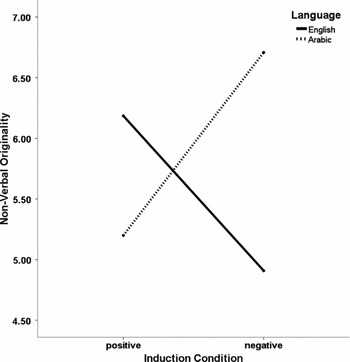
Further, we found a significant effect of interaction of language of testing and the type of induction on the following nonverbal creativity scores: nonverbal originality (F(1, 115) = 4.27, p < .05, η2 = .04) and nonverbal criterion-referenced creativity indicator of unusual visualization (F(1, 115) = 5.54, p < .05, η2 = .05).
To ensure that there was no effect of participants’ proficiency in English and Arabic and age of acquisition of both languages, the analysis was repeated with PNT scores in English and Arabic and age of acquisition of English and Arabic as covariates. The effects of language of testing on verbal creativity and the interaction effects remained the same.
Figure 2 presents the effect of the interaction between the language of testing (English, Arabic) and the type of induction (positive, negative) on nonverbal originality. Post-hoc analyses of all four groups revealed that participants who were tested in English tended to demonstrate higher nonverbal originality when they were induced to a positive mood than to a negative mood (ΔM = 1.28, SE = .95, p = .18). At the same time, negative induction tended to result in greater nonverbal originality in participants who were tested in Arabic as compared to their counterparts who were tested in English (ΔM = 1.66, SE = .99, p = .10).
The interaction between the language of testing (English, Arabic) and the type of induction (positive, negative) on nonverbal originality, N = 119.

The post-hoc analysis of the nonverbal creativity indicator of unusual visualization revealed that participants who were induced to a positive mood while being tested in English obtained significantly higher indicator than those who were induced to a positive mood while being tested in Arabic and those who were induced to a negative mood while being tested in English (ΔM = .32, SE = .13, and ΔM = .31, SE = .13, respectively, both ps < .05).
These findings expose two conditions beneficial for nonverbal creativity: positive induction when tested in English, and negative induction when tested in Arabic.
Discussion
The present study endeavored to weave a thread connecting several areas of scientific investigation: bilingual mood state, bilingual creativity and the effect of mood state on creativity. The ideas pertinent to these areas of research were interlaced to establish a new plane of scientific inquiry, specifically, one in which the relationship between bilingualism, creativity, and mood is explored. Bilingual participants were induced into either a positive or a negative mood state. Then, they engaged in creativity tests using one or another language while in a given mood state.
The effect of mood induction
The induction took place by means of short segments clipped out of two world classics: Chaplin's Circus and Eisenstein's Battleship Potemkin. Despite the fact that both videos dated back to the beginning of the 20th century and were silent and black and white, their affective functioning seemed to be well pronounced. Participants reported changes in their mood state according to the content of the video. Specifically, a humorous segment from Circus slightly elicited a positive mood whereas a tragic Potemkin Stairs episode from Battleship Potemkin significantly elicited a negative mood. This finding further contributes to a vast literature dealing with how to elicit an emotional response in the laboratory setting. Generally speaking, researchers use two major techniques: film segments (see review in Gross & Levenson, Reference Gross and Levenson1995) and recall-of-events procedures (e.g., Abele-Brehm, Reference Abele-Brehm1992; Brewer, Doughtie & Lubin, Reference Brewer, Doughtie and Lubin1980; Zenasni & Lubart, Reference Zenasni and Lubart2008). In the present study, we used both techniques to strengthen the effect, and our findings indicate that, at least partially, we accomplished our goal – in that participants revealed a clear pattern of mood change.
In this respect, it is important to recognize that we did not use a neutral condition, primarily due to a controversy in the literature as to whether it is at all possible to elicit a truly neutral emotional state. For example, Zenasni and Lubart (Reference Zenasni and Lubart2008) argued that “a neutral state is very difficult to induce, usually leading to the emergence of a slightly positive emotional state” (p. 159). Gross and Levenson (Reference Gross and Levenson1995) also reported that their films induced “a relatively neutral state” (italics is added by the authors). On the other hand, absence of induction cannot be equated to a neutral state because participants tend to consider their experimental participation in a somewhat positive way (Yinon & Landau, Reference Yinon and Landau1987).
The effect of language dominance on verbal creativity
In line with the first hypothesis of the current study, bilingual participants who were tested in English revealed greater verbal fluency, originality, and creativity indicators of expression of feelings and emotions, future orientation, and humor/conceptual incongruity. Although participants reported Arabic as their L1 and English as their L2, productive vocabulary test revealed English as their stronger language and Arabic as their weaker language. That is, bilingual participants in our study tended to show greater verbal creativity in their stronger English than in their weaker Arabic.
Several mutually complimentary explanations can be put forward to address these findings. The first explanation refers to the premises of the first hypothesis in the present study. When working on the ATTA's verbal activity, participants who were tested in their stronger language (English) could benefit from more elaborate connections between the lexical and conceptual systems in bilingual memory. A greater variety of readily available lexical representations may result in a larger pool of simultaneously activated conceptual representations (Kharkhurin, Reference Kharkhurin2008). That is, these participants may rapidly produce a larger number of ideas or solutions to a problem, which was demonstrated by their higher performance on verbal fluency. When bilinguals use their stronger language to solve a creative problem in the verbal domain, they may benefit from greater ability to manipulate linguistic units (Kharkhurin, Reference Kharkhurin2010a). An elaborate manipulation of linguistic units may trigger a more elaborate manipulation of conceptual units. The latter, in turn, could underlie important creativity traits such as future orientation and conceptual incongruity (Goff & Torrance, Reference Goff and Torrance2002). Future orientation demonstrates one's ability to project the future consequences of a problem in question. Conceptual incongruity reveals an ability to merge contradictory concepts, which makes people laugh or smile and thereby signifying one's sense of humor. Participants in our study who were tested in their stronger language scored higher on these verbal indicators. Thus, participants working in their stronger language on a creative problem in the verbal domain may have two advantages: they can activate a larger pool of potential solutions to a problem, and they have greater capacity to manipulate these solutions. As a result, they are more likely to extract an original solution, which was demonstrated by our participants, tested in English, who outperformed their counterparts tested in Arabic on verbal originality.
The second explanation of higher verbal creative performance in English takes into consideration the fact that testing in the stronger language may give participants more confidence in self-expression, especially in the expression of emotions. This assumption is supported by our finding that participants who were tested in English obtained higher criterion-referenced creativity indicator of expression of feelings and emotions. Emotional expressivity is considered to be an important trait in creative performance (e.g., Hughes, Furnham & Batey, Reference Hughes, Furnham and Batey2013; Kaufman, Reference Kaufman2001; Zenasni & Lubart, Reference Zenasni and Lubart2008). For example, a meta-analysis of 83 studies of personality traits in scientific and artistic creativity (Feist, Reference Feist1998) demonstrated that creative people are more impulsive than those who are not.
The third explanation assumes that testing in a stronger language increases the pleasure of creative task performance, especially in a verbal domain. When people are presented with a challenging task that matches their capacities, they may experience a state of flow, characterized by full immersion, involvement and enjoyment in the process of activity (Csíkszentmihályi, Reference Csíkszentmihályi1990). The verbal activity of the ATTA when presented in participants’ stronger language may have elicited an overall perceived pleasantry of the task. Zenasni and Lubart (Reference Zenasni and Lubart2011) found that the latter was significantly related to fluency in divergent thinking. Therefore, we could rightly expect that those participants in our study who were tested in English obtained greater verbal fluency scores.
The fourth explanation looks at the status of our participants’ respective languages. The UAE are located on the Arabian Peninsula, and there is a strong tendency, supported by the government, to preserve national identity as a member of the Arab nation. In this framework, Arabic language is associated with Arabic tradition and Islamic values (Khalaf, Reference Khalaf2002). On the other hand, as a rapidly developing country, the UAE continues to take major steps to improve education. This goal is accomplished by transplanting Western curricula and Western experts to lead reforms, and a shortcut to achieving these goals is the adoption of English as the medium of instruction (Hudson & Hoffman, Reference Hudson and Hoffman1993). As a result, bilingual participants in our study may associate Arabic with traditional Arab-Muslim environments and English with Western sociocultural environments. Kharkhurin and Samadpour Motalleebi (Reference Kharkhurin and Samadpour Motalleebi2008) presented evidence that collectivist environments in the Middle East limit an individual's creative capacities. They argued that prescribed ritualistic patterns of behavior reinforced by a low tolerance for deviant groups in collectivist societies prevent people from looking for original solutions to problems and encourages them to present more common, traditional answers. In contrast, individualist environments in the West are generally regarded as fostering creative capacities. The creative performance differences in Western and Middle Eastern sociocultural environments provide a plausible explanation for our findings. Testing in English could have immersed participants into more of a Western individualistic frame of thought, whereas testing in Arabic encouraged them to solve creative problems according to more traditional, collectivist ways of thinking. As a consequence, we observed greater creative performance by the group tested in English.
The effect of mood and linguistic context on nonverbal creativity
With respect to the second hypothesis of the study, we found an interactive effect of the language in which participants were tested and the mood to which they were induced on measures of nonverbal originality and criterion-referenced creativity indicator of unusual visualization. Figure 2 illustrates the former interaction – a finding that to our knowledge has never been captured in the prior literature. Two important conclusions can be advanced from these findings. First, we found that both positive and negative moods may have impact on creative capacities, which contributes to the literature discussed in the introduction. Second, linguistic context was found to moderate the effect of mood on an individual's creativity. If we perceive linguistic context in terms of the specificity of the task enhancing creative performance, we can relate our findings to the literature suggesting that the type of task and the task demands may interact with mood state and moderate creative performance. For example, Isen et al. (Reference Isen, Daubman and Nowicki1987) believed that “creativity can be fostered by appropriate modification of the physical or interpersonal environment” (p. 1128). Zenasni and Lubart (Reference Zenasni and Lubart2008) proposed that “emotions have a differential impact on creativity, depending on [. . .] specificities of the task” (p. 158). In a similar fashion, Abele-Brehm (Reference Abele-Brehm1992) reported that positive mood led to a task-independent increase of fluency, whereas negative mood led to a task-dependent verbal fluency. Kaufmann and Vosburg (Reference Kaufmann and Vosburg1997) also found that positive mood states enhance performance in divergent thinking tasks and hamper it in insight tasks, whereas negative mood states reveal a reverse tendency. Bilinguals’ languages seem to present specific task demands, which may interact with mood state in moderating creative performance.
Thus, we identified two conditions beneficial for nonverbal creativity: positive mood when tested in English, and negative mood when tested in Arabic. Recall that we brought mood state and linguistic context to a single denominator, the level of anxiety. Those conditions were also found to result in the lowest and the highest levels of anxiety, respectively. We can reason as follows. When participants were induced to the positive mood, their level of anxiety decreased, whereas negative induction increased their level of anxiety. At the same time, linguistic context could also change the level of anxiety. The ATTA presented in participants’ stronger language could be perceived as more pleasant and easier to accomplish as compared to this test presented in a weaker language. Therefore, testing in stronger English could have decreased participants’ level of anxiety, whereas testing in weaker Arabic could have increased their level of anxiety. As a result, two conditions, which were found to be the most beneficial for creative performance, are associated with participants’ highest and lowest levels of anxiety, respectively.
The low level of anxiety could permit activation and manipulation of a large pool of unrelated ideas; that is, it can provide an elaborate platform for cognitive flexibility. Note that another finding of our study confirms this point. Participants who were induced to a positive mood and tested in English (that is, those with the lowest level of anxiety) revealed significantly higher nonverbal creativity indicator of unusual visualization as compared to other groups. This indicator reflects an ability to perceive an object from different perspectives (Goff & Torrance, Reference Goff and Torrance2002) and according to Guilford (Reference Guilford1967) signifies flexibility. Participants who were induced to a positive mood state while being tested in English obtained the lowest level of anxiety, and therefore could have greatly benefited from cognitive flexibility. As per previous discussion, enhanced cognitive flexibility may facilitate production of original solutions to creative problems. On the other hand, to compensate for the high level of anxiety, our participants could be motivated to invest more cognitive effort in detailed investigation of the ATTA activities and to persevere in their work until they found the most creative solution. Those who were induced to a negative mood while being tested in Arabic obtained the highest level of anxiety, and therefore could have greatly benefited from the persistence. Participants in the other two conditions supposedly did not obtain the extreme levels of anxiety, and therefore could not have developed either enough cognitive flexibility or enough persistence to demonstrate high creative performance.
Further, the observed effect of an interaction was significant only for nonverbal creativity. We identified at least three factors potentially preventing participants from showing this effect in the verbal ATTA activity. First, presenting verbal ATTA activity in English, their stronger language, could have signaled to participants that they are in a satisfactory position. Based on cognitive tuning theory (Schwarz, Reference Schwarz, Higgins and Sorrentino1990), Kaufmann and Vosburg (Reference Kaufmann and Vosburg1997) argued that this position decreases one's motivation to exert extra cognitive effort. People tend to accept the first available solution that seems to be satisfactory. Presenting verbal ATTA activity in the stronger language could have encouraged participants to leap to the first available solution, which was rated by the ATTA procedure as non-original.
Second, verbal ATTA activity presented in English could have reminded participants of their coursework. Most academic assignments at the American University of Sharjah are also presented as verbal activities in English, but they usually require direct and concrete answers. Participants may have perceived the verbal ATTA task as the academic assignment and activate habitual educational practice, which could have encouraged them to leap to the first satisfactory solution and thereby hamper their creative performance.
Third, let us assume that testing in Arabic could have magnified the effect of negative induction and encouraged participants to thoroughly examine alternative solutions to the verbal ATTA activity until the most effective solution is found. However, their limited linguistic skills could have prevented them from generating a sufficient pool of ideas. Recall that bilinguals’ memory is assumed to facilitate generation of ideas by establishing elaborate links between lexical and conceptual systems (Kharkhurin, Reference Kharkhurin2008). Relatively low proficiency in a weaker language may hamper the efficiency of this mechanism, and therefore limit the pool of solutions for creative problem. Thus, in spite of participants’ increased persistence in finding an optimal solution, their creative performance could have suffered when the task was presented in the verbal domain.
Language organization: L1/L2 vs. language development vector
A possible limitation of the current work, and at the same time an important milestone for bilingualism research, addresses a specificity of language organization in bilingual participants of the present study. The UAE present a striking example of the complexity of the multilingual experience that could not be addressed with a traditional L1/L2 formula. Recall that all participants in our study reported Arabic as their L1 and English as their L2. Their self-ratings confirmed this distribution. However, on average, they revealed significantly higher language proficiency in English than in Arabic and no difference in the length of use of both languages.
The contradiction in participants’ language performance and self-rating seems to be routed in the specificity of social and linguistic landscape of the country. On one side, as discussed above, the UAE reveals a strong tendency to preserve national identity and to maintain Arabic as a language of the nation. As a result, children are exposed to Arabic earlier than English. The sense of national identity could also have encouraged our participants to rate their proficiency in Arabic greater than in English. On the other side, English language and Western culture are ubiquitous in private and public spaces: at home children watch American/British programs on TV; in public spaces, Western cultural messages dominate the social landscape in shopping malls, restaurants, movie theaters and hospitals. English appears the default lingua franca in communication between expatriates from different linguistic and cultural backgrounds, which comprise the majority of the UAE population (UAE nationals make up less than 20% of the total population and 1% of the productive manpower in the private sector; Central Intelligence Agency, 2013). The UAE nationals must know some English to obtain even the most basic services in their own country. Moreover, in all universities in the UAE, no Arabic language proficiency level is required for admission, and most universities employ English as language of instructions. Thus, although Arabic appears to be L1 in a household, as soon as children enter a kindergarten, they become gradually exposed to English. Anecdotal evidence demonstrates that although there are educational institutions in Arabic, Arabic native speaking parents prefer to register their children at the English speaking kindergartens and schools. As a result, when people reach the level of higher education their Arabic gives place to English, and this tendency was revealed by our findings.
This contradiction in language organization in our sample could have masked the potential effects of language of testing in its relationship with mood state. We assumed English as a more comfortable and Arabic as a more problematic linguistic context. The assumption was based on English dominance inferred from participants’ relatively higher scores on language proficiency test in this language. However, participants themselves identified English as their L2 and rated it as weaker than Arabic. Therefore, they could have perceived Arabic as more comfortable and English as more problematic. This consideration turns our entire theory upside-down. The perceived pleasantry of the ATTA activities could have been attributed to Arabic and not to English. Consequently, one can expect the effect of positive mood on creative performance being magnified by testing in Arabic; the effect of negative mood by English.
These considerations contribute to an alarming argument in bilingualism literature warning against a so-called ‘monolingual perspective’ (see Cook & Li Wei, forthcoming, for an overview). In this view, bilinguals are considered as a sum of two monolinguals, which entails that bilinguals are a homogeneous group to be studied in tandem with a monolingual one. This perspective takes as a vantage point a group of monolingual L1 users who due to certain circumstances have acquired L2. This assumption, however, limits a group of bilinguals to migrants who in addition to their L1 had to acquire the language of the country of migration. At the same time, the phenomenon of bilingualism and multilingualism is much richer. In most geographic regions, multilinguals are individuals who were brought up with multiple languages. For example, a survey, Europeans and Their Languages (2006) reported that “56% of EU citizens are able to hold a conversation in a language other than their mother tongue and 28% state that they master two languages along with their native language” (p. 8). Moreover, in a primarily monolingual country, such as the US, second generation migrants are raised multilingual, and their distribution of languages becomes more intricate.
Thus, the L1/L2 categorization seems to provide a limited account for bilinguals’ organization of languages, and there is a growing need for alternative conceptualization that accounts for language dominance, frequency of use, context in which languages are acquired and used, etc. In other words, instead of reducing the assessment of bilinguals’ language organization to an L1/L2 classification, contemporary multilingualism research should establish an assessment vector comprised of a number of factors providing an accurate evaluation of various aspects of language development.
Conclusion
The current work presents a first attempt at investigating the interrelationship between bilingualism, mood, and creativity in the context of a problem-solving task. It proposes that the level of anxiety elicited by emotional and linguistic contexts triggers cognitive mechanisms facilitating creative thinking. The success of this effect is at least partially stipulated by the type and demands of the task as it is presented in verbal and nonverbal context. The findings demonstrate that cognitive flexibility is facilitated in positive mood states when the task is presented in a stronger language, and persistence is facilitated in negative mood states when the task is presented in a weaker language. Both mechanisms appear to play an important role in generating an original solution to a problem presented in a nonverbal context. Moreover, the findings demonstrate that factors such as language proficiency and dominance play specific roles in generating a pool of solutions and extracting an original solution to a problem presented in a verbal context. These findings are placed in a larger theoretical framework calling for re-conceptualization of bilinguals’ language organization. We hope that the current data and their interpretations will spur future research in this area of investigation, as the importance of bilingual research continues to be emphasized within empirical framework.