Introduction
A growing body of research suggests child and adolescent experiences of abuse and neglect have lasting effects on physical and mental health in adolescence and beyond (Shonkoff, Boyce, & McEwen, Reference Shonkoff, Boyce and McEwen2009; Wickrama, Conger, & Abraham, Reference Wickrama, Conger and Abraham2005). Despite this research, the pathways through which abuse, neglect, and other forms of traumatic early life adversity affect health so broadly remain unclear. In this paper, we examine whether adversities are associated with altered functioning of one of our primary biological stress response systems, the hypothalamic-pituitary-adrenal (HPA) axis. More specifically, we examine the association of multiple characteristics of adversity with levels and diurnal rhythms of salivary cortisol, the primary hormonal product of the HPA axis.
The term early adversities encompasses a wide range of experiences. Based on work by Fink and colleagues (Reference Fink, Bernstein, Handelsman, Foote and Lovejoy1995), we use this phrase to include experiences of early parental loss or separation, neglect, witnessing violence, and experiencing physical, emotional, or sexual abuse. Research examining the influence of early adversity on cortisol often has used aggregate measures of severe adversities (Felitti et al., Reference Felitti, Anda, Nordenberg, Williamson, Spitz, Edwards, Koss and Marks1998) or examined a limited subset of experiences, for example, parental loss (Meinlschmidt & Heim, Reference Meinlschmidt and Heim2005; Nicolson, Reference Nicolson2004) and childhood sexual or physical abuse (Cicchetti, Rogosch, Gunnar, & Toth, Reference Cicchetti, Rogosch, Gunnar and Toth2010; Heim et al., Reference Heim, Newport, Heit, Graham, Wilcox, Bonsall, Miller and Nemeroff2000). We expand this literature by using standardized investigator ratings of an interview about specific, concrete, and detailed adverse experiences (thus reducing bias) to test whether different types or domains of adversity, as well as severity and timing of adversity, are associated with the diurnal cortisol rhythm, an important marker of HPA axis functioning, in late adolescence.
HPA axis functioning: Cortisol, early life experiences, and links to health
The HPA axis is activated in response to a wide range of social and physical stressors (McEwen, Reference McEwen1998), leading to a cascade of hormonal responses that culminates in the release of the glucocorticoid cortisol. Cortisol regulates many components of the body’s stress response, as well as metabolism, immune response, and cognitive functioning (Sapolsky, Romero, & Munck, Reference Sapolsky, Romero and Munck2000). Both acute and chronic stress have been linked to changes in cortisol experienced over the course of the day for adults and adolescents (Adam, Hawkley, Kudielka, & Cacioppo, Reference Adam, Hawkley, Kudielka and Cacioppo2006; Stroud, Chen, Doane, & Granger, Reference Stroud, Chen, Doane and Granger2016a). Chronic and acute stressors may have opposite effects. In one study of young adolescents, for example, acute stress was linked to higher latent trait cortisol (LTC), a measure used to characterize an individual’s cortisol pattern as a stable trait, while chronic stress was associated with lower LTC (Stroud et al., Reference Stroud, Chen, Doane and Granger2016a).
Cortisol exhibits a distinct daily rhythm, with moderately high levels at waking and a steep increase to a peak approximately 30 to 40 minutes after awakening (called the cortisol awakening response, or CAR), followed by a decline in levels throughout the day and lower levels at night (Adam & Kumari, Reference Adam and Kumari2009; Pruessner et al., Reference Pruessner, Wolf, Hellhammer, Buske-Kirschbaum, von Auer, Jobst and Kirschbaum1997). The CAR is thought to mobilize resources to address the challenges of the day (Fries, Dettenborn, & Kirschbaum, Reference Fries, Dettenborn and Kirschbaum2009). Psychosocial stress has been associated with both higher and lower CARs (Adam & Kumari, Reference Adam and Kumari2009). In contrast, chronic stress (Gunnar & Vazquez, Reference Gunnar and Vazquez2001; Vedhara et al., Reference Vedhara, Hyde, Gilchrist, Tytherleigh and Plummer2000) and both past and present depression (Doane et al., Reference Doane, Mineka, Zinbarg, Craske, Griffith and Adam2013) are associated with a flattened diurnal cortisol rhythm (smaller decline from morning to evening), often including both lower waking and higher evening cortisol levels. Flatter diurnal cortisol rhythms have in turn been linked to poor physical and mental health outcomes (Adam et al., Reference Adam, Quinn, Tavernier, McQuillan, Dahlke and Gilbert2017; Doane et al., Reference Doane, Mineka, Zinbarg, Craske, Griffith and Adam2013; Kumari et al., Reference Kumari, Badrick, Chandola, Adam, Stafford, Marmot, Kirschbaum and Kivimaki2009), as have chronically low cortisol levels called hypocortisolemia (Goldstein & Klein, Reference Goldstein and Klein2014; Gottesman & Gould, Reference Gottesman and Gould2003).
Like chronic stress, early life adversity may have a lasting effect on cortisol patterns, although evidence here is mixed. A recent meta-analysis examining early life adversities and cortisol found no evidence of an association between adversities and the CAR or AUC (Cullen et al., Reference Cullen, Rai, Vaghani, Mondelli and McGuire2020). Other studies have found early adversity associated with blunted cortisol reactivity in adulthood (Carpenter et al., Reference Carpenter, Carvalho, Tyrka, Wier, Mello, Mello, Anderson, Wilkinson and Price2007; Carpenter et al., Reference Carpenter, Shattuck, Tyrka, Geracioti and Price2011; Heim et al., Reference Heim, Newport, Bonsall, Miller and Nemeroff2001) and the adult diurnal cortisol rhythm (Heim, Newport, Mletzko, Miller, & Nemeroff, Reference Heim, Newport, Mletzko, Miller and Nemeroff2008; Weissbecker, Floyd, Dedert, Salmon, & Sephton, Reference Weissbecker, Floyd, Dedert, Salmon and Sephton2006). Maltreatment, for example, has been linked to a flatter diurnal rhythm (Koss & Gunnar, Reference Koss and Gunnar2018), and neglect with lower morning cortisol (Bruce, Fisher, Pears, & Levine, Reference Bruce, Fisher, Pears and Levine2009). In addition, childhood emotional neglect and abuse and physical neglect, but not physical abuse, are associated with higher LTC in a sample of adolescents (Doane, Chen, Sladek, Van Lenten, & Granger, Reference Doane, Chen, Sladek, Van Lenten and Granger2015). Lastly, early life adversity may lead to a sensitization, or hyperactivation in the face of acute stress, later in adolescence or adulthood (Laurent, Gilliam, Wright, & Fisher, Reference Laurent, Gilliam, Wright and Fisher2015).
Developmental timing and biological mechanisms
Researchers have called for more research examining the role of developmental timing in explaining the associations of adversity with diurnal cortisol (Koss & Gunnar, Reference Koss and Gunnar2018). Several studies suggest earlier rather than later adversity may have larger influences on HPA functioning (Cicchetti et al., Reference Cicchetti, Rogosch, Gunnar and Toth2010; Jaffee et al., Reference Jaffee, McFarquhar, Stevens, Ouellet-Morin, Melhuish and Belsky2015; King, Mandansky, King, Fletcher, & Brewer, Reference King, Mandansky, King, Fletcher and Brewer2001). Early life adversity also may lead to lower LTC observed in young adolescents (Stroud, Chen, Doane, & Granger, Reference Stroud, Chen, Doane and Granger2016b).
Adolescence is another sensitive developmental period during which experiences may strongly influence biology (Dahl, Reference Dahl2004; Doane & Adam, Reference Doane and Adam2010). Adolescent adversities, characterized here as occurring at age nine or older based on the timing of onset of puberty-related hormonal shifts (Sawyer et al., Reference Sawyer, Azzopardi, Wickremarathne and Patton2018; Del Giudice, Ellis, & Shirtcliff, Reference Del Giudice, Ellis and Shirtcliff2011), are associated with physical and mental health outcomes after controlling for the association of childhood experiences (Vrshek-Schallhorn et al., Reference Vrshek-Schallhorn, Wolitzky-Taylor, Doane, Epstein, Sumner, Mineka, Zinbarg, Craske, Isaia and Adam2014; Wolitzky-Taylor et al., Reference Wolitzky-Taylor, Sewart, Vrshek-Schallhorn, Zinbarg, Mineka, Hammen, Bobova, Adam and Craske2017).
Other research suggests the direction of association of early adversity with cortisol reactivity changes depends on timing. As one example, higher cortisol levels were observed among adolescents if adversities were experienced between the ages of 6-11, but lower cortisol was noted if the adversities were experienced between 12-15 (Bosch et al., Reference Bosch, Riese, Reijneveld, Bakker, Verhulst, Ormel and Oldehinkel2012). Ten-year-olds who had the greatest number of recent traumatic experiences and early life adversity (harsh parenting) had the lowest (potentially blunted) cortisol reactivity, whereas those with a large number of recent traumas had the highest levels of cortisol reactivity (Jaffee et al., Reference Jaffee, McFarquhar, Stevens, Ouellet-Morin, Melhuish and Belsky2015). Effects may also change over time. Theoretical models based on adult data suggest that stress may, in the short term, increase the concentration of cortisol experienced over the course of the day, but eventually lead to hypocortisolemia (Miller, Chen, & Zhou, Reference Miller, Chen and Zhou2007).
Severity matters
Severity of adversity is another potentially important factor in explaining the links between early experience and biological alterations. Research suggests that major but not minor stressful life events have an impact on future depression (Brown & Harris, Reference Brown and Harris1978; Vrshek-Schallhorn et al., Reference Vrshek-Schallhorn, Wolitzky-Taylor, Doane, Epstein, Sumner, Mineka, Zinbarg, Craske, Isaia and Adam2014), highlighting the importance of examining this aspect of adversity. Jaffee and colleagues (Reference Jaffee, McFarquhar, Stevens, Ouellet-Morin, Melhuish and Belsky2015), for example, found higher levels of harsh parenting experienced at age 3 years had a different association with cortisol reactivity at age 10 years than lower levels of harsh parenting. Conversely, some have hypothesized that experiencing up to a certain threshold of adversity could serve to strengthen our biological stress systems (e.g., Elzinga et al., Reference Elzinga, Roelofs, Tollenaar, Bakvis, van Pelt and Spinhoven2008), further suggesting the need to examine variation in severity.
Evidence of differential associations of cortisol and different domains of adversity
Many domains of early adversity have been independently linked to changes in the diurnal rhythm, however, differences in the methods used by these studies make it challenging to evaluate across studies whether different domains of adversity affect cortisol similarly or differently. For example, two studies (Meinlschmidt & Heim, Reference Meinlschmidt and Heim2005; Nicolson, Reference Nicolson2004) of young adult cortisol found that early loss of a loved one was associated with alterations in the diurnal rhythm in comparison to individuals who had not experienced early loss. However, the studies focused on two different aspects of the diurnal rhythm (CAR v. AUC).
Different types of adversity may heterogeneously affect development through different mechanisms (Manly, Kim, Rogosch, & Cicchetti, Reference Manly, Kim, Rogosch and Cicchetti2001). Experiences of deprivation, for example, affect neurodevelopment differently than more threatening adversities (McLaughlin, Sheridan, & Lambert, Reference McLaughlin, Sheridan and Lambert2014). In one study, while there were no differences in morning or afternoon cortisol levels for maltreated and non-maltreated children attending a day camp, maltreated children who had been sexually and physically abused (highly threatening adversities) exhibited much higher levels of morning cortisol (Cicchetti & Rogosch, Reference Cicchetti and Rogosch2001). Different domains of adversity may also have opposing influences: foster children with lower morning cortisol levels reported higher rates of physical neglect, while those with the highest morning cortisol had experienced more severe emotional abuse (Bruce, Fisher, Pears, & Levine, Reference Bruce, Fisher, Pears and Levine2009).
Different patterns have also been observed for physical and traumatic stressors (i.e., flatter slopes and greater overall daily cortisol) in comparison to social stressors (higher cortisol in both the morning and evening) (Miller, Chen, & Zhou, Reference Miller, Chen and Zhou2007). These differences also emerged for adolescents, comparing violent victimization to social loss (LaCeulle, Nederhof, van Aken, & Ormel, Reference Laceulle, Nederhof, van Aken and Ormel2017). Acute cortisol rises in the face of acute social stress, but not in the face of a physical stressor without a social stress element (e.g., being judged by a peer) (Dickerson & Kemeny, Reference Dickerson and Kemeny2004). Kuhlman and colleagues (Reference Kuhlman, Geiss, Vargas and Lopez-Duran2015) identified that histories of physical and emotional abuse differently influenced adolescents’ reactions following a social stressor, with physical abuse associated with faster recovery and emotional abuse slower. Together, these studies suggest the importance of examining how domain of adversity influences the relationship between adversity and the diurnal cortisol rhythm.
Current study
In summary, growing evidence suggests early life adversities may influence cortisol functioning, but the impacts of varying severity, timing, and domain of adversity have not been systematically examined in the context of a single study. In this study, we examined the association of early life adversity with cortisol among a non-clinical sample of young adults who completed rigorous cortisol measurement and a well-validated retrospective measure of adversity scored to differentiate severity, timing, and domain (Vrshek-Schallhorn et al., Reference Vrshek-Schallhorn, Wolitzky-Taylor, Doane, Epstein, Sumner, Mineka, Zinbarg, Craske, Isaia and Adam2014). We conducted a series of planned analyses: (1) we examined associations of the overall number of adverse experiences with the diurnal cortisol rhythm, controlling for prior and current depression, current life stress, and other cortisol-related covariates. (2) We then investigate whether stratifying adversity by timing (childhood and adolescence, using age 9 as the cut point), severity (minor and major), and domain of adversity reveal associations of specific types of adversity with key aspects of the diurnal cortisol rhythm. We expected to find that total experiences of adversity would be associated with a flatter diurnal cortisol slope. Based on past literature, we expected to see associations of adversity in both childhood and adolescence with diurnal cortisol, although hypothesized that childhood adversity would be stronger, remaining significant even when controlling for adolescent adversities. We also expected that more severe adversities (e.g., experiencing sexual assault) would have stronger associations with diurnal cortisol than less severe kinds of adversities (e.g., coming home to an empty house for a couple hours as a teen). Drawing from the literature on cortisol and adversity, we expected associations to vary across domains in both direction and magnitude. In particular, we predicted the parental separation or loss and sexual abuse domains to exhibit stronger associations with diurnal cortisol than other domains, including a higher AUC, lower CAR, and flatter slope. Consistent with flatter slope, we anticipated lower waking and higher bedtime cortisol levels.
Methods
Study participants
The Youth Emotion Project (YEP) is a longitudinal study designed to examine risk factors for the development of emotional disorders during the transition from late adolescence to adulthood, with a focus on identifying risk factors for anxiety and mood disorders. Study researchers recruited high school juniors from two socioeconomically and ethnically diverse suburban high schools, one near Chicago, Illinois, and the second near Los Angeles, California (Vrshek-Schallhorn et al., Reference Vrshek-Schallhorn, Wolitzky-Taylor, Doane, Epstein, Sumner, Mineka, Zinbarg, Craske, Isaia and Adam2014; Zinbarg et al., Reference Zinbarg, Mineka, Craske, Griffith, Sutton, Rose, Nazarian, Mor and Waters2010) in three successive annual cohorts. Students who were interested in participating were screened using a 23-item Neuroticism subscale of the revised Eysenck Personality Questionnaire (Eysenck, Eysenck, & Barrett, Reference Eysenck, Eysenck and Barrett1985). The study oversampled participants whose scores were in the highest tertile for neuroticism, a known risk factor for depression and anxiety disorders (Zinbarg et al., Reference Zinbarg, Mineka, Bobova, Craske, Vrshek-Schallhorn, Griffith, Wolitzky-Taylor, Waters, Sumner and Anand2016). The initial sample included 627 participants (69% female), with 59% scoring in the high neuroticism category (EPQ scores ≥ 12), 23% medium (EPQ score between 7 and 12), and 18% low (EPQ scores ≤7).
Following recruitment and completion of the baseline measures (n = 627), a random subsample of 491 individuals were asked to participate in a cortisol sampling protocol after baseline assessments (mean age: 17.1 years, range: 16.1–18.1 years). Of these, a total of 344 participants completed the cortisol protocol (described below). As a second follow-up, in the sixth year of the project, participants of the original study (n = 456, then aged between 22 and 24 years) completed the Childhood Trauma Interview (CTI) (Fink, Bernstein, Handelsman, Foote, & Lovejoy, Reference Fink, Bernstein, Handelsman, Foote and Lovejoy1995) via phone interview. As reported elsewhere, the sample of YEP participants who completed the CTI looked very similar to the overall sample (Vrshek-Schallhorn et al., Reference Vrshek-Schallhorn, Wolitzky-Taylor, Doane, Epstein, Sumner, Mineka, Zinbarg, Craske, Isaia and Adam2014). There also were no significant differences in race/ethnicity, gender, or neuroticism comparing the cortisol sample to the overall YEP sample (Doane et al., Reference Doane, Mineka, Zinbarg, Craske, Griffith and Adam2013). All participants provided informed consent. Institutional review boards at the two universities conducting the research approved all study procedures.
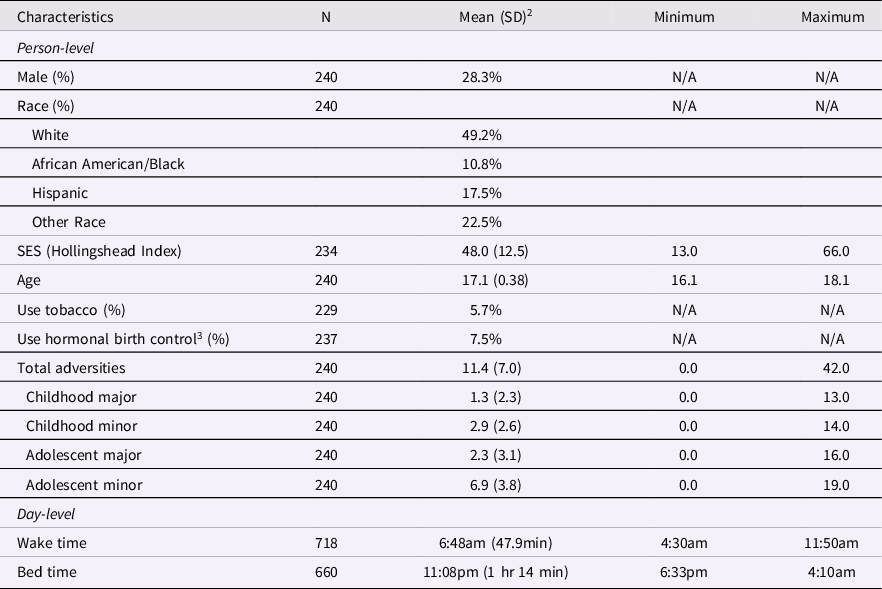
Of the 456 CTI participants, 272 had also completed the cortisol study. For the present study, we excluded participants (n = 21) who did not have sufficient cortisol data. We defined sufficient cortisol as having at least one day of cortisol collection including at least the waking, CAR, and bedtime samples (see below for details). The CAR sample was considered useable if it was taken within 20–60 minutes of waking, representing ±20 from the requested 40-minute post-waking sample. We also recorded whether the CAR sample was taken earlier or later than the 40-minute goal. An additional eleven participants were excluded for using corticosteroid-based medications, yielding a final analytic sample of 240 participants. Of these, about 72% were female. As expected, this was significantly different than the gender distribution in the original YEP sample, which was 69% female (p < .001). Half of participants in the analytic sample were white, 18% Hispanic, 11% African American/Black, and the remainder were classified as other race. The original sample had a higher percentage of Black participants (13%, p < .001). Participants reported experiencing an average of 1.3 major (range: 0–13) and 2.9 minor (range: 0–14) childhood adversities, and slightly greater numbers of adversities in adolescence, specifically 2.3 major (range: 0–16) and 6.9 minor (range: 0–19) adversities. Table 1 presents additional sample characteristics.
Descriptive statistics for sample characteristics. 1

Adapted from Vrshek-Schallhorn et al., Reference Vrshek-Schallhorn, Wolitzky-Taylor, Doane, Epstein, Sumner, Mineka, Zinbarg, Craske, Isaia and Adam2014.
SES – socioeconomic status
1 Summary statistics calculated using the sample before replacing missing values using multiple imputation.
2 For categorical variables, only percentage is presented.
3 All male respondents are assumed to not use hormonal birth control.
Measures and procedures
Adolescent cortisol measurement
Cortisol measurements for these analyses were collected in late adolescence, following the baseline assessments (16.1–18.1 years). The collection protocol has been described in detail in previous publications (Adam et al., Reference Adam, Doane, Zinbarg, Mineka, Craske and Griffith2010; Doane & Adam, Reference Doane and Adam2010). Saliva samples, later assayed for cortisol, were collected via passive drool on three consecutive weekdays, with six samples collected throughout each day: at waking (S1), 40 minutes after waking (S2), mid-morning (S3, approximately three hours after waking), mid-afternoon (S4, approximately eight hours after waking), mid-evening (S5, approximately 12 hours after waking), and at bedtime (S6). Samples S3-S5 were collected at unanticipated times within 2-hour intervals across the day (scheduled to avoid mealtimes), prompted by a programmed watch. For the scheduled samples (S1, S2, S6), participants were asked to avoid eating, drinking, or brushing their teeth during the 30 minutes prior to sample collection; for the unanticipated samples, participants reported whether they had engaged in these behaviors in an accompanying diary report. Participants were instructed to store the samples in a refrigerator, and to return samples to the research team either at their school or through the mail. Cortisol remains stable in saliva stored at room temperature for several days and is not affected by mail travel (Clements & Parker, Reference Clements and Parker1998). Once received by the researchers, the samples were stored at −20˚C, and then shipped to Trier, Germany, where they were assayed in duplicate using time-resolved fluorescent-detection immunoassay (DELFIA) (Dressendorfer, Kirschbaum, Rohde, Stahl, & Strasburger, Reference Dressendorfer, Kirschbaum, Rohde, Stahl and Strasburger1992). As reported elsewhere, the sample intra-assay variation ranged from 4.0% to 6.7%; inter-assay variation ranged from 7.1% to 9.0% (Adam et al., Reference Adam, Vrshek-Schallhorn, Kendall, Mineka, Zinbarg and Craske2014). In all of our analyses, we used natural logarithmically transformed cortisol data to correct for positive skew in the cortisol data. Our key outcomes of interest were the diurnal slope, CAR, AUC, and waking and bedtime levels. The AUC was calculated from the raw data and then transformed.
Childhood trauma interview
The CTI is a multi-dimensional, semi-structured interview tool that retrospectively assesses childhood and adolescent adversity (Fink et al., Reference Fink, Bernstein, Handelsman, Foote and Lovejoy1995). We administered the CTI to our cohort in year six of the study, when participants were between the ages of 22–24 years. Although the CTI typically is used to assess experiences of adversity through age 18, the YEP used the tool to assess experiences up until age 16 years, the age at which participants were recruited into the study; other measures were used to assess adversities experienced after this age and not considered in the current study. Trained interviewers (whose training included information on mandated reporting and strategies for asking about sensitive information) conducted the phone interviews and scored the interviews according to a detailed manual providing over 260 examples of scored adversities. The interview used a conversational, non-threatening style (e.g., does not use the terms “abuse”), and included follow-up prompts to elicit information about the frequency and perpetrator(s) of abuse. Participants were asked about six specific domains of adversity: separation from/loss of a caregiver, neglect by a caregiver, emotional abuse, physical abuse, witnessing violence, and sexual abuse (Fink et al., Reference Fink, Bernstein, Handelsman, Foote and Lovejoy1995). Items represented a spectrum of severity. Using the emotional abuse domain as an example, items ranged from siblings insulting one another to caregivers threatening to kill the child. The CTI is relatively brief, taking approximately 20–30 minutes (Roy & Perry, Reference Roy and Perry2004).
In this study, we scored the CTI according to the approach developed by Vrshek-Schallhorn and colleagues (Reference Vrshek-Schallhorn, Wolitzky-Taylor, Doane, Epstein, Sumner, Mineka, Zinbarg, Craske, Isaia and Adam2014), which examined the domain of adversity, severity level, and age when the adversity was experienced. We included all domains assessed by the tool as described above. Severity was categorized as major or minor, based on research that suggests that only major stressful life events have an impact on future depression (Brown & Harris, Reference Brown and Harris1978; Monroe & Reid, Reference Monroe and Reid2008; Vrshek-Schallhorn et al., Reference Vrshek-Schallhorn, Wolitzky-Taylor, Doane, Epstein, Sumner, Mineka, Zinbarg, Craske, Isaia and Adam2014). All reported experiences were categorized consistent with the methods described in the original CTI scoring manual, although the low prevalence of items rated as “severe” (scoring 5-6 out of 6) led to the combining of “moderate” (scoring 3-4) and “severe” items into a single “major” category. Items rated as having a severity of 1-2 were categorized as minor adversities.
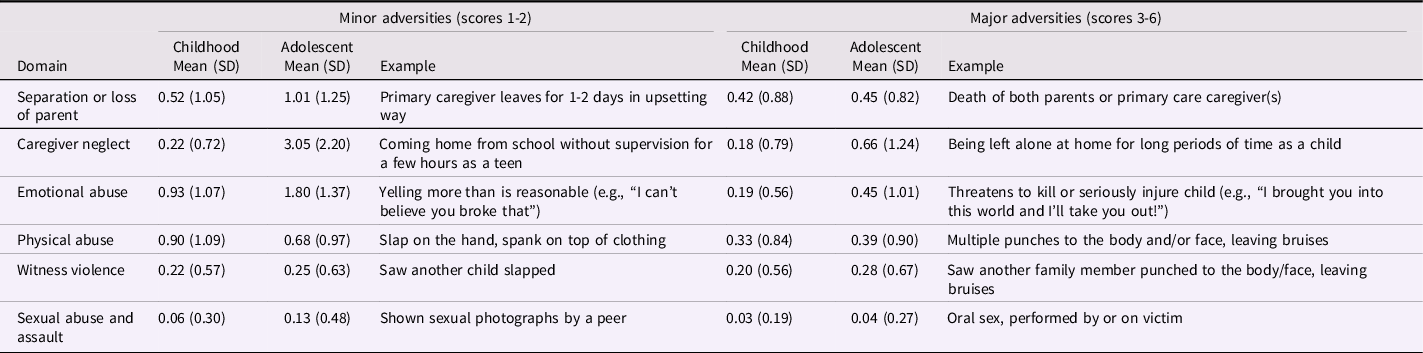
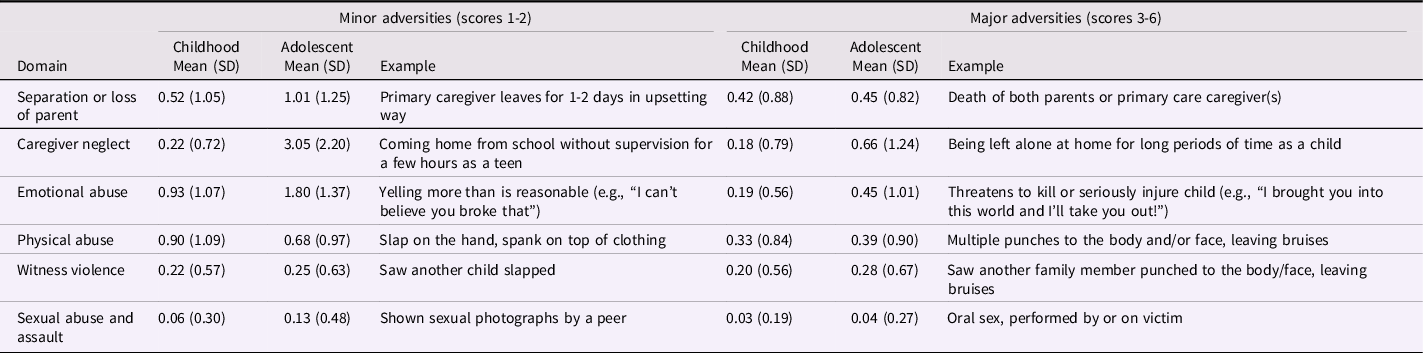
Building on a developmental perspective, which suggests that (a) early life experiences may be particularly influential (Shonkoff & Phillips, Reference Shonkoff and Phillips2000) and that (b) adolescence is a second period of great plasticity and may have a strong influence on adult outcomes (Dahl, Reference Dahl2004), we also distinguished between age of experience. Per Vrshek-Schallhorn et al., (Reference Vrshek-Schallhorn, Wolitzky-Taylor, Doane, Epstein, Sumner, Mineka, Zinbarg, Craske, Isaia and Adam2014), age periods were categorized as childhood (0–9 years) and pre-adolescence through adolescence (9–16 years). Age 9 was selected as the cutoff as there is typically evidence of prepubertal gonadal hormone changes at this age, which is believed to influence brain development and reactivity to adverse life experiences (Romeo, Reference Romeo2010). This age also approximated the mean age for adverse experiences, and was close to the midpoint of the time period covered by the CTI. Table 2 provides examples of each domain of adversity categorized as minor or major severity, as well as the mean number of adversities reported within each domain. Adversities were relatively infrequent, with minor adolescent neglect (mean = 3.05 events), emotional abuse (mean = 1.80 events), and separation or loss (mean = 1.01 events) being the most commonly reported types of adversity. As reported elsewhere, both cross-site and inter-site interrater reliabilities (interclass correlation coefficients, or ICC) were all moderate to high (Vrshek-Schallhorn et al., Reference Vrshek-Schallhorn, Wolitzky-Taylor, Doane, Epstein, Sumner, Mineka, Zinbarg, Craske, Isaia and Adam2014), ranging from 0.72 (cross-site minor adolescent adversities) to 0.94 (cross-site major adolescent adversities).
Summary statistics for adversity domain, stratified by severity and timing.
Demographics and other covariates
Consistent with our multilevel analytic approach (Adam et al., Reference Adam, Heissel, Zeiders, Richeson, Ross, Ehrlich and Peck2015), we considered covariates at the person, day, and moment levels. Person-level demographic covariates included gender, race and ethnicity, age, and socioeconomic status (SES), which previously have been identified as predictors of cortisol outcomes (Adam & Kumari, Reference Adam and Kumari2009; DeSantis, Kuzawa, & Adam, Reference DeSantis, Kuzawa and Adam2015). Race and ethnicity were categorized into four mutually exclusive categories: non-Hispanic white, Black, Hispanic ethnicity, and other (which included Asian, Pacific Islander, Native American, Other, and multiracial racial/ethnic identities). These four categories were dichotomized into dummy variables. Non-Hispanic white was used as the reference group for all analyses. SES was coded using parental education level and occupation, using the Hollingshead system (Hollingshead, Reference Hollingshead1975). We standardized the SES measure, as well as age, to help with interpretation.
We also included a number of health, health behaviors, and current life stress covariates including tobacco use, use of hormonal birth control (for female participants), experiencing past-year episodic life stress, and current mood characteristics which have been found to have associations with cortisol outcomes (Adam & Kumari, Reference Adam and Kumari2009). Past-year life stress was assessed using the UCLA Life Stress Interview (Hammen, Reference Hammen1991; Hammen et al., Reference Hammen, Adrian, Gordon, Burge, Jaenicke and Hiroto1987), which asks participants to report stressful life events that occurred in the past year. Each event that was reported was then rated on severity, ranging from 1 (little to no impact) to 5 (extremely severe impact), by a blind panel of reviewers. Based on the method described in Doane et al. (Reference Doane, Mineka, Zinbarg, Craske, Griffith and Adam2013) and limiting to events that were rated at a severity of 2.5 or above, we summed the severity of each item to create a score representing recent episodic life stress. Person-level mood characteristics were developed using a factor analysis of the momentary mood state reported by the cortisol subsample using an experience sampling methodology. The factor analysis identified three factors: negative emotion and stress, positive emotion/sociality, and sleepy/tired. This factor analysis was reported in prior work (Doane & Adam, Reference Doane and Adam2010), and replicated in the current analytical sample. Of the three mood-related factors, only negative emotion and stress showed a significant correlation with cortisol outcomes (Doane & Adam, Reference Doane and Adam2010). Thus, we excluded the other two mood state characteristics in subsequent models. All non-binary covariates were standardized. Recent life stress and the negative emotion and stress factor were also standardized.
Prior research has found that a) early life adversity predicts increased rates of depression (Kessler, Davis, & Kendler, Reference Kessler, Davis and Kendler1997) and b) present and past experiences of major depression are associated with a flatter diurnal cortisol slope (Doane et al., Reference Doane, Mineka, Zinbarg, Craske, Griffith and Adam2013). Based on these findings, we investigated whether experiencing depression influenced or explained the association between adverse experiences and the diurnal cortisol rhythm as a robustness analysis. Depression was assessed using the Structured Clinical Interview for DSM-IV Non-Patient edition (SCID/NP), which is used to diagnose current as well as lifetime history of depression, among other conditions (First et al., Reference First, Spitzer, Gibbon and Williams2002). For these analyses, we created two dichotomous variables indicating whether an individual was diagnosed with (a) current (baseline) or (b) past but not current diagnosis of a major depressive disorder (MDD) during their baseline assessment, concurrent with cortisol measurements (junior year of high school).Footnote 1 Sixteen (6.81%) participants were diagnosed with current MDD, and 41 (17.45%) with past MDD.
Day-level covariate
We also included each individual waking time as a covariate at the day level. Participants reported waking time in daily diaries.
Momentary activities
At the time of each cortisol sample, participants were also asked to record whether they had eaten, drank alcohol, smoked a cigarette, or exercised immediately prior to collecting the saliva sample. Previous research suggests these activities influence cortisol (Adam & Kumari, Reference Adam and Kumari2009). These were each coded as dichotomous variables, with a code of 1 indicating the presence of this activity. Participants also recorded wake time for each day, which we included as a covariate.
Analysis
After identifying the final analytic sample, missing values for all covariates (not outcomes or independent variables) were imputed using multiple imputation (Graham, Reference Graham2009) in SPSS 24 (IBM Corp., 2016), which uses a combination of linear and logistic regressions to impute missing values. A total of sixteen individuals (6.7%) were missing at least one individual-level variable. We imputed all missing values 50 times, creating 50 complete data sets with all variables of interest. The data were then pooled (averaged) across data sets for analysis.
We then built a series of multilevel models using HLM8 software (Raudenbush, Bryk, Cheong, & Congdon, Reference Raudenbush, Bryk, Cheong and Congdon2019). The use of multilevel models allows us to account for the non-independence of nested data (Raudenbush & Bryk, Reference Raudenbush and Bryk2002), as individual cortisol samples are nested within days, which are subsequently nested within individuals. This modeling approach, developed by Adam and others (Adam et al., Reference Adam, Heissel, Zeiders, Richeson, Ross, Ehrlich and Peck2015; Adam Reference Adam2006; Adam & Gunnar Reference Adam and Gunnar2001; Hruschka et al., Reference Hruschka, Kohrt and Worthman2005), also allows us to include independent variables at the levels of moments (Level 1, e.g., time since waking, whether the participant had recently exercised), days (Level 2, e.g., daily wake time), and individuals (Level 3, e.g., race and gender); we are also able to include cortisol samples across days with incomplete data collection, providing a larger number of data points and offering more precision to our estimates.
We first fit a 3-level multilevel model which models individual-level differences in the diurnal cortisol rhythm. The intercept of the model reflects the waking cortisol level. To model the CAR, we included a Level 1 dummy variable = 1 for Sample 2, if the sample was taken between 20-60 minutes after waking (40 ± 20 minutes). We also included an indicator of whether the CAR was early or late; these variables were not significant in any model, and thus were removed from the model for parsimony. To model the slope, or decline of cortisol level over the course of the day, we included a variable for time since waking at Level 1. This regresses time since waking on cortisol at the moment level, providing an estimate of the decline in cortisol over the course of the day. As this decline generally slows over the course of the day, we also included a quadratic time variable (time since waking squared) at Level 1. We included moment-level behaviors (eating, drinking alcohol, smoking cigarettes, and exercising) at Level 1, assessing each for significance. At Level 2, we included daily wake time as a covariate. At Level 3, we entered our independent variables of interest, representing child and adolescent adversities. We also included Level 3 covariates for individual level factors, specifically dummy variables for race (white as the reference group), male gender, use of birth control, status as a smoker, and both past and current depression, as well as standardized continuous variables for age, SES (Hollingshead Index), the negative emotion and stress factor, and past-year life stress. For all Level 2 variables, we used group mean centering, and for Level 3, we grand mean centered all variables. This approach allows us to interpret the intercept as the predicted level for waking cortisol.
Using this 3-Level model, we first examined our first research question: the association of total adversity with cortisol. To examine our second question about the influences of different characteristics of adversity, we then stratified our adversity count by timing and severity of adversity, yielding four independent predictors: major childhood, minor childhood, major adolescent, and minor adolescent adversity. We next wanted to examine the influence of domains of adversity. We planned to probe significant associations with any of the four timing-severity categories by running an additional model that further stratified that category of adversity (e.g., major childhood) by our six domain types: separation or loss of parent, neglect, witnessing violence, and emotional, physical, and sexual abuse. As a follow-up analysis, we also planned to introduce an interaction term to examine whether childhood adversity moderated the association of adolescent adversity (or vice versa) by severity type, for any category that showed statistical significance. As we were also interested in whether there were any associations of adversity with bedtime cortisol, we also repeated the models described above replacing time since waking with time until bedtime, with bedtime coded as 0, such that the intercept now reflected bedtime cortisol.
We also wanted to examine the relationship of adversity with the total cortisol experienced of the course of the day. To accomplish this, we used a separate 2-level multilevel model that predicted total cortisol. Total cortisol was calculated using all available cortisol samples by taking the area under the curve (AUC) with respect to ground (Adam & Kumari, Reference Adam and Kumari2009; Pruessner, Kirschbaum, Meinlschmidt, & Hellhammer, Reference Pruessner, Kirschbaum, Meinlschmid and Hellhammer2003), which was then, due to a positive skew, transformed using the natural log. For this model, the AUC is a day-level outcome. At Level 1 (day), we included wake time. At Level 2, we included the same adversity measures and individual-level covariates as described above.
Results
Preliminary analyses
We first examined the association of all covariates with all components of the diurnal cortisol rhythm in our multilevel model. In preliminary analyses, the Level-1 (moment level) covariates for recent eating, drinking alcohol, and smoking were not significantly related to diurnal cortisol. We removed these from the model, but did retain the moment level indicator for exercise, which was significantly positively associated with momentary cortisol. All other moment, day, and individual-level covariates were retained either because of significant associations or because of prior research suggesting the importance of including these covariates when modeling the diurnal cortisol rhythm.
Description of diurnal cortisol rhythm and covariate effects
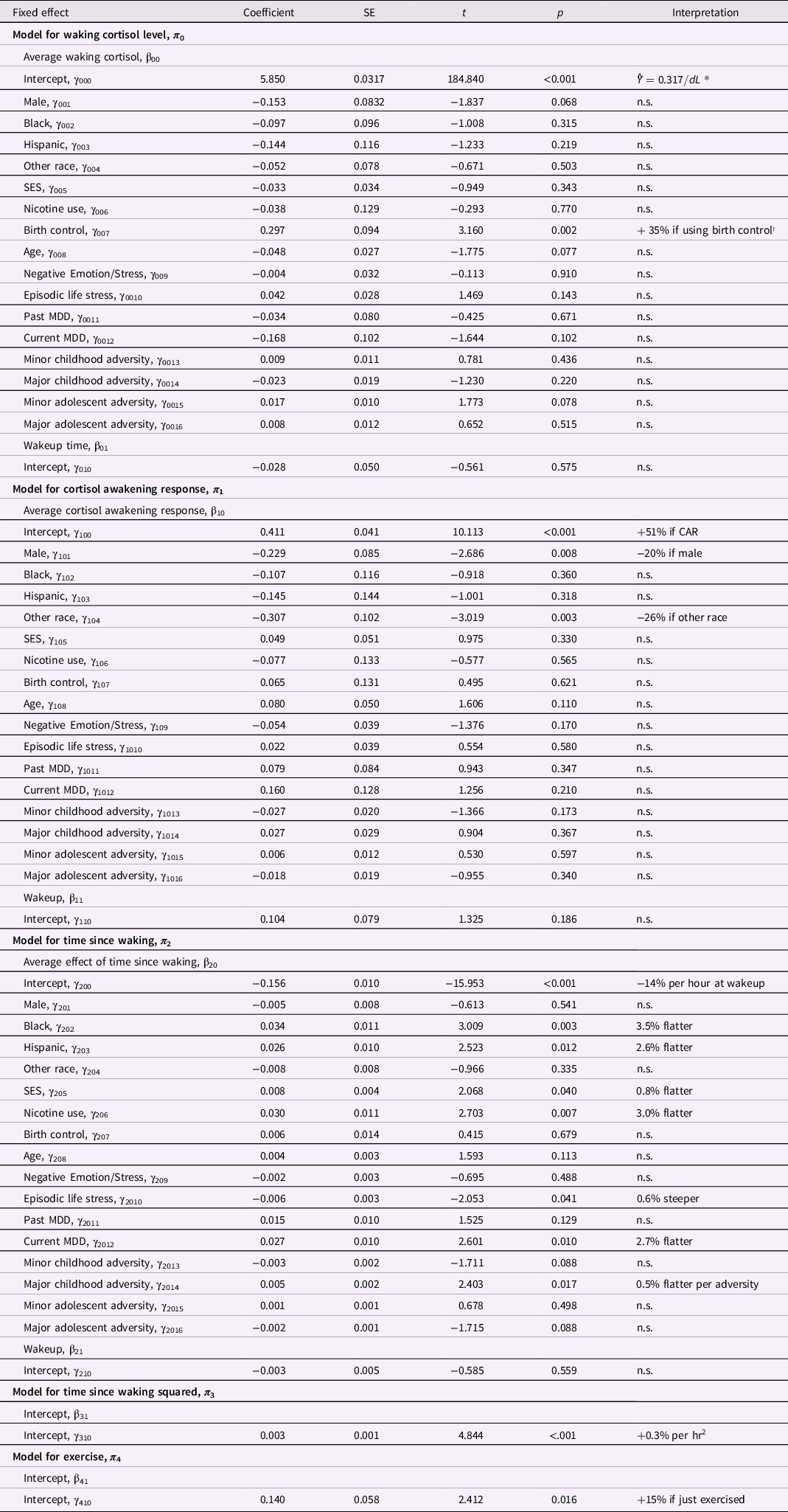
We next conducted a 3-level model examining the association between total adversities (aggregating childhood and adolescence adversities of all severity levels into one independent variable) and the cortisol outcomes, adjusting for all covariates as described above. We describe the average diurnal cortisol rhythm and covariate effects first, before moving on to present our key (adversity) results. Note that cortisol values are transformed using the natural log, so we can calculate the percent change of the cortisol outcome associated with a one-unit change in the independent variable, using the formula B %change = exp(B) – 1.
The diurnal cortisol rhythm showed the expected pattern – an average waking value of 0.317
 $\mu {\rm{g}}/{\rm{dL}} $
, and a CAR about 50% higher than waking cortisol. Also expected, time since waking was associated with a 14.5% decline in cortisol per hour at waking; the quadratic time term was significant, showing a 0.3% deceleration per hour, suggesting the rate of decline of cortisol decelerates over the course of the day.
In addition, using oral contraception (γ007 = 0.312, SE = 0.094, p = 0.001) was significantly associated with higher waking cortisol. Male gender (γ101 = −0.241, SE = 0.083, p = 0.004) and being categorized as other race category (γ104 = −0.280, SE = 0.101, p = 0.006) were associated with having a lower CAR. Black (γ202 = 0.037, SE = 0.012, p = 0.002) and Hispanic (γ203 = 0.025, SE = 0.010, p = 0.015) race/ethnicity were associated with flatter diurnal slope, as was being a smoker (γ206 = 0.035, SE = 0.011, p = 0.002) and reporting current depression (γ2012 = 0.024, SE = 0.010, p = 0.020). As in preliminary analyses, recent exercise at any time point continued to be associated with higher cortisol (γ410 = 0.140, SE = 0.058, p = 0.016).
As previously described, we also conducted a 2-level model, with days (Level 1) nested within individuals (level 2), with AUC as our day-level outcome. We included all of the same day and individual level covariates. In this model, male gender was associated with less cortisol over the day (γ01 = −0.215, SE = 0.079, p = 0.007). No other covariates were associated with the AUC.
Total adversity and the diurnal cortisol rhythm
Moving to the primary set of predictors of interest (adversity), the total number of adversities across childhood and adolescence was not significantly associated with waking cortisol, CAR, or diurnal slope. It was also not significantly associated with bedtime cortisol (γ0013 = 0.004, SE = 0.007, p = 0.583). In contrast, in the 2-level model predicting AUC, total adversity was associated with higher AUCFootnote 2 (γ013 = 0.010, SE = 0.005, p = 0.036).
Considering severity and developmental timing
We next examined the influence of the developmental timing and severity (major vs. minor) of adversity exposure on the diurnal rhythm. This model, presented in Table 3, simultaneously included separate counts of major childhood, minor childhood, major adolescent, and minor adolescent adversities. The coefficient for each category of adversity adjusts for the other three categories, as well as all other covariates, thus indicating its statistically unique association with cortisol outcomes. For this model, adding the four adversity variables reduces level-3 variance in the CAR by 6.5% and variance in the slope by 7.5%. As the general trends for the diurnal rhythm and associations of covariates were quite similar to those in the regressions for total adversity, we only report associations that vary from the previous models.
Multilevel modeling results for associations of experiences of childhood and adolescent adversities and diurnal cortisol parameters.

MDD = Major depressive disorder; SES = socioeconomic status (Hollingshead Index)
All Level 1 predictors are uncentered; Level 2 variables are group mean centered, and Level 3 variables are grand mean centered. The effects of wake-up time, time since waking squared, and exercise were fixed at Level 2; all other variables were set as random.
* Cortisol values were transformed using the natural log, and a constant (7) was added. To calculate the raw value of the cortisol sample, we took the exponent, and report the interpretation here.
† Using a logarithmic outcome allows us to interpret the coefficients as the percentage change in the outcome associated with the independent variable. We use the following transformation for this interpretation: B %change = exp(B) – 1.
Waking cortisol
None of the childhood or adolescent major or minor adversity categories were significantly associated with waking cortisol.
CAR
None of the childhood or adolescent major or minor adversity categories were significantly associated with the CAR.
Diurnal slope
As presented in Table 3, we observed that each major childhood adversity was associated with 0.5% flatter slope (γ2014 = 0.005, SE = 0.002, p = 0.017). In addition to the previously reported covariate effects, this model suggested that each standard deviation increase in SES (γ205 = 0.008, SE = 0.004, p = 0.040) was associated with 0.8% flatter slope and that a standard deviation higher recent life stress (γ2010 = −0.006, SE = 0.003, p = 0.041) was associated with 0.6% steeper slope.
Bedtime cortisol
In the separate model centering time such that the intercept now represents bedtime cortisol in place of waking cortisol, we did not observe a significant association of minor childhood (γ0013 = −0.040, SE = 0.025, p = 0.121), major childhood (γ0014 = 0.040, SE = .031, p = 0.205), minor adolescent (γ0015 = 0.021, SE = 0.013, p = 0.110), or major adolescent (γ0016 = −0.016, SE = 0.021, p = 0.437) adversity with bedtime cortisol level (full results available upon request).
AUC
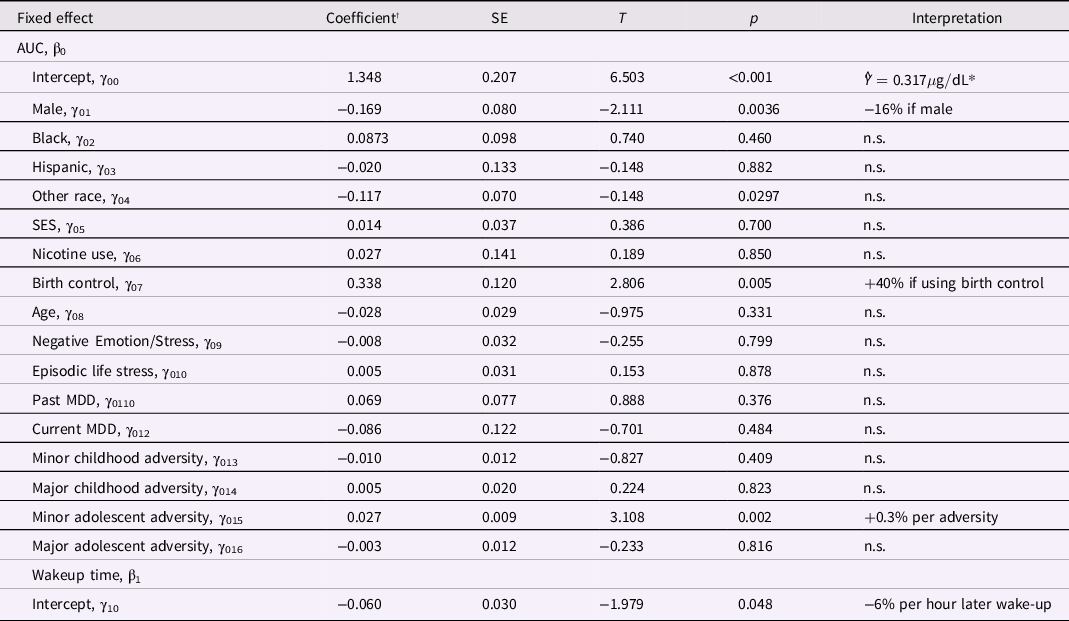
We also examined the association of the four adversity categories with total cortisol experienced over the course of the day using a 2-level model (Table 4). Of the four adversity categories, only minor adolescent adversity (γ015 = 0.027, SE = 0.009, p = 0.002) was associated with a higher AUC. In addition to previously reported covariate effects, birth control was associated with a higher AUC (γ07 = 0.338, SE = 0.120, p = 0.005).
Association of childhood and adolescent adversity with total cortisol experienced over the course of the day (AUC).

AUC – area under the curve; MDD = Major depressive disorder; SES = socioeconomic status (Hollingshead Index)
All Level 1 predictors are uncentered; Level 2 variables are grand mean centered. Wake-up time effect was fixed at Level 1.
* AUC values were transformed using the natural log. To calculate the raw value of the AUC, we took the exponent, and report the interpretation here.
† Using a logarithmic outcome allows us to interpret the coefficients as the percentage change in the outcome associated with the independent variable. We use the following transformation for this interpretation: B %change = exp(B) – 1.
Interactions of childhood and adolescent adversities
In order to examine whether the impact of adolescent adversity on diurnal cortisol was potentiated by or dependent on childhood adversity (a “sensitization” effect) we examined the interaction of major childhood and major adolescent adversity in our 3-level model. The interaction term was not significant, nor were the coefficients for major childhood and major adolescent adversities for the associations with waking cortisol, CAR, and slope. We also examined the association of the interaction term for minor adolescent and minor childhood adversity with AUC; the term was not significant.
Domains of major childhood adversity
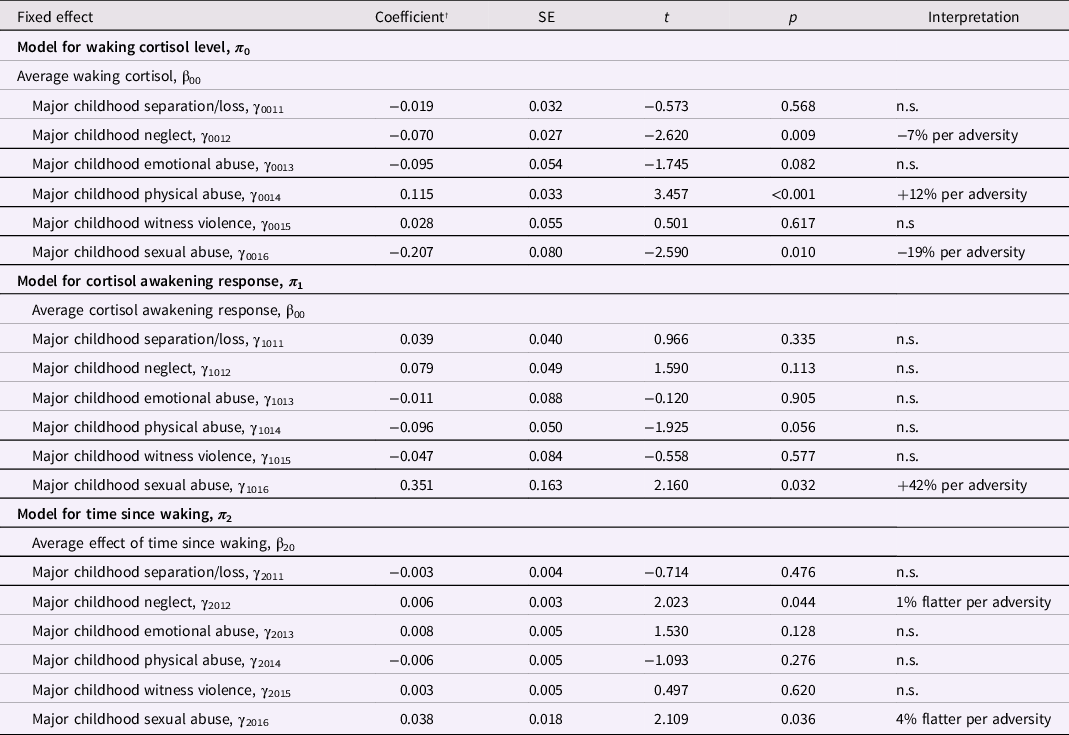
Based on the overall significant association of major childhood adversity with flatter diurnal cortisol slope, we next examined the six different domains of major childhood adversity (separation/loss; neglect; emotional abuse; physical abuse; witnessing violence; sexual abuse) in relation to diurnal cortisol parameters in a 3-level model (Table 5). We again adjusted for all covariates, but omit covariate associations from the table as they are largely similar to prior models.
Multilevel model for childhood adversity domains, stratified by severity.

Covariates from Table 3 are included in the multilevel model, results not shown but are similar to associations observed in Table 3. All Level 1 predictors are uncentered; Level 2 variables are group mean centered, and Level 3 variables are grand mean centered. The effects of wake-up time, time since waking squared, and exercise were fixed at Level 2; all other variables were set as random.
† Using a logarithmic outcome allows us to interpret the coefficients as the percentage change in the outcome associated with the independent variable. We use the following transformation for this interpretation: B %change = exp(B) – 1.
Major childhood adversity domains: Waking cortisol
We observed significant associations for three domains of major childhood adversity with waking cortisol. Both major neglect (γ0012 = −0.070, SE = 0.027, p = 0.009) and sexual abuse (γ0016 = −0.207, SE = 0.080, p = 0.010) were associated with lower waking cortisol. In contrast, each experience of major childhood physical abuse was associated with about 12% higher waking cortisol in late adolescence (γ0014 = 0.115, SE = 0.033, p < 0.001). Parental separation or loss, witnessing violence, and emotional abuse were not significantly associated with waking cortisol levels.
Major childhood adversity domains: CAR
Each report of major childhood sexual abuse was associated with a 42% higher CAR (γ1016 = 0.351, SE = 0.163, p = 0.032). No other domain of major childhood adversity was associated with the CAR.
Major childhood adversity domains: Diurnal slope
Both major childhood neglect (γ2012 = 0.006, SE = 0.003, p = 0.044) and sexual abuse (γ2016 = 0.038, SE = 0.018, p = 0.036) were associated with a flatter slope. No other domains showed a significant association.
Major childhood adversity domains: Bedtime
No major childhood domain of adversity showed a significant association with bedtime cortisol level.
Domains of minor adolescent adversity and AUC
When we examined analyses looking at domains of adolescent adversity and AUC, significant associations were observed between counts of minor adolescent neglect (γ014 = 0.033, SE = 0.015, p = 0.032), emotional abuse (γ015 = 0.052, SE = 0.024, p = 0.032), and witnessing violence (γ017 = 0.132, SE = 0.048, p = 0.007) with increased AUC. We did not observe significant associations for the other three domains of adolescent adversity with the AUC (results available upon request).
Discussion
In these analyses, adversities experienced in childhood and adolescence were associated with alterations in the diurnal cortisol rhythms of older adolescents recruited from non-clinical, community-based settings. We observed that severity and developmental timing of adversity mattered. More specifically, major adversities experienced in childhood were associated with a flatter cortisol diurnal slope even after adjusting for adolescent experiences. Meanwhile, the number of minor adolescent adversities was significantly associated with higher levels of cortisol throughout the day after adjusting for childhood adversities, reflective, perhaps, of the immediate effect of higher acute stress reactivity (Bosch et al., Reference Bosch, Riese, Reijneveld, Bakker, Verhulst, Ormel and Oldehinkel2012). In contrast, minor adolescent adversities were not associated with the diurnal slope, which would reflect a more long-term shift of wear and tear on the diurnal rhythm over time (Adam et al., Reference Adam, Quinn, Tavernier, McQuillan, Dahlke and Gilbert2017). Disaggregating adversities by domain of adversity further revealed interesting patterns of associations based on both the type and severity of the adversity experienced.
Multiple types of childhood adversity were associated with differences in the cortisol rhythm, including the CAR, slope, and AUC. Notably, the association of childhood adversity with later adolescent cortisol outcomes is consistent with models that suggest early childhood maltreatment and other stressors broadly affect biological systems and mental and physical health over time at least in part through HPA axis dysregulation (McEwen, Reference McEwen1998; Miller et al., Reference Miller, Chen and Parker2011). Indeed, both major childhood sexual abuse and neglect were associated with a flatter slope. This is consistent with previous findings that chronic early life neglect is linked to a less robust diurnal rhythm (Gunnar & Donzella, Reference Gunnar and Donzella2002; Gunnar & Vazquez, Reference Gunnar and Vazquez2001; Adam et al., Reference Adam, Quinn, Tavernier, McQuillan, Dahlke and Gilbert2017). While the overall associations generally represented small changes in magnitude (with the exception of sexual abuse) for any one instance of adverse exposure, many participants reported experiencing multiple major adversities in their childhood (mean = 1.3, SD = 2.3), resulting in larger differences in cortisol outcomes among those with a greater number of adversities.
After disaggregating our adversity categories by domain, our findings were partially consistent with past results. A prior study of neglect and the diurnal rhythm suggested childhood neglect predicted flatter slopes and lower CAR among a sample of adult adoptees (van der Vegt et al., Reference van der Vegt, van der Ende, Kirschbaum, Verhulst and Tiemeier2009). While we found individuals reporting childhood neglect to have flatter slopes, we did not observe a significant association with the CAR. We did observe a large effect size of having experienced sexual abuse on a higher CAR, which is consistent with prior studies (Weissbecker et al., Reference Weissbecker, Floyd, Dedert, Salmon and Sephton2006; Mondelli et al., Reference Mondelli, Dazzan, Hepgul, Di Forti, Aas, D’Albenzio and Pariante2010; Bublitz & Stroud, Reference Bublitz and Stroud2012).
Prior studies indicate that childhood parental loss or separation and physical abuse are related to future cortisol outcomes, including both the acute stress response and diurnal rhythms (Carpenter et al., Reference Carpenter, Carvalho, Tyrka, Wier, Mello, Mello, Anderson, Wilkinson and Price2007; Carpenter et al., Reference Carpenter, Shattuck, Tyrka, Geracioti and Price2011; Elzinga et al., Reference Elzinga, Roelofs, Tollenaar, Bakvis, van Pelt and Spinhoven2008; Meinlschmidt & Heim, Reference Meinlschmidt and Heim2005). We did not, however, observe a significant association for major childhood parental loss or separation with diurnal cortisol. However, we did see a significant association of physical abuse with waking cortisol. Given that elevated morning levels are associated with greater alertness and lower fatigue, perhaps this is a vigilance mechanism developed in response to past physical challenge (Del Giudice et al., Reference Del Giudice, Ellis and Shirtcliff2011; Adam et al., Reference Adam, Hawkley, Kudielka and Cacioppo2006).
After adjusting for childhood adversities, minor kinds of adolescent adversity (including both total number, as well as emotional abuse, neglect, and witnessing violence) were associated with total cortisol experienced over the day (AUC). These findings were consistent with past research (Suglia, Staudenmayer, Cohen, & Wright, Reference Suglia, Staudenmayer, Cohen and Wright2010). They are also consistent with the expected functioning of the HPA axis as proposed by Miller and colleagues (Reference Miller, Chen and Zhou2007), where more recent stress (in our model, indicated by minor adolescent stress) is linked to short-term elevation of cortisol levels over the course of a day as a reflection of higher HPA axis activation. We also observed that steeper diurnal slopes were associated with current life stress, again consistent with greater HPA activation related to more recent stress. In addition, Elzinga and colleagues (Reference Elzinga, Roelofs, Tollenaar, Bakvis, van Pelt and Spinhoven2008) noted that moderate exposure to adverse experiences may function as a “stress inoculation.” This interpretation would suggest that the association between minor adolescent adversities and higher AUC are evidence of the development of an efficiently activated stress response system. This is also consistent with the cortisol reactivity threshold model, which proposes that the HPA-activating nature of minor stressors may paradoxically protect individuals in the short term (Vrshek-Schallhorn et al., Reference Vrshek-Schallhorn, Avery, Ditcheva and Sapuram2018).
The general lack of findings for major adversities experienced in adolescence was somewhat surprising. These findings seem to contradict research that suggests more recent adverse experiences may have a stronger effect than more distal experiences on biological systems (Doane et al., Reference Doane, Mineka, Zinbarg, Craske, Griffith and Adam2013; Miller et al., Reference Miller, Chen and Zhou2007) and on mental and physical health (Hazel et al., Reference Hazel, Hammen, Brennan and Najman2008; Kendler et al., Reference Kendler, Karkowski and Prescott1998; Vrshek-Schallhorn et al., Reference Vrshek-Schallhorn, Stroud, Mineka, Hammen, Zinbarg, Wolitzky-Taylor and Craske2015; Wolitzky-Taylor et al., Reference Wolitzky-Taylor, Sewart, Vrshek-Schallhorn, Zinbarg, Mineka, Hammen, Bobova, Adam and Craske2017). It may be possible, as observed in Jaffee et al. (Reference Jaffee, McFarquhar, Stevens, Ouellet-Morin, Melhuish and Belsky2015), that the effects of adolescent adversities may actually depend on the number and kinds of adversity experienced in early childhood, however, we did not observe evidence of an interaction between childhood and adolescent adversities. Still, research suggests adversities experienced in childhood may influence cognitive processes and emotional regulation that promote adaptive psychological functioning later in life (Vrshek-Schallhorn, Ditcheva, & Corneau, Reference Vrshek-Schallhorn, Ditcheva, Corneau, Harkness and Hayden2020; Cicchetti & Toth, Reference Cicchetti and Toth1995; Beck, Reference Beck2008). In sum, the findings from our analyses are consistent with research that suggests early childhood experiences may have an influence even after controlling for more proximal adolescent adversities on biological indicators of health (Ehrlich, Ross, Chen, & Miller, Reference Ehrlich, Ross, Chen and Miller2016), while also suggesting a role for less severe adolescent experiences. Notably, there were fewer major adolescent adversities observed than minor adolescent adversities, although this pattern was also observed for childhood adversities, where a different pattern emerged.
Lastly, we also observed large effect sizes for several individual-level covariates. These findings were generally consistent with past research, with a few exceptions. Notably, men had lower CARs, a finding on which the literature is somewhat mixed (Clow, Thorn, Evans, & Hucklebridge, Reference Clow, Thorn, Evans and Hucklebridge2004). Men also had lower average cortisol over the course of the day. Black and Hispanic participants had, on average, flatter diurnal slopes, consistent with prior work (DeSantis, Adam, Doane, Mineka, Zinbarg, & Craske, Reference DeSantis, Adam, Doane, Mineka, Zinbarg and Craske2007; Adam et al., Reference Adam, Heissel, Zeiders, Richeson, Ross, Ehrlich and Peck2015). We also found that recent exercise was associated with higher momentary cortisol (Kertes & Gunnar, Reference Kertes and Gunnar2004). In contrast to prior work, we found that higher SES was associated with a flatter slope after controlling for other individual level characteristics. This sample has relatively high SES, although these results need additional exploration.
Limitations and future directions
There are several limitations to this work. First, although the sample was recruited from two general high school populations, participants may not be representative of the general U.S. population. As noted earlier, the YEP oversampled for neuroticism, which may have contributed to an over-representation of women in the project as women disproportionately score higher on scales for neuroticism than men (Lynn & Martin, Reference Lynn and Martin1997). Neuroticism (Garcia-Banda, Chellew, Fornes, Perez, Servera, & Evans, Reference Garcia-Banda, Chellew, Fornes, Perez, Servera and Evans2014) and male gender (as observed, e.g., in our CAR analyses) may both influence diurnal cortisol patterns; however, oversampling is not believed to influence effect size estimates obtained through regression techniques (Hauner, Zinbarg, & Revelle, Reference Hauner, Zinbarg and Revelle2014). Additionally, while both high schools draw from diverse communities representing a broad range of SES (including very low and very high SES students), the sample has a somewhat higher average SES than the general population (Vrshek-Schallhorn et al., Reference Vrshek-Schallhorn, Wolitzky-Taylor, Doane, Epstein, Sumner, Mineka, Zinbarg, Craske, Isaia and Adam2014). Future work should examine whether the observed relationships hold in other populations.
There are some additional methodological limitations. The CTI was retrospectively administered in early adulthood, which could lead to differential reporting of adolescent and childhood adversities. Indeed, a recent paper suggests that there is only slight or fair agreement between prospective and retrospective reporting of childhood adversities, although individuals who retrospectively report adversities had a higher risk of psychopathology than those whose caregivers had reported the adversity in real time (Newbury et al., Reference Newbury, Arseneault, Moffitt, Caspi, Danese, Baldwin and Fisher2018). In addition, perhaps a more fine-grained categorization of age would reveal additional distinctions in both childhood and adolescence (Knudsen, Heckman, Cameron, & Shonkoff, Reference Knudsen, Heckman, Cameron and Shonkoff2006; Shonkoff & Phillips, Reference Shonkoff and Phillips2000; Sisk & Zehr, Reference Sisk and Zehr2005). Further, recent work has suggested that differences in cortisol may begin at a later age than 9 years, which was what we used for our cutoff between childhood and adolescence. While we would have liked to further stratify age, we were limited by the small number of adversities experienced by participants. In addition, our analyses do not correct for multiple testing. All analyses were planned a priori, but there were a fairly large number of planned analyses, increasing the likelihood of Type II error. Lastly, the project is limited by the cortisol collection procedures. There was no verification of wake-up times (which can be accomplished through actigraphy) or how closely the first sample collection corresponded with wakeup. Other studies have noted a lag in collection of over 40 minutes versus the reported time, which could artificially inflate the first sample value, and minimize the CAR measurement (Stalder et al., Reference Stalder, Kirschbaum, Kudielka, Adam, Pruessner, Wust and Clow2016). Additionally, although we compared wake time to the time recorded for Sample 1, there was no verification of collection times for later samples. We observed that about 30% of days with waking and CAR cortisol samples indicated lower cortisol for the CAR than cortisol observed at waking, suggesting that there may have been some compliance issues. Objective monitoring of waketimes and the timing of all collection points has been recommended to overcome this challenge (Adam & Kumari, Reference Adam and Kumari2009; Stalder et al., Reference Stalder, Kirschbaum, Kudielka, Adam, Pruessner, Wust and Clow2016).
This study also suggests the importance of longer longitudinal studies that begin in early life (allowing for even more rigorous and real-time collection of data on adversity as well as presence of protective factors) and continue into later adolescence and eventually into adulthood. Such studies should include multiple collections of cortisol and other biological outcomes of interest using current best practice recommendations (Adam & Kumari, Reference Adam and Kumari2009; Stalder et al., Reference Stalder, Kirschbaum, Kudielka, Adam, Pruessner, Wust and Clow2016). This would permit a clearer examination of the timeline and processes with which the effects of adversities on the diurnal cortisol rhythm unfold.
Conclusion
The current study offers new insight into how different aspects of adversity reported in childhood and early adolescence may relate to later stress biology. The joint consideration of developmental timing, severity, and domain of adversity offers nuance to a literature that has established the importance of these factors but not often evaluated multiple criteria at once. Critically, many of the observed associations, which vary across adversity domains, would have been masked if only an aggregate sum of experiences was considered. Both the CTI (yielding investigator-rated severity according to established standards) and cortisol measurement (6 samples a day, over three consecutive days) used relatively rich assessments. The collection of multiple samples across consecutive days provides more information about the diurnal rhythm than earlier studies that have asked similar questions.
In sum, these results build on existing research to suggest which aspects of childhood and adolescent adversity are most strongly associated with diurnal cortisol rhythms in later adolescence. We provide additional support that adverse childhood experiences influence stress response systems, even after controlling for the influence of more recent adolescent stressors. These results may suggest biological mechanisms through which certain kinds of early life adversity are embodied as an endophenotype to create long-lasting changes to stress response systems and mental and physical health outcomes. Future work in this area should continue to explore multiple characteristics of early life adversity – in both childhood and adolescence – to refine our understanding of the persistent and pernicious effects of adversity on biological systems and health outcomes.
Acknowledgments
The authors would like to thank the Youth Emotion Project participants for their years of commitment to the study. We also thank Dr. Royette Tavernier for her guidance on advanced imputation techniques in SPSS, and Emily Ross and Andrea Busby for their review of earlier drafts of the manuscript.
Funding statement
Project funding was supported by a William T. Grant Foundation Scholars Career Award to EKA, a Faculty Fellowship from the Institute for Policy Research at Northwestern University to EKA, a two-site grant from the National Institute of Mental Health (R01-MH065652 and R01-MH065651) to MC, SM, REZ, and EKA and a postdoctoral National Research Service Award from the National Institute of Mental Health to SVS (F32-MH091955). Additional funding for the analysis was supported by US Department of Education, Institute of Education Sciences, Multidisciplinary Program in Education Sciences, Grant Award # R305B140042, to CLK.
Conflicts of interest
None