Introduction
In recent years, interest in organic agriculture has grown around the world. Food safety and environmental concerns have increased the public demand for organic products and shifted the organic sector from the economic margins to the mainstream. Applied agricultural policies have offered farmers several incentives to convert to organic production practices, boosted the development of the organic sector and sharply increased the quantity of organically cultivated farmland in the European Union (EU). At present, 7.8 million hectares in the EU-27, almost 4.3% of the total utilized agricultural area of these nations, are farmed organically1.
However, the importance of organic farming varies among the EU member states. In Greece, the organic sector was relatively unimportant until the mid-1990s (the trade and development of organic products in Europe began in 1993, following the implementation of EU Regulations 2092/91 and 1804/99 for organic crop production and the organic livestock sector, respectively); however, it has undergone rapid growth since that time. In particular, the total land area that has been fully converted to organic farming or is currently under conversion to organic farming practices increased from 591 ha in 1993 to 309,822 ha in 2010, which represents 8.2% of the total utilized agricultural area and approximately 24,000 holdings. In essence, the rapid expansion of the organic market along with the review of the Common Agricultural Policy (CAP), which increased farmers' orientation to the market and strengthened its support to high quality production, paved the way for a rapidly increasing number of Greek farmers to convert to organic. This trend built on the unique opportunities that the Greek landscape and environmental parameters offer especially to the organic cultivation of low input production, well established within the endogenous farming tradition, such as olive oil and fruit products, which enjoyed a price premium in the domestic and international markets and at the same time were satisfying consumers' environmental and food safety concerns.
Several studies have attempted to assess the reasons that drive farmers to adopt or avoid organic farmingReference Burton, Rigby and Young2–Reference Sattler and Nagel15. These investigations have identified a wide range of factors that are associated with the adoption of organic farming; however, researchers generally agree that diverse answers are obtained to the question of ‘how’ and ‘to what extent’ each of these factors affect organic conversion. Parameters that can explain why farmers decide to adopt organic farming practices include not only the personal characteristics of these farmers and various structural factors but also diverse economic, environmental, institutional, social and health considerations. Most studies describe organic farmers as better educated and younger than the conventional ones, while they generally own smaller farms and have limited farming experience. Among other motivations, economic factors (such as better prices, increased demand and market potential for organic products) and non-economic factors (such as lifestyle choices that relate to environmental and health concerns) are reasons that farmers assume the risks of converting to organic production practices.
In contrast to the relatively limited number of factors that encourage farmers to adopt organic practices, a wide range of obstacles to organic conversion has been identified in the literatureReference Duman3, Reference Defrancesco, Gatto, Runge and Trestini12, Reference Flaten, Lien, Koesling and Loes14, Reference Schneeberger, Darnhofer and Eder16–Reference Uematsu and Mishra20. In particular, concerns about production difficulties, income variability, marketing issues, fragmentary and scarce technical support, high production costs, the high volumes of paperwork that are involved in enrolling in subsidy programs and the management of uncertainty are factors that prevent the adoption of innovative farming systems, such as organic agriculture. As organic farming is highly exposed to risk, the choice of rational risk management tools is a fundamental determinant of the long-term viability of this farming systemReference Flaten, Lien, Koesling, Valle and Ebbesvik8, Reference Greiner, Patterson and Miller13, Reference Meuwissen, Huirne and Hardaker21–Reference Hansson and Lagerkvist23.
In Greece, most of the research efforts that have addressed organic agriculture have focused on either economic and technical efficiencyReference Tzouvelekas, Pantzios and Fotopoulos24–Reference Tzouramani, Sintori, Liontakis and Alexopoulos26 or consumer preferencesReference Tsakiridou, Boutsouki, Zotos and Mattas27–Reference Chryssohoidis and Krystallis29, and several studies have addressed the issue of farmer participation in agri-environmental programsReference Beopoulos and Louloudis30–Reference Genius, Pantzios and Tzouvelekas32. However, there is a clear dearth of research that examines the motives, goals and risk management strategies of Greek organic farmers. Therefore, the objective of this paper is twofold: (a) to determine the motives and the goals that are associated with the adoption of organic agriculture and (b) to determine the risk management strategies that are applied by organic farmers in Greece. This study seeks to enrich the debate on the different forms of risk management strategies that are utilized by farmers and to characterize the attitudes and practices that are related to the internal dynamics of organic farming. First, through a factor analysis, we attempt to determine the attitudes of Greek farmers toward risk management strategies, focusing on the differences in risk attitudes between organic farmers and non-organic farmers. We examine the perspective of farmers as innovators through the risk management strategies they employ and compare the risk tolerances of organic and non-organic farmers. Second, through a probit analysis, we attempt to explain the key factors that affect the attitudes of Greek farmers with respect to various risk management strategies. The thorough nature of this investigation provides essential information to policy-makers that will further their understanding of the factors that induce farmers to participate in organic agriculture. Moreover, this study reveals relevant approaches and issues for further research efforts.
The remainder of this paper is arranged as follows. The next section of the paper presents the materials and statistical methods that are used in this study. Then, survey data are presented and critical dimensions of the sample are discussed. Subsequently, the results of the empirical application are discussed and analyzed to determine the factors that influence the participation of Greek farmers in organic agriculture and the risk management tools that these farmers utilize. Finally, the paper concludes with a summary of the main findings of this investigation and the policy implications that can be derived from these results.
Methodology
Farmers' perceptions of risk and risk management strategies were initially examined through descriptive analysis. In particular, a survey was administered to a stratified random sampling of 72 organic and 51 conventional farmers that asked respondents to identify sources of risk and to use Likert scales to rate items that related to risk management strategies. Basic statistics, such as the mean values of the survey responses, were compared for organic and conventional farmers, using standard t-tests for metric (quantitative) variables and chi-square tests for non-metric (qualitative) variables. SPSS (SPSS Inc., Chicago, Illinois, USA) was used to perform the data analysis. Furthermore, a factor analysis was employed; this technique is a well-established approach that has been utilized in the literature to assess similar data and outcomesReference Flaten, Lien, Koesling, Valle and Ebbesvik8, Reference Koesling, Flaten and Lien10, Reference Greiner, Patterson and Miller13, Reference Flaten, Lien, Koesling and Loes14, Reference Lien, Flaten, Jervell, Ebbesvik, Koesling and Valle18. Principal component analysis was then applied to reduce the number of factors and summarize the information that had been obtained about perceptions of risk management strategies. The factor solutions, obtained through the orthogonal varimax rotation of different number of factors, were examined to determine the most characteristic and reliable set of factors. Standardized factor scores for each farmer and each factor were introduced into the subsequent probit analysis.
In an analysis involving a choice between two alternative options, probit analysis is used to quantify the relationship between the probability of selecting one of these alternatives (a number between zero and one) and various characteristics that affect this choiceReference Greene33. The probit model uses the functional formula of Prob[y t=0]=1−Φ(x tβ), where Φ(•) is the cumulative normal distribution; that is, Φ(z) is the probability that a random variable with a normal distribution, zero mean and unit variance does not exceed z. The dependent variable is not continuous but is instead a dichotomous binary variable, i.e., either an organic or conventional farming system. The probability depends on a vector of independent variables (x t) and a vector of unknown parameters β. The task of the estimation is to determine the best values for these parameters. As it is assumed that x tβ is normally distributed, interpreting probit coefficients requires assessing the data in terms of the Z metric. The interpretation of a probit coefficient, β, is that a one-unit increase in a predictor increases the probit score by β standard deviations. The estimation of a probit model is obtained by maximizing the likelihood function. This maximization requires an iterative method; however, in most cases, these iterations operate smoothly because probit functions are remarkably well behaved. Goodness of fit and inferential statistics are based on the log likelihood and chi-square test statistics.
Data
The data that are used for this research are obtained from a survey that was administered in 2010 in the Lakonia area of the Peloponnisos region of Greece. Lakonia is one of the most prominent areas in Greece for organic agriculture, containing 15,851 ha of organically cultivated farmland. In fact, Lakonia is the Greek area with the highest percentage of organic agriculture, and it accounts for 15.9% of the total Greek land area that has been converted to organic farming. The primary crops that are grown in Lakonia are olives (76.8%), citrus fruits (3.9%), nuts (2.4%) and forage crops (0.2%). This very production profile within the prefecture reflects also the structure of the organic output at the national level34, which was an additional reason for the selection of Lakonia as the field area under study, despite the fact that its landscape may not be considered as representative for the country as a whole.
The aim of the survey was to examine farmers’ attitudes with respect to both the primary sources of risk for organic farming and the application of risk management strategies. A stratified random sampling method involving Neyman optimum allocation was employed for the survey which returned a survey sample of 72 organic farmers and 51 neighboring conventional farmers. The organic subsample was drawn from the population of 1046 organic farmers active in the area which was stratified according to their main productive direction, the duration under certificated organic production and the acreage of the farm. For the conventional farmers’ subsample, a two-stage sampling procedure was followed. In the first stage, four rural municipalities were randomly selected from the stratified list of 20 dynamic, less-favored and mountainous municipalities of the prefecture. Conventional farmers within selected units were stratified according to their productive direction and farm size and a random selection was conducted. As this survey included a small sample size, its research findings are considered to be exploratory in nature. To collect the survey data, a questionnaire was administered during personal interviews with the survey respondents. The questionnaire included questions regarding the following topics: (a) the socio-demographic characteristics of the farmer; (b) the physical characteristics of the farm; (c) the farmer's perceptions of risk and of risk management strategies; and (d) the farmer's goals, future plans, motives and knowledge about organic agriculture.
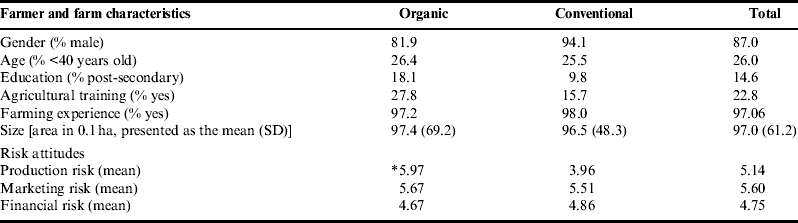
The survey revealed that organic and conventional farmers had similar mean ages, as the average ages for the organic and conventional farmers who were surveyed were 48 and 50 years, respectively (Table 1). However, the percentage of farmers who were less than 40 years old was slightly higher for organic farmers (26.4%) than for conventional farmers (25.5%). In accordance with the social standards of Greek society, farmers of both types were generally married with two children. Organic farmers were better educated; in particular, 18.1% of the organic farmers but only 9.8% of the conventional farmers had acquired a post-secondary education. In addition, there was no significant difference between the two farming groups with respect to the size of the farmed land. Organic farmers had more agricultural training and farming experience due to family tradition in the sector, indicating that they possessed a higher quality of human capital. Agriculture was the main activity for both types of farmers, although a higher percentage of organic farmers (30%) than conventional farmers (9.8%) were engaged in off-farm work. Organic farmers were more willing than conventional farmers to take further production risks as they feel more confident about production changes due to the experience they accumulated during their transition to organic.
Descriptive data.

* Indicates significance at P<0.05.
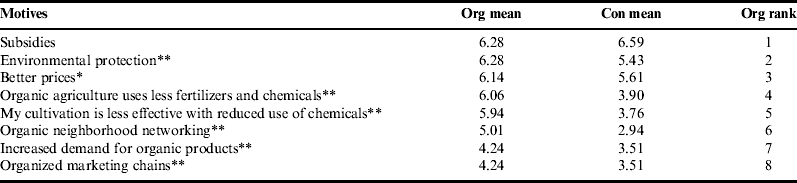
The decision to convert to organic farming involves several types of complex motivations. For organic farmers, the most important motives included both economic and environmental considerations, followed by social motivations (Table 2). In particular, the most highly ranked motives were the subsidies that were provided for organic farmers and a desire to protect the environment. Better prices for organic products and the low needs of olive trees for fertilizers and chemicals prompted farmers to adopt organic agricultural practices. These findings are in accordance with the results of Rigby et al Reference Rigby, Young and Burton5. and Lapple and DonnellanReference Lapple and Donnellan35, who stressed that farmers' decisions with respect to converting to organic farming were likely to be motivated by economic considerations and by social networks. Good relationships with neighborhood networks that related to organic farming were a critical factor that positively affected farmers' attitudes toward adopting organic agricultural practices in the Lakonia area, confirming the results of other relevant studiesReference Wynn, Crabtree and Potts6, Reference Defrancesco, Gatto, Runge and Trestini12, Reference Damianos and Giannakopoulos31, Reference Kaufmann, Stagl and Franks36–Reference Wilson38. Finally, increased demand and organized marketing chains were also among the determinants of the adoption of organic agriculture. Conventional farmers have nearly the same attitudes as organic farmers about the aspects of organic farming that relate to subsidies, prices and environmental protection. In contrast, conventional farmers provided significantly lower ratings than organic farmers for the factors of social networking and organized marketing channels; this result indicated the negative attitude of conventional farmers with respect to these considerations.
Motives for engaging in organic agriculture.
* and ** indicate significance at P<0.05 and P<0.001, respectively.
Analysis and Results
Factor analysis
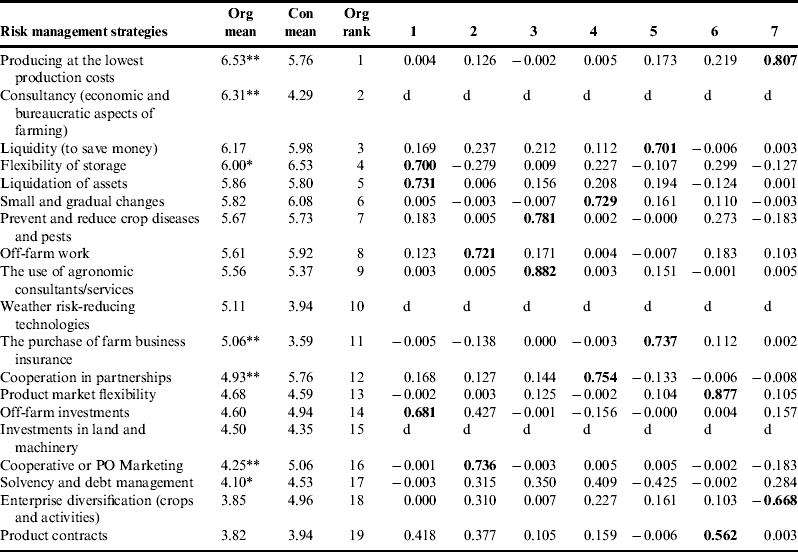
Farmers' opinions of 19 risk management strategies were acquired. Each of these strategies was rated on a Likert scale that ranged from 1 (not relevant) to 7 (very relevant), and the results of these rankings are reported in Table 3. The most preferred strategies for organic farmers are to produce at the lowest possible production cost and to take advantage of opportunities to seek for professional consulting about the economic and bureaucratic aspects of organic farming. The provision of information about organic farming is a crucial issue for these farmers; this information produces positive effects on farm diversification. Moreover, organic farmers seek to save money and prefer to possess increased liquidity because this flexibility offers them greater freedom of action during the current economic recession in Greece. Small and gradual changes in production, the use of agronomic consultants to assist in preventing and reducing crop diseases, and farm business insurance tools are also critical risk management strategies of farmers. Organic farms are not highly diversified but instead follow regional specializations, implying that farmers adopt an ‘input substitution’ approach rather than a ‘system redesign’ approach to organic farmingReference Lamin and Bellon39. The primary goals of organic farmers are profit maximization and continued agricultural activity; therefore, these farmers utilize rational tools to diversify their income. Organic farming offers these farmers the opportunity to improve their product quality and obtain better prices. In addition, organic farmers use alternative distribution channels and methods to sell their products; in particular, direct sales and storage options that yield better prices are the dominant strategies of organic farmers, whereas traditional agricultural strategies, such as collaboration in local cooperatives and debt management, are the approaches that are ranked lowest by organic farmers.
Perceptions of risk management strategies.
The mean values that are marked with * and ** indicate that the scores of organic and conventional farmers are significantly different at P<0.05 and P<0.001, respectively, based on independent sample t-tests.
The ‘d’ entries indicate that the variable has been deleted from the factor analysis because of its low Kaiser–Meyer–Olkin measure (KMO) or low communality.
The most preferred risk management strategies among conventional farmers are flexible storage; small and gradual changes in production; off-farm work; the ability to save money by liquidating assets; cooperation through partnerships; and low cost production. Conventional farmers were not familiar with the use of consultancy services, insurance measures and product contracts, but they would like to use local cooperatives to distribute their products.
A factor analysis of the 19 risk management strategies that were presented to the survey respondents, using principal component extraction combined with a varimax rotation, resulted in seven factors with eigenvalues that were greater than 1. Two risk management options (e.g., weather risk-reducing technologies and investment in land and machinery) have been omitted from the factor analysis because they had insignificant mixed factor loadings. The Kaiser–Meyer–Olkin measure of sampling adequacy was 0.663 for the entire set of variables, suggesting that the matrix was suitable for factor analysis. In factor analysis, any factor loadings that are greater than 0.30 are considered to be significant factors. Factor loadings that are greater than 0.40 are considered to be relatively important, whereas loadings that are greater than 0.50 are considered to be highly significant; the latter types of factor loadings are examined in this studyReference Hair, Anderson, Tatham and Black40.
The seven-factor solution generated the most interpretable factors and was therefore judged to be the most useful solution that was generated by the factor analysis. Standardized factor scores for each farmer were recorded and used for subsequent multivariate analyses. These factors explained 67.8% of the total observed variation. Table 3 displays the seven factors and their respective loading items. Factor 1, which was named flexibility, explained 19.92% of the observed variation and had high loadings for the items of flexibility of storage, liquidity of assets, and off-farm investments. Factor 2, which explained 9.58% of the observed variation, was named traditional income improvement strategies because the dominant variables for this factor are off-farm work and cooperation with a local cooperative. Factor 3, which explained 9.21% of the observed variation, was named consultancy and included the dominating variables of the use of agronomic consultants/services and measures to prevent and reduce crop diseases and pests. Factor 4, which explained 8.30% of the observed variation, was named gradual changes and included the two dominant variables of cooperation in partnerships and small and gradual changes. Factor 5, which explained 7.83% of the observed variation, was named insurance and referred to the variables of buying farm business insurance and the ability to save money through maintaining high liquidity. Factor 6, which explained 6.58% of the observed variation, was named marketing strategy, referred to product market flexibility and product contracts. Finally, factor 7, which explained 6.36% of the observed variation, was named aspects of production cost and incorporated the focus of farmers on low production costs and on improving the diversification of their enterprises.
Probit analysis
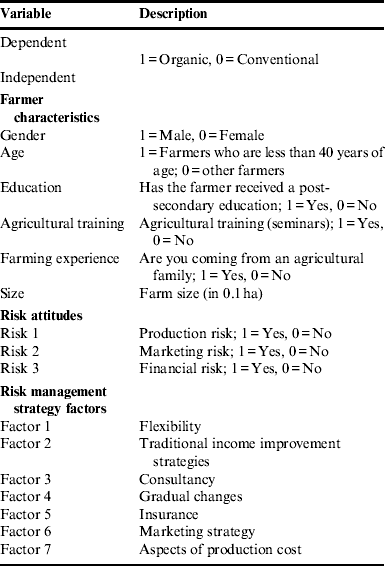
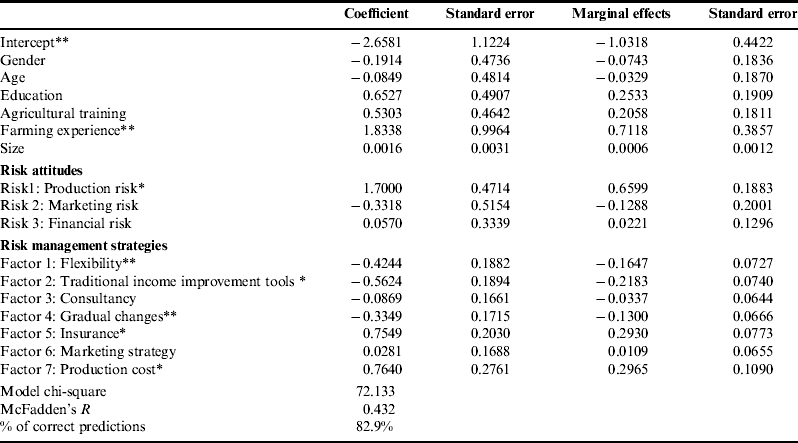
The probit model was estimated using a standard maximum likelihood approach. The dependent variable for this model was the adoption (or lack thereof) of organic farming. In particular, the binary-dependent variable takes the value of 1 if the respondent is an organic farmer and 0 for a conventional farmer. The tentative explanatory variables include both continuous and binary variables and are presented in Table 4. Three categories of variables were included in the probit analysis: farmer characteristics, risk attitudes and the factors from the factor analysis of risk management strategies. The maximum likelihood estimates of the probit model are presented in Table 5. The model results indicate that 82.9% of the observations were correctly predicted. According to the model chi-square statistic, the overall model is significant at the 0.000 level (72.133), and its McFadden R 2 is equal to 0.432. Both of these goodness of fit measures indicate that the probit model performed reasonably well, particularly given the cross-sectional nature of the analyzed data.
The definitions of the variables that are used in the probit model.
The estimation results of the probit model.
* and ** indicate significance at the 0.01 and 0.05 levels, respectively.
The probit results revealed that the experience in agriculture is a vital factor that positively affects farmers' attitudes toward adopting organic agriculture. Farmers with high levels of experience in agriculture are almost 71% more likely to produce organically. This result can be related with the findings regarding attitudes about production risk. Farmers who would like to take production risks are 66% more likely than risk-averse farmers to shift to organic agricultural practices. These results imply that agricultural experience may provide farmers with the confidence to employ an input substitution approach and successfully address the additional production risks that accompany the learning of new organic farming procedures. These farmers' long-term involvement with agriculture causes them to feel positive about assuming the risks of organic production procedures. Among the other farmer characteristics that were examined, gender, age, education, agricultural training and farm size were not found to be significant determinants in explaining the participation of farmers in organic farming. Most previously published studies of organic farming have identified age as a powerful factor that influences conversion to organic farming practices. In our case, there is a negative relationship between age and organic farmers. This result supports the hypothesis that a decreased willingness to participate in an organic farming system is generally associated with older farmers. As demonstrated by several relevant studiesReference Wynn, Crabtree and Potts6, Reference Koesling, Flaten and Lien10, Reference Vanslembrouck, Van Huylenbroeck and Verbeke41, young farmers with education and agricultural training are more willing to take risks.
The ability to utilize a main risk management strategy of reducing production costs and the adoption of a positive attitude toward applying production innovations positively affect (29%) farmers’ decisions to adopt organic farming practices. Organic farmers use rational approaches to maximize their income and to maintain their agricultural activities. The dimension of producing at the lowest cost does not refer to certification costs but instead accounts for the knowledge and application of optimal production cost management approaches for reducing production inputs and addressing all of the new changes that are required by an organic regime.
The ability to face the difficulties and the wide variety of risks that are involved in organic agriculture drive organic farmers to use insurance as a risk management strategy for their farm. The use of insurance tools has a positive effect (a marginal effect of 0.2930) on the adoption of organic agriculture. The use of insurance and the wise management of economic outputs, such as the tendency to save money to account for future risks, an extensive knowledge of production issues, and experience with marketing problems, appear to drive farmers to engage in organic agriculture. As expected, the strategy of small and gradual changes is not suitable for innovative farmers, including organic farmers; thus, it is unsurprising that the employment of this type of strategy was associated with a negative effect on the adoption of organic agricultural practices (marginal effect −0.1300). Finally, traditional strategies to improve farmers’ income, approaches that focus on the use of flexible post-harvest management and investments in assets outside of agriculture are factors that produce negative effects on the adoption of organic agriculture.
Conclusions
The present exploratory study sought to reveal the primary risk management strategies that would facilitate the development of organic farming in Greece. Economic and environmental parameters, as well as social networking effects, explain the immense development of organic farming in the study area. Our results suggest that organic farmers perceive themselves as risk-friendly with respect to the production challenges of organic farming systems but that they may also be regarded as rational and pragmatic individuals who follow sustainable and viable farming strategies. The use of information is a crucial and valuable aspect of their management decisions. Thus, their management strategies involve using new tools, such as the purchase of insurance and the use of consulting resources for agronomic and/or economic aspects of organic farming, before committing to a final decision to engage in organic farming. The enrichment of these two specific needs of organic farmers should be a significant concern for policy-makers in their attempts to improve the institutional framework of agriculture. The development of well-defined and appropriately designed insurance tools and the improvement of the advisory system for farmers are considered necessary features of institutional initiatives to support Greek farmers, particularly in the current environment of uncertainty that prevails in Greece. The forthcoming post-2013 CAP is expected to incorporate these types of measures to increase the productivity and the competitiveness of the agricultural sector. The improvement of the agricultural advisory system and the creation of rural networks will facilitate knowledge creation and transfer, benefiting organic farmers. Moreover, as indicated by the results of this study, the provision of incentives to utilize risk management instruments and active prevention strategies is a policy direction that Greek organic farmers will certainly welcome. This last point is of considerable importance in the midst of the crisis as farmers are all the more focusing on new demanding productive options such as organic vegetables and organic livestock production. At the same time, the low-input set of currently available organic activities, such as olive oil and fruit products, is also enlarged to include organic fodder, to support organic livestock needs, and new fruit categories which face a promising future, especially in international markets.
Although the sustainability development aspect of EU policies has traditionally promoted organic agriculture, improvements to the institutional framework supporting organic agriculture appear to be urgently required. One of the greatest challenges at the present time is to construct a new policy framework that includes not only traditional policy targets but also a wide plethora of new policy objectives, such as maintaining natural capital, sustaining life support systems, minimizing human impact, developing human capital, increasing social capital, promoting economic growth and creating institutionsReference Quental, Lourenco and da Silva42. Many of the aforementioned parameters are strongly connected to the organic farming system. Organic, high-quality products constitute an important aspect of Greek agriculture; given that Greek farmers are increasingly near the epicenter of a new ‘production model’ for Greece, policy-makers should provide necessary institutional support to organic farming by implementing the anticipated new CAP measures in a timely and cautious manner. Such initiatives should also couple the necessary institutional and legal improvements within the domestic supply chain in order to increase the market potential of organic productsReference Tzouramani, Sintori, Liontakis and Alexopoulos26, Reference Tzouramani, Liontakis, Sintori and Alexopoulos43, Reference Tzouramani, Sintori, Liontakis and Alexopoulos44. The creation of a meaningful value chain based on organic output of high quality is considered essential in order to put a dynamic part of the Greek agricultural sector on a sustainable and profitable future and to satisfy at the same time consumers’ concerns and access to foods of high nutritional value.