Introduction
Central to the modern rebirth of Bodh Gaya, as the place of Buddha's enlightenment, has been the growing influence of Buddhist missionaries and transnational religious networks on this pilgrimage landscape in North India.Footnote 1 An exemplary figure in this global missionary movement was the Sri Lankan Buddhist revivalist Anagarika Dharmapala (1864–1933), who wrote in his diary, just a year prior to his death, that at Bodh Gaya, ‘Burmese, Japanese, Chinese, Siamese [and] Tibetans should have cottages built for each country.’Footnote 2 Following Dharmapala's death in 1933, this prophetic statement has become a concrete reality. At Bodh Gaya today, there are over 40 Buddhist institutions, including monasteries, temples, and/or guest houses, many of which represent the unique aesthetic and architectural styles of different Buddhist traditions and national forms. Many of these opulent and lavish religious landmarks, like the Tibetan Tergar Monastery or the Royal Wat Thai, present a pronounced spatial and visual counterpoint to the rural landscape, and project an image and presence of international Buddhism onto the surrounding geography.
In this paper, I approach Bodh Gaya as a religious diasporic landscape and examine the historical and transnational religious processes that support the growing globalization of Bodh Gaya as a world Buddhist site. In using the term ‘transnational’, I am referring to those religious migrants who ‘live their lives across borders and maintain their ties to home, even when their countries of origin and settlement are geographically distant’.Footnote 3 Rather than use ‘traditionalist’ and/or ‘modernist’ frameworks to approach Buddhism at Bodh Gaya, I situate these developments along transnational lines to show the global dissemination and exchange of Buddhist ideas, practices, teachers, and institutions that have played an integral role in mobilizing pan-Asian Buddhist support to reclaim sacred ground.Footnote 4 Central to this investigation are a series of related questions about the production of religious diasporic identity in relation to patrimonial claims over national and cultural heritage: How is the notion of ‘world religion’ formed in relation to sacred space and diasporic consciousness? How have pilgrims and transnational Buddhist networks redefined Bodh Gaya as a sacred site and ascribed the landscape with religious meaning? Finally, how are Buddhist communities confined by national, linguistic, and cultural dimensions in Bodh Gaya today?
In exploring these questions, this paper also intends to build on recent theorization concerning religion and its contemporary articulation with the nation-state and globalization.Footnote 5 According to Hefner, throughout the late twentieth century we have seen far-reaching changes in the translocal cultural regimes known as ‘world religions’ and there have been considerable attempts around the world to map the new transnational terrain of religion, especially in relation to public politics and culture.Footnote 6 For Csordas, these changes are an expression of ‘transnational transcendence’ that point to the ‘existence of modalities of religious intersubjectivity that are both experientially compelling and transcend cultural borders and boundaries’.Footnote 7 As an archetypal model of ‘transnational transcendence’ and a key constituent in the propagation of religious forms of globalization, the practice of pilgrimage has been historically at the forefront of creating new networks of social identity that do not necessarily conform to territorial or nation-state boundaries.Footnote 8 At the same time, it is important not to overestimate the continuing salience of the nation-state in defining religious identity and constraining religious practice. From the viewpoint of Borchert, there is a tendency in the late twentieth and early twenty-first century to think of ‘Buddhism as an international, even global, phenomenon, rather than a national one.’Footnote 9 Despite the extensive and growing ties between Buddhist institutions across national boundaries, Borchert argues that Buddhism cannot be understood outside of a national context and that contemporary Buddhist culture is marked by a deep tension between the transnational and national.
In this paper I argue that this tension is evident in the socio-spatial practices of monastic building in Bodh Gaya, in particular in the ways in which transnational religious networks interface with state agendas and cultural programmes at the national level. To highlight these underlying tensions in the reconfiguration of sacred space, in this paper I provide a detailed enumeration of the different national and regional networks of Buddhist monasteries, focusing on prominent leaders, specific institutions, and events that have shaped the globalization of Bodh Gaya within the last 60 years. Organizing the historical emergence of these monasteries along roughly national and cultural-linguistic lines provides a framework for describing the multiple and overlapping developments that are currently taking place at Bodh Gaya. Although I run the risk of reifying the nation-state in this analysis, it is important to emphasize that within each regional sub-section there is a great deal of competition for representation between Buddhist groups as well as cooperation that transcends political geographies. As I will demonstrate, this process began in the late nineteenth century but grew substantially after the 1956 Buddha Jayanti celebrations when land was provided by the state government for the purpose of supporting pilgrimage from abroad. Hence, the focal point of my analysis is the post-1956 developments at Bodh Gaya which underlie the site's growing international character today.
The navel of the earth: pilgrimage to the seat of enlightenment
In the old days when the message of Buddha went out from India to far-off lands, pilgrims came here from those countries carrying that message. There was coming and going and there was confluence of spirit. Leaving aside all political contingencies and looking at ourselves with detachment we would find that we were all tied together by powerful silken ties. . . Buddhism more than anything else laid the foundation of Greater India and established cultural unity of an abiding value between India and many parts of Asia. A free India can worthily strengthen and revitalize those contacts.Footnote 10
Religion has long underlined the diaspora concept. Although transnationalism and the flow of people, ideas, and goods across regional and nation-state boundaries are often treated as a recent historical phenomenon, pilgrimage and religious movement have always been central to the practice of Buddhism and other ‘world religions’. In fact, as Rudolph and Piscatori have noted, ‘religious communities are among the oldest of the transnationals’ and Buddhism may be one of the earliest.Footnote 11 Ever since Emperor Asoka made Buddhism the official state religion of the Magadha empire (circa 250 BCE) Buddhist word and praxis has crossed vast distances, enlarging the global scope of Buddhism and reinforcing its sacred ties to the Indian subcontinent. Over the course of many centuries, the religion also underwent complex cultural, doctrinal, and ritual adaptations that have led to major differences between Buddhist sects as they adapt to local cultural and social conditions throughout Asia.
In light of these sectarian differences, in The Holy Land Reborn, Huber provides a compelling case against the presumed fixity and stabilization of the Indian Buddhist sites based on the Tibetan experience.Footnote 12 Although his invocation of a fluid geography and ‘shifting terrain of the Buddha’ may apply to pre-modern Tibetan pilgrimage activity, among those sites of memory sanctioned by the Buddha, Bodh Gaya has certainly emerged as the most important pilgrimage destination in the twentieth and early twenty-first century.Footnote 13 Today, as in earlier times, this place is marked by the vajrasana or ‘diamond throne’ that rests beneath the boughs of the Bodhi tree and represents the ‘navel of the earth’: the precise site of the Buddha's awakening.
From Kemper's viewpoint, if the Buddhist ‘ethnoscape’ has a centre of gravity today, it is the sacred sites of North India, because of ‘their historical importance, prelapsarian quality, and material potency’, which draw together Buddhists of all nationalities.Footnote 14 Although the modern reinvention of Bodh Gaya began in the nineteenth century, international interest in the Buddhist geography of South Asia peaked in the mid-twentieth century as part of the nationwide celebrations of the 2,500th Buddha Jayanti held in 1956.Footnote 15 This commemorative event, marking Buddha's parinirvana (based on a Theravada chronology), was a historical landmark for the revival of Buddhism at Bodh Gaya and helped to revitalize key inter-Asian links to the sacred geography.Footnote 16 According to Bond, the event was particularly auspicious among Theravada Buddhist communities, because the Buddha is believed to have prophesied that his sasana would endure for 5,000 years and would undergo great renewal and resurgence at the mid-point of that period.Footnote 17 Not surprisingly, the main lobbying force behind the event was the Maha Bodhi Society, first established by Anagarika Dharmapala in 1891, which sought cooperation from both the Indian state and its international network of Buddhist supporters.
In response to the Maha Bodhi Society's representations, the first prime minister of India, Jawaharlal Nehru (1889–1964), was also of the opinion that this historic event, in memory of the ‘greatest Indian in our country's history’, should be suitably celebrated.Footnote 18 The Buddha provided many of these earlier, secular-leaning nationalist politicians with an ‘all-India inclusive ethic’ and a ‘symbol to declare that India's civilization was noble, culturally variegated, and intellectually respectable’.Footnote 19 However, in the aftermath of partition, Nehru also made the specific point that: ‘So far as the government is concerned, our celebrations will not be of a religious character’ but, rather, would be predominantly ‘cultural’.Footnote 20 Although the Buddha Jayanti was a year-long event held at several Buddhist sites throughout the country, the celebrations reached their zenith over the course of three days between 22 and 25 May. During this period, thousands of visitors, including international Buddhists and foreign dignitaries, converged on Bodh Gaya's sacred space to honour the memory of the Buddha within its new-found national context. According to Doyle's account, the celebrations were ritually marked with a special puja, ‘wherein Buddhist monks chanted and gave Dharma discourses, after which the Bihar government officials and Buddhist dignitaries made speeches, and messages from around the world were read’.Footnote 21 A special chartered plane that released thousands of jasmine, marigold, and rose petals over the Mahabodhi Temple and attendees concluded the event. In other words, as part of the nationwide ‘cultural’ programme, this event helped to reinforce the idea that Bodh Gaya was the navel of the earth and the centre of the Buddhist world within a wider international arena.Footnote 22
In addition to the 2,500th Buddha Jayanti celebrations, 1956 was significant for two other important reasons. First, there was the establishment of the government-constituted Bodh Gaya Temple Advisory Board that grew out of the 1949 legislature which transferred jurisdiction of the Mahabodhi Temple to a joint Buddhist-Hindu administration. This Advisory Board, consisting of a Buddhist majority—‘who may not all be of Indian citizenship’—provided an important transnational link for the representation of Buddhist groups outside of India.Footnote 23 The desire to establish an advisory board that could provide international advocacy in Bodh Gaya was closely aligned with Jawaharlal Nehru's national and political vision that positioned India at the cultural centre of a new post-colonial world order. From Nehru's perspective, ‘It would be desirable to give a certain international character to this temple’ such as an advisory committee that ‘would have no executive authority or power but will nevertheless be helpful and will be a graceful gesture to the Buddhist world’.Footnote 24 He also added that, ‘we have to give a sense of partnership to these foreign countries. . . [and] remember that this advisory body will have a larger significance than merely one for the Bodh Gaya temple. It really brings India into the international picture from another point of view.’Footnote 25 During their inaugural meeting held at the Maha Bodhi Rest House on the 17 March, the applications for plots of land at Bodh Gaya for the construction of monasteries and rest houses constituted one of the chief items for discussion. In lieu of the prophetic statement by Dharmapala, the desire to establish a ‘Buddhist colony’ around the Mahabodhi Temple would enable India to establish friendly relations with other Asian countries and allow Buddhist groups to reside more permanently in this sacred locality. Not only would the state benefit financially from the pilgrim traffic, the Advisory Board suggested, but Bodh Gaya would also develop into a great centre of culture and education as in ancient days.
The second event that had a significant impact on the revival of Buddhism in India was the conversion to Buddhism of the Untouchable leader, Dr Bhimrao Ambedkar (1891–1956) on 14 October in Nagpur, Maharashtra. On this special occasion, Ambedkar embraced the three refuges and five precepts and then proceeded to convert an estimated half a million of ex-Untouchable followers. According to Doyle's analysis, Ambedkar ‘self-consciously waited until the 2,500th anniversary of the Buddha's Parinirvana to stage this diksa ceremony, and. . . his timing lent tremendous symbolic weight and visibility to the controversial act’.Footnote 26 Although it is beyond the scope of this paper to examine the legacy of Ambedkar's highly symbolic conversion to Buddhism, it is sufficient to say that the Dalit political leader had also hoped to revive and reinvent Buddhism as a living religion that would provide a new sense of social identity and hope for millions of his Untouchable followers.Footnote 27 The extent to which the Ambedkar Buddhists and international interests coalesce around the politics of the Mahabodhi Temple today will be something I discuss towards the conclusion of this paper. In the sections that follow, I will turn to a detailed survey of the transnational histories and regional networks of Buddhist institutions that have acquired land at Bodh Gaya before, and after, the landmark 1956 Buddha Jayanti year.
Southeast Asia
Over the last 200 years the Burmese have played a leading role in renewing sacred ties to the place of Buddha's enlightenment. As Doyle and Trevithick have shown, throughout the nineteenth century at least half-a-dozen Burmese royal missions visited Bodh Gaya with the aim of identifying, restoring, and venerating religious structures, especially the Mahabodhi Temple.Footnote 28 The majority of these Burmese missions to Bodh Gaya took place during the reign of the Kon-baung kings (circa 1752–1885) and were integral to Burmese constructions of self through its patronage of the most elevated events, actors, and institutions of Burma's past.Footnote 29 These pilgrimages were in line with traditional Theravada views of dhammic kingship that reinforced the socio-political and spiritual welfare of the Burmese authority through the performance of state-sponsored religious acts.Footnote 30 Growing out of arrangements between the Bodh Gaya mahant (the local Shavaite landlord) and King Mindon Min in 1877, a Burmese Rest House was built 80 yards west of the Mahabodhi Temple for the purpose of worshipping the Bodhi tree and maintaining the sacred shrine. This was the first Buddhist institution to be built in Bodh Gaya in the modern era, but it was later demolished (due to neglect) in preparation for the Buddha Jayanti celebrations in 1956. A second Burmese vihara, however, was constructed in 1936, and this institution became a vital link for the propagation of Buddhism now taking root in the West.
Initiating these developments was the first prime minister of the new Democratic Republic of Burma, U Nu (1905–1997). U Nu was a devout Buddhist and a popular political leader who adopted a conscious policy of sponsoring Buddhism at the state level, following traditional patterns of leadership based on Asokan Buddhist ideals. Linked to these efforts to reform the Buddhist sangha and re-establish religious contacts was his visit to Bodh Gaya in 1956, as part of the Buddha Jayanti celebrations. During this time, U Nu came into contact with Acharya Anagarika Munindra (1915–2003), a Bengali Buddhist and scholar from the Chittagong region (now Bangladesh), who had been elected first superintendent of the Bodh Gaya Temple Management Committee and served from 1953–1957. Although Munindra and U Nu had previously crossed paths during a three-year Buddhist relic tour organized by the Maha Bodhi Society, on this occasion, U Nu invited him to Burma for the purpose of receiving instruction in vipassana, a meditation technique that had been preserved among the great Burmese masters. Accepting this invitation to deepen his understanding and practice, Munindra relinquished his position as superintendent and departed for Burma in early 1957, after which he spent nearly ten years training at the Sasana Yeiktha meditation centre in Rangoon under the guidance of Mahasi Sayadaw (1904–1982), one of the great Burmese meditation masters of the twentieth century.
According to Robert Pryor, when Anagarika Munindra returned to Bodh Gaya in 1966, he was, in fact, also fulfilling a Burmese Buddhist prophecy that anticipated a resurgence of Buddhism and vipassana meditation 2,500 years after the Buddha. These teachings had a tremendous impact on the Burmese vihara.Footnote 31 Located on the Gaya riverside road, a short distance from the police station, this has been the main centre of Burmese Buddhist activity throughout the latter part of the twentieth century. At the same time, the Burmese monks who ran the vihara were also vulnerable to the shifting political contours of post-colonial Burmese nationalism. For example, following the military coup led by General Ne Win, from 1962 until the late 1980s, the Buddhist sangha was totally cut off from political life and all vestiges of state support for Buddhism were eliminated.Footnote 32 Consequently, Burma was largely closed off to foreigners and many of the Burmese monks who were abroad were ordered back.Footnote 33 Despite the travel restrictions imposed by the military, the Burmese monastery found new forms of financial and spiritual support in the late 1960s when it became a central institution in the revitalization of the vipassana movement, especially among Western travellers and meditation practitioners seeking training and basic accommodation. Munindra, in particular, became a key resource for the transmission of vipassana during this time, offering personal instruction at both the Burmese vihara and the nearby Samanvay Ashram.Footnote 34 With his kind and gentle demeanour, Munindraji (as he was often called) was able to make the teachings and practice of Buddhism accessible to a growing number of Western Buddhist followers. According to Pryor, from 1966 to 1969 Anagarika Munindra was the only English- speaking vipassana teacher available in India and many of his students from Europe and the United States, such as Surya Das, Joseph Goldstein, Sharon Salzberg, and Daniel Goleman, have gone on to become renowned Western Buddhist teachers.Footnote 35
Following in the footsteps of Munindra was Satya Narain Goenka (b. 1924). Although of Indian descent, Goenka was born in Burma in 1924 and received formal training in vipassana from the Burmese master Sayagyi U Ba Khin (1899–1971), beginning in 1955. After 14 years of training, Goenka, like Munindra before him, returned to India in 1969 and began leading 10-day vipassana meditation courses and camps throughout the country. In Bodh Gaya, Goenka's first meditation camp took place at the Samanvay Ashram on 4 August 1970 and thereafter he continued to offer several ten-day courses over the winter season at both the Ashram and the Burmese vihara. These popular courses were taught on the roof of the building or under large tents and could draw upwards of 200 participants, many of whom were from Western countries. However, by the mid-1970s, Goenka no longer returned to Bodh Gaya and Munindra provided his last retreat in the 1977–78 winter season. When I spoke with Tara Doyle about her first-hand experience of these changes, she noted that this was ‘an end of an era for Westerners’ but the void was eventually filled through new channels of meditation instruction.
One teacher in particular who helped fill this void was the late Dr Rashtrapal Bhikkhu (1930–2008). Like Munindra, Rashtrapal was a Barua Buddhist monk and scholar from the Chittagong region. In the 1970s, Rashtrapal came to Bodh Gaya and co-founded the International Meditation Centre with Munindra on 29 January 1970. This institution claims to be the first formal Buddhist meditation centre to be established in India and provides regular meditation instruction and budget accommodation for pilgrims throughout the year. Over his long career in Bodh Gaya, Rashtrapal was also an active member of the Bodh Gaya Temple Management Committee from 1984–1994. He also established the annual Kathina Civara Dana ceremonies, which began in 1971 and mark the end of the monsoon season, during which visiting pilgrims offer robes and other provisions to the Buddhist sangha. There were also a number of influential Western practitioners and teachers who became an established part of the winter season in Bodh Gaya from the mid-1970s onwards. One of these instructors is Christopher Titmuss who leads the insight meditation group that has been offering popular ten-day retreats at the Royal Wat Thai every January and February since 1975. There is also the Antioch University Buddhist Studies Program which began in 1979. Robert Pryor is the founder and co-director, along with Tara Doyle, of this successful American-based study-abroad programme that runs each year from September to December. Building on this legacy of Burmese-Western infusion, the education programme is based at the Burmese vihara, where North American students receive four months of intensive training in Buddhist philosophy, South Asian history, contemporary Buddhist culture, comparative meditation traditions, and both the Hindi and Tibetan languages.
Over the course of the last 30 years, the head monk of the Burmese monastery, U Nyaneinda, has also been instrumental in building these transnational connections. He is also one of the senior advisers on the International Buddhist Council at Bodh Gaya—an organization of head monks, nuns, and managers of foreign monasteries that look after the collective needs of the growing international Buddhist community. Doyle maintains that ever since U Nyaneinda arrived in 1976 at the age of 31, he has been active in the ‘Buddhification’ of Bodh Gaya's landscape, both in terms of his combined efforts as an authority for land brokerage among incoming Buddhist organizations, but also in terms of erecting images and Buddhist structures in the surrounding landscape.Footnote 36 Through the joint efforts with famous Burmese sculptor U Han Tin, over a half-dozen Buddhist images have been built around Bodh Gaya which reflect popular legends and stories of the Buddha's biographical life. Together, many of these sculptures—such as the image of the Buddha sheltered by the snake Muchalinda in the water tank nearby the Mahabodhi Temple—have become popular attractions for pilgrims and tourists.
Thus, despite the isolationist policies and foreign restrictions following the military coup in 1962, the Burmese monastery at Bodh Gaya has been a transnational meeting ground between East and West that has served as a key loci for the early dissemination of the vipassana tradition. In recent decades there have also been a growing number of Burmese pilgrims and state officials returning to Bodh Gaya on pilgrimages. As part of the new face of Myanmar foreign policy, on 1 April 1990, there was a ‘Good Will Mission’ to India by a 20-member Myanmar delegation. During their stay in Bodh Gaya, the group met with a number of professors at the nearby Magadh University and set up a programme of mutual cooperation in the form of an exchange of scholars and students between India and Myanmar. As a result of these changing diplomatic relations, by the mid-1990s, Burmese pilgrims and postgraduate monk-students and nuns began to arrive in growing numbers, especially in the last ten years. These recent pilgrimage-based developments have spawned a host of new Burmese institutions such as the Great Holy Land Monastery, the Myanmar Monk-Students’ Welfare Association of India, and the Mahabodhi Meditation Centre. Also, linked to Goenka's earlier influence is the Dhamma Bodhi Vipassana Centre, which was established in 1994 and runs a series of popular 10-day courses throughout the year.
Like the Burmese, and following the landmark Buddha Jayanti celebrations, Thai Buddhists have also shown a renewed interest in the Buddhist sacred sites in India. Although Nehru was of the opinion that a large accommodation hall should be built at Bodh Gaya where foreign scholars and Buddhists could stay, irrespective of their countries of origin, he was also keenly aware of the symbolic and diplomatic connections that Buddhism provided. For these reasons, he accepted a proposal made by the king of Thailand, Bhumibol Adulyadej (b. 1927) shortly after the Buddha Jayanti, and a large plot of land was gifted to the royal monarchy by the state government of Bihar in 1957. Under the name the ‘Royal Wat Thai’, this became the first Buddhist monastery and temple in the post-independent era to be built under the jurisdiction of a foreign head of state.Footnote 37 To celebrate the growing cultural exchange programme between India and Thailand, a golden Buddha image was also installed in the Royal Wat Thai on 3 May 1967 as a gift from the prime minister of Thailand, Thanom Kittikachorn. Indeed, a special United States military aircraft was chartered by the Thai government to fly from Bangkok to the nearby Gaya aerodrome to ensure the safe journey of the golden Buddha image. This was followed by a set of ritual rounds at the Mahabodhi Temple before its formal installation, where a message sent by the king of Thailand was read: ‘Let the installation of the Buddha image in the birth place of Lord Buddha and at the exact place where he attained Enlightenment symbolize the international friendship between India and Thailand.’
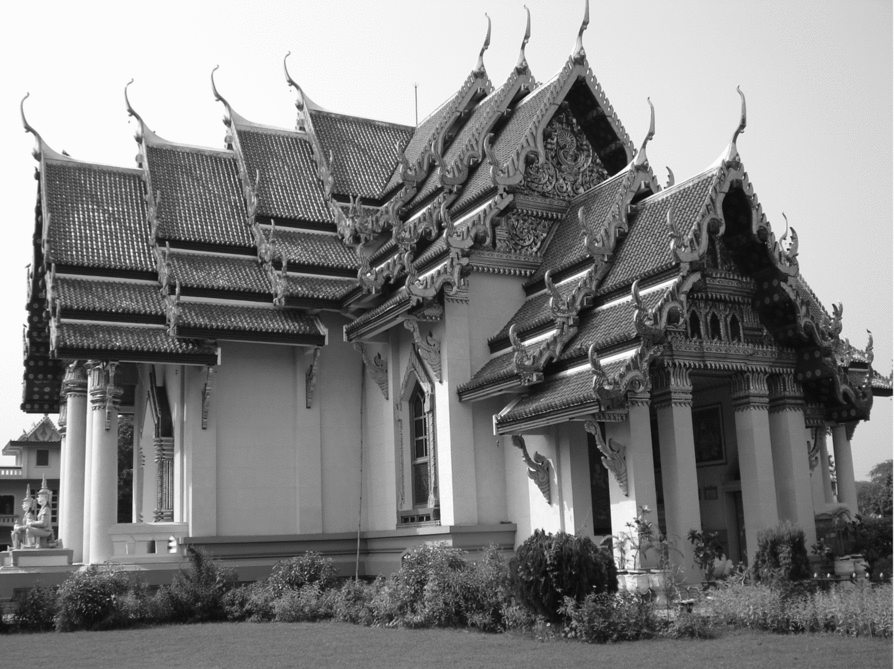
As a result of generous funding from the government of Thailand in the early 1970s, the Royal Wat Thai also received a significant makeover and was modelled after the famous Marble Temple in Bangkok—Wat Benchamabopit Dusitwanaram—which was established by King Rama V in 1899. What is exceptional about the architectural mimesis and replication of the Marble Temple at Bodh Gaya is the extent to which this reconstruction was a reversal of the distribution of Mahabodhi Temple prototypes that were built between the early thirteenth and late-fifteenth century in Burma, Thailand, Nepal, and China. As Guy has suggested, one of the main reasons for the construction of Mahabodhi replicas beyond Buddhist India was the desire to create surrogate temples to allow veneration to continue when, from the twelfth century onwards, direct access to the navel of the earth became increasingly difficult.Footnote 38 Rather than serving as an architectural icon modelled after the Mahabodhi Temple, the establishment of the Royal Wat Thai became a symbol of the nation at the sacred-power centre of the Buddhist world.
The Royal Wat Thai. Source: David Geary.

Following the 1956 Buddha Jayanti, in many ways the Royal Wat Thai provided a benchmark for other national expressions of Buddhist architecture and aesthetic design that followed in its aftermath. With its sloping curved roof and golden tiles, the beautifully adorned Royal Wat Thai remained the only Thai Buddhist institution in Bodh Gaya throughout most of the twentieth century. It was not until the late 1990s—helped by the commencement in 2002 of direct international flights from Bangkok to Gaya—that there began a surge of Thai Buddhist pilgrimage activities and a growing number of religious centres in Southeast Asia. One of these institutions is the Wat Pa Buddha Gaya, which is associated with the Thai Bharat Society and the Forest Monk tradition of Thailand. Stretched over several acres of land directly south of the Mahabodhi Temple, the name Wat Pa derives from its close association with Payap-Parutai Shinawatra, the younger brother of the now deposed Thai prime minister, Thaksin Shinawatra. Similarly, across the river Niranjana is the Wat Neranjawas, established under the directorship of head monk Phrarajpipatanatorn, otherwise known as Luang Por Thavorn. This Thai monk has two honorary degrees from California and New York, as well as a large global network of supporters, including many from prominent American monastic branches in Houston and New York. Lastly, several other Buddhist centres in Southeast Asia have also acquired land in recent years, with monasteries currently under construction. These include the Cambodian Buddhist Monastery, the Wat Thai Magadh Vipassana Centre, the Wat Pa Muchalinda, Wat Lao Buddhagaya International, and the Buddha Sawika Bodh Gaya for Thai nuns.
Tibetan refugees and the Himalayan region
An early pioneer in the transformation of Tibetan pilgrimage culture in the twentieth century was the Tibetan intellectual Amdo Gendun Chophel (1903–1951). Influenced by both European and Asian orientalist scholars and Buddhist modernists, Amdo Gendun Chophel was the very first Tibetan pilgrim in history to systematically visit the major Buddhist sites and produce a popular modern pilgrimage guidebook.Footnote 39 A creative and controversial figure, he was also a close friend of Marxist-Buddhist Rahul Sankrityayan (1893–1963) and maintained close contact with the Maha Bodhi Society after arriving in India in 1934. Over the course of a decade, Amdo Gendun Chophel played a leading role in the reconfiguration of the pilgrimage geography for the Tibetan people by reinforcing the modernist claims towards the ‘authentic’ Buddhist sites and rejecting other popular and ‘invented’ Tibetan Buddhist sites.Footnote 40
Although Amdo Gendun Chophel set a ritual pattern that would encourage many other Tibetans to undertake pilgrimages in the coming decades, perhaps the most politicized pilgrimage was the trip by the 14th Dalai Lama Tenzin Gyatso and the 10th Panchen Lama Lobsang Trinley Lhündrub Chökyi Gyaltsen as part of the 2,500th Buddha Jayanti held in 1956. So far I have described some of the major Southeast Asian Theravada Buddhist developments that grew out of the year-long Buddha Jayanti celebrations. As I have shown, for a number of foreign dignitaries and Buddhist leaders from the religious diaspora, this was their first visit to the seat of enlightenment and the commemorative event served as a catalyst for future growth. Seeking to bridge the sectarian differences between Theravada and Mahayana-Vajrayana Buddhism, the Maharaj Kumar of Sikkim, Pelden Thondup Namgyal (1923–1982), who was then president of the Maha Bodhi Society, issued an invitation to the Tibetan spiritual leader to participate in the Buddha Jayanti celebrations. With added support from the Indian Congress leaders, the Dalai Lama accepted the invitation and departed from Lhasa at the end of November with a small entourage, including the Panchen Lama and his older brother, Lobsang Samten. Under intense geopolitical pressure, they travelled to Gangtok in Sikkim and later to New Delhi, where the Tibetan leaders had an opportunity to undertake direct diplomatic exchanges with the government of India, in particular with Nehru, concerning the unfolding Chinese occupation of Tibet.Footnote 41
In the company of a large number of Tibetan devotees, the Dalai Lama also initiated his first public religious act by performing pilgrimage activities and offering teachings at a number of Buddhist holy sites, including Bodh Gaya, on 27 December. On this special occasion, thousands of people thronged the seven-mile route from Gaya to Bodh Gaya as the Dalai Lama and his entourage drove through numerous welcome arches that had been erected in honour of their visit. In the Dalai Lama's biography Freedom in Exile he writes: ‘I was ecstatic. For us Tibetans, India is Aryabhumi, the Land of the Holy. All my life I had longed to make a pilgrimage there: it was the place that I most wanted to visit.’Footnote 42 At the age of 21, this was the Dalai Lama's first visit to Bodh Gaya but it was certainly not the last. As Huber remarks, the Dalai Lama was acutely aware of the ‘powerful symbolic resonance’ of his activities at the ancient sites where Buddhism was founded, and these earlier instances of pilgrimage marked the beginning of a new ritual relationship between the Buddhist holy land and its increasingly deterritorialized community.Footnote 43
The Chinese occupation of Tibet in the 1950s dramatically changed both the meaning and the conditions for Tibetan pilgrimage in the Buddhist holy land. With the arrival of the Dalai Lama and over 85,000 refugees, India has become a land of exile for the Tibetan people and there are now several generations who have been born and raised in various settlements and cities throughout the country. In addition to the government headquarters in Dharamsala and the scattered refugee settlements, Bodh Gaya and other major Buddhist sites constitute a crucial loci of Tibetan exile geography and a ‘valued terrain in which to put down some temporary roots and rebuild their social and cultural lives’.Footnote 44 Even though Tibetan views of India remain deeply ambivalent, as Huber has recently shown, the renewed status of India's sacred Buddhist geography provides a vital cultural resource for Tibetans’ survival, and their displacement in fact has contributed to both the internationalization of Tibetan Buddhism and the revitalization of many Buddhist sites in India.Footnote 45 Nowhere is the Tibetan consecration of sacred space more evident than at Bodh Gaya, where several thousand Tibetans take up residence during the winter season and perform large-scale public ritual gatherings.
Although the pilgrimage season in Tibet was traditionally held during the summer months, the winter season has now become an integral part of the new ritual calendar for the Tibetan exile community and other Himalayan Buddhist groups.Footnote 46 This ritual pattern was reinforced by the Dalai Lama in the winter of 1959, when he ordained, for the first time in his life, over a hundred Tibetan novices under the Bodhi tree at Bodh Gaya.Footnote 47 Since that time, the draw of the Dalai Lama and other renowned spiritual teachers to the place of Buddha's enlightenment has provided an opportunity for pilgrims to receive personal blessings at the centre of the Buddhist world, undertake seasonal work, and reunite with other Tibetans refugees from all over India and the surrounding Himalayan zone. These events, as both Huber and Doyle point out, are also re-creations or revivals of various rituals that were traditionally performed in villages and monastic communities in the Tibetan plateau. It is precisely because these rituals are now performed at the navel of the earth—where all Buddhas are enlightened—that they generate such wide appeal among the Tibetan diaspora community.
The first major religious ceremony involving the 14th Dalai Lama was the Dukhor Wangchen or the ‘Great Kalachakra Initiation’ held directly in front of the Gelug Tibetan monastery and Maha Bodhi Society in late December 1974.Footnote 48 Bringing together an estimated 100,000 Tibetan Buddhists for the first time, the Kalachakra has since become the largest known public Buddhist ritual to be held in the modern era and an important ritual medium for the revitalization-in-exile of Tibetan culture and religion. This was certainly evident during the 1985 Kalachakra held at Bodh Gaya, which attracted a quarter of a million participants from over 31 countries, and became the largest Kalachakra initiation ever performed by any Dalai Lama in the history of Tibetan Buddhism. The organizers also combined it with a special staging of a six-day Monlam Chemno or Prayer Festival which began on 16 December and brought together thousands of monks and leading lamas from all of the four main schools of Tibetan Buddhism: the Gelug, Nyingma, Sakya, and Kagyu. As both Doyle and Huber have shown, the Monlam—or Vow/Aspiration (often called ‘Prayer’)—Festival was a well-known annual ritual event that has undergone significant innovation in exile.Footnote 49 According to Doyle, the Monlam Chenmo was first inaugurated in 1409 by the Gelug patriarch, Tsongkhapa, and became a popular New Year's festival in the dominant monastic tradition.Footnote 50 As in the case of the Kalachakra, it is also believed that the prayers and virtuous acts by the assembled monks and lay supporters generate vast amounts of religious merit that are multiplied due to Bodh Gaya's sacred space.Footnote 51
Not only was the ritual gathering significant for the Tibetan diaspora, but on the final day, Buddhist monks from Japan, Mongolia, Sri Lanka, Thailand, Vietnam, and India were also invited to participate and they helped to showcase the international character of Bodh Gaya as the seat of enlightenment.Footnote 52 Moreover, on that day, the ‘Prayer for World Peace’ (as it was called by the Tibetan organizers) was performed symbolically under the Bodhi tree. According to Huber, the fact that the 1985 Monlam Chenmo was named ‘Prayer for World Peace’ is highly significant because it reflects an important shift in Tibetan exile self-representations that promote Tibetan religiosity as a significant resource of universal appeal.Footnote 53 In Huber's own words ‘throughout the 1980s and 1990s, an increasingly sophisticated Tibetan exile discourse on world peace and the projection of an essentially non-violent Tibetan national identity and history were deliberately cultivated by the Tibetan government-in-exile and its supporters and publicly represented in various ways’.Footnote 54 The melding of Buddhism with world peace has obvious parallels with the universal claims by many religious groups in the modern era, but through the plight of the Dalai Lama and other charismatic Tibetan lamas, this relationship has certainly become more pronounced, especially among the growing network of supporters in the West.
Given the emphasis on world peace and the Tibetan use of ritual empowerment as a way of colonizing sacred space at Bodh Gaya during the winter season, it is surprising that Huber does not discuss the impact that these large ritual festivals have had on the host community. With the limited capacity of this small rural town and the sudden influx of large numbers of Tibetan pilgrims, the 1985 Kalachakra/Monlam also generated some controversy among local and state authorities. Prior to the Kalachakra, the state government of Bihar had deployed a number of state agents to collect a five-rupee tax on the main road into Bodh Gaya. Doyle writes that the understanding among Bihar government officials and the Tibetan refugee community was that these funds would be spent providing basic facilities such as electricity, drinking water, latrines, and cooking oil.Footnote 55 However, those pilgrims who participated in the gathering maintained that these services were neglected at the time of the ceremony. As a result, the vast tent city of devotees gradually transformed into a gigantic open sewer and both clean water and cooking fuel were almost impossible to find. To make matters worse, on the final day, a gale swept through the place and the rain turned the whole area into a giant mud bath.
Although the event was in all likelihood a lucrative venture for both the state and district authorities, the neglect of basic amenities left many sick, including the Dalai Lama. According to one eyewitness that I spoke with: ‘the locals provided only four toilets so the Tibetans petitioned. . . Shit was all around the river bank, so we began to bury it. There was not even a place for the flies to land. As a result, the Tibetans came and departed swiftly and this led to enormous resentment among the villagers.’ The foul and putrid conditions of the town remained in situ for several months and even overlapped with a Lonely Planet writer who had this to say in his review about the place of enlightenment: ‘Bodh Gaya is small and quiet but, if you are not planning a longer study stay, a day is quite sufficient to see everything. Apart from the stupa and various monasteries Bodh Gaya is just a grubby little dump with an enormous population of flies.’Footnote 56
A second incident deriving from the 1985 Kalachakra ceremony was the confrontation between Tibetan refugees, the government of Bihar, and local municipal authorities concerning the public use of religious structures. Prior to the Tibetan gathering, a temporary dais and stage platform was constructed on the nearby maidan where the Dalai Lama could deliver his religious sermons to the audience. Although there were specific orders by the state to dismantle the religious structure at the ceremony's conclusion, instead an image of the Buddha was installed by devotees to delay the process. This event spawned a violent backlash by some of Bodh Gaya's residents, who argued that if all public spaces were devoted to religious functions, there would be no space for local congregations and meetings. The severity of the incident was not easily resolved and the matter was also taken up in New Delhi.Footnote 57 As a result of this bitter dispute and the heightened tensions between the Tibetan exile community and both local and state authorities, the Dalai Lama temporarily stopped giving teachings at Bodh Gaya and shifted his base to the Central Higher Institute of Tibetan Studies in Sarnath.Footnote 58
Despite the 14th Dalai Lama's temporary disassociation with Bodh Gaya, there were other prominent teachers who reconnected with the sacred space at Bodh Gaya and forged key transnational alliances abroad. One of these influential teachers is Tarthang Tulku (b. 1935). As one of the last remaining lamas to have received a complete Buddhist education in pre-1959 Tibet, Tarthang Tulku left Tibet and taught Tibetan at the Sanskrit University in Benares, before emigrating to the United States in 1969 with his wife, the poet Nazli Nour. Tarthang Tulku had sponsored the occasional puja in Bodh Gaya—all of which were financed by his Californian, Berkeley-based Tibetan Nyingma Institute and led by Nyingma teachers living in India, Bhutan, and Nepal. Then, after spending 21 years in the United States, he returned to India in 1989 and began organizing the Nyingma Monlam Chenmo or the ‘Great Prayer Festival for World Peace’.Footnote 59 With support from his Californian-based Dharma Publications and the Tibetan Aid project, Tarthang Tulku's annual event has grown significantly over the years, providing transportation, room, texts, and board for all the contributing monastics.
Although the Nyingma Monlam is by far the largest ritual event held during the winter season in Bodh Gaya, throughout the 1980s and 1990s, the other three main schools of Tibetan Buddhism each developed their own Monlam ceremonies dedicated to world peace at Bodh Gaya and other major pilgrimage sites in India.Footnote 60 The Nyingma Monlam, for instance, was preceded by the smaller Kagyu Monlam Chemno, first held in 1983 from 5–19 November. Under the leadership of Kalu Rinpoche (1905–1989) and Bokar Rinpoche (1940–2004), the Kagyu Monlam, like Tarthang Tulku's reinvention, has reinforced the sacred and cultural ties of the Karmapa lineage with the navel of the earth. The dramatic departure of Ugyen Trinley Dorje (b. 1985) from Tibet in 2000 also changed the appearance of the Monlam due to the rival fractions in the Kagyu school, each of whom recognize their own Karmapa candidate.Footnote 61 For many supporters of Urgyen Trinley Dorje, the annual Kagyu Monlam has become an opportunity to legitimize his sacred title, surrounded by large numbers of devotees, including the Dalai Lama himself.Footnote 62 In 2002, for example, the Kagyu Monlam brought over 7,000 Buddhist monks from different Kagyu sub-schools, including 17 incarnate lamas to the town. Like the 1985 ritual gathering, the Monlam was directly followed by the third Kalachakra initiation held in Bodh Gaya, an event that was attended by an estimated 500,000 devotees from over 100 different countries.
Given the elevated importance of Bodh Gaya's sacred space among the Tibetan diaspora, other teachings, empowerment practices, and sponsored events are now part of Bodh Gaya's annual ritual cycle and cater to Tibetans, Western practitioners, and a growing number of East Asian Buddhists, especially from Taiwan. These regular programmes and events include: the popular six-month spiritual programme at the Root Institute for Cultural Wisdom, the Shechen Monastery seminar series, annual teachings by the Karmapa before the Kagyu Monlam, lectures by the Nepalese-based Chokyi Nyima Rinpoche as part of Antioch University's Buddhist Studies Program, and ‘Choeje’ Ayang Rinpoche who has been teaching a ten-day Phowa course since 1994.Footnote 63 It is also worth noting that in recent years the legacy of Tarthang Tulku has been passed on to one of his children. In 2002, his daughter, Wangmo Dixey, and her husband Richard established the California-based Light of Buddhadharma Foundation International, with the aim of helping to ‘revive the Arya Sangha in the holy land of India’. Despite the explicit Tibetan cultural ties with Tarthang Tulku, one of the principal activities sponsored by the Light of Buddhadharma Foundation International in Bodh Gaya is the International Tipitaka Chanting Ceremony. This annual event, first held in conjunction with the Maha Bodhi Society, was inaugurated in 2006 and brings together several hundred monks and nuns from Theravada Buddhist countries for the ten-day recitation ceremony.
Due to the great reverence bestowed upon the navel of the earth by Tibetan pilgrims, many leaders from the four main sectarian traditions of Tibet have established a gompa to support their community in Bodh Gaya.Footnote 64 According to Moran, in his study of Boudhanath in Buddhism Observed, ‘for most Tibetan Buddhist masters in exile, building a monastery is not so much about new beginnings and innovation, but rather a re-building of their monasteries in Tibet, with the very specific aim of maintaining and spreading the ritual, philosophical, even artistic traditions of their particular Tibetan Buddhist lineages’.Footnote 65 Although many of these monasteries were established after 1959, the earliest Tibetan Buddhist gompa at Bodh Gaya predates the exiled community by some three decades. Founded by Lama Kanpo-Ngawang Samten of Ladakh, a small Tibetan temple from the Gelug school was constructed next to the Maha Bodhi Society in 1938. However, due to a lack of financial support and resources in Bodh Gaya in British India, in 1947 the first head monk, Lobsang Samten, gifted the Tibetan temple to the Dalai Lama. Since that time, the temple and monastery have been run by the Tibetan government and they serve as the main headquarters for the Dalai Lama whenever he undertakes pilgrimages to Bodh Gaya. Furthermore, from an administrative point of view, the Gelug Tibetan Monastery, under the new name ‘Gaden Phel Gay Ling Tibetan Mahayana Buddhist Monastery’, is now an appendage of the Namgyal Private Monastery in Dharamsala where the 14th Dalai Lama currently resides. Directly west of the main gompa, the temple also operates a large Mahayana Rest House that was built in 1983 and caters to the Tibetan pilgrims throughout the year.
Not surprisingly, in light of Bodh Gaya's revitalization as a magnetic point of Tibetan Buddhist pilgrimage among the exile community, a number of eminent lamas have acquired land to build permanent accommodation and facilities. Since the 2,500th Buddha Jayanti ceremonies, these include: the Urvela Zangskar Ladakh Temple (or Bakror Tibetan Monastery); the Sakya Monastery; the Royal Bhutanese Monastery under the Royal Government of Bhutan; the Root Institute for Cultural Wisdom (affiliated with the Foundation for the Preservation of the Mahayana Teachings) under Lama Zopa and Lama Yeshe; the Karma Tharjay Chokhorling, Kagyupa Vajrayana Buddhist Monastery (known locally as the ‘Karma Temple’) under Rinpoche Beru Khyentse; the Maitreya Project; Duidal Jyangchub Choiling Monastery of the Tamang Buddhist Association from Darjeeling; the Asian Buddhist Cultural Centre; the Nyingma Monlam Institute; the Shechen Tennyi Dargyeling-Nyingmapa Buddhist Monastery; the Druk Ngawang Thubten Choling of Bhutan; the Sikkim Temple Guest House; the Amitabha Meditation Centre; the Battsagaan Mongolian Temple; the Manang Social Development Committee-Meditation Centre; and Palyul Thupten Choskhor Dhargyeling.
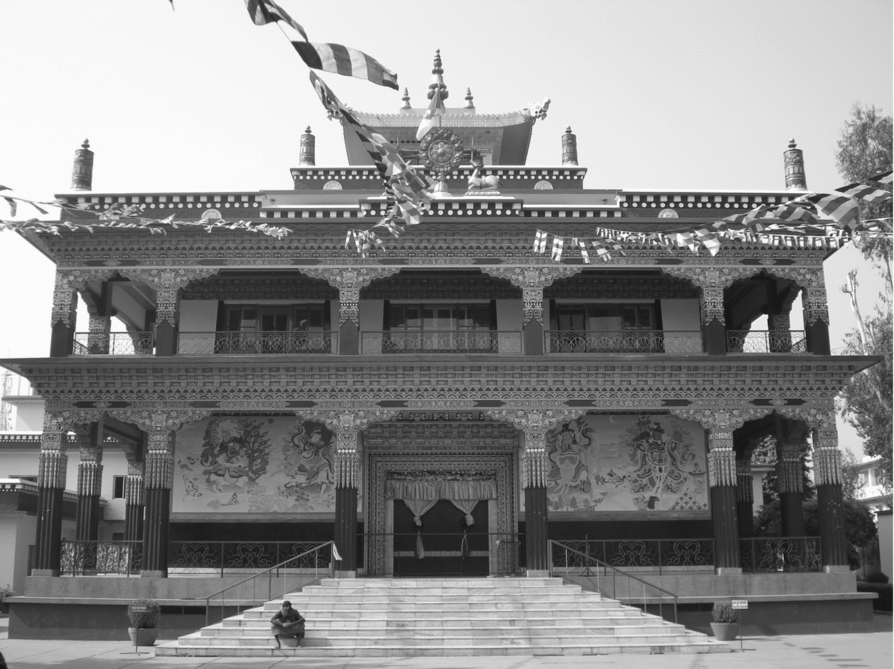
The Karma Tharjay Chokhorling, Kagyupa Vajrayana Buddhist Monastery (‘Karma Temple’). Source: David Geary.
One of the latest Tibetan gompas and temples to be inaugurated at Bodh Gaya is the Pal Tergar Rigzin Khacho Dargye Ling (Yongey Tergar Monastery), which was established in 2007 and is known locally as the ‘Karmapa Temple’. As an example of the ‘global mandala’ and the transnational transformation of Tibetan Buddhism today, the unveiling of the elaborately designed monastery was held on 3 January 2007 and was followed by a ten-day teaching programme that was entirely sponsored by the Taiwan Hwayue Foundation.Footnote 66 Similarly to Boudhanath in Nepal, East Asian patrons are now some of the largest contributors to the Tibetan ritual performances and many of the new Tibetan monasteries in Bodh Gaya are built by lamas with funds from sponsors in Taiwan, Singapore, and Hong Kong.Footnote 67 Although the head of the Tergar Monastery is Mingyur Rinpoche, the monastery is also the seat of the 17th Karmapa Urgyen Trinley Dorje, who resides in private quarters above the main shrine during his teaching programme in Bodh Gaya. Together, they are tied to Tergar International and Tergar Asia, which is a large religious transnational organization that supports dharma groups and social development projects in Bodh Gaya and around the world. In recent years, Urgyen Trinley Dorje has become an integral part of the winter pilgrimage season, attracting the largest number of devotees after the Dalai Lama and reinforcing his sacred ties with the Kagyu school and Tibetan Buddhism, more broadly.
As Huber has shown, the proliferation of monasteries and ritual events at the Buddhist holy sites both reinforce the fragmented and dispersed Tibetan exile world, and also provide a vital cultural resource for the establishment of some religious unity among the diverse and scattered Tibetan Buddhist community.Footnote 68 The ecumenical spirit of these large-scale public rituals are certainly tied to the charismatic leadership of the Dalai Lama and other members of the high-ranking religio-political elite who have strategically appropriated the navel of the earth and other Buddhist sites throughout India for the fostering of good relations among the major Tibetan schools. As ‘intensive occasions’ for a whole host of social relations, these huge rituals provide a crucial arena for the ‘negotiation of Tibetan “national” identity in exile’ but also the elevation of their displaced refugee status within an increasingly globalized arena.Footnote 69 For many Tibetans, the state of exile has been the harbinger of new possibilities, but also a position of deep cultural constraint.Footnote 70 In India and around the world, Buddhism has become the dominant marker of Tibetan identity and their economic survival as refugees is hinged on their conformity to a notion of preserved and authentic Tibetan culture that almost always signifies Buddhism.Footnote 71 This, of course, has much to do with the current Dalai Lama who has become the global saint of Tibetan Buddhism and a moral guide for many followers around the world.
East Asia
One of the oldest Buddhist centres in Bodh Gaya is the Mahabodhi Chinese Monastery and Temple built in 1935 [1945].Footnote 72 The earliest remnants of the Chinese Temple have been linked to Si-Tingchen (or S.T. Chen), a Chinese Buddhist savant, and it was allegedly built on a plot of land donated by the Birla family. Although it is difficult to trace any information on the Chinese temple during this early period, what is certain is that Chinese Professor Tan Yun-Shan (1898–1983), a close friend of the poet Rabindranath Tagore, played an important role in its establishment. After meeting Rabindranath Tagore in Malaysia in 1927, Tan Yun-Shan left for India and embarked on a lifelong journey to rebuild Sino-Indian cultural relations. Throughout his life, he maintained close ties with the Santiniketan School under Tagore and Jinaratana Mahathera from the Maha Bodhi Society in Calcutta. It was these connections with the Maha Bodhi Society that led Tan Yun-Shan to Bodh Gaya in 1931. With his deep-rooted interest in Buddhism, after this initial visit, he played an instrumental role in fundraising for the Chinese Buddhist Temple and remained active in the wider Buddhist revival movement throughout the country.Footnote 73
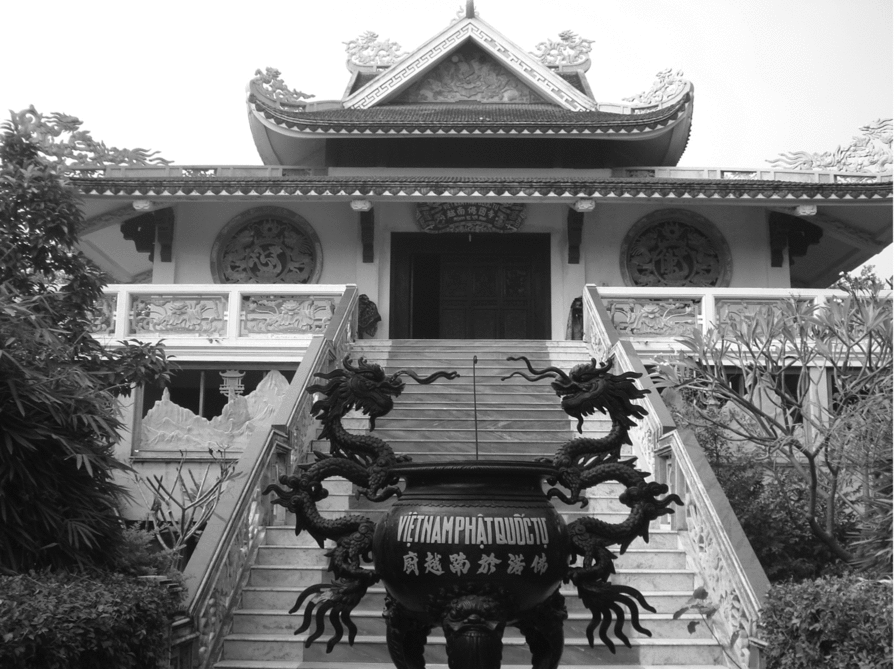
An extension of Chinese Mahayana Buddhism in Bodh Gaya is the growing number of Vietnamese, Korean, and Japanese institutions. Two kilometres west of the Mahabodhi Temple in Bhagalpur village is the Viet Nam Phat Quoc Tu under head abbot, Thay Huyen Dieu or Dr Lam Trun Tu. Established in 1987, this was the first Vietnamese temple to be built in Bodh Gaya. Together with his responsibility for a surrogate temple at the birthplace of the Buddha in Lumbini, Nepal, Dr Lam has played an active role in the revival of international Buddhism in both countries. Today, the Vietnamese temple is surrounded by a large, forested campus that includes a three-storey rest house and a beautifully decorated, multi-tiered pagoda. Following the example set by Dr Lam, a number of Vietnamese monasteries have also been built (or are under construction), such as the Vien Giac Institute, which belongs to the Lin Tzi Zen tradition but practises Pure Land Buddhism; the Linh Son Monastery, which is affiliated with the International Linh-Son Buddhist Association headquartered in Joinville-le-pont, near Paris in France; the Jona Data Temple and School, which is part of the Chua do Sanh Trust; the Tinh Xa Ky Vien, or Indian-Vietnamese Buddhist Trust; and the Vietnamese Mahaprajapati Nunnery near Katorwa village.
The Viet Nam Phat Quoc Tu. Source: David Geary.
Beginning in the early 1990s, the Korean influence on Bodh Gaya's pilgrimage landscape has also grown significantly. Situated on a plot of land adjacent to the Nyingma Institute is the Hankuk Buddhist Society, popularly known as the Korean Temple, which was established in 1991. Both the president of the organization, Dr Hyun Ki Hong, and the general secretary, Dr Kim Kwang Tae, maintain close ties with the Korean National Centre of the Maha Bodhi Society. Another Korean organization that continues to have a social impact on the surrounding landscape of Bodh Gaya is the Join Together Society. Established in 1993, this international organization has its headquarters in Seoul and a growing number of field programme offices in India, the Philippines, Afghanistan, and North Korea as well as overseas chapters in the United States and Germany. According to their websiteFootnote 74, the Society grew out of an encounter with Dalit children in Bodh Gaya who were begging on the streets. After realizing the children had no school to go to, the Join Together Society decided to build a full school complex at the foothills of Pragbodhi Hill in nearby Dungheswari. From this school complex, the Sujata Academy provides education for upwards of 700 students, mostly from Scheduled Castes and Scheduled Tribes, and also provides an additional 17 preschools which have been built in the surrounding villages.
Like many Asian Buddhist organizations in Bodh Gaya today, a number of Japanese Buddhist sects have long maintained close ties with the Maha Bodhi Society and its modern demands for the revival of Buddhism at the navel of the earth.Footnote 75 According to Kemper, since the formal establishment of the Maha Bodhi Society in 1891, many Japanese laypeople have supported Dharmapala's revivalist agenda and considerable amounts of Japanese money and power has flowed into the hands of Sinhala monks.Footnote 76 Not only were the Japanese willing to buy the Mahabodhi Temple to support Dharmapala's early reclamation efforts, but Japanese involvement with the Maha Bodhi Society can be observed in many Sri Lankan monasteries in India, such as the Mulagandhakuti vihara in Sarnath, which has beautifully painted walls depicting the life of the Buddha by Japanese artist Kosetsu Nosu.Footnote 77
In the post-independence era, the first royal Japanese guests to visit Bodh Gaya were Crown Prince Akihito and Crown Princess Michiko, who arrived by charter plane at Gaya airport on 5 December 1960. This event marked the first time in history that an heir-apparent to the throne of Japan had visited the seat of enlightenment. According to Ahir's account, this historic day saw one of the largest receptions ever given to a foreign dignitary in Bodh Gaya, with upwards of 50,000 people in attendance.Footnote 78 Not surprisingly, one of the main coordinators of the event was the Maha Bodhi Society, who formally welcomed the royal couple to the sacred site. In response to their warm reception, the Crown Prince delivered this speech:
Dear Friends,
It has been our long-cherished desire to visit India, especially this holy place of Lord Buddha. The spiritual and cultural tie which was created between India and Japan some 17 centuries ago through the Teachings of Lord Buddha is so deeply rooted and has been maintained up to this day when its revaluation is being ushered in under much changed modern situations, internal and as well as international.
My friends! When I stand here on the very spot where Lord Buddha attained His Supreme enlightenment two thousand and five hundred years ago, my heart is filled with pious respect, and those centuries seem to roll away like the mist. Lord Buddha is still alive in your hearts, and also in the hearts of tens of millions of Japanese. That is the solid spiritual foundation on which the most cordial co-operation between India and Japan might be built and strengthened. For this occasion we thank you most warmly, and wish your Society every success.Footnote 79
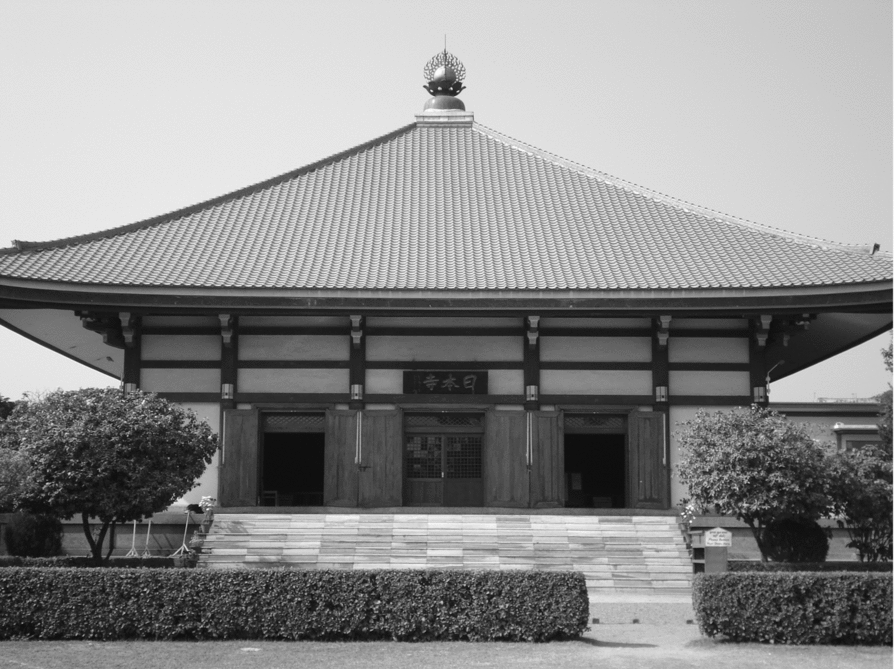
In light of the growing Japanese interest at Bodh Gaya, the Temple Advisory Board and government of Bihar leased a 4.6 acre plot of land to the International Buddhist Brotherhood Association or Kokusai Bukkyo Koryu Kyokai, an independent organization founded by different Buddhist sects in Japan. Under the direction of the chief priest, the Reverend G. Tomatsu, the Japanese have since built a traditional Japanese-style wooden pagoda modelled after a Buddhist temple in Kyoto, a luxurious pilgrim rest house with air-conditioned rooms and ofuro (hot baths), a library, and meditation centre. The formal inauguration of the Indosan Nippon Japanese Temple took place on 8 December 1973—a date that coincides with the Japanese anniversary of Sakyamuni Buddha's enlightenment—and since that time, the International Buddhist Brotherhood Association has played a leading role in supporting Buddhist cultural events and establishing various philanthropic projects that continue today. These include the annual International Buddhist Conference, which commenced in 1975, a nursery and kindergarten, a medical dispensary, and an agricultural technology research centre. In addition to these social and cultural activities, the International Buddhist Brotherhood Association, along with other Japanese development institutions, such as the Overseas Economic Cooperation Fund and the Japanese Bank for International Cooperation, have been providing financial assistance to the state government for town infrastructure and development, especially along the ‘Buddhist circuit’.
The Indosan Nippon Japanese Temple. Source: David Geary.
Despite the International Buddhist Brotherhood Association's claim to represent a number of Japan's Buddhists sects, a second Japanese centre also grew out of close transnational ties with the Maha Bodhi Society. From 1968 to 1983 Jinaratana Mahathera was the general secretary of the Maha Bodhi Society and, like many of his predecessors, he devoted his entire life to the progress of the Society, forging strong links with Buddhist communities, especially in Japan. As a ritual extension of these growing ties, the general secretary gifted a portion of the Buddha's relics to a Japanese Buddhist sect, the Daijokyo Sohonzan of Nagoya, in November 1973.Footnote 80 ‘Daijokyo’ means the ‘Great Vehicle of the Mahayana’ and was founded in 1914 by the late Reverend Tatsuko Sugiyama. It is one of the newest lay sects in Japan and follows the Lotus doctrine and teachings propagated by St Nichiren.
After receiving the Buddhist relics, members of the Daijokyo sect embarked on a pilgrimage tour through North India and Nepal in the late 1970s. During that time, the Daijokyo Association of Nagoya met with the Bodh Gaya Temple Management Committee and members of the Bihar state government to request land for the construction of a second Japanese temple and rest house. The request was eventually granted and the Daijokyo Buddhist Temple, with its three-storied pagoda, was inaugurated on 13 February 1983 in the company of the former president of India, Giani Zail Singh, and Daijokyo president, Reverend Y. Sugisaki. Like the International Buddhist Brotherhood Association before them, the Japanese organization has built a rest house for the benefit of Buddhist pilgrims and has initiated several philanthropic programmes, such as a vocational and agricultural training centre.
In addition to these social activities, today the Daijokyo Buddhist sect is famous for its contribution to one of the greatest tourist attractions in Bodh Gaya—the ‘Great Buddha Statue’. At approximately 80 feet high and nearly 60 feet wide, this image of the Buddha is the largest Buddha statue in India and towers over the rural landscape and surrounding monasteries. The unveiling of the Great Buddha Statue, which depicts the Buddha sitting in the dhyana mudra position (or meditation pose) on a lotus flower with his eyes half closed, took place on 18 November 1989 in the company of the 14th Dalai Lama. The elaborate statue was designed over five years by V. Ganapati Sthapati, one of the best-known contemporary sculptors of traditional images in India, and the execution was done by Thakur & Sons, a prominent stone-working company, who carved the entire statue out of blocks of pink chunar sandstone.Footnote 81 At the base is a solid concrete pedestal and inside is a hollow spiral staircase from the ground floor to the chest of the statue. Wooden shelves have also been built in the interior walls, wherein 16,300 small bronze Buddha images from Japan have been enshrined.
Evident in the description of Buddhist growth at Bodh Gaya thus far is the extent to which the rebuilding of the navel of the earth is highly gendered and most of the caretakers of the various monasteries are men. However, linked to the transnational transformation of Buddhism in Bodh Gaya was the first international gathering of Buddhist nuns, held in February 1987. Like the Great Buddha Statue, this historic event was also inaugurated by the 14th Dalai Lama, and brought together nuns, monks, and lay members from over 26 countries. This special occasion was also the first time in approximately 800 years that a Bhikshuni sangha (a community of fully ordained nuns) in India performed the Bhikshuni posadha, the nuns’ bi-monthly purification and restoration of vows.Footnote 82 Although a lineage of fully ordained women had been kept alive in China, Taiwan, Korea, and Vietnam, this was the first time, after many centuries, that a Bhikshuni posadha had been done in the land in which the Buddha's teachings originated. This movement to establish full ordination for nuns was spearheaded by several women from both the Mahayana and Theravada Buddhist lineages such the American Karma Lekshe Tsomo (originally Patricia Zenn); the late German-born Jewish American dasa sil mata, Aya Khema, founder of a meditation centre at Parrappaduwa, Sri Lanka; Sylvia Wetzel and Jampa Tsedroen (both from Germany); Bhikkhuni Kusuma (formerly Dr Kusuma Devendra from Sri Lanka); and Bhikkhuni Dhammananda (formerly Dr Chatsumarn Kabilsingh from Thailand).Footnote 83
In addition to reviving the Bhikshuni sangha, the special occasion was also the founding meeting of Sakyadhita, which means ‘Daughters of the Buddha’, a worldwide Buddhist women's organization. The Sakyadhita network was established at the end of the conference with the specific aim of addressing gender inequality in Buddhist societies and Buddhist institutions more broadly. Since 1987, the Sakyadhita network—through its bi-annual conferences—has played a key role in creating solidarity among Buddhist women worldwide and has worked to initiate ecumenical and interfaith exchanges across various cultural and educational backgrounds.Footnote 84 One of the initial goals for Sakyadhita was to create opportunities for the full ordination of all Buddhist nuns and to (re)establish the Bhikshuni lineage in Buddhist traditions where it no longer exists. It was for these reasons that the Bodh Gaya International Full Ordination was held in February 1998.
Like the first international gathering of Buddhist nuns, this event brought together over 1,500 participants, including 1,200 Taiwanese pilgrims and 134 nun candidates from over 22 countries. There were translators for English, Hindi, Nepali, Tibetan, and Sinhala, and a series of ordinations took place over nine days. Leading the large-scale Bhikshuni ordination was Master Xingyun from the popular Fo Guang Shan Buddhist order in Taiwan. This Chinese Buddhist monastic order is based in Taiwan and represents a melding of Cha'n and Pure Land traditions and has branches throughout the world. Fo Guang Shan (literal translation: ‘Buddha's Light Mountain’) was founded in 1967 by Master Xingyun, a refugee from the Chinese mainland, and seeks to promote a humanistic approach to Buddhism of which gender equality is an important feature.Footnote 85 Following the meeting, the Taiwanese order also acquired land in Bodh Gaya and has plans to build a Fo Guang Shan Institute of Buddhist Studies and a home for children run by Buddhist nuns. In addition to the Fo Guang Shan Institute, there is a monastery built by the World Chon Ghwa Buddhist Sangha of Taiwan. The Sakyadhita network also has plans to construct a centre that commemorates Emperor Asoka's daughter, Sanghamitra, who transmitted the Bhiksuni lineage from India to Sri Lanka.
South Asia
In line with what H.L. Seneviratne has termed the Sinhala-Buddhist or ‘Mahavamsa-view’ of history, there is a wide belief that Sri Lanka is the stronghold of Buddhist civilization and it is the mission of Sinhalese people to preserve and protect the dharma both in Sri Lanka and around the world.Footnote 86 As evidenced by the earlier missionary connections between the island kingdom and the Mauryan court, there is a long history of mutual religious influence between India and Sri Lanka. However, it was not until the arrival of Theosophist-inspired Anagarika Dharmapala that these symbolic ties received a modern inflection with the establishment of the Maha Bodhi Society on 31 May 1891. Undoubtedly, as I have shown in the previous sections, Dharmapala's activity outside of Sri Lanka as a dharmaduta (‘messanger of Dharma’) set the course for modern Buddhist missionary work and the Maha Bodhi Society can be described as the first transnational Buddhist organization.Footnote 87 With its ecumenical orientation and modern organizational forms, the Maha Bodhi Society has always appealed to pan-Asian Buddhist sentiment and was founded on a moral imperative to revive Buddhism in India and restore the ancient pilgrimage sites, especially the Mahabodhi Temple at Bodh Gaya. Under its charismatic leader, the organization has founded numerous branches overseas and has been at the forefront of pilgrimage activities at Bodh Gaya throughout the twentieth century.
Although the main headquarters for the Maha Bodhi Society was located in College Square in Calcutta, after ten years of perseverance, land was eventually acquired in Bodh Gaya from the Gaya District Board in 1901. Like other Maha Bodhi Society establishments, the Buddha Gaya Centre serves as a receiving institution for Sinhalese monks who aim to educate Indian people about its Buddhist history, maintain Bhikkhus at major pilgrimage sites, and provide accommodation and support for lay pilgrims abroad. As a leftover from the British colonial era, the architecture still retains a British colonial aesthetic dating from the turn of the twentieth century, with its covered verandah and arched entrance ways. Given the building's close proximity to the Mahabodhi Temple and the main bus loop, one could also argue that the Buddha Gaya Centre provides a dual function as both a watchtower for the navel of the earth and a magnet for international visitors providing information to tourists and pilgrims.
Although there has been plenty of scholarship on the founder of the Maha Bodhi Society, Anagarika Dharmapala, little has been written on the Sinhalese monks at Bodh Gaya who followed in his footsteps.Footnote 88 As the personal assistant and chief disciple of Dharmapala, Devapriya Valisinha (1904–1968) played a major role in advancing the Buddhist revivalist movement in India. As a young boy, Devapriya had been inspired by the missionary activities of Dharmapala and moved to India to undertake studies at the Presidency College in Calcutta. Incidentally, he was also the first Sri Lankan to be enrolled at Rabindranath Tagore's Shantiniketan School. Following the death of Anagarika Dharmapala in 1933, Devapriya Valisinha was elected general secretary of the Maha Bodhi Society, a post he held for 35 years until his death in 1968. One of Devapriya Valisinha's foremost contributions was his leadership in resolving the Bodh Gaya Temple dispute, which resulted in the Bodh Gaya Temple Act in 1949. Under this new legislation, he also served on the first Board of Management for the Temple and was instrumental in both the establishment of the Bodh Gaya Temple Advisory Board and the international success of the 2,500th Buddha Jayanti celebrations. It is also worth noting that Valisinha also maintained close ties with B.R. Ambedkar and was present, along with the Burmese monk U Chandramani, for his historic conversion to Buddhism in Nagpur in 1956.
Another important Sinhalese figure in the development of Buddhism at Bodh Gaya was the soft-spoken and benevolent monk known as Bhante Pannarama (1926–1995). With the help of his assistant, Dediyawala Wimala Thero, Bhante first visited Bodh Gaya in 1968 and took over the Buddha Gaya Centre from 1970 to 1994. Over the course of his management, Pannarama helped to promote the Maha Bodhi Society as a centre of learning and culture through the propagation of Buddhist activities, seminars, symposiums, and literature. During this time, he worked closely with the local population and encouraged numerous philanthropic projects, especially among the large numbers of Scheduled Castes and Scheduled Tribes in the area. Today many local residents still recall his warm presence in the surrounding villages where he would regularly attend family functions, weddings, and provide support to those in need, especially the poor.
Reflecting on his early years in Bodh Gaya, Pannarama was also surprised that not a single Indian could recite the three refuges and five precepts:
More than two decades have passed since I had come to this place in 1970. That time only with a sense of veneration to this holiest Buddhist spot I started living here, worrying very little about other things. In course of time I felt that besides chanting Sutras, bowing to the Bo-tree, etc. individual religious routine [sic] something must be done for Buddhist reawakening in the surrounding area. Ven. Dharmapala's vow reminded me that the place of which every inch seems to have been sanctified by the Lord Buddha's feet, must have Buddhistic air in and around.Footnote 89
Inspired by Dharmapala's vow, for nearly 25 years Pannarama and his assistant worked tirelessly to make the basic tenets of Buddhism intelligible to many Hindu and Muslim residents in Bodh Gaya. As a result of these efforts, for the first time in the history of modern Bodh Gaya, three local youths, R.B. Prasad, Ram Swarup Singh (past Bodh Gaya Management Committee member), and Hari Manji (now a senior officer at the Archaeological Survey of India) were initiated into Buddhism by taking the five precepts on the memorable occasion of Buddha purnima day in 1971.Footnote 90 This was followed by several other Buddhist ‘conversions’ from 1972 onwards, including an entire village of Dalits in what is known today as Siddhartha Nagar.
In line with the missionary and philanthropic aims of the Maha Bodhi Society were the visits of Sri Lankan president Ranasinghe Premadasa (1924–1993). Although Sri Lanka was in the throes of civil war, the president made several trips to Bodh Gaya and other Buddhist pilgrimage sites in India between 1992 and 1993. On each of these occasions, his pilgrimage to the seat of enlightenment led to significant religious and social developments that can still be observed today. These include two invaluable offerings: the golden railings (ran veta) that surround the Bodhi tree and the gold plated canopy (ran viyana) that now rests above the vajrasana or diamond throne. In light of the warm public reception he received at Bodh Gaya, the president of Sri Lanka also initiated plans for the construction of 100 brick-concrete houses and a community hall for Dalit families living in nearby Mastipur village. After four months of work, commissioned by the Ministry of Housing and Construction in Sri Lanka, the president himself arrived in Bodh Gaya on 13 April 1992 and handed over the keys to each of the villagers. Inscribed on the foundation stone in front of the community hall is a plaque that reads: ‘BuddhaGayagama—the village of Reawakened People’ in Sinhalese, Hindi, and English.Footnote 91
Around the same time as President Premadasa's pilgrimage to Bodh Gaya, the health of Pannarama had begun to deteriorate and in 1994 he departed to Sri Lanka for six weeks of medical treatment. In recognition of his 25 years of service at Bodh Gaya, a group of local residents held a public felicitation ceremony on 15 May 1994, where he was given a ‘scroll of honour’. The function brought together a large number of Bodh Gaya's residents, university scholars, and international monks who came forward to thank and register their reverence for Bhante Pannarama. As noted in the ‘news section’ of the Sambodhi journal: ‘The one common point which emerged from the speeches was that nobility and simplicity reigns supreme in Bhante's personality. He is the best propagator of harmony, peace and goodwill.’Footnote 92 Pannarama's reply in his laconic speech, echoed the words of Dharmapala before him: ‘Though I was born in Sri Lanka, BuddhaGaya is the dearest to me, I will love to be reborn here if I get rebirth.’ A year after his departure from Bodh Gaya, Pannarama died in Colombo on 18 May 1995.
One of the main reasons why I have drawn attention to Bhante Pannarama of the Maha Bodhi Society is that, to a large extent, the various international Buddhist groups in Bodh Gaya have had little ‘success’ in actually converting anyone to Buddhism (note that, for many, this is not a goal). As Dhammika points out, the overwhelming majority of Indians who have become Buddhist are in fact ‘self-converted’ and follow the teachings and example of Dr Bhimrao Ambedkar.Footnote 93 However, there are a number of Indian Buddhist groups with Theravada roots that have played an active role in Bodh Gaya following the post-independence period. In the same year that major renovations were made to the Royal Wat Thai, the head Bhikkhu, Phra Debvisuddhimoli, also helped to establish a central Indian monastic organization at Bodh Gaya with the support of Jagadish Kashyap (1908–1976). Born in Ranchi, he was ordained in Ceylon in 1933.Footnote 94 As a reputed Buddhist scholar, he was instrumental in transcribing the complete Tipitaka into the Devanagari (standard Hindi) script and was also founding director of the Nava Nalanda Mahavihara Institute in 1951.
With the support of the Royal Wat Thai, Jagdish Kashyap and other influential Indian monks established the All Indian Bhikkhu Sangha in July 1972. Although its main headquarters were situated at the Royal Wat Thai for several years, by the late 1970s members of the Sangha had acquired land from the state government to construct their own monastic centre. However, due to the paucity of funds, it was not until 2003 that the main infrastructure was complete, including several commemorative buildings in honour of prominent Indian Buddhists, such as the Ananda Mitra Guest House, the Ananda Kausalayan Bhikkhu Training Institute, the Bhikkhu Jagadish Kashyap Library, and the Rahul Sankrityayan Seminar Hall. More recently, as a symbol of the long-standing Thai-Indian connections, a large ‘Walking and Blessing Statue’ of the Buddha was gifted by Thai Buddhist donors under chief monk Somdej Phramaharatchamangkhlachan, the lord abbot of Wat Paknam, Bangkok, Thailand on 6 March 2006.
It is also important to highlight that when the All Indian Bhikkhu Sangha was first established in the 1970s, most of its members derived from the ethno-Buddhist background of the Barua and Chakma Buddhists of Bengal and Assam.Footnote 95 This is no longer the case today. Within the last few decades, branches of the All Indian Bhikkhu Sangha were established throughout the country and the membership demographic now reflects the growing presence of Dalit Maharashtran Buddhists or neo-Buddhists from the Ambedkar tradition. According to Singh, Ambedkar used the prefix ‘neo’ for two important reasons: ‘they were new converts to the religion, and the religion they embraced was in fact a new interpretation of Buddhism, one with a strong element of social and political protest’.Footnote 96 This element of social and political protest was certainly evident throughout the 1990s with the campaign to ‘liberate’ the Mahabodhi Temple from Hindu control. These demands for ‘complete control’ of the Mahabodhi Temple first took concrete shape on 20 April 1992 when the All India Bhikku Sangha passed a resolution at its session in Bodh Gaya demanding transfer of the management and control of the Mahabodhi Temple to an ‘All Member Buddhist Committee’.Footnote 97 This resolution was followed by a mass demonstration during the Buddha Jayanti celebrations on 16 May 1992 when over 800 Indian Buddhists (other sources say the number was only between 150 and 200) stationed themselves in front of the controversial panchpandav mandir adjacent to the Mahabodhi Temple and even assaulted the Brahmin priest on duty.Footnote 98 Following this altercation, the Dalit Buddhists were ordered to leave town by the local police, but before their departure they circulated a memorandum outlining their grievances and vowed to return in larger numbers.
The 1992 Buddha Jayanti demonstration was the first of a series of agitations that were held in Bodh Gaya under the banner of ‘Buddha Gaya Mahabodhi Mahavihar All India Action Committee’ (henceforth the Mahabodhi Action Committee). All of these protests have drawn upon a discourse that concerns the ‘“liberation of the Mahabodhi Temple” from Hindu and, to a lesser extent, “elite” foreign and Indian Buddhist influence and a desire to amend the 1949 Act and place the Temple in the hands of an All-Indian Buddhist Committee’.Footnote 99 As Doyle and Guha-Thakurta have examined in detail, this movement was nearly parallel to the Hindu nationalist programme, which culminated in the razing of the Babri Masjid Mosque in 1992.Footnote 100 According to Doyle, similarly to Ayodhya, the Mahabodhi Temple served as a ‘powerful symbol for regaining Dalit Buddhists’ rightful religious and cultural patrimony, forging a sense of group identity, and establishing their socio-political rights all of which they assert have been stolen from them by upper-caste Hindus’.Footnote 101 Yet, despite these authoritative claims in the name of Indian Buddhism, one of the main leaders of the agitation was a Japanese monk with a Nichiren background (and naturalized Indian citizen) known as Bhadant Nagarjuna Arya Surai Sasai.Footnote 102
Under the leadership of Surai Sasai, the agitation grew in size and became more aggressive and militant with each passing year. For example, coinciding with the Buddha Jayanti in 1992, Surai Sasai organized a Dhamma Mukti Yatra (‘Buddhist Liberation Process’), modelled on the highly politicized Rath Yatra undertaken by Bharatiya Janata Party leader, L.K. Advani, in 1990. As a means of mobilizing popular support for the Hindu nationalist party, L.K. Advani had driven a symbolic Bharatiya Janata Party chariot which traversed the northern part of India with the penultimate goal of ‘liberating the Birth place of Lord Rama’ in Ayodhya. Although the Dhamma Mukti Yatra was not nearly as controversial as the Bharatiya Janata Party political campaign, it certainly helped to raise public awareness for the Dalit Buddhist movement. Another significant turning point was the indefinite dharna or fast-until-death, which was held in April 1995 and persuaded the chief minister of Bihar to make some changes in the composition of the Temple Management Committee, designating three out of the four Buddhist positions to leaders of the movement: Surai Sasai, Bhante Anand (a Yadav monk from Agra), and Professor P.C. Roy (a local Buddhist convert and Magadh University scholar).Footnote 103
Although these changes in the management structure afforded new opportunities to members of the Mahahbodhi Action Committee, they also vowed to continue their campaign until they accomplished their goal of changing the 1949 Bodh Gaya Temple Act. During this time, a number of high-level meetings were held in Delhi between Surai Sasai and other leaders of the Buddhist liberation movement with the National Minorities commissioner and the prime minister, P.V. Narasimha Rao. The National Minorities commissioner suggested an amendment to the controversial Act—that the Dalit Buddhist community be granted full rights; however, this recommendation was never implemented. Nevertheless, the chief minister of Bihar, Lalu Prasad Yadav, did initiate some changes to the Bodh Gaya Temple Management Committee, including the removal of long-time ‘Hindu’ General Secretary Dwarko Sundrani and appointing Bhante Prajnasheel, a close associate of Surai Sansai, as secretary. With the Ambedkarite Buddhist leaders now in a secure position of power and influence on the management committee, they were largely in control of overseeing the daily affairs of the temple.
Protest by the Ambedkar Buddhists on Buddha purnima day 2006—next to the Great Buddha Statue. Source: David Geary.
It is important to highlight that during their three-year stint on the Temple Management Committee, there was considerable tension between the Ambedkarites, international Buddhist groups, and the local business community in Bodh Gaya. As Doyle explains, by and large the residents of Bodh Gaya and several local foreign Buddhist institutions wanted nothing to do with the Ambedkarite movement, fearing that ‘“another Ayodhya-type” situation would keep pilgrims away, disrupt business, and make a mess of their community’.Footnote 104 Instead of giving voice to anti-Hindu rhetoric, most of the foreign Buddhists distanced themselves from the campaign, regarding the recent upheaval as an ‘internal domestic problem of the Indian state’.Footnote 105 It is for these reasons that their hold on the Mahabodhi Temple in Bodh Gaya was short lived, and both Bhante Prajnasheel and Bhante Anand were removed from the Management Committee in 2001. During this heightened period of contestation there was considerable fragmentation among Indian Buddhists groups themselves, including the splintering of the All India Bhikkhu Sangha into a separate All India Bhikkhu Maha Sangha that now represents the more militant wing of the Mahabodhi Action Committee. What is also important to highlight in this recent sequence of events is that part of the reason why the Ambedkarites have not had a lasting influence in Bodh Gaya, I would argue, is because of the international character of the site's development which I have described in this paper.Footnote 106 Unlike the prominent place of New Buddhism in Ambedkar's state of Maharashtra, the international growth of monasteries at Bodh Gaya has been a key factor in the marginalization of the Ambedkar Buddhists and their authoritative demands over sacred space. Although the New Buddhists continue their agitation, usually on the Buddha purnima day each year, these demonstrations have become relatively muted and are just one of many public ritual performances tied to the annual cycle in Bodh Gaya today.
It is also clear that the aggressive stance of the Ambedkar Buddhists from Maharashtra do not represent the wider Indian Buddhist expansion that is currently underway at the navel of the earth. In addition to the All India Bhikkhu Sangha, there are a growing number of South Asian Buddhist centres being built in Bodh Gaya today. These include the Bangladesh Buddhist Monastery, the Vajra Bodhi Society, the Dharmouday Buddha Vihara, the Chakma Buddhist Temple, the Chandramani Buddha Vihar and Dhamma Chakra Mission, the Ananda Vihara-Sanga Nayaka Ananda Mitra Memorial and Cultural Centre, the Tai-Bodhi Kham, the Khuva Boonchum Buddhagaya Tai Temple, the Buddhagaya Banavihara and Meditation Centre, the Bodhidruma-International Buddhist Sangha Trust, Bodhi Raja, and the Sukkhita Bhumi Buddha Vihara-Bihar Buddhist Society. However, unlike the international monasteries at Bodh Gaya, which have financial support from a pious and wealthy transnational network of devotees, by and large, the Indian Buddhist groups remain significantly impoverished in comparison, and there continues to be some ambivalence towards the Ambedkar Buddhists and their social and politically motivated cause. The future role of Indian Buddhism at Bodh Gaya is also being usurped by the growing economic benefits of heritage and tourism development for the state government. Since its designation as a UNESCO World Heritage site, Indian Buddhists at Bodh Gaya are certainly outnumbered by the growing crowds of domestic tourists who now frequent the land of enlightenment to see the Great Buddha Statue and tour the colourful global landscape of foreign temples and monasteries.
Conclusion
Pasts become meaningful and usable only when they are activated by the contemporary desires of individuals and communities, and, most powerfully, by the will of the nations.Footnote 107
India was the home of the Buddha though in a sense his message embraced the whole world. We do not wish to deny the others their share but why must we not claim our own especially when he was one of the greatest sons of India?Footnote 108
Buddhism in the twentieth and early twenty-first century has once again taken root in its land of origin through the active resacralization of space. Within the last 60 years, there has been an exponential growth in Buddhist pilgrimage activities that have recentred the sacred topography of Buddhism and activated the collective memory of Bodh Gaya as the navel of the earth. In this paper, I have examined the ways in which institutional practices associated with pilgrimage have shaped Bodh Gaya as an international destination and space of global connection. Similarly to Werbner's analysis of recent Pakistani migrants to Britain, I have looked at the ways in which Buddhist groups make space sacred, and root their identities in new localities and diasporic centres.Footnote 109 Through monastic building, commemorative events, and ritual performances, these rites bridge the historical and narrative forms of social memory with embodied forms of religious practice that inscribe space with sanctity and physically affirm their claim to the new locality.Footnote 110 As devotional vectors that absorb and organize pilgrimage activities for the religious diaspora, the spatial appropriation of land by monasteries is perhaps the most visible symbol of the transnational transformation of Bodh Gaya. Through their monastic architecture, these monumental structures provide the ‘bulwark’ of ‘religious and cultural traditions’ that seek to represent both national-cultural essences and contemporary claims of authenticity.Footnote 111
Ever since the Buddha Jayanti celebrations in 1956, the Indian state and the government of Bihar have been instrumental in encouraging these monastic developments at the place of Buddha's enlightenment. As I have shown, many of these monasteries were established on the basis of foreign government sponsorship in order to serve the laity and cater to visitors at a time when there was little in the way of facilities for those undertaking pilgrimages to Bodh Gaya. Initially, the growth and expansion of transnational networks from the religious diaspora came to reflect the aspirations of Prime Minister Jawaharlal Nehru who viewed India's Buddhist heritage as a critical site for the ideological production of the nation-state and central to constructing and legitimizing its leading role as a cultural power in the region. With the support of the state government and an international advisory board spearheaded by the Maha Bodhi Society, they helped to create a living taxonomy of national Buddhisms as originally envisioned by Dharmapala. Although the number of Tibetan refugees and Himalayan Buddhists on pilgrimage to Bodh Gaya grew substantially after the 1959 Chinese occupation of Tibet, to a large extent the pattern of Buddhist development following independence continued to reflect the larger geography of the British empire and the prominent ties with Theravada countries such as Sri Lanka, Burma, and Thailand. However, by the late 1970s and 1980s, Theravada influence at Bodh Gaya was eclipsed by the growing institutional presence of Mahayana Buddhism and the expanding Vajrayana networks within the Tibetan refugee community.
In light of the proliferation of monastic institutions, the Bodh Gaya Temple Advisory Board met on 4 April 1986 and decided that all Buddhist countries should be directed to maintain a representative ‘national’ character and that land should not be allotted indiscriminately.Footnote 112 However, as I have shown in this historical and descriptive account of the different regional expressions of Buddhism, from the late 1980s onwards, national articulations of Buddhism provided a difficult receptacle for the complex transnational networks of the religious diaspora. This was partly due to the breakdown in the state government's land allocation policy, which had leased land to Buddhist groups as part of the Notified Area, but was also indicative of the extra-national reach of Buddhism and the popular appeal of charismatic leaders who now live their lives across borders. With modern transportation and the rapid growth of monasteries in recent decades, to some extent this has inspired a race for representation among various Buddhist leaders and sects who compete for recognition by building ever more elaborate and opulent temples and images. At the same time it is important to emphasize that there is also considerable support and cooperation between the Buddhist monasteries (as evidenced by the establishment of a Bodh Gaya Temple Advisory Board) and, more importantly, an International Buddhist Council that aims to look after the collective needs of the growing Buddhist community.
An important issue that is often raised in relation to diasporic religious communities is that of their political loyalty to the nation-state and the extent to which these transnational linkages influence crucial economic and political issues. Like other religions, Buddhist pilgrims at the navel of the earth lay claim to ultimate meaning and these aspirations to the sacred traverse nation-states and appeal to the universality of place. In my analysis of the different Buddhist institutions in Bodh Gaya it is clear that there are limitations with regard to state government policies that seek to regulate Buddhist practice in Bodh Gaya. Although some of monastic institutions continue to fall under the supervision of national governments, it is also clear that monks and nuns have different axes of affiliation and are connected through a growing network of disciples and dharma centres throughout the world. Thus, as a sacred centre of universal appeal, it remains to be seen to what extent these Buddhist networks and diasporic communities will undermine national claims to patrimony at Bodh Gaya and challenge the sovereignty of the Indian state over sacred space.
As evidenced in my survey of Buddhist growth in Bodh Gaya, this is also a place of multiple Buddhism(s) where national, sectarian, and cultural-linguistic differences undercut a singular conception of the religion. Despite these inherent differences, the commitment to the symbolic and sacred primacy of place is undeniable. Through the renewal of pilgrimage activities and collective aspirations towards the sacred, Buddhism takes on the aspect of ‘world’ religion at Bodh Gaya and place identity becomes central to the reconstruction of an international Buddhist ethnoscape. What is telling about the recent Ambedkar movement to liberate the Mahabodhi Temple is that one of the main reasons why it had limited success is that it was not representative of the international construction work that had been underway throughout the twentieth century. As ‘one of the greatest sons of India’, to use Nehru's words, the Buddha is India's gift to the world. And as the Buddhist world now looks to reclaim its holy land, there is an underlying tension between Buddhist culture anchored in the national polity and the forces of globalization and religious experience that seek to transcend them.