

Popular press coverage of the sinking Salesforce tower in downtown San Francisco has drawn national attention to private developers building tall skyscrapers in earthquake-prone areas (Fuller et al., Reference Fuller, Singhvi and Williams2018). While local policy-makers cannot prevent earthquakes from striking US cities and municipalities, they nevertheless have the potential to design and advocate for policies that prevent or mitigate their harmful effects – such as the regulation of where private developers can build, requiring that new edifices be built to withstand earthquakes of certain magnitudes and pursuing efforts to inform the public about how to best prepare for major earthquakes.
Whether or not local elected officials actually feel compelled to pursue these policies, however, depends (at least in part) on whether or not the public demands that they take such action. Unfortunately, as several scholars have noted (e.g., Prater & Lindell, Reference Prater and Lindell2000; Comerio, Reference Comerio2004), public demands for policies to mitigate the harmful effects of major earthquakes are generally quite low. This is true even among those living in areas where major earthquakes are comparatively more likely.
Consequently, figuring out why Americans do not demand more from their policy-makers – and studying the conditions under which they might support preventative policies – is a critically important task. This information could be useful in designing public awareness campaigns that encourage constituents to request local policy action. For example, it could be the case that many Americans – including those living in ‘at-risk’ areas – hold inaccurate perceptions about the likelihood that they will experience a major earthquake. If true, bringing hazard perceptions in line with more objective assessments of hazard could be an effective way to encourage the public to demand more policy action.
In this paper, we merge insights from social science research and the physical sciences together to offer a theoretical perspective and empirical framework for studying the opinion dynamics of local earthquake prevention policies. In an original survey of 855 West Coast residents, we uncover a fairly strong disconnect between respondents’ actual and perceived earthquake hazard. Respondents living in some of the most ‘at-risk’ areas of the country appear to be only modestly more concerned than those who live in comparatively safer geographic areas.
Critically, and in contrast to previous research on the subject, we see that Americans’ physical environments are indeed associated with how they think about earthquake policy. However, these relationships are highly conditional. We show that Americans who accurately appraise their hazard of experiencing a major earthquake and who live in highly earthquake-prone areas are significantly more likely to support taking preventative policy action.
Our research identifies a path forward for increasing public demand for earthquake-related policies. By merging insights from research in the physical sciences into public policy research, we suggest that efforts to inform at-risk publics about their earthquake hazards could help constituents bring their perceived and actual earthquake hazards into alignment. Ultimately, this may help boost support for earthquake-related policies.
Our work also advances public opinion and policy research more generally by highlighting the conditional relationship between the physical environment and Americans’ attitudes toward natural disaster policy. Although we are not the first to study this area of contentious debate in the literature, previous work has focused on studies of geographic areas that provide little variation on actual earthquake hazard. Because our study provides substantially more variation on this score, we are able to study how perceived and actual hazard can interact to shape policy preferences. We hope that this empirical endeavor can help serve as a starting point for how to study related questions, in future research.
Perceptions versus reality: public appraisals of seismic hazard
Previous research on public opinion about natural disasters (e.g., droughts, hurricanes) has found that Americans’ physical environments play a limited and often indirect role in shaping public appraisals of hazard (i.e., the perceived likelihood that a natural disaster event will occur). For example, while personally experiencing severe drought conditions does not impact public perceptions of drought hazards, the physical environment might indirectly increase hazard appraisals by boosting the public's ability to accurately recall experiencing these events (Switzer & Vedlitz, Reference Switzer and Vedlitz2017). Similarly, while physical vulnerability to the effects of climate change is correlated with concern about it, these effects are often quite modest and may not hold up in multivariate analyses (e.g., Zahran et al., Reference Zahran, Brody, Grover and Vedlitz2006; Brody et al., Reference Brody, Zahran, Maghelal, Grover and Highfield2007; Lyons et al., Reference Lyons, Hasell and Stroud2018; although see Egan & Mullen, Reference Egan and Mullin2012, who find a stronger role for such events in shaping public opinion). As a more general matter, public hazard evaluations are often at odds with the best available objective evidence due to myriad psychological biases that impact people's evaluation of potential threats (for an extensive review, see Slovic et al., Reference Slovic, Fischhoff and Lichtenstein1980).
Public perceptions of earthquake hazard occupy an interesting and conflicted space in this literature. On the one hand, area studies conducted in at-risk cities like Portland document substantial concern about the short-term possibility of experiencing a major earthquake (Flynn et al., Reference Flynn, Slovic, Mertz and Carlisle1999). This implies at least some link between the physical environment and seismic hazard perceptions (see also Lindell & Prater, Reference Lindell and Prater2000; Lindell et al., Reference Lindell, Arlikatti and Prater2009). On the other hand, however, public awareness about earthquake hazards is quite low. While the public tends to view themselves as fairly well informed about earthquake hazards – even better informed than university researchers – many subscribe to misinformation about the physical markers of earthquake risk (e.g., that animal movement can predict earthquakes; Lindell & Whitney, Reference Lindell and Whitney2000; Whitney et al., Reference Whitney, Lindell and Nguyen2004). Moreover, while people who have recently experienced an earthquake are more likely to take personal action to prepare for them (Lindell & Prater, Reference Lindell and Prater2000) – perhaps indicative of higher perceived hazard – these correlations tend to be quite modest.
It is difficult to say for certain why previous research on seismic hazard perceptions has arrived at conflicting conclusions. As a general matter, though, we suspect that methodological artifacts could obscure the conclusions drawn from social science research in this area. Previous work on the correspondence between seismic risk perceptions and the physical environment has typically focused on a single geographic area (e.g., an earthquake-prone US city; e.g., Flynn, Reference Flynn, Slovic, Mertz and Carlisle1999; Lindell & Whitney, Reference Lindell and Whitney2000; Whitney et al., Reference Whitney, Lindell and Nguyen2004; Lindell et al., Reference Lindell, Arlikatti and Prater2009). This focus is in some way justifiable, because – as we will explore in more detail shortly – individuals in these areas have a personal incentive to demand policy action, which is primarily shaped at the local (i.e., state and municipal) level (Comerio, Reference Comerio2004). Still, this approach stands in notable contrast to the aforementioned work on public perceptions of other types of natural disasters (e.g., those related to climate change), which are typically assessed in more diverse geographic samples of the American public.
Critically, though, area studies relating to seismic hazard provide little to no variation on actual hazard. Consequently, it is difficult to evaluate whether or not hazard perceptions increase (or decrease) under conditions in which actual hazard is substantively greater (or lesser). Correspondingly, it is also difficult to assess how correspondence between the physical and natural environments might then go on to shape individuals’ policy attitudes and other behaviors; a matter we will take up shortly.
Taking this research and its methodological limitations into account, we suspect that public perceptions of seismic hazard, assessed across a diverse geographic environment, will document low levels of correspondence between perceived and actual hazard. In other words, we think that the low degrees of correspondence observed in work on climate-related disasters will likely apply to seismic hazard perceptions as well in more geographically diverse samples. Consequently, we propose Hypothesis 1:
Hypothesis 1:
The relationship between perceived likelihood of experiencing a major earthquake and people's objective hazard of experiencing such an event is substantively modest.
Evidence in favor of Hypothesis 1 could have substantial policy impact. Low levels of correspondence may help us better understand why so few Americans – including those living in ‘at-risk’ areas of the country – demand that their local policy-makers take action to protect constituents from the aftermath of major earthquakes. We describe why we think this might be the case below.
The policy relevance of seismic hazard perceptions
Public demand for policies aimed at mitigating the risks posed by major earthquakes is, in general, quite low (Prater & Lindell, Reference Prater and Lindell2000). While many agree with efforts to invest in earthquake preparedness and information dissemination programs, fewer see a need for the government to place restrictions on where and how developers might build (Flynn et al., Reference Flynn, Slovic, Mertz and Carlisle1999). Fewer still actually petition state and local government officials to take preventative policy action (Prater & Lindell, Reference Prater and Lindell2000; Comerio, Reference Comerio2004).
At first, public apathy about earthquake-related policy may seem somewhat ironic. After all, when disasters like earthquakes occur, they tend to command high levels of media attention (Gans, Reference Gans1979). Interestingly, though, low levels of public concern are perfectly consistent with previous public opinion research on natural disaster policy.
Generally speaking, voters are myopic with respect to natural disaster policy (Healey & Malhotra, Reference Healy and Malhotra2009; see also Achen & Bartels, Reference Achen and Bartels2004, Reference Achen and Bartels2017). While voters reward incumbent politicians who address the aftermath of natural disasters at the ballot box, they are less likely to provide electoral incentives to preempt those disasters. Even though preemption policies can be (quite literally) orders of magnitude more cost effective than efforts to ‘clean up’, the public more strongly rewards politicians who are responsible for the latter (Healey & Malhotra, Reference Healy and Malhotra2009).
This dynamic poses an important policy problem. If policy-makers do not fear electoral retribution for failing to take action regarding preemptive policies (see Mayhew, Reference Mayhew1974), they may avoid putting necessary and life-saving measures in place – potentially putting the public in harm's way. For example, in their widely publicized profile of earthquake-related policy in San Francisco, Fuller et al. (Reference Fuller, Singhvi and Williams2018) noted that nearly a tenth of skyscrapers in the city are vulnerable to collapse in the event of a major earthquake, with no requirement that many of the city's dwellings and office buildings be fit for occupancy after potential collapse. Although the city used to place restrictions on where builders were allowed to develop (i.e., in areas of the city less prone to earthquake-related damage), these regulations seem to have fallen by the wayside in recent decades.
We think that the mismatch between public appraisals of seismic hazard can help explain why more Americans – especially those living in vulnerable areas – do not demand more from their local policy-makers with respect to earthquake policy. Previous research has only partially explored this possibility. Perceptions of hazard are not only correlated with support for a wide range of natural disaster policies, but tend to be better predictors of policy support than actual experiences with those hazards (e.g., Zahran et al., Reference Zahran, Brody, Grover and Vedlitz2006; Shao & Groidel, Reference Shao and Goidel2016; Switzer & Vedlitz, Reference Switzer and Vedlitz2017). In other words, hazard perceptions (accurate or not) tend to be more strongly associated with policy support than the threats posed by the physical environment.
Previous work is limited, however, in the sense that few have attempted to assess how the correspondence between perceived and actual hazard shapes policy support, especially with respect to earthquake policy. This shortcoming is notable given the amount of research, as mentioned in the previous section, devoted to studying the correspondence between perceived and actual risk in and of itself. Consequently, while the field has done an excellent job of highlighting the importance of perceptions (versus reality) in shaping policy orientations, we know less about how perceptions and reality interact to influence policy orientations.
For example, it could be the case that – even though the ‘main effects’ of objective hazard on policy support are limited – people who both live in high-hazard areas and who accurately recognize their risk may be more supportive of policy action. Conversely, it could be the case that people living in high-hazard areas who do not accurately recognize their risk are less supportive of such policy action. If true, these findings would pose an important amendment to previous theorizing about the role that the physical environment plays in shaping policy orientations by a critically important moderating factor: the ability to accurately recognize one's hazard. Bearing this in mind, we propose the following hypothesis:
Hypothesis 2:
Perceived and objective earthquake hazard interact to shape policy support, such that individuals who both live in areas where major earthquakes are comparatively more common and who accurately appraise their elevated hazard are more supportive than individuals who live in these same areas but do not accurately assess their hazard.
Data and measures
To test these claims, we fielded an online survey of 7019 US adults in mid-September 2018. Data were collected via Lucid's Fulcrum Academic's large, online, opt-in panel service. Invitations to participate in the survey targeted representativeness on race, age, sex, income and region of residence. To do this, Lucid quota samples respondents from its database of about 375,000 unique daily visitors, recruited via advertisements and contact lists created by a number of different data vendors (see Coppock & McClellan, Reference Coppock and McClellan2019). To account for potential deviations between our sample and the general US population, all analyses presented in the main text are calculated with survey weights applied. Additional information about the study, recruitment procedure and weighting formula can be found in the Supplementary Materials (available online).
It is important to note that survey data from Lucid are not formally representative of the US adult population. Consequently, we caution against generalizing the raw means and distributions of key variables (e.g., the proportion of respondents who support a particular policy proposal) to the US adult population. Still, recent work suggests that – although Lucid recruits respondents on an opt-in basis – experiments run on Lucid tend to replicate well-established experimental treatment effects (Coppock & McClellan, Reference Coppock and McClellan2019). Data from Lucid are also significantly more representative of the US adult population on several demographic and political variables than more widely used convenience samples (Coppock & McClellan, Reference Coppock and McClellan2019). Consequently, we feel confident that data from Lucid are well suited for detecting covariances between variables of interest.
Although respondents came from all over the USA, we limit our focus to 855 respondents from the West Coast (i.e., California (n = 624), Oregon (n = 98) and Washington (n = 135)) and the two non- contiguous states (i.e., Hawaii (n = 22) and Alaska (n = 12)). Our purpose for doing this is threefold. In addition to (1) being the region of the country most likely to experience earthquake events (Petersen et al., Reference Petersen, Moschetti, Powers, Mueller, Haller, Frankel and Zeng2014) and (2) being the focus of most of the previously mentioned research on the topic, we note that (3) for most of the USA, variation on actual earthquake hazard is actually quite low (as most live in areas that are not earthquake prone). In contrast, the West Coast – in addition to being the region of the country where earthquake concerns are likely most salient – provides substantial variation on actual hazard (see the discussion of our objective hazard variable described below).
Local earthquake policy support
The key dependent variables in our analyses are measures of support for local policy action aimed at mitigating the harmful effects of earthquakes. Previous research suggests several different forms of policy action governments might take, including (negative) restrictions on how businesses are allowed to build and (positive) steps government can take to improve public safety. Using this framework as a guide, we asked respondents to report their agreement (on a seven-point Likert scale) with the following three policy prompts:
1. Building code requirements. Local governments should require that new buildings in earthquake-prone areas are built to resist major earthquakes, even if doing so is costly or hurts the business’ bottom line.
2. Public awareness campaigns. Local governments should invest more taxpayer dollars in programs that provide the public with information about earthquake preparedness.
3. Private development restrictions. Local governments should forbid businesses from constructing very tall buildings (like skyscrapers) in earthquake-prone sections of major US cities, even if doing so forces businesses to relocate.
Note that all three outcome variables are framed as policy tradeoffs – pitting government action against some type of costs to businesses or tax payers. We do this not only to represent the political realities of making such decisions, but to avoid the possibility of acquiescence bias (Schuman & Presser, Reference Schuman and Presser1981; Krosnick, Reference Krosnick1991), whereby survey respondents may simply ‘agree’ with the general idea that the government should do something (rather than nothing), without consideration of its potential costs.
Perceived risk
Our key independent variables in this study are perceived and actual measures of risk. We measure perceived risk by asking respondents to assess the likelihood that a “major earthquake causing catastrophic damage (e.g., loss of life, destruction of buildings)” will occur in the “place where [the respondents] live in the next 20 years.” Respondents were asked to indicate a probability on a sliding (graphic) scale ranging from 0 to 100. Although we might be concerned that the cognitive demands of a probabilistic question like this lead respondents to simply select the middle (50%) option (Tourangeau et al., Reference Tourangeau, Rips and Rasinski2000; see also Krosnick, Reference Krosnick1991), we find that few (about 3%) actually do. On average, respondents in West Coast states scored somewhat above the scale's midpoint on this measure (M = 0.62 when recoded to range from 0 to 1), with a fair amount of variability (SD = 0.28). Full question wording can be found in the Supplementary Materials.
Objective risk (peak ground acceleration)
Because it is impossible to scientifically predict the time, location and magnitude of an earthquake, seismologists typically make probabilistic approximations of the likelihood that an earthquake will occur at a given location. One commonly used metric for doing this is known as ‘peak ground acceleration’ (PGA) (Kramer, Reference Kramer1996). PGA provides information about how much a given area is likely to shake at any given point in time. In our study, we measure respondents’ actual earthquake hazard by merging zip code-level PGA scores into the survey data.
To do this, PGA calculates the maximum amount of ground shaking an area can expect to experience, at which any additional shaking would be highly unlikely to occur (with a probability of 2%). Areas with higher PGA scores are more likely to experience major earthquakes than those with lower scores. These assessments hold true, on a yearly basis, within a 50-year window (and therefore comport well with the 20-year time frame used in measuring perceived risk).
In the physical sciences, PGA is the most commonly used measure of chronic earthquake hazard (Kramer, Reference Kramer1996), and its values typically range from 0 to about 1.30. The average zip code represented in our West Coast data is 0.61, with a standard deviation of 0.28. By comparison, PGA scores are lower and substantially less variable outside of the Pacific states (MPGA = 0.11, SD = 0.12).
Although PGA is a somewhat abstract concept, it is nevertheless highly useful for our research for two reasons: first, PGA is a good conceptual analogue for our perceived risk measure because it provides a probabilistic sense of how likely people are to experience a major earthquake. Areas higher in PGA are – at any given point in time – more likely to experience a major seismic event.
For example, someone living in an area with a PGA of 0.1 is highly unlikely to experience a major earthquake. People in these areas (i.e., most Americans) might experience perceptible ground shaking from time to time, but are not likely to experience an earthquake capable of causing damage. In contrast, people living in areas where PGA is 0.5 (which we might expect in higher-hazard areas, like Tacoma, WA) are more likely to experience the levels of ground shaking that could destroy some buildings in the affected area. People living in areas where PGA meets or exceeds 1 (like in San Francisco, CA, and the Bay Area) are even more likely to experience events that can destroy buildings, and may be at risk of even greater destruction.
A second important property of PGA is its monotonicity. Like our subjective hazard perception assessments, PGA is (conceptually) measured at the interval level, such that the difference in the likelihood of experiencing a major seismic event is the same between PGA scores of 0.1 and 0.5 as it is between 0.5 and 1.0. Unlike measures of seismic magnitude – a related, but conceptually distinct construct – PGA is not measured on a logarithmic scale.
Results
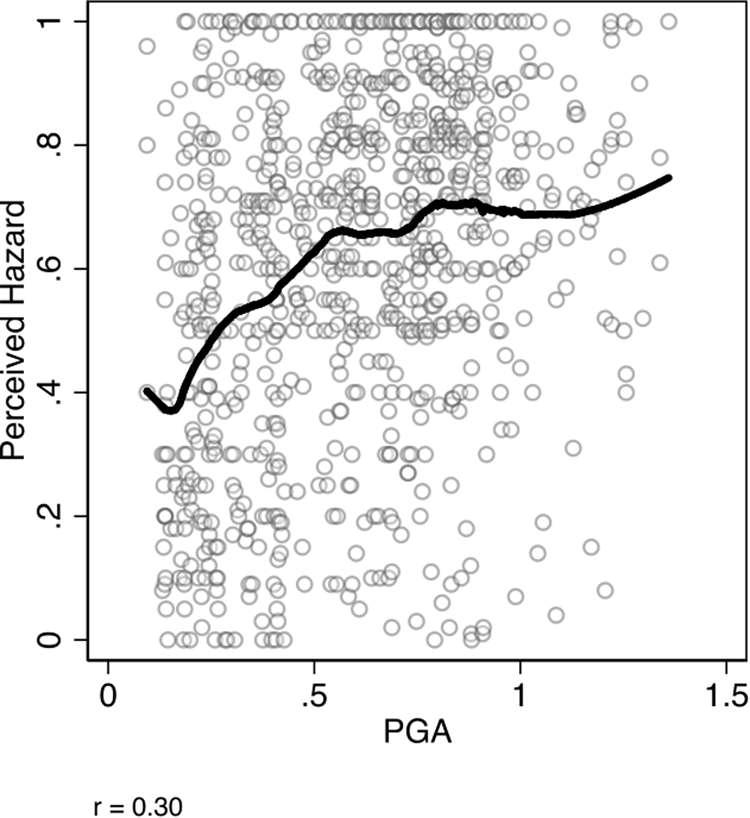
First, we explore the bivariate relationship between actual and perceived hazard. If our predictions are correct, we would expect the correlation between them to be quite low, even for people in areas with frequent seismic activity (Hypothesis 1). Figure 1 presents a scatterplot of PGA and perceived risk scores (in gray), fit with a locally weighted regression line (in black).
The relationship between perceived and actual hazard. Scatterplot overlaid with a locally weighted regression line (bin width = 0.25). Note that perceived hazard is rescaled to range from 0 to 1, while peak ground acceleration (PGA) is left in its natural metric (ranging from 0 to 1.36).

The results suggest a modest association between perceived and actual hazard. While the two factors are correlated with one another at the r = 0.30 level, Figure 1 offers a more nuanced interpretation of the data. People in comparatively lower-hazard zip codes (i.e., those close to zero) appear to accurately recognize their low likelihood of experiencing a major earthquake in the next few decades, and perceived hazard gradually increases as PGA rises. However, perceived hazard plateaus at around 60% (0.60), at PGA values nearing 0.50.
This stagnation is critical, because it indicates that people who live in areas where they are highly likely to experience a major earthquake exhibit only moderate levels of perceived risk. Perhaps most alarmingly, we find that individuals living in zip codes where PGA is in excess of 1 (where a potential earthquake would destroy most buildings, induce landslides, impose serious damage to dams and embankments and potentially put underground utilities completely out of service) are virtually no different – in terms of perceived hazard – than those in areas where PGA is around 0.40 (where a potential earthquake would be comparatively much less severe).
The modest bivariate correspondence between perceived and actual hazard supports Hypothesis 1. But how does that relate to local public policy? We put this question to the test by modeling support for each policy described earlier as a function of perceived and actual hazard. We also included several other controls in the model that we might be expected to be associated with support for this type of policy action, including whether or not respondents are politically liberal or conservative (as conservatives may be less supportive of government action writ large), zip code population density (as policies related to building regulations may be more salient in areas where more populated areas), knowledge about basic scientific facts (as more knowledgeable individuals may be more likely to hold accurate perceptions) and a host of demographic controls (e.g., age, race, sex, etc.).
Full model output and additional information about these variables can be found in the Supplementary Materials. There, we also provide supplemental analyses running all models presented in the main text without survey weights (Tables S1 & S2). Additionally, we test for the possibility of asymmetries in respondents’ policy orientations across states by including state-level fixed effects in all models (summarized in Table S3).
In both cases, the results presented in the main text are robust to these alternative specifications. We also find no evidence of state-level differences in respondents’ support for earthquake policies.
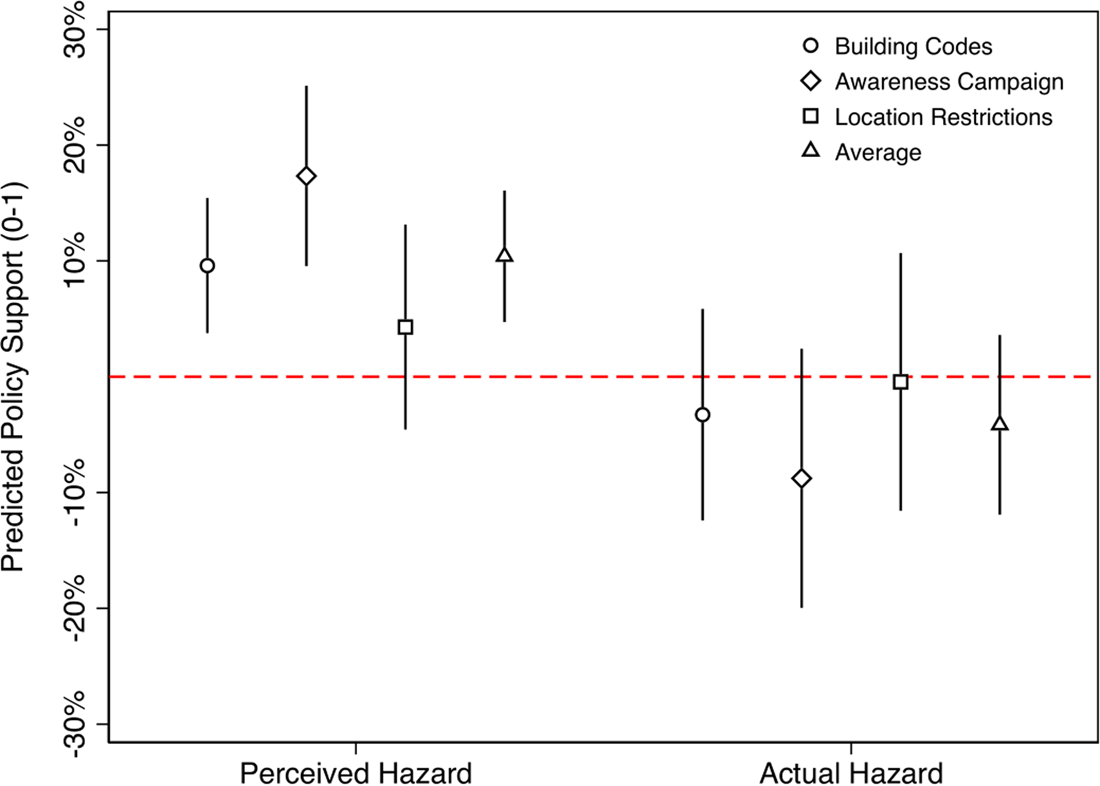
Before formally testing Hypothesis 2 – which concerns the conditional (i.e., interactive) relationship between perceived and actual hazard on policy attitudes – we first describe the ‘main effect’ relationships between perceived and actual hazard on preventative local policy attitudes. The results from these models are presented in Figure 2.
The relationship between perceived and actual hazard and preventative local policy attitudes. Ordinary least squares parameter estimates expressed as percentage change in each policy outcome variable (hollowed shapes) with 95% confidence intervals presented. Full model output can be found in the Supplementary Materials. All variables are scored to range from 0 to 1. Data are weighted. Models run without weights can be found in the Supplementary Materials.

Hollowed shapes are ordinary least squares parameter estimates for perceived and actual risk for each local policy outcome variable, with 95% confidence intervals extending from each one. Because variables are all scaled to range from 0 to 1 – including PGA, which was previously left in its natural metric when testing Hypothesis 1 – parameters are expressed as percentage change in support for each policy, given movement from the minimum to maximum value of perceived and actual risk (respectively). The triangle labeled ‘average’ summarizes the effects across all three policy questions by indexing the items together (α = 0.67).
Figure 2 suggests that perceived risk was positively associated with increased support for stricter building code regulations, awareness campaigns, restrictions on where private businesses can build and the combined index of all three – significantly so (at the p < 0.05 level, two-tailed) in three out of four models.
However, and consistent with previous research, we also find no discernible relationship between actual hazard and policy attitudes. In all four cases, the association between actual hazard and policy attitudes fails to attain conventional levels of statistical significance, and are incorrectly signed (i.e., higher levels of actual hazard are associated with decreased support for each policy after accounting for the effects of perceived risk and the other aforementioned controls). Again, this is consistent with our expectations.
Some might note endogeneity concerns with our decision to include perceived and actual hazard together in the same model. Although the association between the two is quite modest (see Figure 1), they are to some degree correlated. Across all four models, post-estimation variance inflation factor (VIF) diagnostic tests revealed that no covariate in any model produced a VIF greater than 1.17, which is well below problematic levels. Thus, while these two factors are conceptually related to one another, the modest association documented in Figure 1 and low VIF scores suggest that endogeneity concerns are unlikely to influence the results we observe.
Of course, we think that the relationship between actual hazard and policy attitudes is more nuanced than Figure 2 suggests. According to Hypothesis 2, actual danger of experiencing a major earthquake might influence policy attitudes, but only for those who accurately assess their hazard.
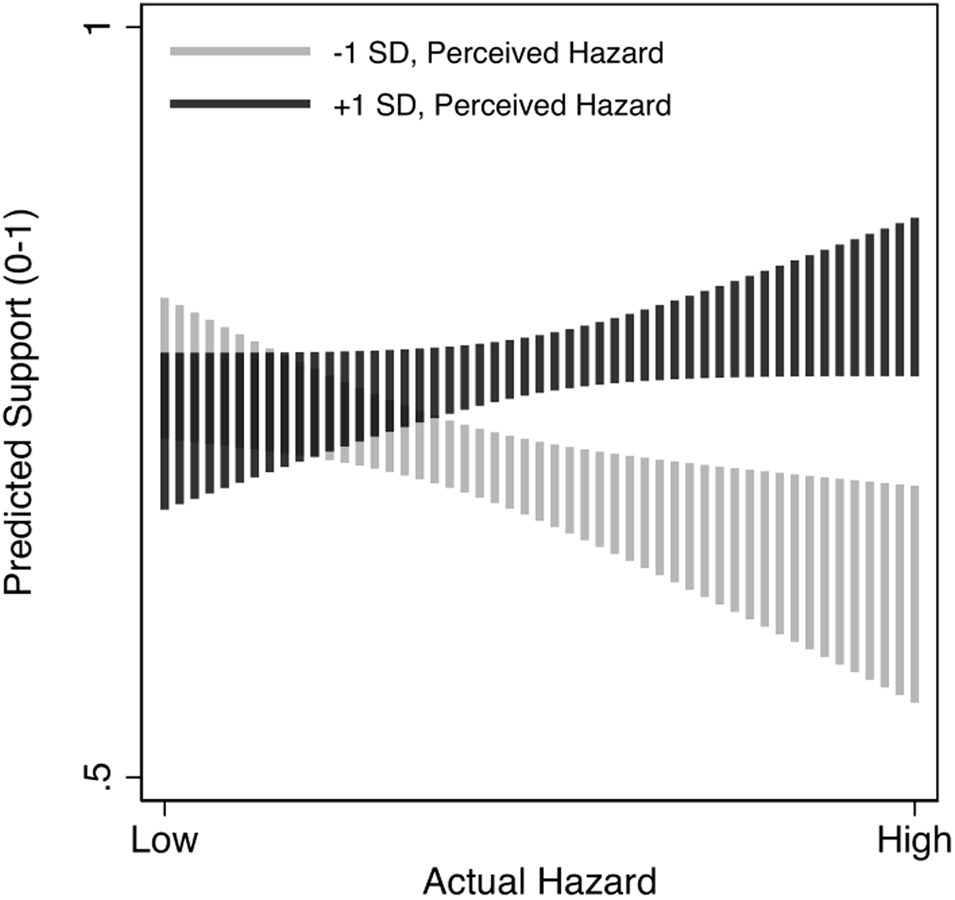
Figure 3 tests Hypothesis 2 by plotting predicted levels of policy support – on the averaged index shown in Figure 2 – across levels of actual hazard for people with low (in light gray) and high (in dark gray) levels of perceived hazard (using standard deviation shifts). These estimates are calculated by re-running the baseline models used to produce Figure 2, and interacting perceived and actual hazard. Vertical lines are 95% confidence bands for predicted support at each value of actual hazard. Suggestive of general support for Hypothesis 2, we find that the interaction between perceived and actual hazard is positive and statistically significant (β = 0.27, p < 0.05), meaning that, as actual hazard and perceived hazard jointly increase, support for preventative policies tends to grow.
The relationship between perceived hazard and local policy views across low and high levels of actual hazard. Predicted probabilities (presented as 95% error bands) hold all other covariates in the model at their mean observed values. Full model output can be found in the Supplementary Materials.

Figure 3 provides a more tractable interpretation of this basic point. At low levels of actual hazard, the association between perceived hazard and policy support is virtually identical for both those who (accurately, light gray line) recognize their low hazard and those who (inaccurately, dark gray line) perceive high hazard, which is consistent with our expectations. However, as actual hazard increases, people who (accurately, dark gray line) recognize that they are potentially in danger of experiencing a major earthquake become more likely to support policies aimed at disaster mitigation. Correspondingly, those who (inaccurately, light gray line) do not recognize their comparatively high hazard become less likely to support these policies, which is consistent with Hypothesis 2.
Discussion
Our work highlights the important role that correspondence between perceived and actual hazard can play in shaping individuals’ preventative policy orientations. Our work finds low levels of correspondence between Americans’ perceived and actual hazard of experiencing a major earthquake. However, and in contrast to previous research, we find that the physical environment can in fact shape individuals’ policy orientations. When individuals living in highly earthquake-prone areas accurately recognize their hazard, they become more likely to support policies aimed at combating the potential losses of life and property posed by major earthquakes.
Of course, our research is not without limitations. As noted earlier, we are relying on results from a single survey of West Coast respondents. We also caution that, while our data are suitable for detecting correlations, we are hesitant to generalize raw means and variances for our key dependent and independent variables to the US adult population.
Another important limitation of our analysis is the use of cross-sectional data. Although we can make correlational claims about the relationship between policy orientations and perceived/actual hazard, we cannot disentangle the causal ordering of these factors. Consequently, the decision to model policy attitudes as a function of perceived hazard makes the assumption – as others have done in past research (e.g., Flynn et al., Reference Flynn, Slovic, Mertz and Carlisle1999) – that more general psychological evaluations antecede attitudes toward specific policies.
Of course, the longitudinal relationship between policy attitudes and perceived/actual hazard could be more complicated. Policy orientations and hazard appraisals could, for example, be co-constitutive, such that change in one leads to change in the other in an iterative way over time. It could also be the case that both policy positions and hazard appraisals are caused by a common factor. For example, while political ideology does not explain away any of the relationships noted in this paper (see Tables S1 & S2), people who are more ideologically conservative tend to be less supportive of all three policies studied in this paper. If this ‘solution aversion’ (Campbell & Kay, Reference Campbell and Kay2014) spills over to cause change in risk perceptions, we would need to present more nuanced and time-varying models of the relationships studied in this paper. It could alternatively be the case that the psychological drive to reduce cognitive dissonance leads people who (accurately) recognize that they live in high-hazard areas to adjust their hazard perceptions downward, potentially to justify the hazard of continuing to live in an at-risk area.
Testing these possibilities is simply not possible with the present data. Disentangling the causal ordering of hazard perceptions and policy attitudes – as well as considering the outside influence of other factors that could cause both – requires measuring all three sets of attitudes over time. Efforts to do this are lacking in the realm of earthquake hazard and policy. We sincerely hope that our research can serve as a building block for more rigorous attempts to study not just the policy consequences of accurate/inaccurate hazard perceptions, but also the development of these attitudes over time.
Finally, although we theorize that public awareness campaigns to bring hazard perceptions in line with reality may ultimately foster support for preventative earthquake-related policies, this is not a proposition we can test with the present data. We think that population-based survey experimental work could be an excellent way to test the effectiveness of such prescriptions in future work.
More generally, this study advances public policy research on at least two fronts. First, we incorporate the use of methods common in the physical sciences for answering research questions of significant importance in the social sciences. We hope that this work can serve as an example for others doing opinion research related to seismic catastrophe and other natural disasters.
Second, and perhaps more importantly, we note the importance of providing variation on both perceived and actual hazard when attempting to draw conclusions about their comparative policy relevance. As noted throughout this paper, much previous research on earthquake policy looks only at areas that provide low variation on actual hazard – making it difficult to assess how the alignment between perceptions and reality might shape policy orientations. We think that this principle is an important one to keep in mind when designing future studies on Americans’ attitudes toward natural disaster policy.
Finally, we hope that our research can be useful in informing efforts to communicate seismic hazard to the mass public, especially those living in areas where objective earthquake hazard is high. Evidence that actual and perceived hazards are out of line, even for those living in highly ‘at-risk’ areas – compounded by the fact that accurate perceptions are a key driver of policy support, highlight the critical importance of public awareness campaigns about the dangers of major earthquakes. What these communication campaigns might look like and whether or not they might ultimately prove effective are key questions for future research.
Supplementary Material
To view supplementary material for this article, please visit https://doi.org/10.1017/bpp.2019.18
Acknowledgments
I would like to thank Ben Lyons, Dan Chapman, Kathryn Haglin and Dan Kahan for their invaluable feedback on early drafts of this paper. I would also like to thank the Annenberg Public Policy Center at the University of Pennsylvania for their support.