Introduction
Very often cropping systems are based on rotations of single genotype crops, although crop diversity is known to be a strong management toolReference Altieri1. Intercropping, planned diversity in space, defined as the simultaneous growth of more than one species in the same fieldReference Willey2 is the practical application of basic ecological principles such as diversity, competition and facilitationReference Hauggaard-Nielsen and Jensen3.
Intercropping including legumes is an old and widespread practice in the low-input systems of the tropicsReference Willey2. However, during the 20th century, farmers around the world replaced legume rotations and other traditional sources of nitrogen (N) with synthetic N fertilizers and increased use of pesticide inputsReference Crews and Peoples4. Today, the food and feed markets are experiencing increased awareness of environmental damage arising from the use of such non-renewable chemical resources, putting emphasis towards alternatives like organic farming. Organic crop production systems are commonly assumed to be more diverse than the conventional counterpart but that is not always the case. In temperate regions organic arable crop rotations consist mainly of sole crops (SC) (monocrops, pure stands) with the more diverse pastures being an exceptionReference Hauggaard-Nielsen, Ambus and Jensen5.
Reported grain legume–cereal intercropping performance indicates some principal advantage worth considering while directing present agricultural practices in more sustainable directions like yield advantages and greater yield stability over years compared to grain legume sole croppingReference Hauggaard-Nielsen, Ambus and Jensen5, Reference Jensen6. Furthermore, pea (Pisum sativum L.)–barley (Hordeum vulgare L.) dual intercropping compared to the corresponding sole cropping has shown a more efficient use of environmental sources for plant growth due to interspecific complementarityReference Corre-Hellou and Crozat7, Reference Hauggaard-Nielsen, Ambus and Jensen8. Special emphasis has been on N dynamics showing, for example, increased barley grain N concentration when intercropped with grain legumes as compared to the respective sole cropped barleyReference Hauggaard-Nielsen, Ambus and Jensen5, Reference Jensen6, Reference Knudsen, Hauggaard-Nielsen, Jornsgard and Jensen9 and higher percentage N derived from fixation (% Ndfa) in intercropped pea compared to sole cropped peaReference Jensen6, Reference Hauggaard-Nielsen, Andersen, Jornsgaard and Jensen10, Reference Izaurralde, Mcgill and Juma11, but also increased competitive ability towards weeds has been highlightedReference Hauggaard-Nielsen, Ambus and Jensen5.
Grain legumes such as field pea, faba bean (Vicia faba var. minor L.) and narrow-leafed lupin (Lupinus angustifolius L.) are valuable protein and energy source in human nutritionReference Iqbal, Khalil, Ateeq and Khan12 and animal feedingReference Gdala13. Furthermore, grain legumes benefit the cropping system, contributing with atmospheric N inputs through biological N2-fixation and recycling of N-rich residuesReference Jensen14—a fundamental process for maintaining soil fertility in, for example, organic farming systemsReference Jensen and Hauggaard-Nielsen15. Other positive effects are disease break-crop effectsReference Trenbath16 in the very often cereal-rich temperate cropping rotations.
The predominant cultivation of grain legumes under European temperate climates is sole cropping of pea. However, a major concern for farmers growing peas is the high degree of yield variabilityReference Jensen, van Cleemput, Haneklaus, Hofman, Schnug and Vermoesen17 due to drought sensitivityReference Heath, Hebblethwaite, Hebblethwaite, Heath and Dawkins18, lodging and weak competitive ability towards weedsReference Hauggaard-Nielsen, Ambus and Jensen5, Reference Liebman and Dyck19. Improved cultivars of faba bean and lupin might be alternative grain legumes to pea with a higher seed protein concentration and stronger stem strength but probably with the some of the same obstacles as peas, such as weak competitive ability towards weedsReference Hebblethwaite, Hawtin and Webb20. Intercropping experiments with faba bean and cereals have shown similar advantagesReference Knudsen, Hauggaard-Nielsen, Jornsgard and Jensen9, Reference Bulson, Snaydon and Stopes21, Reference Jensen22, but knowledge of the effect of intercropping lupin and cereals for maturity is limitedReference Palmason, Danso and Hardarson23.
The main objectives of this three-year study were to determine the effects of dual intercropping of either pea, faba bean or lupin with barley in organic systems on yield performance, grain quality, N use, weed growth and diseases on two soil types in Denmark.
Materials and Methods
Location
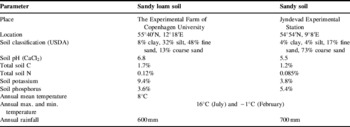
The experiments were carried out in three subsequent years during 2001–2003 on a sandy loam soil and a sandy soil at two different locations in Denmark (Table 1). At both locations the soils have been cultivated for centuries and mainly cropped with cereals for the past four decades.
The experiments were carried out in three successive years during 2001–2003 at two different locations in Denmark on a sandy loam soil and a sandy soil. The soil characteristics have been examined on 0–20 cm topsoil samples.

Experimental set-up
Field pea, faba bean and narrow-leafed lupin were grown as SC and in a two-species intercrop IC with spring barley. The field pea cultivars used were cv. Agadir, a semi-leafless cultivar with tendrils, relatively tall with a weak tendency to lodging (named pea A in tables and diagrams) and cv. Bohatyr, with normal leaves and medium stem strength (named pea B in tables and diagrams). The faba bean cv. Columbo had a low content of tannins and medium to early maturity. The lupin cv. Prima had a relative early and uniform ripening caused by a highly reduced branching structure, where the upper main stem branches are reduced to a single floret in the axil of the main stem leaves. The two barley cultivars were cv. Lysiba, a low to medium yielding cultivar with a high content of the amino acids lysine and threonine (named barley L in tables and diagrams) and cv. Otira, a high yielding cultivar with low protein content (named barley O in tables and diagrams). Both barley cultivars had weak proneness to lodge.
The experimental plots (15 m2 on the sandy loam soil and 36 m2 on the sandy soil) were laid out in a complete one-factorial randomized block design with 16 treatments of IC and SC and four replicates. The dual IC design was based on the replacement principle, with mixed grain legume and barley grain sown in the same rows 12.8 cm apart at relative frequencies of 50:50. The rationale of the replacement design is that the interactions between IC components are not confounded by alterations in the plant density in the IC compared to the SCReference De Wit and Van den Bergh24. Target plant densities in SC of 300, 120, 90 and 40 plants m−2 for SC of barley, lupin, pea and faba bean, respectively, were in general achieved and the IC plant ratio of 50:50 was successfully obtained at both locations. Likewise, in the additional disease trials including three- and four-component IC in the respective 33:33:33 and 25:25:25:25 replacement ratios plant density and relative proportions were successfully established.
Management practice
The soils on the two locations contained efficient populations of native Rhizobium leguminosarum bv. vicia for the pea and faba bean symbiosis to work, whereas the lupin seeds were inoculated with an approved commercial Bradyrhizobium lupini strain just before seeding. Seeds were sown mixed in the rows in the same depth (3–5 cm) in early spring on both locations. The crops were grown according to organic agricultural management practice, except that the half of the barley SC was fertilized with 50 kg N ha−1 in urea. A false seedbed was established prior to sowing on both locations. Mechanical weeding was performed on the sandy soil.
Sampling and analytical methods
Leaf diseases were monitored throughout the experimental growth season, and whenever diseases were observed successive samplings for relevant disease were established using standard protocols.
The crops were harvested at physiological maturity. The plots were harvested manually (1 m2) and separated into three fractions, i.e. grain legume, barley and weeds. The plant samples were dried at 70°C to constant weight and total dry matter (DM) production for each plot was determined separately for grain legumes, barley and weeds. After threshing, the grain DM yields were determined. Total N and 15N content were determined on 3–15 mg sub-samples of finely ground material using an elemental analyzer (EA 1110) coupled in continuous flow mode to an isotope ratio mass spectrometer (Finnigan MAT DeltaPlus).
Calculations and statistics
Combined IC yield is the sum of yields of both the components in the IC. The land equivalent ratio (LER) is defined as the relative land area growing SC required to produce the yields achieved when growing ICReference Willey2.
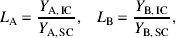
LER for an IC of crop A and crop B is the sum of the partial LER values for crop A (L A) and crop B (L B).

LER values >1 indicates an advantage from intercropping in terms of the use of environmental resources for plant growth compared to SC. When LER <1 resources are used more efficiently by SC than by IC.
The 15N natural abundance (NA) method was used to estimate leguminous symbiotic N2-fixation and calculated as the product of shoot N (grain legume biomass×% N content) and the percentage of plant N derived from fixation (% Ndfa). The percentage of plant N derived from fixation was determined asReference Shearer and Kohl25:

The B value is a measure of isotopic fractionation during N2-fixationReference Unkovich, Pate, Sanford and Armstrong26. In the present study, B values were estimated for each grain legume species by analysis of the δ15N of shoot N of nodulated pea, faba bean and lupin grown in N-free mediaReference Knudsen, Hauggaard-Nielsen, Jornsgard and Jensen9, Reference Hauggaard-Nielsen, Ambus and Jensen27. The δ15N values are the 15N abundance relative to atmospheric N2 (15Natmos) expressed as parts per thousand, calculated for each sample of the legume and the reference plantReference Shearer and Kohl25.

The NA method relies on differences in natural 15N enrichment in soil N compared to atmospheric N2 and reflected in δ15N value of the non-fixing reference plant. The respective barley SC for each replicate was used as the reference plant using an average of δ15N of the two barley cultivars.
Nitrogen balances for crops were determined to evaluate the net effect on the soil N pool when growing grain legume–barley IC as compared to the corresponding SC.

Fixed N positioned in below-ground plant parts for each grain legume species was included assuming that 15.6, 17.2 and 18.6% of total N accumulation in pea, faba bean and lupin, respectively, was present in below-ground plant partsReference Mayer, Buegger, Jensen, Schloter and Hess28. When calculating the amount of fixed N2 positioned in roots the percentage below ground was corrected for the actual % Ndfa in the specific treatment.
Analysis of variance on plant samples was carried out using the GLM procedure of the SAS software29 and probabilities equal to or less than 0.05 were considered significant. Assumptions of normal distribution and variance homogeneity were tested graphically using residual plots. Additional statistical analysis was conducted when evaluating disease data, including the Kruskal–Wallis test.
Results and Discussion
Grain yield and N use
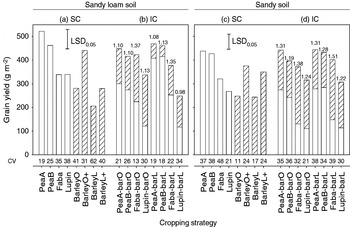
A fundamental aspect of intercropping is to avoid unfavorable intra- or inter-specific competition possibly including interspecific facilitationReference Callaway30, where plants increase the growth and survival of their neighborsReference Willey2, Reference Ofori and Stern31, Reference Vandermeer32. LER ratios varied between 0.98 and 1.51 and indicate complementarities within the present grain legume–barley IC combinationsReference Willey2, Reference Ofori and Stern31, but with considerable variation over location, years and crops (Fig. 1). Combined IC grain yields were comparable to grain yields of sole cropped pea, but significantly greater than sole cropped lupin, faba bean and barley yields (Fig. 1). In descending order, the greatest grain yields were obtained for IC containing pea, faba bean and lupin. Pea was the dominant IC component on both soil types with no significant difference between cultivars. Faba bean dominated in the IC on the sandy loam soil, but not on the sandy soil. Lupin was suppressed by barley at both locations.
Average grain yields, yield stability [indicated below the x-axis as % CV (coefficient of variation) on average yields] of SC and IC of two pea cultivars (Agadir; peaA and Bohatyr; peaB), two barley cultivars (Otira=O and Lysiba=L), faba bean (Columbo) and lupin (Prima), grown in a sandy loam soil and a sandy soil during 2001–2003. Measures of intercropping advantage estimated using the LER are given on the top of IC bars. LSD0.05 between cropping strategies is given by floating bars.

The SC performance supported the interspecific interactions within the IC stand with grain yields of the tested semi-leafless pea cv. Agadir of 520 g m−2 in average over the 3 years on the sandy loam, 13% more than the normal leafed pea cv. Bohatyr. On the sandy soil there was no effect on choice of pea cultivar when sole cropping, averaging grain yields of 430–440 g m−2, but with higher general pea–barley LER values due to lower barley yields (Fig. 1). When yields of IC exceed the yield sum of the component species grown aloneReference Willey2, it is often as a result of better use of available growth resources Reference Hauggaard-Nielsen, Ambus and Jensen8, Reference Vandermeer32, Reference Natarajan and Willey33 typically controlled by the level of interspecific interactions and the corresponding SC yields. It has been inferred that the trend of LER in legume–cereal IC was associated with the yields of the legumesReference Ofori and Stern31, possibly due to the reputation of especially grain legumes having high yield variabilityReference Jensen and Hauggaard-Nielsen15, Reference Giller and Cadisch34, Reference van Kessel and Hartley35. However, in the present study, the weaker interspecific competitor was sometimes the grain legume and sometimes barley depending on crop combination and soil type, which means that it is not a species phenomenon. It may just be the growth of the weaker component that is determining the yield efficiency of the IC combination.
Faba bean and lupin had both a yield of 340 g m−2 in the sandy loam soil, with decreasing yields of 320 and 270 g m−2 on the sandy soil, respectively. However, especially faba bean showed a high degree of complementarity when intercropped, with LER values between 1.37 and 1.51, indicating up to 50% better utilization of the environmental sources for plant growth by the IC than by the corresponding SC. Faba bean might be a better choice than pea due to better spatial or temporal complementarity towards the barley companion crop, leaving space for both crops to develop and thereby utilize available environmental growth resources. The yield of lupin on the sandy loam soil was the results of yields of 420, 430 and 170 g m−2 in years 2001, 2002 and 2003; the latter yield due to the inoculation with an ineffective commercial B. lupini strain. Lupin have the greatest protein content of the present grain legumesReference Jensen, Joernsgaard, Andersen, Christiansen, Mogensen, Friis and Petersen36 and extraordinary ability to mobilize phosphorusReference Braum and Helmke37, but when growing a species under environmental conditions without efficient populations of native symbiotic bacteria difficulties with appropriate inoculation are clearly a limitation for farmersReference Peoples, Ladha and Herridge38.
In contrast to results from JensenReference Jensen6 yield stability of IC was not greater than that of grain legume SC, with the exception of the IC including faba bean. The grain legume–barley IC showed less or similar variability compared to at least one of the respective SCs (Fig. 1). When working in organic cropping systems evaluation of specific species and cropping strategies should be conducted as an integrated part of the organic farming practices. It is not always appropriate to continue with the general knowledge very often gathered under conventional growing conditions, such as robust and stable yielding cereals as compared to unpredictable and variable grain legumes. On the sandy loam soil the highest yield stability was actually observed for the peas, whereas the barley yield was very variable, especially at the low N level.
Faba bean and lupin had lower yield stability than pea and fertilized barley. In contrast, on the sandy soil the highest yield variability was observed in the pea cultivars and faba bean and the lowest in lupin and barley, where the application of urea-N increased the yield variation significantly (Fig. 1). Grain legume–barley intercropping might not be the highest yielding as compared to the yield of one of the corresponding SCs in a single year, but it can be regarded as insurance against the complex abiotic and biotic stresses influencing crop performance, especially in organic systems. Self-regulation within the IC stand caused by interspecific interactionsReference Willey2 can have a compensation effect against temporal or spatial nutritional limitations and/or attack from pest and disease organisms reducing annual yield variability.
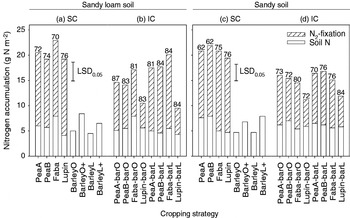
Despite accounting for approximately more than half of the total biomass production (Fig. 1) the grain legumes accumulated less soil N when intercropped than could have been expected from SC uptake (Fig. 2). However, the LER values for soil N uptake were all considerably higher than 1, indicating a better utilization of soil N sources by the IC than by SC (data not shown). In accordance with other reported workReference Hauggaard-Nielsen, Ambus and Jensen5, Reference Jensen6, Reference Knudsen, Hauggaard-Nielsen, Jornsgard and Jensen9 barley obtained proportionately more of the soil N when intercropped (Fig. 2), indicating that barley has a greater competitive ability for inorganic N sourcesReference Hauggaard-Nielsen, Ambus and Jensen5, Reference Jensen6. Likewise, after application of 5 g N m−2 the grain yield of barley was raised 40–50% at both locations independent of cultivar (Fig. 1). When an intercropped cereal is more competitive for soil inorganic N the legume is forced to rely on N2-fixationReference Knudsen, Hauggaard-Nielsen, Jornsgard and Jensen9, Reference Carr, Martin, Caton and Poland39, Reference Corre-Hellou, Fustec and Crozat40. The intercropped grain legumes increased their proportion of plant N derived from N2-fixation by on average 10–15% compared to the corresponding SC (Fig. 2). Nitrogen fixation was very constant in grain legume SC over species and location, varying from 13.2 to 15.8 g N m−2, being lowest in peas and highest in faba bean and lupin. In the IC the nitrogen fixation per area decreased with increasing barley suppression of the grain legume, and fixation was more reduced with barley cv. Otira than when intercropped with barley cv. Lysiba, and more for faba bean and lupin than for peas. Especially lupin was suppressed when intercropping, with a reduced N2-fixation from 15 to 5–6 g N m−2. The interspecific interactions among the crops are delicate and specific to locations, and the growing of a certain IC combination may derive from several considerations such as: (i) more stable yields, (ii) N inputs to the cropping system and (iii) competitive ability towards traditional heavy weed infestation of a specific field, among several others.
Total above-ground nitrogen (N) accumulation in SC and IC of grain legumes and barley partitioned in crop soil N, and leguminous symbiotic N2-fixation at two separate locations during 2001–2003 (for further information see Fig. 1). Measures of percentage of N accumulated in above-ground grain legume originated from fixation are given on the top of bars. LSD0.05 between cropping strategies is given by floating bars.

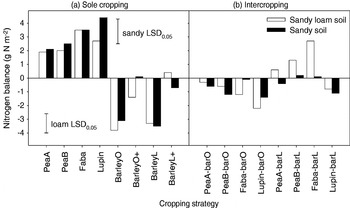
Crop N balances were determined to evaluate the effect of cropping on soil N fertility. After subtracting N exported in the harvested grain crop, N balances were +2 g m−2 for both pea cultivars on both soil types and about +3.5 g m−2 for the faba bean and lupin. In barley, the crop N balances were all negative, ranging from, on average, −3.5 g m−2 on both soil types without urea-N application to near 0 after application of 5 g urea-N m−2 (Fig. 3). As the quantity of N in the harvested grain and the amount of fixed nitrogen is slightly lower for peas than for faba bean and lupin, the N balance is lower for the peas although still positive, meaning that grain legumes make a net contribution of N to the soil. When intercropping, a slightly negative balance was found except when faba bean was intercropped with barley cv. Lysiba on the sandy soil. The same trend was seen for the pea cv. Bohatyr. However, grain legume–cereal IC are not likely to increase soil inorganic N in the long term, but rather deplete it, although at a slower rate than in barley sole cropping.
Nitrogen balance for each cropping strategy of sole cropping (a) and grain legume–barley intercropping (b) on a sandy loam soil and a sandy soil during 2001–2003 (for further information see Fig. 1). Balances were calculated according to equation (5). LSD0.05 between cropping strategies is given by floating bars.

Grain N concentration
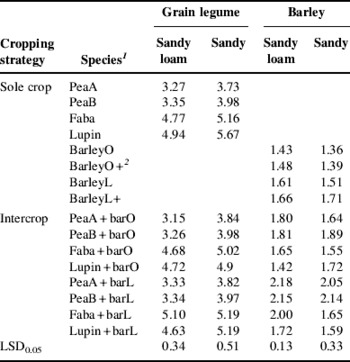
The N content of grain legumes was highest on the sandy soil as compared to the sandy loam (Table 2) whereas the barley grain N content for the two soils went in both directions. The peas had an average N level of 3.6%, the faba bean 5% and the lupin 5.3%. A significant effect of the barley cultivar was noted where barley cv. Lysiba had a N concentration in the grain which was 0.2% higher than barley cv. Otira, and it responded to increased N level by a larger increase in grain N concentration compared to barley cv. Otira, which responded by a higher increase in total grain yield (Fig. 1). Competition from barley had little effect on grain legume grain N concentration despite a general reduced grain legume total N accumulation and increased proportion of N derived from fixation (Fig. 2). When barley was intercropped with pea significantly higher grain N concentration was found compared to the barley SC (Table 1), also when applying fertilizer N. On the contrary, faba bean only increased barley cv. Otira grain N concentration on the sandy loam whereas intercropped lupin did not influence measured barley grain qualities.
Grain nitrogen concentration (%) of sole cropped and intercropped grain legumes with barley at two locations during 2001–2003.

1 For further information on species cultivars see Figure 1.
2 The symbol+indicates application of 5 g urea-N m−2 to the barley sole crops.
Grain legume–cereal interspecific competition can modify cereal grain N concentrationReference Hauggaard-Nielsen, Ambus and Jensen5, Reference Jensen6 because grain legumes in general compete less efficiently for soil N sources. Relatively more soil N becomes available to the intercropped cereal as compared to the respective SC (Fig. 2). However, since grain legumes compete for other growth factors, such as light, water and non-N nutrients, cereals may not increase their yield in direct proportion to the amount of N available and an increased concentration of grain N can be observed. This is presumably the case for the present productive intercropped pea, whereas the less productive faba bean and lupin are not able to create enough interspecific competition towards growth factors other than N to raise barley N concentration (Table 1).
Other studies show how the N content of the wheat (Triticum spp.) grain increases when intercropped with faba beanReference Bulson, Snaydon and Stopes21, Reference Jensen22. From a recent study including intercropping of wheat with faba bean in Denmark, Germany, Italy and UK in both additive and replacement designs it was concluded that the increase in protein concentration of wheat grain in IC could be of economic benefit when selling wheat for breadmaking, but only if the bean crop was also marketed effectivelyReference Godding, Kasyanova, Ruske, Hauggaard-Nielsen, Jensen, Dahlmann, Von Fragstein, Dibet, Corre-Hellou, Crozat, Pristeri, Romeo and Monti41. Other cereal species such as rye (Secale spp.) or oat (Avena spp.) are also possible cereal IC components, depending on the specific target for the IC (grain quality, soil fertility, weed infestation level, etc.). Knowledge of the effect of intercropping lupin and cereals for maturity is limitedReference Palmason, Danso and Hardarson23, but the limited branching ability of the present lupin may reduce the ability to obtain sunlight which can translate into major competitive limitationsReference Midmore42 that strongly influence the interspecific competitive ability.
Competitive ability towards weeds
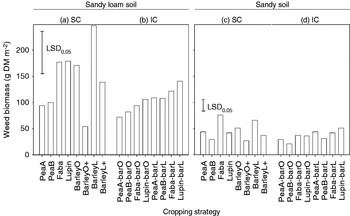
IC that are particularly effective at suppressing weeds capture a greater share of available resources than SCReference Liebman and Dyck19, which was clearly the case in the present study (Fig. 1). Any part of the soil surface that is not occupied by crop species is potentially subject to invasion by weedy species. Therefore, a typically more vigorous barley canopy structure as compared especially to faba bean and lupin in the present study provides a quicker, greater and more extensive soil coverage. A lower grain legume seeding density and initial growth rate, as compared to cerealsReference Hauggaard-Nielsen, Ambus and Jensen8, can fuel a rapid and intensive early weed resource uptake and thereby dominance throughout the rest of the growing seasonReference Liebman and Davis43.
Weed infestation in the different crops were comparable; however, it tended to be highest in sole cropped faba bean, lupin and unfertilized barley, where the application of urea to barley reduced the weed infestation by around 50% (Fig. 4). Especially on the sandy loam soil considerable weed infestation levels were found within faba bean and lupin as well as barley, except for the fertilized barley cv. Otira which was able to suppress the weeds. The weed biomass on the sandy soil was one-quarter that on the sandy loam soil due to efficient mechanical weeding management and less infestation by volunteer red clover (Trifolium pratense), which was a major problem on the sandy loam soil, especially in 2002. In general, the intercrops average the weed infestation levels in such a way that they are always lower than the levels of weeds in one of the IC component crops. This shows a more resilient crop stand able to respond to actual growing conditions as compared to grain legume sole cropping. Such a trait might be important to include as a management tool when the quantity and diversity of the weeds are high, as in the case of organic farming systemsReference Rydberg and Milberg44.
Weed above-ground DM production below grain legumes and barley sole cropping (SC) as compared to below grain legume–barley intercrops at two separate locations during 2001–2003 (for further information see Fig. 1). LSD0.05 between cropping strategies is given by floating bars.

Effect on diseases
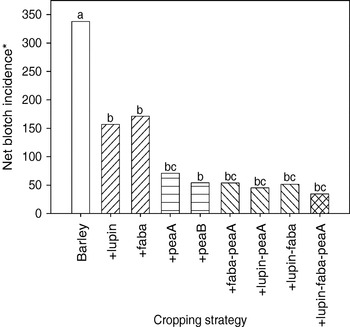
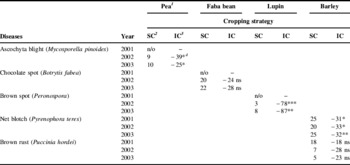
Components of IC are often less damaged by pest and disease organisms than when grown as SC, but this often varies unpredictablyReference Trenbath16. As an example, barley net blotch infestation levels are highlighted in Figure 5, as it was the most serious disease on barley during all 3 years. Interestingly, increasing the number of grain legume components reduced the amount of disease. As a general picture, reduction in disease was observed in all IC systems compared to the corresponding SC (Table 3). For all diseases (with the exception of brown spot on lupin) disease reduction was in the range of 20–40% (Table 3). Pathogens varied in dispersal mechanism and type (biotrophic or necrotrophic) and crops varied in height and anatomy. This suggests that there are mechanisms operating, possibly in all IC systems, whereby disease levels are reduced. However, for one disease in particular (brown spot on lupin) disease reduction was almost 80% in the IC. Furthermore, the well documented complementarity between intercropped barley and pea with respect to NReference Jensen6, Reference Hauggaard-Nielsen, Ambus and Jensen8, Reference Corre-Hellou, Fustec and Crozat40 may in turn influence plant healthReference Kinane and Lyngkjær45.
Effect of two-, three- and four-component IC of barley, lupin, faba bean and pea on incidence of barley net blotch (Pyrenophora teres) during 2002 when grown in the sandy loam soil. * Disease incidence measured as area under disease progress curve (AUDPC). Different letters indicate significant (P<0.05) differences using the Kruskal–Wallis test. For further information see Figure 1.

Diseases observed during the growth seasons 2001–2003 on the sandy loam soil and their percentage severity on the SC and median disease percentage reductions in disease in the dual intercrop systems (IC) as compared to the corresponding SC.

1 For further information on species cultivars see Figure 1.
2 The amount of disease observed when sole cropping (SC) in percentage leaf area covered.
3 Median percentage disease reduction in the present dual IC.
4 *, **, *** indicate significant differences (P<0.05, 0.01, 0.001) from SC using the Kruskal–Wallis test. ns, indicates no significant difference.
To be able to predict which crop–disease combination would give the largest disease reduction, the mechanisms behind the disease reduction in IC must be understood, which was not possible during the present study. However, it is without doubt that under some conditions, intercropping can usefully contribute to the control of disease populations, but do the reductions in disease have any real effect on yield? This is a very difficult question to answer. We believe it is fair to say that if disease levels are high, then reduction in disease levels will have a greater effect on yield than if the initial disease levels are low. To test that, it is necessary to carry out specific yield experiments, where there is a disease-free control, which is impossible when working in organic farming systems.
Intercropping on the market
Most grain legume–cereal mixtures with similar ripening times are easy to combine-harvest using traditional on-farm equipment, but few buyers purchase mixed grains. Farmers are often left with the options of harvesting the mixture for animal feed. However, during the past 3–5 years a few Danish buyers working in the organic market have purchased mixed grains, often used for seed because of less damage from pest and diseases. The buyers charge 15–20€ per ton mixed grain for separation and cleaning, but when it is contracted for seed, a premium is given, making it profitable for the farmers to grow.
Grain legume–cereal intercropping is regarded as a cropping strategy based on the manipulation of plant interactions in time and space to maximize growth, with the possibility of increasing input of leguminous N2-fixation into cropping systems and reducing the need for fertilizer N applications, and reducing pesticides due to improved competition towards weeds and less general damage by pest and disease organisms. Intercropping strategies offer a number of agroecological functions and services to the market, which are of increasing importance taking into account present environmental and energy issues on the global political agenda. Improved harvest technologies may in future make intercropping more attractive in the intensive agricultural areas of developed countries.
Conclusions
We conclude that the intercropping of arable crops has great potential in organic cropping systems. Intercropping may enhance and stabilize yields, reduce weeds and plant diseases and improve resource use. Improved understanding of the ecological mechanisms associated with planned spatial diversity, including additional benefits with associated diversity, will potentially enhance the benefits achieved from intercropping.
Acknowledgement
The project was funded by the Danish Research Centre for Organic Food and Farming (DARCOF).