INTRODUCTION
In a previous paper (Pratlong et al. Reference Pratlong, Dereure, Ravel, Lami, Balard, Serres, Lanotte, Rioux and Dedet2009) the geographical distribution and epidemiological features of Old World dermotropic Leishmania species, L. major, L. tropica and L. aethiopica, usually responsible for cutaneous leishmaniasis were analysed. The study was based on isoenzyme analysis of 1048 strains, collected during 24 years in 33 countries of Africa, and the Near and Middle East. The analysis of 2277 commonly viscerotropic strains collected during 35 years from 36 countries of Europe, Asia and Africa is presented here.
Visceral leishmaniasis was originally described as being due to a protozoon named L. donovani by Laveran and Mesnil (Reference Laveran and Mesnil1903). In 1908, Nicolle distinguished a second taxon, L. infantum, on clinical and epidemiological arguments. These taxa autonomy remained controversial during years until the development of multilocus enzyme electrophoresis (MLEE). Lanotte et al. (Reference Lanotte, Rioux, Maazoun, Pasteur, Pratlong and Lepart1981) separated L. infantum from L. donovani with only 2 zymodemes for each one. Later, Moreno et al. (Reference Moreno, Rioux, Lanotte, Pratlong, Serres and Rioux1986) individualized 2 phenetic groups within the L. donovani complex s.l., with 8 zymodemes for L. donovani and 9 for L. infantum, on isoenzymatic and epidemiological arguments (zoonotic versus anthroponotic cycles and geographical distribution). As the number of strains described increased, the number of zymodemes increased correspondingly and, more recently, Pratlong et al. (Reference Pratlong, Dereure, Bucheton, El-Safi, Dessein, Lanotte and Dedet2001) described 31 zymodemes for L. infantum, 16 zymodemes for L. donovani and introduced a new group, L. archibaldi, with 3 zymodemes.
The present study was based on the analysis of 2277 strains, isolated between 1973 and 2008, cryopreserved in the International Cryobank of Leishmania of Montpellier, France. In addition to providing a substantial amount of new isoenzymatic data, this study aims to evaluate the relevance of the previously described groups. The controversial taxonomic position of L. archibaldi, illustrated by the recent molecular studies, is discussed.
MATERIALS AND METHODS
Leishmania strains
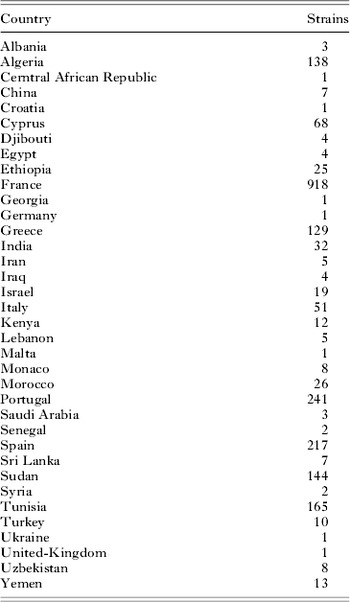
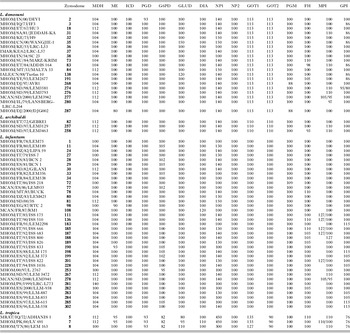
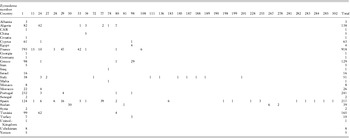
The studied sample included 2277 Leishmania strains isolated between 1973 and 2008 either in our laboratory or by other teams (see Acknowledgements section). They were all cryopreserved in liquid nitrogen, in the International Cryobank of Leishmania of Montpellier, France (number 879 in the data base of the World Data Centre for Microorganisms of the World Federation for Culture Collection). The strains were mainly isolated from humans (n = 1364, 59·9%), but also from mammalian reservoir hosts: dogs (n = 808, 35·5%), foxes (n = 4), racoon dog (n = 1), cats (n = 6) and rats (n = 5), and phlebotomine sandflies (n = 88). They originated in 36 countries, over a wide geographical area, between West-Africa and China (Table 1). The western part of the Mediterranean Basin was well represented, due to field investigations carried out either by our laboratory in France (n = 918 strains), or by collaborating teams: in Portugal (n = 241 strains), Spain (n = 217), Algeria (n = 138 strains), Greece (n = 129) and Tunisia (n = 165). The strains from countries with fewer samples were obtained from occasional clinical human cases. The studied strains were analysed along with 60 zymodeme reference strains and the MHOM/FR/78/LEM75 L. infantum MON-1, as basic reference zymodeme. The World Health Organization (WHO) codes and enzyme profiles of all these strains are shown in Table 2.
Numbers of Leishmania strains according to country

Zymodemes of Leishmania reference strains used

Isoenzymatic identification
Starch gel electrophoresis was performed according to the method described by Rioux et al. (Reference Rioux, Lanotte, Pratlong, Bastien and Perieres1990), using the following 15 enzyme systems: malate dehydrogenase, MDH, EC 1.1.1.37 ; malic enzyme, ME, EC 1.1.1.40; isocitrate dehydrogenase, ICD, EC 1.1.1.42; 6-phosphogluconate dehydrogenase, PGD, EC 1.1.1.44; glucose-6-phosphate dehydrogenase, G6PD, EC 1.1.1.49; glutamate dehydrogenase, GLUD, EC 1.4.1.3; NADH diaphorase, DIA, EC 1.6.2.2; purine nucleoside phosphorylase, NP1, EC 2.4.2.1; purine nucleoside phosphorylase, NP2, EC 2.4.2.*; glutamate-oxaloacetate transaminases, GOT1 and GOT2, EC 2.6.1.1; phosphoglucomutase, PGM, EC 5.4.2.2; fumarate hydratase, FH, EC 4.2.1.2; mannose phosphate isomerase, MPI, EC 5.3.1.8; glucose phosphate isomerase, GPI, EC 5.3.1.9. Isoelectrofocusing was used as a complementary technique with greater resolving power than electrophoresis (Piarroux et al. Reference Piarroux, Trouvé, Pratlong, Martini, Lambert and Rioux1994).
For comparing enzymatic polymorphism by country, a polymorphism index (PI) was calculated: the number of zymodemes/the number of strains studied in the corresponding country, according to Gramiccia (Reference Gramiccia2003). This PI was calculated only for countries with a sufficient sample size (more than 100 strains). Strains from Italy were excluded due to a sampling bias (selection of the strains sent to the Montpellier Cryobank).
Taxonomic methods
Phenetic analysis was based on 15 isoenzyme loci, 60 zymodemes and 51 characters (electromorphs); 3 L. tropica zymodemes were used as outgroup (Table 2). On the hypothesis that Leishmania is ‘mainly’ diploid (Martínez-Calvillo et al. Reference Martínez-Calvillo, Stuart and Myler2005), multiband patterns obtained in starch gels were considered to be heterozygous and electromorph values were duplicated. Genetic clustering was done using the Neighbor-Joining (NJ) method implemented in the PHYLIP3.6 package (Felsenstein, Reference Felsenstein2004). The robustness of the nodes was statistically tested by bootstrap analysis with 1000 replicates (Felsenstein, Reference Felsenstein1985).
RESULTS
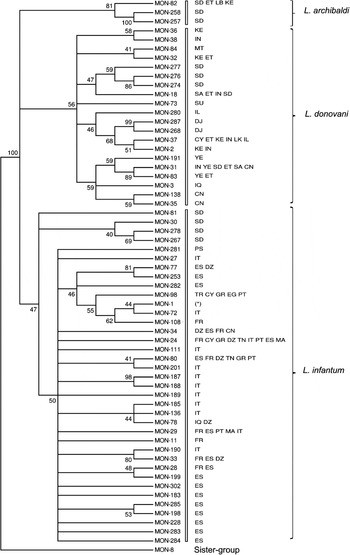
Isoenzyme analysis differentiated the 2277 strains into 60 zymodemes which were split in 3 groups through phenetic clustering : L. infantum, L. donovani and L. archibaldi, corresponding with the classically-known Old World viscerotropic Leishmania species. (Table 2, Fig. 1). In the Neighbour-Joining tree the L. archibaldi group was highly supported (Bootstrap value = 81%), the L. donovani and L. infantum groups were moderately supported (Bootstrap values of 56 and 47% respectively). The L. donovani cluster aggregated 20 zymodemes and appeared well structured. The L. infantum cluster comprised 37 zymodemes and was only weakly structured, leading to a multifurcated topology. There was only a partial correlation between the isoenzymatic sub-groups and the geographical origin of the strains.
Neighbour-Joining (NJ) dendrogram obtained from the matrix of the presence/absence of enzyme character-states using the Neighbour software implemented in the Phylip package on15 iso-enzymatic systems. The robustness of the nodes (bootstrap values) was evaluated with 1000 replicates. Sixty zymodemes representative of the genetic diversity of Leishmania archibaldi, L. donovani and L. infantum were analyzed. Leishmania tropica zymodemes Mon-5, MON-7 and MON-8 were used as an out-group. Branches supported by bootstrap values below 40 were collapsed and a bootstrap value is indicated on the figure for each node. For each zymodeme, the geographical origin of the strains was indicated using the WHO code. (*) zymodeme MON-1 was isolated from DZ, CY, HR, SU, IT, GR, PT, FR, IL, ES, SY, IR, MA, SN, TN, TR, YE, CF, US, UZ, UK, DE and AL.

Among the 3 groups defined, L. infantum has the widest geographical distribution (between China and West Africa) and the largest number of strains (n = 2062). L. donovani has also a wide distribution (between China and East Africa), while L. archibaldi has a restricted geographical range, essentially limited to East Africa. These 2 last species have limited numbers of strains in our sample (n = 169 and 46 respectively).
Leishmania infantum
The majority of L. infantum strains were obtained from human cases (1168 strains, 56·6%). These human strains were mostly from cases of visceral leishmaniasis (77·3%), but also from tegumentary cases (20·8% cutaneous and 0·4% mucosal lesions); the clinical features of 1·5% of the strains were unknown. The other hosts were dogs (n = 796, 38,6%), foxes (n = 4) and a raccoon dog (n = 1), cats (n = 6), and rats (n = 5), and phlebotomine sandflies (n = 81, 3·9%), principally 47 Phlebotomus perniciosus and 32 P. ariasi.
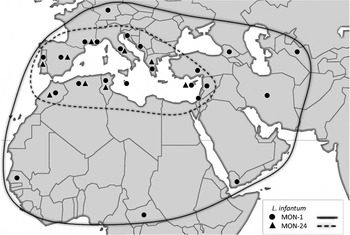
Thirty-seven different zymodemes were described (Table 2) and all of them were found in humans, with the exception of MON-278, the 2 strains of which occurred only in dogs. Only 12 zymodemes out of 37 reported were found in dogs, namely MON-1, MON-11, MON-24, MON-27, MON-30, MON-34, MON-77, MON-98, MON-108, MON-267, MON-278 and MON-281. Out of these zymodemes, MON-1 was largely predominant, with the highest number of strains (n = 1611, 78·2%) and the widest geographical distribution, including Southern Europe, Africa and the Near and Middle-East (Fig. 2). This zymodeme was present in humans, dogs, foxes, cats, rats and sandflies.
Old World geographical distribution of Leishmania infantum zymodemes MON-1 and MON-24.

The second zymodeme with a wide geographical range, corresponding to the Mediterranean Basin (Fig. 2), was MON-24 (n = 132, 6·4%), which was found in humans, dogs, and P. ariasi and P. perfiliewi sandflies. The 761 other strains belonged to 35 zymodemes with more restricted geographical distributions.
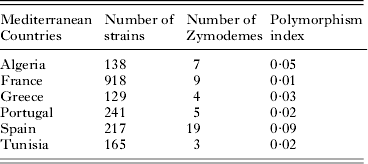
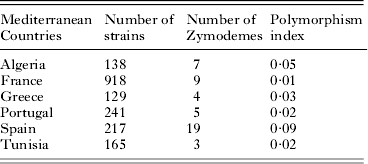
The strains studied were from 28 countries, ranging between Senegal and Portugal in the west and China in the east. Of these, 6, belonging to the Mediterranean Basin, had a sample size greater than 100 strains: Algeria, France, Greece, Portugal, Spain and Tunisia (Table 3). The polymorphism index of Spain was the highest and the France one the lowest (Table 4).
Numbers of Leishmania infantum strains according to country and to zymodeme number

Polymorphism index of the Leishmania infantum zymodemes according to the Mediterranean countries in which the sample was superior to 100
Leishmania donovani
The L. donovani sample included 169 strains, the majority of which were from human cases (n = 158 strains, 93·5%). The remaining strains were from dogs (n = 6, 3·5%) and sandflies (n = 5, 3%). The human strains mostly came from visceral leishmaniasis cases (n = 134, 84·8%), but also from cutaneous (n = 15, 9·5%) and Post Kala-azar Dermal Leishmaniasis (PKDL) cases (n = 9, 5·7%).
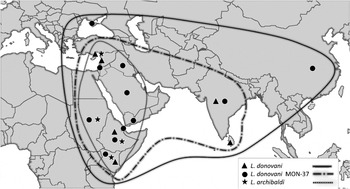
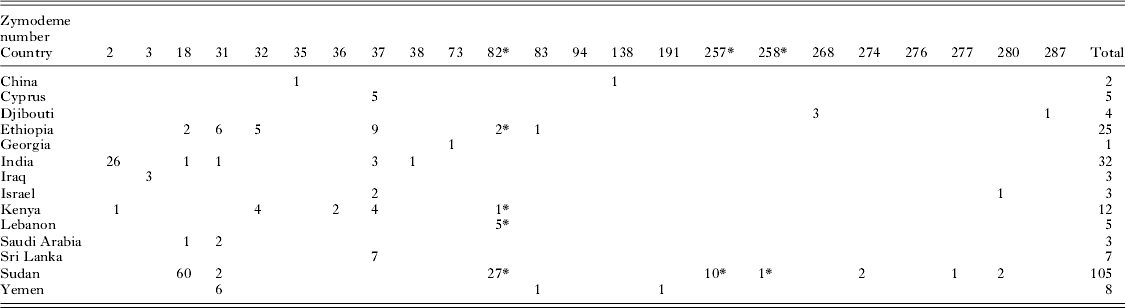
The strains studied were from 13 countries, ranging from East-Africa to China (Fig. 3). The number of strains by country was relatively small, Sudan being the only country with a sample of more than 50 strains due to dedicated epidemiological surveys.
Geographical distribution of Leishmania donovani and L. archibaldi, and particularly L. donovani MON-37.

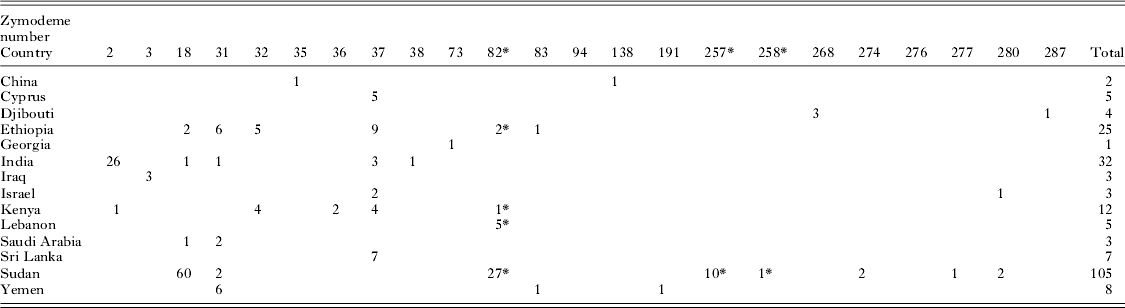
The isoenzyme analysis showed 20 zymodemes, without predominance of any one (Table 2). The number of zymodemes by country ranged from 5 for the most polymorphic (Ethiopia, India and Sudan) to 1 (Cyprus, Sri Lanka and Ukraine) (Table 5). Leishmania donovani MON-37 was the zymodeme showing the widest geographical range, from Sri Lanka and India in the east to Cyprus and East Africa in the west (Fig. 3).
Numbers of Leishmania donovani and L. archibaldi (*) strains according to country and to zymodeme number
Leishmania archibaldi
The L. archibaldi sample was limited to 46 strains, the majority of which were from human cases (n = 38, 82·6%). The remaining strains were distributed between dogs (n = 6, 13·0%) and sandflies (n = 2, 4·4%). Most of the human strains were from visceral leishmaniasis cases (n = 32, 84·2%), but some were also from cutaneous (n = 2) and PKDL cases (n = 1).
The strains studied were from 4 countries in East-Africa and Lebanon (Fig. 2). With the exception of Sudan (n = 38 strains), the numbers of strains by country were small: Ethiopia (n = 2), Kenya (n = 1) and Lebanon (n = 5). The isoenzyme analysis showed 3 zymodemes: MON-82, MON-257 and MON-258.
DISCUSSION
Since their introduction in 1980, MLEE has largely contributed to the construction of a comprehensive taxomony of the Leishmania parasites, which highly improved the knowledge of the geographical distribution and epidemiological features of leishmaniasis.
The present work is a retrospective study based on a 35 years of collection of the strain samples. Such a large sample collection provides a valuable addition to the knowledge of Leishmania geographical distribution and epidemiology. However, this type of collection evidently introduces some sampling bias, related to the geographical localization of the collection and of its main providers. The high number of L. infantum strains is due to our own field work and to collaboration with western Mediterranean country teams. Despite the fact that the sample of L. donovani, including L. archibaldi, is less represented, the number of collected strains, however, gives an indication of the global polymorphism.
In spite of an increase of the number of strains and of the corresponding zymodemes, the global structure of the taxonomic groups previously defined was remarkably confirmed. The present study confirmed the existence of 3 taxonomic groups, in contradiction to several molecular-based approaches. We will discuss separately the isoenzyme data obtained for these groups and will compare them with data in the literature.
In the Old World, L. infantum is a zoonotic species, which has domestic canids as main reservoir hosts, and is transmitted by various sandfly species, mainly belonging to the subgenera Larroussius and Adlerius in the Old World. It is typically responsible for visceral leishmaniasis but, in endemic regions, purely cutaneous cases occur occasionally (Dedet and Pratlong, Reference Dedet, Pratlong, Cook and Zumla2009). This species has a wide range, which reflects the large sample of 2062 strains analysed in this work, originating from 28 countries extending from Senegal and Portugal in the west to China in the east. Our sample included 796 strains isolated from dogs (38·6% of the strains), which confirms the zoonotic character of this taxon. The higher number of human strains (56·6% of the total strains) is based on isolations mainly obtained during human diagnosis. A majority of the human strains (77·3%) were isolated from VL cases.
A high enzymatic polymorphism was detected, with 37 zymodemes identified, of which MON-1 was the predominant one, particularly around the Mediterranean basin. This has already been reported by different studies in various Mediterranean countries: France (Pratlong et al. Reference Pratlong, Rioux, Marty, Faraut-Gambarelli, Dereure, Lanotte and Dedet2004; Marty et al. Reference Marty, Izri, Ozon, Haas, Rosenthal, Del Giudice, Godenir, Coulibaly, Gari-Toussaint, Delaunay, Ferrua, Haas, Pratlong and Le Fichoux2007), Portugal (Campino et al. Reference Campino, Pratlong, Abranches, Rioux, Santos-Gomes, Alves-Pires, Cortes, Ramada, Cristovao, Afonso and Dedet2006), Spain (Jimenez et al. Reference Jiménez, Ferrel-Dufol, Canavate, Gutierrez-Solar, Molina, Laguna, Lopez-Velez, Cercenado, Daudén, Blazquez, Ladron de Gevara, Gomez, De la Torre, Barros, Altes, Cerra and Alvar1995; Martin-Sanchez et al. Reference Martin-Sanchez, Gramiccia, Di Muccio, Ludovisi and Morillas-Márquez2004), Algeria (Harrat et al. Reference Harrat, Pratlong, Belazzoug, Dereure, Deniau, Rioux, Belkaid and Dedet1996), Tunisia (Belhadj et al. Reference Belhadj, Pratlong, Toumi, Kallel, Mahjoub, Babba, Azaiez, Dedet and Chaker2002, Kallel et al. Reference Kallel, Haouas, Pratlong, Kaouech, Belhadj, Anane, Dedet, Babba and Chaker2008) and Italy (Gramiccia et al. Reference Gramiccia, Gradoni and Troiani1992; Reference Gramiccia, Gradoni and Troiani1995; Gramiccia, Reference Gramiccia2003). Out of these 37 zymodemes, 25 were not isolated from dogs, and were considered as small variants of zymodeme MON-1, scarce in humans and the reservoir of which remains unknown. The dog is incontestably the reservoir host of L. infantum MON-1, in the Mediterranean basin, where it represents between 75 and 98·4% of the canine strains depending on the countries (reviewed by Aït Oudhia et al. Reference Aït Oudhia, Harrat, Benikhlef, Dedet and Pratlong2011) (87·2% in the present study). MON-1 has also been found in foxes in Portugal (Campino et al. Reference Campino, Pratlong, Abranches, Rioux, Santos-Gomes, Alves-Pires, Cortes, Ramada, Cristovao, Afonso and Dedet2006), and previous studies described it as L. infantum wild reservoir host in different countries, including France (Rioux et al. Reference Rioux, Albaret, Houin, Dedet and Lanotte1968), Italy (Bettini et al. Reference Bettini, Pozio and Gradoni1980), Spain (Portus et al. Reference Portus, Gallego, Riera, Aisa, Fisa and Castillejo2002) and Portugal (Abranches et al. Reference Abranches, Conceição-Silva, Ribeiro, Lopes and Gomes1983).
The enzymatic polymorphism of L. infantum is in reality somewhat greater than detected in our sample. Nine additional L. infantum zymodemes have been identified in other labs on the basis of their differences with the known MON-zymodemes and qualified as ‘variants’ by the authors : GR-2 (MON-77 var MDH104), GR-8 (MON-77 var MDH104, GPI105), GR-11 (MON-199 var NP1130), GR-13 (MON-183 var NP1140), GR-14 (MON-198 var G6PD102), GR-17 (MON-80 var ME93), GR-19 (MON-24 var NP1150) (Martin-Sanchez et al. Reference Martin-Sanchez, Gramiccia, Di Muccio, Ludovisi and Morillas-Márquez2004), and MON-1 var DIA110, MON-189 var NP1140 (Gramiccia, Reference Gramiccia2003).
Concerning the enzymatic polymorphism, a high level has already been reported in southern Spain, where 20 zymodemes were detected for 161 strains (Martin-Sanchez et al. Reference Martin-Sanchez, Gramiccia, Di Muccio, Ludovisi and Morillas-Márquez2004) and 22 zymodemes in a sample covering all Spain during 1984–2001 (Chicharro, et al. Reference Chicharro, Jimenez and Alvar2003). Similarly, a high polymorphism was described in strains isolated from sandflies in Southern Spain (Martin-Sanchez et al. Reference Martin-Sanchez, Morillas-Márquez, Acedo-Sánchez and Sanchez-Marín1995, Reference Martin-Sanchez, Gramiccia, Di Muccio, Ludovisi and Morillas-Márquez2004). In the last paper, 16 zymodemes were found for 45 strains isolated from sandflies (Martin-Sanchez et al. Reference Martin-Sanchez, Gramiccia, Di Muccio, Ludovisi and Morillas-Márquez2004). In Italy, a comparative study of PI carried out by Gramiccia (Reference Gramiccia2003) showed regional variations, with a particularly high PI in Sicily (14 zymodemes for 108 patients, PI = 0·13,) when compared to the rest of Italy (7 zymodemes for 253 patients, PI = 0·03). Whatever the country, the polymorphism was partially attributed to particular zymodemes found in HIV co-infected patients (Pratlong et al. Reference Pratlong, Dereure, Deniau, Marty, Faraut-Gambarelli and Dedet2003; Chicharro et al. Reference Chicharro, Jimenez and Alvar2003 and Gramiccia, Reference Gramiccia2003). This was particularly evident in Sicily, where the PI was 0·3 versus 0·13, respectively in HIV-positive and HIV-negative patients (Gramiccia, Reference Gramiccia2003).
In Sudan, 39 L. infantum strains belonging to 4 different zymodemes were detected in our work. The existence of this taxon in East Africa has been largely debated. Jamjoom et al. (Reference Jamjoom, Ashford, Bates, Chance, Kemp, Watts and Noyes2004) proposed to explain the presence of L. infantum zymodemes in Sudan as a consequence of a recent mutation of the GOT gene from local L. donovani stocks, a possible example of convergence according to these authors, L. donovani is classically an anthroponotic species, restricted to the Old World, where it is found from East Africa to Central Asia and China. It is transmitted by various sandfly species belonging to the subgenera Euphlebotomus, Synphlebotomus and Larroussius. It is mainly responsible for visceral leishmaniasis and characterized by the subsequent occurrence of PKDL. It can also exceptionally be responsible for localized cutaneous leishmaniasis (Pratlong et al. Reference Pratlong, Bastien, Perello, Lami and Dedet1995). Epidemic outbreaks have been described in India, as well as in Sudan.
Although our sample of 169 strains is much smaller than that of L. infantum, it is representative of the distribution of the species, which involves 13 countries extending from East Africa to China. The only country for which we have a large sample is Sudan, where we carried out an epidemiological survey (Dereure et al. Reference Dereure, El Safi, Bucheton, Boni, Kheir, Davoust, Pratlong, Feugier, Lambert, Dessein and Dedet2003; Pratlong et al. Reference Pratlong, Dereure, Bucheton, El-Safi, Dessein, Lanotte and Dedet2001). The strains of India and Sri Lanka came from collaborations with local teams (Thakur et al. Reference Thakur, Dedet, Narain and Pratlong2001; Karunaweera et al. Reference Karunaweera, Pratlong, Siriwardan, Ihalamulla and Dedet2003). The majority of the strains are of human origin (93·5%) in accordance with the role of the reservoir played by humans. For India, 88% of the strains isolated after 1970 were MON-2 zymodeme. This low polymorphism is in accordance with the data reported by Alam et al. (Reference Alam, Haralambous, Kuhls, Gouzelou, Sgouras, Soteriadou, Schnur, Pratlong and Schönian2009) and Downing et al. (2012), and might be explained as a side-effect of the 1960s anti-malaric campaigns.
By contrast with L. infantum, only 20 zymodemes were found for L. donovani. The enzymatic polymorphism appeared lower, which might be due to the smaller number of strains (about 10 times smaller). With the exception of Sudan, the absence of field epidemiological surveys prevents the evaluation of the enzymatic polymorphism in each country. In this group, the only new findings are the extension of zymodeme MON-37 from East Africa, to India and Sri Lanka (Karunaweera et al. Reference Karunaweera, Pratlong, Siriwardan, Ihalamulla and Dedet2003), and more recently to south-eastern Europe, in Cyprus (Antoniou et al. Reference Antoniou, Haralambous, Mazeris, Pratlong, Dedet and Soteriadou2008). The molecular studies of different strains belonging to this zymodeme are in favour of an alternate hypothesis of a paraphyletic origin (Alam et al. Reference Alam, Haralambous, Kuhls, Gouzelou, Sgouras, Soteriadou, Schnur, Pratlong and Schönian2009).
L. donovani var. archibaldi was named by Castellani and Chalmers (Reference Castellani and Chalmers1919) for the parasite responsible for Sudanese VL, on clinical, epidemiological and geographical grounds. The VL in Sudan was subsequently attributed to either L. donovani or L. archibaldi. The name L. archibaldi was reintroduced by Rioux et al. (Reference Rioux, Lanotte, Pratlong, Bastien and Perieres1990) for a single zymodeme MON-82. Later, Pratlong et al. (Reference Pratlong, Dereure, Bucheton, El-Safi, Dessein, Lanotte and Dedet2001) discussing the taxonomic position of L. archibaldi, stressed 2 options: to consider L. archibaldi as a new complex or as a subunit of L. donovani s.l. Subsequently, the taxonomic status of L. archibaldi has been controversial, and considered by molecular tools as L. donovani (Kuhls et al. Reference Kuhls, Keilonat, Ochsenreither, Chaar, Schweynoch, Presber and Schönian2007). However, a recent paper still individualized the L. archibaldi taxon by a microsatellite loci approach (Rougeron et al. Reference Rougeron, De Meeûs, Hide, Le Falher, Bucheton, Dereure, El-Safi, Dessein and Banyuls2011).
Among the 46 strains studied in the present paper, the same 3 zymodemes occurred as found in the 2001 sample of 6 strains, showing that the increase in sample size did not change the polymorphism. Leishmania archibaldi appears to be mainly located in East Africa.
More recently, independently of the isoenzymes, several molecular methods have been used for the taxonomic description and identification of Leishmania. Molecular analyses were performed both on coding genes (HSP70, PolA, RPOII, CytoB, GP63, genes coding for 10 isoenzymes) and non-coding DNA sequences (repeated sequences, ribosomal ITS, microsatellites). Except in a few studies (Kuhls et al. Reference Kuhls, Keilonat, Ochsenreither, Chaar, Schweynoch, Presber and Schönian2007; Lukes et al. Reference Lukes, Mauricio, Schönian, Dujardin, Soteriadou, Dedet, Kuhls, Tintaya, Jirku, Chocholova, Haralambous, Pratlong, Obornik, Horak, Ayala and Miles2007; Mauricio et al. Reference Mauricio, Yeo, Baghaei, Doto, Pratlong, Zemanoca, Dedet, Lukes and Miles2006), the number of analysed strains and discriminatory genetic markers was generally low, resulting in poor information content and some contradictory outcomes. However, the general messages were quite similar in the different studies and were confirmed in large-scale studies involving multiple genetic markers.
First of all, a good congruence was observed between the genetic data and the geographical distribution of the strains. As stressed by Lukes et al. (Reference Lukes, Mauricio, Schönian, Dujardin, Soteriadou, Dedet, Kuhls, Tintaya, Jirku, Chocholova, Haralambous, Pratlong, Obornik, Horak, Ayala and Miles2007), L. donovani, L. infantum and L. archibaldi from Sudan were globally intermingled in the molecular trees and networks, while the European L. infantum strains (mainly from Italy, France and Spain) were identified as a cluster. In different studies, L. archibaldi was not supported (Gelanew et al. Reference Gelanew, Kuhls, Hurissa, Weldegebreal, Hailu, Kassahun, Abebe, Hailu and Schönian2010) and the authors proposed to include it in L. donovani. The differences between the isoenzymatic and the molecular outcomes could partially be explained by the existence of discrepancies between the isoenzyme-coding gene sequences and the phenotype (electromorphs) observed. Looking at the genetic basis of the enzymatic polymorphism by studying the isoenzyme gene sequences, Mauricio et al. (Reference Mauricio, Yeo, Baghaei, Doto, Pratlong, Zemanoca, Dedet, Lukes and Miles2006) and Zemanova et al. (Reference Zemanová, Jirku, Mauricio, Horák, Miles and Lukes2007) showed that there was a good correlation between the amino-acid sequence polymorphism and related changes in enzyme mobility. Nevertheless, in some cases, distinct genotypes produced identical isoenzymatic phenotypes, and different isoenzymatic phenotypes were coded by identical genotypes.
The contribution of each enzyme to the structure of the global tree was unequal and could be divided into 3 groups: (i) not contributing (ICD, NP2) or poorly contributing (PGD, ME, GLUD, DIA and PGM) to the structure, (ii) shared between the 3 species (G6PD, NP1, FH, MPI, MDH and GPI) and (iii) differentiating the 3 taxa L. infantum, L. donovani and L. archibaldi (GOT1 and GOT2). The exclusion of the 2 GOTs produces a different tree in which the zymodemes belonging to the 3 taxa are intermingled, giving in fine a single large group without evident structure (data not shown). This loss of structure is related to the poor support of the tree.
In conclusion, the classification based on isoenzymes does not show the L. donovani/L. infantum merging resulting from molecular approach, and maintains the existence of 3 taxonomic groups. Except for a case of convergent evolution (Jamjoom et al. Reference Jamjoom, Ashford, Bates, Chance, Kemp, Watts and Noyes2004), there is no convincing explanation for such a discrepancy. As proposed by Schönian et al. (Reference Gelanew, Kuhls, Hurissa, Weldegebreal, Hailu, Kassahun, Abebe, Hailu and Schönian2010) and Van der Auwera et al. (Reference Van der Auwera, Fraga, Montalvo and Dujardin2011), a revision of the taxonomy of Leishmania is needed for taking into account the outcomes of new genetic studies. Such a development might be based on multiple gene sequencing; it must be highly congruent and uncontroversial, and must be applied to the largest possible sample of strains, as has been the case for isoenzyme analysis.
ACKNOWLEDGEMENTS
The authors thank all the collaborating teams and scientists who, over a period of 24 years, sent strains for isoenzyme identification, and kindly agreed that they should be included in the present paper: Abranches P., Lisbon (Portugal); Aït Oudhia K., Algiers (Algeria); Akuffo H., Stockholm (Sweden); Alvar J., Madrid (Spain); Antoniou M., Iraklion (Greece); Ashford R.W., Liverpool (UK); Azaiez R., and Babba H., Monastir (Tunisia); Baneth G., Rehovot (Israel); Belazzoug S., Tipaza (Algeria); Belkadi G., Paris (France); Bettini S., Calgari (Italy); Bogdan C., Erlangen (Germany); Botterel F., Créteil (France); Bourdoiseau G., Lyon (France); Bourée P., Kremlin-Bicêtre (France); Buffet P., Paris (France); Campino L., Lisbon (Portugal); Chaker E., Tunis (Tunisia), Dardé M.L., Limoges (France), Deniau M., Créteil (France), Desplazes P., Zurich (Switzerland), Desjeux P., Divonne-les-Bains (France), Edrissian, Tehran (Iran), Eichenlaub, Munich (Germany), El Safi S., Khartoum (Sudan), El Hassan A., Khartoum (Sudan), Evans D., London (UK), Faraut-Gambarelli F., Marseille (France), Favennec L., Rouen (France), Fleischmann E., Munich (Germany); Gallego M., Barcelona (Spain); Gangneux J.P., Rennes (France); Garifalou A., Athens (Greece); Garnotel E., Marseille (France); Garrabé E., St Mandé (France); Gramiccia M., Roma (Italia); Grimm F., Zurich (Switzerland); Hamane S., Paris (France); Hamers R., Antwerpen (Belgium); Harrat Z., Alger (Algeria); Houin R., Créteil (France); Houzé S., Paris (France); Izri A., Bobigny (France); Karunaweera N., Colombo (Sri Lanka); Kennou M.F., Tunis (Tunisia), Killick-Kendrick R., Sumène (France), Lachaud L., Nîmes (France); Lamothe J., Carros (France); Le Fichoux Y., Nice (France); Le Guern A.S., Paris (France); Le Ray D., Antwerpen (Belgium); Mansouri R., Annaba (Algeria); Marty P., Nice (France); Mauricio I., London (UK); McMahon Pratt D., New Haven (USA); Meredith S., Amsterdam (Netherlands); Modabber F., Geneva (Switzerland); Morillas-Marquez F., Granada (Spain); Osenzoy S. and Ozbel Y., Izmir (Turkey); Perello R, Perpignan (France); Peters W., London (UK); Peyron F., Lyon (France); Piens M.A., Lyon (France); Portus M., Barcelona (Spain); Prinat E., Paris (France); Sarfati C., Paris (France); Schnur L., Jerusalem (Israel); Soteriadou K., Athens (Greece), Sulahian A., Paris (France); Thakur C.P., Patna (India); Vidor E., Lyon (France); Vitale M., Palermo (Italia); Zijlstra E., Rotterdam (Netherlands). The authors also express their acknowledgements to J.A. Rioux, Director of the laboratory until 1990. They also acknowledge expert technical assistance of M. Lefebvre and L. Talignani. Since 1998, the Centre National de Référence des Leishmania has received financial support from the French Ministry of Health, through the Institut National de Veille sanitaire (Paris).