Introduction
The concept of “successful aging” is based on the premise that functional decline noted in the elderly is not inevitably associated with aging but may be related to psychosocial phenomena (Rowe and Kahn, Reference Rowe and Kahn1987). Successful aging is not limited to physical health but extends to maximizing psychological resources as reflected by self-fulfillment and resilience (Bowling and Iliffe, Reference Bowling and Iliffe2011). Central to successful aging is the balance between psychache and resilience. Although little researched, the work of Lomranz (Reference Lomranz, Hobfoll and de Vries1995; Reference Lomranz1998) derived from extensive experience with Holocaust survivors (HS) helps to conceptualize the precarious balance between psychache and resilience. Lomranz (Reference Lomranz1998) developed the a-integration theory that posits the existence of an internal cluster of contradictions that the self can accommodate in old age. Thus, as we age we can remain vague, accept ambivalence, and contain traumatic events with surprisingly little disruption in our daily lives. Lomranz (Reference Lomranz1998) suggests that HS can be vulnerable and aching as well as resilient at the same time. The majority of HS living in Israel have three characteristics in common: the Holocaust experience, the aging process, and the present-day threats to their security and safety. The time elapsed since the Holocaust, the pervasive physical and psychological trauma, the intensity of the experience and its moral implications served to intensify the accumulating impact of the Holocaust on aging survivors (Dasberg, Reference Dasberg1987).
Resilience is characterized by maintenance of health or improvement of physical and mental health following trauma (Ryff et al., Reference Ryff, Singer, Love, Essex and Lomranz1998). Traditionally geriatrics and gerontology focused on research and treatment of illness and loss accompanying the aging process (Ryff et al., Reference Ryff, Singer, Love, Essex and Lomranz1998). The last decade hosted a change and a growing body of research provides insights into satisfaction with life, well-being, and acceptance of aging (Hardy et al., Reference Hardy, Concato and Gill2004). Windle (Reference Windle2010) reviewed the studies on resilience demonstrating its importance for aging and defining it as a process of effective negotiation, adaptation or resource management in times of stress and trauma. Resilience is dynamic and changes along one's lifecycle but the resilient person will be unique in learning how to manage life's events. On the other hand, psychache is the construct relating to human sorrow, suffering, and psychological distress (Shneidman, Reference Shneidman1993). It is a shuddering experience in loss of the important human needs accompanied by accumulation of powerful negative affects. Little is published on the definition and clinical significance of psychache (Orbach, Reference Orbach2003). Irreversibility of loss and awareness of negative changes in the self are typical of psychache and are associated with risk of suicide even more than depression. The distinction between depression, anxiety, and psycache is well established (Orbach et al., Reference Orbach, Mikulincer, Sirota and Gilboa-Schechtman2003). Exposure to trauma results in increasing levels of psychache necessitating a change from the inert cognitive style and value systems we usually employ in our daily lives in order to survive (Epstein, Reference Epstein, Ozer, Healy and Stewar1990). Severe and prolonged psychache may remain in the core of person's self-awareness following massive trauma despite forces of resilience contributing to recovery and creation of new lives.
The trauma suffered by HS is pivotal in its implications for the question: “are HS more resilient or more fragile having survived this massive trauma?” Research findings are unequivocal with reports that aging HS emphasize existential threats (Joffe et al., Reference Joffe, Brodaty, Luscombe and Ehrlich2003), while others report significant resources of strength (Norris and Murrel, Reference Norris and Murrell1988). Many HS employed a-integration during and following the holocaust thus formally functioning in everyday life while carrying extreme mental pain (Lomranz, Reference Lomranz1998). The aim of the present study is to assess the balance between resilience and psychache of aging HS in order to better understand the mechanisms of recovery from massive trauma.
Methods
The present investigation was designed and executed as a cross-sectional study. Using the Israeli National Census database a list of HS was complied. A participant was defined as HS if they had been in Europe in a country under the Nazi occupation and rule during the years 1939–1945. Random sampling from the list of HS was performed and invitation letters were forwarded to chosen individuals. In a similar manner age- and gender-matched non-survivor comparison individuals were approached. A comparison participant was one who was born in Europe but had immigrated to Israel (then Palestine) before 1939.
The authors mailed 832 letters of which only 757 were received by the addressees. There were 230 addressees of our letter who had passed away and were thus excluded. During the first telephone contact with 527 potential participants 313 refused to take part in this project. Thus, 214 participants who consented to be interviewed in a follow-up phone call comprise the present sample. Of these participants there were 107 HS and 107 comparison participants. There were 113 male and 101 female participants, with mean age being 80.7 ± 4.7 years, (range: 68–93). All had signed an informed consent form after detailed explanation by the primary investigator (IO). The study was approved by the Tel-Aviv University committee for experiments with human participants.
Measurements
Two rating scales were endorsed by all participants – in addition to a detailed “face-to-face” qualitative interview. The Resilience Scale (RS; Wagnild and Young, Reference Wagnild and Young1990) is a 25-item rating scale focusing on level of resilience and improved coping. Each item is rated on a 1 to 7 scale (1 = completely disagree to 7 = completely agree) and the total score is the simple arithmetic addition of all item scores, range: 25 to 175. Higher scores represent better resilience. All items are worded positively and the RS has been shown to have good internal consistency (α = 0.80). Psychache was measured using the Orbach & Mikulincer Mental Pain (OMMP; Orbach and Mikulincer, Reference Orbach and Mikulincer2000). The final version of this scale includes 45 items divided into nine domains: irreversibility, loss of control, narcissistic damage, emotional flooding, emotional numbing, estrangement, confusion, social isolation, and emptiness. Each item is rated on a 5-point Likert scale. Higher scores reflect more intense psychache. The total psychache score was found to explain 55.8% of variance. Thus, we analyzed both domains and total psychache in the present study. Internal consistency of the OMMP scale was reported to be high (α = 0.94).
Depression is a well-studied confounder in research amongst the elderly – and especially when focusing on psychache. We used the Geriatric Depression Scale's (GDS) 15-questions version to screen for depression in all participants and comparison members (Albiński et al., Reference Albiński, Kleszczewska-Albińska and Bedyńska2011).
Statistical analysis
All analyses were carried out with SPSS, version 18. Joint tests of significance were conducted using the -2 Log Likelihood Ratio test. Wilcoxon rank sum test was also used. Proportions were compared using χ 2 or two-sided Fisher's exact tests. Logistic regression analyses (analysis of variance (ANOVA) and multivariate analysis of variance (MANOVA)) evaluated the relationships between predictive variables and generated odds ratios and corresponding 95% confidence intervals. Logistic regression also provided a means of controlling for potential confounding variables. Potential predictive variables included in the logistic model were: age, gender, and status.
Results
Demographics
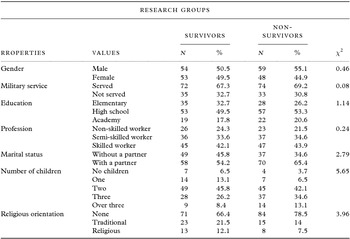
There were no significant differences between the HS and the comparison group in most parameters. There was a minor over-representation of male participants in our sample (52.8%). In both groups the majority of participants had served in the Israeli army after immigrating to the country (67.3% in the HS group and 69.2% in the comparison group).
In both groups just over half of the participants had a high-school education and 43% of the sample had a skilled job during their employment career.
See Table 1 for demographic details.
Characteristics of the study groups – survivors and non-survivors (N = 214)

Resilience
High levels of resilience were scored by participants in both groups. Mean resilience score for HS was 5.82 ± 0.7 and 5.88 ± 0.6 for the comparison group (p = NS).
Psychache
Holocaust survivors reported higher levels of psychache than the levels scored by the comparison group (mean: 1.93 + 0.7 vs. 1.75 + 0.5 respectively, p = 0.02). Examination of the various domains captured by the OMMP demonstrated higher scores for the HS in the “affective numbing” and “narcissistic damage” domains (p < 0.05).
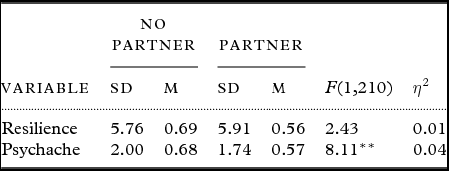
See Table 2 for outcome measures.
Participants living alone versus living with partner

*p < 0.5; **p < 0.01; ***p < 0.001
η 2 = the proportion of variance associated
F = significant differences between the means
M = mean
SD = standard deviation
Mediating variables
Age and marital status were found to mediate the association between psychache, resilience, and history of Holocaust exposure. The older HS participants had higher psychache scores while the association amongst the comparison participants was reversed, with younger participants scoring higher on psychache (p < 0.05). It is of interest to note that nearly half (46%) of the HS were living alone compared to 35% of the comparison participants. Psychache was more pronounced and resilience lower in participants living alone compared to participants living with wife or partner (p < 0.04), see Table 2.
Depression was measured as a continuous variable (score on the GDS ranging from 0 to 15) or as a probable clinical entity (scores higher than 5 on the GDS). Mean score on the GDS was 3.94 + 3.65 for the HS participants and 2.77 + 2.74 for the comparison participants (p = 0.03). Very few participants scored in the range suggesting clinically meaningful depression (only 3% of the between-group variance was explained by depression).
Discussion
The so-called “grey epidemic” of older persons has led to increased interest in maintenance of general health, vigor, and quality of life with aging. Most research continues to emphasize only one or two components of successful aging. Additional focus on understanding contributors to self-perceived health in aging could potentially yield improved quality of life in older persons. Recently, Jeste and colleagues (Reference Jeste2013) described one of the first large-scale community-based studies devoted to evaluating determinants and correlates of self-rated successful aging. They assessed a cohort of 1,006 community-dwelling adults, aged between 50 and 99. Self-rated successful aging steadily increases with age. Among a variety of factors related to positive outcomes mental health appeared to be the key. Greater resilience and less depression were among the strongest variables associated with self-rated successful aging. The best multiple regression models achieved, using all the potential correlates, accounted for 30% of the variance in the score for self-rated successful aging and included resilience, depression, physical functioning, and age. This suggests that increasing resilience through its core attributes such as coping, hardiness, and self-concept, and reducing depression might have effects on successful aging as strong as that of reducing physical disability (Grodstein, Reference Grodstein2013; Hicks and Conner, Reference Hicks and Conner2013).
In the present study we investigated the association between psychache and resilience amongst aging HS. Our working hypothesis stated that both these variables are present and interact in HS as well as in elderly not exposed to the holocaust. Our findings clearly demonstrate that although more than 60 years have passed since World War II, and despite coping and integration in the Israeli society, the holocaust trauma is still active and pulsating amongst HS. Surprisingly, there were no significant differences between the HS and comparison participants and all had high levels of resilience. These findings are in contrast to the stigma that the elderly are frail and dependent. A Swedish study using similar measures supports our findings that the elderly are highly resilient even in comparison to young adults (Nygren et al., Reference Nygren, Aléx, Jonsén, Gustafson, Norberg and Lundman2005).
Yet, we need to explain the high levels of resilience amongst HS. One reason may be the “survivor effect” – the same biopsychological constituents that conferred survival skills moderate the effects of the holocaust trauma and bolster resilience (Palgi and Shmotkin, Reference Palgi and Shmotkin2007). The other plausible reason is that the HS population is heterogeneous and their lives after the holocaust sculptured and modulated the effects of the holocaust and honed resilience. Finally, we cannot rule out the possibility that the scale used to quantify resilience is not sensitive enough to discriminate between groups with relatively high resilience.
Psychache was found to be more profound amongst the HS. To the best of our knowledge the present study is the first attempt to investigate psychache in the elderly. Compared to younger adults and clinically depressed and suicidal patients, psychache levels were lower in our sample. The HS quantified their psychache to be within the range reported by normal healthy adults. We speculate that while suicidal individuals report sharp present psychache, HS are in fact reporting on lifelong existential psychache. Depressed and suicidal persons lack fulfillment of essential psychic and social needs and this reflects in their frustrated perception of psychache (Orbach, Reference Orbach2003). The psychache HS contain is in the nature of a chronic condition that they adapt to over decades. This is also echoed in the higher scores on the “numbing and alienation” subscale of the HS participants, emphasizing their feelings of living apart from their social surroundings. Our findings match the work by Kahana and colleagues (Reference Kahana, Kahana, Harel, Kelly, Monaghan, Holland and Gottlieb1997) who reported paucity of social ties amongst HS. The explanation put forward by Kahana and others was that HS are lonely and socially detached because of the prevailing stigma about them within the Israeli society. We suggest that HS are present with narcissistic impairment and inability to accept help from others. Thus, their weak “social-self” becomes apparent while measures of “inner-self” are stable. Indeed, the “alienation from self” subscale in our study was not scored highly by the HS. The qualitative interview clearly demonstrated that HS feel they have intact insight and knowledge about their inner psychic life. The discrepancy between social and inner lives amongst aging HS may be another manifestation of the a-integration theory by Lomranz (Reference Lomranz1998), particularly an ability to perform cognitive operations that are dialectic and post-formal. Holocaust survivors are aware of the contradictory and constantly changing nature of life and are able to accept the resulting tension inherent in the opposing poles of reality. They are thus less vulnerable to the overt manifestations of psychache, such as anxiety, pain, and guilt.
The present study has several limitations that need be addressed. Willingness to participate in the study was much higher amongst the non-survivors approached and sample size is moderate. The sample is in a way a “convenience” sample as all participants were recruited from the greater Tel-Aviv urban area. In addition, similar to many studies undertaken with HS now days, our participating HS are or relatively old age, possibly more resilient and have a greater life expectancy than the general population.
Research into the long-term psychological effects associated with Holocaust experiences is a mixture of contradicting findings. The main issue is the diverging results of empirical versus clinical studies. One of the leading groups focusing on these issues in HS, second-generation participants, and even the grandchildren of HS, has published several studies, two of which are herein discussed. First, Iliceto and colleagues (Reference Iliceto, Candilera, Funaro, Pompili, Kaplan and Markus-Kaplan2011) compared the two groups of grandchildren of HS and controls on psychological dimensions relevant to traumatic sequelae. They found no differences between the two groups in hopelessness and were similar to controls in affective temperament and self-perception (Iliceto et al., Reference Iliceto, Candilera, Funaro, Pompili, Kaplan and Markus-Kaplan2011). Second, a comprehensive look back at the past centuries to understand why suicide was thought to be confined to psychiatric illness and to document the bias in studies supporting this notion was undertaken. One major step forward in the conceptualization of suicide as a psychological disorder was provided by Edwin Shneidman, who focused on the pain of negative emotions. Such a radical approach is praiseworthy in the present “mechanistic” era of psychopathology (Pompili et al., Reference Pompili, Lester, Leenaars, Tatarelli and Girardi2008; Pompili, Reference Pompili2010). These two studies illuminate the need for and importance of looking at resilience, psychache, hope, and despair while attempting to unlock the mysteries of HS inner world. The present work attempted to follow these general principles.
In conclusion, the negative correlation between resilience and psychache is a unique finding of the present study. Higher resilience levels are associated with less psychache. There are no studies that have examined this relationship, however, work by Shmotkin (Reference Shmotkin2008) demonstrated that people exposed to chronic stress and trauma (wars, immigration, and resettlement) can develop a fine balance between vulnerability and resilience in old age. The HS in the present study seem to exemplify the balance between the lifelong effects of trauma and the creation of new lives following this trauma. Further studies are needed to reveal other aspects of the interplay between resilience and psychache.
Conflict of interest
None.
Description of authors’ roles
All authors (I. Ohana, H. Golander, and Y. Barak) formulated the research questions and designed the study along with writing the paper. I. Ohana carried out the study, and collected and analyzed the data. H. Golander and Y. Barak supervised the data collection and wrote the paper.