Introduction
Research has indicated beneficial effects of Internet use on cognitive functioning in later life (Berner et al., Reference Berner2019; Kamin and Lang, Reference Kamin and Lang2020), but existing studies did not explain possible reasons for this relationship. Therefore, we explore the role of participation in social and leisure activities as a potential mediator of the relation between Internet use and cognitive functioning using a 4-year longitudinal sample of European older adults. We hypothesized that Internet users participate in a greater variety of activities, which, in turn, would be positively associated with cognitive functioning.
The preservation of cognitive functioning is an essential component of healthy aging. Therefore, it is relevant to identify how technology may positively affect cognitive health among older adults. Increasing evidence indicates a longitudinal relationship between Internet use and cognitive functioning in old age. Berner et al. (Reference Berner2019) analyzed two large longitudinal datasets and found that Internet users reported less cognitive decline over time than nonusers. In another study, Kamin and Lang (Reference Kamin and Lang2020) reported that Internet use positively predicted cognitive functioning over the course of 2 years in a large European dataset. However, we do not know whether Internet use itself is a predictor of cognitive functioning. It is possible that other mechanisms may account for this relationship (Moxley and Czaja, Reference Moxley and Czaja2019), but empirical evidence is scarce.
From a theoretical perspective, Internet use involves many opportunities to engage in social and leisure activities in everyday life. Examples include social contact with others (Czaja, Reference Czaja2017), initiation and planning of physical activity (Seifert et al., Reference Seifert, Schlomann, Rietz and Schelling2017), or accessing resources within the community (Forsman and Nordmyr, Reference Forsman and Nordmyr2017). Research indicates an association between the participation in activities and cognition. For example, Litwin and Stoeckel (Reference Litwin and Stoeckel2016) found that older adults who participated in a variety of activities reported better cognitive functioning. Other studies reported that participation in social and leisure activities mitigated cognitive decline (Lövdén et al., Reference Lövdén, Ghisletta and Lindenberger2005). Taken together, these findings suggest that participation in activities reflects a context of cognitive stimulation in later life (Hertzog et al., Reference Hertzog, Kramer, Wilson and Lindenberger2008). On the other hand, the Internet may support the engagement in activities in everyday life, which could indicate a behavioral pathway between Internet use and cognitive functioning.
This research investigates the association between Internet use, participation in activities, and cognitive functioning in a large representative dataset of older adults. In our study, activity is defined as a count variable to indicate the number of different social and leisure activities (e.g. volunteer work, educational courses, and physical activity) participants have engaged in. This approach is consistent with the activity literature in cognitive aging research (Hertzog et al., Reference Hertzog, Kramer, Wilson and Lindenberger2008; Lövdén et al., Reference Lövdén, Ghisletta and Lindenberger2005). Given the previous arguments, we assumed that the participation in a wide range of diverse activities would mediate a positive relationship between Internet use and cognitive functioning. That is, older adults who use the Internet should be more likely to engage in activities, which, in turn, should have a positive influence on cognitive functioning. We tested our assumptions with a cross-lagged panel model to examine the temporal order of the assumed relations over the course of 4 years.
Methods
Participants
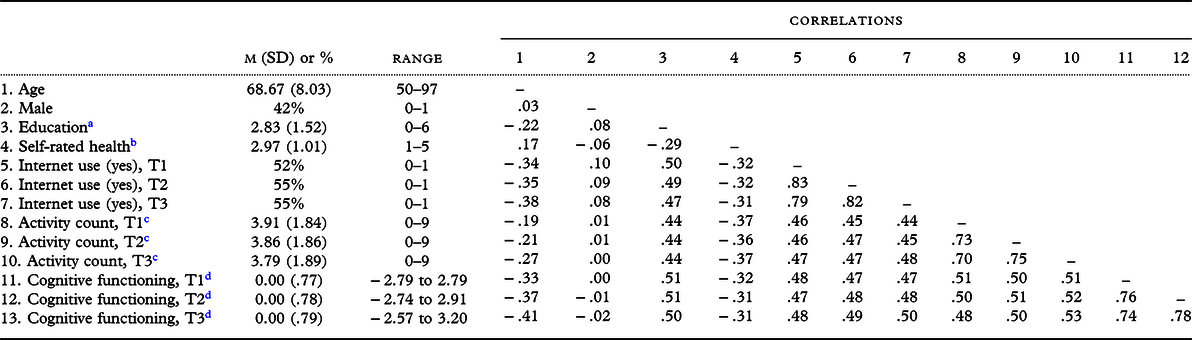
We used three waves (T1:2013, T2:2015, and T3:2017) from the Survey of Health, Ageing and Retirement in Europe (SHARE) (Börsch-Supan et al., Reference Börsch-Supan2013). Only these waves included our measures of interest. Participants came from 10 different European countries and were at least 50 years old. We included only cases with full information on the data. In addition, participants who reported diagnoses of cognitive impairments at T1 were excluded from the sample (Alzheimer’s disease, dementia, stroke, and Parkinson’s disease). The total sample included 8353 participants with an average age of 68.67 years (SD = 8.03) at the first wave in 2013. Table 1 provides a description of the sample.
Descriptive statistics and correlations (n = 8353)

a ISCED-97 coded educational level (0 = lowest to 6 = highest).
b Self-rated health (1 = excellent to 5 = poor).
c Number of activities.
d Standardized composite scores are calculated from the Animal Naming Task, 10-word list immediate recall, 10-word list delayed recall, and Serial 7s task.
Measures
Cognitive functioning at each wave was assessed with cognitive testing instruments (Dewey and Prince, Reference Dewey, Prince, Börsch-Supan, Brugiavini, Mackenbach, Siegriest and Weber2005), namely the Animal Naming Task (executive functioning and pragmatic knowledge), the immediate and delayed recall of a 10-word list (immediate and delayed episodic memory), and the Serial 7s task (concentration and working memory). We adopted a procedure from previous research and calculated composite measures of cognitive functioning by averaging the standardized test scores (Kamin and Lang, Reference Kamin and Lang2020). Cronbach’s alpha of the standardized test scores was .77 at T1, .79 at T2, and .79 at T3.
Internet use at each wave was measured by asking the participants whether they had used the Internet in the past 7 days (0 = no; 1 = yes). This measure has been used in previous research as a broad indicator of regular Internet usage behavior (Berner et al., Reference Berner2019; Kamin and Lang, Reference Kamin and Lang2020).
Activity at each wave was computed as a count variable of different social and leisure activities. Participants answered whether they had engaged in seven activities during the past 12 months: (1) volunteering, (2) educational courses, (3) sport or social clubs, (4) political or community events, (5) reading newspapers and magazines, (6) doing word or number games, and (7) playing games with others. In addition, we included two items asking whether (8) moderate activities (e.g. gardening) and (9) vigorous activities (e.g. sports) had been carried out at least once a month. The resulting count score ranged from 0 to 9, with higher scores reflecting a greater activity level. Cronbach’s alpha of the scores was .60 at T1, .61 at T2, and .63 at T3. We adapted this approach from Litwin and Stoeckel (Reference Litwin and Stoeckel2016).
Covariates included chronological age in years, sex (0 = female; 1 = male), and highest educational level coded by ISCED-97 (0 = pre-primary education to 6 = second state of tertiary education) at T1. In addition, we included a one-item measure of self-reported health (1 = excellent to 5 = poor).
Analytical strategy
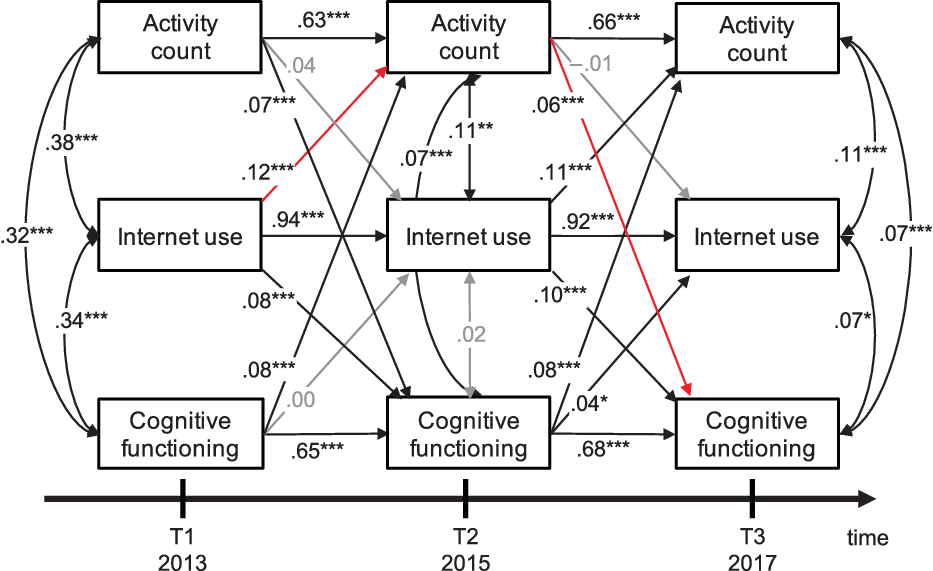
We estimated a three-wave cross-lagged panel model using Mplus 8.3 software (see Figure. 1). This model explored the temporal ordering of the mediation and included T1 Internet use as a predictor of T2 activity participation, which, in turn, predicted T3 cognitive functioning. We specified cross-lagged associations between measurements while simultaneously controlling for prior levels and baseline associations of the variables. This rigorous approach allowed us to control for alternative explanations such that individuals with better cognition would become more active over time. The model was fully controlled for covariates at each wave. We applied a sandwich estimator with bootstrapping (5000 draws) to take possible within-cluster correlations (individuals nested in countries) into account.
Three-wave cross-lagged panel model. Nonsignificant paths are greyed out. Red paths represent the tested mediation effect. Standardized estimates. *p < .05. **p < .01. ***p <.001.

Results
Figure 1 indicates moderate-to-high stabilities of the measures over time. In particular, Internet use was highly stable across all waves indicating less change in this construct. The cross paths showed that Internet use was positively associated with activity one lag apart. This implies that older adults who used the Internet at T1 and T2 were more likely to report a positive change in the number of activities over time. The other direction of this association (activity → Internet) was not significant. The model indicated additional significant reciprocal effects suggesting that higher levels of activity were positively associated with cognitive functioning and vice versa. Moreover, Internet use was positively associated with cognitive functioning over time while cognition was only a predictor of T3 Internet use. With respect to our research hypothesis, we found a longitudinal mediation of activity participation in the association between Internet use and cognitive functioning. That is, Internet use at T1 predicted the number of activities 2 years later at T2. Higher activity levels (T2), in turn, predicted cognitive functioning 2 more years later (T3). The respective indirect effect was significant (B = .007, p < .001). This pathway was controlled for all covariates and the baseline associations of the variables at each wave. Coefficients for the covariates are provided as supplementary information (see Supplementary Table S1).
We performed two supplementary analyses. The first analysis replicated our findings cross sectionally for each wave (see Supplementary Figures. S1–S3). The second analysis tested mediating effects for each activity separately indicating significant effects for all activities with the exception of political events (see Supplementary Table S2).
Discussion
This study examined the longitudinal relationship between Internet use, participation in activities, and cognitive functioning in a large sample of European older adults. Our findings showed that Internet use was a robust predictor of change in cognitive functioning over the course of 4 years. We were able to show that this relationship was partly mediated by the number of activities. That is, older adults who used the Internet at the first measurement, reported a positive change in the variety of conducted activities after 2 years, which, in turn, predicted cognitive functioning another 2 years later.
Existing research has mainly focused on associations between Internet use and cognition (Berner et al., Reference Berner2019; Kamin and Lang, Reference Kamin and Lang2020). However, it is critical to understand the reasons for such associations to exist (Moxley and Czaja, Reference Moxley and Czaja2019). Our study complements the growing body of research by showing that participation in a diverse range of social and leisure activities reflects a potential behavioral mechanism connecting Internet use and cognition among older adults. Our findings revealed that this association not only exists at a single point in time but also unfolds over time. The data may help to maximize the potential benefits of interventions, for example, by focusing on Internet activity patterns that contribute to experiencing cognitively stimulating environments in everyday life. These findings are also in accordance with the cognitive-enrichment hypothesis (Hertzog et al., Reference Hertzog, Kramer, Wilson and Lindenberger2008).
The measures in this study did not allow us to explore associations between different online usage behaviors (e.g. information seeking, social networking, and entertainment) and the participation in specific activities. For example, using the Internet primarily for watching videos may be not or even negatively associated with taking part in voluntary work. Moreover, different activities may be differently associated with cognitive functioning or even detrimental for cognitive health (Hertzog et al., Reference Hertzog, Kramer, Wilson and Lindenberger2008). Although our supplementary analyses indicated relatively consistent associations between most activities, more comprehensive measures are needed to examine the behavioral pathway between Internet use and cognition more specifically. We have adopted a rigorous analytical approach to investigate the temporal and causal relations in the data. However, correlational study designs cannot fully disentangle hypothesized associations from other explanations. It is possible that many different mediators and causes of effects exist, and therefore our findings do not allow causal inferences. Finally, this study aimed to provide a focused analysis of general longitudinal associations between the variables over time. Nothing can be said about within-individual change and, therefore, alternative explanations may have accounted for the associations’ observed associations (e.g. abandoning of Internet use as an indicator of cognitive decline). Despite these limitations, our study has several strengths including a representative database and a rigorous test of temporal mediation within a cross-lagged panel approach. Therefore, we believe that the current findings shed new light on potential mechanisms that account for the beneficial effects of Internet use on cognitive functioning.
Conflict of interest
The authors have no conflicts of interest to declare.
Description of authors’ roles
Stefan T. Kamin carried out the data analyses and drafted the manuscript. Alexander Seifert and Frieder R. Lang contributed to the analyses and to the writing of the final manuscript.
Acknowledgments
This paper uses data from SHARE Waves 5, 6, and 7 (DOIs: 10.6103/SHARE.w5.700, 10.6103/SHARE.w6.700, 10.6103/SHARE.w7.700), see Börsch-Supan et al. (Reference Börsch-Supan2013) for methodological details. The SHARE data collection has been funded by the European Commission through FP5 (QLK6-CT-2001-00360), FP6 (SHARE-I3: RII-CT-2006-062193, COMPARE: CIT5-CT-2005-028857, SHARELIFE: CIT4-CT-2006-028812), FP7 (SHARE-PREP: GA N°211909, SHARE-LEAP: GA N°227822, SHARE M4: GA N°261982), and Horizon 2020 (SHARE-DEV3: GA N°676536, SERISS: GA N°654221) and by DG Employment, Social Affairs and Inclusion. Additional funding from the German Ministry of Education and Research, the Max Planck Society for the Advancement of Science, the U.S. National Institute on Aging (U01_AG09740-13S2, P01_AG005842, P01_AG08291, P30_AG12815, R21_AG025169, Y1-AG-4553-01, IAG_BSR06-11, OGHA_04-064, HHSN271201300071C), and from various national funding sources is gratefully acknowledged (www.share-project.org).
Supplementary material
To view supplementary material for this article, please visit https://doi.org/10.1017/S1041610220003634