1 Background
When a coda-less syllable immediately precedes an onset-less syllable, the result is two vowels occurring alongside one another. In English, such vowel adjacency can occur within words, as in the disyllabic words neon /niː.ɔn/,Footnote 1 chaos /kæɪ.ɔs/, and poet /pəʉ.ət/, and also across word boundaries in phrases such as raw apple /ɹoː æpəl/, high above /hɑe əbɐv/ and two oranges /tʉː ɔɹɪnʤəz/. The phonological context involving the juxtaposition of vowels in two separate syllables is referred to as ‘hiatus’. Bell & Hooper (Reference Bell and Hooper1978: 8) suggest that about half of the world's languages disallow hiatus within a phonological word. This is presumably because languages tend to favour constructions built from syllables that reinforce the alternation between consonants and vowels. Consonant vowel (CV) alternation reflects the sonority hierarchy where optimal nuclei are vocalic and optimal margins are the less sonorous consonants. This universal CV syllable structure may reflect the jaw cycle constraint ensuring that segmental articulation is mapped onto the regular cycle of jaw opening and closing (Redford & van Donkelaar Reference Redford, van Donkelaar, Davis and Zajdo2008).
Hiatus creates a non-optimal condition brought about by the absence of a sonority trough thereby blurring the boundaries between syllables. A range of strategies has been documented for resolving hiatus, one of which is consonant insertionFootnote 2 (Allerton Reference Allerton2000). In English, the approximants /w/, /j/ and /ɹ/ are common hiatus-breakers, with complementary distribution determined by the phonetic characteristics of the vowel on the left edge of the hiatus (Broadbent Reference Broadbent1991). For example, hiatus in the phrases high above /hɑe əbɐv/ and two oranges /tʉː ɔɹɪnʤəz/ may be resolved with phonetically motivated /j/ and /w/, respectively. /j/ occurs when the left edge contains a high front vowel such as /iː/ (as in ski /skiː/) or a diphthong with a high front second element such as /æɪ/ (as in hay /hæɪ/). /w/ occurs when the left edge contains a non-front high vowel such as /ʉː/ (as in two /tʉː/) or a diphthong with a non-fronted closing glide such as /əʉ/ (as in go /ɡəʉ/).Footnote 3 Inserted ‘r’, often referred to as r-sandhi, may occur in non-rhotic varieties of English such as Australian English (AusE) when the left-edge vowel is phonologically non-high, for example in phrases like raw apple /ɹoːɹæpəl/, tuna oil /ʧʉːnəɹoɪl/, car alarm /kɐːɹəlɐːm/ (Cox & Palethorpe Reference Cox and Palethorpe2007). /ɹ/ is phonotactically constrained to pre-vocalic position in non-rhotic varieties and is not produced in word-final position of isolated words such as car /kɐː/ or fear /fɪə/, before a consonant as in cart /kɐːt/, or before a strong prosodic boundary. In AusE the word-final non-high vowels that may encourage r-sandhi are /oː/ sore, /ɐː/ car, /ɜː/ stir, /ɪə/ fear, /eː/ hair, and /ə/ tuna.Footnote 4
Two types of r-sandhi are discussed in the literature: linking (etymologically justified /ɹ/, for instance, car alarm /kɐːɹ əlɐːm /) and intrusive ‘r’ (with no etymological justification, raw apple /ɹoːɹæpəl/, tuna oil /ʧʉːnəɹoɪl/) (see e.g. Windsor Lewis Reference Windsor Lewis1975, Wells Reference Wells1982, Brown Reference Brown1988, Foulkes Reference Foulkes1997, Nespor & Vogel Reference Nespor and Vogel2007, Hay & Maclagan Reference Hay, Maclagan, Preston and Niedzielski2010, Tuinman, Mitterer & Cutler Reference Tuinman, Mitterer and Cutler2011, Hall Reference Hall2013). There is no empirical evidence that linking and intrusive ‘r’ are separate phonological phenomena although there may be some orthographically motivated resistance to intrusive ‘r’ for certain speakers (see Hannisdal Reference Hannisdal2006, Mompeán & Mompeán Reference Mompeán and Mompeán2007, Mompeán & Mompeán-Guillamón Reference Mompeán and Mompeán-Guillamón2009). Both linking and intrusive ‘r’ occur across word boundaries as described above (external sandhi) or within words (internal sandhi) as in stirring /stɜːɹɪŋ/ and drawing /dɹoːɹɪŋ/.
The most salient acoustic feature of /ɹ/, from either a retroflex or bunched articulation, is a lowered third formant (Espy-Wilson et al. Reference Espy-Wilson, Boyce, Jackson, Narayanan and Alwan2000, Foulkes & Docherty Reference Foulkes and Docherty2000, Nieto-Castanon et al. Reference Nieto-Castanon, Guenther, Perkell and Curtin2005, Zhou et al. Reference Zhou, Espy-Wilson, Boyce, Tiede, Holland and Choe2008, but see Heselwood & Plug Reference Heselwood and Plug2011 for an alternative approach). Although we will report F3 results in this paper, we cannot attribute the findings to specific articulatory characteristics as no articulatory work has been conducted on AusE /ɹ/.
1.1 Theoretical basis of r-epenthesis
Abstractionist accounts explain inserted ‘r’ in relation to both synchronic and diachronic processes (see McMahon Reference McMahon2000, Hall Reference Hall2013). The decline of rhoticity in many accents of Britain between the sixteenth and eighteenth centuries suggests that a deletion rule for word-final /ɹ/ precipitated a chain of events that led to both intrusive and linking processes. Deletion presupposes that /ɹ/ remains intact in a speaker's lexical representation but is deleted before a consonant or pause. According to this account, subsequent to historical /ɹ/ deletion, rule inversion occurred, resulting in a new generations of speakers without underlying /ɹ/ in their phonology. For these speakers, intervocalic /ɹ/ surfaces by means of an insertion rule (Vennemann Reference Vennemann1972, McMahon Reference McMahon2000), which generalises by analogy to all contexts where non-high vowels occur on the left edge of a hiatus. The result of these diachronic processes is that underlying representations for words like sore and saw are identical for non-rhotic speakers. The insertion rule applied to both sore ears and saw ears would result in the homophonic sequence ([soːɹɪəz]).
Hay & Sudbury (Reference Hay and Sudbury2005) argue against the rule inversion account based on their observation that speakers in their historical New Zealand English (NZE) corpus exhibited both partial rhoticity and intrusive ‘r’. They argue that a variable but active deletion rule would preclude ‘r’ insertion (Hay & Sudbury Reference Hay and Sudbury2005: 817). Instead, they favour a usage-based approach, where lexical representations are modelled as exemplars of remembered sequences (Bybee Reference Bybee2001a, Pierrehumbert Reference Pierrehumbert, Gussenhoven and Warner2002). Bybee (Reference Bybee2001b) shows that higher frequency constructions in spoken French are more likely to retain liaison, be stored in memory and be reproduced as a chunk, resulting in differences between how words are produced in isolation compared to their production within a phrase. Hay & Sudbury (Reference Hay and Sudbury2005) similarly found that frequency of collocation had a significant effect on the likelihood of intrusive ‘r’. They proposed, in line with a usage-based account, that common phrases containing highly predictable sequences of words are stored and accessed as a whole. Hay & Maclagan (Reference Hay, Maclagan, Preston and Niedzielski2010, Reference Hay and Maclagan2012) in experimental and corpus-based work also found, in support of a usage-based approach, that not only the frequency of the collocation but the frequency of r-sandhi use within an individual predicted the strength of the speaker's linking or intrusive ‘r’.
Gick (Reference Gick1999) instead proposes an Articulatory Phonology (AP) account. In his proposal, /ɹ/ is considered to be underlyingly present after all word-final non-high vowels in certain non-rhotic accents of English. In coda position before strong prosodic boundaries, /ɹ/ is vocalised to schwa and therefore appears to be absent. However, in prevocalic position, the consonantal gesture has greater magnitude revealing the intervocalic consonant. He argues this position on the basis of articulatory evidence for the variable magnitude and timing effects that can be observed in composite segments such as /l/ and /ɹ/ which involve both the tongue tip (consonantal) and tongue body (vocalic) gestures. Onset position allophones of such composite segments have larger consonantal gestures than final position allophones where consonantal gestures occur subsequent to the more prominent vocalic gesture. Such gestural characteristics reflect the sonority hierarchy and can be observed in the strength of initial relative to final consonants (Keating et al. Reference Keating, Cho, Fougeron, Hsu, Local, Ogden and Temple2009). According to Gick (Reference Gick1999), the tendency for consonantal gestures to be temporally offset from vocalic gestures, combined with a decrease in the magnitude of the consonantal gesture in word-final position, explains final consonant reduction and the emergence of prevocalic /ɹ/. More detailed and comprehensive articulatory examination of linking ‘r’ is required to evaluate these suggestions.
1.2 Australian English
Australian English is typical of most non-rhotic varieties of English in that speakers use both linking and intrusive ‘r’. There has been no discussion in the literature about any social indexical function of r-sandhi in this variety of English although there has been comment in the popular press about the former Prime Minister Julia Gillard's Australian accent and the perception that she regularly referred to her opponent Tony Abbott as ‘Mr Rabbit’ (Tatnell Reference Tatnell2010) /mɪstəɹæbət/. Hay & Maclagan (Reference Hay, Maclagan, Preston and Niedzielski2010) provide some evidence from NZE that intrusive ‘r’ is socially conditioned in that variety, and Hay & Sudbury (Reference Hay and Sudbury2005) speculate that linking ‘r’ also has a social function. Considering the close historical relationship between NZE and AusE (Gordon et al. Reference Gordon, Campbell, Hay, Maclagan, Sudbury and Trudgill2004), it is possible that r-sandhi may also be socially conditioned in AusE.
1.3 Linguistic conditioning of /ɹ/
The occurrence of linking ‘r’ is reported to be affected by prosodic context. Foulkes (Reference Foulkes1997), in an analysis of speakers from Derby, found that linking ‘r’ was inhibited when the second hiatus vowel was stressed or when the hiatus straddled a prosodic boundary. He argued that linking ‘r’ was disguised by the boundary between clauses, unlike the almost categorical linking process within a clause. A stressed vowel at the right-edge of the hiatus indicates a foot boundary which, according to Giegerich (Reference Giegerich1999: 265), is a position where ‘liaison is indeed known to be absent’. He cites Gimson (Reference Gimson1994: 155), who notes that rather than liaison, an audible pre-vocalic glottal stop may occur ‘in careful speech’ before a stressed syllable. Giegerich (Reference Giegerich1999: 265) suggests that the domain of liaison is the foot, with liaison ‘at best optional’ across foot boundaries but obligatory foot-medially. Uffmann (Reference Uffmann2007) posits that the glottal stop is inserted to maximise contrast with a stressed right-edge vowel whereas a glide is inserted to minimise contrast between adjacent unstressed vowels. Despite these suggestions regarding the foot boundary, there has been little empirical investigation of the effect of accentual context on linking ‘r’. One of the major cues to the strength of any boundary is the degree of pre-boundary lengthening (see e.g. Lehiste, Reference Lehiste1973; Oller, Reference Oller1973; Klatt Reference Klatt1976; Fougeron & Keating Reference Fougeron and Keating1997; Byrd Reference Byrd2000; Turk & Shattuck-Hufnagel Reference Turk and Shattuck-Hufnagel2000, Reference Turk and Shattuck-Hufnagel2007). Even at the word-level, pre-boundary lengthening has been demonstrated. Beckman & Edwards (Reference Beckman, Edwards, Kingston and Beckman1990) found increased word-final lengthening of the schwa of poppa in poppa posed compared to the word-initial schwa of pop opposed. Turk & Shattuck-Hufnagel (Reference Turk and Shattuck-Hufnagel2000) also found similar word-level timing effects for tuna choir versus tune acquire. Of interest for the inserted ‘r’, Cutler & Norris (Reference Cutler and Norris1988) show that word boundaries are more likely to occur before strong syllables in English. Therefore, pre-boundary lengthening and vowel strength (weak vs. strong) provide the listener with important cues to metrical structure.
Speech rate also plays a role in boundary phenomena. Speakers produce fewer and weaker boundaries at fast rates of speech (e.g. Vaissière Reference Vaissière, Cutler and Ladd1983), whereas in clear speech, cues to the presence of boundaries (including word boundaries) are exaggerated (Cutler & Butterfield Reference Cutler and Butterfield1990, Reference Cutler and Butterfield1991). Faster speech is also characterised by enhanced segmental lenition (see Kirchner Reference Kirchner1998), increased articulator velocity (Kuehn & Moll Reference Kuehn and Moll1976, Gay Reference Gay1981, Tillmann & Pfitzinger Reference Tillmann and Pfitzinger2003), increased gestural overlap, sometimes appearing as segment deletion (Davidson Reference Davidson2006), and increased co-articulation (Byrd & Tan Reference Byrd and Tan1996). Unstressed syllables seem to be affected more than stressed (Fowler Reference Fowler2005) and function words more than content words (see Trouvian 2004, Fletcher Reference Fletcher, Hardcastle, Laver and Gibbon2010, Ernestus Reference Ernestus2014, for reviews).
From this discussion it follows that linguistic features of boundary strength, accentedness of the flanking syllables, speech rate and metrical structure may affect the characteristics and incidence of ‘r’ at the level of phonetic implementation.
Another possible linguistic effect relates to the frequency with which items occur in speech. Hay & Sudbury (Reference Hay and Sudbury2005) and Hay & Maclagan (Reference Hay and Maclagan2012) argue for an exemplar approach where frequency of occurrence predicts tighter cohesion between words that tend to occur together and that a dense and robust exemplar space leads to stronger realisations of /ɹ/ in high frequency users.
1.4 Change in progress
Language change is often demonstrated through the apparent time paradigm where differences determined between the speech patterns of different age groups are said to reflect change in the community (Bailey Reference Bailey, Chambers, Trudgill and Schilling-Estes2001). The incidence of linking ‘r’ reported in the literature varies from effectively categorical rates of 95.6% in the Fens (Britain & Fox Reference Britain and Fox2008), 90% in Derby (Foulkes Reference Foulkes1997) and 83% and 82% in historical NZE data (Hay & Sudbury Reference Hay and Sudbury2005, Hay & Maclagan Reference Hay and Maclagan2012) to 58% in BBC newsreaders (Mompeán & Mompeán Reference Mompeán and Mompeán2007) and 36.9% in younger working class speakers in Newcastle upon Tyne (Foulkes Reference Foulkes1997). Although Bauer (Reference Bauer1984) found no change for linking ‘r’, a more widely held view is that there has been a general trend away from the use of linking ‘r’ for younger people in various English varieties in favour of the glottal stop (Foulkes Reference Foulkes1997, Allerton Reference Allerton2000, Hay & Sudbury Reference Hay and Sudbury2005). This has particularly been shown in more careful speech styles (Allerton Reference Allerton2000, Mompeán & Gómez Reference Mompeán and Gómez2011), but also for ethnic minority groups and the working class of London's East End (Britain & Fox Reference Britain and Fox2008).
The effect of gender on the level of linking ‘r’ use is equivocal too, with no gender effect in Newcastle (Foulkes Reference Foulkes1997) or in RP newsreaders (Mompeán & Mompeán-Guillamón Reference Mompeán and Mompeán-Guillamón2009), and a marginally significant effect for RP speakers (Bauer Reference Bauer1984). In contrast, Hay & Maclagan (Reference Hay and Maclagan2012) and Hay & Sudbury (Reference Hay and Sudbury2005) show that female speakers of NZE used linking ‘r’ significantly less frequently than males.
2 Aims
The aims of the present study are therefore to examine the extent to which speakers of AusE use linking ‘r’ across word boundaries, and to explore various speaker and linguistic factors that may predict its characteristics and use.
There has been little research investigating the effects of a wide range of speaker and linguistic variables on r-sandhi in non-rhotic English (however, see Hay & Sudbury Reference Hay and Sudbury2005; Mompeán & Mompeán-Guillamón Reference Mompeán and Mompeán-Guillamón2009; Hay & Maclagan Reference Hay, Maclagan, Preston and Niedzielski2010, Reference Hay and Maclagan2012), and there have been no studies of r-sandhi for AusE. We hypothesise a set of speaker effects as follows:
-
• Younger speakers will use linking ‘r’ less than older speakers owing to change in progress towards greater use of glottal stops in hiatus contexts (Foulkes Reference Foulkes1997).
-
• If reduction in linking ‘r’ use is found to be a change in progress, females will use linking ‘r’ less than males, as women are known to lead language change (Labov Reference Labov1990). Women are also likely to use more prestigious forms (Eckert Reference Eckert1989). Gender effects have been shown for NZE r-sandhi (Hay & Maclagan Reference Hay and Maclagan2012) and we may expect a similar pattern to exist in Australia.
-
• AusE sociolectFootnote 5 as an indicator of social standing will affect the level of linking ‘r’ use with the most overtly prestigious accent type (Cultivated AusE) yielding fewer instances of linking ‘r’ and the least prestigious type (Broad AusE) yielding a greater incidence. Recall that socially significant variation for inserted ‘r’ has been found for NZE speakers (Hay & Warren Reference Hay and Warren2002, Hay & Sudbury Reference Hay and Sudbury2005, Hay & Maclagan Reference Hay, Maclagan, Preston and Niedzielski2010). This hypothesis assumes that AusE sociolect reflects socially conditioned variation (Horvath Reference Horvath1985). Further comment about this assumption will be made below.
The following linguistic effects are hypothesised:
-
• Linking ‘r’ will be inhibited at the foot boundary, that is, when the vowel on the right edge of the hiatus carries a stronger accent than the vowel on the left edge (see Gimson Reference Gimson1994, Foulkes Reference Foulkes1997, Giegerich Reference Giegerich1999, Uffmann Reference Uffmann2007). In cases where two strong vowels occur across the hiatus, either the left-edge or the right-edge vowel could potentially carry the dominant accent. For example, in the phrase sore arm the right-edge vowel would typically be accented, whereas in poor old (man) the left-edge vowel is accented to prevent stress clash with the following noun. We predict reduced likelihood of linking ‘r’ when an accented vowel occurs on the right edge of the hiatus.
-
• Increased frequency of collocation will promote linking ‘r’ if (as predicted by an exemplar approach) the words flanking the hiatus are stored and accessed as a unit.
-
• Decreased phrase duration, reflective of increased local speech rate, will promote linking ‘r’. Linking ‘r’ has the effect of tightly conjoining the two-word phrase leading to decreased inter-word boundary strength and hence reduction of pre-boundary lengthening and increased segmental reduction.
-
• F3 will be lower (indicating a stronger realisation) for those speakers who use linking ‘r’ more often in their speech as they are expected to have a more robust exemplar space.
3 Method
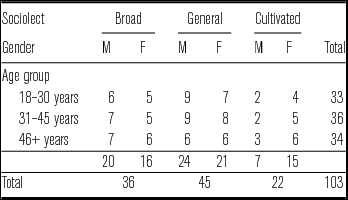
The data to be examined were obtained from the Australian National Database of Spoken Language (ANDOSL), a corpus of AusE speech collected from 108 participants in 1993–94 (Vonwiller et al. Reference Vonwiller, Rogers, Cleirigh and Lewis1995). Speakers who were born and fully educated in Australia were selected for the ANDOSL project according to age (18–30 years, 31–45 years, 46+ years), gender and AusE sociolect (Broad, General, Cultivated). The categorisation of AusE sociolect used here for the ANDOSL speakers was established in Harrington, Cox & Evans (Reference Harrington, Cox and Evans1997). The ANDOSL corpus does not contain sufficient metadata to accurately assign speakers to socioeconomic groups so AusE sociolect category is used here (with caution) as a gross social measure. Age at the time of recording was identified for each speaker. Ages ranged from 18 years to 70 years with a mean age of 38.2 years. Five of the 108 speakers in the corpus were removed from this analysis because their speech contained instances of preconsonantal, labialised or labiodental /ɹ/, or extensive dysfluency. The remaining 103 speakers were grouped as shown in Table 1.
Number of participants according to age, sociolect and gender.

3.1 Corpus data
Among a range of tasks, participants were recorded reading a set of 200 sentences from a computer screen in an anechoic chamber at the National Acoustic Laboratories in Sydney. This set of 200 phonetically rich and phonetically balanced sentences was originally developed for the Spoken Corpus Recordings in British English (SCRIBE) (http://www.phon.ucl.ac.uk/resource/scribe/, accessed 8 March 2013). The sentences were minimally adapted to suit AusE (Millar et al. Reference Millar, Vonwiller, Harrington and Dermody1994). Thirty sentences from the Australianised SCRIBE set containing 32 examples of potential linking ‘r’ in word boundary contexts were identified. See Appendix A for details.
3.2 Data coding
A total of 3296 audio files (103 participants × 32 potential examples of linking ‘r’) were analysed auditorily. Twenty-four files containing reading errors were deleted from the data. As ‘r’ is inhibited across strong prosodic boundaries such as intonational and intermediate phrases (Foulkes Reference Foulkes1997), only instances of hiatus occurring within intermediate phrases were included. All audio files were coded for the hiatus boundary strength according to ToBI boundary indices (Beckman & Ayers Reference Beckman and Ayers1997). Occurrences of boundary indices 3 and 4, representing intermediate phrase and intonational phrase where pitch reset was indicated, were excluded. A total of 320 instances of such boundaries were removed from the dataset.
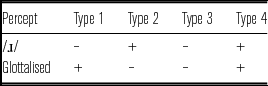
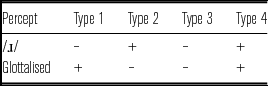
Auditory analysis of the remaining data (2952 tokens) determined that hiatus could be described with reference to two binary features: presence of perceptible /ɹ/ and presence of perceptible glottalisation. We acknowledge that glottalisation occurs on a continuum from laryngealisation through to full glottal stop but varying degrees of glottalisation are not differentiated in this analysis. Dilley, Shattuck-Hufnagel & Ostendorf (Reference Dilley, Shattuck-Hufnagel and Ostendorf1996) found that, in non-phrase-initial position glottalisation was most likely to occur in hiatus contexts. Redi & Shattuck-Hufnagel (Reference Redi and Shattuck-Hufnagel2001) describe a range of acoustic characteristics responsible for the glottal percept and Gerfen & Baker (Reference Gerfen and Baker2005: 332) note that ‘there can be significant phonetic overlap between categories that are labeled as glottal stops versus laryngealized vowels cross-linguistically’.
The data were initially coded into the four categories given in Table 2. It will be shown in the results (Section 4.1) that the Type 3 and Type 4 categories were very infrequent and for the present analysis the categorisation was ultimately collapsed into the binary distinction of present (+) or absent (–) linking ‘r’, that is, the +/ɹ/ category = Type 2 and Type 4, whereas the –/ɹ/ category = Type 1 and Type 3. All occurrences of auditorily identified linking ‘r’ (i.e. Type 2 and Type 4) were confirmed through examination of F3 trough (see below for details).
Binary features used to differentiate the four realisations across hiatus.
Plug & Ogden (Reference Plug and Ogden2003) and Stuart-Smith (Reference Stuart-Smith2007) showed that even trained phoneticians could be inconsistent in their judgement of rhoticity and that knowledge of the variety in question assisted accuracy. In this analysis the authors are experienced AusE speaking phoneticians and therefore well-placed to make judgements of the type required here. A random selection of 10% of the data was re-coded by the first and third authors for intra- and inter-judge reliability purposes. Intra-judge reliability was 96.9% (determined by the third author) and inter-judge reliability was 97.55%. Disagreements were discussed and agreement was reached in all cases.
3.3 Linguistic variables
In order to analyse the influence of linguistic features, the characteristics of prosodic accent, collocational frequency, individuals’ frequency of linking ‘r’ use, phrase duration and frequency of F3 for the /ɹ/ target were established.
3.3.1 Accentual context
The prosodic accent (either strong or weak) of each vowel flanking the hiatus was determined. Unaccented vowels were typically realised as schwa, as is common in AusE (Cox & Palethorpe Reference Cox and Palethorpe2007).Footnote 6 Three possible accentual contexts were identified:Footnote 7
-
(i) Weak–Weak (WW), e.g. number of /nɐmbə əv/
-
(ii) Strong–Weak (SW), e.g. swore an /swoː ən/
-
(iii) Weak–Strong (WS), e.g. offer any /ɔfə eniː/
The WS accentual context represents the foot break which, according to Giegerich (Reference Giegerich1999), is the location where liaison is optional.
3.3.2 Frequency
The lexical frequency of the two-word phrase collocation flanking the hiatus was determined using the British National Corpus of 100 million words (BYU–BNC; Davies Reference Davies2004). Collocational frequency is skewed by the presence of high frequency function words such as and, of, at, and a. A value of mutual information (MI) was therefore calculated through the BYU–BNC (Davies Reference Davies2004) to correct for the function-word frequency effect and allow us to measure the strength of the association between the pairs of words flanking the hiatus. Mutual information compares the probability that items will occur together against the probability that they will occur without each other. BYU–BNC uses the following formula to calculate MI:
-
MI = log ((AB × sizeCorpus) / (A × B × span)) / log (2),
-
where A and B are the individual frequencies of the words
-
flanking the hiatus, AB is the frequency of the collate, and
-
span is the number of words to be included to the left and
-
right of each collate.
In this case we are only interested in the items contained within the two-word collate. An MI score close to zero indicates that co-occurrence is close to chance. Negative MI indicates that the two items are more likely to occur separately than together (McEnery & Wilson Reference McEnery and Wilson2001: 86) and higher positive MI scores reflect genuine associations between items (Church & Hanks Reference Church and Hanks1990). The mean MI score for the present dataset was 1.68. High MI scores in this analysis were deemed to be greater than 3 in line with Church & Hanks’ (Reference Church and Hanks1990: 24) observation that pairs with MI values greater than 3 tend to be ‘interesting’. Phrases like jeer at and dear old had the highest MI scores at 6.33 and 4.97, respectively, whereas phrases like her evening and badger in had low MI scores of –0.25 and –0.76. The mean MI scores for low and high frequency collocations were 0.97 and 4.11, respectively. See Appendix B for a list of sentences with MI scores identified as high or low.
We also established the frequency with which individual speakers used linking ‘r’. The range of values spanned 9/32 (28%) to 32/32 (100%) items. Speakers were classified into low, medium or high frequency users according to the following criteria: low = less than 50% of phrases were produced with linking ‘r’ (16 or fewer items), medium = 50–75% were produced with linking ‘r’ (17–24 items), high = more than 75% of phrases were produced with linking ‘r’ (25–32 items).
3.3.3 Speech rate
To obtain an indication of local speech rate we established the total duration of the two-word hiatus-flanking phrase. We chose this measure rather than a more global full utterance (sentence) or intonational/intermediate phrase duration because speakers exhibited considerable variability with regard to the number and duration of boundaries and pauses. In addition, we were interested in microtemporal variation and the selection of larger chunks would collapse these potentially important elements. Measurement of the two-word phrase was made in PRAAT (Boersma & Weenink Reference Boersma and Weenink2001) by the fourth author and another experienced acoustic coder (50% of the data each) using wide band spectrograms and waveforms to identify and demarcate the acoustic events. The coding criteria used to establish the two-word phrase boundaries were based on conventions developed for ANDOSL and documented in Croot & Taylor (Reference Croot and Taylor1995). To evaluate inter-coder reliability, approximately 10% of the tokens (293 in total) were selected randomly across each sentence and re-coded by both coders. The average difference between coder durations was 3 ms and a paired samples t-test was non-significant (t = 1.171, p = .243), showing high inter-coder reliability.
3.3.4 Formant 3 (F3)
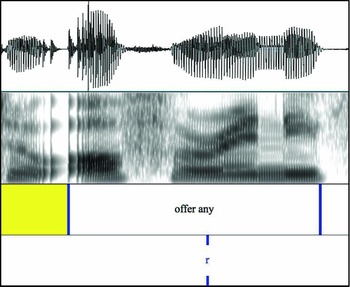
For those speakers exhibiting linking ‘r’, the trough of F3 was identified by hand in PRAAT to represent the /ɹ/ target (Hay & Maclagan Reference Hay and Maclagan2012). Figure 1 illustrates the segmentation points for the phrase offer any. PRAAT TextGrids were imported into the Emu speech database system (Cassidy & Harrington Reference Cassidy and Harrington2001, http://emu.sourceforge.net/) for formant checking and data extraction. The frequencies of the first four formants were automatically tracked using the ESPS/Waves (12th order LPC analysis with a 49 ms raised cosine window and a frame shift of 5 ms). Formant checking was carried out by the first and second authors using high-resolution grey scale wideband spectrograms, LPC spectra and aligned waveforms. A small number of mis-tracked formants were hand corrected. The F3 values for males and females are examined separately here to avoid the problem of formant effects that result from gender-specific vocal tract length and shape. The size of the sample prevents speakers with extreme values from unduly influencing the dataset, therefore no normalisation routines will be used for these analyses.
Spectrogram and waveform illustrating segmentation points for the phrase offer any.

3.4 Data analysis
Two separate statistical procedures were conducted to assess the results of the auditory-based data and the acoustic F3-based data. For the auditory-based data, we employed a multilevel mixed effects logistic regression model (xtmelogit) using STATA (http://www.stata.com/) to identify the factors that best predict the use of linking ‘r’. This technique is optimal for the type of repeated measures binary dependent variable data used in this study (Hu et al. Reference Hu, Goldberg, Hedeker, Flay and Pentz1998). Analysis of this type is necessary to account for the correlated observations within speakers that result from the multiple sentence-reading task. The mixed effects logistic model estimates the speaker-specific effects and avoids the danger of type I error which occurs when a difference is accepted as significant when it is not (Hu et al. Reference Hu, Goldberg, Hedeker, Flay and Pentz1998). The dependent variable was the binary response ±/ɹ/ and the independent variables were the speaker-specific variables of age (continuous variable), gender and AusE sociolect. The linguistic variables were accentual context, MI and duration (used as an indicator of articulation rate). Speaker and sentence were included as random factors. The age of each speaker was centred around the grand mean and duration was centred around the mean duration for each phrase. By centring around the mean phrase duration, the deviation from the mean is a speaker effect rather than a sentence effect. We have controlled for the different phrase durations across sentences by also including in the model the mean durations of each sentence as recommended by Tabachnick & Fidell (Reference Tabachnick and Fidell2013). We estimated the model with main effects and interactions between each of the speaker and linguistic variables. Pairwise comparisons with correction for multiple comparisons were conducted to examine the effects of individual variables.
The second statistical analysis was conducted to examine the F3-based data. We used multilevel modelling (SPSS, Version 21.0, mixed procedure) as it takes into account the effects of multiple repetitions from each speaker. The variables were accentual context (WW, SW, WS), MI (high, low), age group (young, middle, eldest) and frequency of /ɹ/ use (low, middle, high). We also examined the following interactions: accent by age, accent by frequency, MI by age, MI by frequency. Speaker and sentence were included as random factors. Significance level of .05 and conservative post-hoc Bonferroni correction was used.
4 Results
4.1 Auditory analysis
The results of the auditory analysis show that across all contexts hiatus was resolved with linking ‘r’ alone (Type 2) on 70.9% (n = 2093) of occasions and with glottalised realisation alone (Type 1) on 22.8% (n = 673) of occasions. For the remaining 6.3% of cases, hiatus was resolved with a combination of linking ‘r’ plus glottalisation (Type 4) 3.4% (n = 101) and with neither linking ‘r’ nor glottalisation (Type 3) 2.9% (n = 85).
An examination of the infrequent categories (Types 3 and 4) revealed that 47% of occurrences in the true hiatus category where the two vowels appear joined (Type 3) were contained in just three sentences. Of the 85 instances of Type 3, 21 occurred in Sentence 88, containing the phrase before it, 10/85 occurred in Sentence 182 containing were impressed, and 8/85 occurred in Sentence 22, containing are always. For the category containing instances of glottalisation plus /ɹ/ (Type 4), two sentences were responsible for 25% of the occurrences, each with 13/101 instances: Sentence 22, containing are always, and Sentence 99, containing her overworked.
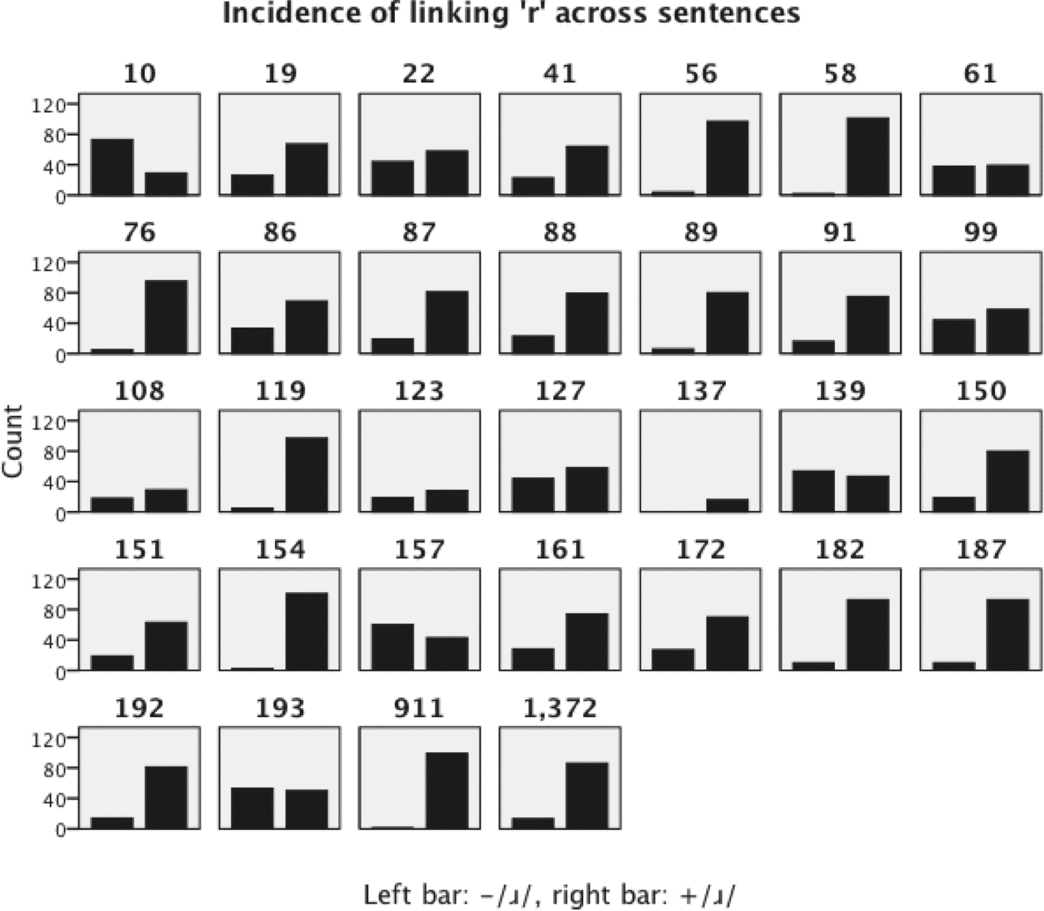
As a consequence of the small numbers in Type 3 and 4 and the difficulties inherent in statistically incorporating these small numbers, the four categories were collapsed into two to indicate the incidence of +/ɹ/ (presence) or –/ɹ/ (absence). The overall result for the resolution of hiatus with linking ‘r’ was 74.3% (n = 2194) and without linking ‘r’ was 25.7% (n = 758). Figure 2 shows the incidence of +/ɹ/ and –/ɹ/ for each of the 32 phrases. The numbers above each panel indicate the sentence number corresponding to those in Appendix A. In each panel, the bar on the right represents the incidence of linking ‘r’. Figure 2 shows that some phrases promote almost exclusive use of linking ‘r’ (e.g. Sentences 58, 154, 911) whereas others contain a more even spread of linking and non-linking realisations (e.g. Sentences 61, 127, 193).
Incidence of linking ‘r’ for each phrase numbered by sentence. The bar on the right of each panel is the +/ɹ/ realisation. Sentences are given in Appendix A.

4.1.1 Factors associated with the incidence of linking ‘r’
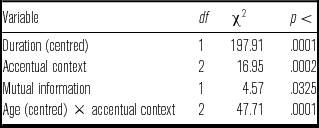
The multilevel mixed effects logistic regression model was fitted to the data to identify factors associated with the incidence of linking ‘r’. Speaker effects: age (grand-mean centred), gender and AusE sociolect, and linguistic factors: duration (phrase-mean centred), accentual context, mutual information (MI) and mean phrase duration were examined for both main effects and interactions. Results showed that the full model containing these factors was statistically significant (Wald χ 2 = 243.46, df = 25, p < .0001) indicating rejection of the null hypothesis that there is no difference between the model without the independent variables and the model incorporating the independent variables.
Manual stepwise backward elimination was used to reduce the model by sequentially removing variables that did not provide a significant contribution. Elimination of the two-way interactions occurred before removal of the main effects variables not included in any remaining significant interactions (Kleinbaum & Klein Reference Kleinbaum and Klein2010: 184). The most parsimonious model (Wald χ 2 = 235.06, df = 8, p < .0001) contained the significant main effect variables of duration (phrase mean-centred), accentual context and MI. There was also a significant interaction between age (grand mean-centred) and accentual context. A summary of the results is given in Table 3.
Summary of the significant main effects and interactions for the multilevel mixed effects logistic regression model.
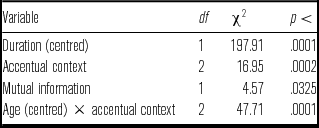
4.1.1.1 Linguistic effects
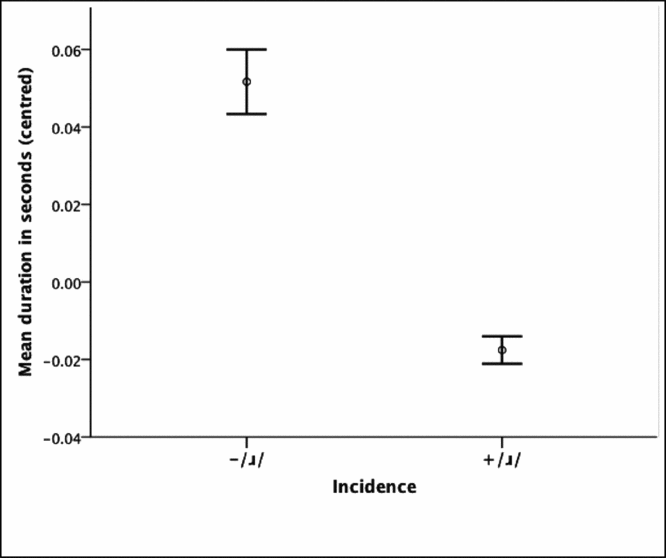
Duration (centred) was a highly influential predictor of linking ‘r’. The duration effect indicates that within phrases, speakers with shorter productions for the two words flanking the hiatus were more likely to display linking ‘r’ (see Figure 3). We interpret this effect to be the manifestation of local speech rate. Speech rate is related to the number and strength of boundaries and reductions. The productions containing absent /ɹ/ typically involved glottalised realisations which are presumably associated with a stronger boundary giving rise to pre-boundary lengthening, hence longer phrases. Recall that all productions containing intermediate or intonational phrase boundaries were excluded from the analysis so any remaining boundary-related lengthening is restricted to foot- or word-level effects.
Centred phrase duration according to incidence of linking ‘r’. Error bars: 95% CI.

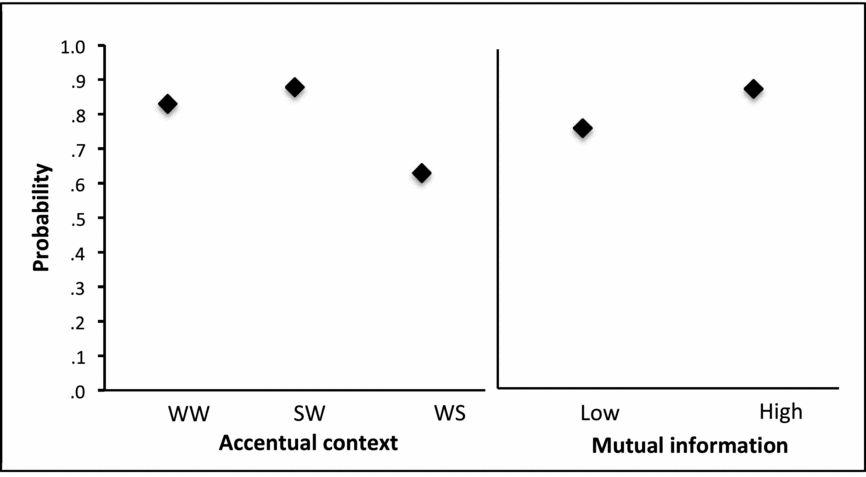
The significant effect for accentual context shows a reduced likelihood of /ɹ/ in the Weak–Strong (WS) vowel context compared with any of the other contexts. The strength of this effect can be seen in the pairwise comparisons where the probability of /ɹ/ occurring in the Weak–Weak (WW) context is 6.13 times greater than in the Weak–Strong (WS) context (Wald Z = 3.30, df = 2, p = .001. In the SW context, the probability of linking ‘r’ is 9.59 times greater than in the WS context (Wald Z = 3.91, df = 2, p < .0001). The left panel of Figure 4 shows the marginal probabilities of /ɹ/ occurring across the three accentual contexts (other factors have been specified at their lowest level). These results provide powerful evidence that linking ‘r’ is more inhibited when the right-edge vowel is strong.
The probability of producing linking ‘r’ according to accentual context (left panel) and mutual information (right panel).

Mutual information also contributed significantly to the model with the high MI context supporting more linking ‘r’ productions and indicating that the frequency of collocation affects the probability of linking ‘r’ use. The right panel of Figure 4 illustrates this finding.
4.1.1.2 Speaker effects
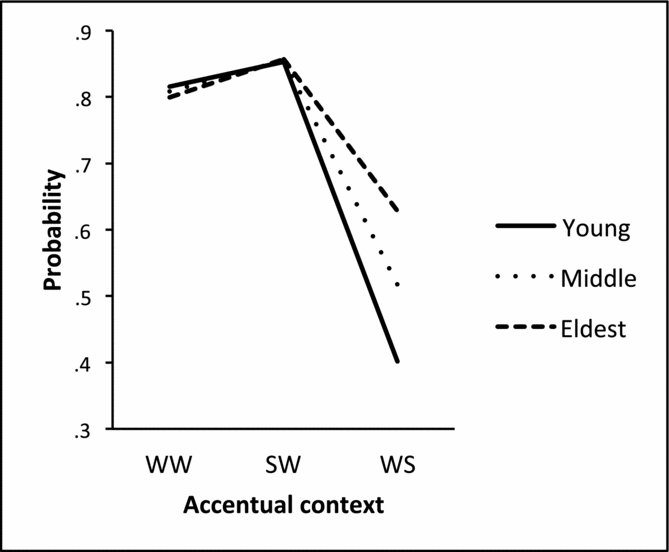
The speaker variables of age, gender and AusE sociolect did not individually contribute to the model. There was, however, an interesting interaction between age and accentual context showing that the incidence of linking ‘r’ is strongly affected by age in the WS context compared to both the WW context (Wald Z = 6.50, df = 2, p < .0001) and the SW context (Wald Z = 5.43, df = 2, p < .0001). There was no significant difference for age between the WW and SW context. The marginal probabilities according to age were calculated to represent the change in odds with increasing age. Age was divided into three groups with reference to the mean age of 38. The young group were those aged younger than 28 (that is, < 38 minus 10). The middle group were between 28 and 48 (between 38 minus 10 and 38 plus 10) and the eldest group were older than 48 (> 38 plus 10). Figure 5 shows that speakers in the young age bracket (18–28) are the least likely to produce linking ‘r’ in the WS context whereas those in the eldest category are most likely.
The probability of linking ‘r’ in the three accentual contexts according to age.

4.2 Acoustic analysis
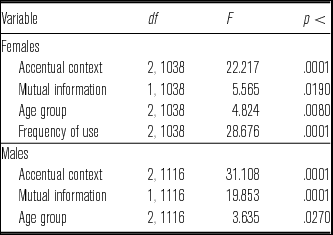
The analysis of F3 was conducted to gain further insight into the characteristics of /ɹ/, in particular to determine whether frequency variables have an impact on the strength of the /ɹ/ F3 target. In addition, the importance of age and accentual context in the auditory analysis prompted us to look at the strength of the /ɹ/ for clues to weakening in the WS context (the foot boundary), that is, the context least likely to contain linking ‘r’. The values of F3 in Hz for the 2194 tokens of /ɹ/ were examined for the female and male speakers separately. For this statistical analysis we used the log transformed F3 as there was significant skew in the data, however, means and standard deviations will be reported in Hz. The multilevel modelling examined the main effects for accentual context (WW, SW, WS), MI (high, low), age group (young, middle, eldest), frequency of /ɹ/ use (low, middle, high) and the interactions: accentual context by age, accentual context by frequency of use, MI by age, MI by frequency of use. Speaker and sentence were included as random factors. The results of this analysis are given in Table 4.
Results of the multilevel modelling analysis of F3 for /ɹ/.
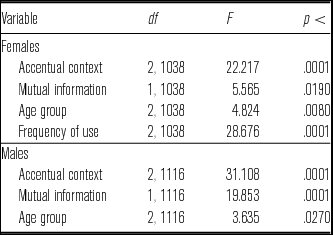
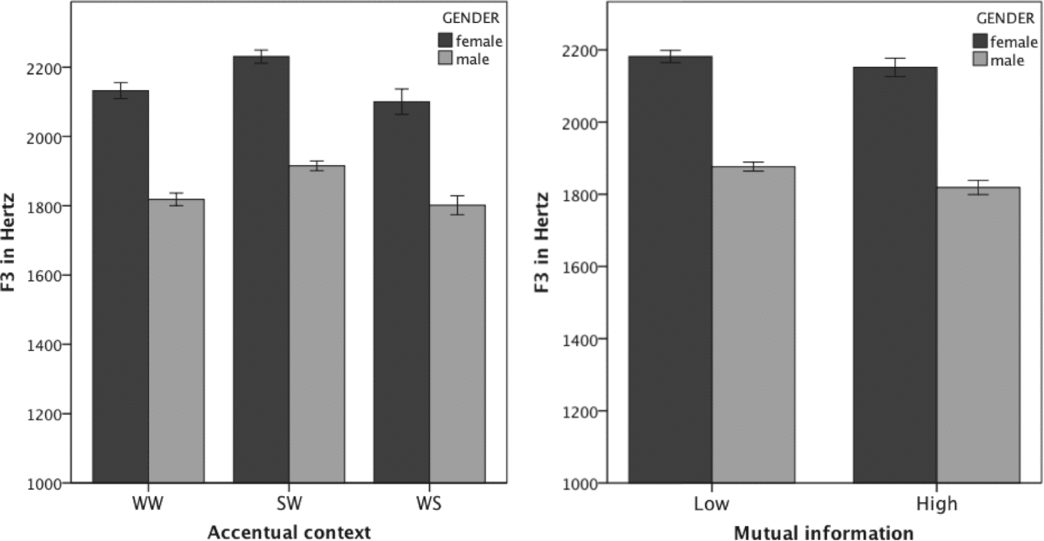
There were no significant interactions but a number of interesting main effects including a strong effect for accentual context which was observed for both females and males. Pairwise comparisons (Bonferroni corrected) showed significant differences in F3 for the SW context (females: 2231 Hz (214), males: 1919 Hz (169)) compared to both the WW (females: 2134 Hz (249), males: 1821 Hz (181)) (p < .0001) and WS contexts (females: 2100 Hz (224), males: 1801 Hz (187)) (p < .0001). The WW and WS contexts did not differ significantly from each other for females or males. Figure 6 (left panel) shows that F3 is higher in the SW context. This suggests that the preceding strong vowel had a significant coarticulatory effect on the realisation of /ɹ/ whereas in the WS context, the /ɹ/ is resistant to coarticulation from the following strong vowel. In the WW and WS context the /ɹ/ appears to be less constrained by context and is free to reach its target position and hence low F3 value.
F3 in Hertz for female and male speakers according to accentual context (left panel) and mutual information (right panel). Error bars: 95% CI.

There was a significant main effect for MI showing lower F3 for the more frequent collocations (female: low 2182 Hz (234), high 2152 Hz (240); male: low 1879 Hz (188), high 1822 Hz (193)). Figure 6 (right panel) illustrates the result.
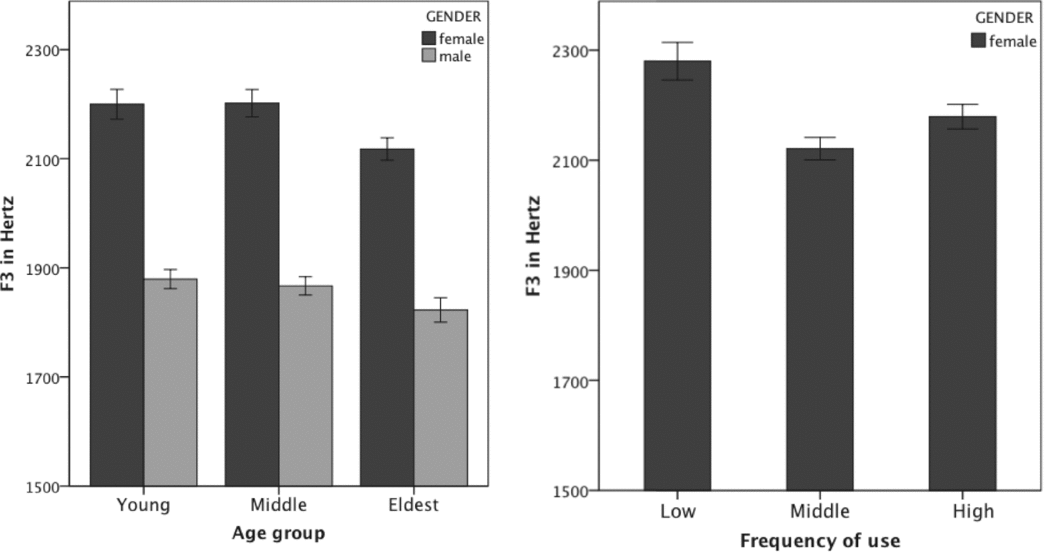
An age effect was present for females (young: 2200 Hz (246), middle: 2201 Hz (247), eldest: 2100 Hz (204)) and males (young: 1882 Hz (186), middle: 1871 Hz (182), eldest: 1824 Hz (206)) (see Figure 7 left panel). Pairwise comparisons showed that for the females, the middle and eldest group differed significantly from each other (p = .006) and for the males, the young and eldest age groups differed significantly from each other (p = .022). We are unable to establish from these data whether this result for age relates to the physiological effects of ageing or else to articulatory characteristics of the /ɹ/.
F3 in Hertz according to age group (left panel) and frequency of use (right panel). Error bars: 95% CI.

Frequency of use effects were found for females (low: 2284 Hz (245), middle: 2121 Hz (221), high: 2179 Hz (230)) but not for males (Figure 7 right panel). Pairwise comparisons showed, in support of Hay & Maclagan (Reference Hay and Maclagan2012), that the low frequency users had significantly higher F3 than the middle (p < .0001) and high frequency users (p < .0001). The middle and high frequency users also differed significantly from each other on F3 (p < .01).
5 Discussion
Our aim was to examine the extent to which speakers of AusE use linking ‘r’ across word boundaries and the characteristics of its use. The corpus-based analysis was structured to determine the factors that best predict the use of linking ‘r’ in these read-speech data. Our results show that speaker variables of age, gender and AusE sociolect did not predict the incidence of linking ‘r’ when other linguistic variables were taken into account. The lack of effect for these speaker variables provides some evidence that linking ‘r’ has reduced social function in AusE and this may explain the lack of discussion of the phenomenon in the AusE phonetic literature. However, more detailed examination of socially stratified speech data is required before definitive conclusions can be made about whether this variable is socially indexed in AusE.
5.1 Speaker variables
We proposed three hypotheses relating to speaker variables on the basis of previous findings from British and New Zealand varieties of English (e.g. Foulkes Reference Foulkes1997; Hay & Sudbury Reference Hay and Sudbury2005; Hay & Maclagan Reference Hay, Maclagan, Preston and Niedzielski2010, Reference Hay and Maclagan2012): firstly that an age effect would be present reflecting a reduction in the use of linking ‘r’ in younger people's speech; secondly that gender effects would show males as more likely to use linking ‘r’ than females; and thirdly that speakers of the Cultivated variety of AusE would be less likely to produce linking ‘r’ compared with speakers of the Broad variety.
The hypothesis that there would be a difference in linking ‘r’ use between younger and older speakers was based on previous observations of change in progress in other English varieties (Foulkes Reference Foulkes1997). Our results show no overall age effect for the presence or absence of linking ‘r’ but a significant interaction with accentual context suggests a change specific to the WS sequence of flanking vowels. The impression of a change in the incidence of linking ‘r’ may relate specifically to its reduced use in this particular accentual context in younger people. The salience of this prosodic effect requires further exploration.
Hypothesised gender effects were based on the widely accepted view that females are the leaders of linguistic change (Labov Reference Labov1990, Tagliamonte & D’Arcy Reference Tagliamonte and D’Arcy2009), so a trend away from linking ‘r’ (particularly if this variable is above conscious awareness) is expected to be led by women. Influencing this hypothesis is the tendency for female speakers of NZE to use inserted ‘r’ significantly less than males (Hay & Sudbury Reference Hay and Sudbury2005) combined with the close ancestry shared by NZE and AusE (Gordon et al. Reference Gordon, Campbell, Hay, Maclagan, Sudbury and Trudgill2004). Our results show no effect for gender, reinforcing the notion that linking ‘r’ does not play a socioindexical role in AusE.
We have found that AusE sociolect is not a significant predictor of linking ‘r’ in these data but one of the limitations of the present analysis relates to employing AusE sociolect as a gross sociocultural measure. We have used AusE sociolect as a mechanism for categorising speakers here because the ANDOSL corpus contains insufficient information to successfully assign speakers to socially constructed categories. The relationship between AusE sociolect and sociocultural status is unclear in present-day AusE, making the use of this variable less than ideal. However, in the early 1990s, when the ANDOSL database was compiled, this categorisation schema had some validity. Indeed it was used by Harrington et al. (Reference Harrington, Cox and Evans1997) to describe characteristics of the ANDOSL. Nevertheless, more accurate measures of social standing would provide finer-grained social differentiation and enable a stronger claim for the lack of substantial social functionality for linking ‘r’ in AusE.
There are important issues to acknowledge when discussing the speaker-based results in the present study. Firstly, the speech data were elicited using a formal reading task and hence our results could be considered conservative. It must also be noted that the ANDOSL corpus is quite old now. It was recorded in the early 1990s and therefore cannot be said to reflect present-day AusE. In line with Hay & Sudbury (Reference Hay and Sudbury2005) and Hay & Maclagan (Reference Hay and Maclagan2012), these results reflect historical aspects of this variety of English. Current analysis is underway to compare these 20-year-old data with present-day speech.
5.2 Linguistic variables
We put forward four hypotheses related to the linguistic variables of duration, accentual context, mutual information and frequency of use. The first three successfully combined to predict the use of linking ‘r’. Our findings show that duration within phrase-type had the most important predictive power, with linking ‘r’ more likely in phrases with shorter durations. This could be interpreted in two ways. Firstly, the segment /ɹ/, contained within the +/ ɹ/ realisation, might simply be shorter than the glottalised component of the –/ɹ/ realisation. We have not been able to examine this aspect due to the considerable difficulty in reliably measuring the duration of the /ɹ/ alone. Even if it were possible to measure /ɹ/ duration, it would be difficult to operationally define the scope of the glottalised variant (which overlaps substantially with the vowel) in a way that would allow a direct length comparison between the +/ɹ/ and –/ɹ/ types. One possible solution would be to measure the VCV construction. The second interpretation is that shorter realisations are faster, leading to more tightly conjoined words within the phrase supported by the linking consonant. Where no linking consonant occurs, increased length presumably reflects a stronger boundary. Lower local speech rates lead to stronger articulatory gestures and reduced articulatory overlap decreasing the probability of reduction (Ernestus Reference Ernestus2014: 33).
Related to the local duration effect is the accentual context effect, which proved to be a highly significant factor in determining the use of linking ‘r’. Foulkes (Reference Foulkes1997) and Uffmann (Reference Uffmann2007) both commented that a strong rightmost word-initial vowel inhibits linking ‘r’ and promotes the use of glottalisation to resolve the hiatus. The results reported here strongly support the hypothesis that linking ‘r’ is inhibited by a strong second vowel. In the present study glottalised realisations regularly replaced linking ‘r’ in the WS vowel context in 51% of cases compared with only 22% in the WW context and 14% in the SW context. According to Uffmann (Reference Uffmann2007), the glottal stop in this context serves to maximise the contrast with the following word-initial strong vowel and therefore supports the foot break. Our results show that the WS vowel context, which straddles the foot boundary supports most –/ɹ/ (mainly glottalised) realisations. These findings provide compelling evidence that prosodic and metrical effects are critical in the phonetic implementation of hiatus. These effects will require examination in future carefully controlled experimental studies to more fully appreciate their role in liaison phenomena. The interaction of age with accentual context is of particular interest, indicating a change in progress at the foot boundary with younger speakers more likely to use a glottalised form to mark the foot break than older speakers.
5.3 F3 analysis
The F3 analysis was conducted to more fully understand the nature of the phonetic characteristics of linking ‘r’ with respect to the lexical and frequency variables that have proved important in previous analyses (Hay & Maclagan Reference Hay and Maclagan2012). In addition, we wanted to look for clues to the reduced use of /ɹ/ at the foot boundary particularly with respect to the interaction with age that had been highlighted in the auditory analysis. The results showed that speaker age, accentual context and frequency effects all contributed to the nature of the F3 target. We cannot determine the source of the age effect (older speakers had lower F3) without further analysis of non-linking ‘r’ as this result could simply reflect the physiology of aging. Rhodes (Reference Rhodes2013) found a decrease in F3 across the lifespan although Harrington, Palethorpe & Watson (Reference Harrington, Palethorpe and Watson2007) found an inconsistent but slight increase in F3 with ageing. It is tempting to speculate that the change in progress for young people has led to a weakening of the exemplar space and/or the phonetic implementation strategies, leading younger people to produce their /ɹ/ with less robust (i.e. higher) F3 values than older people.
Separate phrasal and user-specific frequency effects were also found for the F3 analysis. High MI (indicating a high frequency collocation) was more likely to yield stronger F3 than low MI. This MI effect supports the exemplar approach that word-level representations encode patterns of usage. Exemplar theory would predict that high frequency phrases should encourage greater use of linking ‘r’ because linking ‘r’ is reinforced in memory with each production (Bybee Reference Bybee2002).
We have also found that female speakers who used linking ‘r’ more often had stronger /ɹ/s (i.e. lower F3) than those with lower frequency of use. This finding is in keeping with the results of Hay & Maclagan (Reference Hay, Maclagan, Preston and Niedzielski2010, Reference Hay and Maclagan2012), who offer three possible explanations. Firstly, if a speaker is an avid user of linking and intrusive ‘r’, their exemplar space would contain many /ɹ/s leading to robust phonetic implementation of /ɹ/. Secondly, speakers who are advanced in a sound change will produce stronger or weaker /ɹ/s depending on the direction of the change. Our results indicate a sound change in progress away from the linking ‘r’ in the WS accentual context. Young speakers who are advanced in the change may therefore have a less robust /ɹ/. The third explanation, which reverses the causality of the effect, is that those who produce weaker /ɹ/s are more likely not to produce linking ‘r’. We cannot determine from our data whether the decreased ‘frequency of use’ effect for females is the root cause or a consequence of raised F3 as both explanations are plausible. It is unclear why the frequency effect does not hold for males.
One very interesting finding relates to raised F3 in the SW accentual context. We predicted a reduction in the strength of the /ɹ/ in the WS context as this was the environment where linking ‘r’ was least likely to occur and we expected that reduction in the strength of ‘r’ may have been the antecedent for the loss of /ɹ/ in this context. On the contrary, we found that those speakers who produced /ɹ/ in the WS context did so with a robust /ɹ/. The weakened /ɹ/ was instead found in the SW context. This finding suggests that the /ɹ/ is resistant to coarticulation when the left-edge vowel is weak but susceptible to coarticulation when it is strong. We speculate that this supports the case for linking ‘r’ being tightly associated articulatorily with the preceding syllable given that a strong following vowel did not have a coarticulatory effect. This calls into question the notion that inserted /ɹ/ is resyllabified to onset position. Research has shown leftward and rightward long-range effects for /ɹ/ specific to prosodic context (Hawkins & Slater Reference Hawkins and Slater1994, Tunley Reference Tunley1999, West Reference West1999, Kochetov & Neufield Reference Kochetov and Neufield2013) with coarticulatory effects from /ɹ/ stronger across unstressed than stressed syllables. As unstressed syllables are likely to be more coarticulated than stressed (Fowler Reference Fowler2005), we propose that the left-edge weak vowel anticipates the /ɹ/ with substantial gestural overlap possibly resulting in a rhotic vowel allowing the /ɹ/ target to be fully articulated. However, when the left-edge vowel is strong, it is resistant to gestural overlap from the rhotic resulting in a reduced /ɹ/ target and therefore a raised F3. Further experiments with carefully controlled phonetic contexts including analysis of articulatory data are required to test the predictions related to this finding.
6 Conclusions
The results presented here show that a number of factors are important in determining the use of linking ‘r’ in AusE read speech. We have found that linking ‘r’ is most likely to occur in hiatus contexts within intermediate phrases where the first vowel is phonologically non-high and the second vowel is weak. The nature of the /ɹ/ is determined by metrical, frequency and age effects. Goldrick & Rapp (Reference Goldrick and Rapp2007) propose that those elements which are sensitive to syllabic constituency are post lexical whereas those which are sensitive to frequency are lexical suggesting that the effects observed here have a number of sources with representations at various levels. Ernestus (Reference Ernestus2014: 34) poses the important question: ‘Which part of the observed pronunciation variation reflects characteristics of the selected exemplar and which part results from exact implementation of this exemplar?’. We have found a complex of frequency and metrical effects supporting both a phonetic and a lexical interpretation of this phenomenon. As accentual context and duration are the most powerful cues, we conclude that linking ‘r’ is the phonetic manifestation of prosody. This result combined with the effects for mutual information and frequency of use suggests that both abstractionist and exemplar explanations are possible, supporting a hybrid model of speech production which includes abstract representations, exemplars and phonetic implementation processes.
Future work would benefit from acoustic analysis of gradient behaviours such as glottalisation to glottal stop and reduction processes associated with linking ‘r’ such as coalescence with the left-edge vowel and possible syllabicity. Associated work on other liaison phenomena such as linking /w/ and /j/ and intrusive ‘r’ would help us to understand how linking ‘r’ fits into the more global set of speech production processes that can be harnessed in hiatus contexts. Future controlled experiments manipulating various prosodic, frequency and segmental aspects will greatly add to our understanding of liaison. As this is the first study into hiatus resolution and linking ‘r’ in AusE, it provides a foundation for future research in this area.
Acknowledgements
This work was supported by Macquarie University Research Development grant 9200900671 and ARC Discovery grant DP110102479. We are grateful to Alan Taylor and Anne Grunseit for invaluable advice about statistical analyses and Kelly Miles for assistance with data coding. We would also like to thank Adrian Simpson and three anonymous reviewers for their insightful comments and suggestions.
Appendix A. Sentences containing potential linking ‘r’

Appendix B. Mutual information scores
Low mutual information score < 3: Sentences 19, 56, 58, 61, 87, 88, 108, 123, 127, 137, 150,151, 154, 157, 161, 172, 187, 1372
High mutual information score > 3: Sentences 10, 22, 41, 76, 86, 89, 91, 99, 119, 139, 182,192, 193, 911