INTRODUCTION
The annual sulphur (S) deposition rate in most areas used for beet production in the UK is now less than 8 kg/ha (Fowler et al. Reference Fowler, Cape, Smith, Nemitz, Sutton, Dore, Coyle, Crossley, Storeton-West, Muller, Phillips, Thomas, Vieno, Yang, Famulari, Twigg, Bealey, Benham, Hayman, Lawrence, Vincent, Fagerli and Simpson2009), and is expected to decrease further in the next decade. This compares to, for example, annual deposition of about 70 kg/ha at Woburn, Bedfordshire, England during the mid-1970s (McGrath et al. Reference McGrath, Zhao and Blake-Kalff2002). Then, deposition was sufficient to supply the needs of most crops for S as a nutrient: this is no longer the case. Mineral S, like mineral nitrogen (N), is leached from soil, and so supplies for crop growth must either be added frequently or must be mineralized from soil organic matter reserves. Like N, S is an essential ingredient in proteins, and what little evidence there is suggests that healthy beet crops should contain 25–35 kg/ha (Hoffmann et al. Reference Hoffmann, Stockfisch and Koch2004). Deficient crops have pale green foliage (like those that are N deficient) and a yellow edge to the leaves (like magnesium (Mg) deficiency), and so the symptoms are not easy to identify (Draycott & Christenson Reference Draycott and Christenson2003). In other crops, deficiency causes reduced photosynthetic efficiency and an imbalance in the amino acid composition of the cells. In beet, this is likely to (a) reduce yield and (b) increase α amino N concentration of the roots. In the UK, S deficiency is most likely to be found on sandy soils with low organic matter content, neutral or alkaline pH (McGrath & Zhao Reference McGrath and Zhao1995) and on fields without a recent application of organic manure or S-containing fertilizer. About 0·30 of the beet crop falls into this category. The research described in this paper was conducted to establish where, when and how much sulphur fertilizer should be applied to the UK sugar beet crop to ensure maximum yield of high-quality roots. Field experiments were carried out at locations where either very little S-containing material had been applied to the soil for many years or where positive responses to S fertilizer had been recorded recently in experiments with winter wheat (Zhao et al. Reference Zhao, McGrath, Blake-Kalff, Link and Tucker2002) and oilseed rape (McGrath & Zhao Reference McGrath and Zhao1996).
MATERIALS AND METHODS
Field experiment procedures
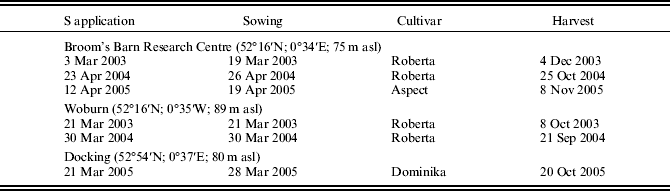
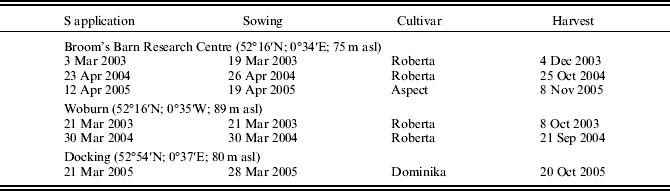
The effect of sulphate fertilizer was tested at Broom's Barn Research Centre, Suffolk, England on a sandy loam soil (Barrow series, Hodge Reference Hodge1991) in 2003, 2004 and 2005. In the same years, the effect of S fertilizer was tested on a loamy sand soil where significant positive yield responses to S fertilizer had recently been measured in cereal or oilseed rape crops. The experiments were at Woburn, Bedfordshire in 2003 and 2004 (Cottenham soil series) and at Docking, Norfolk in 2005 (Newmarket 1 soil series). At all sites the average annual rainfall and air temperatures were approximately 630 mm and 10°C (see Table 1 for further details).
Dates of fertilizer application, sowing and harvesting and the sugar beet cultivars used in the experiments
The experiments at Broom's Barn were made by splitting some of the plots on a long-term experiment testing the effects of fertilizers (Last et al. Reference Last, Webb, Bugg, Bean, Durrant and Jaggard1984). The plots that were split for applications of hydrated calcium sulphate (applied as gypsum) had not received any organic manure since 1965 and had not received any S-containing fertilizers since 1986, when they were all given an application of hydrated magnesium sulphate (kieserite) to supply magnesium. Between 1986 and 2002 the plots received a spray of elemental S (10 kg/ha) on to the foliage of beet plants as a fungicide every third year. All the plots had a history of receiving standard applications of N, phosphorus (P) and potassium (K) fertilizers every year. In each year, eight plots were split into four parts, 0, 10, 20 or 40 kg S/ha was applied as gypsum (CaSO4⋅2H2O) to the seedbed in the 2 weeks before the beet seeds were sown (Table 1). At the same time the plots received their P and K fertilizer and 40 kg N/ha as ammonium nitrate. The remaining 80 kg N/ha was applied when the seedlings reached the 2–4-leaf stage. All plots were sown with the cultivar Roberta in the first 2 years and with Aspect in the third: the seeds were spaced 175 mm apart. All crops received applications of recommended plant protection products (details can be supplied by the lead author on request) to keep them free from serious infestations of weeds, pests and diseases. The plots were five rows (2·5 m) wide and 8 m long; all samples were taken from the central 6 m of the central three rows. All the experiments were sown in late March or April and the plant population density was assessed in early June. The plots were harvested by machine on a single day during autumn/early winter. After harvest, the roots were washed and weighed and then sampled; sub-samples were frozen and subsequently digested in a cold aqueous solution of basic lead acetate and analysed for sugar, sodium, potassium and amino N concentrations (Anon 2005). Representative samples of the roots were weighed, dried at 85°C for 48 h and reweighed to determine dry matter yield. These samples were then milled (<0·5 mm) and stored in sealed glass vials for subsequent determinations of the concentrations of N and S (McGrath & Zhao Reference McGrath and Zhao1996).
The experiments at Woburn and Docking tested five rates of gypsum supplying 0–40 kg S/ha in 10 kg/ha increments: the plots were arranged in five randomized blocks. The sugar beet received 120 kg N/ha in two doses and received recommended doses (DEFRA 2000) of P, K, Na and Mg fertilizers, as indicated by analyses of the topsoil during the previous autumn: none of these fertilizers contained S. The gypsum was applied by hand and incorporated into the seedbed in the week prior to drilling the sugar beet (Table 1). The plots were all 2·5 or 3 m wide and 12 m long and observations were always confined to the central 9 m of the central 3 or 4 rows. These plots were harvested by hand, the plants were counted and the produce was transported to Broom's Barn Research Centre for yield and quality assessments.
Plant and soil samples
The soil in each experiment was sampled in February or March, before any S fertilizer was applied, by taking five soil cores from each zero fertilizer plot in the 0–300 and 300–600 mm depths. The five cores were bulked and mixed. This was repeated immediately after the final harvest, when the plots that had received 40 kg S/ha were also sampled. The soils were dried and milled to <2 mm and were then analysed to determine their sulphate concentration (McGrath & Zhao Reference McGrath and Zhao1996). The plants were sampled to determine dry matter yield and N and S concentrations at approximately the time of canopy closure. These samples were always taken during the last half of June or in early July, when 1·5 m2 was harvested by hand, topped at the level of the lowest leaf scar, cleaned, sub-sampled and dried at 85°C for 48 h and then weighed. The foliage of the beet was sampled to determine dry matter yield and N and S concentrations immediately before final harvest. The top was sliced off 20 plants chosen at random from each plot. The tops were weighed, chopped into small pieces, mixed and sub-sampled, weighed and dried at 85°C for 48 h to determine dry matter yield.
Chemical and statistical analyses
The concentration of available S in the soil samples was measured by an inductively coupled plasma emission spectrometer (ICP-AES) after extraction with 0·016 m potassium dihydrogen phosphate (KH2PO4). The concentration of total S in the crop tissues was measured by ICP-AES after grinding to pass through a 0·5 mm mesh sieve followed by digestion with nitric acid/perchloric acid (HNO3/HClO4). Total N in the crop tissues was measured by the combustion method using a LECO Combustion Analyser. In the experiments in 2003, sub-samples from the leaf tissue collected in June was analysed for the concentrations of sulphate and malate, using the procedures described by Blake-Kalff et al. (Reference Blake-Kalff, Hawkesford, Zhao and McGrath2000).
The data were analysed using ANOVA and restricted maximum likelihood (REML) procedures within the GENSTAT suit of programmes (Lane & Payne Reference Lane and Payne1996). The Broom's Barn experiments were analysed as two replicates of four long-term fertilizer treatments split for four rates of S fertilizer. The Woburn and Docking experiments were analysed simply as five randomized blocks of five treatments.
RESULTS AND DISCUSSION
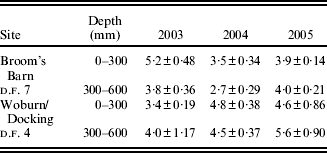
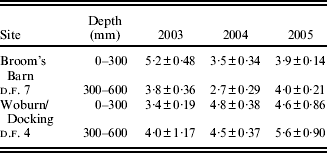
The soils at the start of each experiment contained 3–5 mg/kg of available S in the plough layer and 2·5–5·5 mg/kg in the layer from 300 to 600 mm deep (Table 2). There was no consistent difference in concentration between the surface and subsoil layers. The lack of differentiation in these concentrations between the top soil and the subsoil is similar to the findings of McGrath & Zhao (Reference McGrath and Zhao1996), whose experiments were on the Woburn farm, close to some of the experiments in this study, and the concentrations found in the soils were similar to the amounts reported for the low-S site used by Thomas et al. (Reference Thomas, Hocking and Bilsborrow2003). The amounts of available S in the soils were between 30 and 60 kg/ha.
Plant available sulphur (mg S/kg soil) prior to sowing in plots that did not have an application of S fertilizer
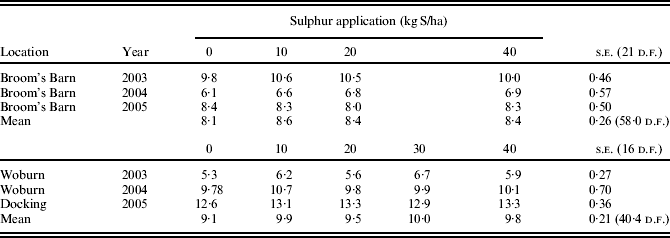
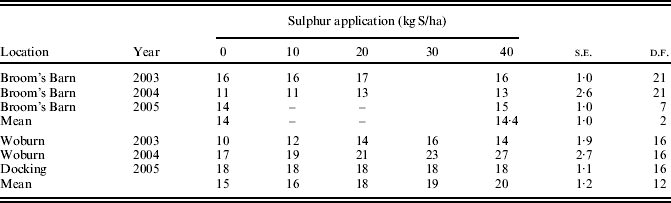
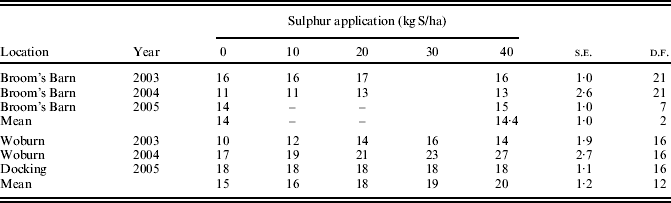
The difference between treatments in the concentration of sugar in the roots at final harvest was never larger than 4 g/kg and the differences were never significant. Therefore, yield effects are reported in terms of the yields of sugar, a variable which is closely correlated with the value of the crop to the grower. In 2003, the growth of these rain-fed beet crops was strongly influenced by dry weather during August and September, which stressed the plants. This had a large impact on growth on the sandy soil at Woburn, where the yield of sugar only averaged 5·96 t/ha (Table 3). In 2004, frequent rain during March and April caused delayed sowing on the medium-textured soil at Broom's Barn Research Centre (Table 1). This, together with an early harvest, was responsible for the small yield there in that year. Frequent rainfall in March and early April again delayed the sowing at Broom's Barn Research Centre in 2005, and this had an adverse impact on yield (Table 3). The smallest and largest yields in these experiments are similar to the average yields for the lowest and highest quartiles of the UK beet crop (Lang Reference Lang2009).
The effect of sulphur fertilizer application on the sugar yield (t/ha) of sugar beet crops
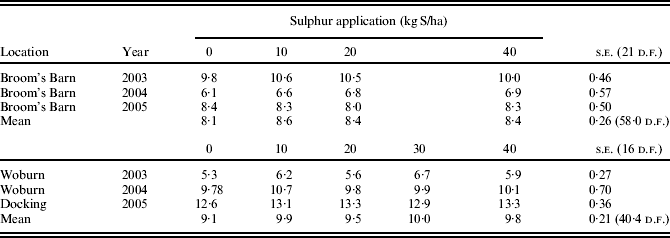
The standard errors of the treatment means over years were calculated using REML variance components analysis.
None of the six experiments, in isolation, produced a significant response to the application of S in terms of sugar yield. However, in five of the six experiments the yield of the control treatment without an application of S was the smallest (Table 3). When analysed over years using REML, there was a significant response in sugar yield to the fertilizer treatments (+0·56 t/ha) in those experiments that were on the loamy sand soils at Woburn and Docking (Table 3), where responses had already been recorded in wheat or oilseed rape. Over all six experiments, the average yield response provided by S applications was 0·45 t/ha of sugar, an increase of 5·2%.
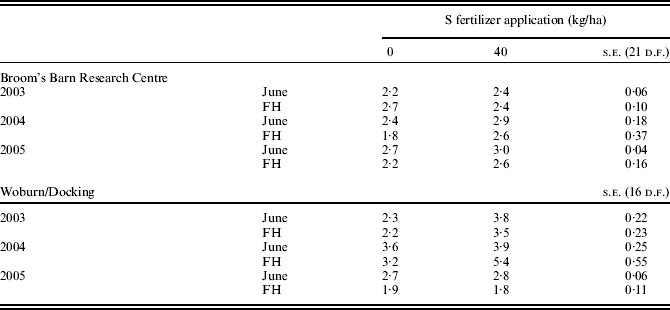
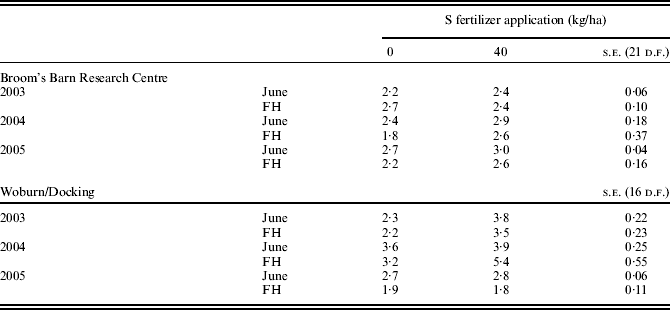
Sulphur concentration in dry matter and uptake by the crops was measured at harvest in October. The S concentrations in the beet tops (leaves plus crowns) ranged from c. 1·8 to 5·4 mg/g, much of the variation being associated with site and season (Table 4). In most cases there was a positive response to fertilizer application. On average, fertilizer raised the concentration at Broom's Barn from 2·22 to 2·52 mg/g (the increase was significant in 1 year) and at Woburn/Docking from 2·40 to 3·08 mg/g (significant in 2 of the 3 years). Concentrations in tops were also measured soon after the canopy closed, in late June or July. There was usually, but not always, a small decline in the concentration between then and final harvest (Table 4). This contrasts with the results of Thomas et al. (Reference Thomas, Hocking and Bilsborrow2003), who observed an increase in the concentration in the foliage between June and early October on all treatments in one of their experiments.
Sulphur concentration (mg/g) in sugar beet tops in summer (late June) and at final harvest (FH)
In the roots at final harvest, the concentrations were between 0·3 and 0·4 mg/g. All of these values are similar to those of Zhao (unpublished) and Bravo et al., 1989 (as tabulated by Draycott & Christenson Reference Draycott and Christenson2003) and are much less than the values obtained by Sexton (Reference Sexton1996).
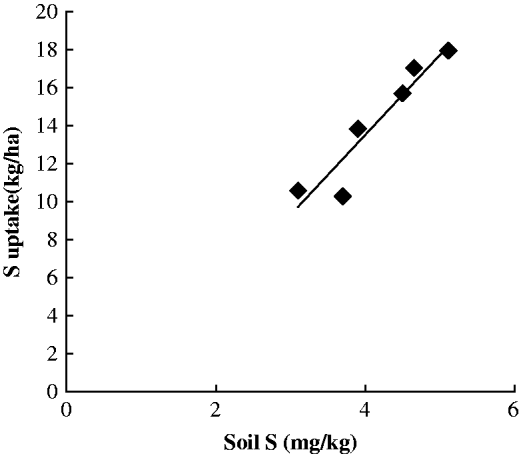
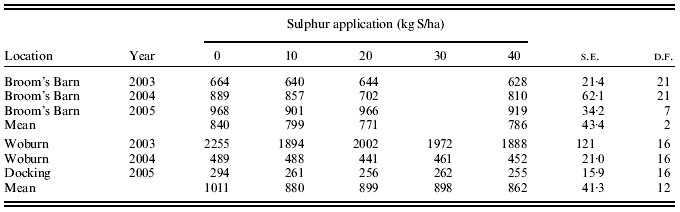
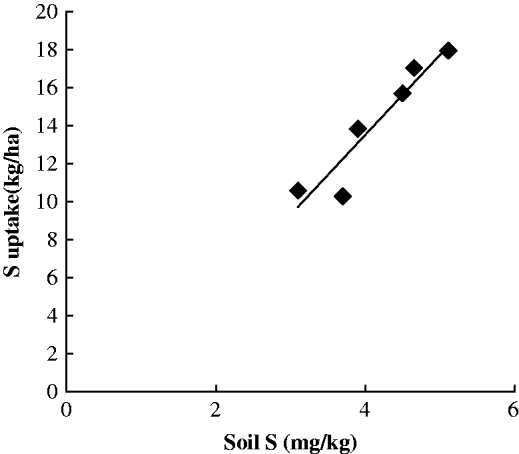
The amounts of S present in the tops varied widely, from 7 to 22 kg/ha and averaged 11·4 kg/ha. However, sometimes there was not a positive response to the fertilizer. This was probably because variable amounts of the crop's foliage dies and falls off the plants by the time of harvest (October onwards). Uptake in the roots ranged between 2·7 and 6·8 kg/ha (average 4·0 kg/ha) and there was always a small gain in uptake from applying fertilizer. In crops without S fertilizer, whole-plant uptake ranged from 10 to 18 kg/ha and averaged 14·2 kg/ha: the variations were related to the average concentration of available S in the uppermost 600 mm of soil at the time of sowing (Fig. 1). Sulphur fertilizer application tended to increase S uptake measured at harvest, but the tendency was never big enough to be significant (Table 5), and the change in uptake from the addition of 40 kg/ha of S fertilizer was only 2·6 kg/ha on average. These uptake quantities are broadly in agreement with values published by Syers et al. (Reference Syers, Skinner and Curtin1987), Bravo et al. (Reference Bravo, Lee and Schmehl1989) and Jourdan et al. (Reference Jourdan, Bourrié and Etourneaud1992), but are rather less than the values reported by Hoffmann et al. (Reference Hoffmann, Stockfisch and Koch2004), especially for the amounts in the roots. All these values are much less than the quantities reported for crops grown in eastern England by Armstrong (Reference Armstrong1985), despite all the yields being similar in size.
Relationship between S uptake by the crops without S fertilizer and the concentration of available S present in the uppermost 600 mm of soil at the time of sowing.
The effect of sulphur fertilizer application on the sulphur uptake (kg/ha) of sugar beet crops at harvest
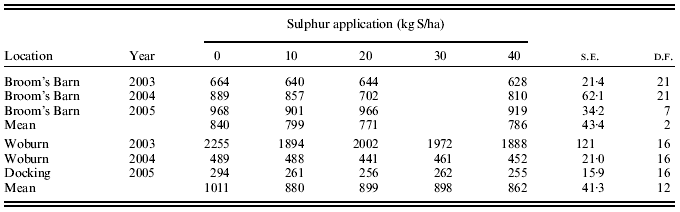
Studies of S metabolism have led some researchers to examine the effect of S fertilizer on the amino N concentration in beet at harvest time. Amino N is an important impurity in beet juice and it reduces the proportion of sugar that can be recovered in a purified form. In these experiments, S fertilizer always reduced the concentration of amino N when expressed on a ‘per unit sugar’ basis (Table 6), but the average value without S fertilizer was 926 mg/kg sugar compared to 825 mg/kg, where 40 kg S/ha was applied. Much of this reduction was associated with the trial at Woburn in 2003, when the concentrations were a great deal larger than in any other experiment. The reductions in amino N due to S fertilizer were always less than 10% and were never significant. This is similar to the observations of Hoffmann et al. (Reference Hoffmann, Stockfisch and Koch2004) but contrary to the findings of Thomas et al. (Reference Thomas, Hocking and Bilsborrow2003), who found a marked reduction in amino N concentration where S fertilizer was added to a low-S soil.
The effect of sulphur fertilizer application on the amino N concentration (mg/kg of sugar) in sugar beet roots at harvest
The malate/sulphate in leaf tissue has been suggested as a stable indicator of sulphur deficiency in cereals and oilseed rape (Blake-Kalff et al. Reference Blake-Kalff, Hawkesford, Zhao and McGrath2000). This ratio was measured in the leaf tissue of the beet plants from the June/July samples in the experiments in 2003. This is approximately the latest time when it would be practical to apply a remedial dose of fertilizer to a beet crop. At both sites, the fertilizer that was given in the seedbed reduced the ratio significantly, from 2·9 to 0·8 (±0·29) and from 1·8 to 0·9 (±0·25). However, the yield results in the experiments gave little indication of a shortage of S supply, and so it was not possible to correlate the ratio with deficiency. Similarly, the N and S concentrations of the foliage of the early samples were measured and the N:S ratios were calculated in all experiments (data not presented). These ranged between 9 and 20 and they seemed to vary more with the weight of the foliage at the time of sampling than with the fertilizer treatment. McGrath & Zhao (Reference McGrath and Zhao1996) also found that the N:S ratio varied greatly with the time of sampling. As was the case with the malate/sulphate ratio, the evidence of a yield response was weak, and so it was not possible to correlate the ratio with deficiency.
A large proportion of beet fields in England receive some sulphate in the fertilizer because c. 0·30 of them are treated with animal manure in autumn before sowing in spring, and most are treated with blended fertilizer to supply P, K, Na and Mg: these blends are partly composed of ground rocks, many of which contain some sulphate. However, all the experiments in this study were grown on sites that had either a history of being responsive to S fertilizer in other crops (wheat or oilseed rape) or where S additions were known to be very small for the previous two decades. Despite this, none of the individual experiments produced a significant yield response to S fertilizer application. However, averaging over years did produce a significant response in the loamy sand experiments and the treatment given no S fertilizer produced the smallest yield in five of the six experiments. In the light of this, it is probably worthwhile to apply some S fertilizer for beet growing on sandy fields that have not received any S-containing fertilizers or manures recently. These experiments provided no evidence of a precise amount of S that needs to be applied, all amounts between 10 and 40 kg/ha produced the largest sugar yield. However, an adequate quantity can be added to the soil simply by using ammonium sulphate for the first application of nitrogen fertilizer. Typically, this applies 30 or 40 kg N/ha, and so would apply 35–45 kg S/ha at an additional cost of £10–20/ha, depending on the relative prices of ammonium sulphate and the alternative N fertilizer. The average yield response to S fertilizer in these experiments was worth c. £70/ha.
We thank the staff at Broom's Barn Research Centre for technical help with this project, especially Chris Clark and Mich Lebloa. Rothamsted Research receives grant-aided support from the Biotechnology and Biological Sciences Research Council. This work was funded by the British Beet Research Organisation.