1. INTRODUCTION
Music is one of the most meaningful activities people can participate in collectively. It is also one of the practices that experience distinct, drastic changes when we cannot gather together in the same location. When the COVID-19 pandemic enforced social distancing and limited travel, it set musicians many challenges that we have yet to reflect on. The scale of the pandemic transformed our social, economic and political reality as performers and as audiences in numerous ways across the globe, revealing our interdependence and highlighting the necessity of sympathy and collaboration. While we could not travel and be close to each other, we could still share, perform and interact. The infrastructure of the internet stood firm and we turned to remote conferencing technologies, which led many musicians to their first experiences of networked music performance. They then explored how they might embrace network technology in their ongoing music practice. The immediate difficulty for these musicians was their limited knowledge of the technology. The practice of playing music together in real-time over the internet had previously been reserved for devoted explorers, early adopters and technology aficionados. Within days of the pandemic, these intrepid practitioners began sharing their experiences and generating a wealth of learning materials. Developers released increasingly affordable and accessible collaboration services, and the extensive knowledge of more than two decades of networked music research was shared, searched for and found. Finally, telematic performances became widely employed. While for some, playing music over remote conferencing technology remains an unpleasant but necessary measure, a richness of possibilities has bloomed for others, particularly those who already have a strong background in electroacoustic technology. After all, the internet is just another data stream that can be integrated into any existing digital workflow. We are also witnessing an unprecedented growth of all forms of online music-making from one-on-one lessons and streamed solo performances to live multilocation ensemble concerts. In the last year, there has been an abundance of new projects from musicians. Even those who have not worked with technology before have begun to seek out solutions to use the internet as a means of performance. Working together online is not only leading to the discovery of new ways of making electroacoustic music but is also influencing musicians who have traditionally preferred to work without electronics, given that the internet requires interfacing with digital technology.
2. AN OPEN LIBRARY
In June 2020, some months after the start of the COVID-19 pandemic, we started working on the Networked Music Performance Library (Networked Music Library 2021). With the schools closed, public events not permitted and social distancing regulations putting an end even to rehearsals, collaborating remotely became a necessity for musicians. On the one hand, many professionals found themselves not ready for the challenge. Their lack of technological expertise led them to either suffer from connection issues, use unfit software or even completely disrupt their own professional activities. On the other hand, a new wave of interest in the internet as an artistic medium attracted many new artists and composers to work with it and find ways to stream their performances using music technology platforms of choice. With all this being in place, the need for a resource that accommodates and curates information about various aspects of networked music performance and how it can be leveraged as a music technology became evident. The public Networked Music Performance Library grew out of an initial personal archive started in 2016 by technology researcher and composer Rebekah Wilson for her Master’s thesis at the New Zealand School of Music in Wellington, New Zealand (Wilson Reference Wilson2018), which was maintained for ongoing research and teaching. The library quickly grew in size and breadth when the library management was taken on by composer Daniil Pilchen, who met Rebekah when participating in her class on Networked Music at the Royal Conservatory of the Hague in the Netherlands. Rebekah’s research as a composer was driven by her knowledge as technical co-founder of Source Elements, a Chicago-based company that has been serving the music and film industry for remote, high-quality collaboration services since 2005 (Source Elements 2020). As both a composer and a technologist, Rebekah’s belief that one day the world would be largely working remotely over the internet fed her impetus to make public and continue developing the research library. A central location for knowledge is critical, that is, to succeed at network performance, musicians must have a firm grasp of technical, musical and performance knowledge. An open library whose purpose is to catalogue without commentary and without any stylistic position is the best way to ensure that musicians of all interests can gain value and insight.
The Networked Music Performance Library currently exists as a public group library in Zotero. In general, reference managers such as Zotero, Mendeley and EndNote are common tools for researchers to create and organise their bibliographies, export references in different styles and store pdfs and other files attached to entries. All popular reference managers allow users to create group libraries that are useful for collaborative research. We chose Zotero mainly because both of us were already using it for our individual research projects. Other reasons include it being free, popular with other researchers, its basic web version being accessible without registration and the Zotero API having a variety of options for embedding and updating bibliographies on a web page, which is useful for the further development of our project.
3. SIMILAR PROJECTS
By no means is this research library the first collection of documents and projects on the topic of networking and its relationship to the sonic arts. To situate the library within the context of research projects aiming to document the current state or the development of networked music technology, we provide a brief description of similar projects. This is by no means an exhaustive list. While there are many more examples, we focus only on projects that have a form of reference lists or databases. Many historical projects of great value are no longer accessible online or were active in the early days of the internet. We anticipate there are also a number of projects we are not aware of because our primary research language is English.
Each of the following projects has a particular theme: some focus solely on software, some on artistic projects, some on written works, some pursue an academic purpose or are educational, focused on preservation or are purely instrumental.
3.1. Awesome Networked Media
Omar Costa Hamido, Michael Dessen, Guillaume Pellerin and Jules Penuchot created Awesome Networked Media, which is ‘a list of real-time software tools for routing audio and video streams between applications and for sending audio and video streams across the network’ (Hamido, Dessen, Pellerin and Penuchot Reference Hamido, Dessen, Pellerin and Penuchot2020). This regularly updated list contains a comprehensive collection of networked arts-related software for audio and video routing and networking. One of the best qualities of this list is that it provides concise and clear descriptions for each reference.
3.2. Networked-based Collaborative Music Making
Many internet pages have been created as a resource for teaching and sharing with students. An example is Stefano Fasciani’s collection (Fasciani Reference Fasciani2020), which lists essential readings and software tools that he has identified as useful for synchronous and asynchronous collaboration on the internet. The collection includes a video introduction to the history and main concepts of networked music.
3.3. History of Spatially Distributed Performance
The history of networked music performance goes way back before the development of the internet. Jeremy Cooperstock’s History of Spatially Distributed Performance, described by the author as ‘an early attempt to document the key points in the history of real time networked media’ (Cooperstock Reference Cooperstock2013), contains annotated references to several important artistic and research projects from 1966 to 2002, and, among other things, provides descriptions of several early projects that work with technologies such as radio, telephony and television. ‘Some of the milestones listed are based on satellite communication of analogue signals, which, while not strictly “network-based” are considered sufficiently relevant to warrant inclusion here’ (ibid.).
3.4. Turbulence.org
Turbulence.org was an organisation that commissioned and supported net art and performance from 1996 to 2016. While it functioned as a ‘premiere site for net art’ (Turbulence 2020), over 220 new works were curated and over 20 live events were hosted. Currently, the site is frozen as an archive in order to provide continued access to the rich wealth of documentation of all the works that had been brought to life by the organisation.
3.5. Networked Music & SoundArt Timeline
The biggest database of networked music-related references so far was the Locus Sonus (2021) project, Networked Music & SoundArt Timeline (NMSAT). The NMSAT database contained over 2,000 entries divided into three parts: ‘Part One concerns early history and literature up until the 1960s, and Part Two is a list of works and references from 1950 to the present. It is complemented by Part Three, which is an alphabetical list of scientific papers and publications’ (Joy and Sinclair Reference Joy and Sinclair2009: 353). The draft version of the database was published by Locus Sonus in two volumes in April 2011 (Joy, Roquigny and Sinclair Reference Joy, Roquigny and Sinclair2011a, Reference Joy, Roquigny and Sinclair2011b). The development of the project stopped after 2011 and the third volume presenting Part Four, which consists of studies related to the database by its initiators Jérôme Joy and Peter Sinclair, remains unfinished (Joy, Roquigny and Sinclair Reference Joy, Roquigny and Sinclair2011c). However, this project was significant because of its extremely high research quality. The database was reviewed by a group of over 60 researchers and each entry was thoroughly validated and annotated extensively.
4. GOALS OF THE LIBRARY
The first contributions to networked music were the live performances of electroacoustic music, with early pioneers including the League of Automatic Music Composers and Pauline Oliveros. This is largely because the internet was initially accessible only through scientific laboratories, which were the first to design and develop music technology. As internet technologies moved into the home and, from the early 2000s, network music technology became easier to use, artists who work outside traditional electronic studios were able to begin to integrate the internet as a part of their creative practice. While a deliberate focus on electroacoustic and sonic arts was not intended, the library includes the largest number of projects within this field because it is where the most research has taken place to date. Further, as the past year’s music technology conferences have revealed, musicians are exponentially turning their focus to the topic of networks, that is, how artists can interact with the internet on multiple levels and how those working in the sonic arts can integrate the characteristics and affordances of digital networking into their work. The maintainers and early adopters of the library are all practitioners and developers of networked music and its technology. As such, the library aims to inspire even more electroacoustic musicians and sonic artists to embrace the medium. While many exquisite new works have already been created, the early adopter knows well how much more remains for the intrepid musician to discover.
In contrast to the projects in the preceding section that focus on a particular area of music practice, we aim to create a universal resource that will collect both the written works (e.g., conference papers, journal articles and books) and the documentation (e.g., recordings and websites) of projects that employ the network as their medium. As a library, the collection has no aesthetic or stylistic preference in order to serve all practitioners and their ways of making arts. Moreover, we want to not only reference the works but also preserve and provide the source files (such as pdfs, videos and website snapshots) whenever possible.
Having started as a research project dedicated to networked music, we want to widen the scope of the library to include additional artistic fields such as theatre, dance and film. Artists in many disciplines use the internet either as an artistic medium in its own right or to facilitate remote production. Given that there is much research on networked theatre, dance, performance art and remote film production, we want to accumulate as much of the knowledge as possible in these fields and, in particular, explore how the internet allows artists to use these practices to collaborate and create entirely new forms. Along with collecting works, it is important for us to create a community of users and contributors. We want to become a platform that encourages researchers and artists to share their works with us and at the same time make use of our library to inform their work. We have been reaching out to many individual researchers and conferences whose resources we came across while building our collection, inviting them to share more works with us and use the library for their research. We are in contact with communities of musicians and researchers, including the Center for Computer Research in Music and Acoustics’s Internet Ensemble Tech Force (IETF 2021), Federico Visi’s Physically Distant series (Visi Reference Visi2020), the annual Web Audio Conference (WAC 2021) and the Music Library Association (Music Library Association 2021). In November 2020, we presented the Networked Music Performance Library at the NowNet Arts Conference (NowNet Arts 2020).
5. THE COLLECTION
5.1. Methodology
Several methods are used to find the works for the collection. One is to follow particular journals and conferences focused on networked arts and music technology, including the Journal of Networked Music and Arts, Organised Sound, Leonardo Music Journal, the Web Audio Conference and the NowNet Arts Conference. We also searched for works using keywords in various search engines (Semantic Scholar, ResearchGate, Academia.edu, Google Scholar, YouTube, Vimeo). Further, we examined the references in already included works, contacted the authors whose works we had already come across and asked them to share more works with us.
5.2. Overview
At the moment of writing we have over 1,300 items in our library, including written works, tutorials, websites and recordings. Since announcing the library, we began receiving materials that had never been published online before, which soon became a unique and exciting highlight of the collection. To provide a general overview of the library’s contents, we analysed the items’ metadata and created graphs representing the distribution of works by item type, year, country and language of the publication, and word frequency in titles, abstracts and tags. Given that the library is at an early stage of its development, it is hard to use it to indicate any trends in networked music research in general. Regardless, it can be useful to indicate the current state of our collection and point at potential areas of development.
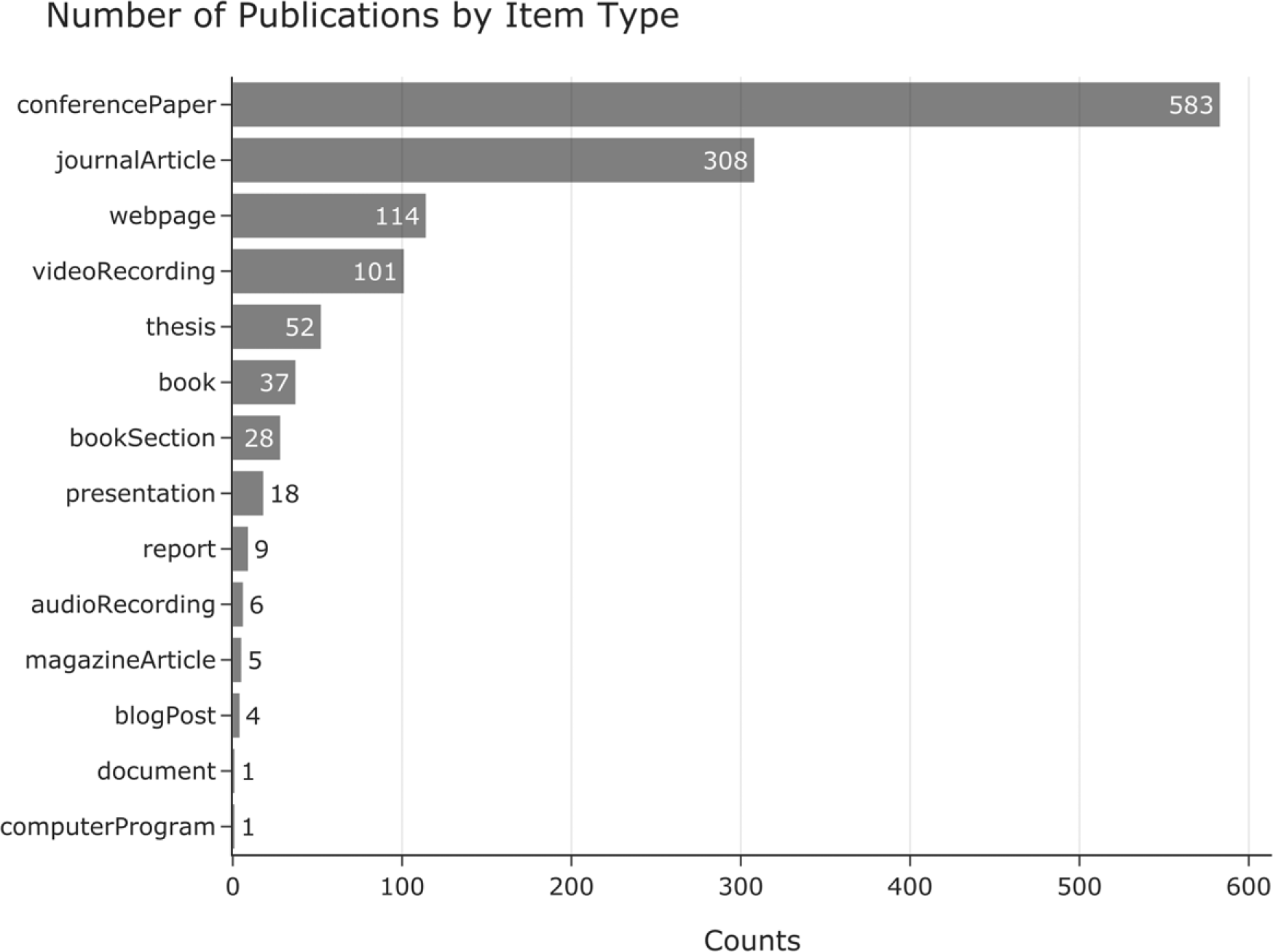
Figure 1 represents the distribution by type of content. The most significant part of the library currently consists of conference papers, followed by journal articles. Other notable categories include webpages, video recordings, theses and books. The prevalence of conference papers can be explained by a large number of conferences specifically focused on networked music, most of which provide free access to their published papers.
Number of publications by item type.

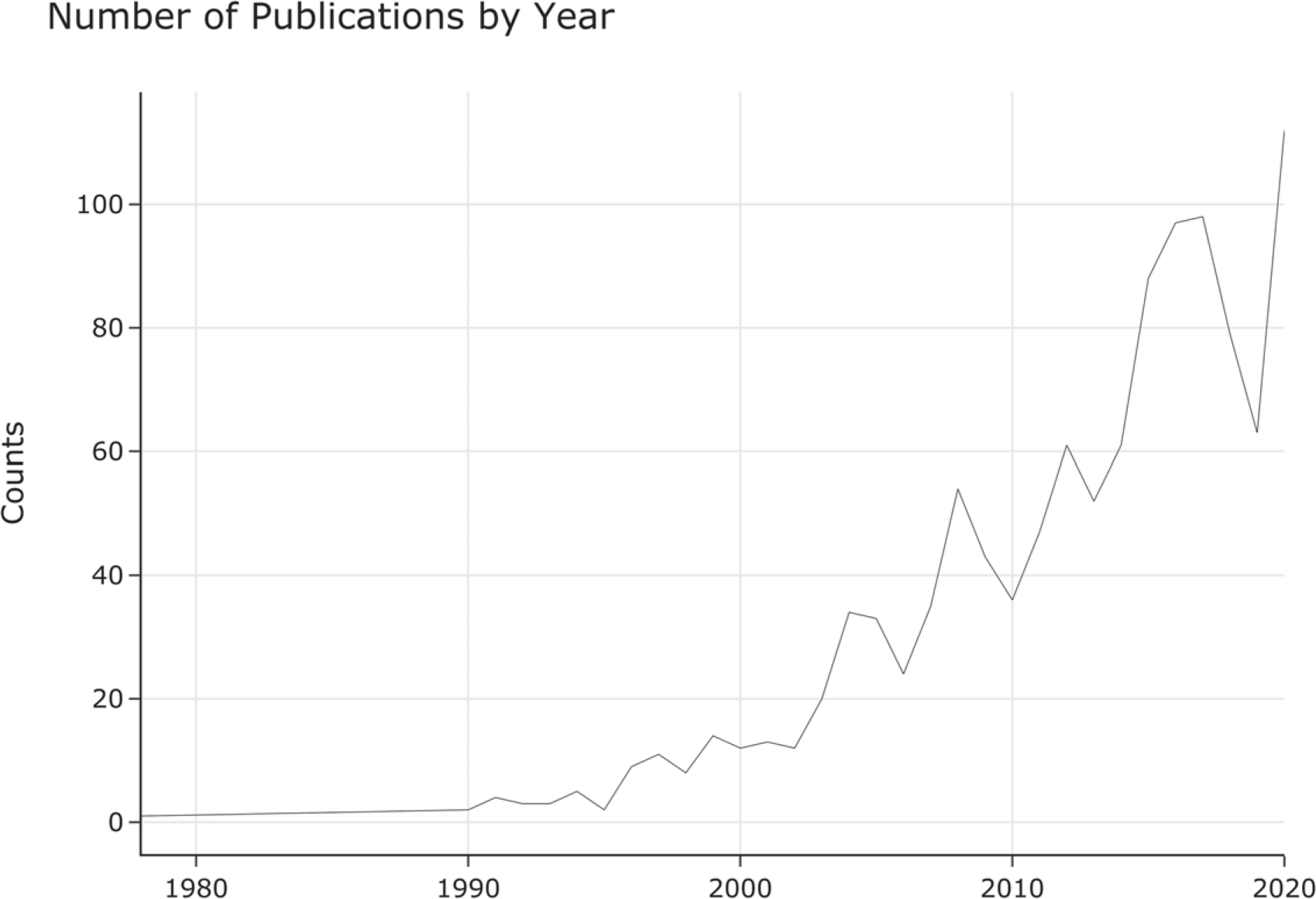
The distribution by year of publication (Figure 2) reveals an expected steady growth of the number of works published each year in the last three decades, and especially in the last five years, with the peak in 2020. It is worth noting that there are still plenty of works published in 2020 that we have not collected yet, so it indeed can be said that 2020 was especially remarkable in networked music research.
Number of publications by year.

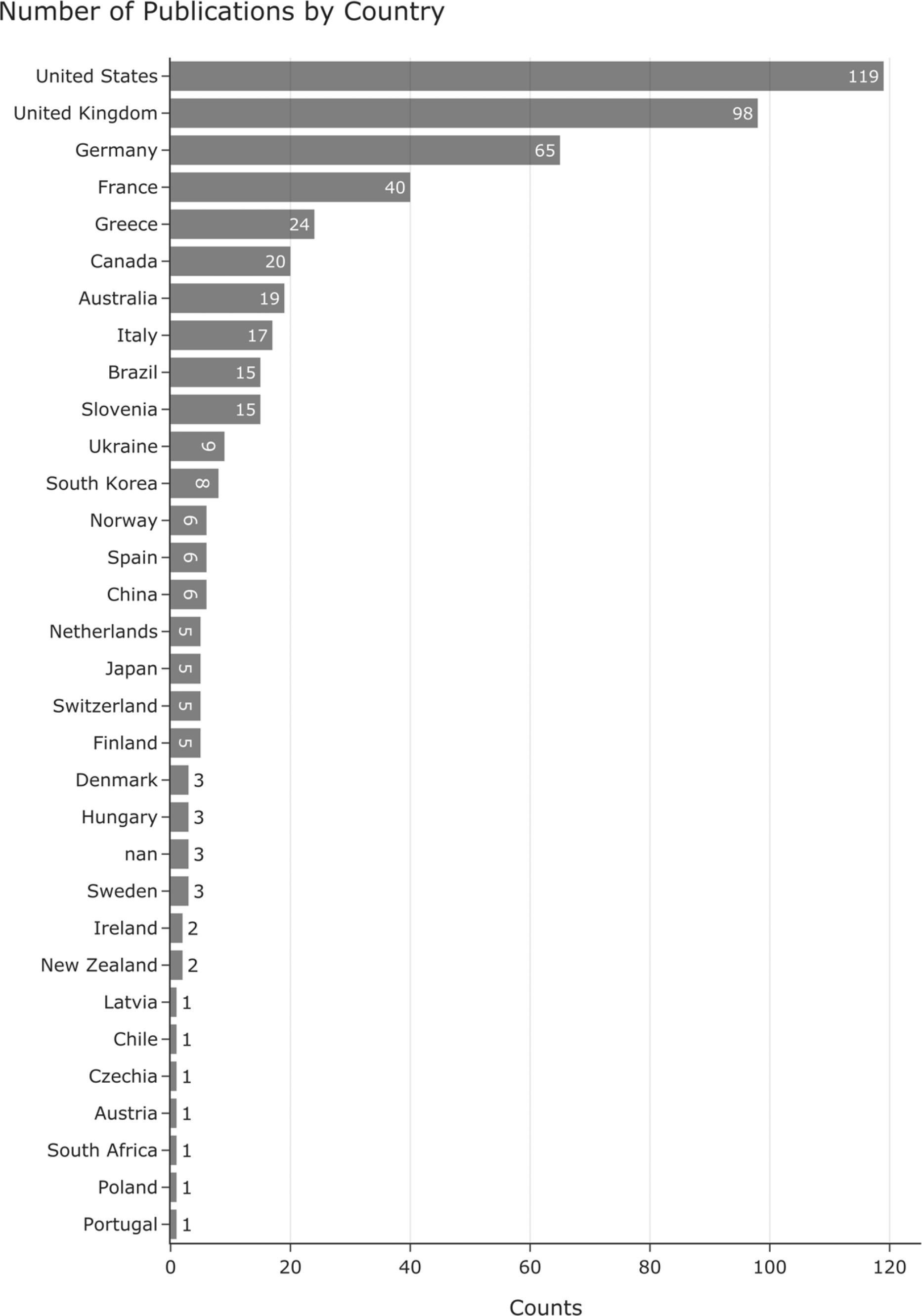
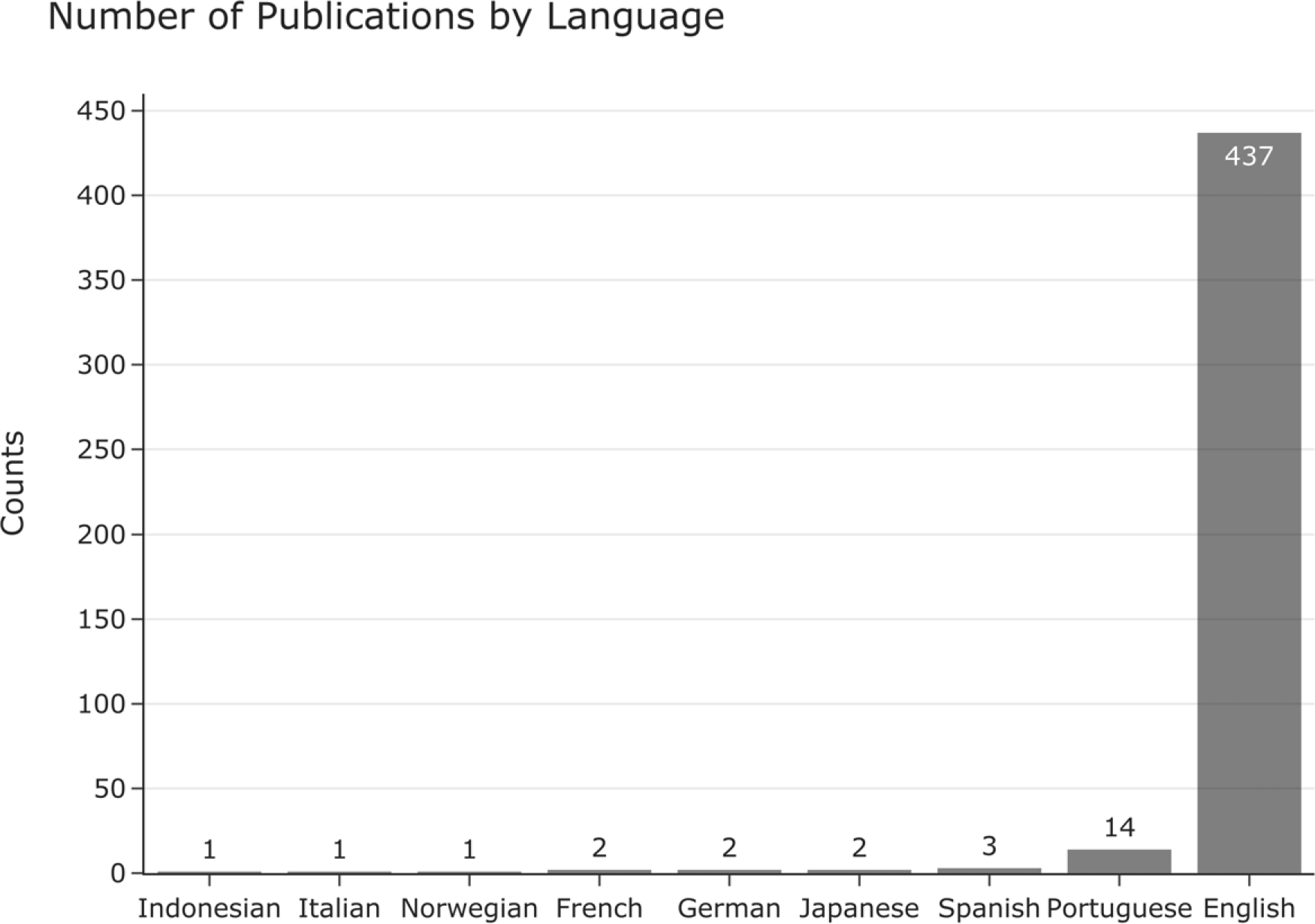
The number of publications by country (Figure 3) demonstrates that most works were published in English-speaking countries. The most likely explanation for this result would be our obvious language barrier, as English is our main research language. That also explains why the absolute majority of works in the library are written in English (see Figure 4). However, we can already see the truly global geographical scope of networked music research, which includes authors from virtually every continent in the world (with the only exception of Antarctica). We are looking forward to overcoming our language limitations in the future and including many more wonderful works from everywhere around the world.
Number of publications by country.

Number of publications by language.

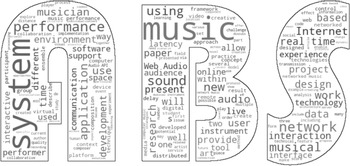
Figures 5–7. represent the word frequencies in titles, abstracts and tags. The most commonly used words in titles (Figure 5) are, expectedly, ‘music’, ‘network’ and ‘performance’. Searching for each of these words in titles would return 648, 387 and 228 results, respectively. The phrase ‘networked music performance’ returns 53 titles. Other common words include ‘system’ (88 titles), ‘interactive’ (74), ‘online’ (73), ‘web audio’ (54), ‘digital’ (35) and ‘real time’ (11).
Title tag cloud.

Abstract tag cloud.

Networked Music Performance Library tag cloud.

The most common words in abstracts (Figure 6) are almost identical to titles. Searching in abstracts for ‘music’, ‘performance’ and ‘network’ returns 753, 522 and 476 results, respectively. A total of 59 items include the phrase ‘networked music performance’ in their abstracts. Other common words include ‘system’ (353 entries), ‘application’ (261), ‘interaction’ (220), ‘development’ (193), ‘technology’ (161) and ‘interface’ (159). The common words in both titles and abstracts indicate the technological trends in many works.
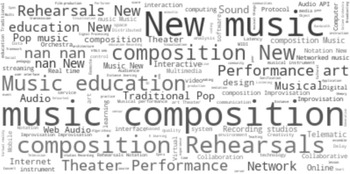
The tag cloud (Figure 7) shows that the most common words used in tags are ‘new music composition’, ‘rehearsals’, ‘music education’ and ‘theater’. These words correspond to the tags we added ourselves in accordance to the subject categories we developed. This practice has the serious downside of having our own tags mixed up with the authors’ keywords, but we use it here as a temporary method because of Zotero’s limited possibilities for categorisation. The subject categories that we develop are based on certain representations of whom we imagine to be the main users of our library. In the next section, we demonstrate six user scenarios based on these subjects: sonic arts, rehearsals, music teaching, concerts and theatre/performance arts.
6. EXAMPLES OF USE
6.1. Sonic arts
Networked music technology falls under the category of sonic arts because participating in a networked performance requires a digital interface. The category of sonic arts is currently the most developed subject in our library and contains over 900 items divided into four subcategories, all of which have corresponding tags in our Zotero collection that researchers can use to filter their search results: improvisation, new music composition, notation and installation. The subject of composition so far has the largest number of entries. This may be because the archive was initially mainly built around the topic of electroacoustic composition. When the management of the library was taken over by Daniil, that collection served as an early reference point. On the one hand, there is undeniably a large worldwide network of composers who are committed to researching and working with the internet, and who contribute numerous papers each year. On the other hand, networked performance is a very broad practice that necessarily includes many spheres of knowledge, which is reflected in our tagging system where many subjects overlap such as improvisation, generative music and sound installations.
Composers can use the tag ‘new music composition’ to find over 700 works, which provides a general introduction to various aspects of networked music performance, as well as highly specialised documentation of specific technologies. Particularly useful would be the works on creative approaches to writing networked music by composers who extensively work with the medium such as ‘Telematic Music: Six Perspectives’ (Oliveros, Weaver, Dresser, Pitcher, Braasch and Chafe Reference Oliveros, Weaver, Dresser, Pitcher, Braasch and Chafe2009), ‘The Constraints, Aesthetic Implications, and Creative Strategies of Composing for Networked Music Performance’ (Wilson Reference Wilson2018) and ‘Synchrony: Music of Sarah Weaver and Collaborations (2006–2019)’ (Weaver Reference Weaver2020). Another useful tag for composers to explore would be ‘notation’, which contains over 60 works that cover particular ways to notate networked compositions. Examples include ‘On the Evolution of Music Notation in Network Music Environments’ (Hajdu and Didkovsky Reference Hajdu and Didkovsky2009), ‘Notating the Unpredictable’ (Rebelo Reference Rebelo2010), ‘A Real-Time Score for Collaborative Just-in-Time Composition’ (Wyse and Yew Reference Wyse and Yew2014) and ‘Towards Responsive Scoring Techniques for Networked Music Performances’ (Wilson Reference Wilson, Hope, Vickery and Grant2019). We also have a large collection of audio and video recordings of different networked compositions that could be inspiring for composers to explore.
Improvising musicians can find over 80 items using the tag ‘improvisation’. The results include numerous papers, articles and recordings dedicated to different aspects of improvising over the internet. Specific topics include electroacoustic improvisation using digital musical instruments, which is covered in ‘Apps, Agents, and Improvisation: Ensemble Interaction with Touch-Screen Digital Musical Instruments’ (Martin Reference Martin2016), live coding in ‘A Distributed Memory For Networked Livecoding Performance’ (Sorensen Reference Sorensen2010), audience participation via a web application in ‘Open Symphony: Creative Participation for Audiences of Live Music Performances’ (Wu, Zhang, Bryan-Kinns and Barthet Reference Wu, Zhang, Bryan-Kinns and Barthet2017), intercultural improvisation in ‘Tele-Improvisation: A Multimodal Analysis of Intercultural Improvisation in Networked Music Performance’ (Mills Reference Mills2014) and more. Some articles describe people’s experiences of organising networked improvisations during the COVID-19 pandemic, such as ‘The Jazz Pianist Using a Computer Program to Play with Other Musicians in Quarantine’ (Kaplan Reference Kaplan2021), which can be helpful for those who have only just begun to get acquainted with networked music technology due to the current restrictions.
The tag ‘installation’ is the last under the category of sonic arts and it contains over 40 items. These are mostly descriptions and recordings of numerous networked sonic and multimedia installations, as well as the documentation of software for their creation. With the growing popularity of virtual and augmented reality and remote galleries, we hope this library will be useful to inspire sound artists to incorporate the internet into their installations.
6.2. Rehearsals
Performing musicians can use the library to find information about different hardware and software solutions to facilitate their rehearsals and online performances. One of the most helpful attributes of the library is the ability to find and study different set-ups previously tried by other musicians. For example, if one looks for information about organising a rehearsal online, one can choose the tag ‘rehearsals’ from the list of tags in Zotero and see the number of references reduced to about 300 entries. In this category it is then possible to find articles with a general introduction to networked music performance, which results in a comprehensive collection of resources. In such an example, we would find the titles ‘Telematic Sonic Performance Parts 1 & 2’ (Alarcón Reference Alarcón2020a, Reference Alarcón2020b), ‘Network Music’ (Rohrhuber Reference Rohrhuber, Collins and d’Escrivan2007), ‘Internet Music: An Introduction’ (Hugill Reference Hugill2005) and ‘AES White Paper: Best Practices in Network Audio’ (Bouillot et al. Reference Bouillot, Cohen, Cooperstock, Floros, Fonseca and Foss2009), in addition to detailed documentation, tutorials and general information about popular software solutions, such as JackTrip (JackTrip Foundation 2021), SonoBus (SonoBus 2021) and Jamulus (Jamulus 2021). The searcher will also find stories about someone figuring out how to play music online from scratch and reporting their experiences, such as ‘A Few Things I’ve Learned About Livestreaming’ (Tepfer Reference Tepfer2020). Furthermore, it is possible to choose a combination of tags and find something more specific using the authors’ keywords. Someone who might be specifically concerned with latency can look for papers using this keyword under the category of ‘Rehearsals’ and find such works as ‘Telematic Performance and the Challenge of Latency’ (Rofe and Reuben Reference Rofe and Reuben2017) or ‘Making the Most of Wi-Fi: Optimisations for Robust Wireless Live Music Performance’ (Mitchell, Hilton, Madgwick and Freed Reference Mitchell, Hilton, Madgwick and Freed2014).
6.3. Music teaching
All the aforementioned resources might be as useful for music teachers as they are for performing musicians. Several works specifically cover networked teaching practices, especially introductory papers and tutorials, which teachers can read themselves and share with their students. The teacher might find useful such works as ‘Distant Teaching of Chamber Music via Local Area Networks’ (Bitzer et al. Reference Bitzer, May, Kurtisi and Loesch2006), ‘The Telematic Learning Environment: Experiences and Outcomes Teaching with Network Audio’ (Chester Reference Chester2012) and ‘Teaching Music Online: Changing Pedagogical Approach When Moving to the Online Environment’ (Johnson Reference Johnson2017). Other documents touch upon specific technologies that can be useful in particular educational scenarios, such as the use of interactive digital scores in ‘A New Medium for Remote Music Tuition’ (Duffy and Healey Reference Duffy and Healey2017), MIDI-controlled grand pianos in ‘Piano Master Classes via the Internet’ (Young and Fujinaga Reference Young and Fujinaga1999) or singing together in virtual reality with ‘Using Virtual Reality to Assist Online Singing Teaching’ (Loveridge Reference Loveridge2020). It can be very useful and inspiring to see a story of a fellow teacher who shares their experience of learning how to use this technology without any prior experience, like Melanie Ragge (Reference Ragge2020) does in her video From No Tech to Hi-tech – A Journey into Online Teaching. In general, the tag ‘music education’ contains more than 200 entries in our library, and using additional tags (such as ‘collaborative learning’, ‘instrumental pedagogy’ and ‘synchronous online instruction’) can help to find information on a particular topic.
6.4. Concerts
Musicians, curators and promoters who are looking for ways to organise concerts can find information about streaming software; for example, OBS Studio (Open Broadcaster Software 2020) and virtual venues, some of which have just emerged in 2020 in the midst of the pandemic, such as Deck10 (Deck 10 Virtual Events System 2020), Digital Stage (Digital Stage 2021) and Nowhere (NWR Corp 2021), and some have existed for many years already, such as UpStage (UpStage 2021). Of particular interest to the library is the rise of virtual and augmented reality platforms, such as Volta XR (Volta XR 2020), which aim to seamlessly project electroacoustic music performance into an interactive venue that can be broadcast worldwide.
It might also be helpful to read reflections on organising online concerts with an extensive description of various software and hardware solutions for different musical configurations, such as ‘Notes on Organizing the Spring Festival Online’ written by composition students of the Royal Conservatoire of the Hague after organising an online version of the annual festival of students’ music (Pilchen et al. Reference Pilchen, Kramer, Jarlkaganova and Melli2020), and review documentation of previously organised online events, such as 02022020.SPACE (02022020.SPACE 2020), during which musicians around the world performed at 20:20 their local time on 2 February 2020, or Earth Day Art Model, a telematic festival held on International Earth Day, which ‘highlights current artistic perspectives that range from scientific observation to creative works of music and intermedia’ (Earth Day Art Model 2020).
6.5. Theatre, dance and performance
The non-musical part of our library is the least developed; however, we anticipate there to be a growing number of projects documented because artists of all forms have begun to work together remotely in recent months, driven by those artists who are particularly interested in interfacing with technology. Existing projects are accumulated under the tag ‘theater/performance art’, which consists of 95 items. Artists in the fields of dance, theatre and performance can also find research works on subjects such as cyber performance, which is the subject of the thesis ‘Adventure in Cyberformance. Experiments at the Interface of Theatre and the Internet’ (Jamieson Reference Jamieson2008); using video-conferencing in dance and theatre, for example, in ‘Distributed Choreography: A Video-Conferencing Environment’ (Naugle Reference Naugle2002) or ‘Enabling Live Presence: Dynamic Video Compression for the Telematic Arts’ (Smith Reference Smith2012), or virtual reality as discussed in ‘Virtual Reality and Performance’ (deLahunta Reference deLahunta2002). One may also find references to emerging virtual platforms for theatrical performance, such as ‘elektron.live’ (Eˉlektron. Live 2020), along with video recordings of numerous theatrical, performative and dance projects.
7. FUTURE WORK
The library resource was made public in response to the need for musicians to quickly become familiar with networked music practices due to the COVID-19 pandemic. The immediate goal for publishing the Networked Music Performance Library was to create a resource not only for researchers and composers who are already technically fluent and looking for an immediate application of collaboration technology for their particular practice, but also for those who are new to networked music technology and seek knowledge and inspiration. Therefore, the library helps to increase the number of musicians who work with technology as a whole. In this way, the library serves as both an educational purpose and an introduction to the main concepts regarding networked music in a purely instrumental application. For many, the library also becomes an introduction to electroacoustic and sonic arts practices. Acoustic musicians who previously had no such need are adding recording and broadcast technologies to their lives. Jérôme Joy, one of the core drivers of the NMSAT library, commented that he was ‘surprised to see that this topic of networked music & performance had gradually diminished compared to the dynamism of the 2000s’ and noted that today’s ‘context with extreme conditions … curiously makes possible to revive this type of question’.Footnote 1
An acknowledged limitation at present is that as our collection grows larger, it becomes exponentially harder for musicians to navigate through it. Making it more accessible is our main priority at the moment. Currently, we have spreadsheetsFootnote 2 with lists of items selected by different subjects referenced on the library’s homepage, but this is far from being a perfect permanent solution. In the future, we will create a dedicated section on the library’s website where all the curated selections will be presented on different pages. Thus, the library will continue to address and curate applications of networked music technology that remain relevant outside the context of a pandemic. In the next section, we will mention four of these applications: assisting socially isolated musicians, teaching, travel and new pandemics.
8. POST-COVID NETWORKED MUSIC APPLICATIONS
8.1. Social isolation
While global social isolation measures during the coronavirus pandemic have dramatically affected most musicians’ ability to collaborate, most of us expect our lives to return to normal once the restrictions are lifted. However, many musicians worldwide are generally isolated due to reasons such as disability or long-term illness, living in a remote location, transport issues and displacement, among others. Networked music performance can be a viable solution for many generally socially isolated musicians (Iorwerth and Knox Reference Iorwerth and Knox2019; Wilson and McMillan, Reference Wilson and McMillan2019). Trevor Grahl’s (Reference Grahl2019) Vocal Postcards, written for two refugee choirs in Athens and Gothenburg, is a wonderful example of using networked music technology to facilitate creative collaboration between communities of people with restricted travel abilities. However, that project required much technological expertise from teams of sound engineers at both locations, and the technological complexity of networked music performance can be a major discouragement for many people when it comes to their individual practices. Therefore, creating software solutions suitable for domestic non-tech-savvy users, as well as facilitating learning about this technology, is vital for more inclusive musical practices.
8.2. Teaching
Teaching opportunities can be widely enriched with the implementation of network technology. While asynchronous forms of networked teaching – from online supplements and recordings exchange to massive open online courses (Lushnikova, Chintakayala and Rodante Reference Lushnikova, Chintakayala and Rodante2013) – have long existed in practice, synchronous networked tutoring had mainly existed in the domain of large universities (e.g., see, Chester Reference Chester2012; Comanducci et al. Reference Comanducci, Buccoli, Zanoni, Sarti, Monache and Cospito2018). A networked learning environment can be used for inviting teachers from abroad, allowing access to education for socially isolated students and organising large-scale collaborations between universities in different locations. However, the pandemic highlighted that domestic use of networked music technology remains inaccessible for many teachers. One reason for that would be their limited access to a high-speed internet connection and professional sound equipment, but another is the lack of easily searchable information about software solutions for education and comprehensible guidelines for their usage.
8.3. Travel
While musicians are probably not the biggest contributors to climate change, many people have made individual choices to travel less. However, co-located performances still seem to be the most important way for musicians to collaborate and a majority of musicians see it as the only option. While it is true in many cases, there are many scenarios where networked music performance might be not only acceptable but also even beneficial. For example, networked presence might be organic for many forms of solo electronic music performance, such as live coding and DJ sets, as well as for rehearsals with composers, such as when an ensemble or orchestra are at one location and the composer is at another. Such collaborations do not require performing music at the same time at both locations; thus, the network latency does not affect the quality of communication. Composer Thanasis Deligiannis has developed a practice of ‘audio-only rehearsals with musicians, because of both travel restrictions and costs’.Footnote 3 Working remotely helped the composer to conduct rehearsals with remote ensembles to ‘help move faster and not lose time’ by introducing them to the planned workshop materials when they can meet in person. Even outside pandemic conditions, travelling costs are a major expense for most new music ensembles and a substantial part of the cost is covering composers’ travels. Networked solutions for rehearsals help ensembles evaluate the necessity of the composers’ physical presence more carefully.
8.4. Future pandemics
Unfortunately, COVID-19 is very unlikely to be the last major pandemic. COVID-19 is the most recent of three endemic coronaviruses circulating among humans that have emerged since the beginning of the century (da Costa, Moreli and Saivish Reference da Costa, Moreli and Saivish2020), and factors such as crowding, urbanisation, poverty, destructive behaviour towards the environment and international travel, among many others are contributing to the unprecedented growth of emerging diseases. ‘One can conclude … that we have entered a pandemic era’ (Morens and Fauci Reference Morens and Fauci2020: 1077). Social distancing has been shown to be effective in controlling the spread of diseases (Choi and Ki Reference Choi and Ki2020) and it is likely that global trends on de-urbanisation and decreased travel will become urgently necessary to prevent new major outbreaks in the future.
Contributing to the library
We are actively inviting researchers and artists to contribute their projects and written works to the Networked Music Performance Library. Making a contribution is possible either via the Google formFootnote 4 or by sending an email to danya@source-elements.com.