Introduction
Background and Significance
Disaster events, whether natural or man-made, pose formidable challenges to global public health systems. Reference Hung, Mashino and Chan1 In these scenarios, a rapid, orderly, and highly effective Emergency Medical Response (EMR) is paramount for reducing mortality and morbidity. Reference Usoro, Mehmood and Rapaport2 Consequently, cultivating medical professionals equipped with robust knowledge, superior decision-making skills, and strong psychological resilience for disaster relief has become a core mission of modern medical education. Reference Hu, Lai and Zuo3 However, the complexity of EMR – which demands multidisciplinary collaboration, operates under severe resource constraints, and unfolds in highly uncertain environments – presents significant challenges to traditional pedagogical models.
Limitations of Traditional Teaching Models
For decades, the lecture-based format has been the cornerstone of medical education. Yet, its limitations are increasingly evident in highly practical domains like EMR. Passive knowledge transfer struggles to simulate the urgency and chaos of a disaster scene. Students often understand theoretical concepts in isolation but fail to effectively translate this knowledge into real-time decision-making capabilities. Reference Sugaya, Kakamu, Iseki and Hasegawa4 Initial teaching observations corroborate this, demonstrating that a lecture-only approach was ineffective in stimulating student interest and fostering comprehensive response skills.
Exploring and Integrating Emerging Pedagogical Methods
To address the shortcomings of traditional methods, educators have explored more immersive and interactive teaching approaches. Game-based learning (GBL), particularly tabletop exercises based on role-playing, significantly enhances learner engagement and practical application by placing students in simulated disaster scenarios. Reference Hu, Xiao and Li5 However, this model introduces new challenges: students may encounter knowledge barriers that halt their progress during the exercise, or they may lack immediate, expert guidance to facilitate deep reflection, thereby limiting the depth and breadth of their learning.
Concurrently, the rise of generative Artificial Intelligence (AI) has introduced revolutionary tools to the educational landscape. Generative AI agents, capable of playing the role of an expert, can provide personalized, on-demand question-and-answer support. Reference Chow and Ng6 This capability perfectly addresses the guidance gap often found in GBL. It was postulated that integrating a generative AI agent as an “intelligent tutor” or “on-site advisor” within a tabletop exercise would not only provide real-time answers to student queries, but would also guide them toward deeper critical thinking, thereby creating a synergy between the two pedagogical methods.
Research Gap and Novelty of This Study
While the applications of GBL and generative AI in education have been individually explored, there remains a significant gap in empirical research on their deep integration to form a “Generative AI-Powered Game-Based Learning” (AI-GBL) framework for EMR education. This study directly addresses this gap. The core innovation lies not in simply using AI as an ancillary tool, but in embedding it within the GBL process to create a synergistic and effective educational ecosystem designed to solve the fundamental problem of disconnecting theory from practice in complex scenarios.
Study Objectives and Hypotheses
Based on the aforementioned background, this study aims to systematically evaluate and compare the effectiveness of three distinct teaching models – traditional lecture, role-playing-based GBL, and generative AI-powered GBL – in an EMR course through a retrospective comparative study. It was hypothesized that, compared to traditional lectures and GBL alone, the AI-GBL model would significantly improve students’ knowledge acquisition, delayed knowledge retention, and comprehensive problem-solving abilities, while also yielding more positive feedback on their learning experience.
Methods
Study Design
This study employed a retrospective, comparative design to analyze educational data from three consecutive cohorts of medical students enrolled in a mandatory EMR course from 2022 through 2024 at a medical school of a comprehensive university. Each cohort was exposed to a different teaching modality, allowing for a naturalistic comparison of educational outcomes. The study was conducted in accordance with the Declaration of Helsinki and received approval from the Biomedical Ethics Committee of West China Hospital, Sichuan University, Chengdu, China (the institutional review board - Number: 2024[1811]). The requirement for individual informed consent was waived due to the retrospective and anonymized nature of the data analysis.
Participants and Setting
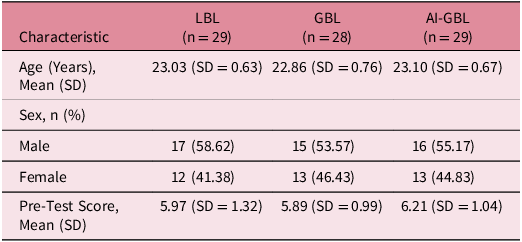
A total of 86 pre-internship medical students participated across the three cohorts (Table 1). This study employed a convenience sampling method, including all students enrolled in the mandatory EMR course across three consecutive academic years. The course was a core component of the Disaster Medicine curriculum, delivered over a single semester. Baseline demographic data, including age and gender, were collected from academic records to ensure comparability between the groups. Given the retrospective design, the sample size was based on the available cohort data rather than an a priori calculation. However, a post-hoc power analysis confirmed that the sample was adequately powered to detect differences across the three arms. Based on the observed effect sizes, the calculated Cohen’s f values were 0.314 for Change1 (improvement from pre-test to post-test) and 0.473 for Change2 (retention from post-test to final-test). With an alpha of 0.05, three groups, and a total sample size of 86, the achieved statistical power was 0.881 for Change1 and 0.995 for Change2, both exceeding the conventional threshold of 0.80. The detailed calculations for the effect size conversion and power analysis are provided in Supplementary Materials.
Baseline Characteristics of Study Participants

Table 1. Long description
A table comparing baseline characteristics of study participants across three cohorts. The table has four rows and three columns. The columns are labeled LBL, GBL, and AI-GBL. The rows are labeled Age (Years), Mean (SD), Sex, n (%), Male, Female, Pre-Test Score, Mean (SD). Row 1: Age (Years), Mean (SD): LBL, 23.03 (SD 0.63); GBL, 22.86 (SD 0.76); AI-GBL, 23.10 (SD 0.67). Row 2: Sex, n (%): Male: LBL, 17 (58.62%); GBL, 15 (53.57%); AI-GBL, 16 (55.17%). Row 3: Sex, n (%): Female: LBL, 12 (41.38%); GBL, 13 (46.43%); AI-GBL, 13 (44.83%). Row 4: Pre-Test Score, Mean (SD): LBL, 5.97 (SD 1.32); GBL, 5.89 (SD 0.99); AI-GBL, 6.21 (SD 1.04).
Abbreviations: LBL, Lecture-Based Learning; GBL, Game-Based Learning; AI, Artificial Intelligence; AI-GBL, Generative AI-Powered Game-Based Learning; SD, Standard Deviation.
Educational Interventions
All three interventions were designed to achieve identical learning objectives, which covered core EMR principles such as the Incident Command System, triage protocols, Reference Peng and Hu7 mass-casualty incident management, and specific injury management in disaster settings. The total contact time for each intervention was standardized to four class hours.
Group 1: Lecture-Based Learning (LBL)—This cohort received traditional didactic instruction. The session was delivered by an experienced faculty member using a slide-based presentation. The content focused on theoretical knowledge and case study descriptions. A 15-minute question-and-answer session was held at the end of the lecture.
Group 2: Game-Based Learning (GBL) with Tabletop Exercise—This cohort participated in a role-playing tabletop exercise simulating a major earthquake scenario. Students were divided into small groups (five-to-six students) and assigned key roles. They were given a map, scenario cards, and resource tokens to manage the incident. An instructor acted as a facilitator, providing the scenario narrative and adjudicating actions, but offered minimal direct instructional feedback to preserve the simulation’s fidelity. The introduction to the educational game is provided in the Supplementary Materials.
Group 3: Generative AI-Powered Game-Based Learning (AI-GBL)—This cohort engaged in the same tabletop exercise as Group 2. The key difference was that they were provided with access to a custom-developed generative AI agent, which they could use on their personal laptops or mobile phones. The AI agent was built on the ChatGLM (Zhipu AI; Beijing, China) application programming interface (API). It was specifically prompt-engineered to act as an “EMR Expert Advisor.” Crucially, to ensure the accuracy and reliability of the guidance, the agent utilized a Retrieval-Augmented Generation (RAG) architecture. This approach strictly confined the AI’s knowledge base to a curated repository of evidence-based Disaster Medicine protocols and the course’s core content, preventing hallucinations. Students could interact with the AI in real-time by typing questions related to their situation, such as “What are the triage criteria for a patient with a head injury and altered mental status?” or “How should we prioritize resource allocation between the treatment and transport areas?”. The AI provided immediate, concise, and context-aware guidance, thereby serving as an on-demand knowledge resource and decision-support tool. The introduction to the generative AI agent is provided in the Supplementary Materials.
Data Collection and Outcome Measures
The primary outcome was the difference in immediate knowledge retention between the three groups. The secondary outcome was the difference in delayed knowledge retention between the three groups. Exploratory outcomes included cognitive load, learning motivation, and technology acceptance. Data were collected from two sources: knowledge assessments and student feedback questionnaires.
Knowledge Assessment—Student knowledge was evaluated using a 20-question written examination, with each question worth 0.5 points for a total possible score of 10 points. The exam utilized a multiple-choice format designed to test factual recall. To ensure content validity, the initial item pool was developed by five faculty members from the teaching team based on the course learning objectives. Subsequently, the questionnaire underwent a content review by an independent panel of three senior EMR educators who did not participate in the item generation. This panel evaluated the relevance, clarity, and alignment of each item with the curriculum, and their feedback was incorporated to finalize the 20 questions. This format allowed for objective scoring using a standard answer key, thereby eliminating potential inter-rater grading bias. It was administered at three time points:
-
• Pre-Test: Immediately before the class to establish baseline knowledge.
-
• Post-Test: Immediately after the class to measure immediate knowledge gain.
-
• Final-Test: Three weeks after the class, with no intervening exposure to the material, to assess knowledge retention.
Student Feedback Questionnaire—A post-course anonymous questionnaire was administered to gather students’ perceptions of their learning experience. The study employed three questionnaires, detailed in Supplementary Materials. For all participants, a learning motivation scale (seven items; adopted from Hwang and Chang Reference Hwang and Chang8 ) and a cognitive load scale (eight items; adopted from Hwang, et al Reference Hwang, Yang and Wang9 ) were administered. As the technology acceptance questionnaire was only relevant to the novel teaching methods, it was administered exclusively to the game-based groups. This scale (13 items; adopted from Chu, et al Reference Chu, Hwang and Tsai10 ) assessed perceived ease-of-use and usefulness. All questionnaires used a six-point Likert scale.
These instruments were selected based on their established validation in prior research. For instance, the cognitive load scale was adapted from Sweller, et al Reference Sweller, van Merrienboer and Paas11 and has demonstrated high reliability in previous studies. Reference Hwang, Yang and Wang9 Similarly, the perception and attitude questionnaires used by Chu, et al Reference Chu, Hwang and Tsai10 were reviewed by experts to ensure content validity. As the medium of instruction for these medical students is English, the original English versions of the questionnaires were utilized to avoid translation bias. To ensure contextual relevance for the EMR setting in the current study, the items were reviewed by a panel of three senior EMR educators. Minor contextual adaptations were made to the scenario descriptions based on their feedback to ensure clarity and appropriateness. Internal consistency was assessed using Cronbach’s alpha. Further details on the questionnaire items, their sources, and validation processes are provided in Supplementary Materials. The total scores for each scale were calculated as the mean of their constituent items. Given the sample sizes and the nature of the scales (averages of multiple items), the data were considered suitable for parametric analysis.
Statistical Analysis
All statistical analyses were performed using IBM SPSS Statistics (version 20.0; IBM Inc.; Armonk, New York USA).
To examine the effects of the three teaching modalities on student performance, a multivariate analysis of variance (MANOVA) was conducted. The MANOVA used the teaching group (LBL, GBL, AI-GBL) as the independent variable and two dependent variables representing performance change: Change1 (post-test score minus pre-test score) and Change 2 (final-test score minus post-test score). Prior to the MANOVA, the assumption of equality of covariance matrices was tested using Box’s M test. The assumption of homogeneity of variance was also checked for each dependent variable using Levene’s test. If the overall MANOVA yielded a significant result, univariate follow-up ANOVAs were conducted for each dependent variable to determine where the group differences lay. For any significant univariate ANOVA, post-hoc pairwise comparisons were performed using Fisher’s Least Significant Difference (LSD) test to identify specific differences between the groups.
For the questionnaire data, a one-way ANOVA was conducted to compare the mean scores across the three groups. For significant findings, Fisher’s LSD test was used for pairwise comparisons.
A two-tailed P value of less than 0.05 was considered statistically significant for all analyses. The widths of the 95% confidence intervals (CI) for secondary and exploratory outcomes have not been adjusted for multiplicity, and the intervals should not be used in place of hypothesis testing.
Results
Baseline Characteristics of Study Participants
A total of 86 medical students were included in this retrospective analysis, with 29 students in the LBL group, 28 in the GBL group, and 29 in the AI-GBL group. The baseline characteristics of study participants are shown in Table 1.
Pairwise Comparisons of Group Scores
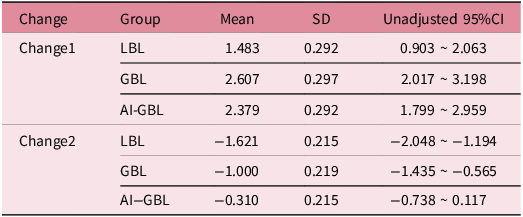
The descriptive statistics for the knowledge score changes (Change1 and Change2) across the three teaching groups are presented in Table 2.
Descriptive Statistics for Knowledge Score Changes by Teaching Group

Table 2. Long description
A table comparing knowledge score changes across teaching groups. The table has two main sections: Change1 and Change2, each with data for three groups: LBL, GBL, and AI-GBL. Each section includes columns for Group, Mean, SD, and Unadjusted 95% CI. Change1: Row 1: Group LBL, Mean 1.483, SD 0.292, Unadjusted 95% CI 0.903 to 2.063. Row 2: Group GBL, Mean 2.607, SD 0.297, Unadjusted 95% CI 2.017 to 3.198. Row 3: Group AI-GBL, Mean 2.379, SD 0.292, Unadjusted 95% CI 1.799 to 2.959. Change2: Row 1: Group LBL, Mean -1.621, SD 0.215, Unadjusted 95% CI -2.048 to -1.194. Row 2: Group GBL, Mean -1.000, SD 0.219, Unadjusted 95% CI -1.435 to -0.565. Row 3: Group AI-GBL, Mean -0.310, SD 0.215, Unadjusted 95% CI -0.738 to -0.117.
Note: The width of the 95% confidence intervals has not been adjusted for multiplicity, and they should not be used in place of hypothesis testing.
Abbreviations: LBL, Lecture-Based Learning; GBL, Game-Based Learning; AI, Artificial Intelligence; AI-GBL, Generative AI-Powered Game-Based Learning; SD, Standard Deviation; CI, Confidence Interval.
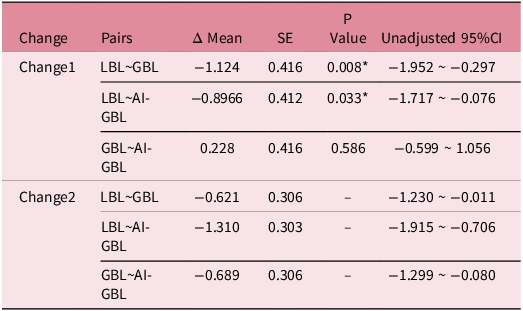
Subsequently, a MANOVA was conducted to examine the differences among the three teaching groups (LBL, GBL, and AI-GBL) on two dependent variables: Change1 (post-test minus pre-test scores) and Change2 (final-test minus post-test scores); Table 3.
Pairwise Comparisons of Knowledge Score Changes Between Groups

Table 3. Long description
The table presents pairwise comparisons of knowledge score changes between three teaching groups: LBL, GBL, and AI-GBL. It has two main sections labeled Change1 and Change2, each with four rows and five columns. The columns are labeled Pairs, Delta Mean, SE, P Value, and Unadjusted 95% CI. Change1 compares post-test minus pre-test scores, while Change2 compares final-test minus post-test scores. Each row within the sections lists specific group comparisons and their corresponding values. For Change1, the pairs compared are LBL-GBL, LBL-AI-GBL, and GBL-AI-GBL, with values such as -1.124, 0.8966, and 0.228 for Delta Mean, respectively. For Change2, the pairs compared are LBL-GBL, LBL-AI-GBL, and GBL-AI-GBL, with values such as -0.621, -1.310, and -0.689 for Delta Mean, respectively. The table includes statistical values like SE, P Value, and Unadjusted 95% CI for each comparison.
Note: The widths of the 95% Confidence Intervals for secondary outcomes have not been adjusted for multiplicity and should not be used in place of hypothesis testing.
Abbreviations: LBL, Lecture-Based Learning; GBL, Game-Based Learning; AI, Artificial Intelligence; AI-GBL, Generative AI-Powered Game-Based Learning; SE, Standard Error; CI, Confidence Interval.
*P < 0.05.
The Box’s M test indicated that the assumption of equality of covariance matrices was violated (Box’s M = 100.564; F = 16.176; P < 0.001). However, given the large sample size (N = 86) and relatively equal group sizes (n = 29, 28, and 29, respectively), the MANOVA interpretation was deemed appropriate, as Pillai’s Trace is robust to this violation.
The multivariate tests revealed a significant main effect of Group (Pillai’s Trace = 0.314; F = 7.730; P < 0.001; partial η2 = 0.157), indicating that the teaching methods had differential effects on student performance changes.
Univariate follow-up analyses showed significant group differences for both Change1 (F = 4.112; P = 0.020; partial η2 = 0.090) and Change2 (F = 9.314; P < 0.001; partial η2 = 0.183). The results of the post-hoc pairwise comparisons using the LSD method are shown in Table 3.
For Change1 (Improvement from Pre-Test to Post-Test)—The GBL group showed significantly greater improvement than the LBL group (mean difference = 1.124 points; unadjusted 95% CI [0.297, 1.952]; P = 0.008). The AI-GBL group showed significantly greater improvement than the LBL group (mean difference = 0.897 points; unadjusted 95% CI [0.076, 1.717]; P = 0.033). No significant difference was found between the GBL group and the AI-GBL group (mean difference = −0.228 points; unadjusted 95% CI [−0.599, 1.056]; P = 0.586).
For Change2 (Retention from Post-Test to Final-Test)—The AI-GBL group showed significantly better retention than both the LBL group (mean difference = 1.310 points; unadjusted 95% CI [0.706, 1.915]) and the GBL group (mean difference = 0.689 points; unadjusted 95% CI [0.080, 1.299]). The GBL group showed better retention than the LBL group (mean difference = 0.621 points; unadjusted 95% CI [0.011, 1.230]).
Analysis of Student Feedback Questionnaires
Reliability analyses indicated satisfactory to good internal consistency across the scales used in the current study. Specifically, the Cronbach’s α was 0.826 for the learning motivation scale. For the cognitive load scale, the α was 0.880 for the mental effort subscale and 0.747 for the mental load subscale. For the technology acceptance questionnaire, the α was 0.851 for the usefulness subscale and 0.815 for the ease-of-use subscale.
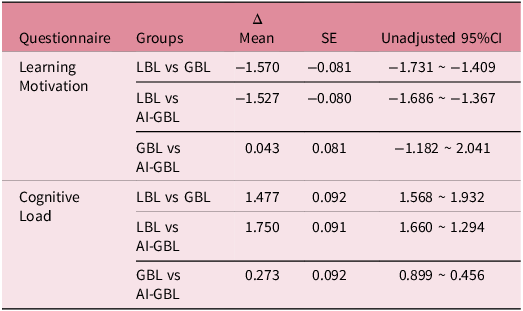
Pairwise comparisons revealed that the GBL and AI-GBL groups scored significantly higher than the LBL group (mean difference = 1.570 points; unadjusted 95% CI [1.409, 1.731] and mean difference = 1.527 points; unadjusted 95% CI [1.367, 1.687], respectively), while no significant difference was observed between the GBL and AI-GBL groups (mean difference = 0.043 points; unadjusted 95% CI [−0.118, 0.204]); Table 4.
Student Feedback Questionnaire Scores by Teaching Modality

Table 4. Long description
The table presents student feedback questionnaire scores by teaching modality, focusing on Learning Motivation and Cognitive Load. It has four rows and three columns. The columns are labeled Groups, Δ Mean, SE, and Unadjusted 95% CI. The rows are grouped under Learning Motivation and Cognitive Load. Under Learning Motivation, the groups compared are LBL vs GBL, LBL vs AI-GBL, and GBL vs AI-GBL. Under Cognitive Load, the same groups are compared. Each row provides the Δ Mean, SE, and Unadjusted 95% CI for the comparisons. Notable trends include higher scores for GBL and AI-GBL groups compared to the LBL group in Learning Motivation, and higher Cognitive Load scores for LBL vs GBL and LBL vs AI-GBL.
Note: Scores were calculated as the mean of constituent items and range from 1 to 6.
The width of the 95% confidence intervals has not been adjusted for multiplicity, and they should not be used in place of hypothesis testing.
Abbreviations: AI, Artificial Intelligence; AI-GBL, Generative AI-Powered Game-Based Learning; LBL, Lecture-Based Learning; GBL, Game-Based Learning; SE, Standard Error; CI, Confidence Interval.
*P < 0.05.
Pairwise comparisons indicated that the LBL group reported the highest cognitive load, followed by the GBL group, with the AI-GBL group reporting the lowest. Specifically, the AI-GBL group had significantly lower cognitive load than both the GBL group (mean difference = −0.273 points; unadjusted 95% CI [−0.456, −0.090]) and the LBL group (mean difference = −1.750 points; unadjusted 95% CI [−1.932, −1.568]). The GBL group also reported significantly lower cognitive load than the LBL group (mean difference = −1.477 points; unadjusted 95% CI [−1.660, −1.294]); Table 4.
The technology acceptance questionnaire, administered exclusively to the GBL and AI-GBL groups, revealed a significant difference in the overall perception between the two modalities. The AI-GBL group reported significantly higher scores than the GBL group (mean difference = 0.338 points; unadjusted 95% CI [0.010, 0.666]). A more detailed analysis of the subscales showed that this difference was driven by the “usefulness” dimension, where the AI-GBL group also reported significantly higher scores (mean difference = 0.513 points; unadjusted 95% CI [0.137, 0.889]). This indicates that students perceived the AI-powered approach as more beneficial to their learning. However, there was no difference between the groups on the “ease-of-use” subscale (mean difference = 0.187 points; unadjusted 95% CI [−0.149, 0.523]).
Discussion
The findings of this study highlight the distinct advantages of both GBL and AI-GBL over traditional LBL. As a critical component of disaster preparedness, EMR education encompasses essential competencies including incident management systems, triage protocols, and immediate medical interventions, Reference Hu, Lai, Tan, Yao and Yan12 ultimately determining survival outcomes in mass-casualty incidents. Reference Suda, Franke, Hertwig and Gooßen13
For immediate knowledge acquisition (Change1), both the GBL and AI-GBL groups significantly out-performed the LBL group. This aligns with the initial hypothesis of this study and corroborates existing literature that suggests that the immersive nature of the tabletop exercise is critical for bridging theory and practice, Reference Sena, Forde, Yu, Sule and Masters14,Reference Hu, Liu and Li15 a known limitation of passive, didactic instruction in high-stakes environments like disaster response. Reference Pandya, Kharel and McMahon16,Reference Chou, Cheng and Lin17
However, the most significant contribution of this study is in delayed knowledge retention (Change2). The AI-GBL group demonstrated significantly better retention than both the GBL and LBL groups, indicating that the AI agent is crucial for solidifying knowledge. The authors propose the AI acted as a cognitive scaffold, providing on-demand support that reduced students’ mental effort. Reference Velupillai and Waite18 This “intelligent tutor” function freed cognitive resources, allowing students to focus on higher-order strategic thinking, which ultimately led to superior knowledge retention. Reference Zhang, Tian and Lu19
Furthermore, both GBL and AI-GBL methods dramatically enhanced learning motivation compared to LBL, Reference Hu, Lai and Yan20,Reference Hu, Lai and Yan21 an expected outcome given the inherent engagement of active, role-based participation. The lack of a motivational difference between the GBL and AI-GBL groups, despite the latter’s lower cognitive load, suggests the core game-based experience was the primary driver of student interest. The AI’s contribution, therefore, appears less about increasing enjoyment and more about enhancing educational efficiency – a finding with important practical implications for instructional design. This efficiency interpretation is corroborated by the technology acceptance results: while both systems were deemed equally easy to use, students in the AI-GBL group perceived their system as significantly more useful. This enhanced perception of usefulness likely stems from the AI agent’s role as an on-demand advisor, which provided immediate, context-aware guidance to overcome knowledge barriers. Reference Alsahafi and Baashar22 This finding aligns perfectly with the lower cognitive load in the AI-GBL group, indicating that efficient access to support not only reduces mental effort, but also elevates the perceived educational value of the tool.
An important consideration when integrating generative AI into medical education is the risk of AI-generated inaccuracies or “hallucinations” – confident but incorrect responses that could potentially reinforce misconceptions or, worse, promote dangerous clinical practices. In this study, several safeguards were implemented to mitigate this risk, including strict prompt engineering to confine the AI’s knowledge base to evidence-based protocols and pre-deployment expert review of AI responses. Nevertheless, the authors acknowledge that no AI system is infallible. It is recommended that future implementations incorporate a human-in-the-loop mechanism, where an instructor periodically reviews AI-student interactions, and that students be explicitly trained to critically evaluate AI-generated advice rather than accepting it uncritically. Reference Chow and Ng23 This aligns with recent calls to frame AI literacy as a core competency in medical education. Reference Ng and Chow24–Reference Holzinger, Zatloukal and Müller26
Ultimately, it is important to acknowledge the fundamental difference in instructional delivery between the LBL and the game-based cohorts. The LBL group received theoretical instruction, whereas the GBL and AI-GBL groups engaged in experiential, practice-driven exercises. The superior performance of the game-based groups likely reflects the intrinsic advantage of experiential learning in bridging the gap between theoretical knowledge and practical application – a gap that traditional didactic methods inherently struggle to close in high-stakes environments like EMR.
Limitations
Despite these promising results, the study has several limitations that must be acknowledged. First, the retrospective design, while allowing for a naturalistic comparison, lacks the randomization of a prospective randomized controlled trial, potentially introducing uncontrolled confounding variables. Second, the use of a convenience sample of students who self-selected to take the Disaster Medicine course may introduce selection bias and limit the generalizability of the findings to the broader medical student population. Third, regarding the measurement instruments, although the questionnaires were adapted from validated instruments and reviewed by an expert panel, a formal pilot study was not conducted prior to their implementation, which represents a methodological limitation.
Fourth, the pre-test and post-test design carries inherent limitations, including the potential for practice effects due to repeated exposure to the assessment items, and the possibility that students acquired relevant knowledge from external sources during the study period. Furthermore, while the three-week follow-up assessed delayed knowledge retention, this interval is insufficient to evaluate true long-term knowledge retention. Fifth, the knowledge assessment focused primarily on factual recall via multiple-choice questions, which may not fully capture the development of complex problem-solving or collaborative skills central to EMR.
Sixth, the study did not adjust for multiplicity in the reporting of 95% confidence intervals for secondary outcomes. Therefore, these intervals should be interpreted with caution and used primarily for hypothesis generation rather than formal hypothesis testing.
Seventh, the study was conducted at a single institution with a specific cohort of medical students, which may limit the generalizability of the findings to other contexts or learner populations. Another limitation concerns the violation of the MANOVA assumption of homogeneity of covariance matrices. While Pillai’s Trace is considered a robust statistic under this condition, particularly with relatively equal group sizes, the violation of this assumption is a methodological limitation that could potentially affect the validity of the statistical inferences. Finally, the AI agent, while effective, was based on a specific model (ChatGLM) and prompt-engineered for this scenario; its performance and applicability in other educational domains remain to be tested.
Research Implications
Given the inherent complexity of EMR education, which requires the seamless integration of theoretical knowledge, practical skills, and rapid decision making under pressure, Reference Hung, Mashino and Chan1,Reference Hai, Ya-Rong and Xin-Miao27 despite these limitations, this study provides a crucial foundation for future research into AI-enhanced medical education. Future studies should aim to validate these findings in prospective, randomized controlled trials to establish stronger causal links and incorporate larger, more diverse samples to improve generalizability. It will also be important to develop more comprehensive assessments that capture complex skills like problem solving and to conduct longitudinal studies that evaluate the delayed retention of knowledge. Furthermore, research should explore the effectiveness of different AI models and prompt-engineering strategies across various medical disciplines, while also carefully considering the ethical implications of wide-spread AI integration in training.
Conclusion
This study suggests that integrating a generative AI agent into GBL has the potential to create a more effective educational environment for EMR training. While the findings show that game-based approaches are superior to traditional lectures, the key contribution of this work is the demonstration that the AI-enhanced GBL model reduces students’ cognitive load compared to standard GBL. By alleviating cognitive demand, this approach helps students focus on core learning tasks, potentially mitigating practice effects and significantly improving both knowledge acquisition and retention – outcomes that are critical for developing proficiency in EMR systems.
Supplementary Materials
To view supplementary material for this article, please visit https://doi.org/10.1017/S1049023X26108978
Acknowledgements
The authors would like to thank Xi-Yun Technology Co., Ltd. (Shenzhen, China) for their technical support in the development of the educational game.
Author Contributions
Yaning Lai: Writing; Review and Editing; Methodology; Data Curation; Formal Analysis; Investigation; Resources; Project Administration.
Xiaoqin Lai: Writing; Review and Editing; Methodology; Validation; Formal Analysis; Data Curation.
Hai Hu: Conceptualization; Software; Data Curation; Investigation; Validation; Formal Analysis; Supervision; Resources; Writing Original Draft; Methodology; Funding Acquisition.
Funding Statement
This work was supported by the 1·3·5 Project of Center for High Altitude Medicine, West China Hospital, Sichuan University, Chengdu, China [Grant No. GYYX24010] and the 2025 Medical Education Research Project from the Chinese Society of Medical Education of the Chinese Medical Association and National Center for Health Professions Education Development, Peking University, Beijing, China [Grant No. 2025B277].
Competing Interests
The authors declare that they have no conflicts of interest statement.
Use of AI Technology
To address the need for interactive training in Disaster Medicine, the authors designed a game-based learning environment for medical students, complemented by an external AI-powered support agent. This agent, developed independently using the ChatGLM large language model, functions as a specialized knowledge base and an interactive tutor. While students engage in the role-playing simulation, they can access the agent on-demand to receive context-relevant information – such as triage principles, emergency procedures, and pharmacological guidance – in response to their specific queries. This integration ensures that learners receive immediate, evidence-based support to guide their clinical reasoning and decision-making processes, thereby enhancing the educational experience without disrupting the game’s flow.