Introduction
Worldwide, trauma is one of the leading causes of death, disability, and health care costs.Reference Dismuke, Walker and Egede 1 , Reference Pfeifer, Tarkin, Rocos and Pape 2 In particular, trauma resulting in traumatic brain injury (TBI) is a major burden for society.Reference Dismuke, Walker and Egede 1 Early identification of TBI is essential. In addition to optimizing treatment strategies, immediate transport to an appropriate-level trauma center with neurosurgical intervention options improves the outcome for TBI patients.Reference Brazinova, Mauritz and Leitgeb 3 – Reference Boer, Franschman and Loer 5
In patients with low Glasgow Coma Scores (GCS), the decision to transport to a Level 1 trauma center is evident. However, this decision is less clear when patients have a temporarily lower GCS, post-traumatic amnesia, or are intoxicated. Adequate patient selection is important, but difficult, when using only clinical parameters. For instance, a patient with an expanding epidural hematoma may initially present with no/mild complaints, but this condition can change rapidly. Prehospital on-site cerebral scanning for a hematoma could optimize patient triage, allow the initiation of brain-preserving resuscitation, and potentially improve the outcome for TBI patients.
Near-infrared spectroscopy (NIRS) is a technique that uses the reflection of light to detect fluid/hemoglobin presence near the brain. Near-infrared spectroscopy has been described as a promising “work in progress” when used for non-invasive cerebral tissue monitoring.Reference Ghosh, Elwell and Smith 6 Near-infrared is the term used to define light with a wavelength of approximately 600 to 1,000 nm. In this range, tissues are relatively translucent because of the low absorption of the waves. The amount of absorption of this energy is used to determine the tissue or fluid type because these light waves are able to penetrate several centimeters into tissues, including bone. Using this measurement, NIRS can be used for non-invasive monitoring and diagnosing. When comparing the reflection patterns on both sides of the patient’s skull, an asymmetrical reading can indicate a subdural, epidural, or extra-cranial haematoma.Reference Davies, Su and Clancy 7
The purpose of this methodological clinical study was to evaluate the practical use of the NIRS Infrascanner device in the prehospital on-site screening of patients suspected of having a TBI. This screening was conducted by members of the physician-staffed helicopter Emergency Medical Service (HEMS).
Patients and Methods
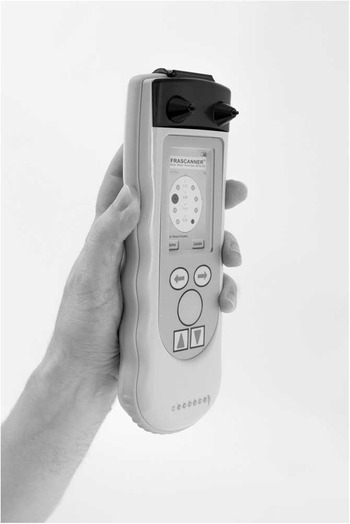
The Infrascanner Model 2000 (InfraScan Inc.; Philadelphia, Pennsylvania USA) is a handheld NIRS apparatus (Figure 1). A precursor of this device was developed with the support of the United States Navy’s Office of Naval Research (Arlington, Virginia USA) and the US Marine Corps (Arlington, Virginia USA) and has Food and Drug Administration (Silver Spring, Maryland USA) clearance,Reference Ding, Wang and Wu 8 , Reference Katzenberger, Chtarbanova and Rimkus 9 which was obtained after clinical testing and validation in a large, double-blinded, multi-center trial.Reference Robertson, Zager and Narayan 10 The Infrascanner was used in TBI patients prior to computed tomography (CT) scans of the brain, which represent the gold standard for detecting intracerebral hematomas. In 365 patients, a sensitivity of 88% and a specificity of 91% were demonstrated for hematomas larger than 3.5 cc in volume and less than 2.5 cm from the surface.Reference Robertson, Zager and Narayan 10 Other studies of smaller patient groups and of children confirmed the usefulness of the Infrascanner in detecting TBIs.Reference Leon-Carrion, Dominguez-Roldan, Leon-Dominguez and Murillo-Cabezas 11 – Reference Braun, Kunz, Schulz, Lieber and Willy 14
The Infrascanner Model 2000 (InfraScan Inc.; Philadelphia, Pennsylvania USA).

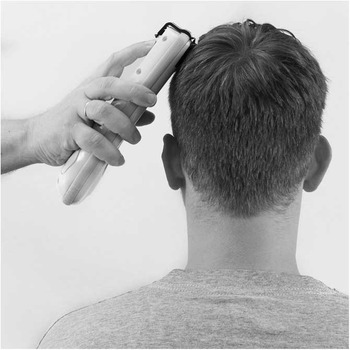
To perform an Infrascanner examination, eight symmetrical points (bilateral frontal, temporal, parietal, and occipital) on the patient’s head must be scanned (Figure 2). The measured data are presented on a screen, and an abnormal reading in comparison with the contralateral side is presented in red.
Scanning a Patient’s Head.

After approval of the local ethical committee (Radboud University Medical Center; the Netherlands), a feasibility study was started with an Infrascanner 2000 in a regional HEMS in the southeast of the Netherlands. In the Netherlands, four HEMS function as an adjunct to paramedic ambulance services, according to dispatch guidelines. These HEMS operate 24/7 using night vision goggles. Dutch paramedic ambulance services (with registered Emergency Medical Service [EMS] nurses) work according to national EMS guidelines. These guidelines state that registered EMS nurses are not allowed to perform advanced prehospital treatment, such as rapid sequence induction using muscle relaxants, nor are they trained to perform thoracostomies for penetrating thoracic trauma. For these interventions in severely injured patients, the physician-staffed HEMS provides additional on-site knowledge and treatment options.
The HEMS physicians (n=8) were adequately trained and familiarized with the scanner, prior to its operational use, by a salesman in cooperation with an author of the manuscript (ET).
Patients with suspected neurocranial trauma were scanned, including patients with normal and diminished GCS. All consecutive patients with TBI could be included, but frequently a scan was not conducted because other treatment priorities. These patients were excluded from the research cohort. Hospital CT scan results were available and were compared with the InfraScan results. Data were collected using the dispatch database combined with a questionnaire regarding ease-of-use and satisfaction with the scanner. In this questionnaire, the HEMS physician scored the scan time, scan results, and ease-of-use on a zero to 10 scale. It was recorded if the scan results led to a change in treatment or hospital choice.
Trauma patient often have suspected cervical spine injures. Because of the immobilization that is needed in these patients, access to the dorsal aspects of the head is limited. This might lead to incomplete scans but reflects the scanner’s actual working environment. To evaluate the scanner’s usability in prehospital setting, all data, including the partial complete scans, were analyzed. Data were collected and analyzed using Microsoft Office Excel 2007 (Microsoft Corporation; Redmond, Washington USA) and are presented as medians with ranges.
Results
A total of 25 patients were included in the study, most of whom were male (n=15; 60%). The median age was 54 years (range 7-79 years). Three children (aged seven, 10, and 11 years) were scanned. The reasons for dispatch included road traffic accidents (n=9; 36%), lowered consciousness from other causes (n=9; 36%), falls from heights (n=6; 24%), and blunt trauma to the head (n=1; 4%). The average GCS at the time of the scan was 6.9 (median=3.0).
In six cases, the scanner was used prior to transporting the patient to the hospital. The other patients (n=19) were scanned during transport to the hospital. The median scan time was four minutes (range 1.5-10 minutes).
The HEMS physicians scored a median ease-of-use of seven (range three to eight). Comments from the users were often related to the difficulty in scanning the dorsal side of the head with the patient in the supine position and to the screen not being visible while scanning. In addition, the Infrascanner produces a sound when the scanning is complete; in a noisy environment, it could be difficult to obtain auditory feedback from the device.
A complete scan, containing all eight scan locations, was conducted in 15 patients (60%). In the other 10 patients, complete scanning of the dorsal occipital site was not possible because of accessibility. These patients were immobilized on a long spine board with head blocks, and because of a suspected cervical spine injury, head manipulation was not conducted.
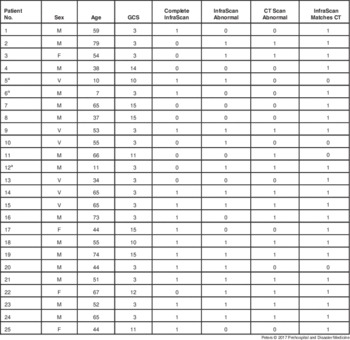
Data of all the scanned patients (n=25) are presented. The InfraScan results were normal in 10 patients. In 15 patients, the device displayed abnormal results. In one patient, the abnormal scan resulted in an addition to the initial treatment: hypertonic saline (10%) for brain preservation. No patients were transported to a hospital other than the location initially planned because of the InfraScan results.
In the accepting hospitals, a CT scan was performed on all patients, and 11 showed no intracranial bleeding. In 14 patients, the CT scan of the brain showed intracranial bleeding. In four cases, the InfraScan results did not match those of the CT scan. There were three false positive results and one false negative result of the InfraScan.
In the patients younger than 16 years of age (n=3), one false positive result occurred; the other two measurements were adequate (Table 1).
Patient Characteristics and Results

Abbreviations: CT, computed tomography; GCS, Glasgow Coma Score.
a Data for patients <16 years of age.
The sensitivity of the Infrascanner in this cohort was 93.3%, with a specificity of 78.6%. When the children were excluded, the sensitivity was the same but the specificity increased to 84.6%.
Discussion
Prehospital Setting
Early detection and quick, appropriate treatment are essential to prevent secondary damage and to optimize initial treatment in patients with TBI. This approach includes patient triage and transport to a trauma center with adequate neurosurgical intervention options. However, such triage can be challenging, and early detection of intracerebral bleeding may be facilitated with new NIRS devices such as the Infrascanner.
Because this device is relatively new in Europe, the results are presented of an initial cohort of 25 patients scanned on-site in prehospital settings by the physician-staffed HEMS.
Feasibility/Usability
There is a learning curve for using the Infrascanner properly, especially in how to scan in the prehospital setting. Scanning a patient takes time, and this is sometimes not available because of other vital priorities. The median scan time was four minutes (range 1.5-10 minutes). Using this time is defendable when it does not delay vital interventions (such as during transport). Most of the patients (76%) were scanned after initial treatment and stabilization while being transported to the hospital. In these cases, the decision had already been made to transfer the patient to a Level 1 trauma center because of a low GCS, trauma mechanism, or associated injuries. The average GCS at scanning was three. The high incidence of severe TBI in this cohort makes is difficult to draw conclusions regarding the use of the NIRS device as a triage tool in suspected TBI patients. More and less severely injured patients are needed to evaluate this topic and to determine the value of this tool in triage.
The ease-of-use of the Infrascanner was scored; the median score was seven. The observations regarding auditory device feedback and screen/button location will be shared with the manufacturer. If possible, customizing the Infrascanner for noisy prehospital environments may enhance future user satisfaction.
Because many of the patients had possible cervical spine injuries that limited access to the dorsal scan zones, a complete scan of the brain was obtained in 60% of patients. Even with this high number of incomplete scans, a sensitivity for intracerebral hematomas of 93.3% was achieved in the entire cohort.
One patient had a normal InfraScan result but had a small subarachnoid hemorrhage with a volume that was likely to be below the detection level of the Infrascanner. As indicated previously, a minimal amount of blood must be present to be detectable, which was assumed to be more than 3.5 ml and in the first 2.5 cm from the surface of the brain.Reference Robertson, Zager and Narayan 10 The larger the area of bleeding is, the more clinically significant it will be. The goal of prehospital scanning is not to detect all minimal hematomas, but to triage patients who eventually need to be transported to a hospital with neurosurgical facilities. Further research is needed to evaluate the detection threshold in relation to clinical intervention.
The obtained sensitivity of 93.3% is slightly higher than that published in the study by Robertson et al (88%). The specificity, at 78.6%, was lower than that previously described in the hospital setting (91%).Reference Robertson, Zager and Narayan 10 This result may have been because more extensive bleeding was encountered, well exceeding the detection threshold mark, which may have increased the number of detections. The relatively large number of false positive results might have been caused by the scanning circumstances. An abnormal NIRS scan result should be verified with a second scan to confirm the reading. In this prehospital study, this was not performed due to the lack of time. Adding a second NIRS scan could further improve the specificity.
In 76% of the cases, patients were scanned while driving at high speeds in ambulances or during helicopter flight. As mentioned before, the back/dorsal side of the patients was frequently not accessible because of the necessity for cervical spine immobilization, which led to a high number of patients with incomplete scans (40%). This limitation distorted the measurements and may have led to a higher number of false-positive scanning results.
In the authors’ opinion, HEMS patients with severe TBI are not the patients who will benefit most from prehospital screening with the Infrascanner. These patients need to go to a center with the highest level of care available, regardless of the scan results. Ambulance services could benefit even more from the NIRS. Further research must focus on the less severely injured patients, who do have an obligatory reason for referral to a Level 1 trauma center, to optimize patient triage and prevent transport delay.
In hospitals, the CT scan is and will remain the gold standard in hematoma screening in TBI patients for the foreseeable future. However, CT scans use potentially harmful radiation and must therefore be used with caution and only with valid indications, especially in children.Reference Bajoghli, Bajoghli, Tayari and Rouzbahani 15 – Reference Blume 17 Thus, alternative algorithms and a step-up approach in cranial screening of TBIs, possibly using NIRS, may be preferable.Reference Salonia, Bell, Kochanek and Berger 12
Further research regarding cost, time management, triage, patient survival, and quality of life is required to determine the prehospital role of NIRS.
Limitations
During this research period, many more TBI patients were treated, although the attending HEMS physician had to take the time to perform the investigation. Often, this time was not available or was needed for other vital treatments. If the patient already had an indication to be transported to a Level 1 trauma center, the added value of NIRS scanning for triage was limited in the opinion of the physicians. The decision against performing an InfraScan examination in these cases was not investigated in this study.
In this study, a selection bias is possible because of under-screening of the most severely injured patients, as not all consecutive TBI patients were scanned. In further research, all patients who are eligible for scanning must be included for study and be evaluated.
No long-term patient follow-up is presented. In this pilot study, the aim was to test the InfraScan in a prehospital setting, comparing results with data of the hospital CT scan to assess its practical use and reliability.
Conclusion
This study obtained promising results using the InfraScan NIRS device in the prehospital screening for intracranial hematomas in TBI patients and found high sensitivity and good specificity. However, further research is necessary to determine the beneficial effects of enhanced prehospital screening on triage, survival, and quality of life in TBI patients.
Author Contributions
ET and JP designed the study and wrote the draft of the article. JP, BvW, NH, and ET conducted the scans and collected the data used in this article. BvW and NH supported by commenting to article draft and helped with data interpretation. All listed authors made critical contributions to this article regarding its structure and conclusions and provided advice for revising the manuscript. JP submitted the article.