As paediatric cardiology and cardiovascular surgery evolve, the complexity of children with congenital and acquired heart disease increases substantially and the technology available continues to advance. Reference Tabbutt, Krawczeski and McBride1,Reference Horak and Bai Shasha2 Consequently, paediatric cardiac critical care medicine has become progressively more sub-specialised. Reference Tabbutt, Krawczeski and McBride1–Reference Penny and Shekerdemian4 Many hospitals have formed dedicated cardiac ICUs separated from the general paediatric ICUs. Reference Tabbutt, Krawczeski and McBride1–Reference Tabbutt, Ghanayem and Almodovar3,Reference Horak, Alexander, Amirnovin, Klein, Bronicki and Markovitz5,Reference Balachandran, Nair, Gopalraj, Vaidyanathan and Kumar6 However, the impact of a dedicated cardiac ICU on cardiac exposure and education during paediatric critical care medicine fellowship has not been well-investigated. Historically, when units were combined, paediatric critical care medicine fellows were exposed to cardiac patients for similar clinical time as other paediatric ICU patients. Reference Rosenberg and Moss7 With dedicated cardiac ICUs becoming increasingly common, many paediatric critical care medicine fellows only gain cardiac experience during explicit cardiac ICU time. This care model may limit their ability to develop cardiac intensivist expertise. Reference Horak, Alexander, Amirnovin, Klein, Bronicki and Markovitz5,Reference Su and Munoz8 Furthermore, quantity of surgeries performed, number of fellow learners (e.g., paediatric critical care medicine, cardiology, neonatology, anaesthesia), team composition and dynamics, and cardiac ICU leadership vary across institutions and likely affect fellows’ clinical training. Reference Tabbutt, Ghanayem and Almodovar3
The 2020 Accreditation Council of Graduate Medical Education paediatric critical care medicine fellowship guidelines stated, “There must be an affiliated pediatric cardiac surgical program with a volume of at least 100 cases per year…[if no cardiac surgeries on site] provision must be made for fellows to have substantial patient care experience in the pediatric cardiac surgical ICU, and such rotations should be considered mandatory…If there is a separate pediatric cardiac ICU, no more than 6 months must be spent on rotations other than pediatric ICU.” Reference Tabbutt, Ghanayem and Almodovar3,Reference Su and Munoz8,9 Minimum clinical time, number of surgical cases encountered, night coverage, educational experiences, and paediatric critical care medicine fellow autonomy are not discussed. Moreover, contemporary literature describing variations in these components of paediatric cardiac critical care training across institutions is limited. We aim to describe the current landscape of paediatric cardiac critical care education during paediatric critical care medicine fellowship in the United States and the variability of this education in terms of time, patient volume, and particular training experiences.
Materials and methods
United States Accreditation Council of Graduate Medical Education-accredited paediatric critical care medicine fellowships were identified and included if they were listed in the National Registry Match Program for the 2020 fellowship match. This list was accessed in January 2021. A review of publicly available information in 2021 was collected using paediatric critical care medicine fellowship programme websites, the Fellowship and Residency Electronic Interactive Database, and the Society of Thoracic Surgeons Public Reporting website. 10–12 Dates websites were accessed are listed in Supplementary Table S1. Information obtained from these sources included geographic location; total complement of paediatric critical care medicine fellows; number of mandatory cardiac ICU weeks during fellowship; supplemental cardiac training experiences; and whether each fellowship programme location has a dedicated cardiac ICU. Fellow complement was determined by what was reported on the public website or derived from annual number of fellows published in the Fellowship and Residency Electronic Interactive Database by multiplying that number by three (for the 3 years of fellowship). 10 Cardiac ICU surgical volume was gauged using data from the Society of Thoracic Surgeons Public Reporting website. 12 Here, the number of CHD surgical cases performed and operative mortality rates are reported by children’s hospital over a 4-year period (2015–2018). A hospital’s overall CHD surgical cases are further broken down into Society of Thoracic Surgeons-Congenital Heart Surgery Database STAT mortality categories, which assign mortality risk on a 1 (lowest) through 5 (highest) scale based on surgical complexity. Details regarding specific cardiac lesions and surgical procedures associated with each STAT category are previously published. 12 As hospital policies and practices vary among institutions regarding placement of patients (i.e., cardiac ICU versus step-down unit or separate cardiology ward), we utilised CHD surgical case volume data rather than average daily cardiac critical care census data.
Fellowship programmes were matched to their affiliated hospitals’ Society of Thoracic Surgeons data if available. Reported Society of Thoracic Surgeons surgical case volume and STAT categories were divided by 4 to estimate annual case volume as well as the complexity of those cases. For this study, we combined STAT mortality categories 1–3 and 4–5 for each hospital. To gather more granular data, a REDCap survey (Supplementary Figure S1) focusing specifically on cardiac ICU experiences during paediatric critical care medicine fellowship was e-mailed to all paediatric critical care medicine fellowship programme coordinators/directors as listed on programme websites. This survey instrument was constructed by the authors based on apparent information gaps identified after a review of publicly available resources. Results are reported using inferential statistics. Institutional Review Board approval was obtained prior to initiation of this study.
Results
Publicly available information
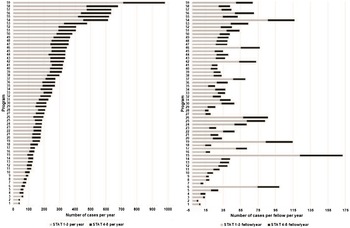
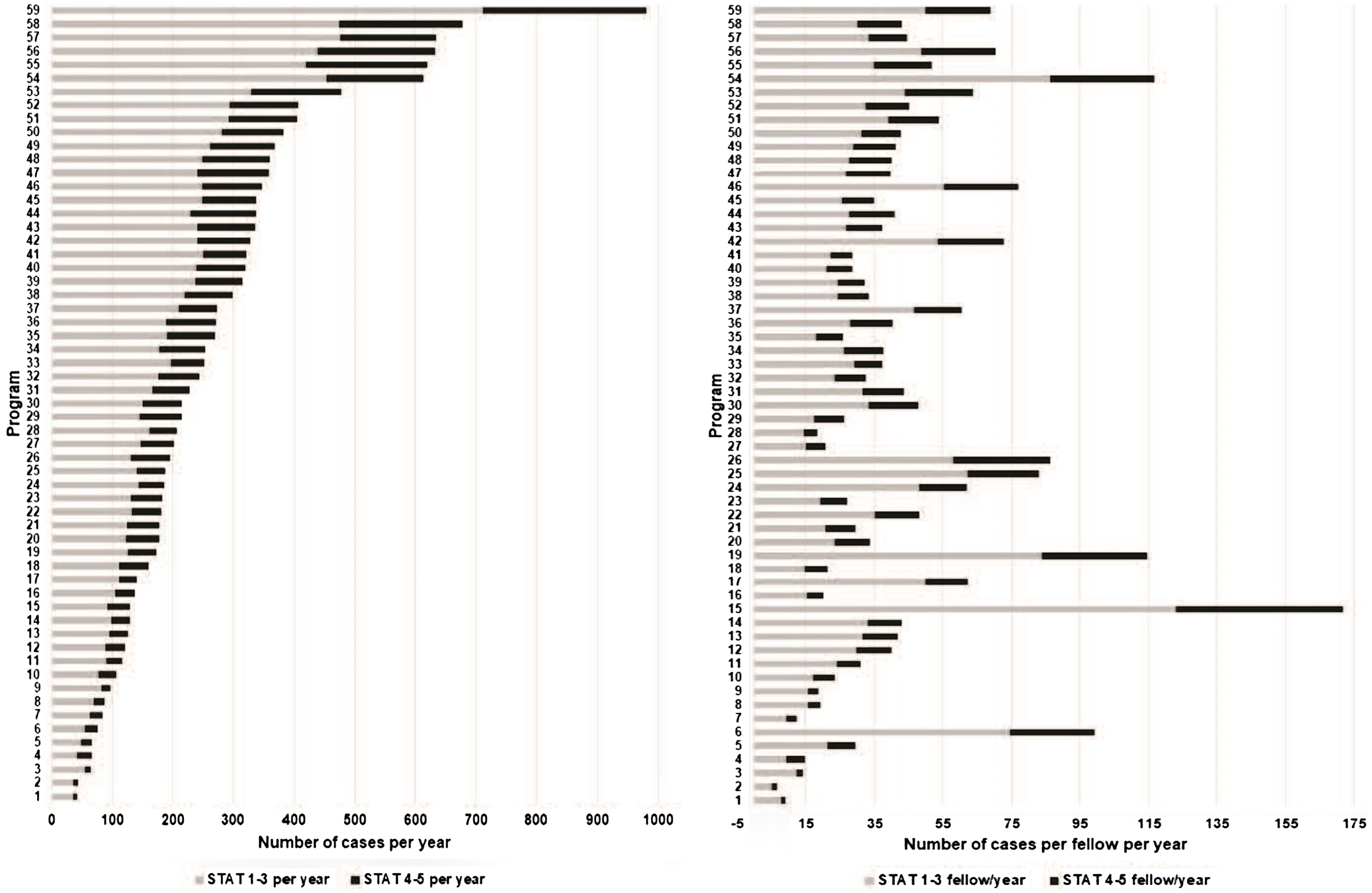
There were 71 United States paediatric critical care medicine fellowships identified. All programmes had publicly available websites, and 57 (80%) reported the complement of paediatric critical care medicine fellows. Remaining programme complements were derived from the Fellowship and Residency Electronic Interactive Database (20%, 14/71). Median number of paediatric critical care medicine fellows per programme was 8 (range: 1, 22; interquartile range: 6, 12). Mandatory cardiac ICU time was reported on 41% (29/71) of websites, median 16 weeks (range: 4, 26; interquartile range: 13, 20). Society of Thoracic Surgeons data were available for 83% (59/71) of programmes’ affiliated hospitals. 12 Median number of CHD surgical cases per year was 215 (interquartile range: 132, 338). Programme variation in CHD surgical case volume and acuity is reported in Figure 1.
Annual CHD surgical case volume is broken down by programme into STAT 1-3 and STAT 4-5 annual cases, depicted in Figure 1a. In Figure 1b, annual CHD surgical cases are further broken down by dividing annual cases by the total number of PCCM fellows. This figure demonstrates that programmes with more annual CHD surgical cases do not necessarily provide more learning opportunities per fellow if the total number of PCCM fellows is considered.
Survey response data
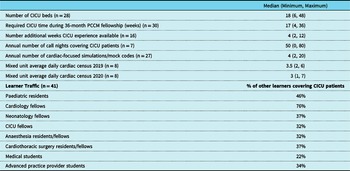
We surveyed 71 paediatric critical care medicine fellowship coordinators/directors, of which 41 responded (58%). Median number of paediatric critical care medicine fellows for responding programmes was 7 (interquartile range: 6, 12), similar to publicly available data. The majority (76%, 31/41) of responding programmes reported having a designated cardiac ICU versus 24% (10/41) mixed paediatric ICU/cardiac ICU. Notable variations in the number of cardiac beds, cardiac weeks of service, fellow night calls, and other learner involvement are listed in Table 1. Autonomous paediatric critical care medicine fellow call coverage of cardiac ICU patients (with no in-house staff) was reported in 17% (7 of 41, 5 with a designated cardiac ICU and 2 with a mixed paediatric ICU/cardiac ICU) of responding programmes.
Patient volume, clinical experience, and learner traffic as reported from survey responses
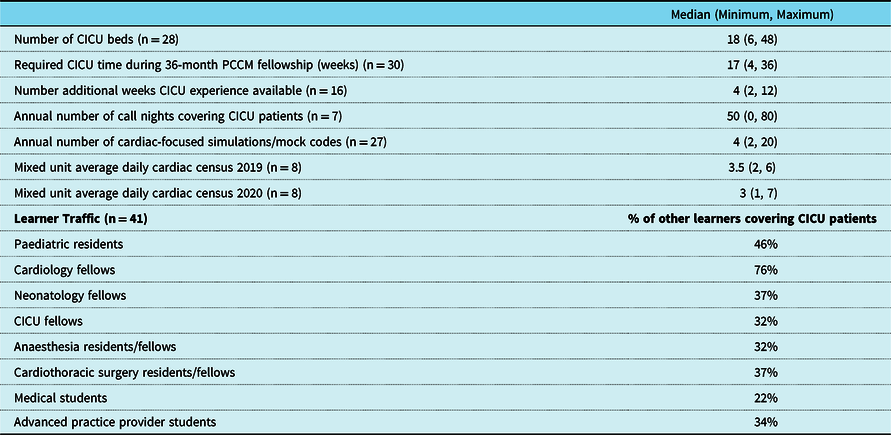
Total n reported is the number of programmes that responded to the specific question in the survey. CICU= cardiac ICU; PCCM= paediatric critical care medicine.
Of responding programmes, 88% (36/41) had paediatric critical care medicine fellows working at the institution’s primary hospital during their cardiac ICU rotations, 5% (2/41) at a separate hospital, 5% (2/41) at a combination of primary and separate hospitals, and 2% (1/41) had available elective time at a second location. When present, the cardiac ICU was reported to be housed under the following divisions: critical care (48%, 15/31), cardiology (29%, 9/31), cardiac critical care (16%, 5/31). One programme reported being under a combination of critical care and cardiology. In programmes with a designated cardiac ICU (n = 31), the percentage of attendings who either completed both cardiology and paediatric critical care medicine fellowships or 1 year of formal post- paediatric critical care medicine fellowship in paediatric cardiac critical care was variable: median 25% (range: 0%, 100%; interquartile range: 0%, 69%). Of respondents, 37% (15/41) of programmes had a 1-year cardiac ICU fellowship available.
Most programmes (71%, 29/41) reported having a structured cardiac critical care curriculum including cardiac-focused lectures within a formal multisystem ICU didactic curriculum (90%, 37/41), a dedicated cardiology lecture series (71%, 29/41), and cardiac-focused simulations or mock codes (68%, 28/41). However, a minority of programmes (29%, 12/41) reported mandating other cardiac experiences for fellows including rotations in the cardiac catheterisation laboratory, cardiovascular surgery, cardiac ICU at another institution, or managing adults with advanced heart failure and cardiac transplants. Only 7.3% (3/41) of programmes reported mandatory formal echocardiography training beyond point-of-care ultrasound.
Discussion
To our knowledge, this study is the first to provide data demonstrating current variability in cardiac ICU training experiences during paediatric critical care medicine. Combining website and survey-based data, we demonstrated that United States paediatric critical care medicine fellowships provide vastly different cardiac ICU training experiences. Some of the most notable variations include time on cardiac ICU service being as short as 4 weeks in some programmes. There are training programmes with no attending physicians with formal cardiac critical care training, though it should be noted that these programmes may include cardiac ICU attendings who were practising before advanced fellowship training pathways were widely available. Only 29% (12/41) of programmes have supplemental cardiac rotations. Finally, some fellows graduate having taken absolutely no call covering critically ill cardiac patients. Ensuring paediatric critical care medicine fellows graduate with competency in caring for cardiac ICU patients is particularly difficult given: 1) differing cardiac ICU structures and learner traffic, 2) varying CHD surgical case volume and acuity exposure, and 3) inconsistencies in cardiac ICU didactic and simulation educational experiences.
Prior literature reporting the landscape of cardiac ICU care models – designated cardiac ICU versus mixed paediatric ICUs – is sparse, with a recent study reporting 67% designated cardiac ICUs. Reference Horak and Bai Shasha2,Reference Horak, Alexander, Amirnovin, Klein, Bronicki and Markovitz5,Reference Morrison, Helfaer and Nadkarni13 Our study demonstrates that 76% (31/41) of responding programmes now have a dedicated cardiac ICU. The learner experience is different in these dedicated cardiac ICUs by nature of unit organisation. Reference Tabbutt, Ghanayem and Almodovar3 For example, dedicated cardiac ICUs may be more likely to utilise temporary circulatory support devices besides extracorporeal membrane oxygenation and durable cardiac support devices (e.g., Berlin Heart EXCOR, heart ventricular assist devices), which are not commonly encountered in mixed units. Reference Tabbutt, Ghanayem and Almodovar3,Reference Horak, Alexander, Amirnovin, Klein, Bronicki and Markovitz5 Separate cardiac ICUs also tend to have increased access to more cardiac-specific subspecialists (e.g., electrophysiology, heart failure, cardiac anaesthesia consultants). Reference Tabbutt, Ghanayem and Almodovar3,Reference Horak, Alexander, Amirnovin, Klein, Bronicki and Markovitz5,Reference Owens, Owens, Rajput, Charpie, Kidwell and Mullan15 More commonly in separate cardiac ICUs vs. mixed units, at least one attending has additional cardiac training. Reference Tabbutt, Ghanayem and Almodovar3,Reference Horak, Alexander, Amirnovin, Klein, Bronicki and Markovitz5,Reference Baden, Zimmerman, Brilli, Wong, Wetzel and Burns14 A recent survey of paediatric critical care medicine directors indicated that approximately 33% of cardiac ICU staff physicians are double-boarded in paediatric critical care medicine and cardiology, 12.5% underwent paediatric critical care medicine fellowship and a 1-year cardiac ICU fellowship, 30% underwent cardiology fellowship in addition to a 1-year cardiac ICU fellowship, and 21% underwent paediatric critical care medicine fellowship with no additional training (including those who were practising long before the addition of the 1-year cardiac ICU and dual fellowship training pathways became readily available). Reference Werho, DeWitt, Owens, McBride, Schaik and Roth16 The 1-year paediatric cardiac critical care fellowship even has standardised training guidelines now; however, dual boarding in cardiology and paediatric critical care medicine remains the gold standard. Reference Tabbutt, Krawczeski and McBride1 While paediatric residents commonly staff mixed units, paediatric critical care medicine fellows are predominant learners in cardiac ICUs, perhaps allowing for more fellow practice autonomy. Reference Tabbutt, Ghanayem and Almodovar3,Reference Horak, Alexander, Amirnovin, Klein, Bronicki and Markovitz5,Reference Owens, Owens, Rajput, Charpie, Kidwell and Mullan15 Unit structural differences create different learning environments for paediatric critical care medicine fellows and likely affect exposure to various CHDs, acuity, surgical procedures, and circulatory support devices. Reference Tabbutt, Ghanayem and Almodovar3
In general, hospitals with dedicated cardiac ICUs have higher surgical volumes and younger patients with higher-risk defects, increasing fellow exposure to higher acuity patients. Reference Tabbutt, Ghanayem and Almodovar3,Reference Hilvers and Thammasitboon17,Reference Burstein, Jacobs, Li, Sheng, O’Brien and Rossi18 We begin to describe the variability in surgical volume exposure and acuity, as depicted in Figure 1. While data in this figure are based on calculated assumptions, they depict an obvious trend: programmes with more CHD surgical cases do not necessarily provide more learning opportunities per fellow. Often, higher volume programmes have more paediatric critical care medicine fellows, supporting the assumption that these cases are shared between more learners. This notion is further complicated by the presence of other learners in the cardiac ICU at any one time. The impact of being the primary fellow responsible for individual patient versus sharing cases for learning opportunities is not well understood. While some literature suggests a positive association between quantity of clinical encounters and medical knowledge acquisition, an ideal patient caseload for optimal fellow learning is unclear. Reference Burstein, Jacobs, Li, Sheng, O’Brien and Rossi18,Reference McCoy, Stenerson, Halvorsen, Homme and McDonald19
There is no standard Accreditation Council of Graduate Medical Education-recommended cardiac curriculum for paediatric critical care medicine fellowships and variable cardiac ICU training pathways post- paediatric critical care medicine fellowship. Reference Horak and Bai Shasha2,Reference Tabbutt, Ghanayem and Almodovar3,Reference Anand, Kwiatkowski, Ghanayem, Axelrod, DiNardo and Klugman20 However, according to the Pediatric Cardiac Intensive Care Society, either the 1-year paediatric cardiac critical care fellowship or dual boarding in Cardiology and paediatric critical care medicine are now the national standard for training for current fellows undergoing training and expecting to care for cardiac critical care patients. 21 Cardiac ICU experiences during paediatric critical care medicine fellowship also vary in terms of time spent on service (for those with separate units) and institution-specific cardiac didactics. Programmes with dedicated cardiac ICU blocks required more total on-service ICU time for their fellows in exchange for less non-ICU experiences, and the effects of this exchange on fellows are unknown. Reference Morrison, Helfaer and Nadkarni13 Some institutions also require their paediatric critical care medicine fellows to spend time on cardiothoracic surgery, cardiology, and/or echocardiography/catheterisation lab rotations, while others do not. While these experiences may expand fellow exposure to cardiology, the potential benefit to fellow education and impact on cardiac ICU preparedness is yet to be determined. Further, while the majority of programmes reported a dedicated cardiac didactic curriculum, this was not universal, highlighting a potential additional disparity among graduating paediatric critical care medicine fellows. Lastly, prior studies demonstrated that simulation advances learner comfort, knowledge, and skills surrounding management of complex cardiac patients. Reference Bergman and Howell22–Reference Cashen and Petersen24 As depicted by our study, critical cardiac simulation experiences are not standardised across United States paediatric critical care medicine fellowships.
Our study has some limitations. Our survey response rate of 58% (41/71) clearly did not encompass all paediatric critical care medicine fellowships. However, respondents came from programmes across the country and were various in terms of institution size and patient load. This study did not assess programme-to-programme variance in primary responsibilities of the paediatric critical care medicine fellow at bedside, number of additional fellows and other learners concurrently rotating through the cardiac ICU, duration of clinical service rotations, or paediatric critical care medicine fellow mandatory research or vacation time. These limitations should be considered when reviewing our results regarding patient volume per paediatric critical care medicine fellow. While we cannot assume all websites were recently updated, programme websites’ fellow listings appeared to be up to date, particularly with the recent national virtual recruitment season due to the pandemic, leading us to believe most information was reasonably recent.
Our findings are congruent with prior studies. Reference Su and Munoz8 Though formal cardiac training pathways now exist, not all paediatric critical care medicine will not pursue them, as even in dedicated CICUs, many attendings staffing these units did not have advanced training. As the trend toward dedicated CICUs continues and the field of paediatric cardiac critical care becomes more standardised, Reference Horak and Bai Shasha2 so should the education. Discussions among field experts regarding minimum amount of time on service, optimal patient to fellow ratios, and the need for supplemental educational experiences during paediatric critical care medicine fellowship should be pursued and more specific recommendations from the Accreditation Council of Graduate Medical Education are needed.
Overall, this study illustrates the continuing trend toward dedicated cardiac ICUs and the variability that currently exists in United States paediatric critical care medicine fellowships. This is important because paediatric critical care medicine fellows are graduating with varying levels of exposure to patients with critical cardiac disease and, consequently, different levels of comfort caring for these patients.
Supplementary material
To view supplementary material for this article, please visit https://doi.org/10.1017/S1047951122000762
Acknowledgements
None.
Financial support
This research received no specific grant from any funding agency, commercial, or not-for-profit sectors.
Conflicts of interest
None.