Introduction
The swash is the upper part of the transition surf zone between the open sea and the sand dunes (Carcedo et al., Reference Carcedo, Fiori and Bremec2015). Generally inaccessible to boats due to low depths and waves, sampling benthic macrofauna in the surf zone is difficult due to logistical problems and there is no standardized approach (Janssen & Mulder, Reference Janssen and Mulder2005; Schoeman et al., Reference Schoeman, Nel and Soares2008). The relatively few studies on benthic macrofauna in the surf zone have used cores (Schoeman et al., Reference Schoeman, Nel and Soares2008); diver-controlled dredge and diver-operated suction sampler (McLachlan et al., Reference McLachlan, Cockcroft and Malan1984); Van Veen grab deployed from a large tripod on wheels (Janssen & Mulder, Reference Janssen and Mulder2005); Van Veen grab from a vessel in the deeper parts of the surf zone under calm conditions (Freitas et al., Reference Freitas, Ricardo, Pereira, Sampaio, Carvalho, Gaspar, Quintino and Rodrigues2011); and hand-held dredge in shallow water (Chartosia et al., Reference Chartosia, Kitsos and Koukouras2010).
Macrofauna of exposed sandy beaches have developed morphological and behavioural modifications such as the ability to bury quickly in sediments of different grain size and to orient in surging swash in response to physical factors such as beach slope, wave action and granulometry (McLachlan & Erasmus, Reference McLachlan and Erasmus1983; McLachlan et al., Reference McLachlan, Cockcroft and Malan1984, Reference McLachlan, Jaramillo, Donn and Wessels1993; McLachlan, Reference McLachlan1990) as well as biological factors such as food availability and organic matter (Defeo et al., Reference Defeo, McLachlan, Schoeman, Schlacher, Dugan, Jones, Lastra and Scapini2009). This makes them difficult to sample with grab samplers or cores, contributing to underestimates of surf and swash zone macrofauna biomass and density. One such species is Pennant's swimming crab (Portumnus latipes) (Pennant, 1777), usually found buried in the foreshore of sandy beaches (see Plymouth Marine Fauna, 1931; cited in Lebour, Reference Lebour1944) and surf zone in the north-east Atlantic and Mediterranean where it has been reported to feed mainly on macro-invertebrates (Chartosia et al., Reference Chartosia, Kitsos and Koukouras2010).
Distribution and density of Pennant's swimming crab along the coast of Portugal were studied by Cores et al. (Reference Cores, Gaspar and Erzini2017) based on bivalve dredge surveys carried out by the Portuguese Institute for the Ocean and Atmosphere (IPMA). Given the size of the research vessel, sampling with bivalve dredges was limited to depths greater than 3 m (Cores et al., Reference Cores, Gaspar and Erzini2017). Our objective was to estimate density of P. latipes in the swash zone, using a new method based on baited stakes and estimated area of attraction. We hypothesize that a method based on attraction to bait would be more effective for a very mobile species that is ineffectively sampled with cores and grabs.
Materials and methods
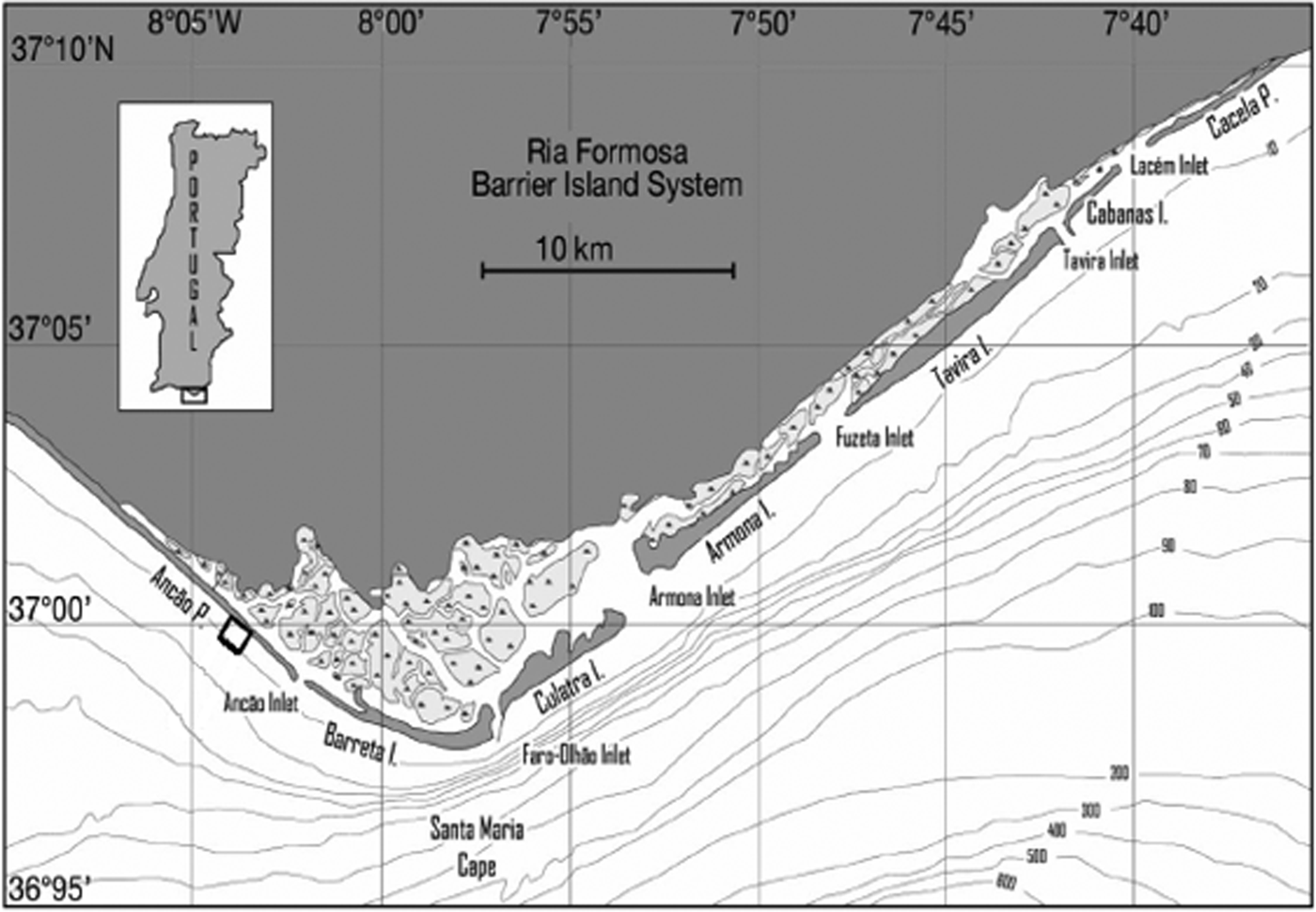
This study was carried out on Ancão litoral (Faro beach), the westernmost of the spits and barrier islands that form part of the Ría Formosa lagoon system (Anfuso & Ruiz, Reference Anfuso and Ruiz2004) (Fig. 1), in June (5, 8 and 18) 2015, within one to two days of the last and first quarters of the lunar cycle. This is an open and sandy beach with a NW–SE orientation, and a meso-tidal range between 1.5 and 2.8 m (during neap and spring tides respectively), although the range can reach a maximum of 3.5 metres (Vousdoukas et al., Reference Vousdoukas, Almeida and Ferreira2011). Sampling took place from 9:50 to 14:03, starting shortly before low tide (0.89, 0.96, 0.88) and lasted from 95 to 135 min. Conditions were calm, with a gentle breeze (17–20 km h−1; Beaufort scale), blowing from E–SE to W–NW on 5 June and E to W on 8 and 18 June. Although we did not measure longshore currents, at the same beach and under very similar conditions, Anfuso & Ruiz (Reference Anfuso and Ruiz2004) reported weak longshore currents (<20 cm s−1).
Study area (rectangle) where the sampling was conducted on the south coast of Portugal (adapted from Dolbeth et al., Reference Dolbeth, Ferreira, Teixeira, Marques, Dias and Pardal2007).

Groups of metal stakes 35 cm in length and 0.9 cm wide, curved at the top for better handling and safety, to which half a fresh sardine Sardina pilchardus (Walbaum, 1792) was attached with a string, were driven into the bottom in the swash zone, leaving the bait touching the sand. Sardines were approximately the same size and were divided into two halves of approximately the same weight. Based on the assumption that each baited metal stake had a circular area of influence (Aedo & Arancibia, Reference Aedo and Arancibia2003), metal stakes were placed in a line in the swash zone in different groups of four metal stakes with the same distance between them (1, 2, 4, 8 and 16 m). The five different groups of baited stakes were separated by distances of 30 m in order to ensure independence (Eggers et al., Reference Eggers, Rickard, Chapman and Whitney1982). After 10 min, each stake was visited and crabs found feeding on the bait, on the surface or buried beneath the bait, were caught by hand. This procedure was repeated five times during each of the three days of sampling, with a 10 min waiting period between each sampling, resulting in a total of 300 samples. The number of samples per stake (5) was judged to be sufficient based on the observed declines in the number of crabs caught over time. All captured specimens were stored alive in a plastic container with seawater and sand on the bottom and returned to the sea at the end of each day's sampling.
The density of P. latipes was estimated from the catch per unit effort (CPUE) and the area of attraction of the baited stakes. Following Aedo & Arancibia (Reference Aedo and Arancibia2003), the following model for the mean CPUE  $(\overline {\hbox{cpue}} _s)$ as a function of distance between stakes(s) was fitted:
 $$\overline {\hbox{cpue}} _s = a(1 - e^{ - bs})$$
Where, a is the asymptotic catch per stake  $(\overline {\hbox{cpue}} _\infty )$ and b the slope or the rate at which
 $\overline {\hbox{cpue}} _\infty $ is reached. The parameters a and b were estimated by the least squares method with the EXCEL add-in SOLVER and the minimum distance at which areas of attraction of adjacent metal stakes did not overlap was estimated.
With this method it is assumed that  $\overline {\hbox{cpue}} $ increases with the distance between baited stakes, to reach
 $\; \overline {\hbox{cpue}} _\infty $, the maximum value that corresponds to the parameter a and a distance of s ∞ at which it can be considered there is no overlapping of the areas of influence of adjacent stakes (Aedo & Arancibia, Reference Aedo and Arancibia2003). It is considered that s ∞ is the distance between stakes corresponding to 98% of the attained estimated
 $\overline {\hbox{cpue}} _\infty $ (sensu McQuinn et al., Reference McQuinn, Gendron and Himmelman1988). The area of attraction area (A at) was calculated using
 $$A_{{\rm at}} = \pi r_{{\rm at}}^{\rm 2} $$
where r at is the radius of the area of attraction:
 $$r_{{\rm at}} = \displaystyle{1 \over 2}s_\infty \; \; $$
The estimated density of Pennant's swimming crab was compared with estimated densities from a bivalve dredge survey along the south coast of Portugal at depths from 3 to 6.6 m, with 5 min tows at 2.0 and 1.5 knots. The bivalve dredge survey (25 May to 3 June 2015) conducted by the national fisheries institute included the beach where this study took place and extended to the west and east on either side, from Olhos d’Água to Vila Real de Santo António (Fig. 1) (Cores et al., Reference Cores, Gaspar and Erzini2017). Standardized tows of 5 min at 1.5–2.0 knots with dredges 64 cm wide at the mouth allowed catches per tow to be converted to numbers per m2.
Results and discussion
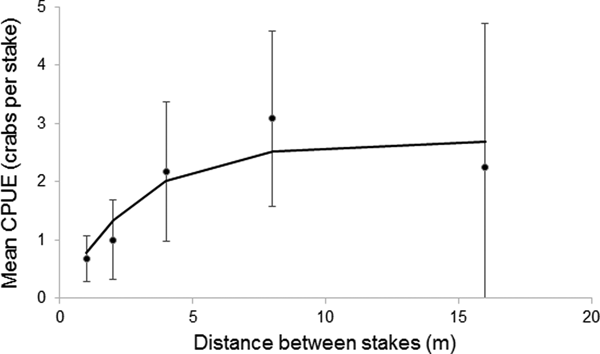
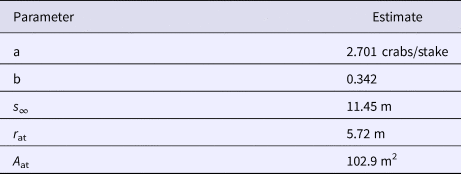
As expected, the mean CPUE increased asymptotically with distance between baited stakes, reaching a maximum observed CPUE at 8 m (Fig. 2). The fitted model is shown in Fig. 1 and the estimated parameters are given in Table 1. With an asymptotic mean CPUE  $(\overline {\hbox{cpue}} _\infty )$ of 2.701 crabs per stake and an area of attraction of 102.9 m2 the estimated density of Pennant's swimming crab in the swash zone of Faro beach is 0.0262 crabs m−2. This density is comparable to the densities estimated using toothed dredges used in bivalve surveys (0.0059–0.0079 crabs m−2) in the near shore area (3.0–6.6 m depths) (Cores et al., Reference Cores, Gaspar and Erzini2017). The lower densities estimated with the bivalve dredge may be due to a patchy distribution, with 219 of 265 tows not catching any P. latipes.
Plot of observed mean CPUE (±SE) and fitted mean CPUE as a function of distance between stakes.

Parameter estimates for the baited stakes data with density estimated using the maximum mean CPUE of 2.701 crabs/stake for an area of attraction of 102.9 m2

The value of  $\overline {\hbox{cpue}} _\infty $ corresponds to the distance s ∞ between traps of 11.45 m. At this distance between traps there is theoretically no overlapping between the areas of attraction of adjacent traps. Other studies have also shown that catches in baited traps and baited hooks increase asymptotically as distance between baits increases, allowing determination of the areas of attraction. Both Eggers et al. (Reference Eggers, Rickard, Chapman and Whitney1982) and Aedo & Arancibia (Reference Aedo and Arancibia2003) showed that maximum catches corresponded to the distance s ∞ between baited traps or hooks at which there is no overlapping.
Aedo & Arancibia (Reference Aedo and Arancibia2003) calculated the effective fishing area of baited traps, which is smaller than the area of attraction, based on the assumption that vulnerability decreases inversely with the square of the distance between individual crabs and the baited trap (Arena et al., Reference Arena, Barea and Defeo1994). Here, we based our density estimates on the estimated area of attraction since there is no evidence that vulnerability to the baited stakes decreases with distance. Based on observations in the field P. latipes can move very fast in the swash zone, using the waves to swim over the bottom or just below the top layer of sand and can easily find the source of the bait plume even in the turbulent swash zone.
We assumed that the area of attraction is a circle centred around the baited stake. Under normal conditions in the swash zone, with weak or negligible longshore currents, this may be a reasonable assumption given the movement of water in different directions in the swash zone. However, under certain circumstances, especially when there are strong currents or waves along the beach the odour plume may spread in a particular direction, requiring different calculations for the area of attraction.
Relatively few studies have considered the macrofauna communities of the surf and swash zones of exposed sandy beaches due to the logistical problems of sampling (Freitas et al., Reference Freitas, Ricardo, Pereira, Sampaio, Carvalho, Gaspar, Quintino and Rodrigues2011), with most studies reporting low biomass compared with deeper water beyond this turbulent transition zone (McLachlan et al., Reference McLachlan, Cockcroft and Malan1984; Janssen & Mulder, Reference Janssen and Mulder2005; Schoeman et al., Reference Schoeman, Nel and Soares2008). We believe that methods such as cores and grabs are ineffective for sampling macrofauna such as P. latipes that are highly mobile and have the ability to bury quickly in the sand, resulting in underestimates of density. For example, Freitas et al. (Reference Freitas, Ricardo, Pereira, Sampaio, Carvalho, Gaspar, Quintino and Rodrigues2011) took 88 in 0.05 m2 grab samples in the surf zone along 80 km of beaches starting 10 km to the east of our study area and did not catch a single P. latipes. In contrast, our baited stakes estimates of P. latipes swash zone densities are comparable to densities estimated using research vessel commercial bivalve dredges in the deeper parts of the same surf zone.
The baited stake method is an alternative, cheap, easy to use and effective method of sampling crustaceans, gastropods and other organisms in shallow water habitats. It is highly selective and has little or no negative impact on organisms or the habitat. It is likely to be effective for other organisms such as gastropods. For example, a different successive capture approach using baited ‘baskets’ was used to estimate density of the banded-dye murex, Hexaplex trunculus (Linnaeus, 1758), that were collected by hand in shallow water (Coston-Guarini et al., Reference Coston-Guarini, Guarini, Boehm, Kerkhove, Rivera, Erzini, Charles, Deprez and Chauvaud2018). More accurate estimates of density can be obtained by improving understanding of the area of attraction under different hydrodynamic conditions.
Acknowledgements
This work received national funds from the FCT-Foundation for Science and Technology through project CCMAR/Multi/04326/2013.