Introduction
Advance care planning (ACP), including the completion of an advance directive (AD) and delegating legal authority in a power of attorney form in the event of disability, is designed to facilitate patient wishes and dignity at the end of life (EOL) and to permit shared decision-making by patients and physicians (Weathers et al., Reference Weathers, O'Caoimh and Cornally2016). ACP is regarded as a continuing communication process requiring updating at regular intervals or when necessary (in der Schmitten et al., Reference in der Schmitten, Lex and Mellert2014). It allows people to have a voice in their healthcare decisions should they lose their capacity to participate meaningfully in these discussions in the future, for example, at times of acute illness. In addition, ACP can improve emotional outcomes for the patient and caregivers (Detering et al., Reference Detering, Hancock and Reade2010; Ayalon et al., Reference Ayalon, Bachner and Dwolatzky2012; Martin et al., Reference Martin, Hayes and Gregorevic2016). ADs have been supported by legislation in several countries since the 1990s (Russell, Reference Russell2014) including Israel (Bentur and Sternberg, Reference Bentur and Sternberg2019).
It has been suggested that the general practice health clinic is an optimal setting for the initiation of ACP discussions (Scott et al., Reference Scott, Mitchell and Reymond2013; Risk et al., Reference Risk, Mohammadi and Rhee2019). Family physicians (FPs) are suited for assisting patients with ADs because of their long and intimate acquaintance with patients and their immediate families (Harringer, Reference Harringer2012; Leal Hernandez et al., Reference Leal Hernandez, Rivas Baez and Martinez Monje2015). Maxfield et al. (Reference Maxfield, Pohl and Colling2003) have shown that patients want their FP to initiate ACP conversations when the patient is still in good health. However, reports concerning the prevalence of signed ADs in community-based clinics suggest poor participation (Pollack et al., Reference Pollack, Morhaim and Williams2010). Zivkovic (Reference Zivkovic2018) asserted that long-standing critiques of persons as static, distinct entities exist uneasily alongside medico-legal approaches to personhood that may find expression in an AD, and that from both a philosophical and practical vantage point, it is impossible to know in advance of incapacity if a patient will want less or more from life. Patients who participate in ACP interventions such as EOL care discussions are significantly more likely to have an AD than those who do not so participate (Peterson et al., Reference Peterson, Hyer and Meng2019). There is a need to overcome collective social denial concerning EOL issues (Bernacki and Block, Reference Bernacki and Block2014) and to better understand the ACP perspectives of older adults in diverse cultures (Ke et al., Reference Ke, Huang and Hu2017).
Clinicians play an important role in ACP and the promotion of ADs. They can both initiate and guide the conversation to help patients understand their choices and decide what is right for them (Chan et al., Reference Chan, Ng and Chan2019). Pizzo and Walker (Reference Pizzo and Walker2015) advocated that it is better for physicians to initiate discussions about ADs with their patients at the time of certain milestones in their lives, such as retirement, in contrast to other milestones, such as a health crisis, and that physicians should be compensated for the time required to have these discussions, something which requires a change in health system policy.
However, a systematic review by Risk et al. (Reference Risk, Mohammadi and Rhee2019) pointed out common barriers to ACP in general practice, including lack of patient and physician knowledge, lack of physician skills and experience, patient, family and physician attitudes, and systemic issues such as time pressure and documentation challenges. Training healthcare professionals in ACP has positive effects on their knowledge, attitude, and skills (Chan et al., Reference Chan, Ng and Chan2019).
The Israeli context
Israel's 2005 Dying Patient Act is a detailed and comprehensive law regulating the treatment of patients at EOL (Steinberg and Sprung, Reference Steinberg and Sprung2007). Israeli society is prone to cultural and religious conservatism, a reality reflected in the Dying Patient Act, which gives expression to liberal values alongside religious views (Schicktanz et al., Reference Schicktanz, Raz and Shalev2010). The law is based on a non-liberal general presumption that democratic values need to be balanced with Jewish religious values, and therefore, neither the principle of the value (sanctity) of life nor the principle of individual autonomy is absolute. Rather, thoughtful human boundaries concerning prolonging life versus avoidance of unjustifiable and unwanted suffering need to be delineated (Steinberg and Sprung, Reference Steinberg and Sprung2007). Every adult (age 17+) is entitled to declare his or her wish to refuse life-extending medical treatment via an AD, which is binding when the estimated life expectancy is 6 months or less. Completed ADs can be deposited at an Israel Ministry of Health AD Registry and must be renewed every 5 years (Bentur and Sternberg, Reference Bentur and Sternberg2019). The Act advances the policy goals of encouraging autonomous patient decision-making and the appointment of surrogate decision-makers (Bentur and Steinberg, Reference Bentur and Sternberg2019). The Act also grants patients the right to express their EOL care preferences in alternative forms. The best known is the Five Wishes® (Eckstein and Mullener, Reference Eckstein and Mullener2010), a form which has been translated into Hebrew (Bentur and Sternberg, Reference Bentur and Sternberg2019). Additional legislation became operative in April 2018 — Amendment 18 to the Legal Competence and Guardianship Act — which entitles individuals to execute a durable power of attorney forms for financial and medical matters.
According to Bentur et al. (Reference Bentur, Shuldiner and Resnitzky2016), only a small proportion (4%) of the Israeli population has signed an AD form, while 50% have said they would like to do so. Only 9 (3%) of the participants in the Bentur study said that someone from the medical system talked to them about their EOL preferences, but 68% said they wanted to have such a conversation. Bentur and Sternberg (Reference Bentur and Sternberg2019) asserted that the combination of top-down action, such as Health Ministry implementation of enacted legislation, alongside bottom-up action in health organizations, “is leading the way and addressing the challenges of ACP implementation” (p. 423), in Israel, but that further study is needed.
The intention of the present study was to better understand the facilitators and barriers to (1) patient-FP discussions about ACP and (2) the signing of ADs in the setting of community health clinics (HMOs) in Israel. We focused on the experiences of older adults with favorable attitudes toward ACP and the views of their FPs. In light of Israeli patients’ low rate of signing ADs, we were interested in what motivates those who are interested, and what can be learned from their experience to encourage other patients to engage in ACP.
Methods
Settings
This investigation was part of an ACP program initiated in the beginning of 2016 by Clalit Health Services, the largest HMO in Israel, and JDC-ESHEL, a leading service development association in Israel, to inform patients over aged 65 of the option of completing an AD and to encourage ACP discussions (including the subject of EOL treatment choices) between patients and their FPs. The ACP program plan included a short training course for FPs about communication and medico-legal, ethical and cultural aspects of EOL, and two FP-patient meetings to discuss, prepare, and sign ADs. It afforded FPs at two community health clinics the opportunity to dedicate up to 1 h/week during office hours to FP-patient ACP discussions. From the beginning of the program's establishment, information leaflets about ACP and ADs have been available at the front desk of these clinics.
The ACP program was carried out in two health community clinics in the Jerusalem area. To the best of our knowledge, at that point in time, this was the first program of its kind in Israel. One clinic (C1) provides services to 8,281 patients, of whom 2,590 (31 percent) are over age 65. The other (C2) provides services to 3,400 patients, of whom 276 (eight percent) are over age 65.
Recruitment and participant characteristics
A total of 28 patients (19 women and 9 men over age 65) participated in the study (Table 1(a)). Of all the interviewees, 22 were served at C1 and 6 at C2. The patients were identified by FPs who knew of their interest in ACP. All patients were Jewish. Most of them (82%) identified themselves as “secular.” Nearly three-quarters (71%) of patients had post-high school academic education and all patients self-reported that their socioeconomic status was good. Two patients stated that they had been diagnosed with a terminal illness, and a third patient said that she had recovered from cancer 15 years ago. A majority (68%) of the patients said they had experience with serious illness (themselves or someone close to them). All patients had children and grandchildren, except for one, a widow who reported that she had a large extended family.
Demographic characteristics of the study participants

a Observed religious customs.
b Believed in God, but did not observe all religious customs.
A total of 11 FPs participated in the study (Table 1(b)). They were recruited by the directors of C1 and C2, with the option of declining to participate. One FP was Muslim, and the rest Jewish. About half of the FPs were “religious.” A majority were age 40 or older, with 10 or more years of experience as family practitioners.
Data collection and research tools
Qualitative data was collected via interviews with patients and three focus group sessions with FPs during the second year of the ACP program over the course of 9 months. In addition, seven FPs completed brief feedback summaries.
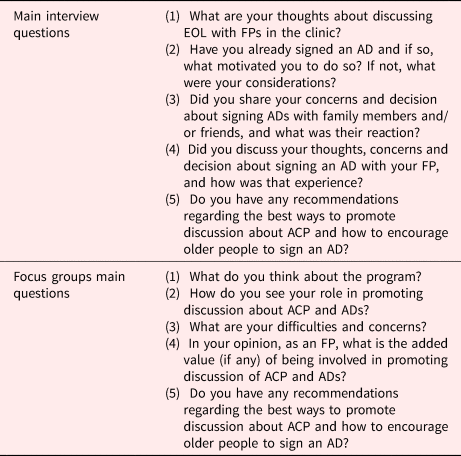
The interviews and focus groups were conducted by the first author using an interview protocol developed for this study (Table 2). The study questionnaire was developed in a four-step process involving an initial brainstorming session, reviews and feedback from three AD experts (an MD and two PhDs), a short pilot involving two physicians and two patients, and a final fine-tuning (Taherdoost, Reference Taherdoost2016).
• Patients
Interview and focus group main questions

We conducted 22 semi-structured in-depth interviews with 28 patients (19 women and 9 men, all over age 65), lasting an average of 60 min at venues chosen by the patients. Most interviews were conducted at the patients’ homes. Of the 28 patients, 16 were interviewed individually. The remainder, 12 in number, consisted of 6 married couples. The choice of a one-to-one interview vs. a one-to-two interview (with couples) was decided by the patients in advance of the interview. While it may be more desirable to delve into individual experiences and matters involving self-reflection in a one-to-one setting rather than in a group setting (Lambert and Loiselle, Reference Lambert and Loiselle2008), we nevertheless responded favorably to those patients who requested to be interviewed together in the interest of offering them an interview setting in which they felt most comfortable given the sensitivity of the interview subject matter. We conducted the interviews with couples following the facilitation principles of focus groups methodology (Cronin, Reference Cronin and Gilbert2008).
• Physicians
The focus groups were held during the workday in the clinics in which the FPs worked and lasted an average of 30 min. Seven FPs worked at C1 and four at C2. The FPs preferred the format of a group due to the demands on their time. All patient interviews and FP focus groups were audio-recorded with the participants’ consent and were fully transcribed by a professional transcriptionist. Transcripts were compared to audiotapes to ensure accuracy by the first author. All participants were registered using pseudonyms.
• The written material from the brief feedback summaries was not rich enough for analysis, but it helped researchers validate insights gained from the focus group sessions.
Analysis
We followed Braun and Clarke's (Reference Braun and Clarke2006) guidelines for six phases of thematic analysis (TA) which is useful in applied research, such as in the policy or practice arenas, and is considered appropriate in health and wellbeing research (Braun and Clarke, Reference Braun and Clarke2014). TA offers flexibility around data collection (interviews, focus groups, surveys, etc.) (Terry et al., Reference Terry, Hayfield and Clarke2017) and can be successfully used searching across a data set — whether several interviews or focus groups (Braun and Clarke, Reference Braun and Clarke2006). The analysis was done manually, meaning no software was used (Basit, Reference Basit2003), and it was conducted separately for the one-on-one patient interview transcripts, the patient couples interview transcripts, and the focus group FP interview transcripts. After reading and re-reading the raw data, we decided to assign the one-on-one patient interviews and the interviews with patient couples as single data set. Overall, the data collected were very rich and we did not recognize a significant difference between the transcripts. We assigned equal value (Lambert and Loiselle, Reference Lambert and Loiselle2008) to the data we collected through the individual patient interviews and the data we collected through the interviews with patient couples. We dealt with the patient and FP responses separately in our results and reserved the integration of the data for our discussion.
The first two stages of analysis, those of becoming familiar with the data and generating initial codes, were conducted by the first author and shared with the second author, both of whom have extensive experience in qualitative data analysis. The first author completed the thematic analysis process and produced a report that was reviewed and affirmed by the research team.
We followed Tracy's (Reference Tracy2010) criteria for qualitative best practices. Transparency was maintained regarding the process of sorting, choosing, and organizing data. The rigor of data analysis was achieved through the development of a rational framework to transform and organize raw data into the research report. The first author headed up the qualitative analysis in collaboration with the research team to ensure triangulation and kept a journal with detailed field notes. This information was shared continuously with the team which offered feedback during the fieldwork and analysis periods. The various sources of data collection (interviews, focus groups, and written feedback) strengthened credibility.
Ethics
This study was approved by the institutional review board (Helsinki) of ‘Clalit Health Services’ (0072-14-COM).
Results
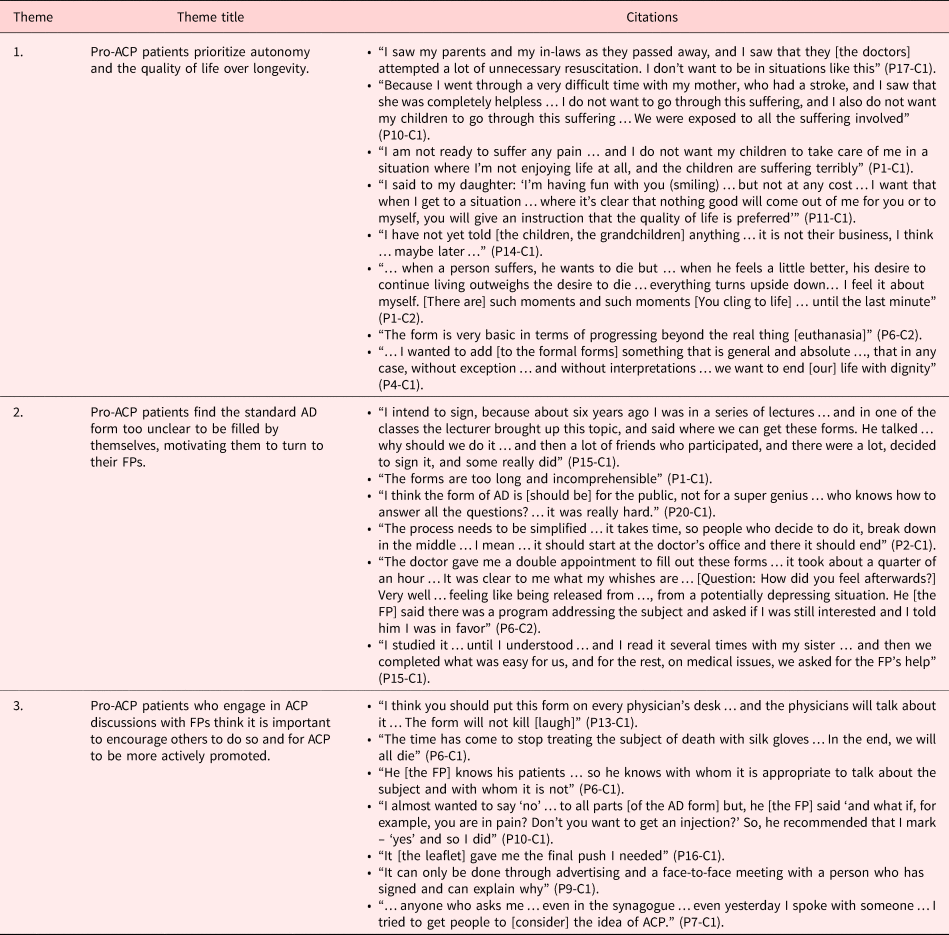
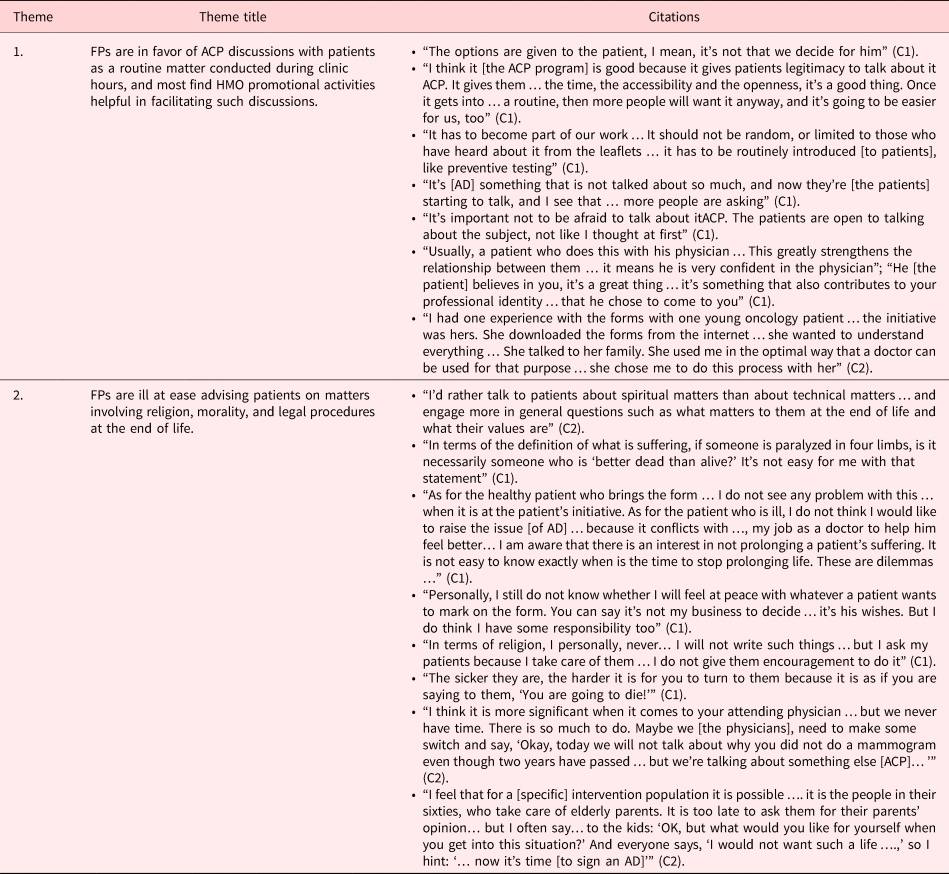
We found three themes in the interviews with patients and two themes in the focus groups with FP (See selected quotations in Tables 3 and 4, respectively).
• Patients
Selected quotations from interviews with patients

Selected quotations from family physician focus groups

Theme 1: Pro-ACP patients prioritize autonomy and the quality of life over longevity.
The patients who participated in this study expressed the great difficulty they felt as they watched the suffering of a loved one, the decline in the quality of life, the rise in dependence on others for assistance with daily activities, and the frustration, anger, and depression exhibited by the person with serious illness. The patients recalled their exasperation when engaging doctors in discussions about ending the suffering of the person with illness.
Overall, the desire to maintain autonomy was a recurring theme in the patients’ narratives. The patients said that their goals in signing an AD were to plan and control their future as much as possible in the event that they developed a serious illness. They were emphatic that their quality of life was more important to them than longevity. They said that it was important for them to make it clear that they did not want to live if they had a severely compromised quality of life. They wished to avoid pain and suffering for themselves and undue burden for their relatives.
The patients said they shared their interest in ACP and the desire to sign an AD with their families, but wished to decide their EOL care preferences without family consultation, preferring to inform the family of their decisions once taken. The patients reported that in most cases, their children showed understanding.
Most patients were not fully aware of the specific timeframe in which ADs take effect under Israeli law, and some confused ADs with euthanasia which they said they preferred. Others, who knew the difference, said that the signing of an AD was a default option for them; they would have preferred the possibility of euthanasia.
Two patients who planned to sign an AD expressed a sense of conflict. One of them, ill with cancer, said that he wanted to sign an AD to avoid unnecessary suffering for himself and his family. At the same time, he talked about holding on to life no matter what, in the hope that the situation might get better. The other patient worried that she might change her mind, but be precluded from effectively expressing herself in the future due to the onset of a medical condition such as aphasia.
A few patients expressed concern as to whether their wishes would truly be respected and assured. Those expressing this concern feared that in real time, doctors would still prolong their lives unnecessarily. One couple said they were considering signing more than one form to make sure their wishes will be respected.
Theme 2: Pro-ACP patients find the standard AD form too unclear to be filled by themselves, motivating them to turn to their FPs.
Some patients had taken proactive steps such as downloading an AD form before the ACP program started, although only a few of them had signed and completed all procedures such as sending the completed form to the Ministry of Health's registry, a step of which many were unaware.
Patients found different ways to navigate the process of signing an AD. Some filled out the AD form together with their FP at one meeting, while others preferred to take the form home, consult with family and friends, and then return to the clinic for a second meeting followed by signing.
Most patients found the AD form unclear, were not certain which form they had signed. They were frustrated that they were unable to fill out the form on their own, but were happy about the possibility of completing it together with their FP. Patients reported that after they signed, they felt a sense of relief.
Theme 3: Pro-ACP patients who engage in ACP discussions with FPs think it is important to encourage others to do so and for ACP to be more actively promoted.
The patients who participated in this study were interested in ADs before the ACP program began. Some said their FP had asked them about signing an AD, either because the FP knew that the patient or a family member had a terminal illness, or because the FP knew of the patient's interest in the subject. Others said that clinic publicity about ADs, especially the informational leaflets, gave them the final impetus they needed to start or complete the ACP process. All the patients supported the idea of promoting discussions about ACP and ADs at community clinics due to the subject's importance, an opinion which had helped motivate them to join this study.
Patients expressed the belief that it was the role of FPs to inform older patients about ADs. Some thought doctors should inform all their patients. Others thought that since EOL is a sensitive matter, FPs should use their discretion as to which of their patients to approach concerning ACP based on patient characteristics.
Most patients described their ACP conversation with their FP as practical. Just a few reported a more in-depth conversation, such as in which the FP discussed the prevention of pain and suffering at EOL through the use of permissible drugs. Prior to such discussions, some patients had considered marking “no” concerning all treatment options.
Patients said they knew friends and family who expressed interest in the subject of ADs. They considered it desirable to increase promotion of the subject, e.g., via a letter to all HMO subscribers or a short advertisement shown on information screens at clinics. Some patients reported that they had encouraged friends and relatives to engage in ACP, eliciting responses ranging from favorable to unfavorable. Some patients favored the idea of arranging small gatherings at places such as private homes or places where older adults take classes, offering presentations by people who have gone through the ACP process and have signed an AD.
• Physicians
Theme 1: FPs are in favor of ACP discussions with patients as a routine matter conducted during clinic hours, and most find HMO promotional activities helpful in facilitating such discussions.
FPs said it was very important to make patients aware of ADs to enable them to choose for themselves whether signing one suited them or not. They said that it is FPs’ responsibility to discuss ACP with their patients. They agreed that speaking with patients about ACP should be part of their routine and that they should be permitted to allocate time within their clinic schedule as was done in the ACP program, but we did not find a consensus among FPs as to whether the promotional efforts at the clinics were effective in raising awareness and fostering discussions with patients about ACP and ADs. There was agreement, however, that ACP and AD promotional activities should be tailored to patients’ cultural characteristics, beliefs, and traditions. A few FPs mentioned that the discussion of ACP could strengthen the physician–patient relationship and enhance their professional identity in the sense of being recognized as a trusted advisor.
FPs estimated that since the establishment of the ACP program, they had discussed ACP issues with dozens of patients but they did not know exactly how many patients had completed the process: discussion, signing the form, and filing it at the Ministry of Health registry.
Theme 2: FPs are ill at ease advising patients on matters involving religion, morality, and legal procedures at the end of life.
FPs articulated professional, personal, and moral dilemmas about promoting ADs. Some wondered whether their role was limited to giving patients requested medical information related to certain details in the forms, or to offering patients information on a deeper level concerning life priorities and moral values.
Most FPs criticized the medico-legal character of the AD form. Some noted the bureaucratic aspects of the AD process, which they found confusing. This concern was also raised in the brief feedback summaries which revealed that FPs felt confident talking about medical issues posed by ACP and ADs, but uncomfortable when it came to issues requiring legal knowledge. Therefore, most FPs preferred introducing their patients to the Five Wishes® form (Eckstein and Mullener, Reference Eckstein and Mullener2010).
A few FPs expressed concern about moral questions such as who can define a “life worth living?” and whether death was preferable to life when a patient lived with a severe disability? FPs found it easier to talk about ACP and ADs with older healthy patients than with patients who had terminal illnesses, particularly since for the latter, such a discussion might be perceived as meaning that there was no more hope.
FPs with religious beliefs raised questions about the relative values of patient autonomy vs. sanctity of life. While these FPs were in favor of ACP, took part in the ACP program, and discussed ADs with their patients, they said that their professional role was limited to taking care of patients and preventing suffering. Therefore, they objected to the idea of patients checking off “no” to all life-prolonging actions in the form, and they encouraged patients to authorize the administration of medicines intended to prevent pain and suffering. Only one of the FPs reported that he had signed a medical power of attorney authorizing his children to act on his behalf. Two religious FPs said that signing an AD was against their beliefs and they would not sign nor encourage elders in their families to one.
A few FPs said they did not discuss ADs with some of their patients. These FPs thought that ACP was probably not suitable for religious patients and for those from less educated, more disadvantaged populations. During a focus group session, an idea emerged that in certain populations ACP discussions and ADs might be raised more effectively by patients’ children and other close relatives.
Discussion
Although ACP is encouraged to help older people prepare for treatment options at EOL, it is a challenging endeavor (Ke et al., Reference Ke, Huang and Hu2017). The completion of ADs remains limited in Israel (Blank, Reference Blank2011; Shaulov et al., Reference Shaulov, Baddarni and Cherny2019). The review of Risk et al. (Reference Risk, Mohammadi and Rhee2019) suggested that the primary care setting is optimal for the initiation of ACP discussions, though EOL issues rarely come up at general practice appointments. Our study goal was to better understand (1) facilitators and barriers to the implementation of ACP and ADs in the setting of community health clinics and (2) ways in which older people who are favorably disposed to signing an AD can be encouraged to actually do so.
There was agreement among patients and most FPs in our study that it was advisable for patients to discuss ACP and ADs with FPs. These findings are consistent with Lifshitz et al. (Reference Lifshitz, Cohen and Shmilovitz2016) who reported that 70% of the physicians in their sample did not inform patients of the option to delegate authority to a proxy decision-maker, but stated that they wanted to do so.
Jezewski et al. (Reference Jezewski, Meeker and Sessanna2007) emphasized the importance of person-to-person interaction during which patients can ask their physician questions and receive assistance in completing forms, thereby increasing the number of people who sign ADs. The FPs in our study favored the option of two visits with an interval between them, a view also favored by those patients who wished to use the interim time to read about and consider treatment options stated in the ACP materials. This preference was consistent with Peterson et al. (Reference Peterson, Hyer and Meng2019) who found that EOL care planning is often part of a continuum in which EOL care discussions are extensions of more routine healthcare discussions. Risk et al. (Reference Risk, Mohammadi and Rhee2019) found an apparent shift by the healthcare community away from considering ACP as a one-time activity to a process.
Our findings suggest that older adults who are favorably disposed to completing ADs encounter informational and boreoarctic barriers, leaving them uncertain about medical and legal issues and administrative aspects of the process. Porensky and Carpenter (Reference Porensky and Carpenter2008) pointed out that some older adults make prospective medical decisions based on misinformation. The majority of patients who participated in our study were unaware that withholding medical treatment is authorized under Israeli law if the patient has signed an AD to that effect, while withdrawing previously begun treatment, such as artificial respiration, is not authorized even if the patient so wishes (Schicktanz et al., Reference Schicktanz, Raz and Shalev2010). Most patients objected to living a life characterized by severe dementia or paralysis, but they were not aware that being ill with dementia or paralysis does not serve as a legal basis for withdrawing medical treatment under the Dying Patient Act (Steinberg and Sprung, Reference Steinberg and Sprung2007). The patients in our study valued FPs’ ability to point out matters of which they were unaware, such as what remedies were available to prevent pain and suffering at EOL.
Ramsaroop et al. (Reference Ramsaroop, Reid and Adelman2007) reviewed studies designed to increase AD completion in primary care settings and concluded that passive education of patients using written materials (without direct counseling) was relatively ineffective in increasing AD completion rates. A systematic review by Myers et al. (Reference Myers, Cosby and Gzik2018) showed that there is a lack of consistent patient outcome evidence to support any one clinical tool for use in ACP or “goals of care” discussions. However, we found that informational leaflets left in the front lobby of clinics effectively motivated previously inclined patients to follow through with ACP with FPs and to sign ADs. This finding goes hand in hand with other studies (Tamayo-Velazquez et al., Reference Tamayo-Velazquez, Simon-Lorda and Villegas-Portero2010; Howard et al., Reference Howard, Robinson and McKenzie2020).
Israeli society is known for strong community and family ties (Fogiel-Bijaoui and Rutlinger-Reiner, Reference Fogiel-Bijaoui and Rutlinger-Reiner2013). The legislative notes associated with the Dying Patient Act state that caregivers have a duty to try to persuade patients to accept oxygen, food, drink, and regular medicine, and that caregivers may not withdraw ongoing medical treatment (Steinberg, Reference Steinberg, Hurwitz, Picard and Steinberg2006). One of the main reasons patients who participated in our study wished to complete ADs was to relieve their family members of the burden of decision-making, and to avoid the financial and emotional burden of prolonged treatment, as has been reported by others (Searight and Gafford, Reference Searight and Gafford2005; Medvene et al., Reference Medvene, Base and Patrick2007; Carr, Reference Carr2012).
Although our patients reported that they did not consult with family before they decided their preferences for EOL care and signed an AD, they informed family members of their EOL care preferences afterward, consistent with Miller et al. (Reference Miller, Tan and Clayton2019). Twelve patients in our sample exemplified this phenomenon by requesting to be interviewed together with their spouses. Some scholars have suggested that an approach of absolute autonomy for patients concerning EOL care is too simplistic (Entwistle et al., Reference Entwistle, Carter and Cribb2010; Kai et al., Reference Kai, Beavan and Faull2011), given the importance of the social contexts and interpersonal relationships within which individuals exist (Walter and Ross, Reference Walter and Ross2014; Zivkovic, Reference Zivkovic2018; Dutta et al., Reference Dutta, Lall and Patinadan2020). Peterson et al. (Reference Peterson, Hyer and Meng2019) concluded that the involvement of family or close friends in patients’ healthcare was significantly related to whether patients engaged in ACP, and they therefore recommended that healthcare providers encourage patients to include significant others in their healthcare decision-making process. As to those patients who were disinclined to consult with family members, perhaps they prioritized autonomous decision-making over other considerations. Detering et al. (Reference Detering, Sutton and Fraser2015) emphasized the importance of framing ACP discussions broadly so that both concepts of individualism, i.e., autonomy; informed concern, on the one hand, and collectivism, i.e., familial roles and obligations, on the other, can be supported.
In general, the patients in our study cared more about their independence, clarity of mind, and quality of life than longevity. To them, the principle of the sanctity of life appeared to have included a strong self-determination component. Some went so far as to express a desire to control their death and were disappointed that active death (euthanasia) was not legal in Israel. They expressed uncertainty about the efficaciousness of Israel's legal framework in real-life situations, finding themselves unsure as to whether their wishes would be carried out notwithstanding the existence of a law specifically enacted to effectuate patients’ wishes. Our patients’ strong interest in having their wishes respected is consistent with the patients studied by Rolnick et al. (Reference Rolnick, Shea and Hart2019) who valued legal regulation of ADs “to ensure document authenticity and delivery of preference-concordant care” (p. 6). Based on Cohen-Mansfield and Lipson (Reference Cohen-Mansfield and Lipson2008), concerns about the enforceability of ADs are not unfounded as ADs were found not to address the majority of treatments considered by physicians, and patient preferences were followed during only 68.6% of treatment events for which a patient had an AD (n = 35), or in half of all treatment events. The most commonly followed patient preferences were those found in ADs concerning no hospitalization, followed by Do Not Resuscitate (DNR) orders.
Pizzo and Walker (Reference Pizzo and Walker2015) pointed out that “complex social, cultural, economic, geographic, and health system factors” (p. 596) contribute to the discordance between how doctors treat their patients and how they themselves wish to be cared for at the EOL. This complexity was articulated by our study's FPs who expressed professional, personal, and moral dilemmas regarding the discussion of ADs with patients.
More than half of our study's FPs reported being religiously observant. A few said that signing an AD was contrary to their worldview or beliefs and expressed discomfort with suggesting the possibility of completing an AD unless a patient was ill or asked to discuss it. These findings are consistent with other studies (Cohen et al., Reference Cohen, van Delden and Mortier2008, Reference Cohen, Chen and Orbach2015; Coleman, Reference Coleman2013), which concluded that social values and religiosity each explained a significant part of the variance in physicians’ attitudes concerning EOL medical decision-making in Israel. In Europe, a study involving 37 intensive care units in 17 countries (including Israel) found significant differences in the rate of withholding or withdrawing medical treatment and conducting EOL discussions with patient families based on physicians’ religious affiliation and cultural background (Sprung et al., Reference Sprung, Maia and Bulow2007).
While the FPs stated that they respected patients’ autonomy, some expressed paternalistic attitudes, conceiving their role as one in which they ought to guide patient EOL treatment decisions. Some saw their role as an information provider whose responsibility was to make sure that patients simply understood the medical options listed on the AD form. Others preferred a broader conversation involving patient's values, priorities, family relationships, and EOL care preferences. Lifshitz et al. (Reference Lifshitz, Cohen and Shmilovitz2016) found an association between an apparent ACP knowledge gap among Israeli FPs and their willingness or ability to empower patient autonomy. Schicktanz et al. (Reference Schicktanz, Raz and Shalev2010) found that compared to German physicians, Israeli physicians focused more on the medical professionals’ duty to respect the sanctity of life than on the duty to respect patient autonomy.
Our research shows that there is considerable confusion among Israeli FPs concerning the legal and administrative aspects of the ACP process. This was one of the reasons why many of our samples preferred to offer their patients the HMO form which is based on the Five Wishes® (Eckstein and Mullener, Reference Eckstein and Mullener2010). These findings follow the conclusion of Bentur (Reference Bentur2008) and Risk et al. (Reference Risk, Mohammadi and Rhee2019) that lack of physician knowledge about ACP is a barrier to physician participation in the ACP process. Lack of training for clinicians has frequently been reported as the reason for their low involvement in ACP discussions. A review by Chan et al. (Reference Chan, Ng and Chan2019) found that certain components, such as communication skills and a values-based ACP process approach, made ACP training programs effective. Our study has shown that it is not sufficient to give doctors background information about ACP and ADs. In order for physicians to implement ACP in their practice, it is necessary to assist FPs by means of mentoring and to help them improve the quality of their involvement in ACP by providing ongoing feedback.
Limitations
Our study is limited by a number of considerations. The patients were all Jewish Israelis, most from the secular sector with a pre-positive attitude toward ACP and ADs. Our results do not answer the question of whether leaflets have an effect on patients with other characteristics, such as those who are unaware of ACP and those predisposed against signing ADs. Although the FPs in our study were more religiously diverse, they were employed at only two clinics. These limitations, however, can be useful when studying homogeneous populations with either similar or diverse cultural norms and values, and when considering what strategies may be beneficial in such groups. Lastly, the integration of individual and focus group interview data can compromise the trustworthiness of research findings (Lambert and Loiselle, Reference Lambert and Loiselle2008). In response to this concern, and to increase the rigor of method combination, we specified the relative weight of each data set.
Conclusions
The subject of ACP takes on added significance at a time when millions of people around the world have died from COVID-19, most of them older adults, some of whom were connected to a mechanical ventilator in their last days, unable to express their thoughts and treatment preferences as to ventilation. The pandemic underscores the importance of clarifying patients’ preferences in advance (Abrams et al., Reference Abrams, Shaker and Oppenheimer2020; Stokar and Pat-Horenczyk, Reference Stokar and Pat-Horenczyk2021) and the value of patient-centered communication and an appropriate decision-making process in clinical practice (Simpson et al., Reference Simpson, Milnes and Steinfort2020), especially concerning EOL care (Arora et al., Reference Arora, Cummings and Crome2016), which, in turn, suggests a need for more physician training, with the overall goal of improving the EOL experience for patients (Houben et al., Reference Houben, Spruit and Groenen2014; Lifshitz et al., Reference Lifshitz, Cohen and Shmilovitz2016). As advocated by Pizzo and Walker (Reference Pizzo and Walker2015) and shown in our research, rather than waiting for new or amended legislation, physicians can act, in part, by setting aside time to encourage patients to express their preferences regarding EOL care. Our research has shown that it is important to learn not only about patients’ medical needs, but also their FP values. The ACP process is enhanced when it involves not only patients’ preferences to reduce pain and suffering at EOL and their desire that their wishes truly be honored when they can no longer express themselves, but also the diversity of their FP philosophical and religious beliefs and cultural values. It may be worthwhile to involve patients who support ACP and AD in community interventions as suggested by some of the patients we interviewed. It is also important to afford physicians opportunities to express and explore their mixed emotions concerning their oath to provide care vs. the preference of many patients to avoid futile treatments when they are fatally ill. Hemsley et al. (Reference Hemsley, Meredith and Bryant2019) suggested that more research is needed to explore the responsibility of both the legal and health professions for initiating and supporting ACP discussions. The times in which we live impose a heightened responsibility upon health leaders and legislators to shape healthcare policy to overcome barriers to the dissemination of information about the public's medical and legal rights concerning ACP and ADs. The purpose of such efforts should be to enable patients and physicians to achieve the goal of enabling the most vulnerable among us to die with dignity.
Acknowledgments
The authors would like to thank Professor Meir Brezis, M.D., and Dr. Ofra Golan, Ph.D., for their support in the project; physicians and other clinics staff—nurses and secretaries—for their efforts to the project's success, and finally to Naomi Halsted and Jenny Rosenfeld for their editing.
Conflict of interests
The authors declare that there are no conflicts of interest.
Funding Declaration
Funding for this research provided by JDC-Eshel – The Association for the Planning and Development of Services for Older Adults in Israel.