Introduction
The adoption of new medical technologies is a complex process which often generates losses in efficiency associated with the excess or insufficient acquisition of new technologies, the inappropriate choice (in terms of economic and clinical parameters) of medical equipment or its poor use. These problems may be seen in countries with different levels of economic development, but Russia appears to be a perfect example for exploring the problem of the adoption of new medical technologies since the health policy implemented from 2006 to 2013 included massive public investment in new equipment for medical institutions. The main tools of this policy were the federal programme named the National Project ‘Health’, implemented from 2006 to 2013, and the regional programmes of health care modernization conducted from 2011 to 2013 with subsidies from the federal government (Popovich et al., Reference Popovich, Potapchik, Shishkin, Richardson, Vacroux and Mathivet2011; Shishkin, Reference Shishkin2013). As a result, the value of fixed assets in health care was three times higher in 2013 than in 2005 (Rosstat, 2015). Such programmes allowed public clinics to improve their technologies and had considerable positive effects on the accessibility of modern medical diagnostic services, tertiary care and more. The number of patients to whom ‘high technology care’ was provided, increased 13.7 times between 2005 and 2015 (Russian Government, 2013; Russian Federation Ministry of Health, 2016).
However, there is a lot of evidence of excessive acquisition and poor use of new medical equipment, problems of allocation and technical inefficiency (RIA Novosti, 2009; Corrupcianet, 2010; The President of Russia, 2010; HSE, RANEPA, 2013; Gerasimenko, Reference Gerasimenko2014). Excessive acquisition includes the overpricing of equipment, and the purchase of equipment redundant for the needs of patients in particular medical facilities. For example, considerable violations were committed in the purchase of computed tomography (CT) scanners for public facilities. Typically, purchases were made at prices two to three times higher than the manufacturer’s price (Corrupcianet, 2010; The President of Russia, 2010).
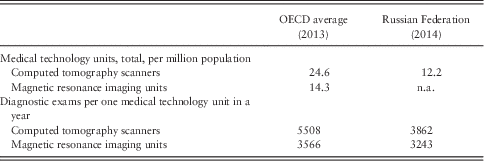
Technical inefficiency reveals the underutilization of new equipment. The annual number of diagnostic exams per one unit of expensive medical equipment in Russia is 10–30% lower than Organization for Economic Co-operation and Development average figures, although the number of such units per million citizens is much lower in Russia (Table 1).

Government procurement under the federal and regional investment programmes was not aligned, in many cases, with the ability of medical institutions to make effective use of the new technology (Gerasimenko, Reference Gerasimenko2014). In 2009, 43% of the surveyed medical institutions had cases of downtime of medical equipment supplied to health facilities under the Project ‘Health’ (RIA Novosti, 2009). According to the estimate of the International Medical Device Manufacturers Association, 30–40% of high-tech medical equipment purchased for federal programmes is underused or not used at all (HSE, RANEPA, 2013).
Our initial hypothesis is that the causes of inefficiencies lie in technology procurement in public hospitals. The purpose of our study is to understand how this process is organized and to explain the reasons for inefficiency (both technical and allocative) when adopting new technologies in Russian public hospitals.
Literature review
Organizational attributes of the innovations’ diffusion in health care is examined in a number of reviews and meta-analyses (e.g. Greenhalgh et al., Reference Greenhalgh, Robert and Macfarlane2004; Grol et al., Reference Grol, Bosch and Hulscher2007; Rye and Kimberly, Reference Rye and Kimberly2007) together with environmental influence, connectedness and innovation characteristics.
Studies on the organizational context of the adoption of new technologies pay most attention to the motivation underlying the decision making in health care facilities. Recent papers often go back to Greer’s (Reference Greer1985) decision system (Teplensky et al., Reference Teplensky, Pauly and Kimberly1995; Silva and Viana, Reference Silva and Viana2011; Lambooij and Hummel, Reference Lambooij and Hummel2013). Greer (Reference Greer1985) identifies three different decision-making systems in hospitals which judge medical technologies: (i) medical-individualistic, (ii) fiscal-managerial and (iii) strategic-institutional. The main differences among these systems are the types of decision makers and their motivation.
Under the medical-individualistic system, physicians and primary specialists are the prominent actors, pursuing goals based on maximizing patient welfare and avoiding risk. Clinical efficacy is their leading motivation. The professional dominance theory explains that the physicians’ ability to influence other hospital workers by effectively controlling the production function might lead to inefficient acquisition and misuse of technologies (Pauly and Redisch, Reference Pauly and Redisch1973; Greer, Reference Greer1984).
The fiscal-managerial decision system includes chief executives and fiscal officers as key actors and considers economic efficiency as their leading motivation. Hospitals are motivated by marginal returns on investments and so acquire new technology only if it is economically efficient to do so. In this spirit, Feldstein (Reference Feldstein1979) describes the profit-maximizing hospital, and Anderson and Steinberg (Reference Anderson and Steinberg1994) develop a price competition model.
The decision makers in the Greer’s (Reference Greer1985) strategic-institutional decision system are governing boards and chief executives. They adopt new capital-intensive medical technologies in order to enhance associated but indirect benefits. These benefits can include improving the hospital’s image and so helping to attract well-known physicians and new patients. Within this understanding, one strand of literature argues that hospitals tend to maximize their sales, not profits, because chief executive benefits depend on the hospital sales and volume of services (Finkler, Reference Finkler1983). The other explanation, corresponding to Lee’s (Reference Lee1971) theory of demonstrative behaviour, is that hospitals acquire new technology (no matter how costly) in order to signal that they are technological leaders. In addition, new technologies can help hospitals compete for physician loyalty (Coile, Reference Coile1990; Renshaw, et al., Reference Renshaw, Kimberly and Schwartz1990). Some authors (Luft et al., Reference Luft, Robinson and Garnick1986) view technology as a form of non-price competition for patients and physicians, and show that in more competitive markets, hospitals tend to overinvest in technology.
Rakich et al. (Reference Rakich, Longest and Darr1992) showed that hospital management and the governing board have more influence in the decision process than physicians, implying more frequent use of cost-benefit analysis and strategic planning. Friedman and Jorgenson (Reference Friedman and Jorgenson1994) suggest that the decision-making process is a function of physician influence and cost-benefit trade-offs. Teplensky et al. (Reference Teplensky, Pauly and Kimberly1995) demonstrated that factors attributed to technological pre-eminence motivation were most important in driving acquisition then profit maximization.
A number of studies adopted Greer’s criteria to determine country-specific dominant strategies for technology adoption. Greenberg et al. (Reference Greenberg, Peterburg, Vekstein and Pliskin2005) examined relevant considerations in Israeli hospitals and suggested that decisions were frequently made within a medical-individualistic decision system. Silva and Viana (Reference Silva and Viana2011) found that the adoption of CT scanners in Brazil was mainly determined by the administrators of private hospitals, who were influenced by physicians and sales representatives. Expected profitability and patient needs were relevant rationales for decision making, but were not the major determinants for acquiring new medical devices. Instead, the institutional strategy of each health care organization based on technological leadership was revealed as the strongest determinant for adoption of CT scanners.
Another strand of literature on priority setting in hospitals defines it as the distribution of resources among competing programmes and patients or patient groups (McKneally et al., Reference McKneally, Dickens, Meslin and Singer1997; Goddard and Hauck, Reference Goddard and Hauck2006; Martin, 2007; Barasa et al., Reference Barasa, Molyneux, English and Cleary2015). They put political context in the centre of the analysis. Goddard and Hauck (Reference Goddard and Hauck2006) stress that policy makers in health care may be motivated by their own self-interest rather than the maximization of social welfare. They argue that four traditional models of political economy (the majority voting model; competing interest group model; the bureaucracy model and the rent-seeking model) can explain priority setting in health care. In a recent review of empirical studies of priority setting in hospitals Barasa et al. (Reference Barasa, Molyneux, English and Cleary2015) draw on the Walt and Gilson’s (Reference Walt and Gilson1994) policy analysis framework of four key domains (content, context, process and actor) to identify factors impacting priority setting in hospitals, including the acquisition of surgical technology. By studying 24 empirical papers they find that priority setting in hospitals is often influenced by factors directly attributed to political context: the decision space, the political interests among key actors, lobbing and bargaining ability, and personal relationships. They argue that these factors often dominated priority-setting decisions especially in developing countries. They identify three main criteria used in priority setting in health care. Two of them (medical and economic) correspond to Greer’s two main types of motivation mentioned above. However the third, administrative, implies a strategic alignment with regional/national priorities, policies and objectives (Barasa et al., Reference Barasa, Molyneux, English and Cleary2015).
In this article we focus our attention on both the organizational context and the political context of new medical technology adoption. We choose three factors that almost all papers devoted to health technology acquisition and priority-setting focus on: prominent actors, the decision-making procedure, and the motivation and criteria for technology adoption.
Methods
To analyse technology adoption in Russian hospitals, the main challenge was to identify common features in the decision-making processes of Russian public hospitals.
Qualitative and quantitative methods are used to obtain data for similar tasks (Barasa et al., Reference Barasa, Molyneux, English and Cleary2015). Similar to Silva and Viana (Reference Silva and Viana2011) we preferred quantitative in-depth semi-structured interviews to any type of survey because decisions about medical technology adoption in Russian public hospitals are not overt, health technology assessment is not used, and priority-setting processes are very unclear. Under these circumstances anonymous in-depth interviews were the most appropriate tool to reveal the process of new medical technology adoption.
We focus on hospitals and do not consider polyclinics (primary care organizations), recreation medical organizations or hospices because hospitals are the main recipients of public investments in new medical equipment. We also do not consider big medical centres providing ‘high technology care’, most of which have the status of federal institutions. These centres are in the first line in medical technology adoption but the objects of our study are typical medical facilities which form the main body of health care system. We chose two distinct geographical locations for analysis – the Kaluga region and Saint Petersburg. Saint Petersburg with five million residents is the second-largest city in Russia and 111 public hospitals, while the Kaluga region with a population of 330,000 has 48 hospitals. Nine hospitals were selected to represent the typical medical institutions operating in the regions and representing different specializations: four city hospitals in Saint Petersburg, including two general, one paediatric and one emergency, and five in Kaluga region, including one regional hospital, one emergency, one clinic specialized on infectious diseases, and two local hospitals in small towns.
The study was based on 19 individual interviews, including 11 public hospital executives and six heads of medical divisions representing different specializations (neurosurgery, cardiac surgery, traumatology, urology, intensive care). Similar to Silva and Viana (Reference Silva and Viana2011) and Lambooij and Hummel (Reference Lambooij and Hummel2013), we interviewed two regional authority heads. All interviews were conducted in June 2009 by face-to-face at the interviewees’ workplaces. All interviewers had experience in conducting health-related interviews and used the same guide. Each interview lasted about one hour – one hour and a half and was stopped when all topics were discussed. The interviews were recorded and then transcribed. We combined multiple techniques to identify common problems and dominant strategies for technology adoption (including searching for missing information, metaphors and similes). In order to have a balanced picture of the situation three researchers have worked with each transcript. Also we compared the interpretation of the main drawbacks in medical technology acquisition given by authority heads and hospitals executives to increase the credibility the results. We also examined regional-specific features that affected the hospital’s decision-making process.
Results
Prominent actors involved in the decision making
The decision-making process in Russian hospitals usually involved a number of participants. These were (a) health care authorities (federal, regional and local), (b) hospital executives, (c) chiefs of medical departments (senior physicians) and (d) staff physicians. As each group had different incentives and motivations, the technology acquisition process was highly political and variable, with all the actors vying for influence.
(a) The federal health care authority (the Russian Ministry of health) determined the list of the equipment proposed to regional authorities for a choice under federal programmes. Regional health care authorities were the main actors in the decision-making process in the regions because they determined which hospital(s) to include in the federal and regional programmes. Most local authorities depended on regional budget subsidies, and were not able to make investment decisions themselves. Regional authorities allocated the main resources for medical equipment, analysed hospitals’ requests, and organized tenders. They could ban the purchase of equipment even if a hospital planned to buy it from its own resources. ‘If I need to buy a medical device, I should ask the authority for permission […] even if I have earned the money myself’. Hospital executives in both regions reported that they had to justify and reconcile with regional authorities about 80% of their expenditures on equipment, consumables and pharmaceuticals. Therefore, formally the decision space of hospital authorities was very limited.
Regional authorities evaluated regional health indicators and the general level of medical care. Ideally (not taking corruption into consideration), their principle motivations corresponded to the needs of the regional health care system. The main criteria for technology adoption therefore were hospital specialization, technical ability to adopt the technology (e.g. workplace characteristics, staff qualification), and future outcomes. However, regional authority heads mentioned that they had to consider the informal status of hospitals. Privileged hospitals (used by the governmental officials and deputies) had priorities in receiving new technologies over other hospitals: ‘If we ban the purchase of equipment to hospital “N” we’ll have problems as our government and deputies receive treatment there’.
It is important that regional health care authorities were the most prominent, but not the final actor in the decision-making process. Their decisions could be overturned by financial authorities: ‘they either finance our claims for technology adoption 100% or decline them […] they have their own criteria and they don’t care about our estimates if we don’t fit with their numbers’, an authority head complained.
(b) Hospital executives, driven mostly by indirect benefits and image considerations, endeavoured to receive from the state budget the best possible equipment. They often requested technology that would contribute to the positive image of the hospital [like an magnetic resonance imaging (MRI) scanner], even if there were no financial and medical reasons for it. The main reasons for new equipment adoption were: the replacement of old (or out-dated) equipment, the introduction of new (or additional) services and the development of new departments, and the improvement of technological processes in terms of timing and quality. As the process of equipment purchasing was highly variable and often unpredictable over long periods of time, executives tended to overstate their real needs and to request ‘reserves’ because they were not sure about getting new equipment in the future.
(c) Chiefs of medical departments (senior physicians) concentrated on the needs of their own departments, and thus tried to persuade hospital executives to invest in technologies they needed. As all hospital executives had a medical background and sometimes maintained a medical practice, they were usually more aware of technologies used in their specialty. They agreed that priority was usually given to chiefs who were ready and capable to develop their departments and who had enough energy and talent to acquire new technologies.
(d) Our analysis showed a difference between staff physicians in the two regions studied. For example, in Kaluga region there was a lack of specialists, particularly those young and willing to work with new technologies. ‘When a physician wants to adopt new technology, we support this person. I go to the authority head and ask for money. I do that only if I have a person who will use the technology’, said the head of a hospital in Kaluga region. Unfortunately for the Kaluga region, quite often those interested in new methods of treatment and professional development sought positions in other locations, mainly in neighbouring Moscow. Hence, for those rare specialists who kept working in local hospitals, the executives and senior physicians tried to meet all their requirements.
In contrast, Saint Petersburg executives rarely had any problems with finding specialists. ‘I have never had a problem finding a specialist to work with new equipment’, said a head of a specialized hospital in Saint Petersburg. They focused mainly on strategic development and invited specialists capable of using the technology and equipment the executives had acquired for their institutions.
Overall, there was strong evidence that financial staff did not participate in the decision-making process. The key decision makers were regional authority leaders and hospitals executives, with senior physicians and staff physicians having a limited influence on other actors. Therefore, a political context is more important in decision-making compared to organizational.
The decision-making procedure
According to Russian legislation any purchase of equipment and/or technology in public organizations (including hospitals) has to go through a tender procedure. Technology acquisition may be initiated either (a) by an authority (federal or regional) or (b) by a hospital.
(a) If the purchase was initiated from above then the equipment usually was delivered within a federal or a regional programme. Authorities were supposed to aggregate hospitals’ requests and take hospitals’ preferences into consideration. However, such programmes usually were limited by lists of equipment available for purchase. Hospital executives in both regions described dozens of situations in which they were forced to take equipment they did not need. Quite often they received equipment that was incompatible with what they had because the different producers use different technical standards. Often they received only the very basic versions of equipment, so they could not deliver all of the services needed. Sometimes hospitals were forced to take equipment that they could not use because they lacked the appropriate specialists or encountered technological gaps or infrastructure problems. To illustrate this situation, an executive in a Kaluga regional hospital described ambulances received within the National Project ‘Health’. These new vehicles were equipped with the latest features, but they could not handle the rough rural roads in the region. As a result, the hospitals had to curtail the use of these vehicles and go back to their old ambulances instead. The respondents noted that when they received equipment ‘from above’, they valued it as a ‘gift’, even though these were often useless. The hospital was obliged to decide simply ‘to take it or leave it’; it could not change the type of equipment received or apply for another producer/specification.
(b) If a hospital initiated an acquisition, the decision-making process had two steps. First, the hospital itself decided what it needed. There were two primary decision makers: Senior physicians advised, and then medical directors had the final say. There were no standard procedures, and no objective measures or quality comparisons or cost-benefit analyses, formal or informal, making the decision-making process very vague.
Second, when a hospital had set its priorities, it has to decide who would finance the technology and organize tenders. Usually the response depended on the price of the equipment. Both regions had special rules for expensive equipment acquisitions. For example, in the Kaluga region, all purchases above 2 million roubles (~$66,000 USD) were to be approved by the deputy governor of the region, no matter who paid. Typically, the hospital applied to the regional authority for financing and the authority examined the need and its ability to satisfy the request. The negotiation with authorities was a complex process, involving bargaining and compromises, unclear and non-transparent decision making, and informal relations.
Neither hospitals nor authorities used health technology assessment procedures in priority setting; information gathering about particular technologies was poorly organized; authorities often did not estimate the hospitals’ ability to use the new technology properly.
If the authority decided to finance the technology, it was usually responsible for tenders. The hospital representatives could be invited to tender commissions. This depended on the hospital relations with the authority and on many other factors, including corruption. The executives complained that quite often they received equipment from unwilling producers because authorities considered only price, or they received the right equipment, but with inconvenient warrantee terms.
Motivations and criteria for technology adoption
Respondents from hospitals in both regions were asked to rank the importance of motivations for technology adoption from three possible choices: (1) financial efficiency, (2) image and indirect benefits and (3) clinical efficacy.
(1) Economic efficiency was considered by most interviewees as crucial to technology acquisition: ‘The main motivation for acquiring new technologies is connected to an increase in the demand for services, and hospitals of course want to earn money for their doctors’; ‘A physician is human – he needs food, theatres and to buy something. This is the most important thing at the moment’. When respondents were asked to specify economic motivations for adopting new technologies, they named new services, more patients, and personal income increase, formal or informal. Physicians in public hospitals are paid salaries according to their qualifications, experience, etc. If a hospital delivers certain services to patients for a fixed charge, physicians receive additional income, depending on the number of services and patient visits. Both basic salary and additional income (if any) are low, and many physicians implied that their income is supplemented by informal payments and ‘presents’.
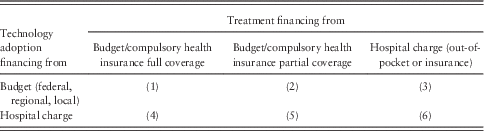
Surprisingly, nobody (including hospital executives) mentioned any economic and financial assessments, cost-benefits analysis or profit maximization models. To understand why no financial and managerial calculations were used to evaluate technologies, see Table 2. Different combinations of financing technology adoption and services delivered with the use of this technology existed and the economic motivation for acquiring new technology was different in each case.
Financial sources to reimburse medical treatment and technology adoption

When a hospital received new equipment and introduced technologies out of the budget (federal, regional, local), it did not consider the initial costs of the equipment and could request for the most expensive technology (situations 1, 2, 3).
If all the maintenance and servicing costs were fully charged to the budget or compulsory health insurance fund (situation 1), the hospital evaluated only the benefits associated with the new equipment (i.e. the formal and informal payments received for using this equipment). The hospital did not consider post-guarantee servicing of the price of consumables.
If a hospital bore the maintenance and servicing costs (situation 2), it had to take a cost-saving strategy into account. All respondents indicated that this was a very typical situation, causing problems: ‘When equipment depreciates […] it needs renovation/repair. And each time we are in trouble – these expenses […] they are huge. Nobody thinks about that’; ‘we can’t afford consumables and servicing costs – we have to look for cheaper parts and often it’s not good for the equipment’.
Most equipment received under the National ‘Health’ Project or under special federal programmes for cardiology, tuberculosis, etc. did not take into account the full post-purchasing costs of consumables. The tariffs for medical services delivered with the use of the new equipment often did not include maintenance costs, forcing hospitals to search for additional sources of financing, usually from chargeable services (situation 3). This finding suggests that contradictions between the hospitals and the authorities responsible for equipment tenders were inevitable: those who organized tenders were interested in low equipment prices and did not take other considerations into account, while hospitals were likely to acquire technologies that did not need expensive materials and repairs, regardless of the initial price.
When public hospitals acquired new technologies using their own sources, mainly from chargeable services (situation 6), they evaluated benefits and total costs, including technology, consumables, maintenance, etc. In such cases hospital behaviour often corresponded to Greer’s fiscal-managerial model. But, unlike western clinics, Russian public hospital executives considered a narrow range of economic effects (enhancement of services, attraction of additional patients, increase of paid services) and did not take into account such indicators as returns on investment, the payback period, the price potential, or the size of the market.
In the less widespread situations 4 and 5 when hospitals purchased new medical equipment themselves and then used it to deliver free-of-charge medical services and cover maintenance costs fully or partly from the budget and compulsory health insurance funds, they took into consideration future benefits, the initial price of technology and part of the maintenance and servicing costs (situation 5). However, income from chargeable services was limited, so hospitals could not buy expensive equipment.
The respondents reported that hospitals (no matter their status and specialization) were usually in situation 1, 2 or 3, making a financial analysis of acquiring technology useless. In general, hospitals were motivated to introduce technologies that were cheap to maintain and compatible with hospital equipment and infrastructure facilities. However, hospitals were not interested in adopting technologies that decreased the length of hospital stays. Furthermore, the respondents reported that because hospitals were reimbursed according to the number of days that a patient stays, they had a financial incentive to maintain less efficient treatments. Most interviewees agreed that in some cases they could discharge their patients earlier but they would lose money: ‘if we discharge a patient on his 5th day we’ll get only 5000 rubles instead of 20,000. […] We know it’s typical – we could have discharged patients much earlier – in surgery division, in gynaecology, in urology… but it’s unprofitable because of the reimbursement tariffs’.
(2) A number of respondents reported indirect benefits such as image as the most important motivation or at least equally as important as financial efficiency. They wanted to be perceived as cutting-edge. They also said that the desire to have the best possible equipment is common for most physicians and executives. ‘A lot is driven by prestige’, said the head of an authority. ‘A desire to have an MRI scanner in a hospital is often just a matter of prestige and has nothing to do with rationality’.
Among indirect benefits, four main motivations drove hospitals to acquire new technologies even when there were no economic and financial rationales: (a) attracting patients, (b) attracting physicians, (c) the satisfaction of chief doctors and (d) privileges for the hospital.
(a) Attracting patients was a dominant motivation. Respondents understood that patients were often aware of new technology, creating a sort of pressure for physicians. Patients evaluated not only the medical equipment but also the design and ergonomic quality of the furniture and the facilities of rooms and wards, motivating hospitals to invest in a comfortable and patient-friendly environment. The interviewees explained that well-equipped hospitals therefore attracted more patients, and more importantly, upper-class patients with higher incomes.
(b) A positive image attracted physicians. For some specialists, the quality of the medical equipment was crucial (e.g. in surgery, dentistry, ophthalmology, etc.), because they saved time and energy and decreased risks. The majority of respondents agreed that highly qualified physicians were rare in Russia. Hospital executives also reported that acquiring new technologies helped them to get better physicians and primary specialists: ‘Technology and equipment helped me to gather a good team. […] I have invited one physician from Novosibirsk […] good specialists easily join our hospital’.
(c) A large majority of interviewees mentioned personal satisfaction as additional, though not key, motivation. This is how an authority head described it: ‘[hospital heads] want to get an MRI scanner to feel proud of possessing it. […] They also want it to be able to boast’. The executives appreciated when their colleagues and patients admired their hospitals and the technical opportunities available: ‘I’m happy that everybody admires our centre’. Respondents also reported that the physicians who used new technologies and procedures expressed delight and satisfaction, and had high self-esteem. Nevertheless, executives admitted that not all physicians wanted to change their well-established practice and position themselves at the leading edge of medical care.
(d) Finally, we addressed reputation and privileges. A hospital that had a leading and prestigious position built a good reputation and received strong support from local (sometimes even regional and federal) authorities. Some executives explained that hospitals with strong reputations often had special relations with prominent citizens and authorities, and these relations helped them to solve different problems. Those respondents who could not boast about having close relations with the local government indicated that they were often left out of the decision-making process; at the same time, their ‘competitors’ were involved in political life through participation in health care commissions and committees. As a result, a leading hospital had more opportunities to influence the priority-setting process and to receive new medical equipment. ‘Our physicians have privileges in the city. […] Our hospital is special because we are at the leading edge of care’.
(3) Although clinical efficacy was last among motivations, all interviewees cited it as an important rational, explaining that hospitals tended to acquire only clinically efficient technologies, but not always the best in class.
A large majority of respondents said it was impossible to adopt the most prominent technologies in Russian hospitals because of technological gaps, including the quality of other hospital facilities, education/skills gaps, quality of infrastructure (buildings, water supply, electricity, etc.) and sometimes out-dated clinical standards. Further, most technologies needed expensive supporting facilities, therefore, clinical efficacy a priori could not be a dominant motivation in most Russian hospitals. ‘We can’t yet demand the best technologies as the level of overall development is not the same as in developed countries. It’s impossible. We therefore choose those technologies that can be adopted here over; technologies that decrease our losses and facilitate our job’.
Our findings on the motivations of hospitals were similar to those that Teplensky et al. (Reference Teplensky, Pauly and Kimberly1995) obtained to explain MRI scanner adoption in the United States, and that Silva and Viana (Reference Silva and Viana2011) discovered for CT scanner adoption in Brazilian hospitals.
Although the hospitals vary in specialties offered, size, reputation, etc., we did not find any important variations in the decision-making processes which could be attributed to a hospital’s characteristics. The acquisition process was similar for all public hospitals, no matter what dimension was studied (information sources, motivations, key decision makers or bargaining procedures). Hospitals of different type/status, often faced the same obstacles to new technology adoption: technological and environmental gaps, physicians’ qualifications, reimbursement policy, the motivation for using old technology and the negotiation process with authorities.
However we observed two important regional-specific features. The first is that technology acquisition was more likely to be driven by competition for desired patient groups in Saint Petersburg, whereas hospitals in the Kaluga region were more likely to be driven by competition for physicians. The second is that in Saint Petersburg regional authorities were more likely to reject hospitals’ requests, seeking to avoid equipment duplication.
Conclusions
The adoption of new medical technologies in Russian hospitals was very intensive during the period from 2006 to 2013 due to a considerable increase in public spending within large-scale federal and regional investment programmes. Although there was increased public access to modern medical technology, there were many cases of ineffective acquisition and underuse of new medical equipment.
This study examined different types of inefficiency (allocative and technical) arising when new technologies were adopted by public hospitals in Russia. We studied the political and organizational contexts that led to inefficiency.
As in previous studies of the motivation for medical technology adoption our research showed that the political context of priority setting played a leading role. A specific feature of all Russian public hospitals was that they were strongly dependent on health authorities’ decisions about the acquisition of new technologies. We found that inefficiency problems arose from the contradiction between the hospitals’ and the authorities’ financial motivation for acquiring new technologies.
When making decisions about equipment purchases, the declared priorities of regional health authorities mainly reflected the setting of the population’s health care needs and purchasing of the most cost-effective equipment. The authorities’ main concern was initial cost of the technology, but usually without taking into account the potential cost of consumables, maintenance, etc. Lack of funds to cover these imputed costs to hospitals was a typical cause of the inefficiency in the use of new technology (the non-use or underuse of medical equipment).
Hospitals tended to adopt technologies which bring benefits to their heads/physicians and minimize maintenance and servicing costs. By acquiring new medical technologies, a hospital generated additional revenue by expanding medical services to its patients. The hospital therefore behaved as a cooperative business venture for physicians who benefited financially. This strongly corresponds to Pauly and Redisch’s (Reference Pauly and Redisch1973) idea of a physician’s cooperative, maximizing their earnings. The evidence of investment to signal to patients that the hospital cares about all aspects of treatment is explained by Lee’s (Reference Lee1971) demonstrative behaviour theory. We also found evidence to support the idea of non-price competition for physicians and desired patient groups (Luft et al., Reference Luft, Robinson and Garnick1986; Coile, Reference Coile1990; Renshaw, et al., Reference Renshaw, Kimberly and Schwartz1990).
When selecting technologies and preparing applications for the acquisition of new equipment from public sources, hospital executives were guided by an interest in obtaining expensive equipment which improved the image of the hospital and was expected to be used largely to provide chargeable services. This could lead to the acquisition of redundant equipment compared with needs of patients and could cause both allocative and technical inefficiency of new technology adoption.
We found that medical technology procurement had a number of drawbacks which could be observed during each step of decision making – poor information gathering, ambiguous procedures of technology assessment, and authoritarian in-hospital priority-setting mechanisms. These drawbacks could lead to allocative inefficiency of new technology adoption by hospitals.
Public procurement experts often point that allocative inefficiency arises when the people responsible for tenders replace efficiency criteria with personal interests as explained by Goddard and Hauck (Reference Goddard and Hauck2006) and the leading interest in this case is the size of the bribe due to the purchase of equipment. We found that leaving aside the corruption issue, the technology adoption process in Russian public hospitals was characterized by fundamental contradiction between its participants, that inevitably contributed to allocative inefficiency. This resulted in a consistently reproduced situation where equipment was purchased over-capacity, and thus, underused.
To increase the allocative and technical efficiency of decision making around medical technology adoption, the Russian government needs to shift the responsibilities of the main actors. The right to select and purchase medical equipment should be delegated to hospitals, while health authorities should be in charge of approval of the hospitals’ development programme. The decision-making process in Russian public hospitals must become more transparent and also take into account the growing body of international research on the relative efficiency of treatments and new technologies.
Acknowledgements
The authors are grateful to all our respondents for giving their time and sharing their experiences with us. The authors would like to thank Dr Christopher Gerry and two anonymous reviewers for helpful comments and recommendations.
Financial Support
The study was funded by the Basic Research Program at the National Research University Higher School of Economics.
Supplementary material
To view supplementary material for this article, please visit https://doi.org/10.1017/S1744133116000347