Introduction
It is neither surprising nor undocumented that there is a strong correlation between levels of church attendance among young people and levels of parental church attendance. Francis and Gibson (Reference Francis and Gibson1993) evaluated the research evidence available at that time and contributed to the cumulative evidence by reporting on their study among 3,414 students, aged 11 to 12 and 15 to 16, attending all the secondary schools in the city of Dundee, Scotland. Their data were modelled to compare the influence of mothers and fathers on male and female adolescents within the two age groups. In relation to frequency of adolescent church attendance, the findings demonstrated that parental influence was important for both sexes and both age groups, that there was little difference in overall parental influence on sons and daughters, that the extent of this influence increased rather than decreased between the ages of 11 to 12 and 15 to 16, that mother’s practice was a more powerful predictor than father’s practice among both sons and daughters, and that parental influence was strongest when both parents were churchgoers.
The picture is, however, more complicated than the simple interpretation of these correlations may suggest. A second well-established research finding is that frequency of church attendance declines as young people progress through the years of secondary schooling. Evidence charting this adolescent drift from church attendance and linking decreasing levels of church attendance with declining attitude toward Christianity more generally was documented by Kay and Francis (Reference Kay and Francis1996). In the light of such evidence the core research question may be re-voiced to examine what keeps adolescents within the church during their teenage years. However, the idea of listening to young churchgoers themselves to explore why they attend church and their attitudes toward the churches they attend seems to have occupied the concern of only a small number of researchers. The present study builds particularly on the work of Francis (Reference Francis1984), Brierley (Reference Brierley2002), Bellamy et al. (Reference Bellamy, Mou and Castle2005), Francis and Craig (Reference Francis and Craig2006), and Francis et al. (Reference Francis, Penny and Powell2018).
In his book, Teenagers and the Church, Francis (Reference Francis1984) reported on an enquiry sponsored by the British Council of Churches, in which 1,328 young people between the ages of 13 and 20 years who attended church on a given Sunday in 90 churches in the north-west of England completed a questionnaire. The findings from this study drew attention to some significant differences between the experiences of the different denominations. For example, the likelihood of young teenage church attenders drifting away from the church during their later teenage years was much higher in the Church of England than in either the Roman Catholic Church or the Free Churches. Another major difference between the denominations concerned the extent to which the young people felt integrated as part of an all-age worshipping community. On this issue, it was the Roman Catholic Church which emerged as facing the greatest criticism.
In his book Reaching and Keeping Tweenagers, Brierley (Reference Brierley2002) reported on an enquiry that drew together questionnaire responses from three sources: 549 young people attending 123 churches; 327 young people attending various Christian youth organizations; and 1,296 young people attending secondary schools. Brierley (Reference Brierley2002: 134-35) drew the following main conclusions about tweenagers’ experience of the church. Not only parents, but also grandparents exercised a large influence on tweenagers. Those with highest school grades were more likely to be regular attenders. Churchgoing tweenagers enjoyed their church because of the people they met there. Many tweenagers stopped attending church at the time when they transferred to secondary school, feeling by that stage they had grown out of it. Those not going to church stayed away because they thought church was boring, and they could no longer be bothered to go. Subsidiary reasons for tweenagers not going to church included not being able to get up early enough and lack of parental encouragement.
In their report on the 2001 Australian National Church Life Survey (NCLS) of church attenders aged between 10 and 14 years, Bellamy et al. (Reference Bellamy, Mou and Castle2005) presented the views of 10,101 young Anglican and Protestant attenders of whom 54 per cent were girls and 46 per cent were boys. The results showed that the majority (82 per cent) of Australian young people who participated in the survey ‘always’ or ‘mostly’ liked the church services that they attended. The level of importance that they placed on God, on Jesus and on their spiritual lives was positively related to the frequency with which they attended church, whether they liked going to church and the predisposition that they had towards dropping out of church. The report also showed that parents have a central role in the development of faith. The authors concluded that the practice of family prayer times, the encouragement of a personal devotional life for children, and parents simply being prepared to talk with their children about faith are all aspects that are positively related to higher levels of belief and a more positive attitude toward and involvement in church life.
In their paper ‘Tweenagers in the Church’, Francis and Craig (Reference Francis and Craig2006) reported on a survey among churchgoers under 15 years of age conducted alongside the 2001 Church Life Survey designed for use primarily in England (Churches Information for Mission, 2001). In this study they drew on information provided by 10,153 participants between the ages of 8 and 14 years. Of these participants 60 per cent were girls and 40 per cent were boys. In their analyses of these data, Francis and Craig (Reference Francis and Craig2006) set out to evaluate the influence of peers and of parents on the development and maintenance of a positive attitude toward church during tweenage years. Two important points are highlighted by the data. The first point is that having friends attending the same church is important to tweenagers. The second point is that parents play a crucial role through what they do and what they model outside their pattern of church attendance. The maintenance of a positive attitude toward church during the tweenage years is associated with having parents who support the faith in conversation and example at home.
In their paper ‘Assessing Peer and Parental Influences on the Religious Attitudes and Attendance of Young Churchgoers’, Francis et al. (Reference Francis, Penny and Powell2018) reported on a survey among young churchgoers between the ages of 8 and 14 years conducted alongside the 2011 Australian National Church Life Survey (Powell et al., Reference Powell, Bellamy, Sterland, Jacka, Pepper and Brady2012). In this study they drew on data provided by 6,256 young participants attending a range of denominations, including Catholic, Anglican, Uniting, Pentecostal, and other Protestant Churches. The data indicated the power of parental example on frequency of church attendance. Frequent attendance among young churchgoers occurred when both parents attended as well. The most positive attitude toward their church was found among young churchgoers who had the opportunity to talk about God with their parents and who did not feel that their parents made them go to church. Young churchgoers responded to parental encouragement better than to parental pressure. Although peer influence within the church did not make much contribution to frequency of attendance, it made a contribution to shaping positive attitude toward church.
Research concerned with individual differences in church attendance (and in religiosity more generally) during childhood and adolescence has also drawn attention to the importance of personal factors and psychological factors (see, for example, Kay and Francis, Reference Kay and Francis1996). In terms of personal factors the early review of empirical studies undertaken by Argyle (Reference Argyle1958) identified sex differences as the best established finding in the psychology of religion, with females consistently reporting higher levels of religiosity compared with males. This finding has been confirmed by the subsequent reviews of empirical studies reported by Francis (Reference Francis1997) and Francis and Penny (Reference Francis, Penny and Saroglou2014). The second personal factor consistently reported as relevant among children and adolescents is age, with a well-documented decline between the ages of 8 and 16 years (Francis, Reference Francis1978, Reference Francis1987, Reference Francis1989). In terms of psychological factors, while in his initial review of the literature Argyle (Reference Argyle1958) concluded that there was insufficient empirical evidence to link individual differences in religiosity, thirty years later Beit-Hallahmi and Argyle (Reference Beit-Hallahmi and Argyle1997) concluded that sufficient evidence had occurred during the intervening years to locate religiosity within Eysenck’s three-dimensional model of personality (extraversion, neuroticism and psychoticism) as proposed by Eysenck and Eysenck (Reference Eysenck and Eysenck1975) and Eysenck et al. (Reference Eysenck, Eysenck and Barrett1985). In particular, high psychoticism scores were associated with lower religiosity (see Francis, Reference Francis1992). For these reasons it becomes prudent for studies exploring the effect of parental and peer influence on church attendance among adolescents to control for personal factors (age and sex) and for psychological factors (extraversion, neuroticism and psychoticism).
Research Question
Against this background the aim of the present study is to build on previous research concerned with identifying influences on the patterns of church attendance among young people and to extend that research in three ways. While the three studies reported by Bellamy et al. (Reference Bellamy, Mou and Castle2005) and by Francis et al. (Reference Francis, Penny and Powell2018) on Australian data, and by Francis and Craig (Reference Francis and Craig2006) on British data focused on young people surveyed during church services, the present study focused on a wider group of young people surveyed within schools. While the earlier studies focused on young people attending church across a range of denominations, the present study focused on those identifying with one specific denomination, namely self-assigned young Anglicans. This study also contained a wider range of variables accessing parental religious identity, parental religious practices and peer-related factors. The current data, therefore, allowed more precisely framed research questions to be addressed. The first research question concerns assessing the combined influence of parental religious identity and parental religious practice on levels of church attendance among young Anglicans after taking into account personal factors (age and sex) and psychological factors (extraversion, neuroticism and psychoticism). The second research question concerns assessing the influence of peer-related factors on levels of church attendance among young Anglicans after parental influence has been taken into account.
Method
Procedure
Within the quantitative strand of the Young People’s Attitude to Religious Diversity project, classes of Year 9 and Year 10 students in Wales, London and the rest of England (13–15 years of age) were invited to complete a questionnaire survey. The sampling frame set out to gather data from at least 2,000 students in Wales, 2,000 students in London and 2,000 students from the rest of England, with half of the students attending schools with a religious character within the state-maintained sector (Anglican, Catholic, and joint Anglican and Catholic) and half of the students attending schools without a religious foundation within the state-maintained sector. The participants were guaranteed confidentiality and anonymity, and were given the choice not to participate. The level of interest shown in the project meant that very few students decided not to take part in the survey. All told 2,328 students participated from Wales, 2,315 from London, and 2,416 from the rest of England, drawn from 19 schools with a religious character and 17 schools without a religious foundation.
Instrument
The survey was designed for self-completion. In the present analysis the following variables were used.
Religious affiliation of students, mothers and fathers was assessed by the questions ‘What is your religion?’, ‘What is your father’s religion?’, ‘What is your mother’s religion?’ followed by a checklist that included the option ‘Anglican (Church of England, Church in Wales)’.
Church attendance of students, mothers and fathers was assessed by three questions: ‘Apart from special occasions (like weddings), how often do you/does your mother/does your father attend religious services (e.g. at church, mosque, or synagogue)?’ followed by the options: never, at least once a year, sometimes, at least six times a year, at least once a month, nearly every week, and several times a week.
Parental and peer support were assessed by seven items assessed on a five-point Likert scale: agree strongly, agree, not certain, disagree, and disagree strongly.
Personality was assessed by the abbreviated form of the Junior Eysenck Personality Questionnaire Revised (JEPQR-A: Francis, Reference Francis1996). This instrument proposes three six-item measures of extraversion, neuroticism and psychoticism. Each item is assessed on a dichotomous scale: yes and no.
Participants
The present analyses were conducted on data provided by the 645 students who self-identified as Anglicans: 320 from Year 9 and 325 from Year 10; 309 males, 334 females, and 2 of undisclosed sex. These 645 Anglican students represent 9.1 per cent of the 7,059 students who participated in the survey from London, the rest of England and Wales.
Results and Discussion
Mapping the Profile of Young Anglicans
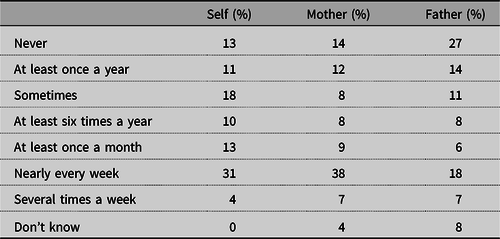
The first step in data analysis involved mapping the profile of the 645 students who self-identified as Anglicans. Table 1 presents the frequency of church attendance reported for the students themselves and for their parents. The data show that weekly attendance was reported for 35 per cent of the students, 45 per cent of the mothers and 25 per cent of the fathers, while 13 per cent of the students, 14 per cent of the mothers, and 27 per cent of the fathers were reported as never attending.
Frequency of church attendance

Table 2 presents levels of perceived parental religious identity and support as the sum of the ‘agree strongly’ and ‘agree’ responses. Considerably greater support is perceived to be provided by mothers than by fathers. Thus, 86 per cent of mothers were identified as Anglican, compared with 60 per cent of fathers; religious identity was thought to be important to 57 per cent of mothers, compared with 33 per cent of fathers; 40 per cent of the students often talked about religion with their mother, compared with 27 per cent who often talked about religion with their father.
Parental religious identity and support

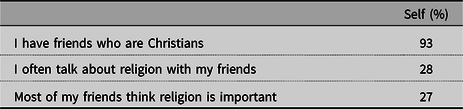
Table 3 presents levels of peer support as the sum of the ‘agree strongly’ and ‘agree’ responses. The majority of the Anglican students had friends who are Christians (93 per cent), but the proportions dropped to 28 per cent who often talked about religion with their friends and to 27 percent who considered that most of their friends think religion is important.
Peer support

Testing the Instruments
The second step in data analysis involved testing the psychometric properties of the abbreviated form of the Junior Eysenck Personality Questionnaire Revised. Table 4 presents the alpha coefficients (Cronbach, Reference Cronbach1951) together with the means and standard deviations. The alpha coefficients for the extraversion scale and for the neuroticism scale are satisfactory for such short instruments (DeVellis, Reference DeVellis2003). The weaker alpha coefficient reported by the psychoticism scale is consistent with the known difficulties involved in operationalizing this dimension of personality (Francis et al., Reference Francis, Brown and Philipchalk1992). The mean scale scores are in line with the data reported by the foundation paper for this measure (Francis, Reference Francis1996).
Personality measures: scale properties

Examining Correlations
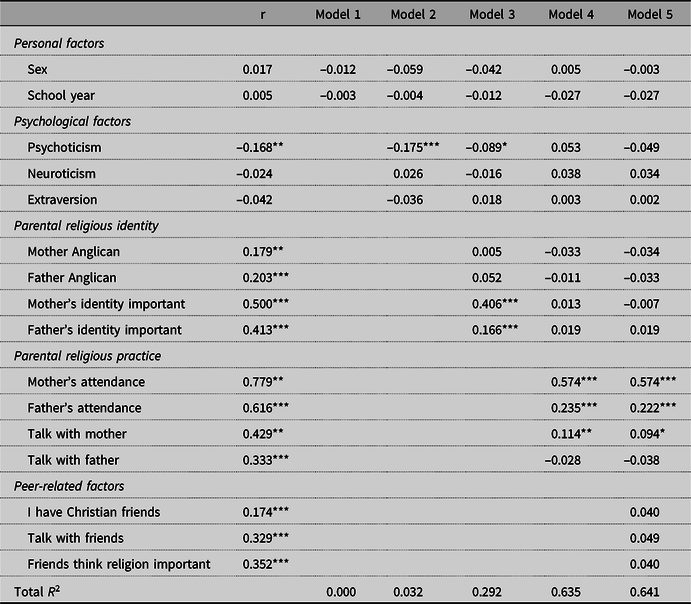
The third step in data analysis involved exploring the bivariate correlations between the frequency of the students’ church attendance and the range of predictor variables assembled for the analysis. These correlations are presented in the first column of Table 5, grouped within the five fields of personal factors, psychological factors, parental religious identity, parental religious practice and peer-related factors. In terms of personal factors, the correlation coefficients indicate no significant association with either age or sex. While age and sex are routinely predictors of frequency of church attendance in general populations, in terms of higher frequency associated with being female and being younger (Kay and Francis, Reference Kay and Francis1996), this is not the case among Year 9 and Year 10 students who have self-identified as Anglicans. In terms of personality factors, higher levels of church attendance are significantly correlated with lower psychoticism scores, but independent of both extraversion scores and neuroticism scores. This finding is consistent with the view advanced by Francis (Reference Francis1992) that psychoticism is the dimension of personality fundamental to individual differences in religiosity and supported by a large number of subsequent studies (see Lewis and Francis, Reference Lewis and Francis2014).
Regression models on student church attendance

Note: *p < 0.05; **p < 0.01; ***p < 0.001
In terms of parental religious identity, high levels of church attendance are significantly correlated with having parents (both mother and father) who are Anglicans, and with having parents (both mother and father) for whom their religious identity is important. In terms of parental religious practice, levels of church attendance are significantly correlated with both mother’s and father’s levels of church attendance and with talking about religion with mother and with father. In terms of peer-related factors, levels of church attendance are significantly correlated with having friends who are Christians, with talking with friends about religion, and with having friends who think that religion is important.
Engaging Multiple Regression
The third step in data analysis involved exploring the cumulative impact of the five groups of predictor variables (personal factors, psychological factors, parental religious identity, parental religious practices and peer-related factors) on individual differences in students’ levels of church attendance. Table 5 presents the series of five regression models, in which fixed order entry was employed. In Model 1, just personal factors were entered (sex and age). In Model 2, psychological factors were added (psychoticism, neuroticism and extraversion). In Model 3, parental religious identity was added (mother Anglican, father Anglican, importance of mother’s religious identity and importance of father’s religious identity). In Model 4, parental religious practice was added (mother’s church attendance, father’s church attendance, talking about religion with mother and talking about religion with father). In Model 5, peer-related factors were added (having Christian friends, talking about religion with friends and having friends who think that religion is important).
The five regression models presented in Table 5 build up an incremental picture of parental and peer influences after personal factors (age and sex) and psychological factors (psychoticism, neuroticism and extraversion) have been taken into account. It is Model 5 that is most revealing when all five sets of predictor variables are taken into account. This model confirms that parental church attendance provides the strongest prediction of church attendance among young Anglicans. More frequent attendance is associated with mother attending church (β = 0.57) and with father attending church (β = 0.22). These two factors operate cumulatively with the stronger influence being when both parents attend church. Moreover parental support in the religious formation of their young through talking about religion offers an additional positive influence on church attendance frequency, on top of the example of parental attendance itself (β = 0.09). After parental religious practice has been taken into account, no additional predictive power is provided by peer-related factors.
Conclusion
The present study was established within the context of earlier empirical research concerned with identifying influences on the pattern of church attendance among young people and to extend the research in three ways. While the two studies reported by Francis and Craig (Reference Francis and Craig2006) and by Francis et al. (Reference Francis, Penny and Powell2018) focused on young people surveyed during church services, the present study focused on a wider group of young people surveyed within school. While the two earlier studies focused on young people attending church across a range of denominations, the present study focused on those identifying with one specific denomination, namely self-assigned young Anglicans. This study also contained a wider range of variables accessing parental religious identity, parental religious practices, and peer-related factors. Four main conclusions emerged from the analyses of these new data.
The first conclusion emerged from mapping the profile of young Anglicans (between the ages of 13 and 15 years) within England and Wales. Within the sample, over a third of the young people who identify themselves as Anglicans (35 per cent) are attending church nearly every week, while almost half (48 per cent) are there at least once a month. Seeing themselves as a member of the Church of England or Church in Wales is no longer really a default option for young people growing up outside the church. Young people are seeing the Anglican Church alongside other denominations in which membership involves practice. The majority of young Anglicans are there because their parents are there also: 86 per cent see their mother as Anglican and 60 per cent see their father as Anglican.
The second conclusion emerged from the correlational analyses. Taken alone, each of the aspects of parental religious identity (mother identified as Anglican, father identified as Anglican, mother’s religious identity is important to her and father’s religious identity is important to him), each of the aspects of parental religious practice (mother’s church attendance, father’s church attendance, mother talks about religion and father talks about religion), and each of the peer-related factors (having Christian friends, talking with friends about religion and having friends who think religion is important) are individually significant predictors of levels of church attendance among young Anglicans. All of these factors operate together as part of a complex system and consequently none should be trivialized or disregarded. Nonetheless, multiple regression analyses are able to draw out priorities within this complex nexus of inter-relationships.
The third conclusion emerged from the regression models in direct response to the first main research question concerned with assessing the combined influence of parental religious identity and parental religious practice on levels of church attendance among young Anglicans. The data demonstrated the key importance of religious practice. Among 13- to 15-year-old Anglicans those who stay in church are those whose parents are there also. In this case the influence of mother is stronger than the influence of father, but the strongest influence is when both parents are there in church. The idea of parental religious practice supported by the regression model confirms that the example of parental church attendance is even stronger when parents (especially mother) talk about religion with their young people at home.
The fourth conclusion emerged from the regressions models in direct response to the second main research question concerned with assessing the influence of peer-related factors on levels of church attendance among young Anglicans after parental influence has been taken into account. The data demonstrated that peer-related factors contributed no additional predictive power within the regression model. In this sense the main influence remains within the home and among parents.
Cumulatively these research findings may carry important implications for the way in which the Church of England and Church in Wales conceptualize ministry among young people. The major implication is that those young people who feel a connection with the Anglican Church (by self-identifying as Anglicans) seem to do so because their parents see themselves as Anglican. Young Anglicans who practise their Anglican identity by attending church seem to do so primarily because their parents are Anglican churchgoers. Moreover, young Anglican churchgoers are most likely to keep going if their churchgoing parents talk with them about their faith. Among this age group peer support seems insignificant in comparison with parental support. The implication from these findings for the Anglican Church in England and Wales to develop and to strengthen its ministry among children and young people is that it may be wise to invest in the education and formation of churchgoing Anglican parents in order to enable them, in turn, to nurture the Christian formation of their young.
This focus on the role of Christian parents holding the main responsibility for nurturing and supporting the Christian formation of young people is consistent with the emphasis of two other recent studies conducted in England and Wales. The first of these reports, Faith in our Families, commissioned by Care for the Family (2016), was based on three sources of data: a quantitative web-based survey among 983 parents, 175 church leaders and 479 children’s workers recruited through Care for the Family’s database; qualitative research among 21 parents and 6 children’s workers who responded to open questions and kept a diary of anything that related to faith with their children over a week; and a focus group held in Northern Ireland. The data indicated that 95 per cent of parents considered that it was largely their responsibility to teach their children about the Christian faith. However, at the same time 92 per cent of parents felt that they should be doing more in this regard. One of the children’s workers in the qualitative survey commented that:
To encourage parents to nurture their children in the faith within the home is a new concept and the churches need help to understand why this is necessary and why it is their responsibility. (p. 16)
In the second of these reports, Passing on Faith, Mark (Reference Mark2016) reviewed the findings of 54 published studies concerned with various aspects of faith transmission. She concludes that ‘research reveals that high quality relationships in the home are key to successful faith formation’ (p. 12), the faith commitment of both parents matters, that grandparents play an important part too, and that modelling is key in the sense that parents need to be people of faith as well as to practise faith.
The present study adds further empirical weight to support the trends already identified by Care for the Family (2016) and Mark (Reference Mark2016) and does so with special focus on young Anglicans. This may be a finding worth taking seriously by the Anglican Church in England and Wales when evaluating and developing strategy to promote and strengthen its ministry among children and young people. That the Church of England is indeed willing to attend to implications arising from such research for policy and practice is evidenced by the paper presented to the General Synod in February 2019 under the title ‘Growing Faith: Churches, Schools, and Households’ (General Synod, 2019). This report asserts that ‘research shows that parents have the largest influence on their children in matters of faith’ (para. 11), and wants to see ‘100% of Anglican parents recognising the importance of sharing faith with their children and actively engaging in this responsibility’ (para. 13b). Responding to this objective, alongside investing in church schools and in facilitating ministries among children and young people within local churches, it may also be wise to explore novel ways for equipping Anglican parents to take a more proactive part in shaping the religious and spiritual formation of their children. Such a vision may need to begin by investing in the religious and spiritual formation of the parents themselves.
A limitation with the present study concerns the relatively small number of self-identified young Anglicans on whom the analyses have been conducted. From an original database of 7,059 young people from across Wales, London and England only 645 self-identified as Anglicans (9.1 per cent). There would be benefit now in replicating the study among a larger sample of young Anglicans, and also in extending the model of analysis among young people self-identifying with other Christian denominations. A second limitation with the present study concerns the lack of direct contact with parents themselves. There would be real value in future research being able to access parents as well as young people.
Note
Young People’s Attitudes to Religious Diversity Project (AHRC Reference: AH/G014035/1) was a large-scale mixed methods research project investigating the attitudes of 13- to 16-year-old students across the United Kingdom. Students from a variety of socio-economic, cultural, ethnic and religious backgrounds from different parts of England, Wales, Northern Ireland and Scotland, with the addition of London as a special case, took part in the study. Professor Robert Jackson was principal investigator and Professor Leslie J. Francis was co-investigator. Together they led a team of qualitative and quantitative researchers based in the Warwick Religions and Education Research Unit, at the University of Warwick. The project was part of the AHRC/ESRC Religion and Society Programme and ran from 2009-2012.