The mid-range rocket was fired on 16 September … but it crashed ten seconds later and burst into flames. In order to recover from this humiliation, another satellite was fired the following day, but it met a similar fate ….
This quote, translated with deliberate omission of the pejorative language in the original, is not referring to the failed North Korean missile launch in September 2012. Titled “Tallara ro kaja” [Let's go to the Moon] and published in October 1959 in the North Korean children's magazine Adong munhak [Children's literature] (Kim Tong Chŏn 1959), the piece was likely recalling the failed American missile launch that took place in December 1957. “The Soviets have landed their second rocket on the Moon!” proclaims a triumphant voice, two years before the first successful human spaceflight launched by the Soviets and ten years before the first American lunar landing of Apollo 11.
This piece of fictional reportage is one of eighteen science fiction works published and serialized in Adong munhak between 1956 and 1965. Comprising mostly of prose but also poetry, theater scripts, and mock-reportage essays, and accompanied by illustrations of children in space suits surrounded by aliens, sea creatures, or barren, otherworldly landscapes, North Korean science fiction attests to the wide influence of Soviet bloc cultural production and the circulation of ideas about space travel, scientific innovation, and environmental reform in the region. Indeed, at the heart of North Korean science fiction from this period is the implication of science, technology, and the environment in the political discourses of development shared across both sides of the Iron Curtain at the height of the Cold War. The Cold War was framed as a race of weapon acquisition, but economic might and technological sophistication were crucial to its success, and its executing agents were to be the young pioneers. For this reason, it was absolutely necessary that children be trained in science and technology, and children's literature was to form one of the conduits of this ideological and scientific education. At the same time, the science fiction genre responded to needs that were articulated in debates within the North Korean literary establishment about literature's commitment to the production of scientifically objective representations of reality while also projecting an imminent, utopian future. In the process of doing so, North Korean science fiction had to resolve the inherent tension between the desirable and seemingly contradictory qualities of the ideal scientist—obedient servant of the collective, yet indefatigable questioner—in order to establish the child-scientist as the new protagonist of the DPRK.
North Korean Literature: The Soviet Connection
With the establishment of two separate Korean governments in August and September of 1948, and in the wake of the Korean War, the literary establishments on both sides of the 38th parallel sought to articulate the identity and desirable direction of their national literatures in their post-liberation, post-division age. Spearheading these efforts, and continuing the debates that were underway in the colonial period, were literary groups formed by writers, poets, and various artists. They organized in order to debate collectively the pressing social and artistic issues created by the deeply entrenched ideological rifts that had developed in response to prolonged colonization and prevalent social injustices. Organizations, such as the Chosŏn Federation of Cultural Organizations (Chosŏn Munhwa Tanch'e Chŏng Yŏnmaeng) and the National Association of Cultural Organizations (Chŏnguk Munhwa Tanch'e Chŏng Yŏnhap), emerged as platforms for writers to engage in public debates as well as on the published page through organization-affiliated literary periodicals.Footnote 1 They provided a certain sense of solidarity among writers and a foundation upon which to share ideas and promote ideologies that were to guide writers and poets through the uncertain climate of postwar North Korean cultural production.
Following division, the North Korean literary field underwent a transformation that reflected the attempt to both resolve internal debates and reconcile external influences—particularly the extent to which the Soviet literary establishment was to be emulated. In the discussions that took place during the writers’ conferences that preceded the establishment of North Korea, writers called for the elimination of the vestiges of colonial rule and the establishment of socialist realism as the guiding model for North Korean writers. Tatiana Gabroussenko (Reference Gabroussenko2010) calls the late 1940s to mid-1950s the “Soviet era,” arguing that the development of North Korea's literary policy was marked by a wholesale imitation of the Soviet Stalinist models, exemplified by the overwhelming number of translations of Soviet literature, literary exchanges, and the sheer presence of the Soviet Union in the literary imagination of North Korea.Footnote 2 David-West (Reference David-West2007a, 128–29) demonstrates that the North Korean literary establishment remained faithful to “Zhdanov's essential, paradigmatic demand … for a heroic socialist realist fiction infused with didacticism, ethnocentrism, populism and glorification of party control of literature” that adhered to the three cardinal tenets of socialist realism: Partiinost (party spirit), Narodnost (national character), and Ideinost (ideological expression). This literary agenda was part of North Korea's guiding political philosophy, David-West explains, of “Socialism in One Country,” advanced by Stalin and Bukharin—an approach established after 1924 that “was based on the utopian conception that the classless socialist society could be built upon the national reserves of a geographically confined nation-state” (128–31). While there are differing opinions as to the quality of the impact of Zhdanovism and social realism on the North Korean literary establishment in its formative stage, its presence cannot be refuted.Footnote 3
North Korean debates over the desirable direction of the literary establishment and the embrace of the Soviet model extended also into the realm of children's literature. In the Soviet Union, children's literature had already been identified for the critical role that it should play in the shaping of young Soviet minds. Nadezhda Krupskaya, who married Lenin and who made her mark on the establishment of libraries and the creation of access to books in Soviet Russia, proclaimed that “the children's book is one of the most powerful weapons of the socialist character—education of the growing generation” (O'Dell Reference O'Dell2010, 54). She acknowledged that the fresh and impressionable young Soviet minds were ideal targets for social, political, and moral reformation—through literature.Footnote 4 In North Korea, the “Decisions of the National Writer's Association” (Chŏnguk Chakka Yesulga taehoe kyŏlchŏngsŏ) published in the literary magazine Chosŏn munhak (1953, 139–40) included the following declaration:
We must take particular interest in the development of creative writing and the arts for children… . The problem of strengthening the emotional education of our children—who are both our heirs and the protagonists of the future—is among the most important facing us today… . The artistic achievement of Soviet literature is like a lighthouse to our own literary development, it is our future.
Poets and writers, such as Paek Sŏk (1912–96) and Ri Wŏn U (1914–85), two prominent colonial literary figures who still held a prominent place in North Korea after division, engaged in public debates over the direction of children's literature, publishing their essays on children's literature in the literary magazine Chosŏn munhak and the magazine for young readers, Adong munhak. The shadow of Soviet literature looms large: it is visible in the reverence toward Soviet writers, poets, and intellectuals; it echoes in the many translations of Soviet prose and poetry; and it is evident in the presence of the portraits of Tolstoi, Gorki, and Pushkin under which children study in their afterschool circles. At one gathering of readers, educators, and publishers to discuss the direction of North Korean children's literature (and right before the screening of a Russian film and cartoons), the essayist declares:
First, we must follow the example of the advanced nation, the Soviet Union, and write not just for adults but for children. Second, our writers should anticipate children's psychology as well as their radiant future and create works of literature that showcase our commitment to create a happy future that is as bright for our children as it is for the Soviet Pioneers.” (Adong munhak 1954, 69)
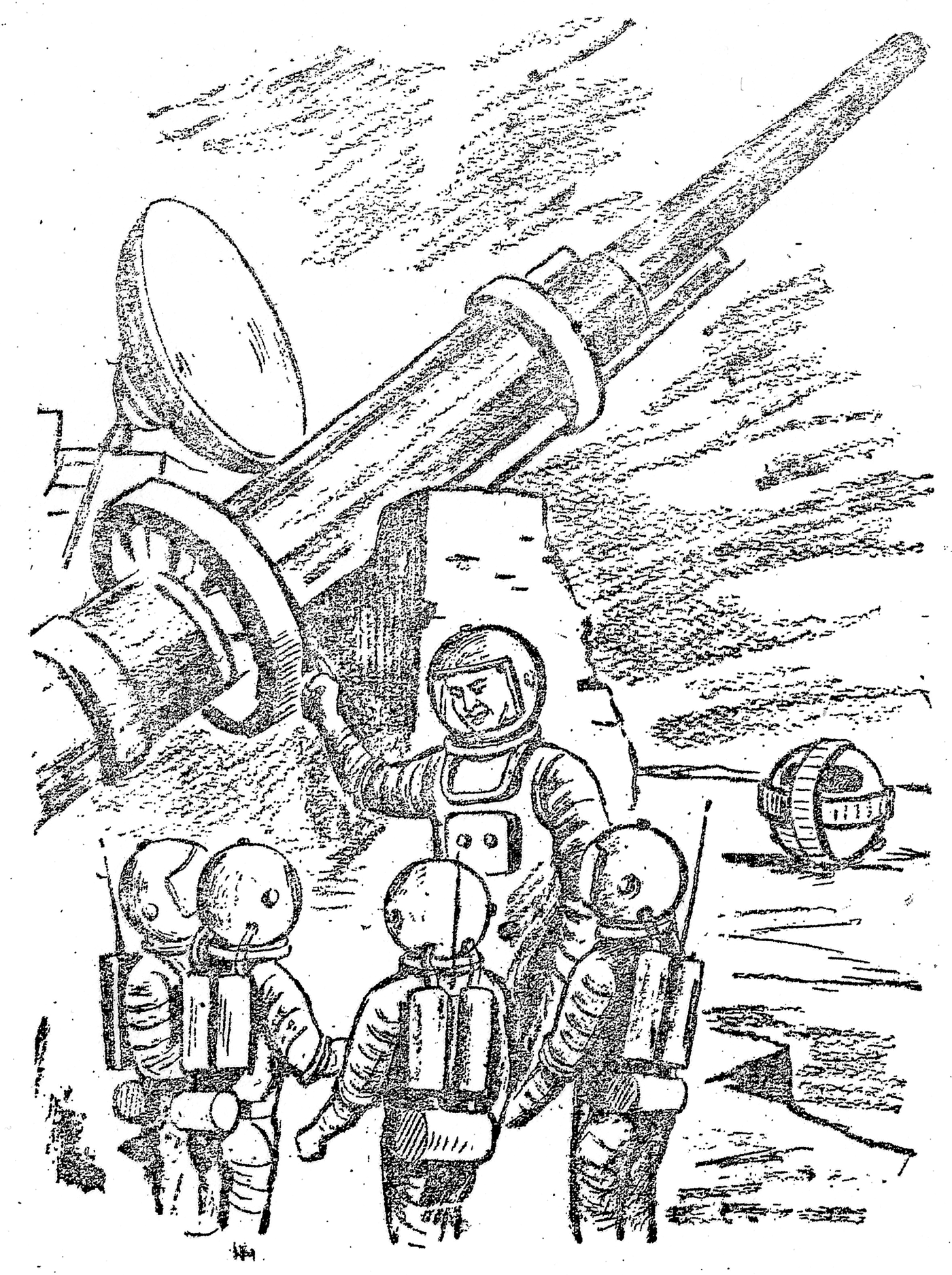
The circulation of Soviet literature in the communist bloc and its influence on children's literature of the DPRK is evident particularly in the science fiction narratives published in North Korea from the mid-1950s until 1965.Footnote 5 This presence is evident both textually and visually, as demonstrated by the fact that images of the helmet in the Soviet film Kosmicheskiy reys from 1936 and images of space travelers from the Soviet magazine Pioner (1954) bear a resemblance to the North Korean image from 1960 (see figure 1) and the image of Yuri Gagarin from the Soviet magazine Znanie-sila (Knowledge and strength) from May 1961.Footnote 6
North Korean pioneers on Mars. From Adong munhak (1960, no. 5), p. 98.

The wide circulation of space travel images was, of course, not incidental: with the successful Soviet launch of Sputnik in 1957, space had become a focal point of identification for Soviet society in general and for young Russians in particular (Gerovich Reference Gerovitch, Andres and Siddiqui2011a, Reference Gerovitch2011b; Major Reference Major2003). Space travel acquired transcendental, utopian connotations, and by the mid-1960s youth “did not dream of becoming doctors and lawyers, but cosmonauts” (Sylvester Reference Sylvester and Maurer2011, 121; see also Banerjee Reference Banerjee, Balina and Rudova2008, 69; Rüthers Reference Rüthers and Maurer2011, 207). Tropes of space adventure and exploration fueled technical and scientific magazines, and catered to the special technical schools that served the space program. These tropes also flourished in the literary and visual materials produced for young readers that reported not only facts and data but also speculated about the possibilities of life on other planets (Rüthers Reference Rüthers and Maurer2011, 206–10). The spread of images was not meant only for internal consumption: for the Soviet Union, the cosmic fever “was also used to strengthen the alleged friendship between socialist countries and to ensure the leading position of the Soviet Union” (217). Soviet images of space travel resonated throughout East Germany, Poland, Romania, Hungary, the Czech Republic, and China, emphasizing the internationalist nature of socialism and setting it in opposition with the Cold War “free world.”
The first appearance of science fiction in the history of the children's magazine Adong munhak came in April 1956 with a short story titled “Uridŭl ŭn hwasŏng e watta” (We landed on Mars), translated by Song Tong Kyu from Boris Lyapunov's original and illustrated by Ŏ Sun U (whose illustrations bear a striking resemblance to Soviet science fiction magazine illustrations from the same period, as in the aforementioned magazine Pioner). Set in 1995, it recounts the arrival of a team of explorers on Mars. They know of its thousand canals, its breathable air, and its drinkable water, but the team discovers that the gravity of Mars is weaker, its trees are blue, its sky is dark blue bordering on purple, and it has two moons; also, canals provide evidence that life had once existed there. Tension in the story is created when communication with Earth is briefly cut off, but the team eventually returns home safely.
“We landed on Mars” was the only translation of science fiction to appear in Adong munhak. This story was followed, almost every month, with original science fiction prose, poetry, theater scripts, and nonfiction. Like their counterparts in the Soviet bloc, these narratives resounded with a passionate cry for the mastery of a brutal, untamed environment, as well as an enthusiastic embrace of technology and science—an enthusiasm that emerged in this period as a part of the global Cold War discourse and cult of technology embraced on both sides of the Iron Curtain. Just as Stalin's engineering projects were undertaken like military campaigns in which nature was the enemy, the struggle between communism and Western imperialism was articulated as one between rational man and nature. Graham (Reference Graham1993, 62) notes that Stalin's favorite books before the revolution were books of science fiction that depicted amazing feats of engineering accomplished through the manipulation of traitorous engineers, the underlying impression being that engineers were the key to unlocking the secrets of nature but were not to be trusted. This framing of the Cold War struggle was conducive to the dramatization of scientific fiction for young readers.
Correcting Nature's Mistakes
Issues of technology, science, planetary exploration, and mastery of the environment fell neatly within the sphere of imaginative literature because they were entertaining, informative, and conducive to disseminating revolutionary ideology. As McCannon (Reference McCannon2001, 155) explains, “[Soviet] children's authors embraced science and technology as symbols and subject matter, portraying them as forces that would enable the USSR to create the world's greatest industrial economy, the world's most equitable social order, even the world's highest class of human being—in short, as the tools with which Soviet utopia was to be built.” From its inception, the leaders of the Soviet Union subscribed to the belief that technology and science were the undisputed keys to knowledge that was central to the struggle for hegemonic domination in the new Cold War order.
Imaginative and fantastical literature had been endorsed publicly by the Soviet writer Samuil Marshak in a speech at the First Congress of Soviet Writers in 1934. There, Marshak insisted that “children's books must be handsomely produced and look inviting, and their contents must not be dry and dreary,” and that “it is essential not only to register things … but to invent and imagine them” (Kelly Reference Kelly2007, 99). Gorki insisted that adding “a healthy dose of excitement and heroism to art that was also ideological” would make its message more appealing (McCannon Reference McCannon2001, 165). Marshak and Gorki's fiction and biographies were translated into Korean by Paek Sŏk and published in Adong munhak (Paek Reference Paek1956a, Reference Paek1957). Paek, who spoke against the overt didacticism and politicization of North Korean children's literature and poetry in particular, admired Marshak for his lyricism that was, he argued, at once spiritual and concrete.
Of course, the cult of technology and science did not gain favor exclusively in the Soviet bloc. Krige (Reference Krige2006a, 3) notes that “science was embedded in, and instrumentalized for, the projection of American power in postwar continental Europe,” and he explains that the restructuring and rebuilding of European science by the United States in the postwar period must be viewed as part of the US engagement in a hegemonic project that was facilitated by its tremendous political power and economic and technological advantages. For the US State Department, Krige notes, science “had become a significant component of foreign policy” (35) as captured by the term “atoms for peace”—a term chosen deliberately as a “direct challenge to the Soviets’ near monopoly of ‘peace’ propaganda” and as a way for the United States to “go on the moral and ideological offensive against the Communists” (Krige Reference Krige2006b, 162). Science and technology were adapted in entertaining and informative modes of storytelling for young readers, and became tools in the struggle for legitimacy between the political systems of the Soviet Union and the United States.
Yet while the purpose of prioritizing science and technology was to achieve ideological, political, and economic superiority in the new Cold War order, science, as Pepper (Reference Pepper1996, 6–7) explains, is always “at the center of social constructions of nature,” and is imagined to be a leading source of authority of “truth” about the natural world. And indeed, one of the modes of expression of the role of science and technology in the new world order was the relocation of the environment—nature, climate, and the unexplored frontiers of the deep sea and outer space—as the target of reform. Mao, with his famous mantra, ren ding sheng tian (人定勝天) or “man must conquer nature,” framed the transformation of the natural environment as a war: Maoist ideology pitted the people against the environment since “the State's battle against individualism, feudalism, capitalism, and revisionism was also a battle against nature” (Shapiro Reference Shapiro2001, 3). In the Soviet Union, this was represented by Stalin's slogan, “Man, in transforming nature, transforms himself” (Husband Reference Husband2006, 301), and, as Husband points out, the expression ‘correcting nature's mistakes’ “emerged in the 1930s in propaganda that promoted the Great Transformation of Nature, the Party's campaign to create a planned, improved environment” (315).
Under Stalin, then, the Soviet Union's scientific, materialistic worldview—which also saw nature as lacking an intrinsic value beyond what could be exploited by humans, and that predicated the development of the superior human on the transformation of nature—was disseminated also in literature for children. Children's literature was, as Kelly (Reference Kelly2007, 102) explains, “a version of Socialist realism writ small … supposed to deal (in a manner suited to the child's mentality) with the themes of socialist production, revolutionary history, and scientific progress.” Among the many images that circulated was that of Stalin as the chief warrior, who oversaw the project of nature “being conquered and transformed to the benefit of the socialist motherland” (121).
As noted above, the Soviet-Stalinist cultural decrees of the 1930s had a direct influence on the emergent North Korean literary field, which embraced the virtually interchangeable perspectives of didacticism, ethnocentrism, populism, and party control (David-West Reference David-West2007b, 103). With this embrace came also the prevalent view of the environment as a wild, irrational space that must be controlled. And nothing spoke more of the conquest of nature than raising the ocean floor, and no mastery of the universe was more clearly articulated than through adventures into outer space—both scenarios that figured centrally in North Korean science fiction. These works of fiction took the young reader from the depths of the sea to the far corners of the solar system, and were set in the socialist utopias of a not-so-distant future. They celebrated young, courageous, diligent, scientifically minded, and inquisitive boys and girls of North Korea who (often with Soviet guidance) thwarted evil plans devised by American imperialists or, more frequently, were charged with the task of conquering hostile, wild terrain and bridling those valuable sources—oil, water, and nuclear power—that would have otherwise gone to waste. They cited an abundance of scientific measurements and jargon, intending not merely to delight but also to inform their young readers and underscore the crucial role played by scientific knowledge for the survival of the North Korean state.Footnote 7
At the same time, science fiction narratives responded to the larger debates raging between writers of children's fiction about the desirable direction of North Korean literature. Specifically, science fiction narratives were sites of intervention for writers faced with this most central of concerns: how does one depict reality in a way that expands and cultivates the imagination of young readers, and still remain loyal to clear ideological lines? How does one expound on the necessary qualities of the scientist—daring experimentation, pushing acceptable boundaries, challenging common knowledge—while never stepping beyond the demand for the absolutely authority of the state?
Depicting the Real, Imagining the Fantastic
Five months after the beginning of the armistice of the Korean War, Kim Myŏng Su, a literary critic and member of the North Korean Federation of Writers, published an essay on children's literature in which he declared as follows:
The task of correct cultivation of our children demands that we create a prosperous future for our nation and secure the happiness and freedom of our people. It is precisely children's literature that is the national force that must play a key role in fulfilling the glorious responsibility of this task. (Kim Myŏng Su 1953, 97)
Kim Myŏng Su went on to cite Gorki, Marshak, Mayakovski, and Tolstoi as models of emulation. Yet while he praised the Soviet models, Kim and his contemporary writers and critics voiced concerns about the particular development of North Korean children's literature with regard to its use of age-appropriate language, its literary quality, its status in the literary establishment, and its future trajectory. Such concerns about literature for children were not new: conversations had begun in the colonial period among proletarian writers, such as Song Yŏng, Im Hwa, Pak Se-yŏng, Paek Sŏk, Yi T'ae-jun, and Yi Wŏn-u (Ri Wŏn U), and were published, among other places, in the colonial-period children's magazines Pyŏllara and Sinsonyŏn. Song Yŏng, for example, took an interest in writing for children as early as 1923, around the same time as the appearance of the serial publication of the children's magazine Ŏrini, and published his first children's story in the magazine Yŏmgun (Wŏn Reference Wŏn2012, 20). One of the earliest organizations formed after liberation, the Chosŏn Munhak Kŏnsŏl Ponbu (Construction HQ of Chosŏn Literature), boasted of members dedicated to children's literature of the likes of the poet Chŏng Chi-yong, the fiction writer Yi T'ae-jun, and Im Hwa, who took charge of children's theater scripts (36–37). Kim Nam-ch’ŏn, another pillar of the leftist writers’ organization in the colonial period, famously stated during the first meeting of the Construction HQ of Chosŏn Literature in November 1945 that literature must “cultivate children through precise knowledge, new experiences, and a proper sense of heroism, and develop and foster children's creativity so that they can hoist the new Chosŏn on their shoulders and carry it into the future” (37). Kim Nam-ch’ŏn also accused bourgeois children's literature of indulging in anti-scientific stories that needed to be replaced with correct scientific language.
These statements reflect the degree to which the post-liberation debates struggled to define the particular form and function of realism, and the critical role that scientific imagination could and should play in literature for children. Realism, of course, was the guiding force of narrative in Korean fiction already at the turn of the century, and was theorized into a scientific narrative methodology by early colonial writers and by the proletarian intellectuals and semi-affiliated writers under the influences of contemporary socialist literary doctrines (see Kim and Yang Reference Kim and Yang2006; Park Reference Park2006).Footnote 8 In the 1920s, concerns had shifted toward representation of social and material reality of colonial Korea in order to expose “the exploitative colonial social order, which the colonizer veiled by the rhetoric of gradual reform” (Park Reference Park2006, 186). The term hyŏnsil, or reality, was at the center of these literary and visual debates, and it embodied the perceived need to awaken the readers and viewers to the Real as a critical step in their true understanding of the mechanics of power and class, since resistance and counter-narrative could only be enabled with a true appreciation of reality.Footnote 9
Three keywords persist in the critical writing about children's literature in the early 1950s: reality (hyŏnsil), imagination/fantasy (hwansang/kongsang), and science (kwahak). The general agreement among critics writing about children's literature was that realism—which involved, among other narrative techniques, the correct depiction of the social mechanisms of good and evil—must be the goal, and that the raw material must be drawn from children's real, lived experiences (Kim Myŏng Su 1953, 104). Chang Hyŏng Chun (1958, 279) insisted that creative writing for children must avoid at all costs any sentimental and unrealistic (pihyŏnsilchŏk) depictions, and that its effectiveness lay also in the ability of fiction to imitate the real speech of the people and offer solutions to realistic (hyŏnsilchŏk) problems. Kim Myŏng Su (1955, 403–5) cited Ri Wŏn U as the most successful at capturing colloquial language that strengthened the presence of the people's character (inminsŏng) in fiction for children. In his book-length work on children's literature from 1956 (Adong munhak ch'angjak ŭi kil [The path to creative writing for children]), Ri insisted that the material of literature must come from children's lives, but must be adjusted to their different stages of development. According to Ri, the way to tap into appropriate material for children's literature was through kwanch'al—scientifically objective observation.
The word “science” appeared frequently as a part of the discourse that was attempting to redraw the limits, functions, and possibilities of literature for children. Science began to appear as an independent genre in children's magazines in the late 1940s: the magazine Sonyŏndan (Children's group), published in North Korea, for example, included a science section in its monthly issues starting in 1949 (Wŏn Reference Wŏn2012, 101). In 1954, writers and critics compiled a short document of nine points in which they elucidated their concerns, and noted the lack of literature that could cultivate and enhance children's knowledge of science (Chosŏn munhak 1954, 146). In other published documents, Han Sŏr Ya demanded that the material of children's literature go beyond the narrow limits of school life to include “scientific fantasy” (Wŏn Reference Wŏn2012, 197); Han Sik called for the best literary minds to join the ranks of children's literature writers, emphasizing the need for the creation of scientific reading material (78); and Kim Myŏng Su (1955, 372–73) praised short fiction that featured scientific investigation. Science, then, was not just a means of enriching the storytelling for the sake of amusement but an end in itself and an essential tool for the development of the nation—and literature for children was to facilitate its consumption.
At the same time, writers warned against allowing scientific jargon to overpower children's literature and deplete its entertaining qualities. The most outspoken critic of the increasingly politicized and didactic content of children's literature was the renowned poet Paek Sŏk. He spoke of the importance of cultivating children's imagination, and he insisted that reality, while undoubtedly the most important element of poetry and fiction, can still exist in abstract forms. Paek (Reference Paek1956b, 55) argued that children needed humor, which would draw children's passions to nature and the environment, and that they also needed romantic and adventurous literature, including literature about outer space. Paek (Reference Paek1956c, 120) was particularly passionate about the depiction of nature in poetry for children, and expressed his belief in the ability of nature to facilitate an understanding of the material world. Others, too, demanded that a balance be struck between science and fantasy: “Children's dreams must be driven by science … but the attempt to curtail the fantasy and imagination that is the organizing force of their dreams is as foolish an endeavor as blocking the pulse of development of their hopes for the future,” warned Han Sik (Wŏn Reference Wŏn2012, 81). Chang (1958, 330) lamented that, while fantasy is the life force of children's fiction, many writers have a poor opinion of fantasy and mistakenly believe that children's fiction should be driven by science, not imagination. And Ri (Reference Ri1956) insisted that literature for children go a step beyond documentation, and achieve more than what mere photographs can achieve: literature must show children the world as it could be. “We must write stories that offer a view of the future that is scientifically imaginative,” he wrote. “For example, the discovery of new theories, scientists that unlock the secrets of our planet, and scientific research on the planets of the solar system and other planets in the universe must be the new foundations of fantasy” (115). Of course, Ri objected to fantasy that is born out of a writer's random whims: it must be based on lived experiences. “Scientific fantasy must be completely original,” he concluded, “because we are living in a new era of atomic energy use—an era of scientific revolution” (115–16).
As the summary of these critical essays on children's literature shows, the particular combination of fantasy and science was identified as most conducive to fulfilling the function of literature. Science fiction could provide children with the critical knowledge that would open their eyes to reality; it would provide children with sound, scientific information that would build those skills needed to develop their nation's resources; and it would entertain and please them, and give flight to their imagination so that they could realize that the glorious future, in its scientific sophistication, was already taking form in the present. A close reading of the science fiction from this period illuminates how these texts fulfilled their weighty calling, thereby contributing to the identification of North Korea's own privileged protagonists and burgeoning “red engineers.”Footnote 10
Science Fiction in Adong Munhak
Between the years 1956 and 1965, the magazine Adong munhak (Children's literature) published science fiction works that included one short story translated from Russian, one play, two essays, five poems, and nine works of fiction ranging from short stories to serialized novels published over a period of three to ten months. This body of work does not hold an exceptional place in the overall collection of postwar literature in North Korea; still, it stands out for the way in which it responded to the imperatives of literature, which was to provide a reflection of the real and cultivation of the imagination that many intellectuals agreed North Korean children needed most. These illustrated, futuristic pieces for the most part share four main characteristics. First, they established North Korea at the forefront of deep-sea and outer-space exploration in the international community. Second, they promoted scientific education by interjecting the texts with scientific jargon, numbers, and facts that enhanced the informative function of the text beyond its entertainment value. Third, they enforced political awareness by highlighting the American threat while cultivating socialist sensibilities through emphasis on the socialist/communist friendship. Last, they spoke of the urgent need to reform the environment for the development of alternate sources of energy and the conquering of other planets, and thus established the superiority of man over nature as a prerequisite for the fulfillment of utopia.
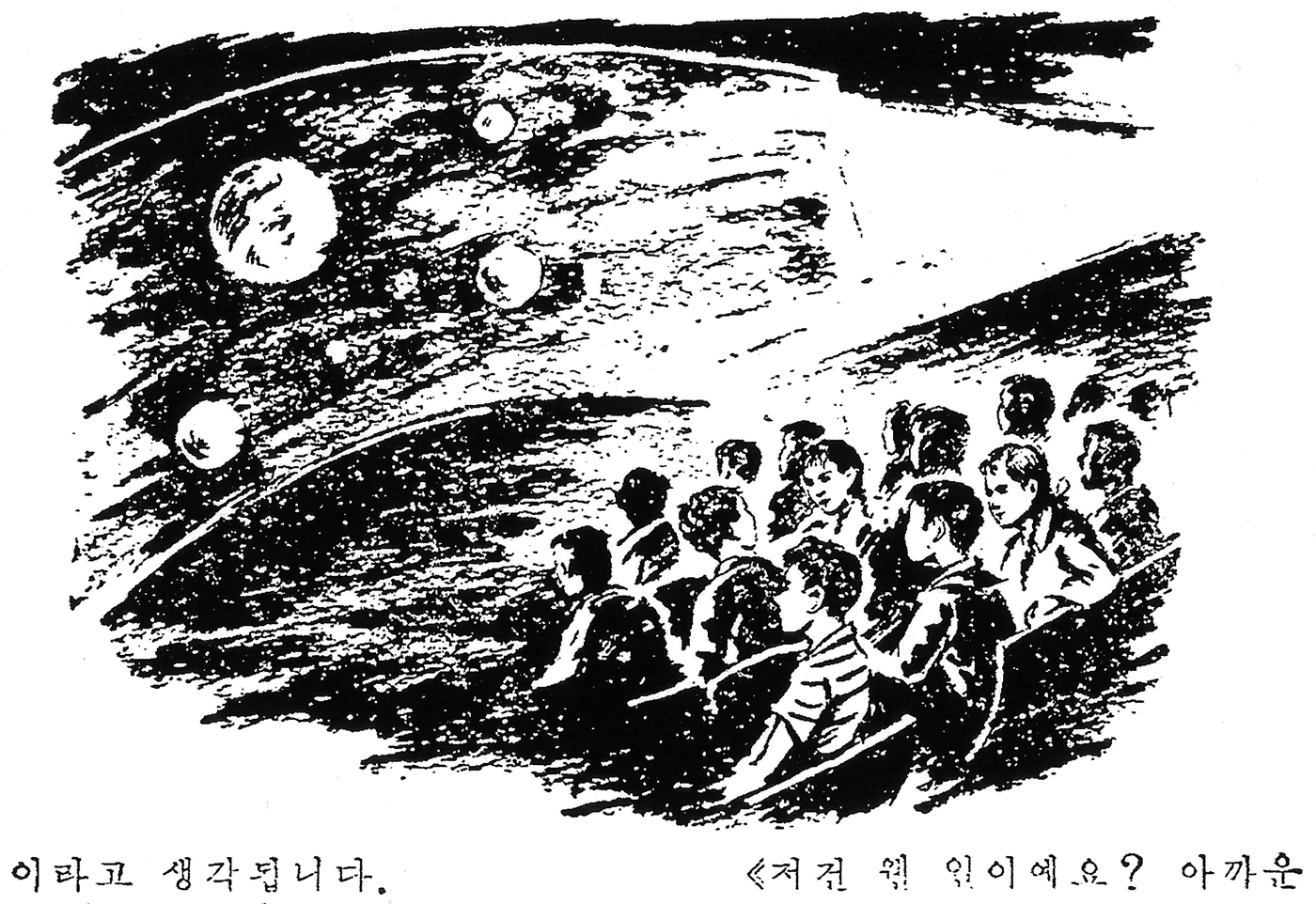
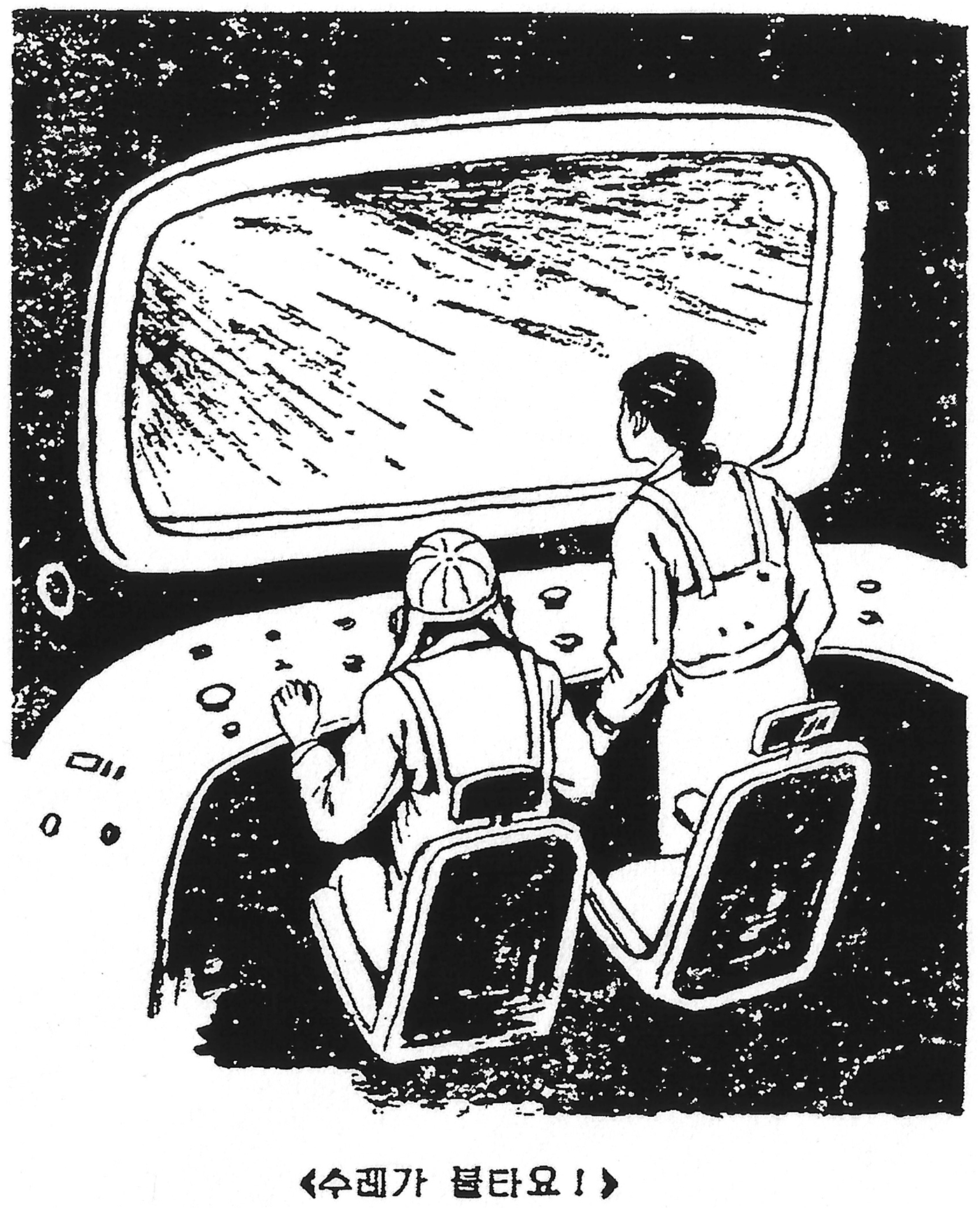
Two serialized novels published in the magazine, Sonyŏn uju t'amhŏmdae (Youth space expedition team, 1960) and Pada esŏ sosanan ttang (The land surging from the sea, 1964–65), both written by Kim Tong Sŏp and illustrated by Ŏ Sun U, are exemplary of these characteristics. Youth space expedition team recounts the adventures of an international team of children led by a North Korean boy. Together with children from Germany, Russia, Africa, Iraq, China, Poland, Hungary, Indonesia, Japan, and the United States, they travel to Mars with their Soviet mentor Kurbatov after stopping in Soviet space stations along the way. When the children land on the planet, the North Korean boy makes a momentous discovery: he finds a silent, three-dimensional film that holds the key to the mystery of the disappearance of the Martians. Titled Utopia (see figure 2), this documentary had been kept hidden in a gold crate by the Martians, and it details the circumstances that drove them to abandon their planet.
Watching “Utopia.” From Adong munhak (1960, no. 6), p. 103.
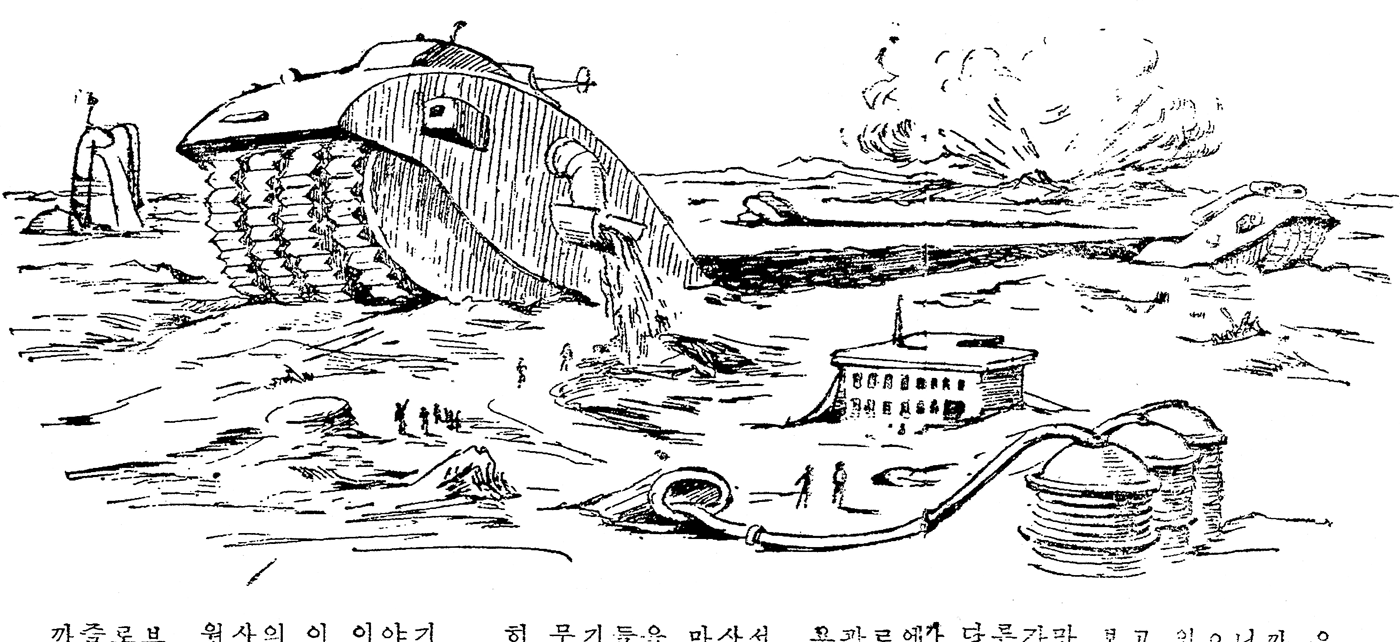
From this film, the children learn that Mars had developed an advanced, utopian society founded on a workers’ revolution that rid the planet of exploitation and violence: the film depicts Martians destroying their weapons or banishing them into outer space (to the horror of the American boys, who hate to see good weapons go to waste). The film further reveals that the Martians struggled with a growing lack of water supply. They had melted their ice poles and dug canals from the planet's northern pole to irrigate their land, and used atomic explosions to facilitate these changes and to obtain desperately needed water for agriculture (see figure 3). This process slowly transformed the landscape, making water even more scarce and the environment uninhabitable. While the children marvel at this feat, their instructor reminds them that similar efforts are underway on Earth, where a reformation of nature has brought about such good weather to Siberia and Korea that birds no longer need to migrate.
Melting the ice caps. From Adong munhak (1960, no. 7), pp. 92–93.
As the film plays on, however, the children learn that the Martians began to run short of not only water but also physical space and energy, having exhausted their sources of coal and oil. As a result, the Martians in the film debate solutions to the lack of sustainable energy: they try to create solar-powered machines and they consider the option of trading with other planets, but none of these solutions prove useful. As a final resort, they venture into outer space in search of a new habitable planet. Upon their return from this outer galactic exploration, the Martian explorers bring news of a “virgin land,” a wilderness waiting to be tamed. It has all the clean air, warm temperatures, and space the Martians need. While the older Martians argue in favor of staying on Mars, the younger Martians insist on a fresh start to provide the future generations with hope of survival. The Martians abandon their planet for this virgin land to implement five-year economic development plans. Watching the film, the children's curiosity about Mars is stoked, and they return to Earth and to their much-aged families with a renewed commitment to science.
The land surging from the sea recounts the adventures of a team of young nature explorers: a boy, Ch’ŏl Su, and a girl, Suk Hŭi. One day they stand overlooking the sea when it occurs to them that if the floor of the sea could be raised, it would increase the amount of tillable land and permit access to resources deep in the Earth. Their aspirations are affirmed by scientists on site, who demonstrate, through a film screening that has documented Earth's development since before the dinosaurs, that man can reform nature to suit his social and economic needs. The past is reconstructed in the film through sophisticated technological advances; but as one of the scientists explains, the future depends entirely on these two children. The purpose of science is explained to them as not just a means to understanding the natural world but as a way to develop tools to use that knowledge to reform nature for the benefit of mankind. In response to the children's ardent insistence, one of the scientists agrees to reveal to them a glimpse of the future, and his cigarette smoke envelops and transports them forward in time.
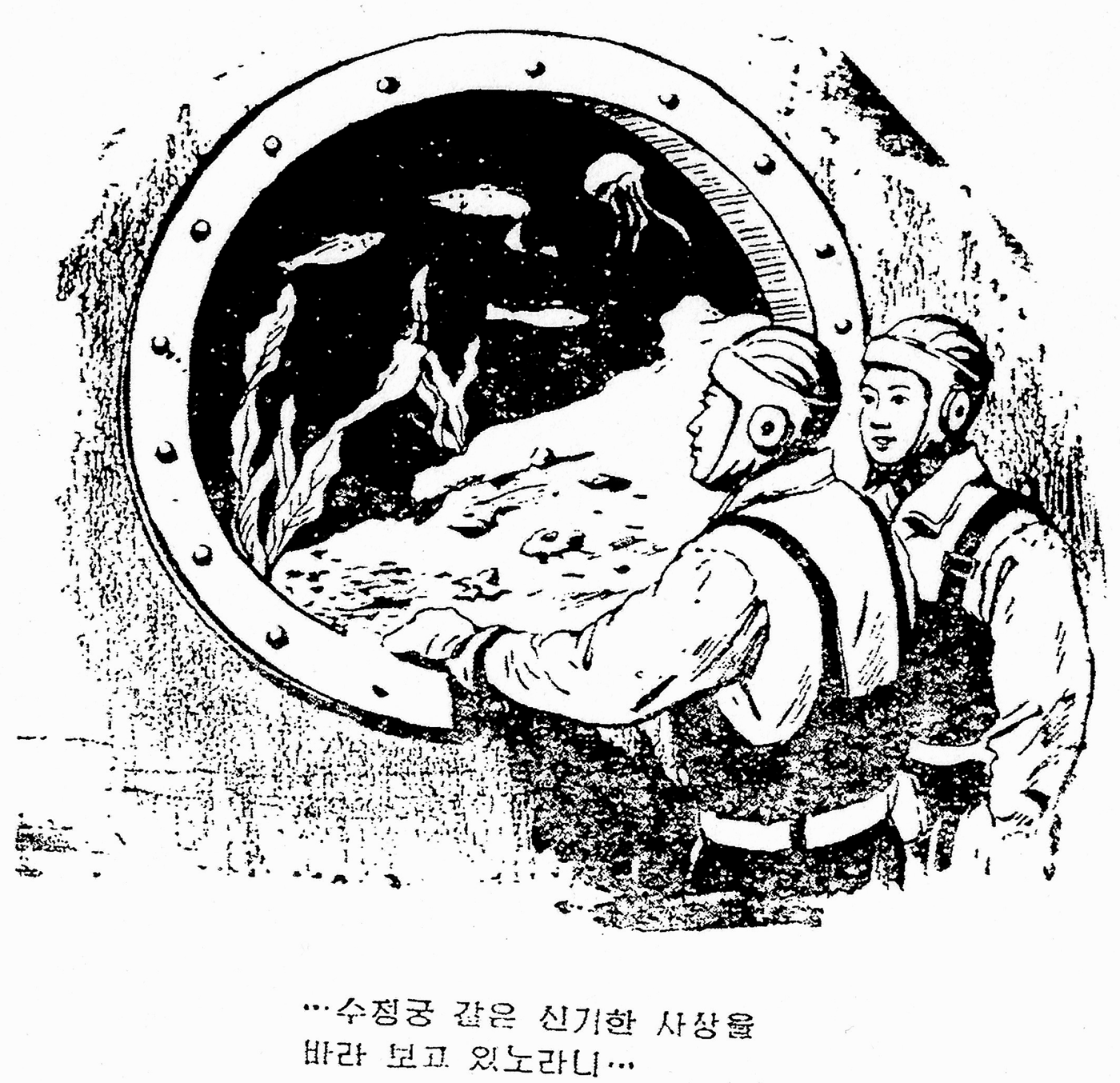
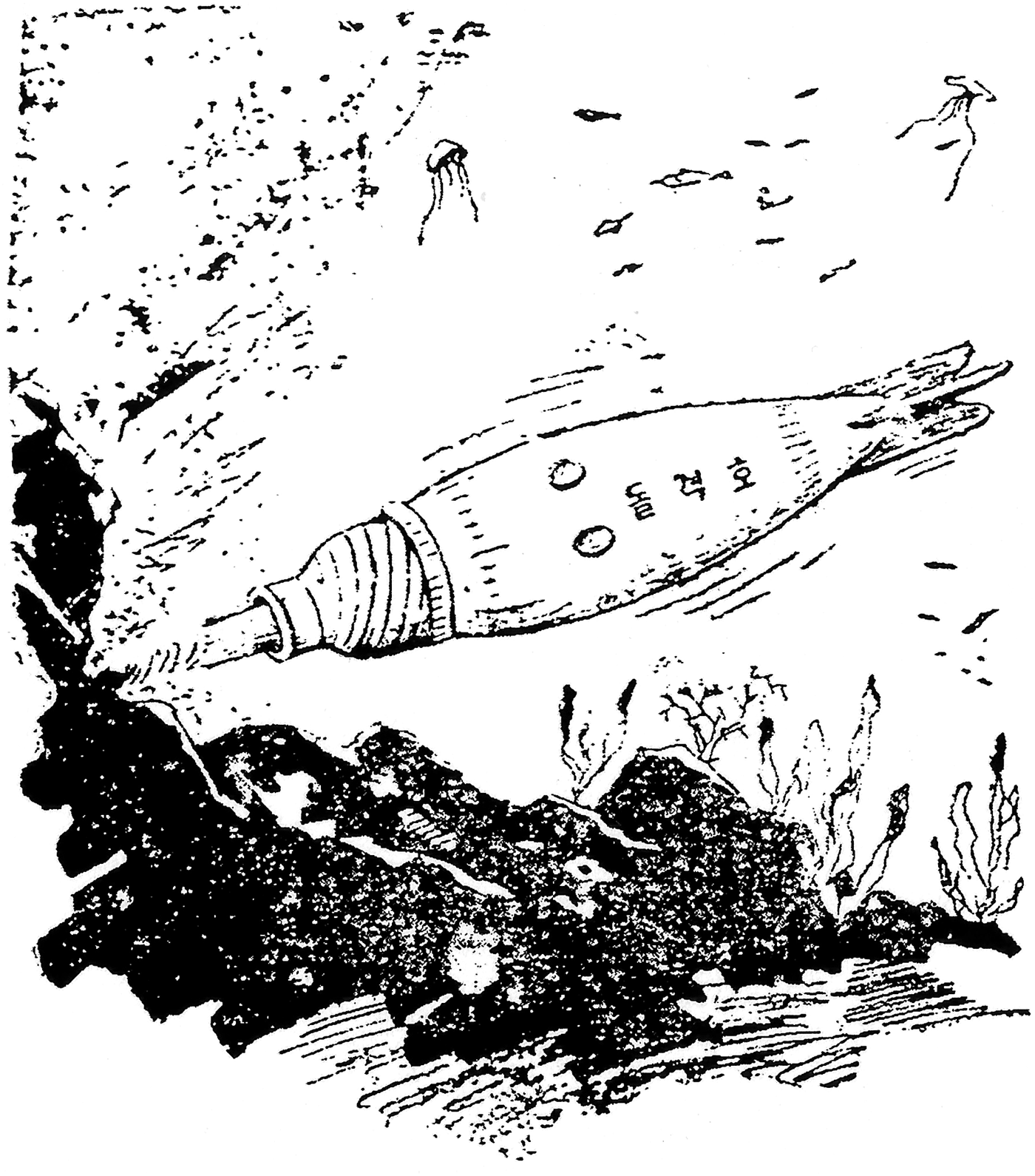
The children are then reintroduced as budding scientists committed to unlocking the secrets of the deep sea and using its pent-up energy for the benefit of the North Korean people. They travel to the ocean depths and find an endless supply of their favorite seafood delicacies (see figure 4), and they drill through granite to discover the existence of an abundance of minerals and oil (see figure 5).
Deep sea exploration. From Adong munhak (1964, no. 12), p. 66.
Deep sea drilling. From Adong munhak (1965, no. 1), p. 87.
At the same time, Ch’ŏl Su and Suk Hŭi are pursued by an American who attempts, and almost succeeds, to melt their ship (see figure 6), but his attack causes their ship to go off-course and they are dropped into unmarked territory. This misadventure is a turning point, for they discover a much-needed key component: atomic material with energy that can be manipulated to raise the ocean floor. The two create a new map of this unchartered terrain, and in the end of the novel they raise the land out of the sea, to the amazement of the throngs of young people who come to witness this miracle. The purpose of science is reaffirmed: it is the means of liberating man from the shackles of nature and conquering it for peaceful purposes, and for the benefit and happiness of all people.
American attack. From Adong munhak (1965, no. 3), p. 37.
In both of these novels, then, it is North Korea that marches at the forefront of deep-sea and galactic exploration. Of course, due respect is paid to Soviet science in all the science fiction pieces, such as in this poem, “Moon,” from 1958: “The wise Soviet scientists, our neighbors / Have paved our way to the universe. / O blessed children of our new world, our new country! / How delightful will it be to cross the sea of stars / How peaceful the Eden of laurel trees!” (Hŏ 1958). In Youth space expedition team, the adult roles are played by Russians: the Soviet instructors Kurbatov and Koslov deliver lectures on space exploration and the Martians; Blokhin is the pilot of their ship; and, upon their arrival at the Soviet space station, the international team of children are guided by young Soviet scientists Nina, Galina, Nikitin, and Natasha. However, it is the North Korean boy Yŏng Ch’ŏl who makes all the crucial observations: for example, he anticipates correctly the outer appearance of the Martians, and he makes the most important discovery in the novel—he locates the hidden Martian film, something that none of the Soviet scientists were ever able to do. The last of the science fiction pieces, The land surging from the sea, is staged in a post-unification era in which the American imperialists have been mostly marginalized, and demonstrates how, despite the attempts of an American and a few Korean traitors to derail their mission, North Korean science triumphs to the benefit of the entire world. North Korean superiority is also established in the various stories through naming of objects and mapping of regions that effectively tame these otherwise unmapped and unnamed objects.
The science fiction pieces published in Adong munhak include scientific jargon, numbers, and scientific facts to maintain an informative function. In Youth space expedition team, the Russian instructor Kurbatov provides the youth in space with a detailed account of the contributions of Giovanni Schiaparelli, Vasily Fesenkov, and Percival Lowell. Adults and children recite textbook facts: the Russian girl Vera explains that “Mars has only 1/6 of the volume of Earth, and only 1/3 of Earth's mass, so our bodies are roughly three times lighter out here,” and the Russian boy Andrei notes that
5/6 of Mars is covered by a reddish surface, and it is believed that this is similar to earth's surface. Second, Mars has been observed to have a dark blue zone, which scholars believe to be an ocean. Third, the planet has white spots on its poles that seem to grow during the winter and shrink in the summer. These have been identified as the planet's poles and are believed to be covered in snow, just like Earth. (Kim Tong Sŏp 1960, 4:80)
Adult scientists prompt the children to come up with questions and voice their observations, and share their knowledge with the children in order to educate them (and the readers) and whet their curiosity. Measurements are provided in detail: the frequency and distance with which Mars approaches the Earth; the precise amount of land that will be gained if the bottom of the sea is raised; the amount of time that it takes to travel from Sinŭiju to Pusan in a specially designed, gravity-pulled bullet train (forty-two minutes and twelve seconds) (Nam 1957); and the length of the day and the temperature on the Moon (fifteen days when the heat is between 100 and 120 degrees Celsius, followed by fifteen nights when the weather is −160 degrees Celsius) (Ch'a 1959). These numbers make the knowledge appear more concrete, and also contribute to the call among critics to ground imaginative works in real figures.
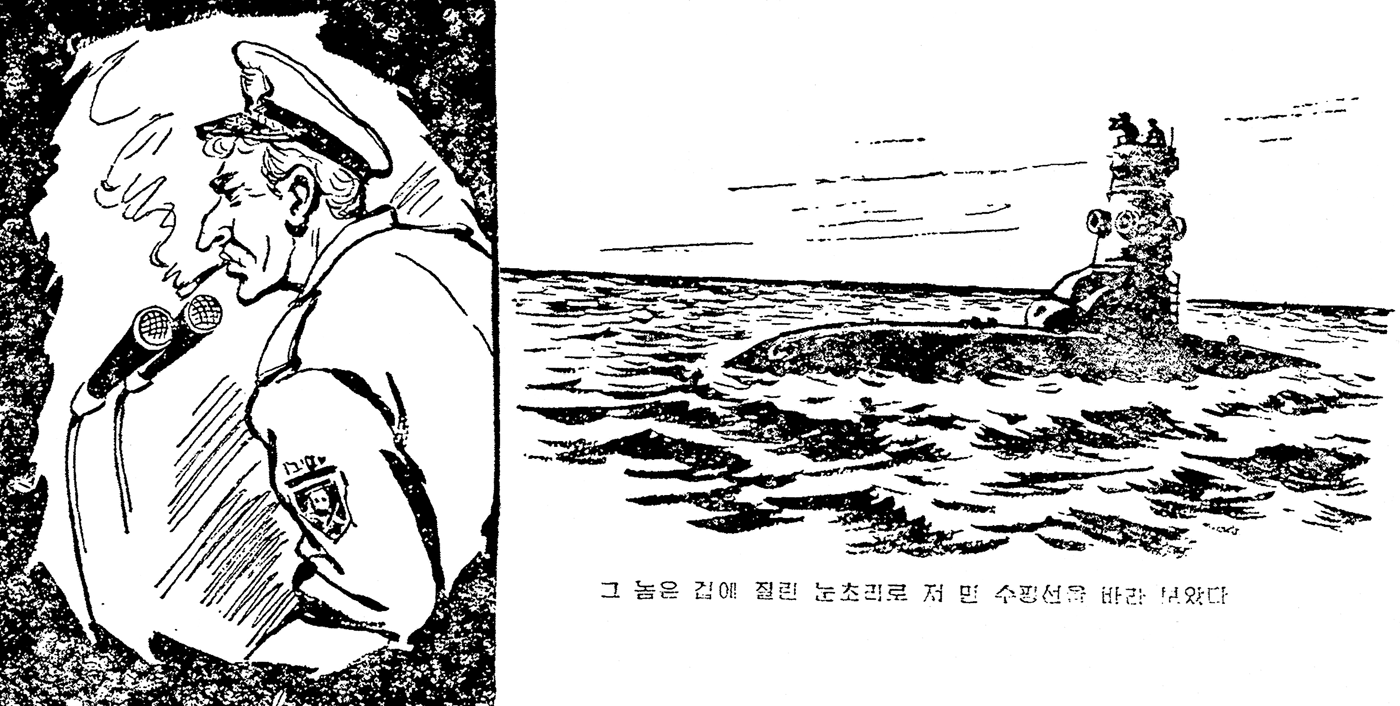
Not unlike most of postwar North Korean literature, science fiction narratives also comply with the imperative of enforcing a shared political understanding of the new world order of North Korea and its socialist allies against the United States. In Youth space expedition team, the represented countries give an indication of North Korea's geopolitical field of vision, with the majority of children coming from North Korea's political allies (and thus also providing an indication of the future world order) (Major Reference Major2003, 84). The Russians in particular are portrayed as well informed, disciplined, and always willing to share their scientific knowledge and guidance, thereby enforcing the depiction of kind guidance provided by the Soviet bloc in the North Korean imaginary. The American children, for their part, demonstrate such undesirable qualities as greed, laziness, and stupidity.Footnote 11 Brown and John, for example, are excited about the discovery of a golden crate in the Martian dungeon because of the possibility that it might make them rich. The American “Harry Man” in The land surging from the sea is a foul-mouthed, raspy-voiced, snake-eyed, gun-toting, morally deranged representative of the free world who pursues the children and tries to kill them in a submarine that looks as sinister as its captain (see figure 7).
Sinister American and his submarine. Left, from Adong munhak (1965, no. 3), p. 33; right, from Adong munhak (1964, no. 9), p. 67.
South Koreans are also featured in many of the works, mostly as spies. In the short story “King of rare metals” by Ch'a Yong Ku (1959), three boys travel to the Moon, where they discover a new mineral. This mineral provides energy more powerful than atomic fuel without emitting dangerous radiation; allows their ship to travel in the air, through water, and on land; and also makes their space suits indestructible. One of the boys, Pyŏng Nam, goes missing; he is found unconscious in a cave. Later, he recounts the actions that led to his collapse, and by doing so the children manage to reconstruct Pyŏng Nam's own father's death at the hands of an evil South Korean scientist who followed the young boy's father into the cave in order to harvest minerals powerful enough to cause a scientific revolution and also create weapons of mass destruction.
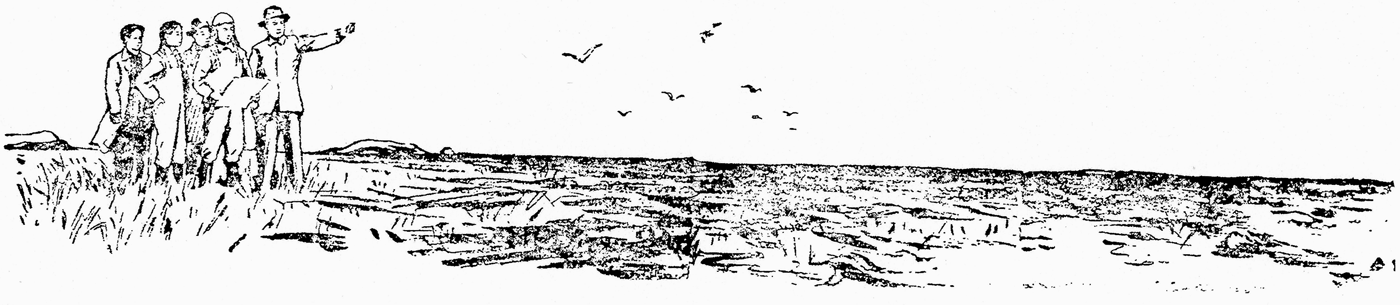
Last, North Korean science fiction fosters an urgent need for the great reform of nature (taejayŏn kaejo). This need is framed less as a desire for grandeur than as a practically motivated need to correct nature's mistakes. In Youth space expedition team, for example, nature is available for human (or alien) consumption, and must be manipulated to serve its inherent purpose: when water is scarce, the icebergs must be melted; when resources on Mars run low, a migration to the Virgin Land is the only obvious solution. Indeed, the Virgin Land is pristine, its trees drooping with fruit begging to be picked, and its free-flowing oil threatening drinkable water because there is no one on the planet to make use of it. The Virgin Land is teeming with magic beasts with no people to tame them. And while there is a nudge toward sustainability—after all, the source of the Martians’ plight lies in the abuse of Mars's resources—ultimately the solution is mastery of the environment. The terms “conquer” (chŏngbok) and “peace” (p'yŏnghwa) are used in one breath, in reference to the way in which the Russians have successfully harnessed nuclear power for the peaceful purposes of conquering outer space.Footnote 12 In “Sea grass of longevity” by Kim To Pin (1960), the young protagonist Yŏng Pok travels to the bottom of the sea to discover the properties of seaweed, which he names “longevity grass” for its properties, much to the gratitude of the undersea creatures that claim to have been incapable of naming it themselves. And in a grand gesture of human feat, The land surging from the sea ends with the successful effort to raise the bottom of the ocean and therefore exploit the resources of the ocean floor for much-needed agriculture (see figure 8).Footnote 13
Raising the bottom of the sea. From Adong munhak (1965, no. 4), pp. 76–77.
Countless spectators of all ages gather at the seaside to observe a phenomenon described as “a reform of the environment that neither the spirits or God could ever achieve” (Kim Tong Sŏp 1965, 4:74) The Earth groans in its ascent, the waves start to part, and finally, the bottom of the sea pokes out of the water. People cheer and rub their eyes in disbelief as the water clears way for the risen land. “The bottom of the sea, having never seen the light of the East Sea, is finally exposed… . It shines like a newborn's face peering upon the world for the first time, it wears the ashen countenance of those who have been oppressed their entire lives” (4:75) The bottom of the sea has been liberated from the oppression of nature. A scientist pronounces:
Some people may think that environmental reform is simply about eliminating the ocean in order to add a few more acres of land. Not only that, the few remaining imperialists dismiss our glorious victory with injurious slander. Of course, land is important. But this particular victory is about more than adding several tens of thousands of p'yŏng of land or harvesting a few thousand tons of ground.
This victory is precisely about liberating ourselves from the binds of nature, which have subordinated us from the beginning of time. We are boldly setting ourselves free and, in the manner that we deem right and for the sake of our freedom, we are mastering our world's history.
Of course people have dug large canals, built dams, and blocked off the sea. They also built artificial reservoirs and lakes. But these forms of struggle with nature came at a high cost of human sweat and blood.
We have uncovered the secrets of nature and manipulated nature's processes through the strength of science in a way that the magicians and brave men of the past could never have even dreamed of doing.
I believe that the day is near when not only our country but the entire world will be decorated in this glorious way. (4:77–78)
The political struggle for ideological hegemony is present in science fiction, but it is secondary to—indeed, it is dependent on—the more pressing project of environmental conquest and reformation. Political legitimacy is important, but even more so is the task of acquiring the knowledge needed to master the final frontiers of the deep sea and outer space. As these narratives demonstrate, mastery of untamed spaces will make the enemies of the DPRK redundant—perhaps useful for creating tension in a story or an amusing anecdote, but otherwise utterly superfluous.
The Child Scientist as the Protagonist of the Future
The science fiction narratives that were published in Adong munhak effectively responded to the demands made by poets, fiction writers, and cultural critics in the post-liberation discussion for the creation of appropriate reading material for North Korea's children. The most pressing concerns converged on the importance of drawing on the material of reality for fiction while cultivating the imagination. This would enable young readers not only to have a correct understanding of present reality—an understanding rooted in scientific facts—but also to be able to anticipate the impending and bright future, which was expected to be nothing less than idyllic. It was equally important to stage these narratives in the very near future—an aspect common to socialist realist science fiction, which insisted that utopian storytelling be “proximate rather than intangibly distant” (Major Reference Major2003, 85). By using familiar Korean landscapes as a backdrop and making use of scientific jargon, measurements, and commonplace names of famous scientists that circulated in the socialist/communist bloc, North Korean science fiction narratives immersed their readers in scientific readings and drew their attention to an imminent social and political utopia that was, as these stories implied, well under way.
There is, however, an inherent tension in the science fiction genre that requires resolution: the tension between scientific inquiry that demands constant dispute of axioms, and unquestioning adherence to authority.Footnote 14 Indeed, scholars have acknowledged the predisposition of the science fiction genre toward depicting alternative realities that might pose political, economic, or social challenges to the present. Science fiction was often a privileged site of social commentary, and it is precisely its potential for subversion that made it increasingly subjected to censorship with the rise of Stalinism. According to Major (Reference Major2003, 73), “science fiction in the Eastern bloc increasingly came to diverge from official prescriptions and to engage in a semi-detached critique of the regime.” Esler (Reference Esler2010, 48) argues that Soviet science fiction declined with the rise of Stalinism because the reductive pressures and oppressive aspects of Stalinism damaged the imaginative potential of the genre. And Csicsery-Ronay (Reference Csicsery-Ronay2004, 343) notes that in the period following the thaw in the mid-1950s, there were “very few cases [of] open attacks on the system or the ideals of Communism” in science fiction. And yet the science fiction narratives of North Korea were written precisely under the shadow of Stalinist-Zhdanovist cultural and literary models. In these narratives, young scientists are placed in situations where they are expected to push boundaries of accepted knowledge, defy caution, and, if necessary, disobey orders in order to arrive at scientific truth. For example, in The land surging from the sea, Ch’ŏl Su and Suk Hŭi travel to the bottom of the ocean with orders from their professor to investigate the sea floor. They are ordered not to seek adventure outside their mission, but they end up exploring unmarked territory and making a momentous discovery. Ch’ŏl Su remarks on the good luck of having stumbled upon this new site, for otherwise his results would have been inaccurate, and the two young scientists reiterate the importance of not being complacent and pursuing experiments in a rigorous and consistent manner. Another example is that the Martian film in Youth space expedition team is silent; the children viewing the film must come to their own conclusions about what they see based on knowledge that is mediated by their Russian instructor. But, being the good pedagogue, he does not provide the children with answers. Instead, he insists that the children examine their conclusions and methodology, and demands that they meditate upon the limits of their knowledge. He recalls the story of the blind men and the elephant—each man gropes at a different part of the beast and comes to a different conclusion about its appearance. The instructor then offers his own doubts about the extents of knowledge and the theoretical impossibility of knowing truth.
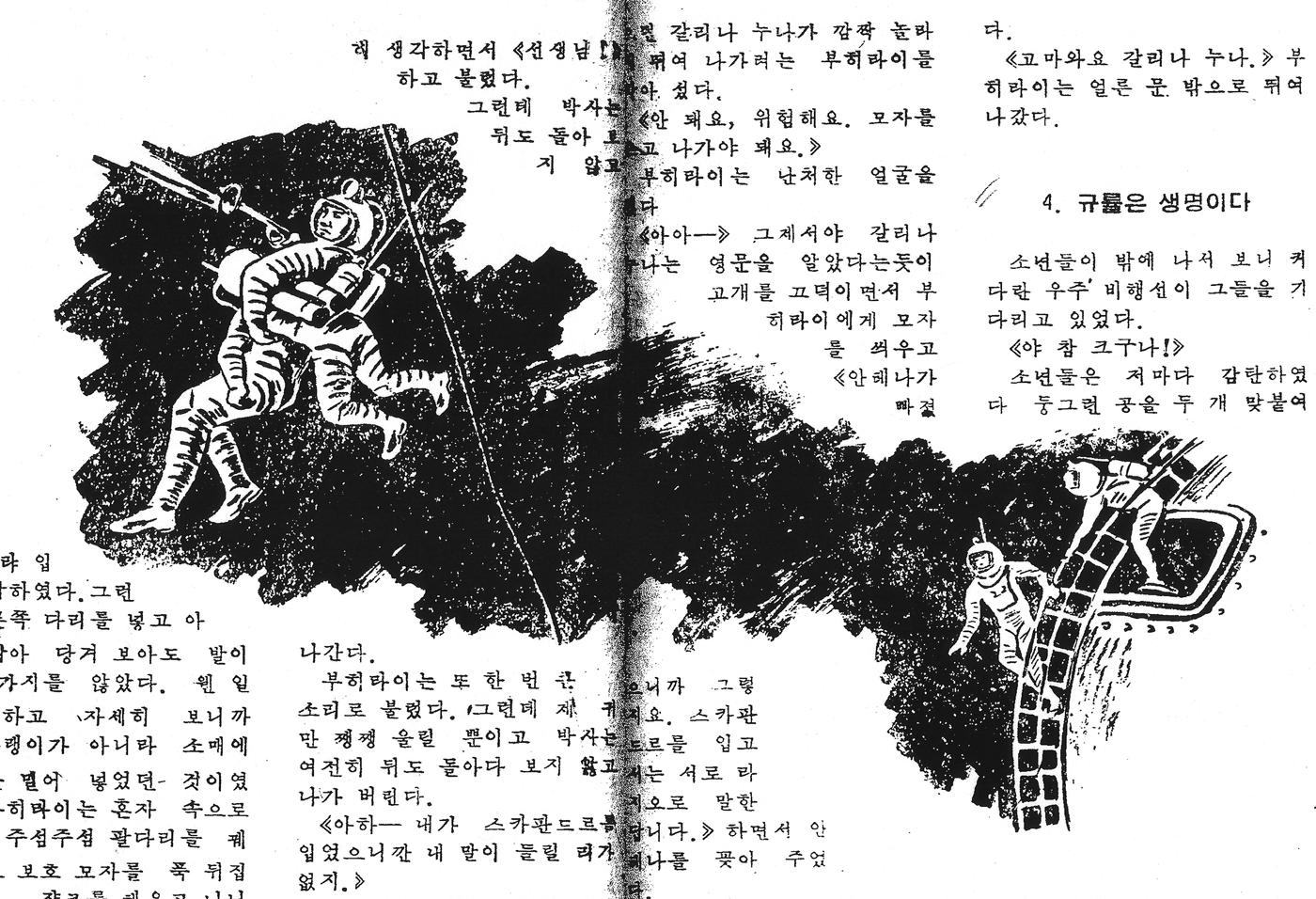
This tension, however, had been dealt with in the science fiction of the communist bloc: in Soviet fiction, Major (Reference Major2003, 85) explains, “Marxism-Leninism and dialectical materialism … posed another series of constraints on the communist SF imagination. The laws of historical development had to prevail; human agency could not play an overdetermining role.” And indeed, in the above-mentioned scene in The land surging from the sea, the children reach unmarked depths in violation of their orders, but they do so not out of their own volition but as an unintentional result of their ambush by the American enemy. Above all, a distinction is made between violation of rules for the purpose of scientific investigation that will benefit the collective, and violation for selfish purposes. For example, in Youth space expedition team, the American, John, tries to cut through a queue of children climbing into the space station, out of disrespect for rules, and ends up floating into space. He is saved by the Russian instructor, who had expected as much from the American boy (see figure 9). Reflecting on this incident, the children conclude that John disobeyed the rules because he suffers from liberal influence, thus asserting the superiority of collectivism.
The rogue American is saved. From Adong munhak (1960, no. 3), pp. 48–49.
The young scientist Ch’ŏl Su in The land surging from the sea, whose underwater research results in the mapping of new underground territories rich in untapped resources, expresses the realization that he, as an individual, is only as strong as the collective that supports him:
In the past, when my scientific experiments failed, I hesitated, doubting my strength. Now I see now that strength is not determined by the passion and talents of a few individuals, but in the strength of the collective. Because the boundless desires of our people form an internal support, I realize that no difficult or significant obstacle can stand in our way. (Kim Tong Sŏp 1965, 3:44).
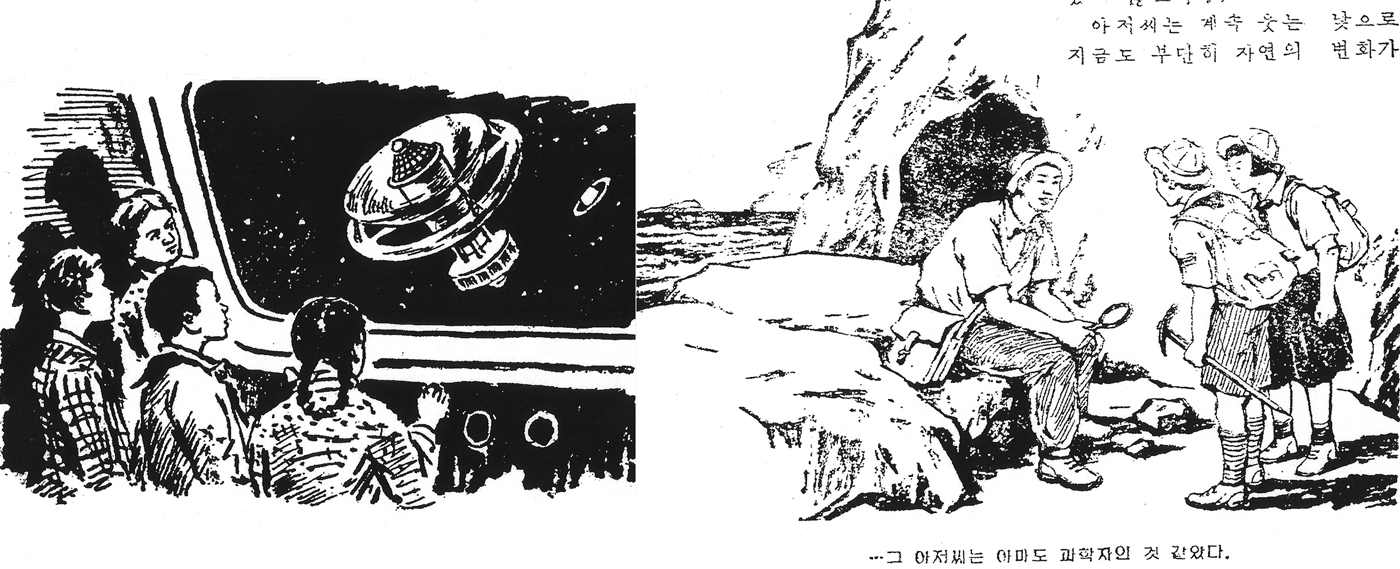
These narratives, then, resolve the tension between the need for boundary-breaking individualism demanded by scientific innovation and absolute ideological obedience demanded by the authorities by establishing the importance of individual research for the benefit of the collective. And the agents that are to carry out this critical function are the (mostly male) North Korean youth. The archetypical child that emerges from the science fiction narratives of North Korea is the bright student and excelling scientist; the child whose interest lies in that of the group rather than that of his own; the child who is adventurous and fearless; and the child who maintains, always, a posture of loyalty and admiration for the father figure and for the nation in general. As David-West (Reference David-West2011) demonstrates, if North Korean literature is to be read as a continuation of politics by other means, then the archetypical child that emerges in these narratives provides the characteristics of the desirable hero that children should seek to emulate.Footnote 15 On the whole, a preference is given to the male child, but he is surrounded by resilient girls who are almost their male counterparts’ equal—but not quite. Not a single piece of fiction or play features a girl as the dominant protagonist; in The land surging from the sea, in which male Ch’ŏl Su and female Suk Hŭi work as a team, most of the important discoveries are initiated by Chŏl Su. Still, the young women on the expedition to Mars and to the deep sea are bright, adventurous, and diligent, and in most illustrations they are barely distinguishable from the boys (see figure 10).
Girl scientists. Left, from Adong munhak (1964, no. 6), p. 10; right, from Adong munhak (1960, no. 3), p. 44.
The eighteen works of science fiction that appeared in the children's magazine Adong munhak between the years 1956 and 1965 point to scientific technological advances as the driving force of the future. These advances are meant to facilitate the freeing of man from the shackles of nature so that the individual members of the socialist community—acting on behalf of the collective—can realize their full potential. Utopia, as these pieces show, is imminent: in these pieces, many of which are staged ten or twenty years into the future, Korea has already been unified, and the imperialist American threat provides little more than narrative tension or comic relief. The agents of the scientifically driven advances are North Korea's youth. They take the center stage less because the adults around them are incompetent—in fact, a benevolent male father figure or instructor is always present. Rather, these children model the inquisitiveness, intelligence, proper social attitudes, and indefatigable spirit that the young readers of the magazine Adong munhak would surely be encouraged to emulate.
Acknowledgment
Research for this article was conducted at the Library of Congress and was facilitated by the staff of the Asian Reading Room.