Introduction
Medicinal plants are used to cure several diseases, including infertility problems (Tsobou et al., Reference Tsobou, Mapongmetsem and Van Damme2016). Some plants are rich in compounds that exhibit regulatory effects on reproductive function, acting directly or indirectly on the hypothalamic–pituitary–ovarian axis by induction or inhibition of ovarian activity (Telefo et al., Reference Telefo, Moundipa, Tchana, Tchouanguep and Mbiapo1998). Therefore, their use can bring direct answers to some health problems such as reproductive disorders (Mbemya et al., Reference Mbemya, Guerreiro, Donfack, Silva, Vieira, Sousa, Alves, Izaguirry, Santos, Telefo, Pessoa, Johan, Figueiredo and Rodrigues2017). The use of medicinal plants such as E. speciosa in response to reproductive problems can be seen as an alternative to manufactured drugs, especially in developing countries in which they are expensive and/or inaccessible (Rates, Reference Rates2001).
E. speciosa is a medicinal plant used in Cameroon to normalize the menstrual cycle, cure female infertility, dysentery, anaemia, haemorrhoids and urinary tract infection (Oben et al., Reference Oben, Assi, Agbor and Musoro2006). Phytochemical analysis of aqueous extract from leaves suggests the presence of alkaloids, flavonoids, saponins and tannins (Tagne et al., Reference Tagne, Telefo, Njina, Bala, Goka, Yemele, Lienou, Mbemya, Donfack, Kamdje and Moundipa2014). These metabolites could present significant important antioxidant activities important for the regulation of the female reproductive activity. In vivo, this activity is often evaluated on reproductive organs of immature female rats (16–23 days) that have long been used as a model system for studying effects of pharmacological compounds (Tohei et al., Reference Tohei, Sakamoto and Kogo2000) and medicinal plants (Lienou et al., Reference Lienou, Telefo, Bale, Yemele, Tagne, Goka, Lemfack, Mouokeu and Moundipa2012; Goka et al., Reference Goka, Telefo, Mbemya, Awouafack, Lienou, Yemele, Njina, Donfack, Tagne and Fekam2016) on ovarian folliculogenesis. In vitro activity, conversely, has been assessed through activation and development of ovarian preantral follicles using diverse medicinal plants such as Justicia insularis (Mbemya et al., 2017; Reference Mbemya, Cadenas, Ribeiro de Sá, Damasceno Guerreiro, Donfack, Alberto Vieira, Canafístula de Sousa, Geraldo Alves, Lobo, Santos, Lima Pinto, Loiola Pessoa, Smitz, Comizzoli, Figueiredo and Rodrigues2018), Amburana cearensis (Gouveia et al., Reference Gouveia, Macedo, Santos, Barberino, Menezes, Müller, Almeida, Figueiredo and Matos2016; Barberino et al., Reference Barberino, Barros, Menezes, Santos, Araújo, Queiroz, Almeida, Palheta and Matos2016); Auxemma oncocalyx (Leiva-Revilla et al., 2016; Reference Leiva-Revilla, Cadenas, Vieira, Macedo, Campello, Aguiar, Celestino, Pessoa, Apgar, Rodrigues, Figueiredo and Maside2017). In both in vitro and in vivo studies, biological activity was due to the presence of gonadotropin-like compounds of the extract.
Related to the gonadotropin-like effect of the plant mixture, its oral administration to female immature animals initially primed with a dose of PMSG, with no significant effect on their ovarian and uterine weights, could modify the anatomical and biochemical parameters of the rats. Moreover, priming of the immature rat with PMSG would stimulate an advance in the physiological maturation to a stage at which only short-term treatment (15 days) with any exogenous stimulating compound would lead to puberty onset. This approach could be useful for confirmation of the follicle-stimulating hormone (FSH)-like effect of aqueous extract of E. speciosa, as the time needed as for in vivo experimental protocols on the study of medicinal plants used to cure some forms of infertility is generally long.
Accordingly, this study was conducted to evaluate the effect of an aqueous extract of E. speciosa on the age at puberty onset in PMSG-primed immature female rats, as well as its FSH-like effect through some physiological parameters.
Materials and methods
PMSG and plant extract preparation
The concentration of lyophilized PMSG (0.01 IU/ml) used in this study was selected based on a previous study. This concentration represents the highest dose of PMSG (HD) used without effects on ovarian and uterine weights and which did not induce vaginal opening in immature female rats after 5 days of injection (Goka et al., Reference Goka, Telefo, Mbemya, Awouafack, Lienou, Yemele, Njina, Donfack, Tagne and Fekam2016).
Fresh leaves of E. speciosa, identified at the National Herbarium of Cameroon under voucher specimen code 23604/SFR/CAM (Tagne et al., Reference Tagne, Telefo, Njina, Bala, Goka, Yemele, Lienou, Mbemya, Donfack, Kamdje and Moundipa2014), were collected in a town in Western Cameroon (Dschang subdivision, Menoua division, 5°26′N, 10°03′E, altitude 1345 m). Leaves were dried at 24°C in the shade and subsequently ground in a mortar; 10 g of the powder obtained was boiled in 50 ml of distilled water for 24 h. After maceration, the extract was filtered before being dried in a ventilated oven at 45°C. The powder extract was stored in the refrigerator at −20°C for further use. The dose of 8 mg/kg was obtained by reconstitution based on information gathered from traditional medicine practitioners in an ethnopharmacological survey performed in Dschang (Telefo et al., Reference Telefo, Lienou, Bayala, Yemele, Lemfack, Mouokeu, Goka, Tagne and Moundipa2011) and the two other doses (32 and 64 mg/kg) are its multiples.
Polyphenol analysis
The phenolic compounds were quantified in the methanol/methylene chloride, aqueous residue, ethanolic and ethyl acetate fractions of E. speciosa using high pressure liquid chromatography (HPLC). The sample was dissolved in pure water at a 3% concentration and centrifuged at 2647 g for 10 min. The supernatant was filtered through a cellulose acetate membrane filter (0.20 µm or 0.45 µm; Schleicher and Schuell) and used for analysis. A 25 µl portion of the filtrate was injected into the HPLC system and eluted. Analysis was performed on an Agilent Technologies 1200 HPLC system fitted with a SUPELCOSIL LC-18 column (length 250 mm, diameter 4.6 mm, packaging size 5 µm). The column temperature was settled equal to 20 ºC. The mobile phase consisted of an aqueous solution of 0.5% volume acetic acid (‘A’) and acetic nitrile (‘B’). At the start and finish for the first 2 min of the run, 100% A was used. From 2–60 min after the run had started, a linear ramp was used, targeting 40% A and 60% B. The flow rate settled to equal to 1 ml/min. Polyphenols were measured using a ultraviolet (UV) light detector (280 nm). Beforehand, the retention times of the polyphenolic compounds of interest were measured using single polyphenol standard solutions at a concentration of 1%.
Animals
Animals used in this study were female immature Wistar rats, bred in the animal house of the Department of Biochemistry (University of Dschang, Cameroon). At the beginning of each experiment, the animals were 21–23 days old, weighing 30–35 g. They were housed under uniform husbandry conditions of light (12 h cycle) and temperature (22 ± 2°C) and fed with standard laboratory diet and tap water ad libitum.
PMSG-inducing effect potentiation by E. speciosa extract on animal growth, puberty onset and some biochemical parameters of reproduction
To evaluate the potentiation effect of PMSG-inducing effect on animal growth, puberty onset and some biochemical parameters of reproduction by the aqueous extract of the plant, 48 animals were divided into two experimental groups: non-PMSG-primed and HD-primed animals. The non-PMSG-primed group received distilled water (control group), and 8, 32, and 64 mg/kg doses of the extract, whereas the other group receive an injection of PMSG prior to oral administration of the extract at the same dosages (0, 8, 32, and 64 mg/kg) over 15 days. Each rat was checked every day for vaginal opening. At the end of the experimental period, animals in each group were randomly sacrificed by anaesthesia using chloroform. Their ovaries and uteri were removed, blotted, weighed and stored at −20°C until use. The ovaries were homogenized and the supernatants used for quantification of protein and total cholesterol.
Preparation of the uterine and ovarian supernatants and biochemical analysis
Ovaries and uteri were homogenized in Tris–sucrose buffer (0.25 M sucrose, 1 mM EDTA and 10 mM Tris–HCl, pH 7.4) at 1% and 2% respectively. The homogenate was then centrifuged at 6000 g at 4°C (Beckman model J2–21) for 15 min, and the supernatants collected were used for protein (Bradford, Reference Bradford1976) and total cholesterol (Richmond, Reference Richmond1973) assays.
Statistical analysis
Data were analysed using the SPSS system (version 23.0). Analysis of variance (ANOVA) was used to determine the sources of variation (or to detect the significance of treatment) in mean values of ovarian and uterine weights. Student–Newman–Keuls and Fisher’s least significant difference (LSD) tests were used for comparison between means whenever experimental factors were significant for ANOVA. The percentages of rats showing vaginal opening were analysed by Levene test to verify homogeneity and the ANOVA was performed by Tukey test with 5% probability for comparison between means.
Results
HPLC analysis for phenolic compounds
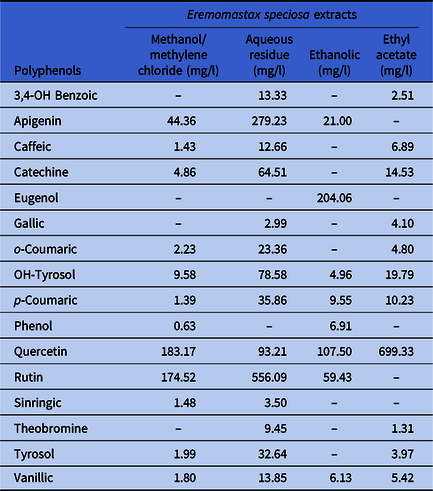
The quantitative evaluation of phenolic compounds in the aqueous residue of Eremomastax speciosa showed the following quantities expressed in milligrams per litre (mg/l): 3,4-OH benzoic 13.33, apigenin 279.23, caffeic 12.66, catechine 64.51, gallic 2.99, o-coumaric 23.36, OH-tyrosol 78.58, p-coumaric 35.86, quercetin 93.21, rutin 556.09, sinringic 3.50, theobromine 9.45, tyrosol 32.64, and vanillic 13.85 (Table 1). These results showed very high quantities of apigenin and rutin while the lowest values were reported for gallic and theobromine (Table 1).
Constituents found in each fraction of E. speciosa using HPLC

Effect of E. speciosa on body weight gain
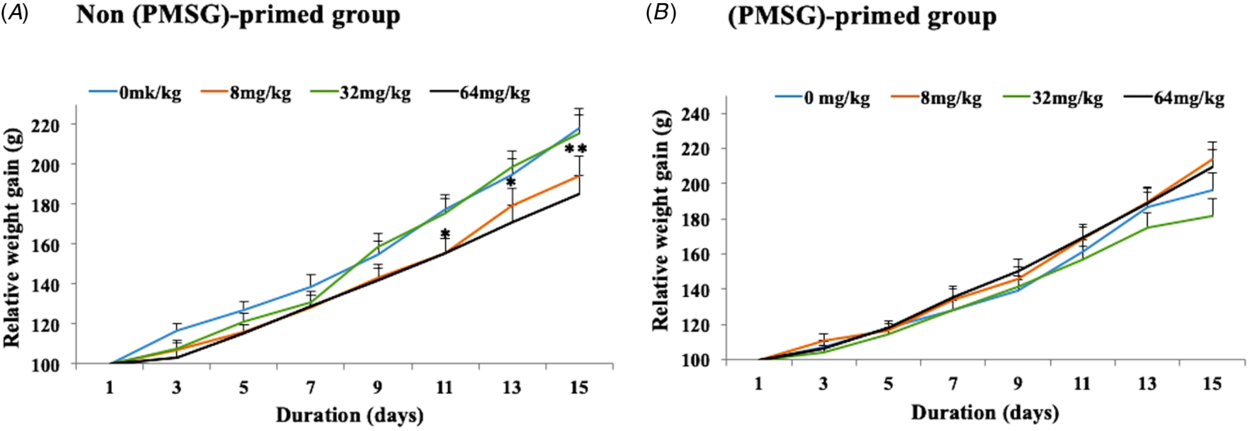
The effect of E. speciosa on body weight of non-PMSG-primed and primed female rats is presented in Fig. 1. A linear increase in the growth rate of primed (A) and non-primed animals (B) was observed. However, the body weights of non-primed animals treated at the dose of 8 mg/kg were significantly (P < 0.05) lower than those of the control group on days 11, 13 and 15.
Body weight gain of non-PMSG-primed (A) and primed (B) rats after oral administration of 8, 32 and 64 mg/kg doses of E. speciosa. Each point represents the mean ± SEM of six animals per group. Values statistically different from that of the control group each corresponding day, respectively at *P < 0.05 and **P < 0.01.

Effect of E. speciosa on uterine weight and proteins
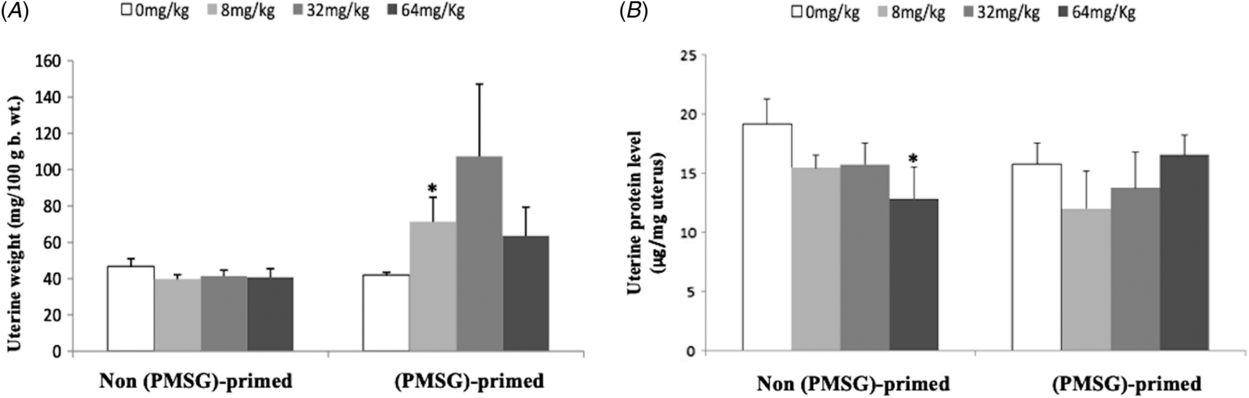
PMSG-primed rats treated at the dose of 8 mg/kg showed higher (P < 0.05) uterine weight when compared with the other treatments (Fig. 2A). Regarding the uterine proteins, a decrease (P < 0.05) was observed at the dose of 64 mg/kg when compared with the control treatments (Fig. 2B).
Effect of E. speciosa on uterine relative weight (A) and proteins level (B). Each histogram represents the mean ± SEM of six animals per group. Values significantly different (*P < 0.05) from those of the control group.

Effect of E. speciosa on ovarian weight and proteins
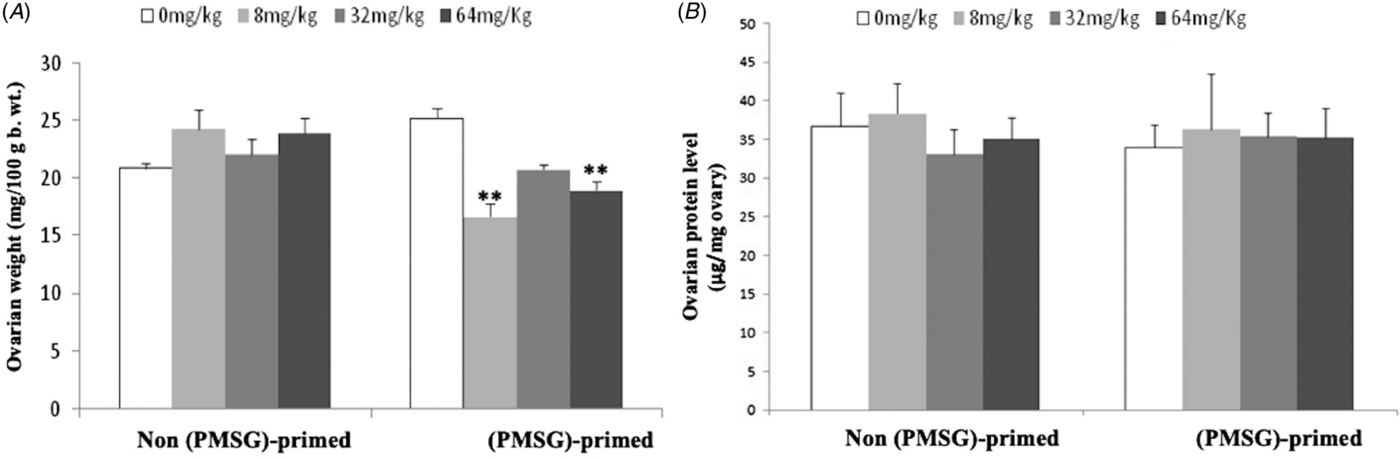
The oral administration of E. speciosa to non-PMSG-primed immature female rats did not affect the ovarian weight, however a significant decrease (P < 0.01) was observed on primed rats at 8 mg/kg and 64 mg/kg dosages when compared with control group (Fig. 3A).
Effect of E. speciosa on ovarian relative weight (A) and proteins level (B). Each histogram represents the mean ± SEM of six animals per group. Values significantly different at (**P < 0.01) from those of the control group.

No variation was observed in ovarian proteins in both primed and non-primed animals (Fig. 3B).
Effect of E. speciosa on ovarian cholesterol
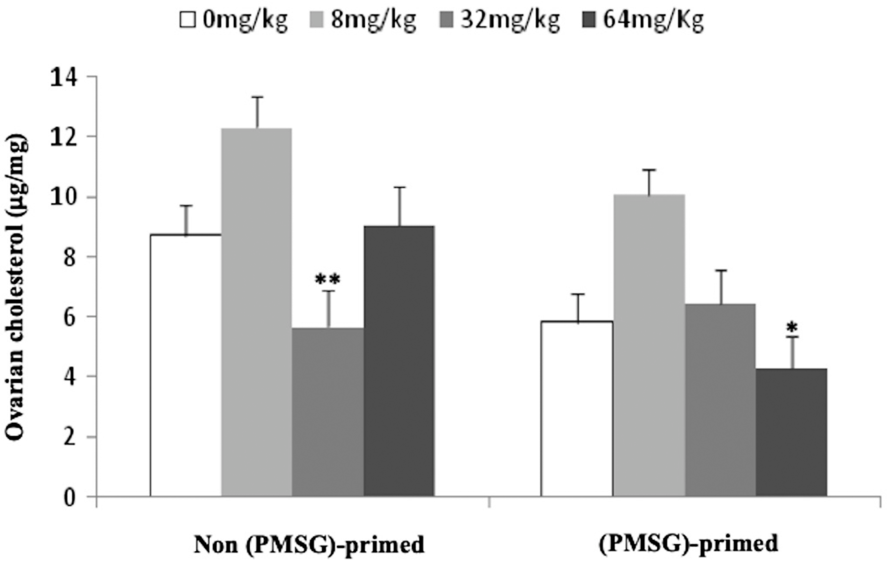
As can be seen from Fig. 4, in non-PMSG-primed rats, the ovarian cholesterol significantly decreased (P < 0.01) at 32 mg/kg dosage compared with the control. Whereas in primed animals, the cholesterol level increased significantly at 8 mg/kg dosage compared with the control group, while it decreased (P < 0.05) at 64 mg/kg.
Variation of the ovarian cholesterol in non-primed and PMSG-primed immature rats. Each histogram represents the mean ± SEM of six animals per group. Values statistically different from that of the control group of each day at *P < 0.05, **P < 0.01.

Effect of E. speciosa on days of vaginal opening
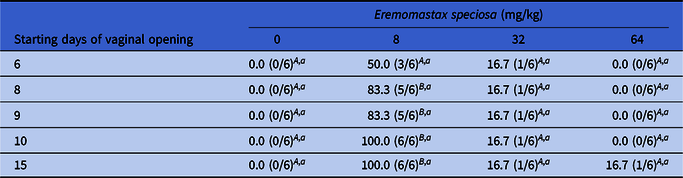
No vaginal opening was observed in non-primed immature female rats. Table 2 shows the percentages of PMSG-primed rats presenting vaginal opening. The vaginal opening was observed on day 6 at 8 and 32 mg/kg dosages (3 and 1 opening respectively). The remaining rats treated at 8 mg/kg opened on the 10th day of treatment. Only one rat treated at 64 mg/kg dose was open on that 10th day.
Percentages of PMSG-primed rats showing vaginal opening
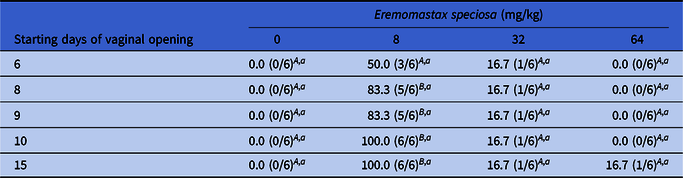
Uppercase letters in the same row and lowercase letters in the same column indicate differences, P < 0.05. Total number of rats: n = 6.
Discussion
The present study showed a significant difference in body growth rate, uterine weight and proteins, total ovarian cholesterol and induction of vaginal opening in female rats after oral administration of different doses of aqueous extract of E. speciosa.
HPLC–phytochemical screening of polyphenols of the methanol/methylene chloride extract, its ethyl acetate and ethanol fractions and the aqueous residue of E. speciosa revealed the presence of several polyphenolic compounds among which apigenin and rutin presented high amounts. Chemically known as 4′,5,7,-trihydroxyflavone, apigenin is a yellow crystalline powder belonging to the flavone class (Ali et al., Reference Ali, Rahul, Naz, Jyoti and Siddique2017). It is present in many fruits and vegetables and has diverse biological effects including antioxidant and antigenotoxic properties (Liu, Reference Liu2004; Ali et al., Reference Ali, Naz, Jyoti and Siddique2014) and modulation of immune cell function (Nicholas et al., Reference Nicholas, Batra, Vargo, Voss, Gavrilin, Wewers, Guttridge, Grotewold and Doseff2007). According to Singh et al. (Reference Singh, Mishra, Noel, Sharma and Rath2012), the cancer preventive effect of apigenin is due to its potent antioxidant and anti-inflammatory activities. It has also been demonstrated that apigenin promotes metal chelation, scavenges free radicals and stimulates phase II detoxification enzymes in cell culture and in vivo tumour models. (Middleton et al., Reference Middleton, Kandaswami and Theoharides2000). Rutin (3,3′,4′,5,7-pentahydroxyflavone-3-rhamnoglucoside) is a flavonoid of the flavonol class that is widespread in plants and fruits (Hosseinzadeh and Nassiri-Asl, Reference Hosseinzadeh and Nassiri-Asl2014). Like quercetin and eugenol (Miean and Mohamed, Reference Miean and Mohamed2001), which are antioxidants that protect the body against oxidative stress, rutin has a wide range of pharmacological properties that have been exploited in human medicine and nutrition. In recent years, Hsu et al. (Reference Hsu, Shih, Chia, Lee, Ashida, Lai and Weng2014) reported that rutin serves as a potential agent for glycaemic control through enhancement of insulin-dependent receptor kinase activity, thereby inducing the insulin signalling pathway, and therefore causing increased glucose transporter 4 translocation and increased glucose uptake. Many endogenous or synthetic neurotransmitters influence the hypothalamic–pituitary–gonadal axis and can consequently affect menstrual cycling. Similarly, the emotional state may disrupt reproductive functioning through the effects of stress hormones on the hypothalamic–pituitary–gonadal axis (Baldwin and Mayers, Reference Baldwin and Mayers2003). These various pharmacological effects of phenolic compounds encountered in the medicinal plant may explain their multiple therapeutic usages in traditional medicine (Telefo et al., Reference Telefo, Lienou, Bayala, Yemele, Lemfack, Mouokeu, Goka, Tagne and Moundipa2011; Mbemya et al., Reference Mbemya, Guerreiro, Donfack, Silva, Vieira, Sousa, Alves, Izaguirry, Santos, Telefo, Pessoa, Johan, Figueiredo and Rodrigues2017).
A previous study showed that subcutaneous injection of 0.01 IU PMSG to immature female rats over 5 days led to a significant increase in ovarian and uterine weights as well as vaginal opening (Goka et al., Reference Goka, Telefo, Mbemya, Awouafack, Lienou, Yemele, Njina, Donfack, Tagne and Fekam2016). PMSG is a natural glycoprotein with FSH-like and weak LH-like activities (Moore and Ward, Reference Moore and Ward1980). Worthington and Kennedy (Reference Worthington and Kennedy1979) showed that the use of PMSG during 6-week intervals increased the weight of the uterus and the ovary, stimulating the conversion of follicles into corpora lutea and increased the number of follicles (Worthington and Kennedy, Reference Worthington and Kennedy1979). The application of PMSG in immature rats increases ovulation and prevents the atresia of periantral and antral follicles (Braw and Tsafriri, Reference Braw and Tsafriri1980).
In non-PMSG-primed animals, the daily oral administration of an aqueous extract of E. speciosa led to a significant reduction in body weight on days 11, 13 and 15, and was even not dose dependent. Uterine proteins also showed a significant reduction. These results could be due to anti-oestrogenic compounds in E. speciosa. Caffeic acid (3,4-dihydroxycinnamic acid) and gallic acid (3,4,5-trihydroxybenzoic acid) found in the aqueous residue of E. speciose are phenolic compounds known for their anti-oestrogenic activities (Hidalgo et al., Reference Hidalgo, Martin-Santamaria, Recio, Sanchez-Moreno, de Pascual-Teresa, Rimbach and Pascual-Teresa2012; Rezaei-Seresht et al., Reference Rezaei-Seresht, Cheshomi, Falanji, Movahedi-Motlagh, Hashemian and Mireskandari2019). Mechanisms suggest an affinity for the oestrogen receptors and display agonist effects. Furthermore, De Oliveira et al. (Reference De Oliveira, Fighera, Bianchet, Kulak and Kulak2012) also suggested that polyphenols from E. speciosa could have anti-oestrogen activity, which by binding to oestrogen receptors would interact at the early stages of oestrogen synthesis.
In primed animals, the increase in the relative uterine weight could be due to the anabolic effect of FSH-like compounds from E. speciosa. Our results rattest the presence of FSH-like compounds in the extract and may justify its traditional used. FSH has a well established role in reproduction. In females, FSH acts via the FSH receptor located in ovarian granulosa cells to control follicle development and steroidogenesis (Simoni et al., Reference Simoni, Huhtaniemi, Santi and Casarini2019). Sun et al. (Reference Sun, Peng, Sharrow, Iqbal, Zhang, Papachristou, Zaidi, Zhu, Yaroslavskiy, Zhou, Zallone, Sairam, Kumar, Bo, Braun, Cardoso-Landa, Schaffler, Moonga, Blair and Zaidi2006) proposed that rising FSH levels with age may directly induce bone loss independent of oestrogen deficiency. In contrast, contrary to the proposed FSH-induced bone loss, Allan et al. (Reference Allan, Kalak, Dunstan, McTavish, Zhou, Handelsman and Seibel2010) demonstrated that FSH has dose-dependent anabolic effects on bone via an ovary-dependent mechanism, which is independent of LH activity and does not involve direct FSH actions on bone cells. How polyphenols from E. speciosa act on the uterus awaits further investigations.
In the present study, a decrease in the ovarian weight was observed at 8 mg/kg and 64 mg/kg in primed rats. This is an unexpected result and could be because PMSG and FSH-like compounds present in E. speciosa have probably affected FSH receptors at the granulosa cell level through downregulation. Zhang and Roy (Reference Zhang and Roy2004) reported that in vivo, exogenous compounds like those with FSH-like activity downregulated FSH receptors in the hamster ovary and could be associated with a reduction in ovarian weight and activity. Dierich et al. (Reference Dierich, Sairam, Monaco, Fimia, Gansmuller, LeMeur and Sassone-Corsi1998) showed that impairing FSH signalling in vivo resulted in reduction of the ovarian and uterine weights. In vitro studies, conversely, have shown that in situ culture of rats granulosa cells with high concentrations of FSH (>10 ng/ml) caused downregulation of its own receptor (Xiao et al., Reference Xiao, Robertson and Findlay1992).
Cholesterol is the main precursor of steroids hormones during their biosynthesis (Moon et al., Reference Moon, Choi and Kim2016). Its reduction in both groups at doses of 32 (non-primed) and 64 mg/kg (PMSG-primed animals) clearly showed its utilization in the biosynthesis of estradiol. Similar results have been reported by others authors (Lienou et al., Reference Lienou, Telefo, Bale, Yemele, Tagne, Goka, Lemfack, Mouokeu and Moundipa2012; Telefo et al., Reference Telefo, Tagne, Koona, Yemele and Tchouanguep2012).
As reported previously, the main external phenomenon at puberty in immature rats is vaginal opening (Navarro et al., Reference Navarro, Fernandez-Fernandez, Castellano, Roa, Mayen, Gaytan, Aguilar, Pinilla, Dieguez and Tena-Sempere2004). FSH and LH stimulate proliferation of follicular cells and the production of estradiol by ovarian cholesterol catabolism (Skibola, Reference Skibola2004). Overall, hormonal signalling culminates in opening and cornification of the vagina, and to an increase in ovarian and uterine weights (Counis et al., Reference Counis, Combarnous, Chabot, Taragnat, Thibault and Levasseur2001). In non-PMSG-primed animals, the administration of E. speciosa extract at all doses did not lead to vaginal opening, while in primed animals, at dose of 8 mg/kg, on day 15, the vaginal orifices of all the animals were opened. This effect demonstrated that antioxidant polyphenol compounds from E. speciosa such as apigenin (Ali et al., Reference Ali, Rahul, Naz, Jyoti and Siddique2017) and rutin (Jahan et al., Reference Jahan, Munir, Razak, Mehboob, Ain, Ullah, Afsar, Shaheen and Almajwal2016) can influence the hypothalamic–pituitary–gonadal axis and can consequently induce puberty. The same result has been obtained at the 8 mg/kg dose, with the ethanolic extract of Senecio biafrae (Lienou et al., Reference Lienou, Telefo, Bayala, Yemele, Lemfack, Mouokeu, Goka, Tagne and Moundipa2010).
In conclusion, this study confirmed the presence of FSH-like compounds in the aqueous macerate of E. speciose, which acts in synergy with PMSG to allow physiological and biochemical modifications of parameters of reproduction and also precocious puberty of immature rats. Globally, a therapeutic dose of 8 mg/kg improved ovarian activity of rats and therefore justifies its used by traditional healers.
Acknowledgements
The authors thank the collaborators from their respective institutions for observations on the manuscript and for their technical assistance.
Financial support
This research received no specific grant from any funding agency, commercial or not-for-profit sectors.
Conflict of interest
None of the authors have any conflict of interest to declare.
Ethical standards
This study was performed according to the internationally accepted standard ethical guidelines for laboratory animal use and care as described in the European Community guidelines (Radzikowski, Reference Radzikowski2006).