Implications
In this study, dietary bacteriophage was aimed to act against coliforms and Clostridium spp. to avoid their proliferation in unstable intestinal microbiota after weaning, when their feed form changes from milk to mash. To our knowledge, no previous work has been surveyed the effect of bacteriophage cocktail against four different pathogens in the weaning period, furthermore no information is available regarding the effect of bacteriophages on intestinal morphology of weanling piglets. This approach has provided new insights into the use of a bacteriophage cocktail to improve the gut health of piglets.
Introduction
At weaning, piglets are exposed to nutritional, environmental, physiological and social stressors that can lead to a depressed feed intake, a high incidence of diarrhea, poorer growth performance and increased mortality of piglets (Frydendahl, Reference Frydendahl2002; Halas et al., Reference Halas, Heo, Hansen, Kim, Hampson, Mullan and Pluske2007). To counteract these effects, antibiotic growth promoters are commonly added to weanling pig diets to maintain gut health and to improve growth performance. However, persistent use of antibiotics in animal feed has resulted in problems like emergence of drug resistant bacteria, imbalance of normal intestinal microflora and antibiotic-residue in animal products (Schwarz et al., Reference Schwarz, Kehrenberg and Walsh2001), which has led to the total ban or restriction on the use of antibiotic growth promoters in many countries including the Republic of Korea (Pettigrew, Reference Pettigrew2006; GAIN, 2011). Therefore, the search continues for non-antibacterial growth promoters that are active in vivo, are fast acting, possess a broad spectrum in activity, do not induce bacterial resistance and subsequently promote growth performance of pigs. A number of research findings on the use of alternatives like probiotics, oligosaccharides, organic acids and antimicrobial peptides to replace antibiotics in feed have been documented with varying success (Kenny et al., Reference Kenny, Smidt, Mengheri and Miller2011; Choi et al., Reference Choi, Kim, Ingale, Kim, Shinde, Kwon and Chae2011a; Yoon et al., Reference Yoon, Ingale, Kim, Kim, Lee, Park, Kwon and Chae2012). In this context, bacteriophages are believed to be an ideal candidate, due to their natural antibacterial properties (Jamalludeen et al., Reference Jamalludeen, Johnson, Shewen and Gyles2009; Yan et al., Reference Yan, Hong and Kim2012).
Bacteriophages are obligate intracellular parasites that multiply inside bacteria by making use of some or all of the host biosynthetic machinery (McGrath et al., Reference McGrath, Fitzgerald and Sinderen2004). Most of the previous studies on bacteriophages evaluated their therapeutic effects on disease challenged pigs (Barrow, Reference Barrow2001; Jamalludeen et al., Reference Jamalludeen, Johnson, Shewen and Gyles2009; Wall et al., Reference Wall, Zhang, Rostagno and Ebner2010) only against one pathogen bacteria, but in the current experiment the bacteriophage cocktail included ten different bacteriophages against Salmonella, Coliforms, Streptococcus and Clostridium. The application of a bacteriophage cocktail can be a better way to prevent the proliferation of pathogens in gut microflora to avoid incidence of diarrhea and other related diseases. Recently, it has been reported that supplementation with bacteriophages resulted in improved growth performance and gut health of growing pigs (Yan et al., Reference Yan, Hong and Kim2012; Kim et al. Reference Kim, Kim, Lee, Lee, Lee, Kim and Kil2014b). Previous studies in the author’s laboratory reported that the multimicrobial probiotic products had potential to improve the performance and gut health, and could be used as an alternative to antibiotic growth promoters in pigs and broilers (Choi et al., Reference Choi, Shinde, Ingale, Kim, Kim, Kim, Kwon and Chae2011b; Kim et al., Reference Kim, Ingale, Kim, Kim, Sinol, Ryu, Lohakare, Kwon and Chae2012). Therefore, the present study was designed to investigate the effects of dietary supplementation with bacteriophage and also its combination with fermented probiotic product on growth performance, nutrient digestibility, intestinal and fecal microbiota and intestinal morphology of weanling pigs.
Material and methods
Bacteriophages
The bacteriophage product used in the present study was obtained from a commercial feed company (CTC Bio Inc., Seoul, Republic of Korea) by mixing of excipients with lyophilized bacteriophage cocktail infecting Salmonella (S. typhimurium, S. enteritidis, S. cholerasuis and S. derby), Staphylococcus aureus, Escherichia coli (k88, k99 and f41) and Clostridium perfringens types A and C. These bacteriophages are isolated from water, soil and farm waste samples and their antibacterial activities were confirmed by a conventional plaque assay. The titer of each bacteriophage in the bacteriophage cocktail was 109 plaque-forming units (pfu)/g bacteriophage cocktail.
Preparation of fermented probiotic product
Lactobacillus acidophilus K31 isolated from feces of weaned pigs, Bacillus subtilis K 42 isolated from natto (fermented soybeans), and Saccharomyces cerevisiae K47 isolated from koji (malted wheat) were maintained in the laboratory as stock culture. A culture broth (CB) medium containing 60.0 ml corn steep liquor, 40.0 ml molasses, 3.0 g/l yeast extract, 5.0 g/l KH2PO4 and 2.5 g/l K2HPO4 in distilled water was prepared and autoclaved before being used.
A quantity of 2 l of autoclaved CB was inoculated with 2.0 ml of culture of each microbe separately and subjected to fermentation for 48 h. L. acidophilus and B. subtilis were incubated at 37°C at pH 7.0, whereas S. cerevisiae was incubated at 3°C at pH 4.0. The microbes grown on CB were directly sprayed on corn-soybean meal (1 : 1) followed by drying at 40°C for 72 h.
The microbes grown on CB were used as starter and pasteurized corn : soybean meal (1 : 1) was used as the substrate for carrying out fermentation as described previously by Shim et al. (Reference Shim, Shinde, Choi, Kim, Seo, Pak, Chae and Kwon2010). Then the substrates (13.0 kg) were inoculated with 2.0 l of starter and fermented for 7 days at 32°C and at pH 7.0. After 7 days of fermentation, the complete fermentation batch was dried at 40°C for 72 h and mixed to obtain the fermented probiotic product. The colony counts of L. acidophilus, B. subtilis and S. cerevisiae in fermented probiotic product (Shim et al., Reference Shim, Shinde, Choi, Kim, Seo, Pak, Chae and Kwon2010) were 4.0×10⁸, 4.8×10⁹ and 1.0×10⁴ colony-forming units (cfu)/g, respectively.
Animals, diets and management
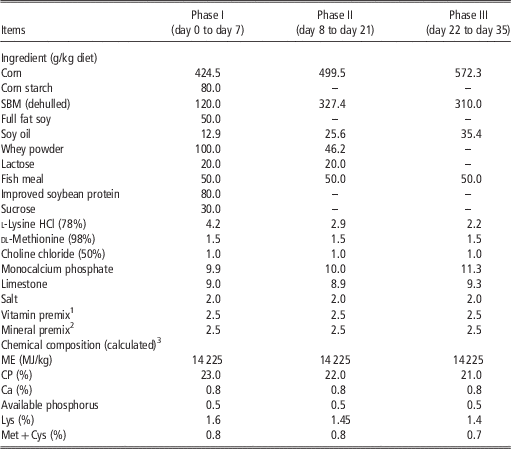
In Experiment 1, a total of 150 weaned piglets (Landrace×Yorkshire×Duroc; initial BW: 7.77±0.250 kg; 24±3 days of age) of mixed sex were randomly allotted to three treatments on the basis of BW and sex. There were five replicates pens in each treatment with 10 pigs per pen. The dietary treatments included a basal diet supplemented with 0 (control diet without any antimicrobial), 1.0 and 1.5 g/kg commercial bacteriophage product (109 pfu/g). Whereas, in Experiment 2, 200 weaned piglets (Landrace×Yorkshire×Duroc; initial BW; 7.76±0.280 kg; 24±3 days of age) of mixed sex were randomly allotted to four treatments on the basis of BW and sex. There were five replicates pens in each treatment with 10 pigs/pen. Dietary treatments included basal diet without any antimicrobial, basal diet supplemented with 3.0 g/kg fermented probiotic product (P), basal diet supplemented with 1.0 g/kg bacteriophage (B) and basal diet supplemented with combination of 1.0 g/kg bacteriophage and 3.0 g/kg fermented probiotic product. Fermented probiotic products used herein contained L. acidophilus, B. subtilis and S. cerevisiae. In both experiments, treatment diets were fed in a meal form in three phases (day 0 to day 7, phase I; day 8 to day 21, phase II and day 22 to day 35, phase III). Diets for phases I, II and III were formulated to contain 14.23 MJ/kg metabolizable energy and 16.0, 14.5 and 14.0 g/kg lysine, respectively (Table 1). All diets met or exceeded the nutrient requirements as suggested by NRC (1998).
Ingredient and chemical composition of basal diets (as-fed basis; Experiments 1 and 2)

SBM=Soybean meal; ME=metabolizable energy.
1 Supplied per kilogram of diet: 16 000 IU vitamin A, 3000 IU vitamin D3, 40 IU vitamin E, 5.0 mg vitamin K3, 5.0 mg vitamin B1, 20 mg vitamin B2, 4 mg vitamin B6, 0.08 mg vitamin B12, 40 mg pantothenic acid, 75 mg niacin, 0.15 mg biotin, 0.65 mg folic acid.
2 Supplied per kilogram of diet: 45 mg Fe as ferrous sulfate, 0.25 mg Co as cobalt sulfate, 50 mg Cu as copper sulfate, 15 mg Mn as manganese oxide, 25 mg Zn as zinc oxide, 0.35 mg I as potassium iodide, 0.13 mg Se as sodium selenite.
3 Based on NRC (1998) values.
The project underwent proper ethical standards and the experiments were approved by the Institutional Animal Care and Use Committee of Kangwon National University, Chuncheon, Republic of Korea. These experiments were conducted at the facility of Kangwon National University farm and the piglets were housed in partially slotted and concrete floor pens with a pen size of 1.90×3.0 m. All pens were equipped with a self-feeder and nipple drinker to allow ad libitum access to feed and water.
Experimental procedures, measurements and analyses
Individual weanling piglets weight and feed disappearance from each pen were recorded at the beginning of the experiment and at the end of every phase to calculate average daily gain (ADG), average daily feed intake (ADFI) and gain to feed ratio (G : F). To evaluate the effects of dietary treatments on the apparent total tract digestibility (ATTD) of nutrients, 0.25% chromic oxide (an inert indigestible indicator) was added to all three phases (Phase I, 0 to 7 days; phase II, 8 to 21 days and phase III, 22 to 35 days) diets of each experiments. Pigs were fed diets mixed with chromic oxide from day 0 to day 7, day 14 to day 21 and day 28 to day 35, and fecal grab samples were collected from each pen on the last 3 days of each experiment to determine the ATTD of dry matter (DM), gross energy (GE) and CP. The fecal samples were pooled within pen and dried in a forced air oven at 60°C for 72 h, and ground in a Wiley mill (Thomas Model 4 Wiley Mill, Thomas Scientific, Swedesboro, NJ, USA) using a 1 mm screen and used for chemical analysis.
The incidence of diarrhea was measured by scoring the feces as 0 (normal), 1 point (soft feces), 2 points (mild diarrhea), 3 points (severe diarrhea) in all the experiments. The overall cumulative incidence of diarrhea was measured daily at 0900 h for 5 weeks and the final diarrhea incidence was determined as the average of the scores.
To study the effects of dietary treatments on small intestinal morphology and microbiota of ileal and cecal digesta, representative piglets from each group (two per pen) reflecting the average BW of the pen were selected and sacrificed by electrocution at day 35 of each experiment. The digesta from the ileum and cecum were collected in sterile plastic bottles for microbial analysis. The samples collected for microbial analysis were immediately placed on ice until analyses were conducted. The samples of the intestinal segment from the region of duodenum, jejunum and ileum were collected after removing the content and flushing with physiological saline. The samples were then submerged in a fixative solution (0.1 M collidine buffer, pH 7.3) containing 3% glutaraldehyde, 2% paraformaldehyde and 1.5% acrolein, and then brought to the laboratory to study the morphological changes.
Chemical and microbial analyses
Experimental diets and excreta samples were analyzed in triplicate for DM (Method 930.15) and CP (Method 990.03) using Association of Official Analytical Chemists (2007) methods. GE of diets and feces were measured by a bomb calorimeter (Model 1261, Parr Instrument Co., Moline, IL, USA), and chromium concentration was determined with an automated spectrophotometer (Jasco V-650; Jasco Corp., Tokyo, Japan) according to the procedure of Fenton and Fenton (Reference Fenton and Fenton1979).
The microbiological assay of ileum and cecum digesta was carried out by culturing in different media as suggested by Choi et al. (Reference Choi, Kim, Ingale, Kim, Shinde, Kwon and Chae2011a).
One gram of the composite cecum or ileum sample was diluted with 9 ml of 1% peptone broth (Becton, Dickinson and Co., Franklin Lakes, NJ, USA) and then homogenized. Viable counts of bacteria in the samples were then conducted by plating serial 10-fold dilutions. For the determination of Lactobacillus spp. (using Man, Rogosa and Sharpe (MRS) agar+0.200 g/l NaN3+0.500 g/l l-cystine hydrochloride monohydrate), Bifidobacterium spp. (Man, Rogosa and Sharpe-nalidixic paromomycin neomycin lithium: MRS agar+nalidixic acid, paromomycin+neomycin sulphate+lithium chloride), Clostridium spp. (tryptose sulphite cycloserine agar) and coliforms (violet red bile agar) were used.
The microbiological assay of potential probiotic products was also carried out by culturing technique. Lactobacillus spp. was enumerated using MRS agar+0.02% NaN3+0.05% l-cystine hydrochloride monohydrate, B. subtilis by using plate count agar, S. cerevisiae by potato dextrose agar. The MRS agar (No. 288130), violet red bile agar (No. 216695), plate count agar (No. 247940), and potato dextrose agar (No. 213400) used were purchased from Difco Laboratories (Detroit, MI, USA). The bacterial concentrations were transformed (log) before statistical analysis.
Small intestinal morphology
Three cross-sections for each intestinal sample were prepared after staining with azure A and eosin using standard paraffin embedding procedures (Yoon et al., Reference Yoon, Ingale, Kim, Kim, Lee, Park, Kwon and Chae2012). A total of ten intact, well-oriented crypt-villus units were selected in triplicate for each intestinal cross-section. Villus height was measured from the tip of the villi to the villus crypt junction, and crypt depth was defined as the depth of the invagination between adjacent villi. All morphological measurements (villus height and crypt depth) were made in 10 μm increments by using an image processing and analysis system (Optimus version 6.5 software, Media Cybergenetics, North Reading, MA, USA).
Statistical analysis
In first experiment, statistical analysis was conducted using the one-way ANOVA procedure (SAS Institute Inc., Cary, NC, USA), and when significant differences (P<0.05) were identified among treatment means, they were separated using Tukey’s Honestly Significant Difference test. In both experiments, the pen was used as the experimental unit for analysis of all the parameters. Probability values of ⩽0.05 were considered as significant in both experiments.
Data generated in the second experiment was analyzed as a 2×2 factorial arrangement in a completely randomized design. Pens were considered the experimental unit for growth performance, and piglets were experimental units for measuring the digestibility of nutrients and all intestinal sampling. The main effects of bacteriophage cocktail and probiotics, and their interaction were determined by mixed procedure of SAS statistical program (SAS Institute Inc.). P-values ⩽0.05 were considered statistically significant.
Results
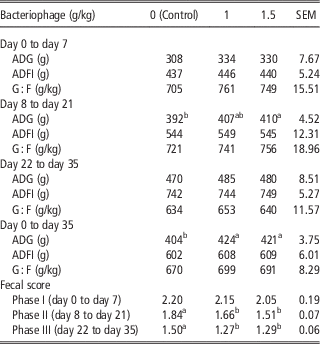
In Experiment 1, for phase I and II, pigs fed the diet supplemented with 1.0 and 1.5 g/kg bacteriophage cocktail showed reduced (P<0.05) fecal score than the pigs fed the control diet (Table 2). In overall result, pigs fed the diet supplemented with 1.0 and 1.5 g/kg bacteriophage cocktail exhibited similar growth performance and had significantly better (P<0.05) ADG than the pigs fed the control diet. Dietary treatments had no effects (P<0.05) on G : F and ADFI of piglets.
Effects of dietary levels of bacteriophage on growth performance and fecal score in weanling pigs (Experiment 1)Footnote 1

ADG=average daily gain; ADFI=average daily feed intake; G : F=gain to feed ratio.
a,bValues with different superscripts in the same row are significantly different (P<0.05).
1 Each mean based on six replicates.
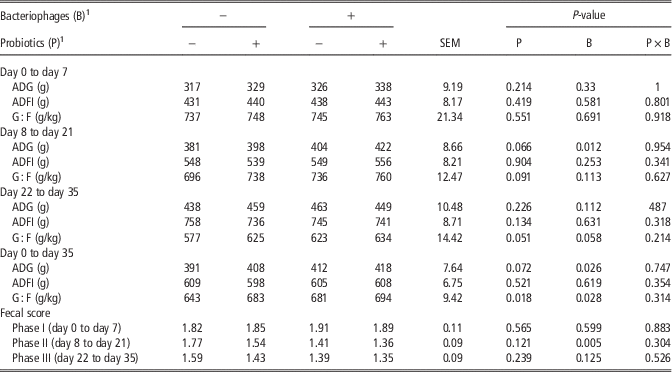
In Experiment 2, in phase II of study, pigs fed the bacteriophage cocktail showed lower (P<0.05; Table 3) fecal score. Pigs fed bacteriophage cocktail had greater (P<0.05) ADG in phase II and in overall result. Moreover, the overall G : F of piglets fed the bacteriophages or probiotics diets were significant (P<0.05).
Effects of dietary levels of bacteriophage on growth performance and occurrence of diarrhea in weanling pigs (Experiment 2)

ADG=average daily gain; ADFI=average daily feed intake; G : F=gain to feed ratio.
1 0.10% bacteriophage cocktail and 0.30% probiotics.
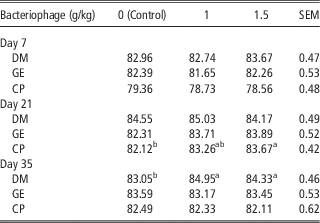
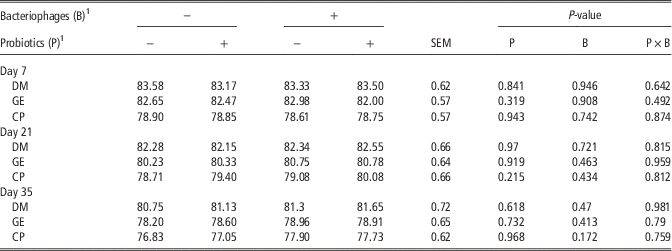
In Experiment 1, pigs fed diets supplemented with 1.0 and 1.5 g/kg bacteriophage cocktail exhibited similar ATTD of nutrients (P>0.05) at day 7. However, digestibility of CP was significantly higher (P<0.05) only in the highest level of bacteriophage cocktail (1.5 g/kg feed) than the piglets fed the control diet at day 21. Bacteriophage treatment group had significantly greater (P<0.05; Table 4) ATTD of DM at day 35. In Experiment 2, the digestibility of nutrients was not significantly different among the groups (Table 5).
Effects of dietary levels of bacteriophage on apparent total tract digestibility (%) of nutrients in weanling pigs (Experiment 1)

DM=dry matter; GE=gross energy.
a,bValues with different superscripts in the same row are significantly different (P<0.05).
Effects of dietary probiotics, bacteriophage or their combination on apparent total tract digestibility (%) of nutrients in weanling pigs (Experiment 2)

DM=dry matter; GE=gross energy.
1 0.10% bacteriophage cocktail and 0.30% probiotics.
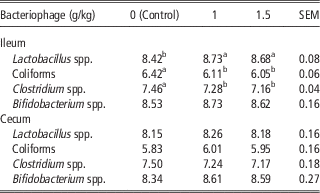
In Experiment 1, pigs fed diets supplemented with 1.0 and 1.5 g/kg bacteriophage cocktail had greater (P<0.05; Table 6) ileal Lactobacillus spp. populations and fewer coliform and Clostridium spp. colonization (ileum and cecum) than that of pigs fed the control diet. Cecal Lactobacillus spp., Bifidobacterium spp., Clostridium spp. and coliform populations were similar among pigs fed diet supplemented with 1.0 and 1.5 g/kg bacteriophage cocktail.
Effect of dietary levels of bacteriophage in microflora (log10 cfu/g) in ileum and cecum content of weanling pigs (day 35; Experiment 1)

a,bValues with different superscripts in the same row are significantly different (P<0.05).
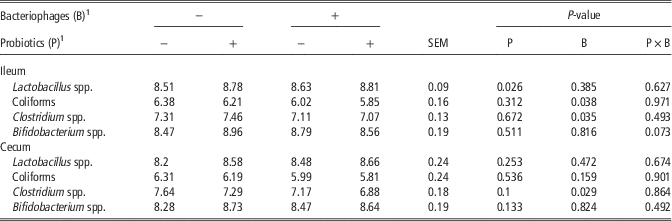
In Experiment 2, pigs fed probiotics had greater (P<0.05; Table 7) ileal Lactobacillus spp. populations, however, coliform, Clostridium spp. and Bifidobacterium spp. numbers were similar in both ileum and cecum. Fewer (P<0.05) coliform (cecum) and Clostridium spp. (cecum and ileum) populations were observed in pigs fed bacteriophage cocktail.
Effect of dietary probiotics, bacteriophage or their combination on small intestine microbiota (Experiment 2; day 35)

1 0.10% bacteriophage cocktail and 0.30% probiotics.
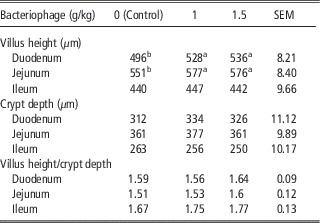
In Experiment 1, pigs fed the diet supplemented with 1 or 1.5 g/kg bacteriophage product had greater (P<0.05) villus height, but there was no effect of bacteriophages or probiotics on intestine crypt depth (Table 8).
Effect of dietary levels of bacteriophage on small intestinal morphology of weanling pigs (day 35; Experiment 1)

a,bValues with different superscripts in the same row are significantly different (P<0.05).
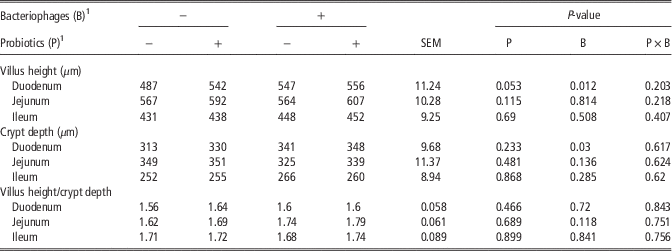
In Experiment 2, pigs fed probiotics (P=0.051) or bacteriophage treatment group (P<0.05; Table 9) had greater villus height (duodenum). Pigs within the bacteriophage treatment group were found to have deeper crypts in the duodenum.
Effect of dietary probiotics, bacteriophage or their combination on small intestinal morphology of weanling pigs (Experiment 2; day 35)

1 0.10% bacteriophage cocktail and 0.30% probiotics.
Discussion
In recent years, considerable efforts have been made for developing novel non-antibiotic feed additives which have the potential to improve the gut health, immunity and performance of pigs (Jin et al., Reference Jin, Shinde, Yang, Choi, Yoon, Hahn, Lim, Park, Hahm, Joo and Chae2009; Choi et al., Reference Choi, Shinde, Ingale, Kim, Kim, Kim, Kwon and Chae2011b; Yoon et al., Reference Yoon, Ingale, Kim, Kim, Lee, Park, Kwon and Chae2012 and Reference Yoon, Ingale, Kim, Kim, Park, Lee, Kwon and Chae2014). Among various alternatives, bacteriophages have received attention due to their natural antimicrobial properties and lower propensity for the development of bacterial resistance (Gebru et al., Reference Gebru, Lee, Son, Yang, Shin, Kim, Kim and Park2010; Wittebole et al., Reference Wittebole, Roock and Opal2014; Kim et al. Reference Kim, Kim, Lee, Lee, Lee, Kim and Kil2014b). The present study demonstrates the effects of bacteriophage cocktail, fermented probiotic product and their combination on performance and gut health of weanling pigs.
Results from the current study demonstrate that dietary bacteriophage cocktail and probiotics both improve G : F (Experiment 2) and ATTD of DM (Experiment 1) but the combination of bacteriophage and probiotics did not show a superior interaction. Our results are in agreement with Kim et al. (Reference Kim, Kim, Lee, Lee, Lee, Kim and Kil2014b), who observed improvement in growth performance and ATTD of nutrients in pigs fed diets supplemented with bacteriophage and probiotics. Similarly, Gebru et al. (Reference Gebru, Lee, Son, Yang, Shin, Kim, Kim and Park2010) reported improvement in of overall ADG and G : F of Salmonella challenged pigs fed diets supplemented with 3×10⁹ pfu/kg diet S. typhimurium bacteriophage. In contrast to the report by Kim et al. (Reference Kim, Kim, Lee, Lee, Lee, Kim and Kil2014b) and present results, Yan et al. (Reference Yan, Hong and Kim2012) observed that dietary supplementation with anti-Salmonella bacteriophage had no effect on ADG and G : F of growing pigs. These variations in the results are likely associated with variations in age of pigs, level and type of bacteriophage supplemented, health status within herds, farm hygiene, diet composition, feed forms and interactions with other dietary feed additives. Phages probably pass gastro-intestinal tract safely because they are able to survive in an acidic environment, however, pH=6 to 7 is the optimum range for most of them to show the highest efficiency. Lu et al. (Reference Lu, Breidt, Plengvidhya and Fleming2003) reported that 24 phage isolates were obtained in fermentation tanks with sauerkraut (pH<3.5) after 60 days. Yan et al. (Reference Yan, Hong and Kim2012) reported that growing pigs fed diets supplemented with anti-Salmonella bacteriophage had greater digestibility of DM, which is in agreement with our results (Experiment 1, phase 3). The results of our second study indicated the growth promoting of 1.0 g/kg diet bacteriophage cocktail and showed there were not synergistic effects of combining the bacteriophage cocktail with the fermented probiotic product. Similarly, Kim et al. (Reference Kim, Kim, Lee, Lee, Lee, Kim and Kil2014b) working with growing pigs reported that there were no synergistic effects of combining the bacteriophages with the probiotics. In the present trials, improved ADG of the pigs with dietary inclusion of bacteriophages in both Experiments 1 and 2 might be associated with a relative reduction of coliforms and Clostridium spp. or improved intestinal morphology. Reduced fecal score as a sign of incidence of diarrhea in weaning pigs fed the diet supplemented with bacteriophages reported in the present study is in agreement with Jamalludeen et al. (Reference Jamalludeen, Johnson, Shewen and Gyles2009) who observed that a combination of three bacteriophages could prevent E. coli induced diarrhea in weaned pigs. Weaned piglets seem to be more susceptible to intestinal infection by pathogens such as coliforms and Clostridium spp. Diarrhea occurring after the weaning period can be caused in different situations including the presence of E. coli (Hopwood et al., Reference Hopwood, Pluske and Hampson2005). The lower colonization of coliforms and Clostridium spp. can be the main reason for lower fecal score.
In the present trials, pigs fed diets supplemented with probiotics had higher Lactobacillus spp. in ileum. There are numerous studies about probiotics which show higher lactobacillus colonization in intestine (Choi et al., Reference Choi, Kim, Ingale, Kim, Shinde, Kwon and Chae2011a and Reference Choi, Shinde, Ingale, Kim, Kim, Kim, Kwon and Chae2011b; Baker et al., Reference Baker, Davis, Spencer, Moser and Rehberger2013). We had hypothesized an interaction between bacteriophages and probiotics, because bacteriophages have the ability of eliminating pathogens and give the opportunity to Lactobacillus spp. from probiotics to proliferate in a less competitive environment. Furthermore, Lactobacillus genus are the most closely studied group of probiotics that facilitate the growth of certain microbes while inhibiting the growth of others particularly enterobacteria such as Salmonella and E. coli mostly by the reduction in pH due to anaerobic fermentation in the intestine (Kenny et al., Reference Kenny, Smidt, Mengheri and Miller2011). However, probiotics in the current study did not affect the colonization of pathogens. Fewer coliforms in ileum was the result of using bacteriophages in the diet, but the combination of bacteriophages and probiotics were not significantly effective. Kim et al. (Reference Kim, Ingale, Kim, Lee, Lee, Kwon and Chae2014a) observed reduced Clostridium Perfrigensis shedding score in broiler chickens fed diets supplemented with a bacteriophage cocktail including an anti-Clostridium bacteriophage. In contrast to the present results, Kim et al. (Reference Kim, Kim, Lee, Lee, Lee, Kim and Kil2014b) observed no additional benefits of combination of bacteriophage and probiotics on fecal Lactobacillus spp. and coliforms populations. It has been well established that antimicrobial feed additives beneficially affect the host animal by improving its intestinal balance (Fuller, Reference Fuller1989) and creating gut micro-ecological conditions that suppress harmful microorganisms like coliforms and by favoring beneficial microorganisms like Lactobacillus spp. (Heyman and Menard, Reference Heyman and Menard2002; Choi et al., Reference Choi, Kim, Ingale, Kim, Shinde, Kwon and Chae2011a; Yoon et al., Reference Yoon, Ingale, Kim, Kim, Lee, Park, Kwon and Chae2012 and Reference Yoon, Ingale, Kim, Kim, Park, Lee, Kwon and Chae2014). In the current experiment, bacteriophages had the most notable effects against Clostridium spp. as the main cause of necrotic enteritis, since their population dramatically decreased in ileum of the first experiment and in both Ileum and cecum in the second experiment. In a previous study, it was showed that bacteriophage proteins were capable of lysing C. perfringens and could be expressed in yeast and added as lysates to animal feed to reduce the bacterium to improve health and food safety for monogastrics animals during production (Miller et al., Reference Miller, Skinner, Sulakvelidze, Mathis and Hofacre2010). The host-specificity role of bacteriophages (Endersen et al., Reference Endersen, O’Mahony, Hill, Ross, McAuliffe and Coffey2014) can be considered as a positive feature of phage therapy because they only infect bacteria which have the membrane receptor. Tail penetration through cell walls degraded enzymatically drives insertion of phage DNA into the cytoplasm of the host to encode specific enzymes and proteins by the phages genome in order to lyse host cell (Endersen et al., Reference Endersen, O’Mahony, Hill, Ross, McAuliffe and Coffey2014). Another experiment with humans showed that prophylactic phage therapy of Clostridium difficile infection can considerably reduce the burden of C. difficile vegetative cells and caused a clinically relevant decrease in toxin production (Meader et al., Reference Meader, Mayer, Steverding, Carding and Narbad2013). Results obtained herein provide new information regarding potential of bacteriophage or probiotics for improving intestinal microbiota of weanling pigs.
The changes in small intestinal morphology and in particular the villus height and crypt depth of duodenum, jejunum and ileum are indicative of gut health and digestive capacity of pigs. Increased villus height is directly correlated with an increased epithelial turnover (Fan et al., Reference Fan, Croom, Christensen, Black, Bird, Daniel, McBride and Eisen1997), and longer villi correlate with the activation of cell mitosis (Samanya and Yamauchi, Reference Samanya and Yamauchi2002). In the present study, dietary supplementation with bacteriophages and probiotics (P=0.053) reported increased villus height of duodenum. However, there were no additional beneficial effects of combining bacteriophages and probiotics. Previous studies in our laboratory on pigs and broiler reported improved intestinal morphology with dietary supplementation with fermented probiotics product (Choi et al., Reference Choi, Kim, Ingale, Kim, Shinde, Kwon and Chae2011a and Reference Choi, Shinde, Ingale, Kim, Kim, Kim, Kwon and Chae2011b; Kim et al., Reference Kim, Ingale, Kim, Kim, Sinol, Ryu, Lohakare, Kwon and Chae2012). Mourao et al. (Reference Mourao, Pinheiro, Alves, Guedes, Pinto, Saavedra, Spring and Kocher2005) reported that a decreased number of pathogenic bacteria in the gut may improve proliferation of epithelial cells to build villus and thus enhance intestinal morphology. In general there is a void of information regarding the effect of feeding bacteriophages on the histomorphology of small intestine of weaning piglets. In the present study, dietary bacteriophages and probiotic produced a relative improvement in villus size; however it was a non-uniform alteration in the individual intestinal segments.
Conclusion
In conclusion, the results obtained in the present study indicate that the bacteriophages are believed to influence the colonization of coliforms and Clostridium spp. in ileum, it can be postulated that fewer mentioned pathogens may have helped improve intestinal morphology and the growth performance, however, there were no interactive effects between bacteriophages and probiotics.
Acknowledgements
This study was supported by CTC Bio Inc. and 2014 Research Grant (No. 120140254) from Kangwon National University Chuncheon, Republic of Korea.