


Introduction
Social anxiety disorder (social phobia) (American Psychiatric Association, 1994) is a common and disabling anxiety disorder with an early onset and a generally unremitting course (Bruce et al., Reference Bruce, Yonkers, Otto, Eisen, Weisberg and Pagano2005; Kessler, Berglund, Demler, Jin and Walters, Reference Kessler, Berglund, Demler, Jin and Walters2005). Significant progress has been made in developing effective psychological treatments for the condition. Six meta-analytic reviews have concluded that there is strong empirical support for the efficacy of cognitive behavioural treatments (CBTs) (Feske and Chambless, Reference Feske and Chambless1995; Taylor, Reference Taylor1996; Chambless and Hope, Reference Chambless and Hope1996; Gould, Buckminster, Pollack, Otto and Yap, Reference Gould, Buckminster, Pollack, Otto and Yap1997; Acaturk, Cuijpers, van Straten and de Graaf, Reference Acarturk, Cuijpers, van Straten and de Graaf2009; Fedoroff and Taylor, Reference Fedoroff and Taylor2001). However, little is known about the mechanisms by which CBTs achieve their effects.
Individual cognitive therapy (ICT), a relatively recent development within CBTs for social anxiety disorder, is associated with large effect sizes and has been shown to be superior to SSRIs (Clark et al., Reference Clark, Ehlers, McManus, Hackmann, Fennell and Campell2003), a form of group CBT (Stangier, Heidenreich, Peitz, Lauterbach and Clark, Reference Stangier, Heidenreich, Peitz, Lauterbach and Clark2003), exposure in vivo combined with applied relaxation (Clark et al., Reference Clark, Ehlers, Hackmann, McManus, Fennell and Grey2006), intensive group cognitive therapy, (Mörtberg, Clark, Sundin and Åberg Wistedt, Reference Mörtberg, Clark, Sundin and Åberg Wistedt2007), medication based treatment as usual (Mörtberg et al., Reference Mörtberg, Clark, Sundin and Åberg Wistedt2007), interpersonal psychotherapy (Stangier, Schramm, Heidenreich, Berger and Clark, Reference Stangier, Schramm, Heidenreich, Berger and Clark2011), and psychodynamic psychotherapy (Leichsenring, Reference Leichsenring2012). ICT is derived from a cognitive model of social anxiety disorder (Clark and Wells, Reference Clark, Wells, Heimberg, Liebowitz, Hope and Schneier1995; Clark, Reference Clark, Crozier and Alden2001) and specifically targets the maintenance factors specified in the model. The hypothesized maintenance factors are: 1) Negative social phobia related cognitions (automatic thoughts, images and beliefs); 2) Self- focused evaluative attention, which reduces the processing of external social events and increases access of potential misleading internal information (feelings and images); and 3) Safety-seeking behaviours, which prevent disconfirmation of social phobia related negative beliefs and have a negative impact on the social interaction. It is tempting to assume that ICT works by changing these maintenance factors but so far there have been no direct tests of this hypothesis.
Five studies have explored mediators of therapeutic improvement in other CBTs for social anxiety disorder and have generally reported results that are consistent with cognitive models (Clark and Wells, Reference Clark, Wells, Heimberg, Liebowitz, Hope and Schneier1995; Rapee and Heimberg, Reference Rapee and Heimberg1997), but one cannot safely assume that these results would generalize to ICT as it involves several unique therapeutic procedures. In the first study, Hofmann (Reference Hofmann2000) found that pre to post change in self-focused attention mediated differences in outcome between a group CBT and a wait-list control condition. In the second study, Rapee and colleagues (Rapee, Gaston and Abbott, Reference Rapee, Gaston and Abbott2009) found that pre to post change in the perceived cost of negative outcomes mediated differences on outcome between another group CBT and control conditions. In the third study, Boden et al. (Reference Boden, John, Goldin, Werner, Heimberg and Gross2012) found that pre to post change in social-phobia related interpersonal beliefs mediated differences in outcome between individual CBT (Heimberg protocol) and a wait-list control. All three of these studies only assessed putative mediators at pre and posttreatment. As a consequence, they were unable to assess a key requirement of mediation, namely that change in the mediator must precede change in the outcome. In the fourth study, in which temporal precedence was tested, it was found that judgemental biases (probability and cost of harm) mediated changes in social anxiety during a brief exposure based treatment (Smits, Rosenfield, McDonald and Telch, Reference Smits, Rosenfield, McDonald and Telch2006). The final study (Hoffart, Borge, Sexton and Clark, Reference Hoffart, Borge, Sexton and Clark2009) assessed putative mediators and outcome weekly during residential versions of CT and interpersonal psychotherapy. Both treatments had been substantially modified for residential, largely group based delivery. Consistent with cognitive models, changes in self-focused attention at week X predicted changes in social anxiety at week X plus 3 days over a 10-week course of either residential treatment.
The present study is the first to examine change processes within ICT. Two putative mediators (self-focused attention and social anxiety related negative automatic thoughts) were assessed every week during therapy and related to changes in social anxiety one week later.
Data for our study were collected in a randomized controlled trial (Mörtberg et al., Reference Mörtberg, Clark, Sundin and Åberg Wistedt2007), which demonstrated the superior effects of ICT as compared to an intensive (3-week) group cognitive therapy (IGCT), and to medication based treatment as usual (TAU). ICT was associated with a high effect-size (Cohen's d = 2.14) on the primary outcome measure, and 56% of patients demonstrated a reliable and clinically significant change at posttreatment (Mörtberg et al., Reference Mörtberg, Clark, Sundin and Åberg Wistedt2007). Weekly process and outcome measures were only collected in the ICT branch of the trial. The study addresses the following questions:
-
1. Do the specified cognitive process variables change with treatment?
-
2. Do weekly changes in the process variables predict subsequent changes in social anxiety?
Method
Participants
Participants were 29 patients who received ICT as part of the randomized controlled trial reported by Mörtberg et al. (Reference Mörtberg, Clark, Sundin and Åberg Wistedt2007). Three participants who were randomized to ICT were not included as they only attended the initial assessment and provided baseline data. Participants were recruited through advertisements in the local newspaper and were included in the original trial if they: (a) had a diagnosis of social anxiety disorder (social phobia) according to DSM–IV (First, Spitzer, Gibbon and Williams, Reference First, Spitzer, Gibbon and Williams1995); (b) were 18 to 65 years old; (c) did not suffer from current depressive episode, bipolar disorder, acute stress disorder, addiction or psychosis; (d) did not take psychotropic medication; or (e) did not undergo current psychotherapy (for further details see Mörtberg et al., Reference Mörtberg, Clark, Sundin and Åberg Wistedt2007).
In the present sample, the mean age was 35.9 years (SD = 9.6). Seventy-six percent were suffering from generalized social phobia. Forty-one percent were married or cohabiting, 48% had a higher education, 69% were female. On average, participants’ duration of social phobia was 21 years (SD = 10.1).
Individual cognitive therapy
The main-steps of ICT (16 weeks) were: (a) Deriving an individualized version of the cognitive model using the patient's thoughts, images, anxiety symptoms, safety-behaviours and strategies of attention; (b) Conducting behavioural experiments to demonstrate the adverse effects of safety behaviours and self-focused attention; (c) Using video feedback to modify distorted self-imagery; (d) Training externally-focused attention (i.e. to shift attention away from oneself and onto to the social situation; (e) Conducting behavioural experiments to enable patients to test the validity of their negative predictions in a variety of social situations; (f) Identification and modification of problematic anticipatory and post-event negative processing; and (g) Identification and modification of social anxiety related dysfunctional assumptions.
CBT competence and supervision
Seven CBT-trained therapists with between 5 and 25 years of experience in the treatment of anxiety disorders delivered ICT. Therapists had group supervision by a highly experienced cognitive therapist (Anna Kåver) once a month to check adherence to the protocol. All sessions were video-recorded and the tapes were viewed during supervision to check treatment integrity.
Process measures
Self-focused attention
Self versus external focus of attention in social situations was measured weekly by one item of the (5-item) Social Phobia Weekly Summary Scale (SPWSS) (Clark et al., Reference Clark, Ehlers, McManus, Hackmann, Fennell and Campell2003). Participants were asked to rate (on a 0–8 scale) their focus of attention in social situations during the previous week on a scale from 0 (totally focused on the situation) to 8 (totally self-focused).
Social phobia related negative automatic thoughts
Negative thoughts related to social phobia (e.g. “I will not be able to speak”) were measured weekly by the 22-item Social Cognitions Questionnaire (SCQ) (Wells, Stopa and Clark, Reference Clark1993; Clark and Wells, Reference Clark, Wells, Heimberg, Liebowitz, Hope and Schneier1995). Each thought was rated twice: for the frequency with which the thought occurred in the last week when he/she was “nervous or frightened” (1 = never, to 5 = always when frightened) and for the belief with which the thought was believed to be true (0 = I do not belief this thought, to 100 = I am completely convinced that this thought is true). Both scales (frequency and belief) had good internal consistency (Cronbach's α = 0.89) and discriminant validity.
Social anxiety measures
For the mediation analysis, social anxiety levels were measured every week by four of the five items (rated on a 0–8 scale) of the SPWSS (i.e. not including the self versus external focus of attention item) that covered feeling anxious in social situations, avoidance of social situation, anxious anticipation of social encounters, and post-event rumination (Clark et al., Reference Clark, Ehlers, McManus, Hackmann, Fennell and Campell2003). The SPWSS has good internal consistency (Cronbach's α = 0.81) (Clark et al., Reference Clark, Ehlers, McManus, Hackmann, Fennell and Campell2003, Reference Clark, Ehlers, Hackmann, McManus, Fennell and Grey2006) and is sensitive to treatment effects (Clark et al., Reference Clark, Ehlers, McManus, Hackmann, Fennell and Campell2003, Reference Clark, Ehlers, Hackmann, McManus, Fennell and Grey2006; Mörtberg et al., Reference Mörtberg, Clark, Sundin and Åberg Wistedt2007).
The self-report version of the LSAS (Baker, Heinrichs, Kim and Hofmann, Reference Baker, Heinrichs, Kim and Hofmann2002) was also used to assess severity of social anxiety but was administered only at pre and posttreatment. In our sample, there was a significant correlation (p < .01) between the pre to post change score on the SPWSS (four items) and the pre to post change scores on the LSAS (r = .46), supporting the validity of the four item SPWSS as an outcome measure.
Statistical analyses
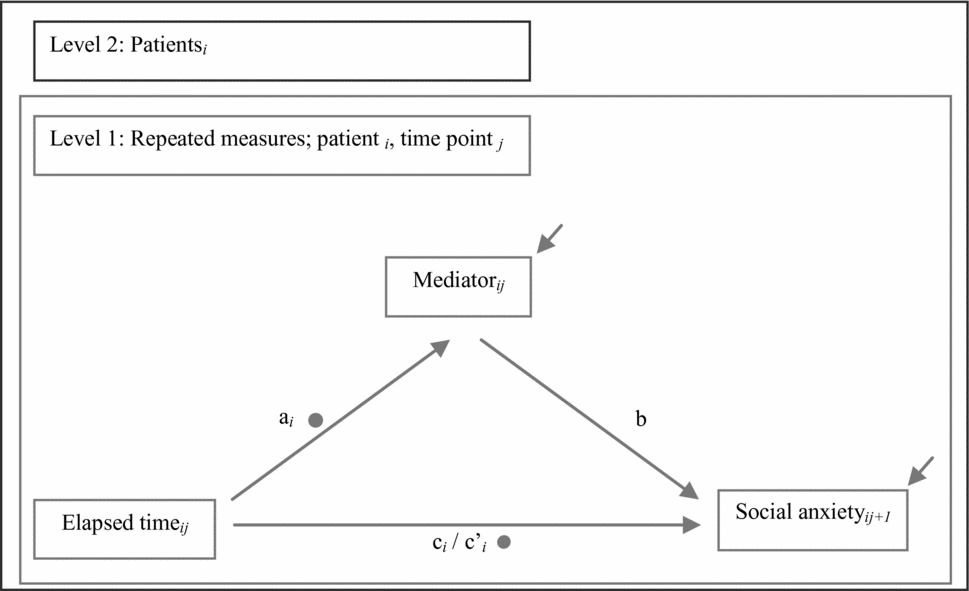
The present study aimed to examine whether weekly changes in the specified cognitive process variables mediated subsequent weekly changes in social anxiety. In longitudinal designs, repeated measurements that have been obtained on the same individuals can be appropriately analysed with hierarchical linear models where repeated measures (lower level units) are nested within persons (upper level units). Multilevel models can effectively manage unequal observation numbers as well as missing data and control for the correlation of repeated observations within each subject (Raudenbush and Bryk, Reference Raudenbush and Bryk2002). Mediation analysis aims to describe a potential causal pathway through which an independent variable affects an outcome variable (Bauer, Preacher and Gil, Reference Bauer, Preacher and Gil2006). For the present study, we specified “elapsed time” (days) as the independent variable, “process variables at week j” as potential mediators; and “social anxiety at week j+1” as the dependent variable, to model a temporal lag between changes in mediator and outcome variables, which has been deemed necessary to establish mediation (Kraemer, Wilson, Fairburn and Agras, Reference Kraemer, Wilson, Fairburn and Agras2002). The multilevel models include: (a) the effect of elapsed time on changes in the putative mediator (path ai) which was specified as random to account for the fact that the mediator might change differentially over time across patients; (b) the effect of changes in the suggested process variable on subsequent changes in social anxiety if time was being held constant (path b), which was specified as fixed as the influence between mediator and outcome by definition be the same across patients and time points; and (c) the indirect effect of elapsed time on social anxiety via changes in the putative mediator (aib). The parameters were estimated in a multilevel model using the procedure described in Bauer et al. (Reference Bauer, Preacher and Gil2006) when all relevant variables are measured at the lower level. This procedure allows for the simultaneous estimation of all parameters (the point estimates of ai, b, c’ and their standard errors) involved in lower level mediation. Simulations have shown that these estimates are unbiased under most conditions. The product of the two-path coefficients aib was tested for significance using the Sobel test (Sobel, Reference Sobel1986) as applied for multilevel mediation modelsFootnote 1 (Krull and MacKinnon, Reference Krull and MacKinnon1999). For all analyses HLM 6.08 was used. Figure 1 illustrates the tested mediational models.
Random effects multilevel mediation model as estimated for the present study. Subscripts indicate varying measures across patients i and time points j. Continuous arrows and path labels illustrate hypothesized causal effects. Filled circles adjacent to path labels represent random slopes. Path labels without filled circles represent fixed slopes. Raised arrows indicate residuals.

Results
Overall outcome
A detailed description of the overall outcome findings for the study is reported elsewhere (Mörtberg et al., Reference Mörtberg, Clark, Sundin and Åberg Wistedt2007). In summary, all three treatments (individual CT, intensive group CT, and treatment as usual) were associated with significant reductions in social anxiety, with ICT producing significantly greater improvement.
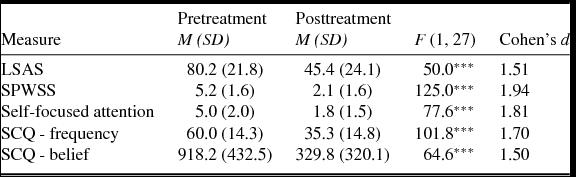
Turning to the within ICT analyses for this report, the random total effect of time on social anxiety (as measured by the SPWSS) was significant (path ci = −0.0132, SE = 0.0018, p < .0001) indicating that patients’ social anxiety changed significantly over time. There was no therapist x time interaction effect indicating that therapists did not differ in their impact on social anxiety over time. Descriptive data for the outcome (LSAS) and process measures at pre and posttreatment are shown in Table 1.
Outcome measure and process measures at pre and posttreatment (n = 281)

Notes: 1One patient who dropped out after five sessions was not included.
LSAS = Liebowitz Social Anxiety Scale, SPWSS = Social Phobia Weekly Summary Scale, SCQ = Social Cognitions Questionnaire.
*** p <. 001
Assessment of potential mediators
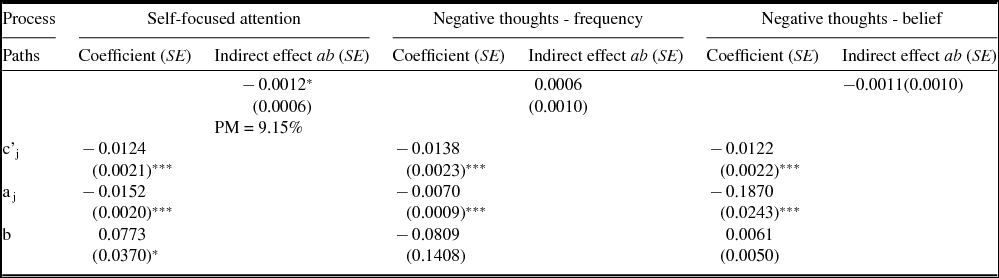
Self-focused attention and social phobia related negative automatic thoughts were examined in separate multilevel mediation models. The aim was to examine if changes in social anxiety could be attributed to preceding changes in the respective process variable. Changes in self-focused attention mediated subsequent changes in social anxiety, whereas changes in social phobia related negative automatic thoughts (frequency and belief) did not predict subsequent changes in anxiety. See Table 2 for the relevant path coefficients and estimates of the indirect effects.
Path coefficients and indirect effects for process effects on social anxiety

Notes: Path c’ denotes the direct effect of time on outcome, controlling for a process effect. Path ai denotes the effect of time on the specified process variable. Path b denotes the effect of a specified process variable on the subsequent week's outcome, when time is being held constant. PM = Percent Mediation (i.e. proportion of the total effect which is accounted for by the indirect effect). SE = standard error; *p < .05, ***p <.0001
Both self-focused attention and social phobia related negative automatic thoughts changed significantly with treatment. However, holding time constant, only changes in self-focused attention further predicted subsequent changes in social anxiety. The indirect effect for self-focused attention was significant, indicating that changes in social anxiety over time could be attributed to preceding changes in this process variable. Importantly, the reverse mediation model, which tested whether changes in social anxiety mediated the effect of elapsed time on subsequent self-focused attention, was not significant (c’j: −0.0146 [SE = 0.0018] p < .001; aj: −0.0149 [SE = 0.0026] p < .001; b: −0.0033 [SE = 0.0512] p >.05; ab: 0.0000 [SE = 0.0009] p >.05). There was also no evidence of reverse mediation for social phobia related negative automatic thoughts. It is possible that the lack of a significant lagged relationship between social phobia related thoughts and subsequent social anxiety is due to the fact that changing thoughts has a fairly immediate effect on anxiety (see Clark, Reference Clark1993 for example). If that is correct, we would expect to obtain evidence for mediation in a non-lagged model; this was in fact the case. In a concurrent (non-lagged model) change in social phobia related thoughts mediated the relationship between elapsed time and change in social anxiety (SCQf: c’j: −0.0077 [SE = 0.0019] p < .001; aj: −0.1510 [SE = 0.0199] p < .001; b: 0.0450 [SE = 0.0090] p < .001; ab: −0.0068 [SE = 0.0012] p < .001; SCQbFootnote 2 : c’j: −0.0073 [SE = 0.0021] p < .001; aj: -4.0259 [SE = 0.5494] p < .001; b: 0.0016 [SE = 0.0003] p < .001; ab: −0.0065 [SE = 0.0012] p < .001).
Discussion
The present study examined the predictive relationships between self-focused attention, social phobia related negative automatic thoughts and social anxiety in ICT. The main findings were that weekly changes in self-focused attention accounted for subsequent changes in social anxiety and that frequency of, and belief in, social phobia related negative automatic thoughts were not predictive of subsequent social anxiety. Moreover, changes in social anxiety did not account for subsequent changes in self-focused attention. However, both self-focused attention and negative social phobia related automatic thoughts changed in line with overall outcome and were significantly reduced over the course of treatment.
The findings are consistent with previous studies suggesting a causal link between self-focused attention and levels of social anxiety (Bögels and Lamers, Reference Bögels and Lamers2002; McManus et al., Reference McManus, Clark, Grey, Wild, Hirsch and Fenell2009), and a relation between treatment change of self-focused attention and decreases in social anxiety (Woody, Chambless and Glass, Reference Woody, Chambless and Glass1997; Hofmann, Reference Hofmann2000).
It is difficult to interpret the lack of an indirect effect of time on social anxiety via changes in social phobia related negative thoughts. Clearly, social phobia related thoughts decrease over the course of successful treatment (Wells et al., Reference Wells, Clark, Salkovskis, Ludgate, Hackmann and Gelder1995; Wells and Papageorgiou, Reference Wells and Papageorgiou1998; Hofmann, Reference Hofmann2000; Mörtberg et al., Reference Mörtberg, Clark, Sundin and Åberg Wistedt2007; McManus, Sacadurab and Clark, Reference McManus, Sacadurab and Clark2008). It is possible that the temporal relationship may be tighter than that observed for self-focused attention and social anxiety. Consistent with this suggestion, Hoffart et al. (Reference Hoffart, Borge, Sexton and Clark2009) found that changes in the estimated probability and cost of feared outcomes predicted subsequent changes in social anxiety after a gap of half a week, rather than the full week interval used in this study. Consistent with the short time lag idea, we found that change in social phobia related thoughts did account for improvement in social anxiety in a concurrent (non-lagged mediation) model. Sample size may also be an important consideration. For example, Boecking, Ehlers and Clark (Reference Boecking, Ehlers and Clark2013) recently found evidence for a significant relationship between changes in social phobia related negative automatic thoughts and subsequent changes in social anxiety in a study with a substantially larger sample of patients treated with ICT.
The main strength of this study was the frequent assessment of both process and outcome variables and the use of multilevel methods to estimate process-outcome relationships. Some limitations should be recognized when interpreting the results of the present study, most of which relate to measurement issues. First, putative mediators and outcome were assessed using self-report measures, although with sound psychometric characteristics. Second, self-focused attention was measured by only one item. Third, process variables were measured only on a weekly basis in the ICT branch of the trial. The superiority of ICT compared to the other treatments in the trial was evident in the process variables as well as the social anxiety measures (Mörtberg et al., Reference Mörtberg, Clark, Sundin and Åberg Wistedt2007). However, as weekly process ratings were not collected in the other treatments, we were unable to determine whether similar mediators accounted for improvement in the other treatments.
In summary, the present study provides preliminary support for the proposed mediation model that changes in self-focused attention over time lead to reductions in social anxiety during cognitive therapy for social anxiety disorder. This suggests that clinicians should pay careful attention to monitoring the extent to which self-focused attention does, or does not, change during the course of therapy. ICT emphasizes attention training. The present results suggest that outcome might be further improved by enhancing this component of the treatment. Other psychological therapies for social anxiety disorder may also benefit from an explicit emphasis on facilitating a shift from internal to externally focused attention.
Acknowledgements
This study was supported by grants from the Söderström-Königska Foundation, the Torsten and Ragnar Söderbergs Foundation, The Lundbeck Foundation and the Centre for Health Care Science, Karolinska Institutet. David M. Clark is supported by Grant 069777 from the Wellcome Trust and by the National Institute for Health Research Biomedical Research Centre at the South London and Maudsley Health Service Foundation Trust and Kings College London and the NIHR Oxford Cognitive Health Clinical Research Facility. Benjamin Boecking was funded by a Biomedical Research Studentship from the National Institute for Health Research (NIHR) Mental Health Biomedical Research Centre at South London and Maudsley NHS Foundation Trust and King's College London.



Comments
No Comments have been published for this article.