A congenital cardiac defect treated with surgery is seldom totally cured. The incidence of residua, sequelae, and comorbidity is quite high. Re-operations are often needed, and patients even more often require medical treatment to maintain their physical competence.
Patients with cardiac defects often suffer from additional diseases. In addition, various genetic syndromes and other congenital malformations are common. There is also strong evidence of a relationship between cardiac defects and neurological sequelae.
The aim of this population-based follow-up study was to assess the actual prevalence of health problems requiring medicinal treatment after paediatric cardiac surgery.
Methods
This is a retrospective follow-up study of the patients operated on for congenital cardiac disease. The usage of medicines and prevalence of chronic diseases during the year 2004 served as the outcome measure.
According to the Finnish Research Registry of Paediatric Cardiac Surgery, a total of 7240 cardiac operations were performed on 6460 children in Finland during the years 1953–1989. According to the Finnish Population Registry, on the closing day of the study, that is, on 23 August, 2004, 5116 (79%) of them were alive and living in Finland. Overall mortality was 18% (1142/6460). The outcome of 203 (3%) patients was unknown.
Data on the patients’ medication were obtained from the medication registry of the Finnish Social Insurance Institution. The registry contains information on the details and costs of purchases of prescribed medicines. The records are based on on-line computerised information provided to the Social Insurance Institution by all Finnish pharmacies. In the registry, medications are categorised according to the Anatomical Therapeutic Chemical classification.1 Use of a medication was defined as at least one purchase during the year 2004.
The medication registry did not include knowledge of the indication of the medicine. The knowledge of chronic diseases of the population was obtained from the registry of the entitlements to special reimbursement also maintained by the Social Insurance Institution. In Finland, individuals with certain specific chronic diseases (nearly 80 diseases) are entitled to special reimbursement for the drug treatment costs of that disease. Patients apply to the Social Insurance Institution for entitlement to special reimbursement. The application requires a certificate from a physician giving the details of diagnosis and treatment for the disease.
Purchases and entitlements to special reimbursements are linked to the social security numbers of individuals. Identification numbers also enable the information from the Social Insurance Institution to be linked to the Research Registry of Paediatric Cardiac Surgery.
We studied differences in the usage of medications between patients with various diagnoses. Patients were divided into groups according to their main diagnosis based on a previously published hierarchy.Reference Nieminen, Jokinen and Sairanen2 The groups studied separately were patent ductus arteriosus, coarctation of the aorta, atrial septal defect, ventricular septal defect, tetralogy of Fallot, transposition of the great arteries, and univentricular heart.
For each patient in our study population, two matched control subjects were chosen from the population registry. The matching criteria were sex, age (plus or minus 2 years) and the hospital district in which the patient lived.
The Finnish Research Register of Paediatric Cardiac Surgery was established with the permission of the Finnish Ministry of Social Affairs and Health. The Social Insurance Institution approved the use of the data from the medication registry.
Statistical methods
In this follow-up study, the prevalence of chronic diseases and the use of medications of patients were compared to that of the control subjects. Differences were calculated as risk ratios with 95% confidence intervals and were considered significant if the confidence limit did not include the value of 1.00. Student’s t-test served in counting the difference between the mean ages of patients and controls.
Results
This study included a total of 5116 patients who underwent surgery during 1953–1989. Their mean age at the first operation was 5.4 years with a median of 5.0 (ranged from 0 to 15) years. On the closing day of the study, the patients were on average of 33.4 years with a median of 32.7 (ranged from 14.7 to 64.8) years old, and their mean follow-up time was 28.1 with a median of 27 (ranged from 16.6 to 51.3) years. Altogether, 198 (3.8%) patients were mentally retarded. Most patients with mental disabilities had a genetic syndrome: 119 (2.3%) patients had Down’s syndrome.
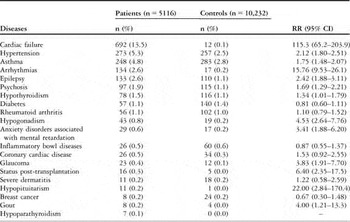
The patients studied had more entitlements to special reimbursements for medicines than did the controls, 30% (1550/5116) and 12% (1194/10,232), respectively (risk ratio: 2.60, 95% confidence interval: 2.43–2.78). The five most common chronic diseases among patients were cardiac failure (14%), hypertension (5%), asthma (5%), arrhythmias (3%), and epilepsy (3%). The controls most often had asthma (3%) and hypertension (3%). In all other diseases, the proportion of controls with a disease was less than 2% (Table 1).
Prevalence of chronic diseases according to special medication reimbursement records.

95% CI = 95% confidence interval; RR = risk ratio
Only 6 of the 20 most common diseases had the same prevalence within the patient population and control subjects. The patients’ risk for diabetes, rheumatoid arthritis, inflammatory bowel diseases, coronary cardiac disease, severe dermatitis, and breast cancer was similar to that of controls (Table 1).
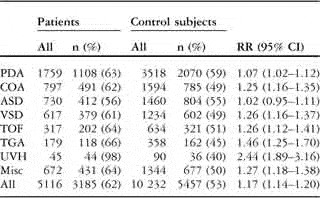
The patients’ actual usage of medicines was somewhat higher than that of the control subjects. A total of 62% (3185/5116) of the patients had bought at least one prescribed medicine, whereas 53% (5462/10,232) of controls had purchased any medication (risk ratio: 1.16, 95% confidence interval 1.13–1.20) in 2004. Only patients with atrial septal defect used equal amount of medicines as controls (Table 2).
Use of all medicines.

ASD = atrial septal defect; COA = coarctation of aorta; Misc = miscellaneous diagnosis; PDA = patent ductus arteriosus; RR = risk ratio; TGA = transposition of the great arteries; TOF = tetralogy of Fallot; UVH = univentricular heart; VSD = ventricular septal defect; 95% CI = 95% confidence interval
Cardiovascular medicines
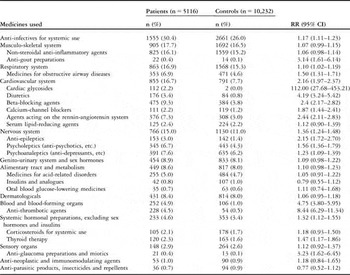
A total of 17% (855/5116) of the patients and 8% (791/10,232) of the control subjects used medications for cardiac diseases (risk ratio: 2.16, 95% confidence interval: 1.97–2.37; Table 3). Patients using cardiac medicines were younger than controls – their mean age at follow-up was 38.2 plus or minus 0.4 versus 44.9 plus or minus 0.4 years (p < 0.001).
Use of medicines.

95% CI = 95% confidence interval; RR = risk ratio
Patients using medication for cardiovascular diseases were older and had undergone surgery at an older age than the other patients; the mean age was 38.9 plus or minus 0.4 versus 32.3 plus or minus 0.2 years (p < 0.001) and the mean age at the first operation was 6.4 plus or minus 0.2 versus 5.1 plus or minus 0.1 years (p < 0.001), respectively.
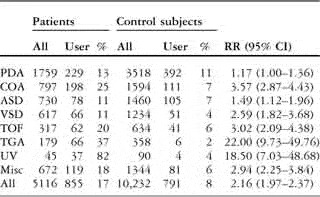
The proportion of patients using cardiovascular medicines was high in all diagnosis groups, varying from 11% to 82% (Table 4). The proportion was highest among patients with univentricular heart. Most patients with transposition of the great arteries (151/179, 84%) had undergone an atrial switch operation; 38% of them used cardiac medicines.
Use of all medicines for cardiovascular system in diagnosis groups.

ASD = atrial septal defect; COA = coarctation of aorta; Misc = miscellaneous diagnosis; PDA = patent ductus arteriosus; RR = risk ratio; TGA = transposition of the great arteries; TOF = tetralogy of Fallot; UVH = univentricular heart; VSD = ventricular septal defect; 95% CI = 95% confidence interval
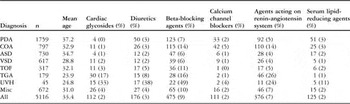
The actual usage of different medications is presented in Table 5. The group of serum lipid-reducing agents was the only group of cardiac medicines in which the proportion of users among patients and controls was similar (risk ratio: 1.12, 95% confidence interval: 0.90–1.39).
Use of cardiac medicines in diagnosis groups.

ASD = atrial septal defect; COA = coarctation of aorta; Misc = miscellaneous diagnosis; PDA = patent ductus arteriosus; TGA = transposition of the great arteries; TOF = tetralogy of Fallot; UVH = univentricular heart; VSD = ventricular septal defect
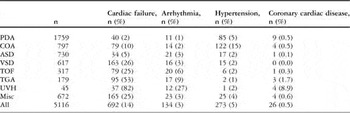
The number of patients with entitlements to special reimbursement for cardiovascular disease medication was high in every cardiac defect group (Table 6). Hypertension was most common among patients with coarctation of the aorta (15%). The proportion of arrhythmias was greatest among patients with univentricular heart, transposition of the great arteries, and tetralogy of Fallot (27%, 9%, and 6%, respectively). Coronary cardiac disease was common among the patient and control population risk ratio 1.53, 95% confidence interval 0.92–2.55). Of the 26 patients with coronary disease, 4 (15%) had a cardiac transplantation. Surprisingly, none of the 16 patients who underwent arterial switch operation for transposition of the great arteries had coronary cardiac disease.
Entitlements to special reimbursement for cardiac diseases in diagnosis groups.

ASD = atrial septal defect; COA = coarctation of aorta; Misc = miscellaneous diagnosis; PDA = patent ductus arteriosus; TGA = transposition of the great arteries; TOF = tetralogy of Fallot; UVH = univentricular heart; VSD = ventricular septal defect
Comorbidity
The health problems clustered. Altogether, 26% (397/1550) of patients and 19% (228/1194) of controls had entitlements to special reimbursement for at least two diseases. Even after omitting cardiac diseases, there were 110 patients with more than one chronic disease; 20% of all 540 patients had no entitlements to special reimbursement for cardiovascular medicines.
Asthma
The patients’ risk ratio for asthma was 1.75 and 95% confidence interval was 1.48–2.07 (Table 1). Of the patients with asthma, 10% (26/248) underwent surgery before the age of 1 month (risk ratio: 1.61, 95% confidence interval: 1.08–2.37), when compared to patients who underwent surgery later on. Among patients who underwent operation neonatally, the risk for asthma was highest among those with patent arterial duct (16/139, 12%) when compared to those with other cardiac defects (10/212, 5%; risk ratio: 2.46, 95% confidence interval 1.15–5.27). However, even after excluding all patients who underwent surgery neonatally, the risk ratio of asthma was 1.65 (95% confidence interval: 1.38–1.96) times higher than that among the controls. Cardiopulmonary bypass surgery had no impact on the patients’ risk for asthma.
Epilepsy
Patients were at a 2.42 (confidence interval: 1.88–3.11) times higher risk for epilepsy than were the controls (Table 1). Altogether, 133 (2.6%) patients had epilepsy, of whom 23 (17%) had undergone cardiac surgery as neonates – risk ratio for other patients was 2.87 and 95% confidence interval was 1.85–4.43. There was no difference in the prevalence of epilepsy between the patients with patent arterial duct and other neonatal patients. After excluding patients who underwent surgery neonatally, the risk of epilepsy remained 2.12 (95% confidence interval: 1.62–2.76) times higher than that among the controls. Open-heart surgery did not increase the risk for epilepsy.
Over one-fifth (23%, 31/133) of the patients with epilepsy were mentally retarded, most of whom had chromosomal abnormalities. However, even after exclusion of retarded patients, the number of patients with epilepsy was significantly higher than that of controls.
Psychiatric disorders
Altogether, 506 (9.9%) patients and 769 (7.5%) controls used medicines for psychiatric disorders (risk ratio: 1.32, 95% confidence interval: 1.18–1.46).
Depression was the biggest and most common mental health problem among both patients and controls. A total of 391 (7.6%) patients and 635 (6.2%) controls used anti-depressants (risk ratio: 1.23, 95% confidence interval: 1.09–1.39; Table 3). A chronic disease increased the risk of depression among patients and controls. If a patient had an entitlement to special reimbursement for medication of some chronic disease, the risk for using anti-depressants was 1.65 (95% confidence interval: 1.36–1.99) when compared to patients without chronic diseases (Table 7). The risk was even greater among the control population (risk ratio: 2.84, 95% confidence interval: 2.41–3.34). Symptomatic cardiac disease increased the risk for depression similarly among patients and controls: 15% of those persons with entitlement to special reimbursement for cardiovascular medicines also used anti-depressants (124/855 patients and 120/791 controls).
Chronic diseases and depression.

95% CI = 95% confidence interval; RR = risk ratio
The patients’ risk for psychosis was 1.69 (95% confidence interval 1.29–2.21) times higher than that of controls; 1.9% (97) of patients and 1.1% (115) of controls had an entitlement to special reimbursement for anti-psychotics (Table 1). The prevalence of psychosis was similar in cardiac defect groups.
Other diseases
Patients had hormone deficiencies more often than did controls (Table 1). Most of the patients with hormonal diseases had genetic syndromes. For instance, the difference in the prevalence of hypothyroidism disappeared when the patients with Down’s syndrome were excluded from the analysis. Of the 78 patients with hypothyroidism, 16 had Down’s syndrome.
The patients’ risk for gout was high (risk ratio: 4.00, 95% confidence interval: 1.21–13.3; Table 1). There were four out of eight patients with gout who had tetralogy of Fallot with extended cyanosis: two had had only palliative shunts, and the other two underwent corrective surgery at the ages of 11 and 27 years.
Usage of antibiotics
The medicines most used among all the study subjects were antibiotics; 30% of patients and 26% of controls (risk ratio: 1.2, 95% confidence interval: 1.11–1.23) purchased anti-infective medicine at least once during the year 2004 (Table 3). Patients had bought 2789 cures of antibiotics (0.55 per patient), and controls 4314 cures (0.42 per patient).
Discussion
In this population-based follow-up study, we examined the comorbidity and the usage of medicines of the patients who underwent surgery for a congenital cardiac defect.
The accuracy of the research registry of paediatric cardiac surgery in Finland guaranteed the reliability and coverage of the study. Data on the usage of the medicines were also reliable because in Finland all medications are sold only in pharmacies and the medicine registries got knowledge of purchases on line.
Patients exhibited many chronic diseases, in addition to cardiac disease, and they used more medications than did the control subjects. Yet, the usage of medicines in this study gives too little prevalence of diseases among patients with operated congenital cardiac disease, as most of the patients who died during the follow-up time suffered from the diseases measured in 2004. In our previous study, it was shown that patients died most often due to cardiac disease, but other diseases also caused high mortality.Reference Nieminen, Jokinen and Sairanen3
Patients with chronic diseases in general often bear a big burden of medicines.Reference Ikäheimo, Hartikainen, Tuuponen, Kiuttu and Klaukka4, Reference Reunanen, Kangas, Martikainen and Klaukka5 Part of this may result from frequent visits to the doctor, when the minor discomforts can be easily brought out, examined, and treated.
The patients in our study underwent surgery before the 1990s. The results of patients who recently underwent surgery will probably differ from this early material, as patients who undergo surgery nowadays have more severe defects and more often have chromosomal diseases. However, the leading comorbidities in our study were quite similar to those in a Belgian paediatric population published in a recent study.Reference Massin, Astadicko and Dessy6
Cardiovascular medicines
Astonishingly, 83% of the patients needed no cardiac medication. Even 62% of patients who underwent atrial switch operation for transposition of the great arteries used no medication for cardiac symptoms. However, the patients on average used more cardiovascular medicines than did the controls.
Patients who need cardiac medication were operated on at an older age than other patients. Thus, the older the patient at the time of the surgery, the more often some cardiac sequelae will appear. Patients should undergo surgery as early as possible, but neonates should undergo surgery only in urgent situations, as we discovered that the risk for neurological and pulmonary damages among them were very common.
Arrhythmias occurred most frequently among patients with univentricular heart, transposition of the great arteries, and tetralogy of Fallot; all are known to have high prevalence of both arrhythmias and sudden deaths.Reference Saliba, Butera and Bonnet7–Reference Gatzoulis, Balaji and Webber9
The risk for hypertension was equal among patients and controls with the exception of patients with coarctation of the aorta. The 15% prevalence of hypertension among patients who underwent coarctation repair as children was approximately the same as in the previously published data.Reference Høimyr, Christensen and Emmertsen10, Reference Cohen, Fuster, Steele, Driscoll and McGoon11
Coronary cardiac disease was as common among patients as among controls. Earlier studies have claimed that the prevalence of coronary disease among patients with operated coarctation of the aorta is high.Reference Høimyr, Christensen and Emmertsen10, Reference Cohen, Fuster, Steele, Driscoll and McGoon11 Our results disagreed with those studies, and were in line with our previous study, in which we discovered that patients with aortic coarctation seldom died due to coronary cardiac disease.Reference Nieminen, Jokinen and Sairanen3 That the patients were under 15 years of age at the time of the surgery may have protected them from hypertension, and through that, from coronary disease.
The emergence of coronary disease in patients with a cardiac transplant resulted from allograft vasculopathy. It was slightly surprising that none of the survivors of the arterial switch operation in our material required medication for coronary problems, though such problems have often been related to the old era of switch surgery.Reference Legendre, Losay and Touchot-Koné12
Comorbidity
The health problems clustered within the patient and control populations. The vast majority of patients and controls had no entitlement to special reimbursement for medication for any disease, whereas 25% of the patients and 19% of the controls had more than one chronic disease requiring regular medication. In addition, the use of anti-depressants was most common among persons with chronic diseases. This connection has been described recently in the World Health Surveys,Reference Moussavi, Chatterji, Verdes, Tandon, Patel and Ustun13 and should be kept in mind in day-to-day clinical work.
Heart patients often suffered from asthma. Most asthma patients were with patent arterial duct that was closed as neonates. The cause of asthma among them was most probably prematurity.Reference Jaakkola, Ahmed and Ieromnimon14 However, the difference in the prevalence of asthma between patients and controls was high even after excluding all neonatally operated patients. Thus, mature lungs may have incurred damage either because of the cardiac surgery or due to the cardiac defect itself. Open-heart surgery did not increase the risk for asthma within the patient population, which supports studies in which post-surgery lung injuries have been connected to blood transfusion and ventilation more often than to the cardiopulmonary bypass perfusion.Reference Groeneveld, Jansen and Verheij15, Reference Silliman, Ambruso and Boshkov16
Patients were at high risk for epilepsy. Numerous studies have been published concerning the effect of open-heart surgery on the neurodevelopment of children.Reference Hövels-Gürich, Seghaye, Däbritz, Messmer and von Bernuth17–Reference Clancy, McGaum and Wernovsky19 Our study showed that the risk for epilepsy was high regardless of the type of surgery. Of the patients with epilepsy, one-fifth underwent surgery as neonates, and one-fifth were mentally retarded. There is a strong relationship between intellectual disability and epilepsy.Reference Arvio and Sillanpää20 In our subjects, most retarded patients had chromosomal defects, but some of the mental disability also resulted from the cardiac defect or surgery. Nowadays, the number of patients with surgery-induced brain damage would probably be much lower as the monitoring and protection of cerebral circulation has improved immensely.Reference Williams and Ramamoorthy21
The number of patients using medicines for psychiatric diseases was significantly higher than that of controls, though the number of controls using anti-depressants was also high. In previous studies, patients have expressed some anxiety and depression,Reference Popelova, Slavik and Skovranek22–Reference van Rijen, Utens and Roos-Hesselink24 but no signs of such common phenomena have been reported. In spite of our subjects including patients with mental retardation whose condition is often complicated by psychiatric diseases,Reference Arvio and Sillanpää20 the number of patients using psychiatric medication was high. In particular, the high prevalence of psychosis demands further investigation.
The number of patients with gout was high, which supports a previous study in which cyanotic patients had high urate levels and a high prevalence of gout.Reference Ross, Perloff, Danovitch, Child and Canobbio25
Patients used antibiotics more often than did controls, which could be due to their lower resistance to infections, and antibiotic prophylaxis was used before various procedures. Patients may also consult a general physician more easily when they have an infection, and perhaps doctors prescribe medicine more easily for them.
Limitations
The biggest limitation of this method in studying morbidity was that no knowledge was found of diseases requiring no medicinal treatment. In addition, the medicines sold over-the-counter and used in hospitals were excluded from this study, as the medicine records provided no such information.
The rather high number of mentally retarded patients could have an increasing effect on comorbidity. Most patients with mental retardation had genetic syndromes that often cause comorbidity, as was seen in the hormone deficiencies. Unfortunately, we had no knowledge of the number of retarded persons among the control population. The expected number of control subjects with low intelligence quotient (IQ), assessed on the basis of Finnish epidemiological study,Reference Arvio and Sillanpää20 was less than 60 patients (<0.6%).
Conclusion
Patients who underwent surgery for a congenital cardiac defect as children needed a considerable number of medications for chronic diseases. The health problems clustered among both patients and controls. The hearts of most patients recovered well after surgery as 83% of patients required no cardiac medication. The neonatal brain and lungs proved quite vulnerable as patients who underwent surgery during the first month of life were at high risk for asthma and epilepsy.
Acknowledgements
The authors thank the statistical advisor Hanna Koskinen, MSc. This study has been financially supported by The Finnish Medical Foundation, The Finnish Foundation for Cardiovascular Research, The Finnish Slot Machine Association, and The Finnish Association for Heart Children and Adults. The authors declare that they have no conflict of interests.