Introduction
While anorexia nervosa (AN) and bulimia nervosa (BN) are both major psychiatric disorders, affecting approximately 2–3% of young women (APA, 2000; Hudson et al. Reference Hudson, Hiripi, Pope and Kessler2007), the most prevalent eating disorders fall into the category of eating disorder not otherwise specified (EDNOS) (Keel et al. Reference Keel, Heatherton, Dorer, Joiner and Zalta2006, Wade et al. Reference Wade, Bergin, Tiggemann, Bulik and Fairburn2006). Experts have called for more research to increase understanding of EDNOS given their prevalence and clinical significance (Grilo et al. Reference Grilo, Devlin, Cachelin and Yanovski1997; Fairburn & Bohn, Reference Fairburn and Bohn2005). In answer to this call, a great deal of work has been conducted on the etiology and treatment of binge-eating disorder (BED), an EDNOS characterized by recurrent binge eating in the absence of inappropriate compensatory behaviors. In contrast, purging disorder (PD)Footnote †, an EDNOS characterized by recurrent purging in the absence of objectively large binge episodes (Keel et al. Reference Keel, Haedt and Edler2005), has gained only recent attention in the scientific literature (Keel et al. Reference Keel, Mayer and Harnden-Fischer2001, Reference Keel, Haedt and Edler2005; Binford & le Grange, Reference Binford and le Grange2005; Mond et al. Reference Mond, Hay, Rodgers, Owen, Crosby and Mitchell2006; Wade et al. Reference Wade, Bergin, Tiggemann, Bulik and Fairburn2006; Wade, Reference Wade2007).
Recent epidemiological studies in Australia (Wade et al. Reference Wade, Bergin, Tiggemann, Bulik and Fairburn2006) and Italy (Favaro et al. Reference Favaro, Ferrara and Santonastaso2003) indicate that PD may be as common as other major eating disorders. In these studies, PD affected 1.1–5.3% of women in their lifetimes, compared to 1.9–2.0% for AN, 2.9–4.6% for BN, and 0.6–2.9% for BED (Favaro et al. Reference Favaro, Ferrara and Santonastaso2003; Wade et al. Reference Wade, Bergin, Tiggemann, Bulik and Fairburn2006). Notably, the prevalence estimates for PD excluded women with lifetime histories of other DSM-IV eating disorders. This hierarchical approach in forming lifetime diagnoses makes prevalence estimates for PD more striking as they reflect women who would be excluded from most studies of the epidemiology, etiology and treatment of eating disorders. As an unfortunate example of this, the replication of the National Comorbidity Survey (NCS) did not provide information on the prevalence of PD in the USA because structured interviews employed ‘skip rules’ in which the presence of purging was not queried if participants denied histories of low weight and objectively large binge episodes (Hudson et al. Reference Hudson, Hiripi, Pope and Kessler2007). However, a recent latent class analysis of bulimic symptoms in the USA supported a three-class solution in which 5.6% of individuals fell into a ‘purging’ class, 4.7% were in a ‘bingeing’ class, and 1.0% were in a ‘binge-purge’ class (Striegel-Moore et al. Reference Striegel-Moore, Franko, Thompson, Barton, Schreiber and Daniels2005). Although these classes do not map onto the syndromes of PD, BED, and BN, they do reflect the subgroups among whom these diagnoses could be made.
Research has indicated that women with either current (Keel et al. Reference Keel, Haedt and Edler2005) or lifetime (Wade et al. Reference Wade, Bergin, Tiggemann, Bulik and Fairburn2006) histories of PD report significantly greater depression, anxiety, co-morbid Axis I and II disorders, and suicidality compared to women with no lifetime history of eating disorders. In addition, studies have demonstrated that PD may not differ meaningfully from BN in dietary restraint, body image disturbance, or overall eating disorder severity (Keel, Reference Keel, Wolfe, Liddle, De Young and Jimersonin press) or chronicity (Keel et al. Reference Keel, Haedt and Edler2005; Wade et al. Reference Wade, Bergin, Tiggemann, Bulik and Fairburn2006). Thus, studies indicate that PD may be worthy of elevation from the category of EDNOS which could have significant advantages for examining PD's etiology and treatment.
Despite these results, certain limitations of previous studies are worthy of note. First, previous studies have examined the clinical significance of PD in terms of associated distress but have not examined evidence of impairment associated with PD. According to the DSM-IV-TR (APA, 2000, p. xxxi), evidence that a syndrome is associated with ‘impairment in one or more important areas of functioning’ would represent disability and further support the syndrome's clinical significance. Second, given high rates of co-morbidity between PD and mood, anxiety, and substance use disorders (Binford & le Grange, Reference Binford and le Grange2005; Keel et al. Reference Keel, Haedt and Edler2005; Wade, Reference Wade2007), it is unclear whether one should attribute elevated levels of distress to the presence of PD. It is possible that purging should be thought of as a behavior that accompanies other Axis I disorders in a small subset of women rather than forming the central feature of a separate eating disorder syndrome. Thus, the current study sought to advance understanding of PD by examining evidence of impairment as well as distress and by determining the extent to which these features are manifest after controlling for co-morbid disorders.
Methods
Participants
Women (n=119) were recruited from the community for participation in a study of the clinical significance and distinctiveness of PD. The study involved two out-patient visits, and results concerning the distinctiveness of PD from BN on subjective and physiological responses to a test meal are reported elsewhere from a subset of participants (n=90) who completed both visits (Keel et al. Reference Keel, Wolfe, Liddle, De Young and Jimersonin press). The current report includes findings that have not been reported elsewhere from interview and self-report assessments completed in the first study visit in women (n=57) with DSM-IV BN-purging subtype [mean (s.d.) age=22.5 (5.1) years; body mass index (BMI)=22.3 (1.9) kg/m2; purging frequency=8.0 (6.9) episodes/week], women (n=24) with PD [mean (s.d.) age=21.8 (4.9) years; BMI=22.1 (2.0) kg/m2; purging frequency=6.1 (4.7) episodes/week], and controls (n=38) with no eating disorder [mean (s.d.) age=22.3 (4.0) years; BMI=22.2 (1.5) kg/m2; purging frequency=0.0 (0.0) episodes/week]. PD was defined by the presence of purging (self-induced vomiting, laxative, or diuretic abuse) to influence weight or shape at least twice per week for a minimum of 3 months, the undue influence of weight or shape on self-evaluation, and the absence of objectively large binge episodes (Keel et al. Reference Keel, Haedt and Edler2005). Thus, individuals with PD might have episodes in which they felt a loss of control over their eating while consuming a normal or small amount of food, termed subjective binge episodes, but they did not have episodes of binge eating as defined in DSM-IV (APA, 2000). In addition, individuals with PD could not have lifetime histories of BN or BED. Non-eating disorder controls were required to have no history of eating disorder behaviors, no dieting for the purpose of weight loss within the 8 weeks preceding study participation, and Three Factor Eating Questionnaire Cognitive Restraint scale scores <10 (Stunkard & Messick, Reference Stunkard and Messick1985). All participants were between the ages of 18 and 45 years, were free of psychotropic medications, were free of medical conditions or treatment that might influence weight or appetite, and had a BMI between 18.5 and 26.5 kg/m2. Thus, participants were within a healthy weight range, and none met criteria for AN.
There were no significant differences among groups in age [F(2, 116)=0.24, p=0.79], BMI [F(2, 112)=0.07, p=0.93], race [χ2(6)=5.63, p=0.47], or educational status [χ2(6)=3.84, p=0.70]. Racial/ethnic composition of the sample was 82% Caucasian, 5% Black/African American, 10% Asian/Pacific Islander, 2% Hispanic, and 1% Undisclosed. One participant (1%) had not completed high school, 68% had a high-school degree, 27% had a college degree, and 4% had a graduate degree.
Recruitment
Participants were recruited from the community using posters at local college campuses, and advertisements on public transportation and in newspapers. Study advertisements invited women with no eating problems, women who binged and purged, and women who used ‘extreme measures to control weight’ to call a toll-free number. Trained research assistants conducted telephone screens with participants as an initial assessment of eligibility; final determination of study eligibility was made using in-person structured clinical interviews (see below). Although all participants were recruited from the community, several had sought mental health treatment in their lifetimes, including 71.9% of BN participants and 66.7% of PD participants [χ2(1)=0.22, p=0.64, Fisher's exact test p=0.79]. Among those seeking treatment, 68% of BN participants had sought help for their eating disorder compared to 44% of PD participants [χ2(1)=2.93, p=0.09, Fisher's exact test p=0.13]. Further, 19.3% of BN participants had received in-patient treatment compared to 4.2% of PD participants [χ2(1)=3.06, p=0.08, Fisher's exact test p=0.07]. Because controls could have a lifetime history of other mental disorders, a proportion of controls (29%) had sought mental health treatment in their lifetimes; however, none (0%) had sought treatment for eating problems or received in-patient treatment.
Comparisons of groups on distress and functional impairment and effect sizes
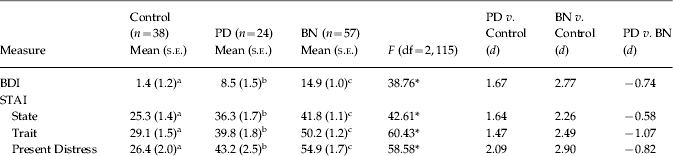
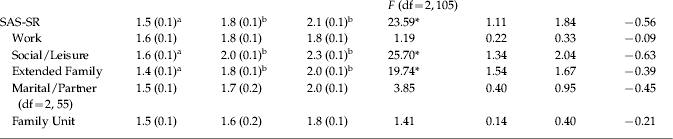
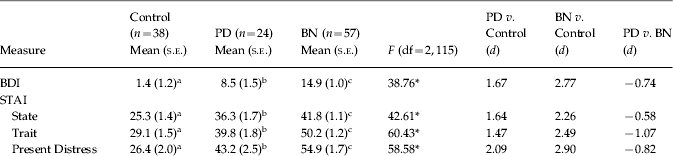
PD, Purging disorder; BN, bulimia nervosa; BDI, Beck Depression Inventory; STAI, State-Trait Anxiety Inventory; SAS–SR, Social Adjustment Scale–Self-Report.
a,b,c Superscripts that differ between groups represent significant differences of p<0.05 between groups after Bonferroni correction. The number of participants who were parents (n=2 per group) was too small for meaningful analyses of this subscale. Using Cohen's (Reference Cohen1977)characterization of effect sizes, d=0.20 represents a small, d=0.50 a medium, and d=0.80 a large effect size.
* p<0.001.
Comparisons of groups on Axis I and Axis II disorders

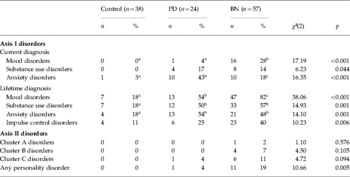
PD, Purging disorder; BN, bulimia nervosa.
a,b,c Superscripts that differ between groups represent significant differences of p<0.05 between groups after Bonferroni correction.
Measures
Participants completed structured clinical interviews and self-report assessments of eating and related psychopathology. In addition, participants completed a measure of social adjustment to assess impairment in important areas of functioning.
Eating Disorders Examination (EDE; Fairburn & Cooper, Reference Fairburn, Cooper, Fairburn and Wilson1993)
The EDE was used to confirm eligibility for study participation. This semi-structured clinical interview can be used to make diagnoses of DSM-IV eating disorders. The main advantage of the EDE includes the clinical rating of binge-eating episodes to distinguish between objectively large and subjective binge episodes. The EDE has demonstrated high inter-rater reliability for eating disorder diagnoses in previous research (Wilson & Smith, Reference Wilson and Smith1989; Rosen et al. Reference Rosen, Vara, Wendt and Leitenberg1990). Kappa reliability for eating disorder diagnoses was 1.0 in the current study. Comparisons of groups on eating disorder-related variables are presented in a separate paper describing physiological responses to a test meal (Keel et al. Reference Keel, Wolfe, Liddle, De Young and Jimersonin press). Briefly, both eating disorder groups reported significantly greater eating concerns, dietary restraint, body image disturbance, and overall eating disorder severity compared to controls but did not differ significantly from each other (Keel et al. Reference Keel, Wolfe, Liddle, De Young and Jimersonin press). Results were the same in analyses of the larger sample included in the current paper.
Structured Clinical Interview for DSM-IV Axis I Disorders (SCID-I; First et al. Reference First, Spitzer, Gibbon and Williams1995)
This semi-structured diagnostic interview includes modules that assess current and lifetime diagnoses of mood, substance use, anxiety, and eating disorders and an addendum assessing impulse control disorders. For current diagnoses, inter-rater reliability was κ=0.65 for mood, κ=0.78 for anxiety, and κ=1.00 for substance use disorders. Inter-rater reliability for current impulse control disorders was low (κ=0.31), and we do not present analyses for this variable due to problems with reliability. For lifetime diagnoses, inter-rater reliability ranged from κ=0.85 for impulse control disorders to κ=1.00 for mood, substance use, and anxiety disorders.
Structured Clinical Interview for DSM-IV Axis II Personality disorders (SCID-I; First et al. Reference First, Gibbons, Spitzer, Williams and Benjamin1997)
This semi-structured diagnostic interview assesses the presence of paranoid, schizoid, schizotypal, antisocial, borderline, histrionic, narcissistic, avoidant, dependent, and obsessive–compulsive personality disorders. In a study of psychiatric in-patients and out-patients of which 15% were diagnosed with eating disorders, the SCID-II demonstrated good inter-rater reliability (mean κ=0.91) (Fossati et al. Reference Fossati, Maffei, Bagnato, Donati, Donini, Fiorilli, Novella and Ansoldi1998). In the current study, inter-rater reliability for personality disorder diagnoses was κ=0.83.
Barratt Impulsiveness Scale-11 (BIS-11; Patton et al. Reference Patton, Stanford and Barratt1995)
This 30-item questionnaire assesses impulsiveness and has demonstrated good concurrent and criterion validity and high internal consistency (α>0.75) in clinical and non-clinical populations (Patton et al. Reference Patton, Stanford and Barratt1995). Internal consistency in the current study was α=0.87.
Beck Depression Inventory (BDI; Beck et al. Reference Beck, Ward, Mendelson, Mock and Erbaugh1961)
This 21-item questionnaire assesses presence and severity of depression over the past week. The BDI has demonstrated good test–retest reliability as well as criterion validity (Beck et al. Reference Beck, Ward, Mendelson, Mock and Erbaugh1961). Internal consistency was α=0.94 in the current study.
State-Trait Anxiety Inventory (STAI; Spielberger et al. Reference Spielberger, Gorsuch, Lushene, Vagg and Jacobs1983)
This 40-item questionnaire assesses levels of current anxiety (state) and anxiety proneness (trait). Factor analysis of this measure has confirmed the two factors in both clinical (Oei et al. Reference Oei, Evans and Crook1990) and non-clinical samples (Spielberger et al. Reference Spielberger, Vagg, Barker, Donham, Westberry, Sarason and Spielberger1980). This measure has demonstrated good concurrent validity (Spielberger & Vagg, Reference Spielberger and Vagg1984). Consistent with the construct of trait versus state anxiety, test–retest reliability was high for the Trait scale (0.80) and low for the State scale (0.35) (Spielberger & Vagg, Reference Spielberger and Vagg1984). In the current study, internal consistency was high for both the State (α=0.95) and Trait (α=0.96) scales.
Present Distress
Consistent with the evaluation of present distress in the NCS (McWilliams et al. Reference McWilliams, Cox and Enns2003), items assessing current depression (e.g. ‘I feel sad’) and anxiety (e.g. ‘I feel upset’) were taken from the BDI and STAI to form a 37-item composite scale of Present Distress. Items assessing somatic symptoms such as changes in appetite or difficulties with sleep were not included (McWilliams et al. Reference McWilliams, Cox and Enns2003). Internal consistency of this scale was high (α=0.96), suggesting that items were tapping a unitary construct, consistent with previous findings for a similar measure (McWilliams et al. Reference McWilliams, Cox and Enns2003).
Weissman's Social Adjustment Scale – Self-Report (SAS-SR; Weissman & Bothwell, Reference Weissman and Bothwell1976)
This 54-item questionnaire comprises six subscales: Work, Social and Leisure, Extended Family, Marital, Parental, and Family Unit that assess role performance, interpersonal relationships, friction, feelings and satisfaction across different settings. Thus, this measure evaluates ‘impairment in one or more important areas of functioning’ (APA, 2000, p. xxxi). The correlation for overall adjustment measured by the interview versus self-report derived social adjustment was 0.72 (Weissman & Bothwell, Reference Weissman and Bothwell1976). The correlation between report by an informant and a psychiatrically ill patient was 0.74 (Weissman & Bothwell, Reference Weissman and Bothwell1976). In the current study, internal consistency ranged from α=0.69 for the Family Unit scale to α=0.74 for the Marital scale, and internal consistency for the total score was α=0.84. This measure was added to the study after the first nine participants were completed. Thus, data are missing for a small number of control (n=4), PD (n=1), and BN (n=4) participants.
Analyses
Multiple analyses of variance (MANOVAs) were used to compare groups on continuous measures. χ2 analyses were used to compare groups on categorical variables, with Fisher's exact test used for post-hoc comparisons of groups on binomial variables. To determine whether elevations in distress and impairment were associated with PD after controlling for co-morbid disorders, we used MANCOVA with lifetime history of Axis I or II disorders as a covariate. These analyses controlled for disability associated with co-morbid disorders even when the disorders themselves are not acutely present (Ormel et al. Reference Ormel, Oldehinkel, Nolen and Vollebergh2004). Because of the large number of statistical tests, a conservative Bonferroni-corrected p value (p=0.0033, reflecting the 15 independent analyses reported in Tables 1 and 2) was used to evaluate the significance of omnibus tests before conducting post-hoc comparisons, and we used the Bonferroni method for post-hoc comparisons of groups.
Results
Table 1 presents comparisons among groups on indicators of distress and impairment. Participants with PD reported significantly elevated levels of depression and anxiety compared to controls. However, PD participants reported significantly less depression and anxiety compared to BN participants. Reflecting these patterns, PD participants reported significantly greater present distress compared to controls but significantly less present distress compared to BN participants. Finally, PD participants reported significantly greater impairment on measures of social and familial function, as well as overall psychosocial function, compared to controls and did not differ significantly from BN participants (see Table 1).
Table 2 presents comparisons for rates of Axis I and II disorders in participants. Women with PD demonstrated a significantly greater prevalence of Axis I psychopathology compared to non-eating disorder controls for current anxiety disorders and lifetime mood, substance use, and anxiety disorders (see Table 2). Compared to BN women, PD women had lower rates of current and lifetime mood disorders and higher rates of current anxiety disorders. Otherwise, PD and BN participants had comparable rates of co-morbid Axis I disorders.
Groups did not differ in point prevalence of personality disorders (see Table 2). However, analyses of the BIS-11 supported significant differences on impulse control across groups [F(2, 116)=9.12, p<0.001], with BN women [mean (s.e.)=65.1 (1.4)] and PD women [mean (s.e.)=61.5 (2.2)] reporting significantly greater impulsiveness compared to controls [mean (s.e.)=55.4 (1.7)].
To assess present distress and impairment associated with eating pathology, rather than with co-morbid disorders, comparisons of groups were repeated using Axis I and II disorders as a covariate. These analyses supported a significant effect for group on distress [F(2, 102)=34.2, p<0.001] and impairment [F(2, 102)=14.5, p<0.001]. Post-hoc comparisons indicated greater levels of distress [F(1, 52)=30.9, p<0.001] and impairment [F(1, 52)=8.7, p=0.005] in PD compared to controls that cannot be attributed to differences in lifetime history of other Axis I or II disorders. A similar pattern of results emerged for comparisons of BN participants and controls on distress [F(1, 81)=65.4, p<0.001] and impairment [F(1, 81)=32.8, p<0.001]. Finally, post-hoc comparisons of PD and BN controlling for co-morbid disorders revealed significantly greater distress in BN participants [F(1, 70)=7.0, p=0.01] compared to PD participants but no significant differences in impairment [F(1, 70)=2.9, p=0.09].
Discussion
Consistent with previous studies (Keel et al. Reference Keel, Haedt and Edler2005; Binford & le Grange, Reference Binford and le Grange2005; Wade et al. Reference Wade, Bergin, Tiggemann, Bulik and Fairburn2006; Wade, Reference Wade2007), we found elevated levels of co-morbidity and distress in PD compared to controls. We extended previous results by establishing that distress was associated with PD after controlling for co-morbid disorders. Without these data, purging could be viewed as a behavioral feature among some women with other Axis I or II disorders rather than the central feature of a separate syndrome. In addition, we found evidence of impairment in important areas of functioning, further supporting the clinical significance of PD (APA, 2000).
PD was associated with lower levels of distress compared to BN in the current study, consistent with results from two recent investigations (Keel et al. Reference Keel, Haedt and Edler2005; Wade, Reference Wade2007). This raises the possibility that PD may reside on a continuum of severity with BN and represent a less severe variant of BN (Wade, Reference Wade2007). However, comparisons between PD and BN in the literature have yielded small effect sizes for global measures of eating disorder severity, dietary restraint, and body image disturbance (Keel,Reference Keel, Wolfe, Liddle, De Young and Jimersonin press). Thus, an alternative interpretation of results is that PD is a more ego-syntonic disorder than BN. Women with PD may express less distress because they are more personally invested in maintaining their illness, similar to what has been observed in women with AN (Halmi et al. Reference Halmi, Agras, Crow, Mitchell, Wilson, Bryson and Kraemer2005). The ambiguous nature of distress as an indicator of clinical significance highlights the importance of examining disorder-related impairment in PD. Individuals with PD and BN did not differ significantly on associated impairment, and results in BN were consistent with findings in the literature (Rorty et al. Reference Rorty, Yager, Buckwalter and Rossotto1999).
Examination of co-morbidity patterns suggested that BN and PD may have distinct psychological correlates. BN was associated with elevated rates of both lifetime and current mood disorders compared to PD. One major theory for the development of BN posits that binge episodes develop as a method of affect regulation (Polivy & Herman, Reference Polivy and Herman2002). Although individuals with PD reported elevated lifetime mood disorders compared to controls, current rates were not elevated. Individuals with PD may be protected from developing objectively large binge episodes by having relatively less difficulty with affect regulation. Future research is needed to examine this hypothesis.
In contrast to differences in current mood disorders, PD was associated with elevated rates of current anxiety disorders compared to BN. Early explanations of BN (Leitenberg et al. Reference Leitenberg, Gross, Peterson and Rosen1984) hypothesized that purging developed as a means of combating anxiety about weight gain elicited by binge eating. In the absence of binge eating, recurrent purging may still serve as a means of reducing anxiety about gaining weight or becoming fat. If purging is effective in reducing anxiety, this may explain why women with PD reported lower anxiety on the STAI despite having higher rates of current anxiety disorders compared to women with BN. Alternatively, higher STAI scores in BN compared to PD may reveal the extent to which psychological factors alone cannot explain differences in clinical presentation between groups. Future research is needed to examine possible biological as well as psychological factors that explain purging in the absence of binge eating.
In a previous report, we found that BN participants had higher BIS-11 scores compared to PD participants (Keel et al. Reference Keel, Mayer and Harnden-Fischer2001) and posited that problems with impulse control may increase propensity to binge. However, subsequent research by our group (Keel et al. Reference Keel, Haedt and Edler2005) and the current study did not replicate this finding. The association between purging and impulsivity merits greater attention in future research (Keel, Reference Keel, Wolfe, Liddle, De Young and Jimersonin press).
The current study had a number of strengths. It is the first study to examine evidence of disorder-related impairment in PD or to examine whether elevated distress is specifically associated with PD. To our knowledge, ours is the first study to compare PD and BN participants who were all free of psychotropic medications. We used psychometrically sound assessments and Bonferroni correction to minimize Type I errors in describing group differences.
Despite these strengths, there were certain limitations. We had unbalanced group sizes, with BN participants outnumbering PD participants by approximately 2:1. These numbers may reflect biases resulting from recruitment for a two-part study in which subjective and physiological responses to a test meal were compared (Keel et al. Reference Keel, Wolfe, Liddle, De Young and Jimersonin press). Analyses were underpowered to detect small effect sizes, and use of a Bonferroni-corrected p value for omnibus tests increased the risk of Type II errors. Although most participants with BN and PD had received mental health treatment at some point in their lifetimes, all participants were recruited from the community. This recruitment method minimizes the impact of Berkson's Bias in the evaluation of co-morbidity (Berkson, Reference Berkson1946); however, it raises questions regarding the generalizability of findings to treatment-seeking samples. Finally, our assessments of distress and impairment did not directly evaluate the extent to which these features were consequences of disordered eating. Since completing data collection for the current study, a new measure evaluating psychosocial consequences of eating disorders has been presented (Bohn & Fairburn, Reference Bohn, Fairburn and Fairburnin press) that could address such limitations in future studies on PD. In addition, future research should examine evidence of medical morbidity associated with PD because ‘increased risk of suffering death, pain, disability, or an important loss of freedom’ (APA, 2000, p. xxxi) represents a third criterion along with present distress or impairment for defining psychological syndromes as mental disorders. Given that electrolyte imbalances, dental erosions, and aspiration pneumonitis all have been attributed to purging behaviors in eating disorders (Pomeroy, Reference Pomeroy and Mitchell2001), we anticipate that PD would probably meet this criterion of clinical significance as well.
More studies are needed to examine the epidemiology of PD, to examine factors associated with propensity to purge in the absence of binge eating, and to evaluate the efficacy of different interventions for PD. It remains unclear how much of this work needs to be completed before a diagnosis of PD might be considered for inclusion in future editions of the DSM. However, based on the dramatic increase in research on BED following its inclusion in DSM-IV (Walsh & Kahn, Reference Walsh and Kahn1997), it is clear that this work would be greatly facilitated by inclusion of PD as a provisional diagnostic category in DSM-V. Research criteria for PD would enhance future investigations by providing a standardized definition for PD (Keel, Reference Keel, Wolfe, Liddle, De Young and Jimersonin press) and by clarifying the boundaries between PD and both BN and other forms of EDNOS.
Acknowledgments
The authors thank Christina Capodilupo, Kyle De Young, Crystal Edler, Alissa Haedt, Susan Hermes, Rebecca Hopkinson, and Natalie Lester for their contributions to data collection. This work was supported by grants from the NIMH (R01 MH61836) and the National Center for Research Resources, General Clinical Research Centers Program (M01-RR-0132).
Declaration of Interest
None.