Introduction
The design, development, control, and convenient use of health-care products, especially cosmetics, are amongst the objectives of ‘pharmacy.’ These products are not natural, but are mainly fabricated with natural materials, including minerals and, in particular, clays. Clays are used in the manufacture of cosmetics because they possess characteristics which help to generate the desired and useful technological properties, and also because they can participate in the effects of the products when they are applied (cosmetological properties). Clay characteristics are used to improve technical properties, e.g. increase the stability of emulsions and the viscosity of suspensions (Viseras et al., Reference Viseras, Carazo, Borrego-Sánchez, García-Villén, Sánchez-Espejo, Cerezo and Aguzzi2007). Clays also provide specific functions to the cosmetics, including solar protection, water-loss reduction, and cleaning of skin and hair (Viseras et al., Reference Wittmer2019). Clays are, therefore, both technological additives and cosmetologically active ingredients in cosmetic products (López-Galindo et al., Reference López-Galindo, Viseras and Cerezo2007; Viseras et al., Reference Viseras, Carazo, Borrego-Sánchez, García-Villén, Sánchez-Espejo, Cerezo and Aguzzi2007, Reference Wittmer2019; Carretero & Pozo, Reference Carretero and Pozo2009, Reference Carretero and Pozo2010). Clay functionalities in cosmetics result mainly from their surface properties (surface area, cation exchange capacity, layer charge, among others); rheological properties (thixotrophy, rheopexy, viscosity, plasticity), and other physical and mechanical properties including particle size, shape, color, softness, opacity, reflectance, iridescence, etc. (Moraes et al., Reference Moraes, Bertolino, Cuffini, Ducart, Bretzke and Leonardi2017).
The global cosmetic ingredients market is valued at approximately €30 billion (US$35 billion)/year, and is led by western Europe and North America, accounting for half of the market share. The cosmetic products made from these ingredients retailed for a total of €80 billion (US$92 billion) in Europe (2019), thus making it the largest cosmetics market in the world (Cosmetic Europe, 2019).
Cosmetics include a heterogeneous group of products, including everyday hygiene products such as soap, shampoo, deodorant, and toothpaste but also beauty items such as perfumes and makeups. Distinguishing between cosmetics and other products for human health care is not easy. The difficulty lies mainly in the type of substances used to make cosmetics, which are very often the same as those used in the formulation of other health-care products of different categories. In particular, clays, given their ubiquity, low cost, and special properties derived from their structure, are used widely in formulations and products with different purposes. The attributes that determine the quality of a particular clay ingredient (identity, purity, and richness) will be different depending on the product’s purpose, so that the same mineral may appear in different products, although the use requirements will be different.
COSMETIC INTENDED USE AND COSMETIC TYPES
A cosmetic is defined in Europe as “any substance or mixture intended to be placed in contact with the external parts of the human body (epidermis, hair system, nails, lips, and external genital organs) or with the teeth and the mucous membranes of the oral cavity with a view exclusively or mainly to cleaning them, perfuming them, changing their appearance, protecting them, keeping them in good condition, or correcting body odors (Regulation (EC) No 1223/2009, Reference Ricard and Kongmanyn.d.). In the USA, cosmetics are also defined in view of their purpose, as "articles intended to be rubbed, poured, sprinkled, or sprayed on, introduced into, or otherwise applied to the human body . . . for cleansing, beautifying, promoting attractiveness, or altering the appearance" (Federal Food, Drug, and Cosmetic Act, 2021). Consequently, cosmetics are clearly distinguished from medicinal products (Europe) or drugs (USA), as these are used in the diagnosis, cure, mitigation, treatment, or prevention of diseases. It is important to note that the difference between a cosmetic product and a medicinal product is the intention of use, so that two products identical in composition and form may be considered to be different. Some interesting examples are the use of essential oils for perfuming (cosmetics) or aromatherapy (medicinal product), as well as the use of a massage cream to hydrate the skin (cosmetic) or to relieve muscle pain (medicinal product). To complicate the situation further, there are two other products used for health care that have a place in the legislation and the objectives and/or mechanisms of action of which are different from those of cosmetics or medicinal products. These are medical devices and dietary supplements. Medical devices have the same indications as medicinal products (diagnosis, cure, mitigation, treatment, or prevention of disease) but differ in the mechanisms to achieve these, as medical devices do not work by any pharmacological, biochemical, or metabolic pathway (as medicinal products do). Dietary supplements (USA) or food supplements (Europe) are those products taken by mouth that contain a ‘dietary ingredient’ intended to supplement the diet. Each of these four products (medicinal product, medical device, dietary supplement, and cosmetic) has different regulations with different approval, registration, manufacturing, and labeling requirements. Detailed information can be found on the websites of the two public bodies dealing with these products in Europe (European Medicines Agency, 2021) and the United States (Food and Drug Administration, 2021). On occasion, it is difficult to discern the corresponding category of a certain product, especially when it accomplishes mechanisms, intended uses, or ingredients of other categories at the same time. A fifth group of products exists which covers ‘borderline’ products and which includes those healthcare products for which uncertainty exists about the regulatory framework that applies (Manual on borderline and classification in the community regulatory framework for medical devices, 2019). The intended uses of cosmetics are limited to cleaning, perfuming, and changing appearance, protecting, keeping in good condition, or correcting body odors. If the promotional information of a cosmetic drives the consumer to use it for a purpose other than those indicated, the product is no longer a cosmetic. Consequently, any claim or statement that may induce the consumer to expect (for instance) a reduction in cellulite or a regeneration of skin cells are forbidden in cosmetics. It is also forbidden to include ingredients that may cause the product to be considered a therapeutic substance (e.g. fluoride in toothpastes). The poorly defined limits between products result in frequent warning letters advising of an incorrect use of a product (Federal Food, Drug, and Cosmetic Act, 2020; Food and Drug Administration, 2020).
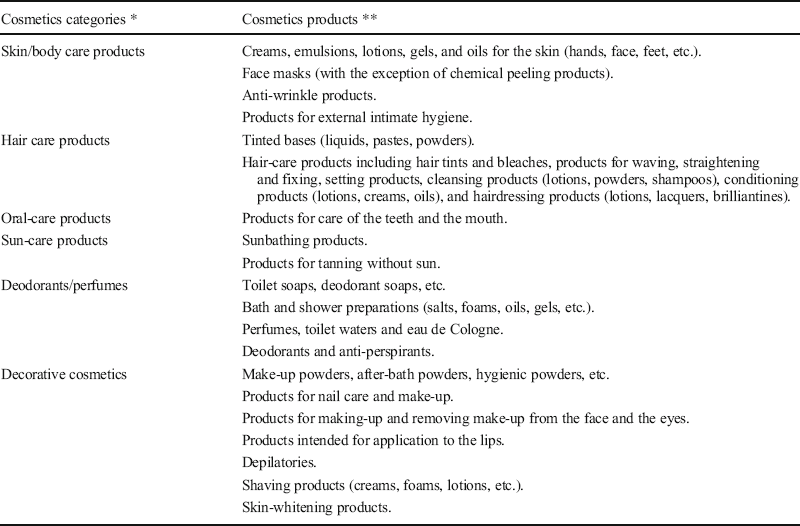
The European cosmetic directive 76/768/ECC lists, in Annex I, the recognized cosmetic products in the European market (Council Directive 76/768/EEC, 2009). This heterogeneous list can be divided (Table 1) according to three major classification criteria: the place of application, the purpose, and the shape or consistency. The European association of cosmetic fabricants classifies cosmetics in seven categories (Cosmetic Europe, 2019): those applied to the hair to clean it, protect it, and keep it in good condition (hair-care products); those applied to teeth and the oral cavity (oral-care products), skin (skin-care products), or the body in general (body-care products). Moreover, some cosmetics have a much more specific purpose, as happens with deodorants (to correct body odors), sunscreens (to protect the body from sun), decorative cosmetics (intended to change the appearance of different body parts), or perfumes (to alter the body odors). These specific cosmetics can be used independently (on their own) or be part of other cosmetics, as typically happens with perfumes.
Types of cosmetics

*Categories according to the European association of cosmetics fabricants (https://cosmeticseurope.eu/cosmetic-products/).
**Types according to European cosmetics directive 76/768/ECC list in annex I.
CLAYS AS INGREDIENTS IN COSMETICS
Clays have been used for cosmetic purposes since prehistoric times (Carretero, Reference Carretero2002). There is evidence of the use of clays to modify appearance in prehistoric rituals, including body painting. Many indigenous populations continue to use clays for their rituals (Mpako et al., Reference Mpako, Matike, Ekosse and Ngole2011), being fundamental ingredients in what could be called ethnocosmetics; e.g. the elaborate hairstyle of the Hamer community from Ethiopia made with clay and butter (Fig. 1) or the Suri earlobe discs, facial painting, and hairstyle (Abbink, Reference Abbink2009).
Hairstyle of the Hamer community, Ethiopia

Without detracting from the importance of these uses, the current study is focused on the use of clays and derivatives as ingredients in commercial cosmetics products. A wide range of cosmetics products containing clay minerals in their composition has been designed throughout time and most of them have been patented. The use of a substance as a cosmetic ingredient requires, first, its precise identification. The Regulation (EC) No 1223/2009, in Article 33, states that the Commission shall compile and update a glossary of common ingredient names (CINs) employed in cosmetic products (CosIng, 2021). Together, the INCI (International Nomenclature Cosmetic Ingredient) names, developed by the International Nomenclature Committee and published by the Personal Care Products Council in the International Cosmetic Ingredient Dictionary and Handbook (Nikitakis & Lange, Reference Nikitakis and Lange2016; PCPC, 2021) are used to identify uniformly the substances in cosmetic labels. Note that the assignment of an INCI name to an ingredient does not imply that the ingredient complies with a particular national or international regulation. Manufacturers and/or suppliers usually assign Trade Names (TN) to their cosmetic ingredients that can be different for the same ingredient supplied by different companies. Manufacturers and suppliers can assign a ‘Trade Name Mixture’ to identify a particular blend of cosmetic ingredients that cannot be used for labeling purposes; the INCI name of each individual component of the mixture must be listed separately.
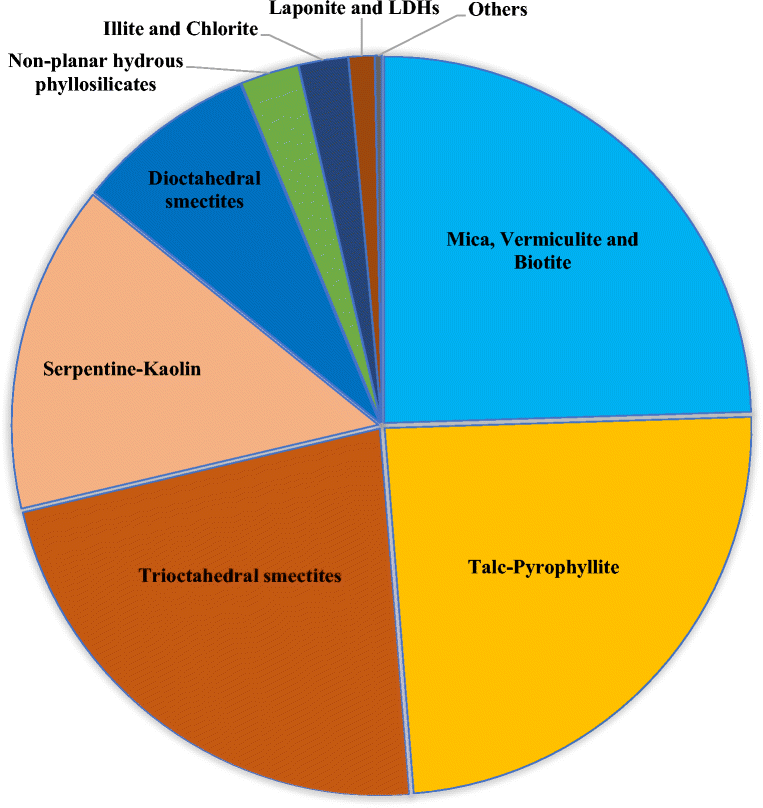
Phyllosilicates with different layer types, net negative charges, or chemical compositions are used widely in cosmetic formulations (Fig. 2). Talc, kaolin, mica, and bentonite stand out for being the most used, but many other clays are used frequently, providing the formulations with advanced functions. To classify the clays and clay minerals used as cosmetics ingredients, the classification proposed by Martin et al. (Reference Martin, Bailey, Eberl, Fanning, Guggenheim, Kodama, Pevear, Środoń and Wicks1991) has been taken as the starting point and updated by the nomenclature committee of AIPEA (Association Internationale pour l’étude des Argiles - international clay organization) in 2006 (Guggenheim et al., Reference Guggenheim, Adams, Bain, Bergaya, Brigatti, Drits, Formoso, Galán, Kogure and Stanjeh2006). Two extra sections with synthetic clays and those clays with a trade name that do not correspond to a specific mineral have also been included.
Distribution of patent applications for cosmetics which include clays

Zero-Charge Phyllosilicates
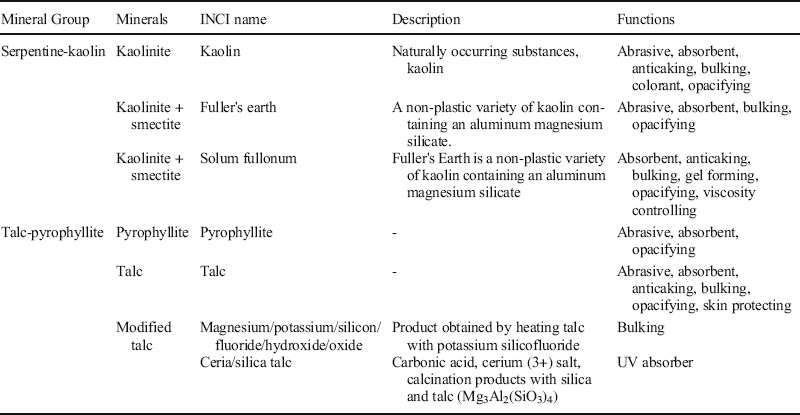
Both talc and kaolinite are often included in hair-care formulations such as shampoos and hair masks intended to treat ‘oily hair.’ The oil-absorbing capacity of clays is a result of their large specific surface area and makes them particularly interesting ingredients in these formulations. Three INCI ingredients contain kaolinite (Table 2). Note that both Fuller’s earth and Solum fullonum have been included here according to their cosmetic ingredient description. Nevertheless, these names are well known to correspond to other minerals (smectites and/orpalygorskite-rich rocks) in the mining industry. Kaolin is used in 1700 cosmetic patents whereas 34 patents of cosmetics (most of them in the last century) cite Fuller’s earth as the ingredient, described as a mix of kaolinite and smectites. High viscosity and thixotropic properties are desirable in several cosmetics formulations. For example, shampoo is expected to present high consistency at rest, avoiding separation of the constituents, but a significant decrease in viscosity when stress is applied to ease product application. In concentrated clay suspensions, the aggregation of particles by different mechanisms (depending on the type of clay minerals, pH, and ionic strength) is known to result in thixotropic and high-viscosity gels. The number of patents using these minerals has increased significantly in the last century, the main applicant companies being Oreal® and Procter and Gamble®.
Zero net charge phyllosilicates used as cosmetic ingredients

In the 21st century, kaolin has been used in makeup formulations (Kim & Kim, Reference Kim and Kim2012; Choi et al., Reference Choi, Hyun, Kim and Yoon2013), powder masks (Kim, Reference Kim2007, Reference Kim2009), as well as in makeup-removal products (Braunagel et al., Reference Braunagel, Golz, Stanzl and Zastrow1997; Koely-Therouin & Mattei, Reference Koely-Therouin and Mattei2001). Synthetic kaolin was proposed by the Sekisui Company to formulate color masks (Nishi, Reference Nishi2001). The effectiveness of kaolinite and montmorillonite as vehicles for the administration of certain active ingredients was shown by Hamilton et al. (Reference Hamilton, Roberts, Hutcheon and Gaskell2019) to improve acne affections. Peel-off mask gel formulations have been developed with Aloe Vera and kaolinite (Beringhs et al., Reference Beringhs, Rosa, Stulzer, Budal and Sonaglio2013) or montmorillonite (Asthana et al., Reference Asthana, Pal, Aljabali, Tambuwala, Gomes de Souza and Pandey2021). The ability of emulsions formulated with Litchi chinensis leaf ethanolic extract in combination with kaolin to prevent UVB-induced photodamage was studied by Thiesen et al. (Reference Timothy, Cziryak and Kljuic2020).
For 2:1 layer phyllosilicates with zero net negative charge, talc is the cosmetic ingredient used most often, with >3000 patents. Talc is used as an emulgent in ‘makeup preparations’ because of its large surface area. Unlike other clay minerals, the structure and properties of talc make it particularly useful to improve the flow and softness of solid powdery mixtures, rather than in the form of aqueous dispersion. Talc has been proposed recently as a color booster and to enhance the cohesion and coverage of skin powders (Dumousseaux, Reference Dumousseaux2011; Meli & Pagis, Reference Meli and Pagis2018). Similarly, pyrophyllite has been also proposed with similar features (Chae & Kim, Reference Chae and Kim2012; Kim et al., Reference Kim, Kim, Kim, Kim, Lee, Lee, Lee and Song2012). Likewise, talc has been formulated with butane to obtain aerosol-moisturizing formulations (Kang et al., Reference Kang, Park, Park and Yun2004). Opacity effects and skin protection are also important functions of talc in cosmetic formulations (Kaida et al., Reference Kaida, Murui, Osawa and Suzuki2004), as well as its abrasive and adsorptive functions in shaving formulations (Albrecht & Stelzer, Reference Albrecht and Stelzer2003; Kohut & Ruppert, Reference Kohut and Ruppert2004). Nanoparticulate synthetic talc combined with nanoparticulate silica was used as a filler for polymers (Wittmer, Reference Wuesteneck and Wuesteneck2002) or to adsorb ultraviolet protection actives in sun-protecting formulations (Arseguel et al., Reference Arseguel, Balard and Clauss2000). Synergistic effects can be obtained by modifying or combining talc with other minerals such as mica (Hechavarria, Reference Hechavarria1994; Iida & Nishimura, Reference Iida and Nishimura1998).
Smectites
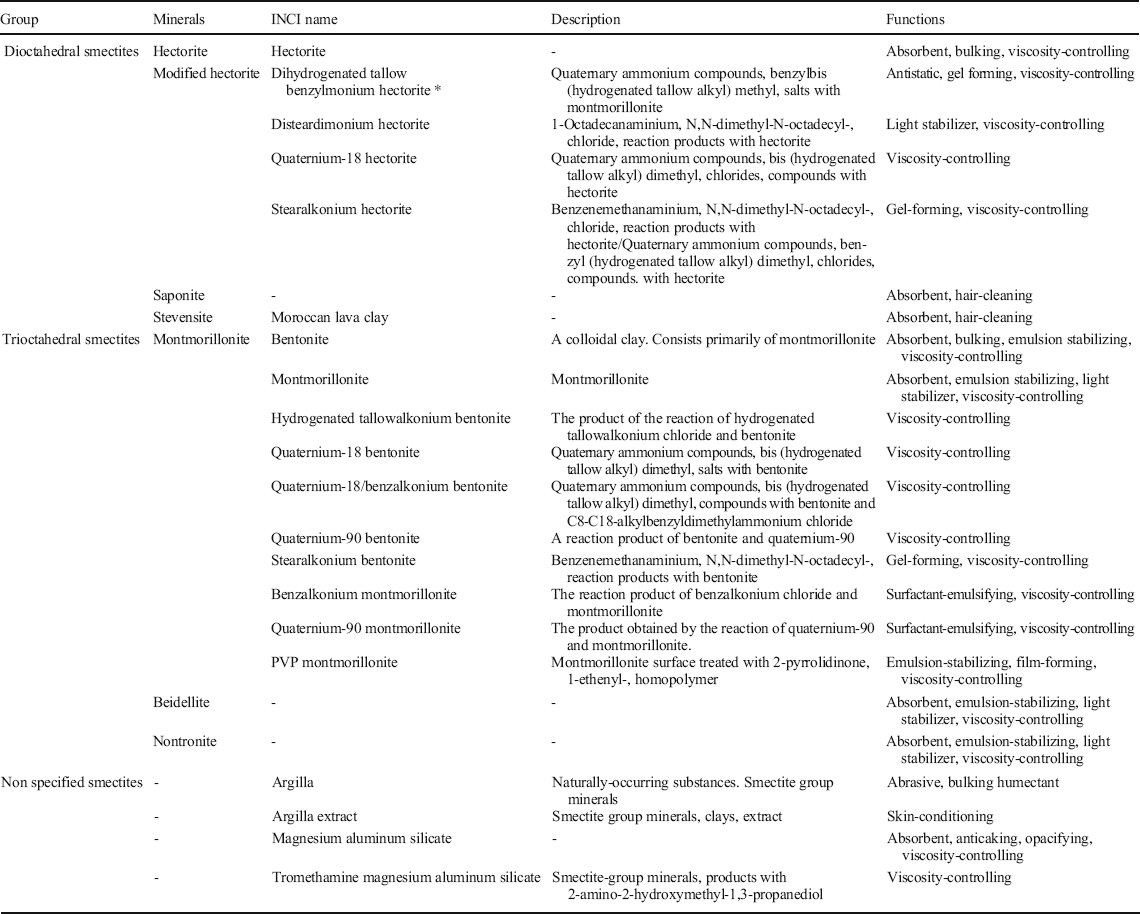
Both dioctahedral and trioctahedral smectites are used as cosmetic ingredients (Table 3). Raw hectorite and organically modified hectorite are used as rheology modifiers, gel-forming agents, and bulking additives in several cosmetic formulations. Together, stevensite (INCI name = ‘Moroccan lava clay’) as well as saponite are useful as cleansing and conditioning hair-product ingredients. About 600 cosmetic patents use hectorites, of which 61 are quaternium-18 hectorite, 71 are stearalkonium hectorite, and 79 are disteardimonium hectorite. Hectorite has been included in the lipid phase of a semisolid cleansing emulsion (Koopmann et al., Reference Koopmann, Riedel, Schwanke and Syskowski2006). Stearalkonium hectorite (0.01 to 0.1% by weight) has been included in lipid-based compositions such as lipsticks (Mendoza, Reference Mendoza2015), whereas quaternium-18 hectorite is used as a non-surfactant dispersing agent at 2.5% w/w. A deodorizing cosmetic agent in the form of a suspension, containing 1.0–35 wt.% quaternium-18 hectorite was patented by Doring (Reference Doring2017).
Smectites used as cosmetic ingredients

*The hydrogenated tallow fatty radicals are derived from tallow fatty acids, including oleic (~40%), palmitic (~25%), stearic (~20%), myristic (~5%), and linoleic (~2%) acids with other minor components.
Stevensite is used as a cosmetic ingredient, under its INCI name, in 56 cosmetic patents. Due to their superb cleaning properties, both stevensite and saponite have been used for centuries as a natural soap and shampoo. In fact, they are included in currently commercialized skin/body and hair-care products, e.g. Himalayan charcoal purifying glow mask© (The Body Shop®) or Moroccan black soap© (Savon Stories®).
Dioctahedral smectites (mainly montmorillonite, but also beidellite and nontronite, for example) are important ingredients in skin-care cosmetic products. They are used widely in facial-mask formulations as their large absorption/adsorption capacities allow them to remove sebum, dirt, toxins, and dead cells. Facial masks are made with clays because of their cleansing, astringent, exfoliating, and lifting effects. Skin masks usually have pseudoplastic properties for easy application, a rheological behavior that can be achieved by incorporating smectites. Bentonite is used in 1151 cosmetics patents, 46 of which are related to quaternium-18 bentonite, 10 to quaternium-90 bentonite, and 30 to stearalkonium bentonite. Together, montmorillonite is specified in 597 patents, whereas the number of patents with beidellite or nontronite are 69 and 49, respectively.
Bentonite was used as an emulsifier in a nail-enamel remover (Carter, Reference Carter1940), in oil-in-watermake-up (O/W) (Gabriel, Reference Gabriel1973), vanishing low oil-content creams (Alexander, Reference Alexander1973), and in cleansing lotions (Sarfaraz, Reference Shchukin, Sukhorukov, Price and Lvov2016). Bentonite particles accumulate around the internal drop’s phase of emulsions and decrease the interfacial tension between the two insoluble liquid phases, avoiding their coalescence, phase separation, and emulsion breakage. The mechanisms of emulsification with clay particles and the formation of Pickering emulsions were studied deeply by Abend and Lagaly (Reference Abend and Lagaly2001) and most recently reviewed by Machado et al. (Reference Machado, de Freitas and Wypych2019). Bentonite has been used in makeup products (Kim et al., Reference Kim, Kim Jae and Yoon2003) and montmorillonite as a stabilizing agent in cosmetic emulsions (Calello et al., Reference Calello, Pagano, Patil and Sandewicz2006) and as a sebum remover (Ko et al., Reference Ko, Lee, Lee, Lee, Lee, Lee and Yoo2010). The optimization of a peel-off, facial-mask formulation containing smectite and aloe vera was studied by Beringhs et al. (Reference Beringhs, Rosa, Stulzer, Budal and Sonaglio2013). More recently, a dry shampoo composition comprising a smectite, natural starches, and a natural-oil absorbent was developed and subsequently patented (Perfitt & Carimbocas, Reference Perfitt and Carimbocas2017). Face masks with bentonite, starch and polyvinyl alcohol were formulated by Chakraborty et al. (Reference Chakraborty, Anoop, George, Bhagyasree and Mary2019). Some formulations also included zinc oxide, which acts as a UV filter, or silver nanoparticles and gold nanoparticles, with antibacterial properties. Bentonite has been modified to quaternium-18 bentonite to stabilize oil in water (O/W) emulsions by Yang (Reference Yang2015) and combined with polymers to retain a chemical oxidizing agent in a hair-lightening product (Delostal & Seneca, Reference Delostal and Seneca2019). Quaternium-18 bentonite is used in eyebrow pencil, eyeliner, eyeshadow, eye lotion, and other eye-makeup preparations, as well as in lipstick and aerosolized deodorant formulations (up to 0.6%). More recently, bentonite has been proposed as an anti-aging cosmetic ingredient due to an induction of telomerase activity (Bae et al., Reference Bae, Choi, Jang, Kim and Lee2021). Both trioctahedral and dioctahedral smectites, with high refractive indices and optimal light dispersion properties, have been included in sunscreens, acting as a physical barrier that blocks the solar radiation and protects the cellular nucleic acids (Ghadiri et al., Reference Ghadiri, Chrzanowski, Lee and Rohanizadeh2014; Mattioli et al., Reference Mattioli, Giardini, Roselli and Desideri2015). Smectites are also used as natural eye shadow, blush powder (Gamoudi & Srara, Reference Gamoudi and Srara2018), and facial makeup (Cavalcanti et al., Reference Cavalcanti, Brasileiro, Macedo and Ferreira2018).
The main companies using natural smectites are Oreal® and Shiseido®, whereas Amorepacific®, Henkel AG®, LG Household®, and Beiersdorf AG® are the applicants using organically modified smectites.
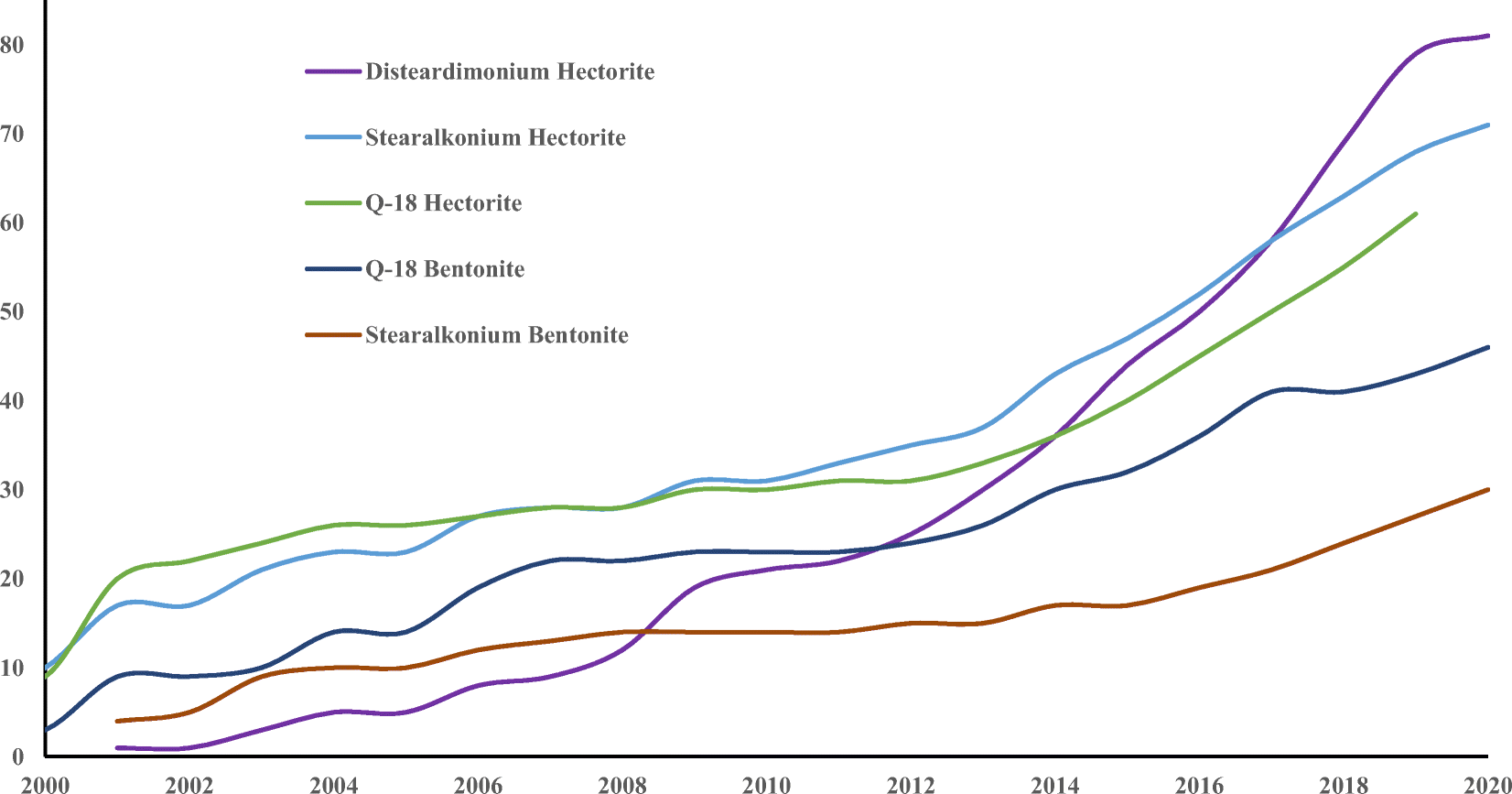
Decorative nail polishes consist of a polymeric base, usually made of nitrocellulose, solvents, plasticizers, and pigments. Modern gel nail polishes contain a suspension system, frequently based on modified organic clays able to solve stability issues, specifically pigment sedimentation and syneresis (Grigale-Soročina et al., Reference Grigale-Soročina, Ingmārs and Kalnins2017; Kovalenko et al., Reference Kovalenko, Kotov, Yeroshkina and Zaychuk2017; Grigale-Soročina & Birks, Reference Grigale- Soročina and Birks2019). Alkali and alkaline earth metals in smectites may be exchanged easily with quaternary ammonium chloride cations, covalently bonded to aliphatic chains, aromatic rings, and/or other functional groups, to obtain organophilic clays. This cation exchange shifts the nature of these minerals from hydrophilic to lipophilic. Different organoclays can be obtained by changing the negative charge density of the clay mineral and, therefore, the packing density of the alkyl chains (Lagaly & Dékany, Reference Lagaly and Dékany2005). Organomodified clays such as smectites (montmorillonite, hectorite) and organomodified sepiolite (organoclays) have been used widely as cosmetic ingredients, acting as dispersing agents, emulsion stabilizers, and viscosity enhancers (Fig. 3).
Trends in terms of the top five organoclays included in the patent applications for cosmetics (over the period 2000–2020)

Other 2:1 Planar Hydrous Phyllosilicates
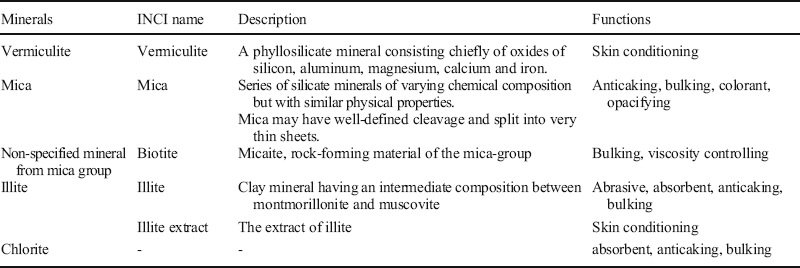
High net layer charge (>0.6) planar phyllosilicates are also used as cosmetic ingredients (Table 4). Of this group of minerals, mica is the cosmetic ingredient used most often, being present in >2800 patents. Mica is used in makeup products (illuminators, powder makeup, lipsticks, or eye shadows) based on its ability to absorb and reflect light (Wuesteneck & Wuesteneck, Reference Yang1984; Ikeda et al., Reference Ikeda, Kawai, Tanimoto, Yamada, Yasuki and Yoneyama1986; Ando & Kosugi, Reference Ando and Kosugi1989; Bajan et al., Reference Bajan, Ogawa, Ono and Sakurai2002; Kumagai et al., Reference Kumagai, Ogawa, Ono, Sugimori, Suzumura and Yamamoto2004; Choi et al., Reference Choi, Choi and Park2012; Cho et al., Reference Cho, Kim, Kim, Moon and Park2016). Mica has also been formulated with cyclodextrin (Coutelle et al., Reference Coutelle, Dussert and Gooris1998), silicones (Koenig et al., Reference Koenig, Lanzendoerfer and Stelling2006; Ricard & Kongmany, Reference Rincón-Fontán, Rodríguez-López, Vecino, Cruz and Moldes2020), and camellia oil (Choi, Reference Choi2017). Synthetic mica was proposed as a cosmetic ingredient (Ishikawa & Kuratani, Reference Ishikawa and Kuratani2000; Saeki, Reference Sánchez-Espejo, Aguzzi, Cerezo, López-Galindo and Viseras2000) and used in sun products (Debacker, Reference Debacker, Dick, Ganguly, Karrick, Nicolas, Pharo and Staveley2005) and eye shadows (Ando et al., Reference Ando, Higuchi, Inokubo and Suzuki2006). Synthetic micas combined with L-arginine have been used to prepare moisturizing powders (Han et al., Reference Han, Moon, Na and Park2008) and, once modified (Abiko et al., Reference Abiko, Nagahama and Ohta2011) or loaded with Zn (Nagahama, Reference Nagahama2012), have been included in cosmetics. Mica is also included in many cosmetic formulations with sunscreen activity, not only because it protects against solar radiation, but because it also provides a shimmering effect on the skin (Su et al., Reference Suh2014). The UV-Visible absorption ranges of some clays have been characterized in numerous studies (Babin & Stramski, Reference Babin and Stramski2004; Hoang-Minh et al., Reference Hoang-Minh, Le, Kasbohm and Gieré2010). Sunscreen formulations based on mica and a biosurfactant extract were designed and characterized by Rincón-Fontán et al. (Reference Rizo, Muñoz, Hernández, Rudnikas, Rodríguez, Rodríguez, Martín, Fagundo Castillo and Martínez-Villegas2018).
Minerals from the vermiculite, mica, and interlayer-deficient mica and chlorite groups used as cosmetic ingredients

Vermiculite is used mainly in skin-conditioning products (>200 patents), whereas biotite, illite, and chlorite are cited in 59, 116, and 157 patents, respectively. Vermiculite has been included in cosmetics packs (Kim & Kim, Reference Kim and Kim2004) and used as a sorbent (Atamaniuk, Reference Atamaniuk2006). Illite has been included in skin ointments (Kim & Son, Reference Kim and Son2006), body-cleaning products able to absorb sebum exudates (Kim et al., Reference Kim, Kim, Lee, Lee, Lee, Oh, Park and Park2008; Park, Reference Park2020), and as decorative color products (Do, Reference Do2013; Hyun et al., Reference Hyun, Kim, Lee and Yun2013). Illite has also been used in sun-care products (Ang et al., Reference Ang, Jeong, Kim, Kim, Kim, Lee, Lee, Lee, Lee, Park, Park and Song2014) and anti-wrinkle products (Park, Reference Park2015), also in combination with artichoke leaf (rich in anti-aging polyphenols) (Do, Reference Do2021).
Non-planar Hydrous Phyllosilicates
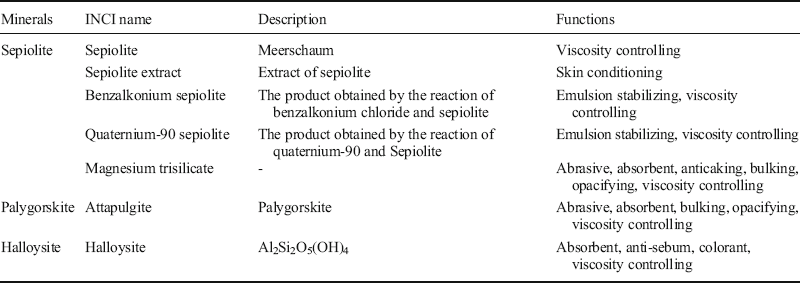
Sepiolite (or magnesium trisilicate) is the non-planar clay mineral used most frequently in cosmetics (>150 patents), followed by palygorskite (attapulgite) with 111 cosmetic formulations, and halloysite (64 patents). These minerals are used with different technological functions derived from their particular structures (Table 5). Sepiolite, palygorskite, and halloysite have been proposed as carriers of compounds that absorb UV radiation (Del Hoyo et al., Reference Del Hoyo, Vicente and Rives2001; Suh, Reference Suh and Cho2015). In recent years, palygorskite (Tang et al., Reference Thiesen, Bretzke, Bittencourt, Silva, Bresolin, Santin and Couto2020) and organically modified palygorskite (Cao et al., Reference Cao, Deng, Feng, Liao, Liu, Wang and Zhang2020; Huang, Reference Huang2020) have been used in makeup formulations and sun-care products (Cho et al., Reference Cho, Ju and Kil2013). Hair-care cosmetic formulations with halloysite loaded with other cosmetic ingredients have been designed (Shchukin et al., Reference Su, Tang, Zhu, Li and Lin2005; Suh et al., Reference Tang, Wang, Wang, Wang, Xu and Zhang2011; Santos et al., Reference Sarfaraz2019; Sadjadi, Reference Saeki2020). The effective loading of dyes onto halloysite reduces the direct contact of the dye with the scalp, thus minimizing toxicity and possible allergic reactions. Suh and Cho (Reference Suh, Kil, Chung, Abdullayev, Lvov and Mongayt2015) developed TiO2 nanoparticles on halloysite, obtaining suitable nanoparticle-halloysite hybrid powders for the formulation of sunscreens. Ascorbic acid loaded into halloysite nanotubes has also been proposed as a cosmetic product (Baschieri et al., Reference Baschieri, Amorati, Benelli, Mazzocchetti, D'Angelo and Valgimigli2019). A photoprotective treatment for hair, based on halloysite and keratin hybrid nanotubes, was developed by Cavallaro et al. (Reference Cavallaro, Milioto, Konnova, Fakhrullina, Akhatova, Lazzara, Fakhrullin and Lvov2020).
Non-planar hydrous clay minerals used as cosmetic ingredients

L’Oréal® is the main user of sepiolite and halloysite as cosmetic ingredients, whereas Procter and Gamble® is the major user of palygorskite in cosmetic products.
Other Clays and Related Materials
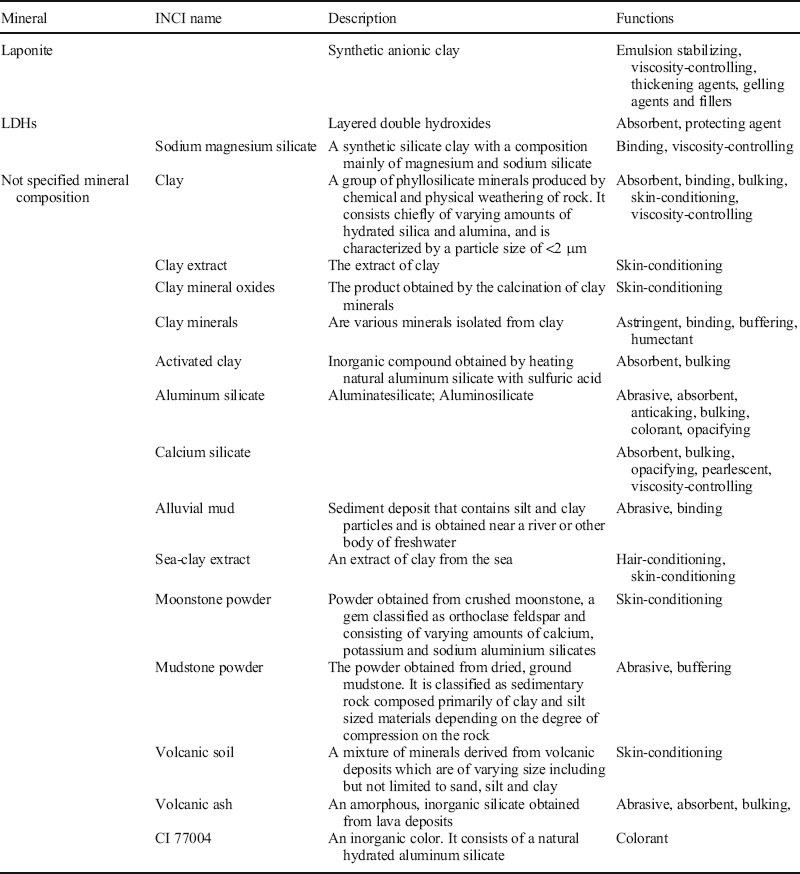
Synthetic materials with clay-like structures (such as Laponite®) or with structure in sheets similar to hydrotalcite (layer double hydroxides; LDHs) have also been used in cosmetics, mainly due to their ability to exchange cations or anions, respectively. Avon® has two patented formulations with Laponite® allowing the delivery of incompatible ingredients in a single formulation (Deleo et al., Reference Deleo, Howell, Patel, Rubinson and Stagg2015; Howel et al., Reference Howell, Lull and Novack2015). Layered double hydroxides, due to their ability to absorb, spread, and reflect UV radiation, are suitable structures to protect the photo or chemical activity of molecules, avoiding photo-instability and preventing direct contact with the skin (Franco et al., Reference Franco, Ataide, Ferreira and Mazzola2020). They have been used to design various color palettes of pigments, especially for nail-polish applications (Kovalenko & Kotok, Reference Kovalenco and Kotok2020) (Table 6).
Other clays and related materials used as cosmetic ingredients

Other INCI denominations of clays or related materials that cannot be correlated to any specific minerals are listed in Table 6.
The treatment of a clay with sulfuric acid at elevated temperature results in an activated clay. This acid treatment creates discontinuities in both tetrahedral and octahedral sheets due to the partial dissolution of the layers, increasing the specific surface area and sorptive capacity. The use of ‘activated’ clay minerals in skin-care products continues to be an area of active research. As an example, activated bentonite was included in electrospun nanofibers (Bazbouz & Russell, Reference Bazbouz and Russell2018) to prepare a product with skin-protection properties. A mineral-based sunscreen containing activated clay combined with a dispersing agent and one or more inorganic sunscreen actives has been patented. As a result, a mineral sunscreen with high UVB/UVA protection, non-whitening effect, and exceptional spreadability was obtained (Timothy et al., Reference Veniale, Bettero, Jobstraibizer and Setti2015). An emulsion with unspecified phyllosilicates together with “inosilicate, cyclosilicate, tectosilicate, neosilicate, or sorosilicate” have been used as skin-care products (Rochette et al., Reference Sadjadi2017).
Traditional and historical provenance names are included as cosmetic ingredients: Canadian colloidal clay, Elguea clay, Heilmoor thermal clay, and Palau white clay. Canadian colloidal clay is used as skin conditioning in cosmetic formulations. The commercial mask, Gravitymud© (Estee Lauder®), contains Canadian colloidal clay. Many of these clay materials are used in thermal centers to prepare suspensions with mineral waters (referred to as peloids or thermal muds). Because the majority are not commercialized, it is difficult to determine their composition, stability, and properties (Sánchez-Espejo et al., Reference Santos, Panchal, Rahman, Pereira-Silva, Pereira, Veiga and Lvov2014). Together, some of these clay materials are sold without quality control, e.g. Medina Clays (Khiari et al., Reference Khiari, Mefteh, Sánchez-Espejo, Cerezo, Aguzzi, López-Galindo, Jamoussi and Viseras Iborra2014).
The following list of references provides access to detailed information on the use of clays in pelotherapy (Veniale et al., Reference Viseras, Aguzzi, Cerezo and Lopez-Galindo2007; Gomes et al., Reference Gomes, Carretero, Pozo, Rautureau and Delgado2013; Carretero, Reference Carretero2020a, Reference Carretero2020b). Some examples of commercialized peloids are Elguea and Heilmoor clay. The Elguea clay is a native clay obtained from Elguea Cuban thermal center (Villa Clara province), known for its abrasive and absorbent properties. The peloid used in this thermal center has a hydrothermal origin and a dark gray color. It is composed mainly of clay minerals, carbonates, and halite (Rizo et al., Reference Rizo, Muñoz, Hernández, Rudnikas, Rodríguez, Rodríguez, Fagundo Castillo, Martínez-Villegas and Zerquera2017, Reference Rochette, Doyon and Elkurdi2018). Heilmoor clay (trade name: Thermal Heilmoor© clay) is a natural mud from Heilmoor (Austria), formed slowly by the accumulation and decomposition of vegetal residues at the bottom of peat bogs. Its ability to improve blood circulation and the presence of numerous organic and inorganic components able to partially penetrate the skin make the mud an optimal ingredient for cosmetic products with revitalizing and purifying properties. Face mask with propolis for oily skin (Apivita® Company) is a commercial cosmetic that includes Heilmoor© clay as an ingredient. Palau white clay is obtained from Ngeruktabel Island in Palau (western part of the Pacific Ocean). The Hokkaido Akan© clay is obtained from the volcanic area of Hokkaido Akan Caldera, Japan. The basement of Akan volcano consists of Cretaceous–Tertiary sedimentary and volcanic rocks. Manicouagan clay© is located in Baie-saint-Ludger, in the Manicouagan peninsula. Argile Eau Mer® is the company responsible for exploiting this clay and for the manufacture of three types of products for cosmetic and therapeutic applications. Detox shampoo© by American Crew® includes Manicouagan© clay among other ingredients.
CLAYS IN COMMERCIAL FORMULATIONS
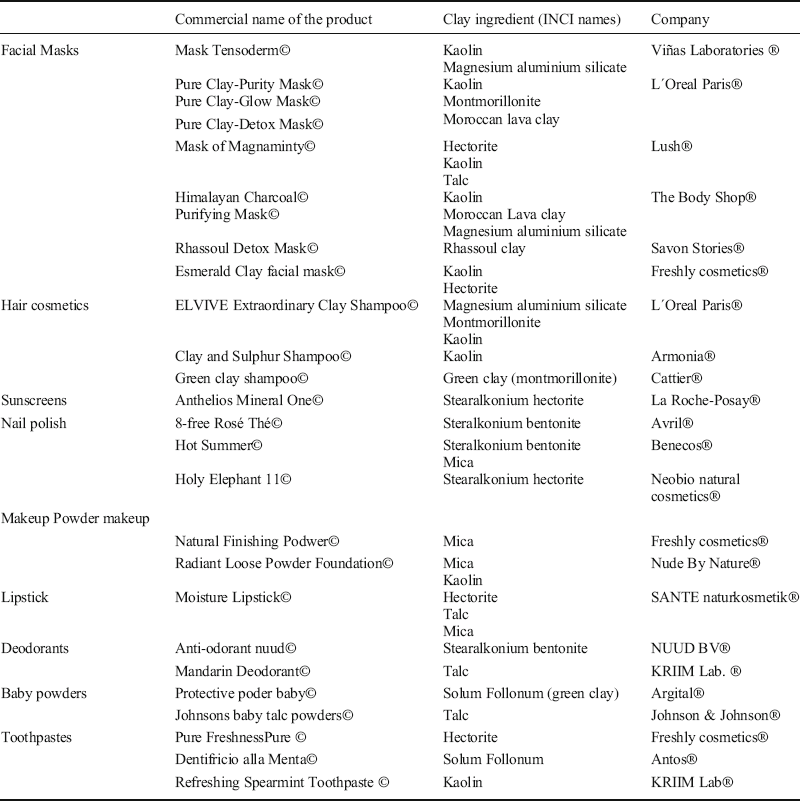
Cosmetics formulations may contain more than one clay among their ingredients. A considerable number of cosmetics exist that include clays as ingredients; examples are listed in Table 7. Some clays are used for their technological functions and others for a specific cosmetic function, e.g. cosmetic formulations with halloysite, kaolinite, and montmorillonite allow 5–10 wt.% loading efficiency and 10–20 h of sustained release of glycerol, ascorbic acid, and other bioactive compounds (e.g. vitamins) (Suh et al., Reference Tang, Wang, Wang, Wang, Xu and Zhang2011). Cosmetic patents often propose alternative clay minerals for the same functions. For instance, a composition with a UV-shielding effect included microparticulate titanium dioxide, magnesium, and/or calcium hydroxide and a clay mineral that could be selected from mica, talc, kaolin, bentonite, or smectite (Ijiri et al., Reference Ijiri, Sato, Suzuki and Hasegawa2015).
Some examples of commercial cosmetic products with clays

Conclusions
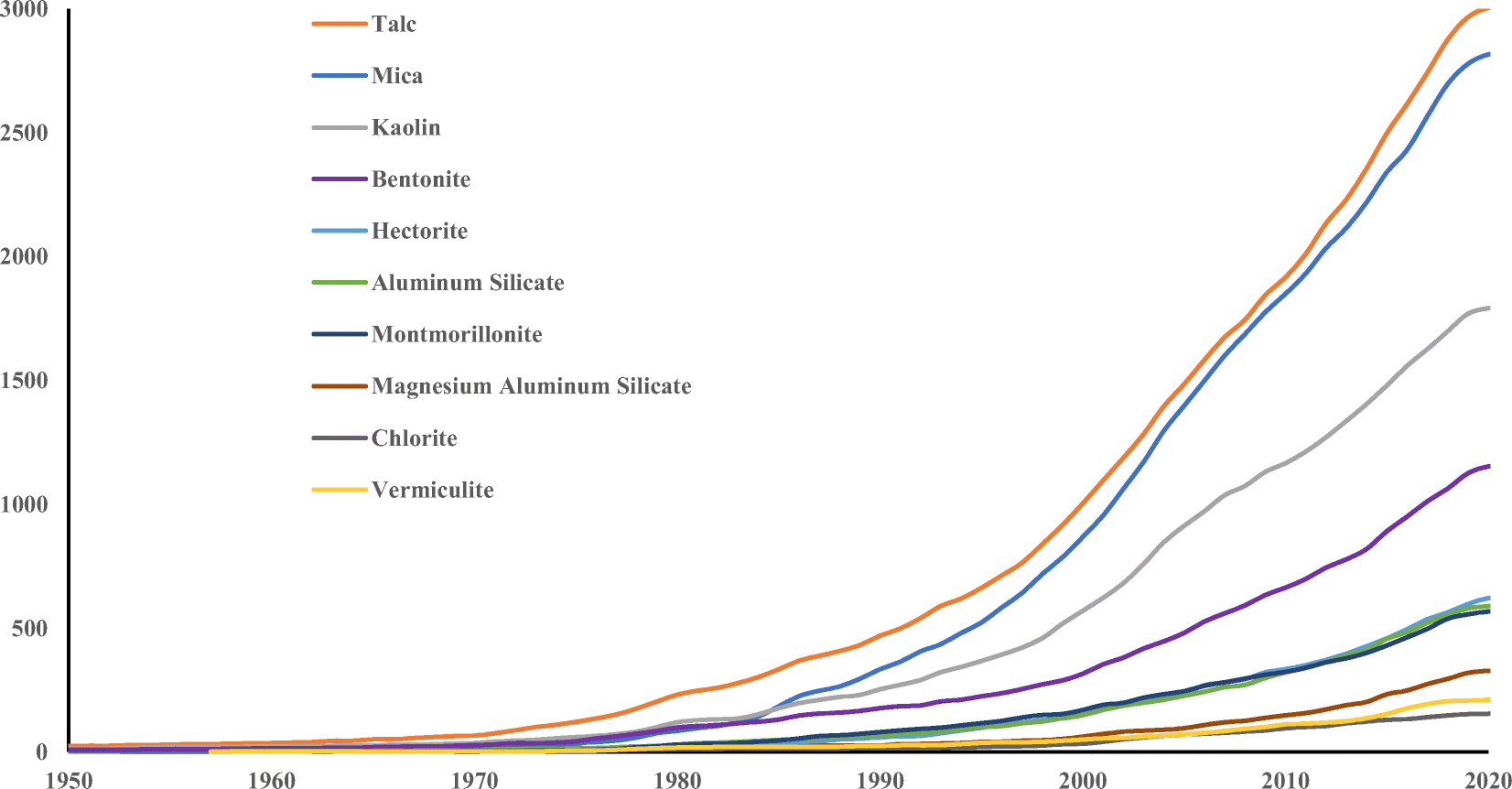
Clays are used in numerous cosmetic formulations with both technological and cosmetological functions. The trends, since 1950, of the top ten clays (INCI names) in patent applications for cosmetics are shown in Table 4. Talc, kaolin, mica, and smectites are the clay minerals used most frequently in cosmetic products, with a sustained increase in their use, followed by other clay minerals. As with other industries, controversies exist about the use of certain names to refer to materials, which makes understanding difficult and which should be standardized. The current study has summarized and highlighted the possibilities offered by clays and clay minerals in the cosmetics field. The cosmetic ingredients and final cosmetic product markets are concentrated in a few companies. New, advanced uses of clays could open the market to include novel companies in this market in the future Fig. 4.
Trends in terms of the top ten INCI clays included in the patent applications for cosmetics (over the period 1950–2020)

ACKNOWLEDGMENTS
The work has been supported by funding from the Spanish group CTS-946 and project P18-RT-3786.
Funding
Funding sources are as stated in the Acknowledgments.
Declarations
Conflict of Interest
The authors declare that they have no conflict of interest.