Introduction
Acute coronary syndromes (ACS) are a heterogeneous population with various short- and long-term risks of major adverse cardiac events (MACE) like death, and their clinical presentation is broad. Reference Collet, Thiele and Barbato1,Reference Abu-Assi, Ferreira-González and Ribera2 The most important symptom initiating the diagnostic cascade in patients with suspected ACS is acute chest discomfort, and the treatment process varies according to the electrocardiogram (ECG). Reference Collet, Thiele and Barbato1 Clinicians diagnosed ST-segment elevation ACS because of specific ECG findings, but non-ST-segment elevation ACS (NSTEACS) patients may be missed due to atypical chest pain presentation, or no ECG elevation. Even troponin values may be normal.
Current guidelines emphasize the importance of early clinical risk stratification to identify patients’ mortality risk, select the optimal site of care, and determine the therapeutic intensity with the risk of adverse outcomes. Reference Abu-Assi, Ferreira-González and Ribera2,Reference Li, Cheng and Yu3 In addition, risk scores have shown that early coronary intervention improves clinical outcomes in high-risk patients. Reference Santos, Aguiar Filho Lde and Fonseca4 Today, the most preferred variables used to determine the risk of coronary artery disease (CAD) in the emergency department (ED) are: Thrombolysis in Myocardial Infarction (TIMI); History, ECG, Age, Risk Factors, Troponin (HEART); and Global Registry of Acute Coronary Events (GRACE) scores. These scores analyze classical risk factors, such as chest pain type, age, comorbid diseases (diabetes, hypertension), blood pressure, pulse, smoking history, ECG findings, elevated troponin, and creatinine. Reference Antman, Cohen and Bernick5–Reference Fox, Fitzgerald and Puymirat7
The Gensini score considers the coronary anatomy, arterial morphology, and stenosis severity of lesions. Reference Gensini8 Assessment of the severity of CAD according to this scoring system (Gensini score ≥20) is associated with short- and long-term cardiovascular risk. Reference Sinning, Lillpopp and Appelbaum9,Reference Chen, Chen, Qian, Ma and Ge10 The accuracy of TIMI and GRACE scores in predicting the angiographic severity of CAD is conflicting. Reference Roy, Abu Azam, Khalequzzaman, Ullah and Arifur Rahman11–Reference Routray14 There are few studies in the literature comparing HEART score and angiographic severity scores.
The aim of this study was to investigate the ability of TIMI, HEART, and GRACE risk scores to predict the development of MACE and the angiographic severity of CAD in patients diagnosed with NSTEACS in the ED. In addition, independent variables associated with the development of MACEs were also examined.
Methods
Study Design and Setting
This study was a prospective, observational, single-center study initiated after the local ethics committee approval (ethics committee number: 2019/12-19). The study was conducted in association with Emergency Medicine and Cardiology Clinics in Izmir (Turkey) Tepecik Training and Research Hospital, a tertiary hospital with approximately 190,000 annual emergency admissions and approximately 5,000 annual percutaneous coronary interventions (PCIs) from August 1, 2019 through March 1, 2020. This hospital is one of the primary percutaneous transluminal coronary angioplasty centers in the province; emergency medicine and cardiology specialists are on duty 24/7.
Selection of Participants
All patients admitted to the ED with angina and equivalents were evaluated clinically with their vital signs, history and physical examination findings, ECG, and laboratory tests. The patients were evaluated by an emergency medicine specialist and resident in the ED. Cardiology consultation was requested for the patients considered to have ACS. Cardiologists who decided on which patients were hospitalized were blind to the results of risk scores. All patients over 18 years of age who were planned to be hospitalized for pre-diagnosed NSTEACS (non-ST elevation myocardial infarction+ unstable angina) were included in the study consecutively.
Patients with the following characteristics were excluded from the study: new arrhythmias upon admission or during hospital follow-up (such as atrial fibrillation, atrial flutter, sustained or recurrent ventricular tachycardia, and 2nd- or 3rd-degree atrio-ventricular block); evidence on the ECG of ST-segment elevation myocardial infarction before PCI; history of coronary artery bypass graft (CABG); renal failure requiring dialysis; pregnancy; patients with communication problems (such as language barriers or aphasia); missing data; patients who refused PCI or who were treated with medical therapy alone; and those diagnosed with non-acute coronary syndromes (such as pulmonary embolism, heart failure, pneumonia, myopericarditis, or aortic dissection).
Variables, Data Sources, and Measurements
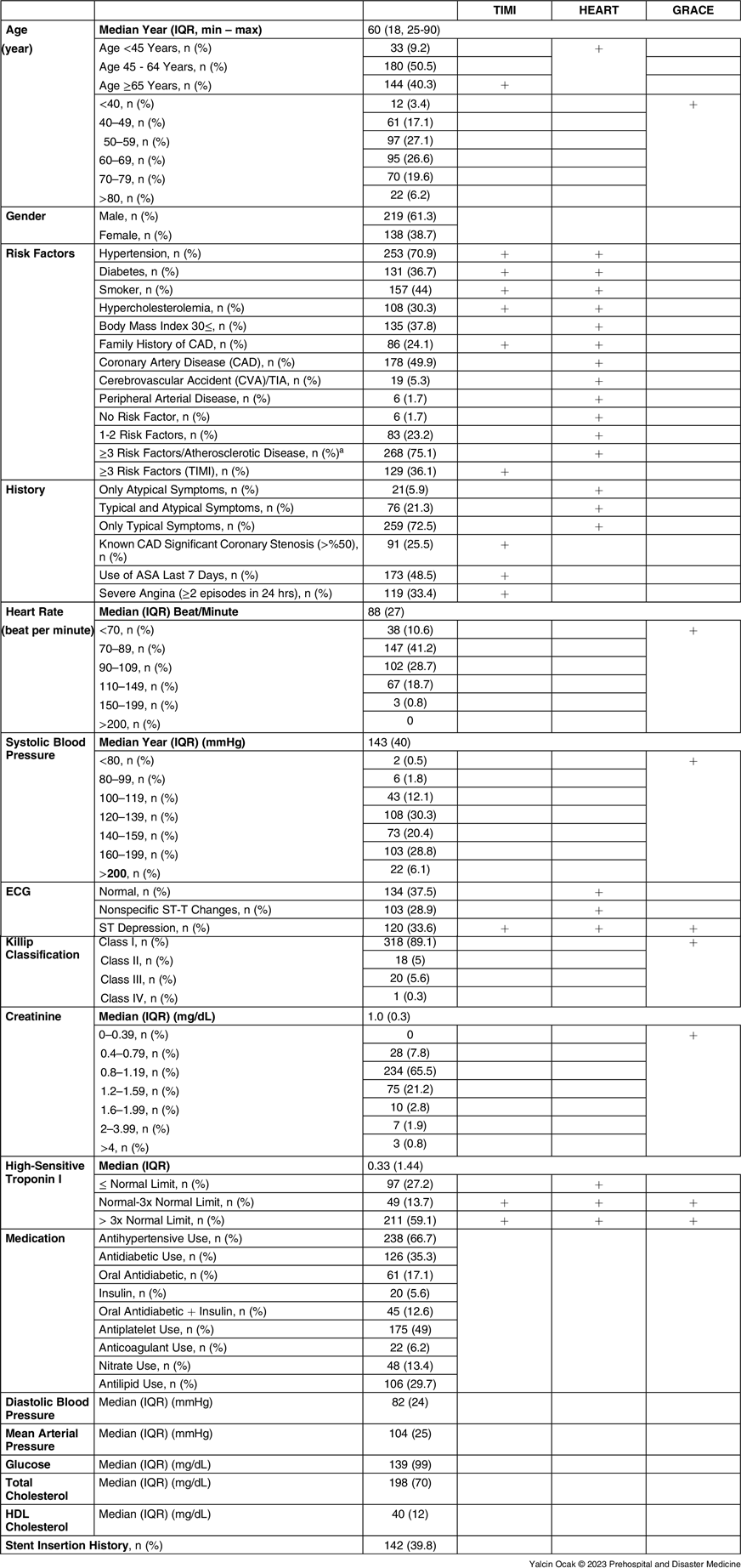
Patients’ demographic information and all variables necessary for calculating risk scores (TIMI, HEART, and GRACE) were recorded (Table 1). Reference Antman, Cohen and Bernick5–Reference Fox, Fitzgerald and Puymirat7 In addition, gender, glucose, high-density lipoprotein (HDL) cholesterol, total cholesterol, medications, stent insertion history, alcohol use history, and vital signs (diastolic blood pressure, mean arterial pressure [MAP], and oxygen saturation) were recorded.
Study Population Characteristics in Risk Scores

Note: The + sign shows variables present in early clinical risk scores.
Abbreviations: CAD, coronary artery disease; CVA, cerebrovascular accident; HDL, high-density lipoprotein; TIMI, Thrombolysis in Myocardial Infarction; HEART, History, Electrocardiogram, Age, Risk Factors, Troponin; GRACE, Global Registry of Acute Coronary Events.
a Prior myocardial infarction, percutaneous coronary interventions/coronary artery bypass graft, cerebrovascular accident/TIA, or peripheral arterial disease.
Chest pain features were clearly defined on the study form, and suitable ones were selected. Central or left-sided chest pain with radiation to the arms or throat or sweating or clamminess presentation was defined as typical pain. Right-sided chest pain or without chest pain or pain that radiated to the back or worsened on inspiration or palpation presentation was defined as atypical pain. Patient history was classified as typical pain (two points), both typical and atypical pain (one point), or atypical angina (zero points). The calculation of the history for the HEART score was made according to these data. Reference Six, Cullen and Backus15
A 12-lead resting ECG was obtained on admission at a paper speed of 25mm/s and 10mm standardization. Initial ECGs of all patients were evaluated and scored together by an emergency medicine specialist and a cardiologist. For HEART score calculation, ECGs were divided into three groups (normal, non-specific repolarization disturbance, and significant ST-depression). Reference Six, Cullen and Backus15
Family history was defined as parent or sibling with cardiovascular disease before age 65. Reference Backus, Six and Kelder16 Smoking was defined as a current or recent (less than three months) smoker. Reference Six, Cullen and Backus15
High-Sensitive Troponin I (SIEMENS ADVIA Centaur Tn I-Ultra kit) (0.02-0.06ng/mL), creatinine (0.8-1.4mg/dL), glucose (74-106mg/dL), total cholesterol (110-199mg/dL), and HDL cholesterol (40-60mg/dL) results were recorded. The peak serum concentration of High-Sensitivity Troponin I value was collected during ED follow-up. Accepted were: zero points for <0.07ng/mL, one point for 0.07-0.21ng/mL, and two points for >0.21ng/mL for the HEART score.
In this hospital, the standard Judkins technique with the femoral approach is used in coronary angiography performed for myocardial infarctions. Images are acquired at 30fps at multiple angles (Artis Zee; Siemens, Healthcare; Erlangen, Germany). Two experienced cardiologists (BK, IM) evaluated all coronary angiograms and calculated the Gensini score. They differed from the performer and were blind to the results of risk scores. Severe CAD was defined as having a Gensini score of 20 or more. Reference Chen, Chen, Qian, Ma and Ge10
All risk scores (TIMI, GRACE, and HEART) were calculated by using original formulas. Reference Antman, Cohen and Bernick5–Reference Fox, Fitzgerald and Puymirat7 Low-, moderate-, and high-risk ranges for all scores, respectively: zero-to-two was low, three-to-four was moderate, and five-to-seven was high-risk for TIMI score; zero-to-three was low, four-to-six was moderate, and seven-to-ten was high-risk for HEART score; and ≤108 was low, 109-140 was moderate, and above 140 was high-risk for GRACE score.
Statistical Analysis
The data were evaluated with the Shapiro-Wilk test, and it was found that they did not show normal distribution characteristics. Dichotomous data are expressed as frequencies, and continuous data are expressed as median and interquartile range values. The reliability of risk scores was evaluated by Receiver-Operating Characteristic (ROC) analysis. Binomial univariate and multivariate regression analyses were used for the analysis of independent risk factors for MACE. Analyses were performed at 95% confidence intervals (CI). P value less than .05 was accepted as significant. The IBM SPSS version 20.0 (IBM Corp.; Armonk, New York USA) and Jamovi version 2.3.21 (Sydney, Australia) were used in statistical analyzes.
Results
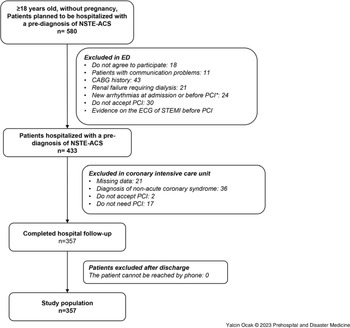
Data were collected from August 1, 2019 through March 1, 2020. During the study period, 580 patients older than 18 years of age presented to the ED with a pre-diagnosis of NSTEACS; 223 were excluded. A total of 357 patients were enrolled in the study (Figure 1).
Patient Flow Chart.
Abbreviations: NSTEACS, non-ST-segment elevation acute coronary syndrome; ED, emergency department; CABG, coronary artery bypass graft; PCI, percutaneous coronary intervention; ECG, electrocardiogram; STEMI, ST-elevation myocardial infarction.

The median age was 60 (IQR: 18) years, and 220 (61.6%) were male. History of hypertension (70.9%) was the most prevalent cardiovascular risk factor. Study population characteristics in risk scores are given in Table 1. The median (IQR, min-max) TIMI, HEART, and GRACE risk scores for all patients were three (2, 0-7), seven (2, 2-11), and 92 (44, 24-204), respectively.
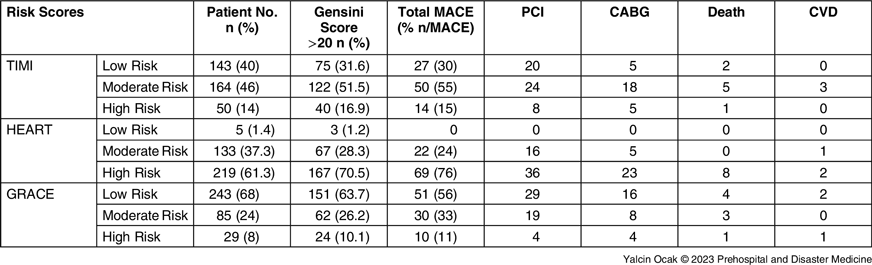
In this study, 91 MACE (52 PCI, 28 CABG, three cerebrovascular disease [CVD], and eight deaths) happened, and two of the eight deaths were in-hospital deaths. The 30-day MACE rate was 25.5%. The distribution of patients’ risk scores classification according to MACE is given in Table 2.
Major Adverse Cardiac Events Occurring within 30 Days of Admission to ED

Abbreviations: ED, emergency department; MACE, major adverse cardiac event; PCI, percutaneous coronary interventions; CABG, coronary artery bypass graft; CVD, cerebrovascular disease; TIMI, Thrombolysis in Myocardial Infarction; HEART, History, Electrocardiogram, Age, Risk Factors, Troponin; GRACE, Global Registry of Acute Coronary Events.
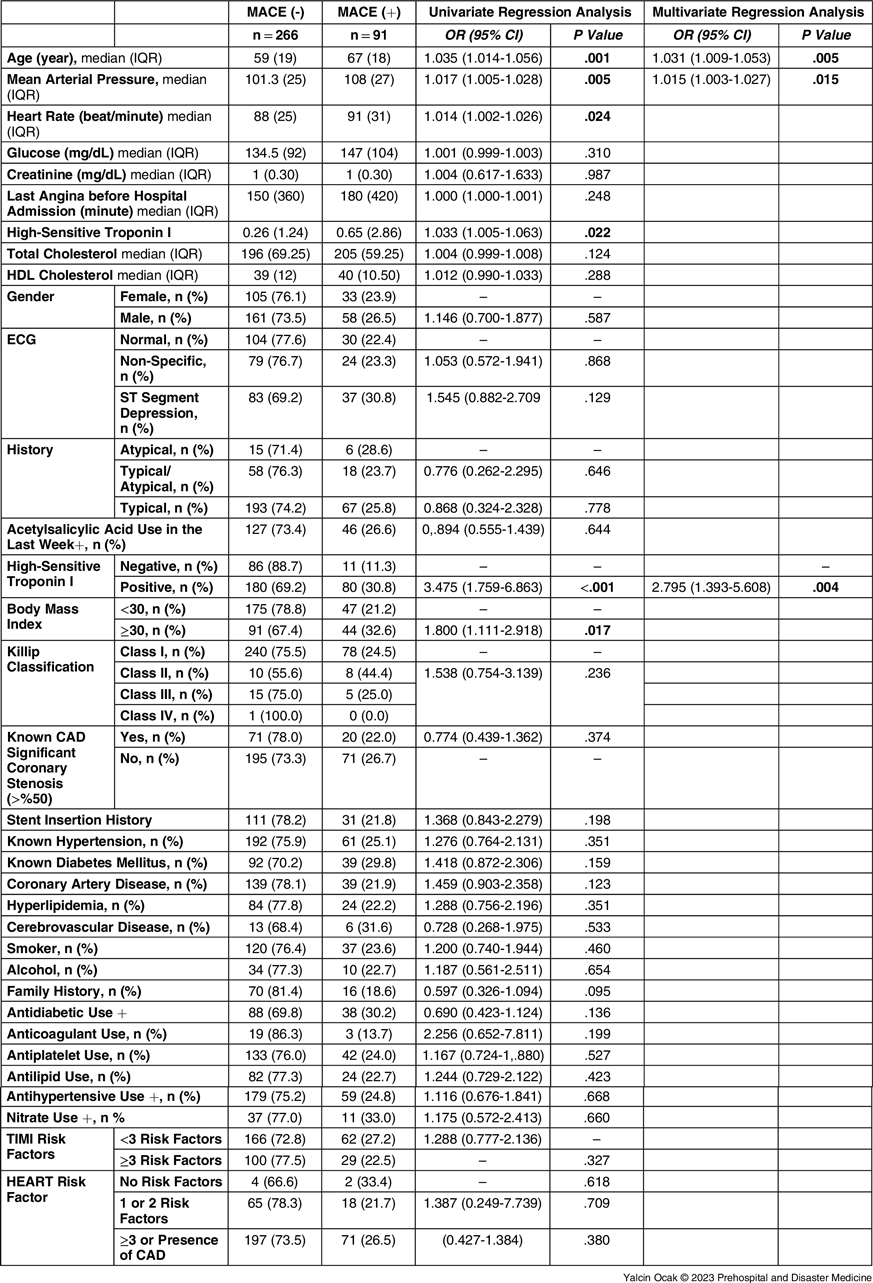
Univariate and multivariate regression analysis in predicting MACE are given in Table 3. The results showed that age, MAP, pulse rate, High-Sensitive Troponin I, and body mass index (BMI) were statistically significant in univariate logistic regression models (P <.05). When statistically significant variables were included together on the final multiple logistic regression models, age (P = .005), MAP (P = .015), and High-Sensitive Troponin I (P = .004) were statistically significant.
Study Population Characteristics and Two-State Univariate and Multivariate Regression Analysis in Predicting Major Adverse Cardiac Events (MACE)

Abbreviations: MACE, major adverse cardiac event; ECG, electrocardiogram; HDL, high-density lipoprotein; CAD, coronary artery disease; TIMI, Thrombolysis in Myocardial Infarction; HEART, History, Electrocardiogram, Age, Risk Factors, Troponin.
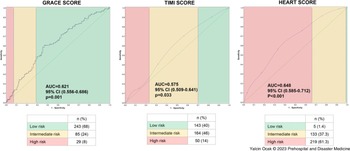
According to MACE, area under the curves (AUC) values for TIMI, HEART, and GRACE risk scores were 0.575 (P = .033; 95% CI, 0.509-0.641), 0.648 (P <.001; 95% CI, 0.585-0.712), and 0.621 (P = .001; 95% CI, 0.556-0.686), respectively (Figure 2).
Risk Group Distributions, Receiver Operating Characteristic (ROC) Curves, and Areas Under the Curve (AUC) of Patients who Developed Major Adverse Cardiac Events (MACE) for TIMI, HEART, and GRACE Risk Scores.
Abbreviations: TIMI, Thrombolysis in Myocardial Infarction; HEART, History, Electrocardiogram, Age, Risk Factors, Troponin; GRACE, Global Registry of Acute Coronary Events.

When the areas under the ROC curves were compared, a statistically significant difference was found only between the HEART and TIMI risk scores (P = .015).
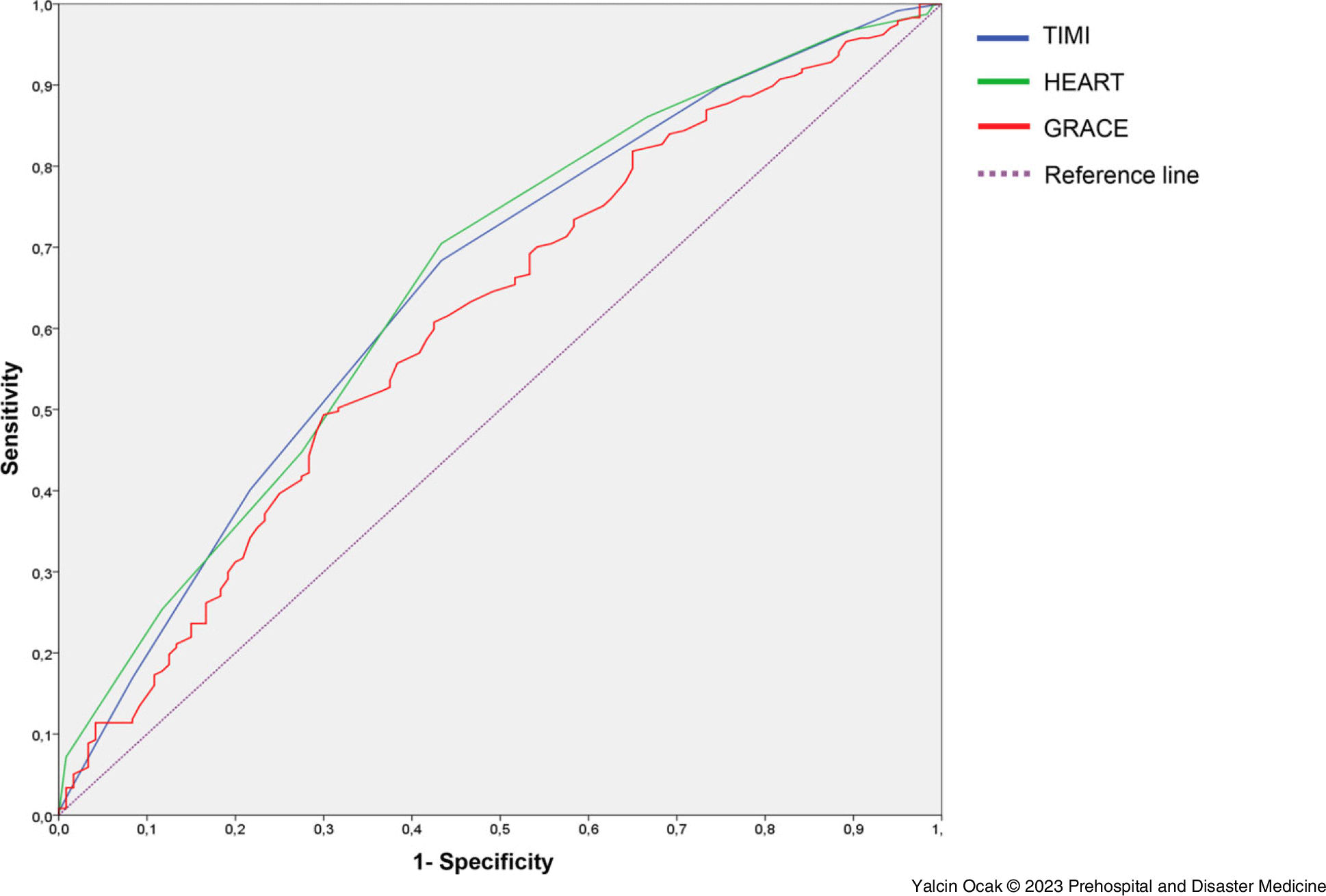
According to severe CAD (Gensini score >20), AUC values for TIMI, HEART, and GRACE risk scores were 0.652 (P <.001; 95% CI, 0.591-0.713), 0.659 (P <.001; 95% CI, 0.599-0.719), and 0.611 (P = .001; 95% CI, 0.549-0.673), respectively (Figure 3).
Receiver Operating Characteristic Curve for TIMI, HEART, and GRACE According to Gensini Score.
Abbreviations: TIMI, Thrombolysis in Myocardial Infarction; HEART, History, Electrocardiogram, Age, Risk Factors, Troponin; GRACE, Global Registry of Acute Coronary Events.

The low-risk group constituted 40.0% and 68.0% of the population, respectively, in TIMI and GRACE scores, despite this study population being diagnosed with NSTEACS patients. In the HEART score, the low-risk group was 1.4%. The frequency of MACE in low-risk groups of TIMI, HEART, and GRACE scores was 18.8%, 0.0%, and 21.0%, respectively.
Discussion
In this study, the low-risk group constitutes 40.0%, 1.4%, and 68.0% of the population, respectively, in TIMI, HEART, and GRACE scores. Although TIMI and GRACE were designed for patients with proven ACS, their low-risk group patients were higher than the low-risk group of the HEART score. The GRACE score is a well-validated prediction model of death in ACS patients. Low-risk groups of GRACE and TIMI have four and two of all eight deaths, respectively. But all deaths were predicted in the high-risk group of the HEART score. At the same time, the HEART score gave better results in predicting MACE and severe CAD than the other two scores. Age, MAP, pulse rate, High-Sensitive Troponin I, and BMI were statistically significant predictors of MACE in univariate logistic regression models. When these variables were included in a multiple logistic regression model, age, MAP, and High-Sensitive Troponin I remained statistically significant predictors of MACE. Low to moderate correlation was found between the Gensini score and TIMI, HEART, and GRACE risk scores.
Al-Zaiti, et al Reference Al-Zaiti, Faramand, Alrawashdeh, Sereika, Martin-Gill and Callaway17 in their study aimed to compare early risk scoring systems in high-risk patients for ACS in ED retrospectively. For TIMI, GRACE, and HEART, they evaluated the moderate- and high-risk groups together as the high-risk group. In their study population, 115 (15.3%) patients were diagnosed with ACS at first admission, and the 30-day MACE rate in these ACS patients was 16.5% (n = 19). For classifying 30-day MACE, TIMI (AUC = 0.73), HEART (AUC = 0.72), and GRACE (AUC = 0.70) had fair discrimination power; but none of the scores had a good discrimination power. The HEART misclassified seven out of the 115 ACS events and seven of 33 MACE events (21%); TIMI misclassified 15 and 11 (33%) of these events, respectively. In this study, it was predicted that the early risk scores would mostly be as moderate- or high-risk groups because of the study population. The HEART score was the only score that accomplished this expectation, as same as in the study of Al-Zahiti, et al. In the current study, 25.5% of patients experienced MACE. The patients who developed MACE in the low-risk group of TIMI and GRACE scores were 18.8 % and 21.0%, respectively. For MACE, AUC values from ROC curve analysis for TIMI, HEART, and GRACE risk scores were 0.575, 0.648, and 0.621, respectively. Similarly, none of the scores had good discrimination power. These values indicate that the HEART score is more successful than the others in detecting low-risk patients in the ED.
Many studies have examined the relationship between GRACE and TIMI scores to angiographic severity scores in NSTEACS patients. In the literature since 2010, three studies were found comparing the Gensini score with the GRACE and TIMI risk scores in NSTEACS patients. Reference Roy, Abu Azam, Khalequzzaman, Ullah and Arifur Rahman11,Reference Barbosa, Viana and Brito12,Reference Routray14
Barbosa, et al Reference Barbosa, Viana and Brito12 in their study assessed 112 NSTEACS patients. The mean age was 70 (SD = 12) years, 51% were male, and 31% were diabetic. To predict severe CAD, they found the area under the ROC curve for the GRACE score was 0.59 (95% CI, 0.48-0.70), and for the TIMI score was 0.66 (95% CI, 0.56- 0.76). They reported these scores were not sufficient to be accurate predictors of coronary angiography results. Roy, et al Reference Roy, Abu Azam, Khalequzzaman, Ullah and Arifur Rahman11 in their study included 205 NSTEACS patients who had undergone coronary angiography. Their population mean age was 51.8 (SD = 9.1) years and 80% of them were male. They have excluded those who had any heart disease or cardiac event history. Their clinical characteristics were 69.3% hypertensive, 57.1% diabetic, 74.6% smoking, 28.9% had a family history, and 33.7% had dyslipidemia. They found the area under the ROC curve for the GRACE score was 0.943 (95% CI, 0.893-0.993), and for the TIMI score was 0.892 (95% CI, 0.853- 0.937). Routroy, et al Reference Routray14 conducted their study with 202 NSTEACS patients who accepted coronary angiography. Their study population had no cardiac event or cardiac disease history, the same as Roy, et al’s study. The mean age was 59.3 (SD = 9.19) years, and 71.5% were male. Clinical characteristics of patients were 60.8% hypertensive, 34.6% diabetic, 23.3% smoking, 20.3% had a family history, and 31.7% had dyslipidemia. They found the area under the ROC curve for the GRACE score was 0.765 (95% CI, 0.676-0.854), and for the TIMI score was 0.715 (95% CI, 0.618- 0.812). Both Roy, et al and Routroy, et al found these risk scores had good predictive value in the assessment of the CAD severity in NSTEACS patients. Also, they both found the GRACE score was superior to the TIMI score.
In the current study, the area under the ROC curve for the GRACE score was 0.611 (P = .001; 95% CI, 0.549-0.673), for the TIMI score was 0.652 (P <.001; 95% CI, 0.591-0.713), and for HEART score was 0.659 (P <.001; 95% CI, 0.599-0.719). The difference between the current study and the data in the literature may be due to the higher-risk group of patient population and the presence of a history of heart disease in one-half. Considering the inclusion and exclusion criteria, the current study draws attention as it represents the general population better than the other studies.
These risk scores were statistically significant in predicting severe CAD and the HEART score highest AUC. There were few studies in the literature comparing the HEART score and the angiographic severity score.
Limitations
The important limitations of this study are that it was a single-center study and that patients who did not undergo coronary angiography could not participate in the analysis. The hospitalization decision of the patients was made by different cardiologists. It was not examined whether cardiologists performed a risk score or additional evaluation for the clinical evaluation of patients.
Conclusion
The ability of the GRACE, HEART, and TIMI risk scores to predict severe CAD in patients with NSTEACS is similar. In patients with NSTEACS, the HEART and GRACE risk scores can better predict the development of MACE than the TIMI risk score. When low-risk groups are evaluated according to the three risk scores, the HEART score is more reliable to exclude the diagnosis of NSTEACS.
Conflicts of interest/funding
This research did not receive any specific grant from funding agencies in the public, commercial, or not-for-profit sectors. The authors declare no conflicts of interest.