Introduction
Cognitive impairment is a central feature of schizophrenia and related psychoses (Kahn and Keefe, Reference Kahn and Keefe2013). Substantial evidence indicates that cognitive dysfunction precedes the onset of psychosis (MacCabe et al., Reference MacCabe, Wicks, Lofving, David, Berndtsson, Gustafsson, Allebeck and Dalman2013; Meier et al., Reference Meier, Caspi, Reichenberg, Keefe, Fisher, Harrington, Houts, Poulton and Moffitt2014) and has been observed across all stages of the illness (Lewandowski et al., Reference Lewandowski, Cohen and Ongur2011). Patients with established schizophrenia or first-episode psychosis have been found to exhibit moderate-to-large deficits across multiple cognitive domains relative to healthy participants, particularly in memory, attention, processing speed and executive functions (Heinrichs and Zakzanis, Reference Heinrichs and Zakzanis1998; Mesholam-Gately et al., Reference Mesholam-Gately, Giuliano, Goff, Faraone and Seidman2009; Aas et al., Reference Aas, Dazzan, Mondelli, Melle, Murray and Pariante2014). Literature has also shown that impaired cognition is critically associated with functional disability (Green et al., Reference Green, Kern, Braff and Mintz2000; Bowie et al., Reference Bowie, Reichenberg, Patterson, Heaton and Harvey2006) and worse clinical outcome (Chen et al., Reference Chen, Hui, Dunn, Miao, Yeung, Wong, Chan and Tang2005; Chang et al., Reference Chang, Hui, Wong, Chan, Lee and Chen2013), and responds poorly to antipsychotic treatment (Keefe et al., Reference Keefe, Bilder, Davis, Harvey, Palmer, Gold, Meltzer, Green, Capuano, Stroup, McEvoy, Swartz, Rosenheck, Perkins, Davis, Hsiao and Lieberman2007; Davidson et al., Reference Davidson, Galderisi, Weiser, Werbeloff, Fleischhacker, Keefe, Boter, Keet, Prelipceanu, Rybakowski, Libiger, Hummer, Dollfus, López-Ibor, Hranov, Gaebel, Peuskens, Lindefors, Riecher-Rössler and Kahn2009; Nielsen et al., Reference Nielsen, Lavader, Kjaersdam, Jensen, Østergaard and Leucht2015).
In fact, cognitive dysfunction has long been conceptualized as a vulnerability marker as well as a potential risk predictor for the development of psychotic disorder. Two research paradigms have been widely applied in investigating cognitive impairment prior to the onset of psychosis, namely familial (FHR) and clinical high-risk (CHR) approaches. A large body of research has revealed that unaffected first-degree relatives of patients with schizophrenia display modest degree of cognitive impairment that is intermediate between patients and healthy controls (Sitskoorn et al., Reference Sitskoorn, Aleman, Eibsch, Appels and Kahn2004; Snitz et al., Reference Snitz, MacDonald and Carter2006; Agnew-Blais and Seidman, Reference Agnew-Blais and Seidman2013; Bora et al., Reference Bora, Lin, Yung, McGorry and Pantelis2014). Data from twin studies further indicate substantial genetic overlap between cognition and schizophrenia liability (Blokland et al., Reference Blokland, Hesholam-Gately, Toulopoulou, Del Re, Lam, DeLisi, Donohoe, Walters, Seidman and Petryshen2017), supporting cognitive impairment as an important endophenotype for elucidating genetic risk architecture of the disorder (Mark and Toulopoulou, Reference Mark and Toulopoulou2016). Alternatively, recent meta-analytic reviews have demonstrated that people at CHR state (or known as at-risk mental state) (Yung and McGorry, Reference Yung and McGorry1996; Fusar-Poli et al., Reference Fusar-Poli, Bordwardt, Bechdolf, Addington, Riecher-Rössler, Schultze-Lutter, Keshavan, Wood, Ruhrmann, Seidman, Valmaggia, Cannon, Velthorst, De Haan, Cornblatt, Bonoldi, Birchwood, McGlashan, Carpenter, McGorry, Klosterkötter, McGuire and Yung2013), a putatively prodromal phase of psychotic disorder, have widespread cognitive deficits (Bora et al., Reference Bora, Lin, Yung, McGorry and Pantelis2014; Fusar-Poli et al., Reference Fusar-Poli, Bonoldi, Yung, Borgwardt, Kempton, Valmaggia, Barale, Caverzasi and McGuire2012a,Reference Fusar-Poli, Deste, Smieskova, Barlati, Yung, Howes, Stieglitz, Vita, McGuire and Borgwardtb; Giuliano et al., Reference Giuliano, Li, Mesholam-Gately, Sorenson, Woodberry and Seidman2012; De Herdt et al., Reference De Herdt, Wampers, Vancampfort, De Hert, Vanhees, Demunter, Van Bouwel, Brunner and Probst2013) which are nonetheless less pronounced than those observed during first episode of psychosis (Hauser et al., Reference Hauser, Zhang, Sheridan, Burdick, Mogil, Kane, Auther, Carrión, Cornblatt and Correll2017). Accumulating evidence has also revealed that cognitive dysfunction in CHR individuals is related to functional impairment (Carrion et al., Reference Carrion, Goldberg, McLaughlin, Auther, Correll and Cornblatt2011; Meyer et al., Reference Meyer, Carrion, Cornblatt, Addington, Cadenhead, Cannon, McGlashan, Perkins, Tsuang, Walker, Woods, Heinssen and Seidman2014; Cotter et al., Reference Cotter, Drake, Bucci, Frith, Edge and Yung2014) and may enhance prediction of psychosis transition (Lin et al., Reference Lin, Yung, Nelson, Brewer, Riley, Simmons, Pantelis and Wood2013; Michel et al., Reference Michel, Ruhrmann, Schimmelmann, Klosterkotter and Schultze-Lutter2014; Cannon et al., Reference Cannon, Yu, Addington, Bearden, Cadenhead, Cornblatt, Heissen, Jeffries, Mathalon, McGlashan, Perkins, Seidman, Tsuang, Walker, Woods and Kattane2016).
Contrasting the cognitive profiles of FHR and CHR samples, who are presumably at different levels of psychosis risk and are free from the confounds of antipsychotic medications and illness chronicity, could shed light on the developmental course of cognitive dysfunction predating the onset of full-blown psychosis. Importantly, this would facilitate identification of impairment in specific cognitive functions that may be differentially linked to an imminent risk for psychosis v. trait (genetic risk) of the illness. A recent meta-analysis examining cognitive deficits in FHR and CHR individuals has suggested that the two high-risk groups were similarly impaired in cognitive functions as compared with healthy controls (Bora et al., Reference Bora, Lin, Yung, McGorry and Pantelis2014). However, there is a paucity of research directly comparing cognitive functions in FHR and CHR samples. Until now, there are only five published reports (Myles-Worsley et al., Reference Myles-Worsley, Ord, Ngiralmau, Weaver, Blailes and Faraone2007; Seidman et al., Reference Seidman, Giuliano, Meyer, Addington, Cadenhead, Cannon, McGlashan, Perkins, Tsuang, Walker, Woods, Bearden, Christensen, Hawkins, Heaton, Keefe, Heinssen and Cornblatt2010; Mukkala et al., Reference Mukkala, Ilonen, Nordström, Miettunen, Loukkola, Barnett, Murray, Jääskeläinen, Mäki, Taanila, Moilanen, Jones, Heinimaa and Veijola2011; Ucok et al., Reference Ucok, Direk, Koyuncu, Keskin-Ergen, Yüksel, Güler, Karadayı, Akturan and Devrim-Üçok2013; Hou et al., Reference Hou, Xiang, Wang, Everall, Tang, Yang, Xu, Correll and Jia2016) in this respect [including the only two studies (Ucok et al., Reference Ucok, Direk, Koyuncu, Keskin-Ergen, Yüksel, Güler, Karadayı, Akturan and Devrim-Üçok2013; Hou et al., Reference Hou, Xiang, Wang, Everall, Tang, Yang, Xu, Correll and Jia2016) which also recruited first-episode schizophrenia sample for cognitive comparison] and mixed findings were observed across studies. Of particular note, several important methodological limitations of earlier research merit attention. First, most studies recruited CHR individuals who were non-help-seeking in nature (Myles-Worsley et al., Reference Myles-Worsley, Ord, Ngiralmau, Weaver, Blailes and Faraone2007; Mukkala et al., Reference Mukkala, Ilonen, Nordström, Miettunen, Loukkola, Barnett, Murray, Jääskeläinen, Mäki, Taanila, Moilanen, Jones, Heinimaa and Veijola2011; Hou et al., Reference Hou, Xiang, Wang, Everall, Tang, Yang, Xu, Correll and Jia2016) which may significantly dilute the risk for psychosis, resulting in underestimation of cognitive impairment. Second, CHR samples in all of these five studies (Myles-Worsley et al., Reference Myles-Worsley, Ord, Ngiralmau, Weaver, Blailes and Faraone2007; Seidman et al., Reference Seidman, Giuliano, Meyer, Addington, Cadenhead, Cannon, McGlashan, Perkins, Tsuang, Walker, Woods, Bearden, Christensen, Hawkins, Heaton, Keefe, Heinssen and Cornblatt2010; Mukkala et al., Reference Mukkala, Ilonen, Nordström, Miettunen, Loukkola, Barnett, Murray, Jääskeläinen, Mäki, Taanila, Moilanen, Jones, Heinimaa and Veijola2011; Ucok et al., Reference Ucok, Direk, Koyuncu, Keskin-Ergen, Yüksel, Güler, Karadayı, Akturan and Devrim-Üçok2013; Hou et al., Reference Hou, Xiang, Wang, Everall, Tang, Yang, Xu, Correll and Jia2016) comprised varying but significant proportion of participants who fulfilled clinical risk criteria by having positive family history of psychotic disorder and concurrent functional deterioration (i.e. trait and state risk factors). Including individuals at genetically increased risk for psychosis in CHR group membership for comparison analysis with FHR participants may compromise validity of study results owing to a substantial overlap between familial and clinical risk constructs in the study samples. Third, sample sizes of high-risk groups in some studies were small (n ⩽ 30) (Mukkala et al., Reference Mukkala, Ilonen, Nordström, Miettunen, Loukkola, Barnett, Murray, Jääskeläinen, Mäki, Taanila, Moilanen, Jones, Heinimaa and Veijola2011; Ucok et al., Reference Ucok, Direk, Koyuncu, Keskin-Ergen, Yüksel, Güler, Karadayı, Akturan and Devrim-Üçok2013) which may obscure potentially subtle yet significant between-group cognitive differences owing to insufficient statistical power.
To this end, we present a study which aimed to compare cognitive functions in three groups of participants lying across the psychosis risk spectrum including patients with first-episode schizophrenia-spectrum disorder (FES), their unaffected siblings (i.e. FHR group) and help-seeking, antipsychotic-naive CHR individuals with no family history of psychotic disorder, relative to healthy controls. Based on prior literature, we hypothesized that FES, FHR and CHR groups would exhibit significantly poorer cognitive performance than healthy controls. Furthermore, we predicted that FES patients would be the most cognitively impaired, while the two high-risk groups would display comparable cognitive functions.
Methods
Participants
A total of 258 Chinese participants aged 15–40 years were included in the study (between January 2014 and December 2016), comprising 69 FES patients, 71 individuals at CHR for psychosis, 50 unaffected siblings of FES patients and 68 healthy controls. Clinically stable FES patients who had DSM-IV (American Psychiatric Association, 1994) diagnosis of first-episode schizophrenia (n = 51), schizophreniform disorder (n = 16) or schizoaffective disorder (n = 2) were recruited from the outpatient units of territory-wide specialized early intervention service for first-episode psychosis (namely EASY programme) in Hong Kong (Chung and Chen, Reference Chung, Chen, Chen, Chan and Wong2013) within 3 years (median: 255 days) following initiation of antipsychotic treatment. Diagnosis was determined using all available information including Chinese-bilingual Structured Clinical Interview for DSM-IV (CB-SCID-I/P) (So et al., Reference So, Kam, Leung, Chung, Lui and Fong2003) administered at intake, medical records and informant history. First-episode status and duration of untreated psychosis was ascertained using Interview for Retrospective Assessment of Onset of Schizophrenia (IRAOS) (Häfner et al., Reference Häfner, Riecher-Rössler, Hambrecht, Maurer, Meissner, Schmidtke, Fätkenheuer, Löffler and van der Heiden1992). Help-seeking individuals presenting with suspected prodromal symptoms to EASY programme were identified and assessed with Comprehensive Assessment of At-Risk Mental State (CAARMS) (Yung et al., Reference Yung, Yuen, McGorry, Phillips, Kelly, Dell'Olio, Francey, Cosgrave, Killackey, Stanford, Godfrey and Buckby2005) for verification of CHR status. Those who were antipsychotic-naive, did not have past history of psychotic disorder (by CB-SCID-I/P), and fulfilled one or more of the following CAARMS criteria were enrolled in the study: (i) attenuated psychotic symptoms (n = 64) or (ii) brief limited intermittent psychotic symptoms (n = 7). Thirteen individuals who met CAARMS criteria based on positive family history of psychosis in a first-degree relative (i.e. trait and state risk factors) were excluded from the current investigation so as to avoid overlap with FHR group. Among the 71 CHR participants, 13 were taking antidepressant medications. Unaffected siblings of FES participants (as FHR group) were invited to participate in the study. A group of healthy controls was recruited from the community via advertisements and word-of-mouth among recruited participants. Participants in FHR group and healthy controls were screened to confirm that they had no lifetime psychiatric diagnosis (by CB-SCID-I/P) and were not taking any psychotropic medications. Candidates for healthy controls were excluded if they had family history of psychotic disorder. General exclusion criteria for all study groups were intellectual disability, history of head injury, neurological disease or substance abuse (based on DSM-IV criteria) in the past 6 months. The study was approved by the local institutional review boards. All participants provided written informed consent. For those aged under 18 years, consent was also obtained from a parent.
Assessment
A standardized battery of cognitive tests were administered to all participants, comprising letter–number span (LNS) test (Gold et al., Reference Gold, Carpenter, Randolph, Goldberg and Weinberger1997), digit symbol coding subtest of the Wechsler Adult Intelligence Scale–Revised (WAIS-R) (Hong Kong Psychological Society, 1989a), monotone counting test (Wilkins et al., Reference Wilkins, Shallice and McCarthy1987), category verbal fluency, and logical memory and visual reproduction subtests of the Wechsler Adult Memory Scale–Revised (WMS-R) (Hong Kong Psychological Society, 1989b). Standardized z-score for each of the cognitive tests completed by participants in FES, CHR and FHR groups was computed based on the performance of healthy controls. Cognitive composite score for each participant was then calculated as a measure of global cognitive function by averaging the z-scores of individual cognitive tests. Psychopathology was assessed in participants of FES and CHR groups only using Positive and Negative Syndrome Scale (PANSS) (Kay et al., Reference Kay, Opler and Fiszbein1987).
Statistical analysis
To compare demographic characteristics between the FES, CHR, FHR and healthy control groups, one-way analysis of variance and χ2 tests were conducted, as appropriate. Severity of symptom dimensions between FES and CHR participants were compared using independent t tests. Group differences in cognitive test performance were examined using multivariate analysis of covariance (MANCOVA), controlling for potential confounding effect of age which differed significantly between groups in preceding analyses, followed by a series of univariate analyses for individual cognitive tests, with Bonferroni correction performed for post-hoc pairwise comparisons. Effect sizes indicating the magnitude of standardized mean differences on cognitive performance between four groups were calculated using Cohen's d. Additional analyses focusing on cognitive comparisons between FES and CHR groups were conducted, with age and PANSS general psychopathology score (which was significantly different between these two groups) as covariates. To address the non-independence of observations within families (i.e. FES and FHR groups), we also performed linear mixed models for comparisons of cognitive performance among study groups using family as a random factor with random intercept, group (FES, CHR, FHR and control groups) as a fixed factor and age as a covariate. Restricted maximum likelihood method with compound symmetry structure was adopted (assuming constant variance and covariance across each family member within a family) for model parameter estimation. Post-hoc pairwise comparisons were then conducted with Bonferroni correction applied. Mixed-model analyses were conducted in R (version 3.4.4) using the Ime4 package. All other analyses were performed using IBM SPSS, version 24.
Results
Characteristics of the samples
Table 1 summarizes the demographic and clinical characteristics of the participants. There were significant differences among the groups in age and education. Participants in CHR group were significantly younger and had lower educational attainment than those in the other three groups. Comparison between FES and CHR groups further found that CHR participants had significantly higher PANSS general psychopathology score than FES patients.
Demographic and clinical characteristics of the study samples

CHR, clinical high-risk; CPZ, chlorpromazine; DUP, duration of untreated psychosis; FHR, familial high-risk; FES, first-episode schizophrenia-spectrum disorder; HC, healthy controls; PANSS, Positive and Negative Syndrome Scale.
a Mean (s.d.) of DUP of FES sample was 216.4 (287.1) days.
Comparison of cognitive performance among study groups
FES, CHR and FHR groups v. healthy controls
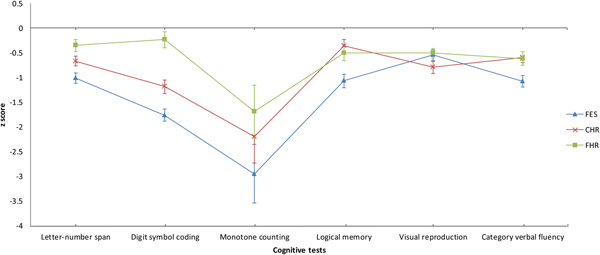
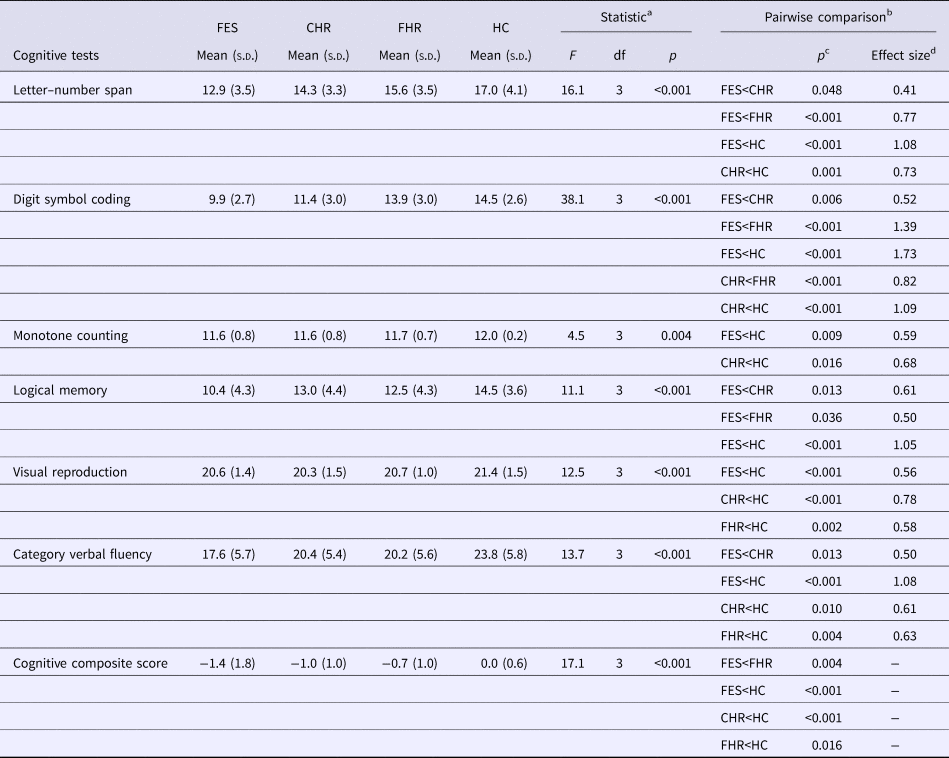
The overall MANCOVA was significant (F = 8.14, p < 0.001), with subsequent univariate analyses showing significant group difference in performance across all of the individual cognitive measures (Table 2, Fig. 1). Post-hoc pairwise comparisons revealed that FES patients significantly underperformed in all cognitive tests than healthy controls (d = 0.56–1.73). CHR participants exhibited significantly poorer performance in LNS, digit symbol coding, monotone counting and visual reproduction tests relative to healthy controls (d = 0.61–1.09). Unaffected siblings performed significantly worse than healthy controls in visual reproduction (d = 0.58) and category verbal fluency (d = 0.63) tests, and demonstrated a trend toward significance (p = 0.069, d = 0.47) in underperformance of logical memory test as compared with healthy controls. Participants in FES, CHR and FHR groups also displayed significantly lower cognitive composite scores than healthy controls. Linear mixed-model analyses controlling for within-family correlation replicated and confirmed the results derived from MANCOVA (Table S2).
Cognitive profiles of the FES, CHR and FHR groups standardized against the healthy control group. CHR, clinical high-risk; FHR, familial high-risk; FES, first-episode schizophrenia-spectrum disorder. Note: The straight line, which was set to zero score, represents cognitive performance of the healthy control group.

Cognitive functions of the FES, CHR, FHR and control groups

CHR, clinical high-risk; FHR, family high-risk; FES, first-episode schizophrenia-spectrum disorder; HC, healthy controls.
a Multivariate analysis of covariance (MANCOVA) with age being adjusted as a covariate, followed by univariate analyses for individual cognitive measures were conducted.
b Bonferroni correction was applied in post-hoc pairwise comparison analyses on all individual cognitive tests
c Bonferroni-corrected p values were presented, with p < 0.05 indicating statistical significance.
d Effect sizes were calculated with Cohen's d following significant pairwise comparisons.
FES group v. CHR group
As shown in Table 2 (and Table S2), FES patients had significantly poorer performance than CHR participants in LNS, digit symbol coding, logical memory and category verbal fluency tests. Between-group differences in these four cognitive functions remained statistically significant in subsequent comparison analyses even when PANSS general psychopathology score was adjusted as a covariate in addition to age (Table S1). FES patients also had significantly lower cognitive composite score than CHR participants when both age and PANSS general psychopathology score were adjusted (Table S1; p = 0.077 when only age was adjusted in univariate analysis).
FES group v. FHR group
Pairwise comparisons indicated that unaffected siblings performed significantly better in LNS, digit symbol coding and logical memory tests, and had higher cognitive composite score than FES patients (Table 2 and Table S2).
CHR group v. FHR group
Among six cognitive tests, CHR and FHR groups differed from each other only in digit symbol coding performance, with the former exhibiting greater degree of impairment than the latter (Table 2 and Table S2). There was no significant group difference in cognitive composite score.
Discussion
The current study sought to investigate cognitive functions across FES patients, their unaffected siblings and individuals at CHR for psychosis. To our knowledge, this is one of the few studies which directly compared cognitive performance between familial and clinical risk groups for psychosis. The study is also among the very few reports which included first-episode patient sample for direct comparison of cognitive functions with the two high-risk groups. Three major findings emerged from the study. First, FES, CHR and FHR participants had significantly poorer cognitive functions than healthy controls, with FES patients exhibiting the most severe cognitive impairment among the four groups. Second, CHR and FHR groups displayed largely comparable performance across most of the cognitive tests. Third, digit symbol coding was the most sensitive discriminator of FES and CHR groups from healthy controls, as well as the only cognitive task significantly distinguishing between CHR and FHR participants.
Consistent with the well-established evidence indicating severe generalized cognitive dysfunction in first-episode populations (Mesholam-Gately et al., Reference Mesholam-Gately, Giuliano, Goff, Faraone and Seidman2009; Aas et al., Reference Aas, Dazzan, Mondelli, Melle, Murray and Pariante2014), we found that FES patients had medium-to-large impairments across all individual cognitive tests relative to healthy controls. Our findings of widespread cognitive deficits affecting multiple domains in CHR participants also concur with the extant literature showing that impaired cognition is already evident prior to the onset of full-blown psychosis (Bora et al., Reference Bora, Lin, Yung, McGorry and Pantelis2014; Fusar-Poli et al., Reference Fusar-Poli, Bonoldi, Yung, Borgwardt, Kempton, Valmaggia, Barale, Caverzasi and McGuire2012a,Reference Fusar-Poli, Deste, Smieskova, Barlati, Yung, Howes, Stieglitz, Vita, McGuire and Borgwardtb; Giuliano et al., Reference Giuliano, Li, Mesholam-Gately, Sorenson, Woodberry and Seidman2012; De Herdt et al., Reference De Herdt, Wampers, Vancampfort, De Hert, Vanhees, Demunter, Van Bouwel, Brunner and Probst2013; Hauser et al., Reference Hauser, Zhang, Sheridan, Burdick, Mogil, Kane, Auther, Carrión, Cornblatt and Correll2017). Additionally, our results revealed that unaffected siblings of FES patients were significantly cognitively impaired as compared with healthy participants. This is thus in agreement with substantial body of research demonstrating that people with familial risk for schizophrenia are associated with compromised cognitive abilities (Sitskoorn et al., Reference Sitskoorn, Aleman, Eibsch, Appels and Kahn2004; Snitz et al., Reference Snitz, MacDonald and Carter2006; Agnew-Blais and Seidman, Reference Agnew-Blais and Seidman2013; Bora et al., Reference Bora, Lin, Yung, McGorry and Pantelis2014) which represent vulnerability markers for the disorder (Mark and Toulopoulou, Reference Mark and Toulopoulou2016).
Our comparison analyses of FES, CHR and FHR participants showed that FES patients displayed the worst performance in most of the individual tests as well as the poorest global cognitive function relative to the two high-risk groups. This is in line with the results of most previous studies contrasting cognitive performance of first-episode sample with either CHR or FHR group (Bora et al., Reference Bora, Lin, Yung, McGorry and Pantelis2014; Hauser et al., Reference Hauser, Zhang, Sheridan, Burdick, Mogil, Kane, Auther, Carrión, Cornblatt and Correll2017). Specifically, our observation that cognitive impairment was more pronounced in FES patients than in CHR participants appears to lend support to the proposition of decline in cognitive functions over transition from CHR state to overt psychosis (Addington and Barbato, Reference Addington and Barbato2012). However, this may partly be explained by the nature of CHR construct. It is well recognized that CHR status is clinically heterogeneous, with conversion rate to full-blown psychosis of approximately 18–36% over 6–30 months after presentation (Fusar-Poli et al., Reference Fusar-Poli, Bonoldi, Yung, Borgwardt, Kempton, Valmaggia, Barale, Caverzasi and McGuire2012a,Reference Fusar-Poli, Deste, Smieskova, Barlati, Yung, Howes, Stieglitz, Vita, McGuire and Borgwardtb). Hence, CHR comprises true prodrome for psychosis and false-positive cases with various non-psychotic mental disorders including depression and anxiety disorder. Accumulating data has demonstrated that CHR individuals who later convert to psychotic disorder experience more severe cognitive impairment at baseline than those non-converted counterparts (Bora et al., Reference Bora, Lin, Yung, McGorry and Pantelis2014; Fusar-Poli et al., Reference Fusar-Poli, Bonoldi, Yung, Borgwardt, Kempton, Valmaggia, Barale, Caverzasi and McGuire2012a,Reference Fusar-Poli, Deste, Smieskova, Barlati, Yung, Howes, Stieglitz, Vita, McGuire and Borgwardtb; Giuliano et al., Reference Giuliano, Li, Mesholam-Gately, Sorenson, Woodberry and Seidman2012; De Herdt et al., Reference De Herdt, Wampers, Vancampfort, De Hert, Vanhees, Demunter, Van Bouwel, Brunner and Probst2013; Hauser et al., Reference Hauser, Zhang, Sheridan, Burdick, Mogil, Kane, Auther, Carrión, Cornblatt and Correll2017). As a group, CHR participants are thus expected to be less cognitively impaired than FES patients. Alternatively, there is evidence suggesting that cognitive impairment associated with schizophrenia is neurodevelopmental in origin (Bora, Reference Bora2015) and is characterized by slower gain (i.e. developmental lag) instead of cognitive deterioration across illness stages (Reichenberg et al., Reference Reichenberg, Caspi, Harrington, Houts, Keefe, Murray, Poulton and Moffitt2010). A recent meta-analysis has also revealed an absence of significant cognitive decline over time in CHR individuals (Bora and Murray, Reference Bora and Murray2014). Given the cross-sectional nature of the current study, we were not able to adequately address whether there is cognitive decline from CHR state to psychotic disorder or to further delineate baseline cognitive differences between converters and non-converters among CHR participants. Reassessment for conversion status and cognitive functions of our CHR cohort at follow-up is required to clarify these unresolved issues.
Of note, we found that CHR and FHR groups did not differ significantly in global cognition and were, in general, similarly impaired across most of the cognitive tasks administered. In fact, this accords with the majority of prior studies which directly compared cognitive functions between CHR and FHR individuals and revealed lack of significant group differences (Seidman et al., Reference Seidman, Giuliano, Meyer, Addington, Cadenhead, Cannon, McGlashan, Perkins, Tsuang, Walker, Woods, Bearden, Christensen, Hawkins, Heaton, Keefe, Heinssen and Cornblatt2010; Mukkala et al., Reference Mukkala, Ilonen, Nordström, Miettunen, Loukkola, Barnett, Murray, Jääskeläinen, Mäki, Taanila, Moilanen, Jones, Heinimaa and Veijola2011; Ucok et al., Reference Ucok, Direk, Koyuncu, Keskin-Ergen, Yüksel, Güler, Karadayı, Akturan and Devrim-Üçok2013). Conversely, one recent study, which recruited CHR participants who were exclusively of first-degree relatives of schizophrenia patients and presented with prodromal symptoms, found greater cognitive deficits in CHR than in FHR group (Hou et al., Reference Hou, Xiang, Wang, Everall, Tang, Yang, Xu, Correll and Jia2016). This contrary finding, however, might be due to the combined effect of clinical and familial risks in CHR group membership, with co-occurrence of both risk states being associated with more severe cognitive impairment (Bora et al., Reference Bora, Lin, Yung, McGorry and Pantelis2014; Seidman et al., Reference Seidman, Giuliano, Meyer, Addington, Cadenhead, Cannon, McGlashan, Perkins, Tsuang, Walker, Woods, Bearden, Christensen, Hawkins, Heaton, Keefe, Heinssen and Cornblatt2010).
Our findings that digit symbol coding demonstrated the largest effect size among various cognitive tests in FES v. control comparison agree with substantial evidence showing that digit symbol measure is the most sensitive individual cognitive test discriminating patient status of either established schizophrenia (Dickinson et al., Reference Dickinson, Ramsey and Gold2007) or first-episode populations (Mesholam-Gately et al., Reference Mesholam-Gately, Giuliano, Goff, Faraone and Seidman2009) from healthy participants. Our results that digit symbol coding also yielded the largest impairment in CHR group are in line with the literature which suggested digit symbol measure as one of the most sensitive cognitive tests distinguishing CHR individuals from healthy controls (Fusar-Poli et al., Reference Fusar-Poli, Bonoldi, Yung, Borgwardt, Kempton, Valmaggia, Barale, Caverzasi and McGuire2012a,Reference Fusar-Poli, Deste, Smieskova, Barlati, Yung, Howes, Stieglitz, Vita, McGuire and Borgwardtb; Hauser et al., Reference Hauser, Zhang, Sheridan, Burdick, Mogil, Kane, Auther, Carrión, Cornblatt and Correll2017; Lin et al., Reference Lin, Yung, Nelson, Brewer, Riley, Simmons, Pantelis and Wood2013; Seidman et al., Reference Seidman, Giuliano, Meyer, Addington, Cadenhead, Cannon, McGlashan, Perkins, Tsuang, Walker, Woods, Bearden, Christensen, Hawkins, Heaton, Keefe, Heinssen and Cornblatt2010). More importantly, digit symbol coding was shown as the cognitive measure of greatest discriminant capacity in differentiating CHR from FHR participants. In fact, this study is the first to provide empirical evidence, based on direct comparison between two high-risk samples, indicating that digit symbol coding performance might be the most sensitive cognitive parameter in differentiation between CHR and FHR groups. Intriguingly, this is also consistent with a recent meta-analysis which compared CHR or FHR individuals with healthy controls on cognitive functions and indicated digit symbol as the only cognitive test showing significantly greater impairment in CHR relative to FHR group (Bora et al., Reference Bora, Lin, Yung, McGorry and Pantelis2014). Digit symbol coding task, which requires participants to correctly substitute symbols and digits using a key under timed conditions, is regarded as a measure of processing speed. It is acknowledged that processing speed is a fundamental cognitive function influencing the execution of many higher order cognitive operations and may represent a core cognitive deficit in schizophrenia (Dickinson, Reference Dickinson2008). Previous studies showed that deficient processing speed was associated with poor functional outcome in schizophrenia (Bowie et al., Reference Bowie, Leung, Reichenberg, McClure, Patterson, Heaton and Harvey2008) and CHR samples (Carrion et al., Reference Carrion, Goldberg, McLaughlin, Auther, Correll and Cornblatt2011; Meyer et al., Reference Meyer, Carrion, Cornblatt, Addington, Cadenhead, Cannon, McGlashan, Perkins, Tsuang, Walker, Woods, Heinssen and Seidman2014). Recent data have further revealed that digit symbol coding added modest but significant independent contribution above clinical measures to a risk calculator algorithm for psychosis prediction in CHR individuals (Cannon et al., Reference Cannon, Yu, Addington, Bearden, Cadenhead, Cornblatt, Heissen, Jeffries, Mathalon, McGlashan, Perkins, Seidman, Tsuang, Walker, Woods and Kattane2016). It should, however, be noted that a growing body of evidence has indicated that digit symbol coding performance was predicted by multiple cognitive functions (Knowles et al., Reference Knowles, Weiser, David, Glahn, Davidson, Gold, Davidson and Reichenberg2012) and its adequate performance might be more reliant on executive function than cognitive components constituting processing speed domain (Knowles et al., Reference Knowles, Weiser, David, Glahn, Davidson and Reichenberg2015). Owing to the paucity of existing data, further research which directly compares cognitive functions between the two high-risk groups is warranted to confirm our findings that digit symbol coding performance may best discriminate CHR from FHR individuals. Additionally, future investigations should carefully parse cognitive components of digit symbol coding so as to verify whether processing speed deficit is a major contributor to the discriminant capacity of digit symbol coding in delineating the two high-risk samples.
Several methodological limitations need to be acknowledged in interpreting the study results. First, the current study was cross-sectional in design which precludes us from examining the trajectories of cognitive functions over time, in particular the possibility of cognitive deterioration from high-risk state to full-blown psychosis. Likewise, we were not able to determine the predictive capacity of specific cognitive measures on psychosis conversion owing to lack of longitudinal clinical data. Second, we used a relatively brief battery of cognitive assessments which may not adequately capture the breadth and degree of impairment across multiple cognitive domains. Third, social cognition, which was found to be impaired in FES, CHR and FHR individuals to a different extent (Lavoie et al., Reference Lavoie, Plana, Bedard, Godmaire-Duhaime, Jackson and Achim2013; Van Donkersgoed et al., Reference van Donkersgoed, Wunderink, Nieboer, Aleman and Pijnenborg2015; Healey et al., Reference Healey, Bartholomeusz and Penn2016), was not evaluated in the study. Fourth, our modest sample size may compromise the statistical power to detect subtle group differences in cognitive test performance.
In conclusion, our results indicate that FES patients displayed the largest deficits in cognitive functions while CHR participants and unaffected siblings exhibited largely comparable cognitive impairment that was intermediate between FES and control groups. Among various cognitive tests, digit symbol coding showed the greatest magnitude of impairment in FES and CHR samples relative to healthy controls, and was the only cognitive measure that significantly discriminated between clinical and familial risk groups. Our findings thus suggest that digit symbol coding performance may constitute a sensitive cognitive parameter indexing illness risk and severity for schizophrenia and related psychoses.
Supplementary material
The supplementary material for this article can be found at https://doi.org/10.1017/S0033291718002726
Acknowledgements
This study was supported by the Hong Kong Research Grants Council (GRF: 762713). The funding body had no involvement in any aspect of the study or manuscript preparation. We thank all the coordinating clinicians and staff from the participating hospitals, clinics and medical records departments for their kind assistance. We are also grateful to the individuals who participated in the study.
Conflict of interest
Author E.Y.H.C. has participated in the paid advisory board for Otsuka, has received educational grant support from Janssen-Cilag, and has received research funding from Astra-Zeneca, Janssen-Cilag, Eli Lilly, Sanofi-Aventis and Otsuka. E.H.M.L has been a member of the paid advisory boards for Eli Lilly and AstraZeneca. The authors report no conflicts of interest. The authors alone are responsible for the content and writing of the paper.