As a result of its repetition in the rosary, the Ave Maria remains the most widely uttered prayer in Christian devotional life.Footnote 1 It reverberated throughout the late Middle Ages, particularly in the fifteenth century, as Marian devotion reached its apogee, and it emerged as a natural component of the medieval day. In some ways, the Ave Maria established a rhythm of life in urban culture: when bells pealed to signal the hours at the church of St Donatian in medieval Bruges, an interval of time was left between each of the bells' strokes for one to say a Hail Mary.Footnote 2 The Ave Maria also punctuated the liturgical day: St Bonaventure recommended that three Aves be prayed at the sound of the Vesper bell, in particular, and in the early fourteenth century, John XXII codified the general practice known as the Angelus.Footnote 3 By the end of the fifteenth century, the Ave Maria was also to be found in the private devotion of the rosary.Footnote 4 Yet despite – or perhaps because of – its widespread recitation, the Ave was scarcely documented in writing, remaining an oral tradition until late in the Middle Ages. Moreover, the written evidence of the prayer points to a complex history of multiple forms which crystallised into the prayer known today only in the later sixteenth century.
Music has long played a role in the propagation of the Ave Maria, even from the infancy of the prayer. After a survey of the essential contribution of music in early forms of the prayer, linked by their common use of verses from the gospel of Luke, this article will identify three cases in which what can now be seen as the prayer's ‘first half’ was enhanced with additional text relating to – though not identical with – the supplication to Mary that forms the ‘second half’ as it had emerged by the end of the sixteenth century. These examples, drawn from the repertory of Ars Antiqua polyphony – a genre not normally associated with the history of the Ave – provide further nodes in the tangled network of prayers based on the words of Gabriel and Elizabeth in Luke's gospel. A review of the Ave Maria in the Divine Office and a survey of known examples of the prayer's expansion beyond its core biblical verses lay the groundwork for three case examples from the vast corpus of early Parisian polyphony. These select pieces offer a rare glimpse of supplicatory additions to the prayer, which are seldom encountered in the period before the fifteenth century. As we will see, the poet-composers responsible for these pieces not only provided litanical accessories to the first half of the Ave but also drew attention to these supplications through special musical devices of the period.
The origins of the Ave and the role of the Divine Office
The first half of the Ave Maria links two proximate, though not successive, verses from the evangelist Luke. These verses are both proclamations – one from the angel Gabriel at the scene of the Annunciation, the other from Elizabeth at the Visitation. The incipit of the Ave quotes Gabriel almost verbatim:Footnote 5

The only difference between the relevant verse of the Vulgate and its casting in the conventional Latin prayer is the vocative ‘Maria’ after the salutatory ‘Ave’ of the Annunciation. In the succeeding scene of the Visitation from Luke, Elizabeth's declaration recalls the words of Gabriel with the phrase ‘blessed art thou among women’, despite its Latin variant (see text below). This affirmation further enhances the core of the angel's announcement with Elizabeth's own recognition of the unborn Jesus, made evident to her viscerally by her own expected child, John the Baptist, who famously leaped in her womb:

Together, the joint salutations were kept almost perfectly intact in the core of the Ave Maria that has come down to us: ‘Ave Maria gratia plena, Dominus tecum, Benedicta tu in mulieribus, et benedictus fructus ventris tui’. With the authoritative weight of Scripture, the scenes of the Annunciation and Visitation quenched Christians' thirst for canonical details on the life of the Virgin in the advent of late medieval Marian devotion.Footnote 6 The liturgies of St James of Antioch and St Mark of Alexandria, which may date from as early as the fourth century, constitute the earliest combination of the words of Gabriel and Elizabeth.Footnote 7 The joining of the two proclamations was registered in the Latin West neither in apocryphal nor theological texts, as one might expect, but in the Roman liturgy, where the Ave Maria appeared as early as the seventh century in an offertory for the feast of the Annunciation, which was then celebrated in April. The Franks later assigned this offertory to the fourth Sunday of Advent, a date which they added to the liturgical calendar.Footnote 8
Sources of the Office reveal the proliferation of this fundamental core of the Ave Maria in the liturgy of the Latin Church. Various forms of the Ave found their way into the daily ritual of the Office as recitations and in musical settings.Footnote 9 The most common musical setting of the text (CAO 1539), present in all twelve of the sources representing the earliest layer of Offices for both the Roman and monastic cursus, sets only the words of Gabriel (Luke 1:28) as an antiphon for the feast of the Annunciation. The relatively syllabic casting of this first-mode antiphon includes the simple addition of an ‘Alleluia’ to close the piece. Some sixty Office items, spread across a range of liturgical positions and seasons, feature some resemblance to the core verses of the Ave, many containing the text ‘Ave Maria’ or ‘Ave gratia plena’ at the outset or during the course of the melody. About half of these settings venture beyond the words ‘Dominus tecum’. Among these sixty identified plainchants, only eleven unite the salutations of the angel and Elizabeth.Footnote 10 Most striking of these eleven are the two antiphons that similarly embed the full first half of the Ave Maria prayer within their respective settings (Ingressus angelus ad Mariam [CAO 3340] and Gabriel angelus locutus est [CAO 2916]). In only one liturgical setting – a responsory for the third Sunday in Advent (CAO 6156) – is the full first half of the Ave Maria presented alone, as a self-contained item, and this responsory seems to have had limited circulation in the earliest sources of the Office.Footnote 11
All of these liturgical items containing some or all of the first part of the Ave Maria in some way allude to the Annunciation narrative, but the Office settings were not strictly wedded to the feast day celebrating the Annunciation (25 March). The multiple melodic castings shuttled freely among other Marian seasons and feasts, from Advent and Christmas to Purification and even the Nativity of Mary. The angel's announcement was indeed the best-known event in Mary's life from Scripture, and hence seems destined to have been used repeatedly in both Marian and non-Marian feasts. Thus, despite the early substantiation of the united Marian greetings in both eastern and western Christendom, the conjunction of the two successive salutations from Luke was by no means etched in the Christian tradition, either as a cohesive prayer encapsulating the biblical narrative, or as a text wedded to the liturgical celebrations of the Virgin.
Further evidence of continued variability in the forms of the Ave Maria prayer is to be found in thirteenth- and fourteenth-century Books of Hours, which preserve the Little Office of the Virgin.Footnote 12 Within these manuscripts of personal devotion, a scaled-down Office for Mary, modelled on the Officium parvum BMV in breviaries, contained various prayers to the Virgin and allowed the laity to imitate the practices of monastic culture. As the devotional core of the Book of Hours, the Little Office of the Virgin maintained the basic structure and components of the Divine Office, supplemented by miniatures and historiated initials for contemplation.Footnote 13
To begin the Little Office, an Ave Maria was to be recited, but explicit instructions to do so were hardly ever recorded in the manuscripts.Footnote 14 After the traditional reflections on Psalm 51 (‘Domine, labia mea aperies’) and Psalm 70 (‘Deus in adiutorium meum intende’), the ‘service’ of Matins usually opened with another Ave Maria gratia plena of indeterminate length, this time cast as an invitatory with the usual ‘Venite exultemus’ (Psalm 95).Footnote 15 Since compilers generally provided only unnotated incipits, we cannot always be certain of either the full text or the melodic referent. At most, the invitatory included the words of Gabriel up to ‘in mulieribus’.Footnote 16 The Hours of the Virgin also included several occasions to say the antiphon CAO 1709 or the versicle CAO 7971, both of which begin Benedicta tu in mulieribus and include the words specific to Elizabeth's salutation (‘et benedictus fructus ventris tui’).Footnote 17 Thus, the Little Office accrued its share of Ave sentiments and, as a popular and privately performed liturgy, no doubt developed traditions that contributed to the propagation of the prayer in the late Middle Ages.
Before moving to a discussion of the additional texts that were added to these various forms of the core of the prayer, we must finally address the different ways in which this core was ‘completed’ in devotional life. In the most widespread version of the Ave Maria in the Divine Office (CAO 1539), the word ‘Alleluia’ capped off the short setting of the antiphon, as mentioned earlier. Antiphons and responsories generally do not command a closing Alleluia or Amen, but forms of the Ave Maria had a range of different terminations following ‘fructus ventris tui’.Footnote 18 In tracing the history of the Ave, historians have noted a crucial addendum to the successive greetings – the naming of Jesus. In all the previous examples, the words ‘Jesus Christ’ never stood as an appositive indicating the ‘fruit of [Mary's] womb’. The identification of the Saviour remained implicit in the salutations of Gabriel and Elizabeth, although in the narrative the angel expressly reveals that Mary's son should be called ‘Jesus’ (Luke 1:31) only a few verses following the declamation of the Ave.
The scholarly literature has not precisely dated the tradition of naming Jesus in the Ave Maria, but it is doubtful that the designation of Christ prefigured the concerted reverence for the ‘Holy Name of Jesus’, a feast celebrated towards the end of the fifteenth century and officially extended to the Church only in 1721.Footnote 19 Instead, legend has it that Urban IV (1261–64) ordered that the word ‘Jesus’ or, more commonly, ‘Jesus Christus, Amen’, be appended to the Ave.Footnote 20 John XXII (1316–34) recognised the importance of this subtle addition to the prayer and granted indulgences for attaching the name of Jesus to the Ave.Footnote 21 Wholly characteristic of an oral tradition, the versions naming Jesus did not supplant the previous renderings of the Ave Maria. Rather, varied practices of saying the prayer continued in parallel, creating a network of possibilities for this increasingly fundamental expression of Marian devotion. Even into the fifteenth century, one routinely encounters the short version of the Ave, lacking the name of Jesus. For example, in two distinct Marian poems from this period (Ave plena gratia virgo singularis and Ave porta poli), a lengthy acrostic generates the ‘whole’ Ave, which, in each case, offers nothing past the words ‘fructus ventris tui’.Footnote 22 We will likewise find varied approaches to setting the Ave Maria in music of the thirteenth and early fourteenth century, including the use of acrostics and addenda to the joint salutations.
As the foregoing evidence suggests, the first half of the Ave Maria, while established in some devotional realms, was by no means standardised as a single text in Christian ritual life in the late Middle Ages. Aves were in no short supply in the period: it was their length and formulation that remained inconsistent. Indeed, there was no single recitation to speak of, only variations on a biblical theme. The act of including a second part to the prayer – the brief supplication to the Virgin for intercession – reveals a similarly unstable history.
A second part to the Ave Maria
In all the tangled textual history of the Ave Maria, late fifteenth- and early sixteenth-century reformers argued that the repetitive devotion in its short form was not a prayer, properly speaking, but merely a recitation of two greetings.Footnote 23 Yet a second part to the prayer seems to have emerged in some contexts much earlier than the time of these reformational voices, likely beginning centuries earlier as a silent or private addition to the initial salutations.Footnote 24 Unlike the first part of the Ave Maria, the second half of the standardised devotion (‘Sancta Maria, mater dei’) has no biblical precedent. The petition addresses Mary as ‘holy’ and with the title ‘Mother of God’. The Church as a whole directs the supplication, urging Mary to intercede with her Son on behalf of the faithful (‘us sinners’) in order to obtain the necessary grace for salvation both now and at the hour of death.
The constituent parts that came to make up the second half of the Ave are not difficult to grasp. The name Mary, of course, is revealed in Scripture, and her post-biblical title as ‘Mother of God’ (Theotokos, ‘God-bearer’) was established in the Byzantine Church following the anti-Nestorian Council of Ephesus in 431.Footnote 25 The precise appeal (ora pro nobis) is a very general plea, recalling the Litany of the Saints and reflecting later medieval doctrine concerning the saints' power to intercede for believers.Footnote 26 It affirms that Mary, bearer of Christ and full of grace, sat in an especially advantageous position as Mediatrix for Christians. The complete devotion materialised as a powerful Mariological statement, uniting the biblical declarations with later supplicatory traditions. The intensified fervour for Mary in the later Middle Ages and the bipartite structure of the Ave also resulted in significant divisions among Christians, who wrestled with the dichotomy between the weight of the scriptural verses of the prayer and the exalted soteriological position of Mary.Footnote 27
The second half of the Ave Maria was formally in place by the later sixteenth century with the issue of the Roman breviary under Pius V in 1568.Footnote 28 Scholars have toiled, however, over the early history of the ‘Sancta Maria, mater dei’ text. One account has attributed this part of the Ave to the Ethiopian liturgy of uncertain antiquity.Footnote 29 Others conservatively place the second part of the Ave in the fifteenth or early sixteenth century, as an addition of unknown provenance.Footnote 30 Some have located the appearance of the ‘Sancta Maria’ petition in the liturgical books of various monastic orders in the early sixteenth century, including the Franciscan breviary of 1525.Footnote 31 Whatever the precise circumstances of the emergence of the prayer that has reached us today, the late dates proposed for its standardisation reflect the continued multiplicity of Ave devotions, many of them transmitted orally, well into the fifteenth (and perhaps sixteenth) century.
Historians have long sought a precise origin for the second part of the Ave Maria, but little, if any, of the marshalled evidence reveals a direct connection to the final prayer. Take, for example, the Litany of the Saints found in the prayer book GB-Lbl, Cotton Titus D. xxvi, written in the second quarter of the eleventh century for Ælfwine, Dean of the New Minster at Winchester. This prayer testifies to Anglo-Saxon devotion to Mary, particularly in its elaborate supplication to the Virgin, and has a vague resonance with the second part of the Ave known today. The sinner invokes the Virgin six times, summoning her with familiar titles near the end of the prayer and pleading with her directly for intercession, particularly at the time of death.Footnote 32

Yet this litanical supplication is not attached to words of Gabriel's proclamation, and thus hardly warrants serious consideration as a precursor of the second part of the Ave in its final form. Nonetheless, historians have regularly drawn on examples of similar or more concise entreaties to the Virgin – particularly in visual art – to support teleological arguments concerning the prayer's origins and development.Footnote 33 According to Thurston, the concluding petition for the Ave Maria may also have arisen in paraphrases or glosses on the dual salutations recited in the first half of the prayer. Support for this claim may be found in the sacred vernacular poetry commonly attributed to Dante.Footnote 34 Within the strictures of terza rima, the author recasts and expounds the three central prayers of western Christendom – the Credo, Paternoster and Ave Maria.Footnote 35 In the verses in honour of the Virgin, the salutations of Gabriel and Elizabeth are readily noticeable, and are followed by a concluding supplication to Mary.Footnote 36

It is true that in the direct address to the Virgin, the vernacular supplication ora pro noi and the reference to intercession al nostro fin have some general resonance with the ingredients from the final Latin version from the sixteenth century. However, the Dantean reference to Paradise and the naming of Christ in this gloss of the petition suggest that a ‘second half’ was both an uncommon and an inconsistent phenomenon. Another early fourteenth-century source contains an intriguing second part to a form of the Ave. The founder of Max Stoke Monastery in Warwickshire devised a supplement to the Ave Maria, though it does not formally issue the request for Mary to intercede. This formulation curiously ‘ends’ the prayer with an Amen, before continuing with prominent mention of Mary's mother, St Anne (italics mine): ‘Ave Maria, gracia plena, Dominus tecum, benedicta tu in mulieribus, et benedictus fructus ventris tui, Jesus. Amen. Et benedicta sit venerabilis mater tua Anna, ex qua tua caro virginea et immaculata processit’.Footnote 38 (And blessed be your venerable mother Anne, from whom your virginal and immaculate flesh proceeds.) We will shortly see a similar tactic in a musical setting, as one case of a transitional Ave appears to close with an Amen, before resuming with a textual addition, apparently understood as part of the prayer.
In the vernacular gloss above, the propinquity of Ave-type sentiments to the traditional Paternoster points up an important relationship between these familiar Christian prayers, which would eventually become the devotional substance marking the contemplative progression through the vita christi in the rosary, as it developed in the fifteenth century.Footnote 39 The devotional coupling of the Ave Maria and Paternoster spawned an important tradition in music of the early sixteenth century, which saw polyphonic settings deliberately pairing these two prayers. The practice of juxtaposing these two texts appears to have begun with the sumptuous, six-voice setting by Josquin and continued into the later sixteenth century with more than two dozen settings by some of the century's most highly regarded composers, including Willaert and Palestrina. In a study of these pairings, Daniel Freeman has demonstrated not only their proliferation, but also – significantly for the present study – the remarkable instability of a second part to the Ave Maria, even in the heyday of the Renaissance.Footnote 40
A range of alternative additions to the Ave Maria continued to be found throughout the fifteenth and sixteenth centuries. Frequently cited is evidence from the Franciscan missionary Bernardine of Siena (d. 1444), who, when reciting the Ave in a 1427 sermon, made this textual addition after the two salutations: ‘Sancta Maria, mater dei, ora pro nobis peccatoribus’.Footnote 41 A French vernacular rendering of this abbreviated addendum to the prayer appears in the popular medieval almanac known as the Compost et Kalendrier des Bergiers of 1493, while Richarde Pynson's 1506 English edition (Kalendar of Shepherdes) faithfully translates the ending, ‘Holy Mary moder of God praye for us synners. Amen’.Footnote 42 Finally in a commentary on the Ave Maria (c.1495), the great Dominican reformer Girolamo Savonarola unveiled a version of the prayer nearly identical with the Ave that was later to become canonical, except for the omission of the single word ‘nostrae’.Footnote 43 As close as it was to the ultimate wording, this supplication evidently saw little circulation at the time, although it is present in some music of the period.Footnote 44 Still at the turn of the sixteenth century, no single conclusion to Gabriel's announcement was predominant. A handful of musical and liturgical sources which provide a petitionary supplement to the prayer supply further evidence that it was routinely lengthened, though the question of how (if at all) these examples contributed to the development of the final, standardised form of the Ave remains a scholarly conundrum.
Petitions in Plainchant
The most significant gap in the received history of the second part of the Ave Maria remains the chronological gulf between the eleventh-century prayer book from Winchester and the Italian gloss of the Marian devotion from the early fourteenth century. Significant barriers stand in the way of interpreting these two texts as prefiguring the second part of the Ave Maria known in the sixteenth century: the former lacks a connection to the angel's announcement, and latter is cast in the vernacular. A number of musical pieces, dating from the intervening period and hitherto unmentioned in the literature on the Ave, provide evidence of its ongoing enhancement with additional, supplicatory text in a number of distinct formulations.
Surprisingly, the voluminous sources of plainchant that have survived provide little indication of an addendum attached to the Ave Maria. A few Office plainchants begin with the words ‘Sancta Maria’ before continuing with text related to the supplicatory half of the Ave Maria.Footnote 45 The most widespread of these, Sancta Maria succurre miseris (CAO 4703), has the most distant relationship to the text of the canonical prayer.Footnote 46 Closer to the sentiment is the Matins invitatory Sancta Maria dei genetrix (CAO 1158), which simply urges the Virgin to intercede on behalf of ‘us’ (‘Sancta Maria dei genetrix virgo intercede pro nobis’). This brief invitatory for the feast of Our Lady of the Snow achieved small circulation, surviving in only one of the twelve early sources of the Divine Office and a few later manuscripts.Footnote 47 The antiphon Sancta Maria virgo dei genetrix (CAO 4704) for the feast of the Assumption likewise survives in just one of the early sources of the Office, but is more specific in its plea to the Virgin and displays some similarities of language to the ultimate second half of the Ave (‘Sancta Maria virgo dei genetrix te deprecamur cum sanctis omnibus ut intercedas pro peccatis omnibus ut mereamur tecum habere perpetuum’).Footnote 48 In no case are these plainchants formally connected to the first part of the Ave, so a precise relationship with the prayer cannot be established in the first place.
The vast repertory of liturgical sequences for the Virgin Mary provides more evidence of supplicatory additions to the Ave Maria.Footnote 49 Medieval sequence writers crafted glosses on the Ave, sometimes including an entreaty to close the poem.Footnote 50 Thurston found one of the earliest examples of such a petition in a mid-twelfth-century sequence located in no fewer than eight manuscripts.Footnote 51 The poetry is attributed to the great composer of sequences, the monk Gottschalk of Aachen, although his death, likely in the early twelfth century, does not support the dating of this sequence to the year 1151.Footnote 52

The characteristically unpaired first stanza consists of the unadulterated words of Gabriel. Each of the stanzas thereafter ends with a short appeal to Mary and a veiled trope of the prayer (forms of ‘gratia’, ‘plena’, ‘dominus’, ‘tecum’, ‘benedicta’ and ‘tu’ [italics above]) is sprinkled throughout the poem. Stanza 4a recalls the opening of this short sequence (Gabriel's salutation), while the beginning of versicle 4b in particular (‘Hic nobis et mortis in hora succerre’) bears a close relationship to the second half of Ave Maria text that became fixed only in the sixteenth century. Nevertheless, this petition is scattered among several entreaties (repara, libera and recognosce) in the sequence, and thus cannot be regarded as a direct precursor to the simple and generic ‘ora pro nobis’ that would endure in the later devotion.
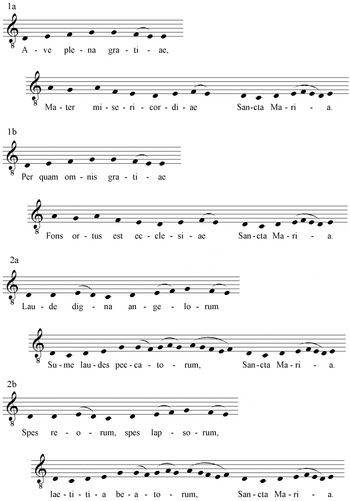
Among some forty sequences beginning with the formulation ‘Ave Maria’ (or similarly, such as ‘Ave plena gratiae’), few contain a final invocation comparable to the sequence attributed to Gottschalk.Footnote 53 One may single out the widespread sequence Ave plena gratiae, which repeatedly invokes the Virgin with the text ‘Sancta Maria’. In this rhymed sequence of seven versicle pairs, there is a textual and musical repetition of ‘Sancta Maria’ as punctuation at the end of each versicle (as shown in the excerpt in Example 1). In this way, the invocation takes on rhetorical significance as a component of both the text and the melody, and this unusual and memorable quality may perhaps have contributed to the sequence's wide distribution in at least three dozen manuscripts.Footnote 54
Excerpt of the sequence Ave plena gratiae, edited from Munich, Bayerische Staatsbibliothek 9508, fol. 267v (fifteenth century).

Additions to the Ave in early polyphony
Isolated and distinct hints of the association between the biblical portion of the Ave Maria and various supplicatory addenda have been traced in spoken and sung liturgies and in non-liturgical contexts between the eleventh century and the sixteenth. The international repertory of Ars Antiqua polyphony, surviving from the thirteenth and early fourteenth centuries, provides further notable cases. Nearly fifty Ave-inspired polyphonic works survive in the early Parisian corpus in sources mainly from the mid-to-late thirteenth century, several of which are mentioned in Anne Robertson's broader study of polyphony for the Annunciation.Footnote 55 However, only a handful set phrases from the biblical verses followed by a supplication, in ways that resemble – albeit loosely – the final form of the Ave Maria. The remainder of this article unveils three previously unacknowledged instances where a supplicatory addendum not only follows the core of the Ave, but is also formally demarcated from it through polyphonic techniques, suggesting that composers of polyphony also participated in the construction of late medieval Marian piety.
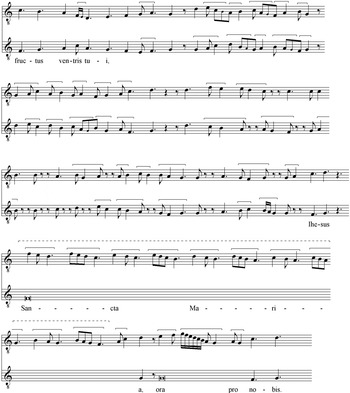
We first turn to the two-voice conductus Ave Maria gratia plena, an unicum from the well-known Las Huelgas manuscript (Burgos, Monasterio de Las Huelgas, ms 9), a manuscript from a Cistercian convent in northern Spain compiled in the first quarter of the fourteenth century and a rare source to survive in the location for which it was written.Footnote 56 The conductus in question contains the chief hallmark of the genre – an original tenor, not an import of some pre-existent plainchant.Footnote 57 The conductus, shown in Figure 1, includes the typical alternation between melismatic and syllabic sections, although some melismas in its first part are notably extended. Although not shown in this figure, the first syllable of the prayer (‘A-ve’) consumes more than twenty perfections, while the first syllable of ‘te-cum’ occupies more than thirty perfections, the exact numbers depending on how the text is underlaid. The brevity of the conductus text may perhaps have prompted such lengthy melismas, although other phrases, such as ‘Benedicta tu in mulieribus, et benedictus’, are ‘bunched’ with syllabic declamation and hardly obscured.
Ave Maria gratia plena (excerpt), Burgos, Monasterio de Las Huelgas, ms 9, fol. 152v.

The text of the conductus joins the first half of what was to become the ‘standard’ Ave Maria (including the name ‘Ihesus’) with a brief supplication (italicised below).

In his own survey of the various Ave Maria castings in Renaissance music, Freeman briefly called attention to this conductus from Las Huelgas as an early example of a petitionary conclusion to the prayer, but did not pursue an analysis of its music.Footnote 58 Beyond its litanical formulation, the notational and musical rendering of the concluding appeal to Mary further reinforces the uncharacteristic nature of this passage. The middle of the folio shows a lengthy melisma at the end of the first half of the prayer on the final, unstressed syllable of ‘tu-i’, while the text underlay of ‘ih[es]us s[an]c[t]a Maria ora p[ro] nobis’ receives even spacing across its own staff. The scribe's conspicuously drawn longa maxima above the word ‘Maria’ in the tenor, however, draws the eye towards the invocation – an effect that is matched aurally by the striking change of melodic and contrapuntal activity at this point. These long held notes of the tenor present immediate problems of underlay, since the ten syllables of the petition must either be fitted to just five notes, or pushed back into the previous, contrapuntally active section. Despite the eye-catching source underlay of ‘Maria’ beneath the longa maxima in the tenor and the corresponding sequential descent through the octave in the duplum, editors have generally chosen to set the word ‘ora’ in this situation, to avoid splitting the long single notes.Footnote 59 In Example 2, I have elected to delay the declamation of ‘Ihesus’ until the cadence of the long melismatic phrase before the petition, thus breaking the tenor's long note in order to distribute ‘Sancta Maria’ within the unusual descending pattern in the duplum. The advantage of the present rendering is that it effectively articulates the end of the ‘first half’ and the concluding supplication of the conductus with identical cadential statements (corresponding to ‘Ihesus’ and ‘nobis’).
Transcription of Ave Maria gratia plena conductus (excerpt) from Figure 1.

No matter how the editor distributes the text, the final sustained notes of the tenor provide a salient moment akin to pure organum, highlighting and demarcating the supplication to the prayer not only in text but also in musical decoration. At this most striking moment in the composition, the upper voice embarks on an extensive and systematic descent through the octave f to F, a gesture rarely encountered in the large conductus repertory.Footnote 60 The music of this final portion of the conductus is shared with another composition in Las Huelgas – specifically an organal setting of the Benedicamus Domino.Footnote 61 Though the chronology of these pieces cannot be securely established, the use of what seems to have been a favoured musical passage to accompany the addition of a supplication to the joint salutations of Gabriel and Elizabeth may be interpreted as a powerful musical gesture that draws attention to this petitionary enhancement.
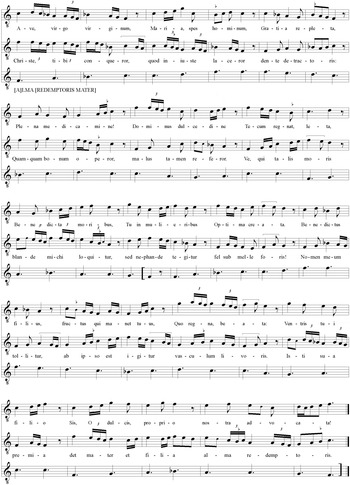
Two additional examples from slightly earlier sources offer curious supplementary appeals affixed to the biblical salutations and heretofore unrecognised in polyphonic music of the thirteenth century. In these cases, it is not the conductus but the early motet that serves as the host genre for the unexpected Marian appeals in connection with the first part of the later prayer. In contrast to the Ave conductus just discussed, the following two motets are polytextual creations, each voice constructed by definition with allegiance to a foundational plainchant tenor.Footnote 62 The first motet, Ave virgo virginum/Christe tibi conqueror/ALMA, an unicum from the Montpellier Codex, sets a Marian triplum text and Christ-centred motetus over the first musical phrase of the Marian antiphon Alma redemptoris mater.Footnote 63 Though the relationship with the Ave is not apparent at first sight, the triplum reveals the salutations of Gabriel and Elizabeth through an acrostic (in boldface below), which prepares a gloss of nearly every word that would later make up the prayer's first half.Footnote 64


The words of the salutations are not distributed evenly in the acrostic in the triplum. The poet not only omits the conjunction et in the joining of the successive greetings, but, more noticeably, forces multiple words into single lines on two occasions. Conversely, lines 9 and 12 of the poem are simply ‘skipped’ in the unfolding of the acrostic.Footnote 65 Still, other structural considerations are at play: the poet observes a strict syllable pattern of 7.7.6 and a consistent rhyme scheme within the tercet structure (AAB-CCB-DDB and so on) of the poem. The text of the motetus participates in these same poetic parameters.
The Ave Maria unveiled in the acrostic excludes the appositive ‘Jesus’, though we have seen above that there was still – by the thirteenth century – a high degree of variability over the inclusion of the name in texts based on the biblical salutations. The dative filio…proprio, however, might be viewed as a substitute for the name of Jesus here. More importantly for our purposes, this triplum text persists for two lines after the acrostic formally comes to an end. The text of these lines constitutes an appeal to the Virgin, effectively affixed to the core of the Ave. Dovetailing with the acrostic, the concluding petition involves the intercession of Mary with her son. She is addressed as neither ‘Holy Mary’ nor ‘Mother of God’, but in the vocative as ‘O sweet one’ (O dulcis).Footnote 66 The explicit summoning of Mary as ‘nostra advocata’ recalls the Marian antiphon Salve regina (Eia ergo advocata nostra), a text which contains its own reference to ‘sweetness’ (O clemens, O pia, O dulcis Maria).Footnote 67 This echo of the Salve over the tenor ALMA reinforces the pervasiveness of the vocabulary from the Marian antiphons, regardless of the assigned liturgical season. In this highly unstable period in the transmission of Ave-related texts, the language of the Marian antiphons cannot be ignored and evidently became intertwined with the biblical salutations in devotion to the Virgin.
Ave virgo virginum/Christe tibi conqueror/ALMA.

The simultaneous declamation of texts in this and other motets makes both poems almost impossible to decipher in performance.Footnote 68 But if these texts were to be performed separately, each in conjunction with the ALMA tenor, the result would articulate the rhymed and metrical texts with clarity, increasing intelligibility. In the case of the triplum's gloss of the Ave, the unfolding of the poem using the first mode brings the acrostic to life when heard in isolation. With the exception of the two lines that do not participate in the acrostic (and the two final lines), each musical phrase in the triplum begins with one of the words from the Ave (see Example 3). With consistent short rests between each ordo, it is certainly possible that attentive listeners could comprehend the acrostic, even to the point of producing expectation of the well-known biblical words to follow. Equally, this close connection of regular musical phrases with the progression of the acrostic could be interpreted as an aid to memory for the performance of the motet.Footnote 69 The plea to the Virgin follows seamlessly in the brief composition. The triplum mirrors the poetic structure of the motetus, preserving the structural rhyme and syllable count across five tercets (generating fifteen poetic lines). The tenor is made up of the expansive octave-spanning gesture which opens the Marian antiphon Alma redemptoris mater; a second tenor cursus must be inferred to complement the remaining upper-voice material. At the end of Ave virgo virginum/Christe tibi conqueror/ALMA, striking poetic gestures coincide in the motetus and triplum voices. The former arranges its text to have the words ‘alma redemptoris’ in its final line, no doubt to accord with the tenor fragment – a typical technique of the Latin motet. At the same moment, the triplum text breaks away from the acrostic that governed its first thirteen lines and presents a closing supplication to Mary. In an oblique fashion, the motet thus bequeaths a petitionary addendum to the first half of the Ave and – like the conductus discussed above – draws attention to it through the textual and musical construction of the composition.
The final piece involving a curious supplement to the Ave Maria, the motet Ave beatissima civitas divinitatis/Ave Maria gratia plena/AVE MARIS STELLA, survives in multiple sources of polyphony dating from the later thirteenth century, including the Montpellier Codex, which contained the motet Ave virgo virginum/Christe tibi conqueror/ALMA just discussed.Footnote 70 The similarities between these pieces extend beyond their common manuscript heritage. This polytextual motet likewise features a Marian acrostic, though not one related to the Ave Maria text. In the present motet, it is the tenor that plays a role in articulating the division of the prayer.
Ave beatissima/Ave Maria/AVE MARIS STELLA may be modelled on a French double motet which has not survived, as a result of its occasionally clumsy musical setting in Latin based on the atypical second rhythmic mode. The frequent divisiones of the triplum in particular approach a disposition in the sixth rhythmic mode, which would further be evidence of a vernacular template.Footnote 71 Whatever its roots, the Latin triplum Ave beatissima civitas divinitatis bears an acrostic in this polytextual creation, in this case an abecedarian text reproducing the alphabet through the first letter of each word.Footnote 72

Because of the elevated pressures of the genre devised by the poet-composer of the triplum's abecedarian text, the grammatical constructions may be compromised or simply unclear at times. For example, the series of images beginning with the ‘house of justice’ (Habitaculum iustitie) may be tied to the command ‘obsecra’, may be vocative, or may be connected with the previous clause. The ending of this text varies between different sources. While the musical sources of this text terminate the triplum after the word ‘zima’ (unresolved syntactically), the text is known elsewhere to continue with the following postscript: ‘antiquum expurga ipsius oraculo vite mediatrix auxiliatrix, reparatrix, illuminatrix, adjuva reos, genetrix omnipotentis’ (‘[and] purify the old [leaven] before his mercy-seat – mediatrix of life, helper, restorer, illuminator, help [us] sinners, O mother of the all-powerful one’).Footnote 74 The supplement features two new acrostics, the first passing through the five vowels (AEIOU) and then one on the word MARIA. The final three letters (R[eos], G[enetrix], and O[mnipotentis]) may be an abbreviated acrostic for the word [VI]RGO, to connect with the preceding MARIA.
The composer of this motet paired this rigidly structured abecedarian triplum in honour of the Virgin with a Marian motetus, the majority of which is recognisably the first part of the Ave Maria. The coupling of the Marian abecedarius with the Ave has an even stronger link: children learning the alphabet in order to read syllables and eventually words in Latin undoubtedly encountered the Hail Mary as a foundational text.Footnote 75 This motet may in some way be seen as a demonstration of the poet's mastery of grammar in the spirit of Marian devotion. The Ave motetus reads as follows:

In this text, the words of the angel Gabriel at the Annunciation are connected with Elizabeth's salutation at the Visitation to produce the customary first half of the Ave Maria. Absent is the name of Jesus as a modifier to ‘fructus ventris tui’, but this should come as no surprise by now. What is remarkable about the unfolding of this prayer in the motetus is the presence of an ‘Amen’ in the middle of the text. As a devotional prose, the Ave has no internal rhyme scheme or pattern of line-length. Thus, the Amen simply interrupts the text of the prayer, both affirming the preceding biblical greetings and formally separating these verses from the extra-biblical petition to follow.
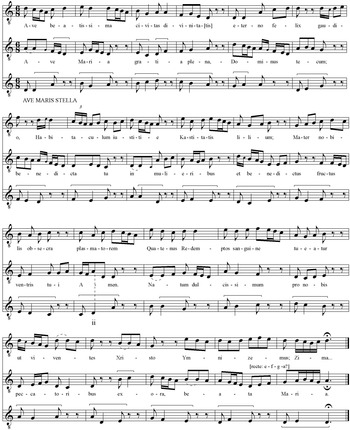
The structural separation of first and second parts of the text in the motetus was registered not just with the ‘Amen’ (recorded in both sources of the motet), but also at the musical surface as well (Example 4). The tenor AVE MARIS STELLA, the governing voice of the motet, in fact participates in the formal delineation of the motetus text. In the case of the Montpellier Codex, the scribe incorrectly identified this tenor as IOHANNE, a popular motet tenor derived from the Alleluia from the feast of John the Baptist.Footnote 76 The error is understandable: both melodies open with the same rising fifth (D–a), continuing up another step, and eventually descending a pentachord, and Ave beatissima civitas divinitatis/Ave Maria gratia plena/AVE MARIS STELLA is, in fact, the only motet with the tenor AVE MARIS STELLA in the entire Notre Dame corpus.
Unlike the melismatic fragments so common in the tenors of the early Parisian motets, the tenor AVE MARIS STELLA takes the entire Marian hymn tune as its cursus. The composer sets two statements of the hymn melody, one full and one condensed. The second, truncated iteration of the tune (marked ‘ii’ in Example 4) proceeds a little more than halfway through the melody with a new rhythmic casting, culminating with a typical cadential pattern in the final two measures.Footnote 77
While editors working with music of this period (and especially later polyphony) have been attuned to the progression of tenor statements, far less attention has been paid to the coordination and interaction of these tenor iterations with the textual substance of the upper voices.Footnote 78 The genre of motets on the whole, it seems, prides itself on formal asymmetry, as musical phrases of the triplum and motetus often move in and out of phase with each other and against the tenor, a point of distinction from the genres of the conductus or conductus-motet, which normally proceed in homorhythmic strokes.Footnote 79Ave beatissima/Ave Maria/AVE MARIS STELLA generally conforms to these motet hallmarks, with characteristic overlapping gestures separating cadences from phrase incipits. But the fluidity at the surface can be deceiving when viewed on a larger scale of compositional planning.
Ave beatissima/Ave Maria/AVE MARIS STELLA. Transcription based principally on Montpellier, Bibliothèque Inter-Universitaire, Section Médecine, H196 (fols. 93r–94v) with reference to Paris, Bibliothèque nationale de France, nouv. acq. fr.13521, ‘La Clayette’ (fol. 384r).

The motetus declaims the Ave Maria text in two unequal parts divided by an Amen, whereas the triplum progresses through its special alphabetic acrostic with no formal partition internally. Part of the subtlety of this motet seems to be the curious coordination between the motetus and the tenor AVE MARIS STELLA. At the very moment when the Amen separates the two salutations from the concluding supplication to the Ave, the tenor begins its restatement of the Marian hymn. By beginning the tenor's second statement at the end of the Ave's joint salutations, the composer masterfully articulates the two-part structure of the prayer in the motetus (drawn with a dashed line in Example 4). The tenor further matches the disproportionate addendum to the Ave with a compressed second cursus, only partially related to the hymn tune foundation though still in the third rhythmic mode. This apparent adjustment of the tenor to fit the upper voices (both of which are to a certain extent fixed, either through the abecedarian construction of the triplum, or the use of the biblical salutations in the motetus) presents a challenge to the typical ‘bottom-up’ view of the composition of motets.Footnote 80
In her commentary on Ave beatissima/Ave Maria/AVE MARIS STELLA in the Montpellier Codex, Yvonne Rokseth called the appendage to the Ave Maria in the motetus ‘a short invocation, which replaces the second part of the modern prayer, not yet fixed in the thirteenth century’.Footnote 81 Her suggestion can be misleading. Nothing is being ‘replaced’ since a supplemental petition in the Ave was still a rare occurrence, as we have seen. By this time, it was most common simply to say the two salutations with an Amen to punctuate. Indeed, the motetus of Ave beatissima/Ave Maria/AVE MARIS STELLA emphasises the strangeness of its own additive invocation by leaving the ‘Amen’ to separate the biblical text from the supplicatory postscript.
What does the motetus's terse petition (Natum dulcissimum pro nobis peccatoribus exora, beata Maria) offer as an appended text? For one thing, characterising the ending as a ‘free poetic conclusion’, as Ludwig did, dismisses the subtlety of this petition to the principal Ave. Footnote 82 The vocative beata Maria can be compared with the more majestic title ‘Sancta Maria, mater dei’, but the clause exora pro nobis peccatoribus, though generic, links more directly with the early fifteenth century in the 1427 formulation by Bernardine of Siena, which used the command ora instead of the somewhat stronger exora. The phrase natum dulcissimum distinguishes this particular petition to the Virgin Mary, drawing attention to the recipient of her own prayers – her ‘sweetest son’. The precise formulation natum dulcissimum was unusual, but the synonym dulcissimum filium was apparently not uncommon in sermons and devotional literature.Footnote 83
Apart from the object natum dulcissimum, another part of the addendum to the Ave Maria (‘pro nobis peccatoribus exora’) recalls the ending of the Marian antiphon Ave regina caelorum (‘et pro nobis semper Christum exora’), which was well in circulation by the end of the thirteenth century.Footnote 84 In light of the connection of the earlier motet Ave virgo virginum/Christe tibi conqueror/ALMA to the Marian antiphon Salve regina, the present association of this motetus text with a Marian antiphon may provide more context in describing the nature of these rare supplements to the Ave in music of the Ars Antiqua. Through some fleeting hints, the evidence from these select Parisian motets suggests that the poet-composers who affixed a supplicatory ending to the joint salutations in part drew from the well of Marian antiphons – songs whose familiar texts were uttered in speech and song throughout the year.
Conclusion
At the height of troping practices in the central and late Middle Ages, canonical texts were subject to wide manipulations and transformations. The Ave Maria, as we have seen, remained an oral devotion that was neither standardised nor officially recognised until the end of the sixteenth century. Consequently, any closing invocation attached to the two prose salutations in this period must be viewed not as a manipulation of – or substitute for – the Ave's second half, but as an experiment with a formal addendum to the prayer. Although it is probable that concluding petitions were long associated with the Ave, they were scarcely recorded. Indeed, around the time when the rosary was steadily gaining currency as device of lay devotion, the Ave was still declaimed formally using only five phrases (Ave…/ Gratia…/ Dominus…/ Benedicta…/ Et benedictus…).Footnote 85
The large repertory of sequences most certainly contains glosses of the Ave with generic closing supplications, but in length and complexity, such texts are only distant relations of the concise devotion that later took hold. The late thirteenth-century sources of Ars Antiqua polyphony, however, provide a number of examples of shorter, Ave-related texts. It was here that a glimpse of a supplicatory addition to the Ave Maria may be seen. The musical pieces discussed here do not provide a direct line to the well-known ‘second half’ supplication. Nonetheless, they are previously neglected examples of pieces based on the biblical salutations that are enhanced with concluding petitions. The musical and poetic techniques employed to draw attention to and demarcate these petitions would seem to be strong evidence that the addition of a supplication to the first half of the Ave Maria remained an unusual practice. These findings also shift some of the geographical focus away from an assumed Italian heritage of the prayer towards sources with connections to Paris, easily the most important centre of theology north of the Alps in the thirteenth century.
Above all, this article has endeavoured to remind musicologists of the astonishing lack of uniformity during the Middle Ages of one of the essential prayers of the Christian faith. While not an exhaustive study of the musical castings of Ave Maria before the Renaissance, the article nevertheless points to some significant instances of affixing a petition to the core devotion. As an experimental polyphonic genre that tested simultaneous texts with both phonetic and exegetical potential, the motet in particular provided opportunities for textual and musical emphasis of the petitionary enhancement. It is music, so often neglected in textual histories, which will continue to help historians fill out the picture of devotional practices in the Middle Ages.