INTRODUCTION
Voss (Reference Voss1962) described Idiosepius biserialis from South Africa. The species could be distinguished from other idiosepiids by the biserial arrangement of the suckers on the tentacular clubs. Both ventral arms were hectocotylized with four suckers closely grouped at the base. The shape of the right ventral arm in the male was very distinctive, slightly wider than the left arm and bordered by a low, inconspicuous membrane on each side.
Chotiyaputta et al. (Reference Chotiyaputta, Okutani and Chaitiamvong1991) described Idiosepius thailandicus from the Gulf of Thailand, having characters similar to I. biserialis but stated that they had longer arms including hectocotylus. Furthermore, I. thailandicus had double rows of pegs, with a tendency to be triple or quadruplicated, occurring in the distal portion of the tentacle suckers. Hectocotylus of I. thailandicus carried 3–4 suckers on the basal area. They inhabited mangrove and shallow water of the littoral zone (Chotiyaputta et al., Reference Chotiyaputta, Okutani and Chaitiamvong1992).
In the same year, Hylleberg & Nateewathana (Reference Hyllberg and Nateewathana1991b) reported I. biserialis as a new record from the Andaman Sea. The species inhabited mangrove channels and sea grass biotopes. Idiosepius biserialis had distinct circlets of pegs which became more crowded and irregularly arranged in the distal portion (Hylleberg & Nateewathana, Reference Hyllberg and Nateewathana1991b). Hectocotylus carried 3–7 suckers in various combinations surrounded by a low protective membrane at the base of the arms.
The similar characters of the two species have led students of idiosepiids to raise the question whether the two species are distinct or just a case of geographical variation within populations of the two waters (Boletzky et al., Reference Boletzky, Nishiguchi, Nabhitabhata and Nugranad2005). Chaitiamvong (Reference Chaitiamvong1993) suggested, from morphological characters, that I. biserialis and I. thailandicus might be the same species. The purpose of this study is to analyse the relationship of the two species in terms of reproductive behaviour and cross-mating experiments.
MATERIALS AND METHODS
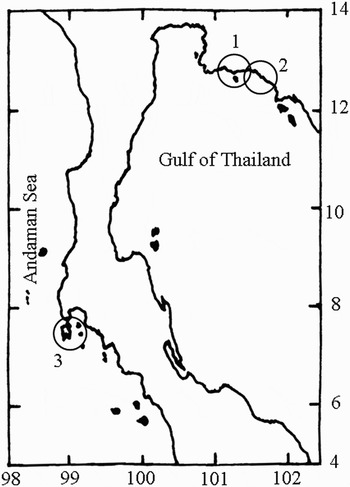
Live specimens of the Thai pygmy squid, Idiosepius thailandicus, were collected with hand scoops in estuaries and mangrove channels of Chantaburi River, Chantaburi province in the eastern part of the Gulf of Thailand (South China Sea, Pacific Ocean), about 250 km from Bangkok (Figure 1). Total number of squid specimens was 102 squid composed of 86 females and 16 males. The biserial pygmy squid, Idiosepius biserialis, were collected with hand scoops from sea grass beds in channels in Phuket province (Andaman Sea, Indian Ocean). Total number of specimens was 41 males and 38 females. Male and female squids were separated into different plastic bags. The live specimens were transferred to Rayong Coastal Fisheries Research and Development Center, Rayong province, and maintained in a glass aquarium of 320 × 760 × 350 mm provided with a sub-gravel filter. About 80% of the water volume was changed daily. Live mysids (Mesopodopsis orientalis) and palaemonid shrimps (Palaemon styliferus) collected from the wild were supplied excessively as food for the squids. Ten pairs of each species were selected and each pair was maintained in a glass aquarium of 130 × 250 × 160 mm for observation of individual pairs. Maintenance followed Nabhitabhata (Reference Nabhitabhata1994a, Reference Nabhitabhatab, Reference Nabhitabhata1998) in details. Seaweeds, Padina sp., Sargassum sp. and Caulerpa sp., and sea grass, Enhalus sp., were introduced into the large aquarium for observation of the behaviours in presence of natural substrates. Behaviour was recorded in notes, sketches and still and video photography. Temperature during the study was 28–30°C and salinity 30–33 ppt.
Specimen collecting locations (circled) of Idiosepius thailandicus in Rayong (1) and Chantaburi provinces (2), eastern part of the Gulf of Thailand (South China Sea, Pacific Ocean) and of Idiosepius biserialis in Phuket province (3) (Andaman Sea, Indian Ocean).

Cross-mating in captivity was studied with interspecific pairs in separate glass aquaria of 150 × 300 × 200 mm. Two pairs were composed combining two I. biserialis males (9.4 and 6.2 mm ML) with two I. thailandicus females (27.0 and 12.3 mm ML), respectively. The other combination was made by one I. thailandicus male (4.6 mm ML) with an I. biserialis female (11.7 mm ML). Another male (4.6 mm ML) replaced the first male when this died. Cross-mating behaviour was recorded.
RESULTS
Habitat
In the eastern part of Thailand, Idiosepius thailandicus was found associated with seaweed in the littoral zone in Rayong province, and in a mangrove biotope in the neighbouring Chantaburi province where the squids attached their eggs to the mangrove roots. In the Andaman Sea, southern Thailand, Idiosepius biserialis inhabited subtidal sea grass beds at the mouth of mangroves and on sand bars with rocks. The squids and their eggs were attached to the underside of the sea grass leaves. Idiosepius biserialis was not found in mangrove areas.
Reproductive behaviour
MATING BEHAVIOUR
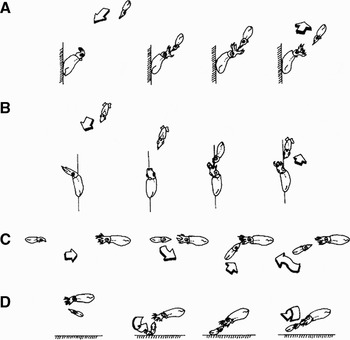
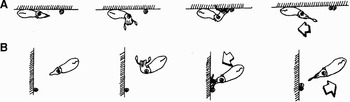
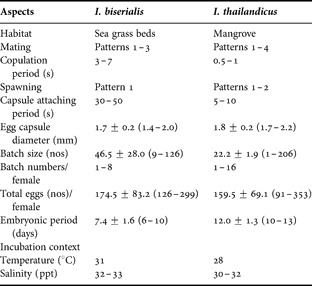
Mating occurred all day in the shade with a peak activity during 1500–1700 h. Pair formation was never observed in the two pygmy squids. The mating behaviour was promiscuous, the males mated any females but the larger ones were preferred. The females accepted one to three males for copulation in the same time without distinction. At first the mature males appeared anxious. They stretched their tentacles in and out regularly. The female swimming from her adhered position (the place on the aquarium wall where the female is adhering) stimulated the anxious male to approach. Before swimming from her adhered position, the female spread out her arm cone into an umbrella shape and ventilated with strong movements of the mantle. The female then swam approaching to the bottom, moving back and forth. Mating behaviour was performed in the head-to-head position with four different patterns (Figure 2). Both tentacles were used in ‘remote copulation’ (from a distance without contact of other arms and body parts) in all patterns. Patterns of mating behaviour differed slightly between the two species. Male I. biserialis extended one tentacle followed later by another one before reaching the buccal region of the female but I. thailandicus extended both tentacles at the same time. The copulation took 3–7 seconds in I. biserialis and only 0.5–1 seconds in I. thailandicus. Other details were similar. Eight to fifteen mating, in all patterns, was observed daily in the two species, with a decreasing trend towards post-spawning mortality. Difference in mating frequency by pattern between species was not observed. Patterns 1–4 were observed in I. thailandicus but only patterns 1–3 were observed in I. biserialis.
Mating behaviour patterns. (A) Pattern 1, hovering male to adhering female; (B) pattern 2, adhering male and female; (C) pattern 3, hovering male and female; (D) pattern 4, adhering male to hovering female (arrows indicate the direction of male manoeuvre).

Pattern 1
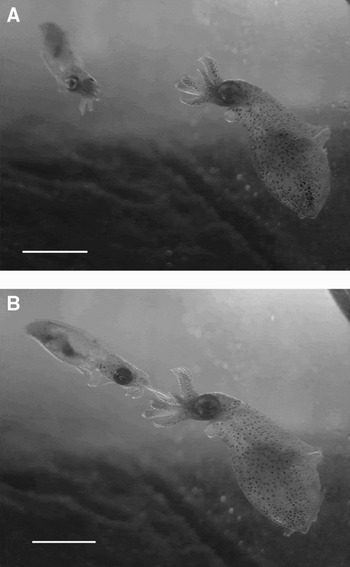
This pattern was observed between a hovering male and an adhering female (Figure 2A). The male displayed dark-brown side stripes on his transparent body and approached the female from above (Figure 3A). At a distance of his arm length from the female, the male stretched both of his tentacles to fix spermatophores in the buccal region of the female. In the meantime, the female spread her arms out in an umbrella shape and displayed dark-brown side stripes on her transparent body (Figure 3B). Then the male drew back his tentacles. The male repeated the copulation. After mating, the male moved backward and adhered to the substratum near the female. About 70% of the observed mating behaviour occurred in this pattern.
Mating behaviour sequence: (A) swimming male (left) approaching adhering female (right) (Idiosepius biserialis), with his fourth arm pair (hectocotylus) separately hanging from arm cone; and (B) mating behaviour pattern 1, hovering male (left) to adhering female (right) (Idiosepius biserialis). Scale bar: 5.0 mm.

Pattern 2
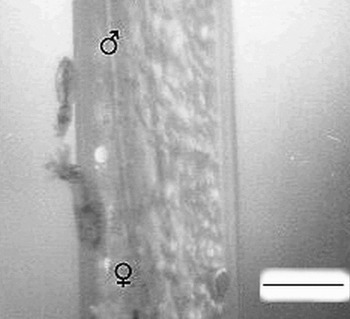
This pattern was observed in an adhering male and a female (Figure 2B). In a vertical position, the male was adhered head-down to the substrate above the female and displayed transparency with brown V-shaped stripes on the ventral side. The ‘V’ stripes ran to his head through the eyes like in the side-stripes display. The arms were kept and pointed straight together. At a steep angle, the adhering male approached the female which adhered vertically head-up. The male stopped at a certain distance of about his arm length. The female used her arm tips to touch the arm tips of the male and then spread her arms into an umbrella shape. The male stretched his tentacles to fix spermatophores (Figure 4). In the meantime, the male displayed dark-brown side stripes with a golden-brown dorsum. About 25% of the observed mating behaviour followed this pattern.
Mating behaviour pattern 2, adhering male (above) to adhering female (below) (Idiosepius thailandicus). Scale bar: 10.0 mm.

Pattern 3
This pattern was observed only once in each species, on a hovering male and a female (Figure 2C). The female hovered horizontally spreading her arms. The male was stimulated by the motion of the female and approached her swimming in the same horizontal level. The male stopped and hovered at a distance of his own mantle length from the female. Then he moved downward, approached from below and stretched the tentacles to fix spermatophores. The male was translucent during the process.
Pattern 4
This pattern was observed only once between an adhering male and a hovering female of I. thailandicus (Figure 2D). The female hovered horizontally near the bottom of the aquarium and displayed a yellow-brown colour pattern. The male was transparent with dark-brown side stripes and swam around the female. The male approached the female to a distance of his arm length and turned upside down to adhere to the bottom on his dorsum. Then the male twisted the upper part of his mantle with head up and stretched his tentacles to fix the spermatophores. After that he swam upward, turned to the normal position and mated again in pattern 3.
SPAWNING BEHAVIOUR
The two pygmy squids mostly spawned at night or in the shade at daytime. The sequence of laying a single egg capsule took 5–10 seconds in I. thailandicus and 30–50 seconds in I. biserialis. After spawning a batch of egg capsules, the female swam away to adhere to the substratum. Just after spawning she performed fast respiratory movements of the mantle and seized the first passing prey. The female did not take care of her egg capsules after spawning. The spawning period of the two species lasted 4–21 days and post-spawning mortality of both sexes was within 6 hours to 2 days. Two different processes were observed on the spawning behaviour of I. thailandicus (Figure 5) but in I. biserialis only pattern 1 was observed.
Spawning behaviour patterns. (A) Pattern 1, adhering female; (B) pattern 2, hovering female (arrows indicate the direction of female manoeuvre).

Pattern 1
This egg-laying pattern was observed in I. biserialis as well as in I. thailandicus (Figure 5A). The adhering female raised her head, stretched up her arms and curled the arm tips into a conical shape. Her funnel was inserted into the arm cone. The tentacles stretched sideward for 1–2 seconds. Then the female lowered her head to the substratum and attached the egg capsule to the substratum with her arms (Figure 6). At first, a pair of ventral arms was stretched and touched the substratum. After that, the female stretched her whole body and blew away some pieces of capsule sheath with her arms using a water jet from her funnel. Then she cleaned her arms and tentacles before depositing the next egg capsule. After laying 2–3 egg capsules, the female moved backward to attain proper position and then repeated the egg laying process.
Female attaching egg capsules to aquarium glass wall (Idiosepius thailandicus). Scale bar: 10.0 mm.

Pattern 2
This pattern was observed on hovering female (Figure 5B). The female hovered head-down with the dorsum faced downward to the bottom (upside-down) at an angle of 40–50°. She swam forward to attach the egg capsule and swam backward when she finished egg-laying. The female repeated hovering back and forth for laying every egg capsule. Details of the sequence followed those of pattern 1. This pattern of spawning was rare and observed only once in I. thailandicus.
Egg and hatchling
The egg capsule contained a single egg, round in shape without a stalk. The average greater diameter of the egg capsules was 1.7 mm in I. biserialis and 1.8 mm in I. thailandicus (Figure 7). The capsule was transparent with 14–20 and 17–22 coating layers, respectively.
Egg capsule (Idiosepius thailandicus). Scale bar: 5.0 mm.

The female was able to spawn 1–8 egg batches for I. biserialis and 1–16 for I. thailandicus. Average numbers of egg capsules in one batch of the two species were 46.5 and 22.2, respectively (Table 1). The female attached the egg clusters in the same or in different sites. Total number of eggs spawned by one female averaged 174.5 and 159.5 eggs, respectively (Table 1). The egg capsules were attached to the underside of seaweed fronds and sea grass blades. In the aquarium without seaweed, egg capsules were attached on the surface of the glass wall, especially on the lower third from the bottom.
Comparison on behaviour aspects of Idiosepius biserialis and I. thailandicus in this study.

The embryonic period was 7.4 for I. biserialis and 12.0 days for I. thailandicus. Hatching occurred all day but mainly at night. Hatchlings were planktonic with 1.0 ± 0.1 mm mantle length on average (Figure 8). Arms were able to seize preys. Hatchlings were fed on mysis of Mesopodopsis orientalis, Artemia nauplii, zoea larvae of the blue swimming crab, Portunus pelagicus and wild marine copepods. Adhering behaviour and prey seizure by tentacles were never observed in hatchlings.
Hatchling (Idiosepius thailandicus). Scale bar: 5.0 mm.

Cross-mating
Mating was observed in male I. biserialis crossed with female I. thailandicus or in male I. thailandicus with female I. biserialis. Mating behaviour was performed as remote copulation using tentacles as observed in male I. thailandicus and I. biserialis. The detailed sequences of mating and spawning patterns were also similar.
FEMALE I. THAILANDICUS × MALE I. BISERIALIS
Mating patterns were similar to pattern 1 (hovering male to adhering female in both initiated pairs) and pattern 3 (hovering male to hovering female only in the second pair). The frequency of pattern 1 mating was about 7 times a day compared to about 3 times a day in pattern 3. The subsequent spawning was similar to pattern 1 (adhering spawner). The female of the first pair spawned 3 batches of 91 eggs in total over a two day period. The female of the second pair spawned 4 batches of 196 eggs in total over a three day period. All eggs died in the same day (3–7 days old) for unknown reasons. The embryos had developed to at least organogenesis (stage of rotating embryos) before dying. Both females died after spawning of the last batches with a few eggs left in their ovaries.
FEMALE I. BISERIALIS × MALE I. THAILANDICUS
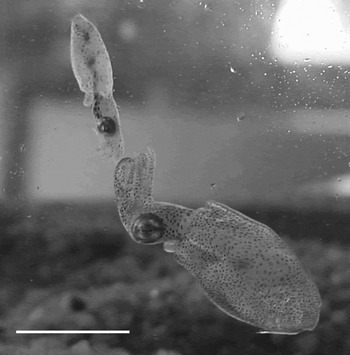
Mating patterns were similar to pattern 1 (Figure 9) and pattern 3. Pattern 1 was observed more frequently, 5 to 2 times a day. The male died after five days and then the second male was introduced. Mating of pattern 1 performed by the second male was observed for 3 times a day. The pair died before yielding any eggs.
Cross-mating (in pattern 1) of male Idiosepius thailandicus (left) and female Idiosepius biserialis (right). Scale bar: 10.0 mm.

DISCUSSION
The different habitats between Idiosepius biserialis (sea grass bed) and Idiosepius thailandicus (mangrove, seaweed bed) seemed to indicate that the two species should differ ecologically. However, in the location where I. biserialis were collected, Phuket Island in the Andaman Sea, the mangrove area was inhabited by I. pygmaeus, the larger species (Suwanamala et al., Reference Suwanamala, Byern and Nabhitabhata2006), and I. biserialis inhabited the sea grass bed downstream in the lower estuary. The smaller I. biserialis might be forced to migrate out in order to avoid competition with larger species. Occurrence of I. pygmaeus was not recorded in the eastern Gulf of Thailand (Hylleberg & Nateewathana, Reference Hylleberg and Nateewathana1991a; Chotiyaputta et al., Reference Chotiyaputta, Okutani and Chaitiamvong1992; Nateewathana, Reference Nateewathana1997) allowing I. thailandicus to inhabit mangrove. Moreover, inhabiting mangrove by I. thailandicus might be seasonal (for reproduction) since they are abundant in mangrove during winter in Thai waters, November to March (Nabhitabhata, Reference Nabhitabhata1994a).
Mating behaviour of pygmy squids was different from sepiid cuttlefish, Sepia pharaonis, (Nabhitabhata & Nilaphat, Reference Nabhitabhata and Nilaphat1999). Pygmy squids did not form pairs. Mating was promiscuous and males did not defend females. These features as well as solitary habit might be the consequences of sexual-sizes dimorphism (larger female did not need defence by smaller male) and reproductive strategy (females were larger in order to maximize the reproductive output (Boletzky, Reference Boletzky2003)). A larger female compared with male was the common character of this genus. Females of I. biserialis and I. thailandicus were about twice as long, and 10 times heavier than the males (Nabhitabhata, Reference Nabhitabhata1998). Females of I. pygmaeus and Idiosepius notoides were larger than males in final size and also larger in size at the same age (Jackson & Choat, Reference Jackson and Choat1992; Tracey et al., Reference Tracey, Steer and Pecl2003). Yamamoto (Reference Yamamoto1949) reported similar sexual dimorphism in size of I. paradoxus. However, those mentioned features (no pair formation, promiscuous mating, no female defence by mated male and solitary habit) also resembled sepiolid squids, Euprymna hyllebergi of which both sexes were similar in size (Nabhitabhata et al., Reference Nabhitabhata, Nilaphat, Promboon and Jaroongpattananon2005)
Dart motion of the male mating in I. paradoxus (Kasugai, Reference Kasugai2000) was not observed in I. thailandicus and I. biserialis. Mating in head-to-head posture without arm contact might be the consequence of the sexual size dimorphism involving larger females. The larger size of the female is more pronounced in I. biserialis and I. thailandicus than in I. paradoxus and I. pygmaeus. The size of males of the former two species was less than 50% of females, thus similar in size to their food organisms, (Mesopodopsis orientalis). Cannibalism was not observed in any idiosepiids, but post-mating cannibalism was observed in octopods. Cheng & Caldwell (Reference Cheng and Caldwell2000) observed a female blue-ringed octopus, Hapalochlaena lunulata, feed on her mate after mating. Hanlon (Reference Hanlon and Boyle1983) observed that the same thing happened to an Octopus briareus mate. Mating of more than one male to the same female at the same time and remote copulation has been observed in the octopods, O. vulgaris, O. digueti and O. bimaculatus (Hanlon & Messenger, Reference Hanlon and Messenger1996). This behaviour is also observed in I. biserialis and I. thailandicus.
Both ventral arms are hectocotylized in Idiosepius. The male I. paradoxus (Kasugai, Reference Kasugai2000) and I. pygmaeus (Nabhitabhata et al., Reference Nabhitabhata, Nilaphat, Reunreng and Promboon2004) used the hectocotylus, the left arm IV, to attach spermatophores to the arm base of the female during the copulation. The function of the hectocotylized arms is a puzzle in I. thailandicus and I. biserialis since they were not used in copulation, at least not directly to fix spermatophores. The real function of hectocotylus needs further study in the two species.
Tentacles were used for attachment of the egg capsule by I. paradoxus (Natsukari, Reference Natsukari1970) and I. pygmaeus (Lewis & Choat, Reference Lewis and Choat1993) in contrast to arms only in I. paradoxus (Kasugai, Reference Kasugai2000; but see Natsukari, Reference Natsukari1970 for a contradictory viewpoint), I. pygmaeus (Nabhitabhata et al., Reference Nabhitabhata, Nilaphat, Reunreng and Promboon2004; but see Lewis & Choat, Reference Lewis and Choat1993 for a contradictory viewpoint) and I. biserialis and I. thailandicus in the present study. Boletzky (Reference Boletzky1995) stated that the peculiar function of the adult tentacles in spawning females of I. paradoxus, as observed by Natsukari (Reference Natsukari1970), most probably represented autapomorphic features of the family Idiosepiidae. Therefore, the function of the adult tentacles in mating males of I. biserialis and I. thailandicus in the present study should be added to this feature.
Mating of the pygmy squids, I. biserialis and I. thailandicus, differed from I. pygmaeus (Nabhitabhata et al., Reference Nabhitabhata, Nilaphat, Reunreng and Promboon2004) and I. paradoxus (Kasugai, Reference Kasugai2000). The former two did not have arms contact, no dart motion during copulation and the used tentacles in spermatophore fixation instead of arms (hectocotylus). From this point of view, mating behaviour of idiosepiid squids can be separated into two groups: a hectocotylus-using group and tentacle-using group, where I. paradoxus and I. pygmaeus, belong to the former and I. biserialis and I. thailandicus (if they are different species) to the latter.
Cross-mating revealed that I. biserialis and I. thailandicus are closely related. However, further genetic evidence and other evidence on viability of embryos and fertility of their offspring is needed for confirmation that they are one species. On the other hand, cross-mating of I. biserialis and I. pygmaeus was also initiated and no mating was observed (Nabhitabhata & Suwanamala, unpublished data).
During the reproductive period, both species of Idiosepius were capable of spawning multiple egg batches. Lewis & Choat (Reference Lewis and Choat1993) considered I. pymaeus to be functionally iteroparous, rather than the intermittent semelparous spawner. The fecundity of approximately 160 and 175 eggs per female in I. thailandicus and I. biserialis was considered similar and high compared to that reported by Natsukari (Reference Natsukari1970) of only 52 in I. paradoxus. His specimens had probably laid some eggs before collection since mating behaviour was not observed in his observation period.
The characters of egg capsule and hatchling are similar among Idiosepius. The shorter period of embryonic development in I. biserialis was probably due to the higher water temperature. The numbers of coating sheaths were similar, approximately 14–20, in I. biserialis and I. thailandicus, compared to 8–10 in I. paradoxus (Natsukari, Reference Natsukari1970). Comparative embryonic development should be studied in detail in order to improve our understanding of the evolutionary biology of these small cephalopods.