INTRODUCTION
The temporally and spatially patchy nature of disturbance results in temporal and spatial mosaics of vegetation at varying successional stages for which the role of sprouting differs (Bellingham & Sparrow Reference BELLINGHAM and SPARROW2000, White & Pickett Reference WHITE, PICKETT, Pickett and White1985). Some studies have documented reduction in number of sprouts and stems contributed by sprouting with advancement of succession after catastrophic disturbances, such as logging, slash-and-burn agriculture and fire (Donnegan & Rebertus Reference DONNEGAN and REBERTUS1999, Kammesheidt Reference KAMMESHEIDT1998, Reference KAMMESHEIDT1999; McCoy et al. Reference MCCOY, JAFFRÉ, RIGAULT and ASH1999, Rodrigues et al. Reference RODRIGUES, TORRES, MATTHES and PENHA2004). Furthermore, there has been observed a negative relationship between canopy height and density, and sprouting of canopy species (Falster & Westoby Reference FALSTER and WESTOBY2005, Kruger et al. Reference KRUGER, MIDGLEY and COWLING1997, McCoy et al. Reference MCCOY, JAFFRÉ, RIGAULT and ASH1999), which may suggest that canopy sprouters are light demanding and hence adapted to low canopy, open, early-successional stages of forest development (Horn Reference HORN1974). These observations are commensurate with the argument that sprouting is a strategy useful for recovery after disturbance (Bellingham & Sparrow Reference BELLINGHAM and SPARROW2000, Karlsson et al. Reference KARLSSON, TENOW, BYLUND, HOOGESTEGER and WEIH2004). However, there are examples of canopy species that sprout under a closed canopy and are late-successional shade-tolerant species (Ohkubo Reference OHKUBO1992, Ohkubo et al. Reference OHKUBO, TANIMOTO and PETERS1996). This contradiction calls for specific research to establish the role of sprouting in the succession of a given ecosystem.
Species diversity may be higher in communities dominated by non-sprouters (Cowling et al. Reference COWLING, RICHARDSON, SCHULTZ, HOFFMAN, MIDGLEY, HILTON-TAILOR, Cowling, Richardson and Pierce1997, Kruger & Midgley Reference KRUGER and MIDGLEY2001, Le Maitre & Midgley Reference LE MAITRE, MIDGLEY and Cowling1992). However, the relationship between sprouting and species diversity may be confounded if only canopy species are considered (Kruger & Midgley Reference KRUGER and MIDGLEY2001) since the advantages and disadvantages of sprouting change with life-form (Bellingham & Sparrow Reference BELLINGHAM and SPARROW2000). Sprouting may enhance species diversity by enabling coexistence through segregation of species according to sprouting ability (Loehle Reference LOEHLE2000, Nanami et al. Reference NANAMI, KAWAGUCHI, TATENO, LI and KATAGIRI2004).
Trees tend to sprout just below the point of damage (Del Tredici Reference DEL TREDICI2001). Usually the segment of the tree above the point where sprouts emerge dies and rots. Where disturbance severity is low, trees will produce more sprouts higher along the stem (trunk sprouts) than at the base of the stem (basal sprouts) (Bellingham & Sparrow Reference BELLINGHAM and SPARROW2000, Bellingham et al. Reference BELLINGHAM, TANNER and HEALEY1994), so as to minimize the cost of stem loss (Nzunda et al. Reference NZUNDA, GRIFFITHS and LAWES2007). This means that, because succession occurs as a result of change in disturbance regime, the relative significance of basal and trunk sprouts may change with advancement of succession.
Species composition may be related to succession or to site factors that are not necessarily related to succession (Clarke et al. Reference CLARKE, KNOX, WILLS and CAMPBELL2005, Falster & Westoby Reference FALSTER and WESTOBY2005, McCoy et al. Reference MCCOY, JAFFRÉ, RIGAULT and ASH1999). Because sprouting confers species competitiveness on sites with appropriate productivity and disturbance regimes (Bellingham & Sparrow Reference BELLINGHAM and SPARROW2000, Clarke et al. Reference CLARKE, KNOX, WILLS and CAMPBELL2005), which change with time, in a landscape where sprouting plays an important role, succession may explain species composition better than site factors (McCoy et al. Reference MCCOY, JAFFRÉ, RIGAULT and ASH1999).
In accordance with the intermediate disturbance hypothesis, species diversity is expected to increase during initial stages of succession and decrease towards the climax stage (Connell Reference CONNELL1978, Roxburgh et al. Reference ROXBURGH, SHEA and WILSON2004, Wilson Reference WILSON1994). However, the pattern of variation of species diversity with succession may depend on the type of forest, which determines the possibility for competitive exclusion (Bongers et al. Reference BONGERS, POORTER, HAWTHORNE and SHEIL2009, Sheil & Burslem Reference SHEIL and BURSLEM2003). In dry forests, species diversity declines towards the climax stage while in moist forests it does not (Bongers et al. Reference BONGERS, POORTER, HAWTHORNE and SHEIL2009).
In this study, relationships among sprouting, succession and tree species diversity in a subtropical dry coastal dune forest were investigated. The study was based on four hypotheses emanating from field observations and the above discussion: (1) Compared with site factors (slope and stem leaning), succession is more important in explaining species composition; (2) The incidence of basal sprouting decreases with advancement of succession whereas that of trunk sprouting increases with advancement of succession; (3) Tree species diversity decreases with advancement of succession; and (4) Basal sprouting is associated with high species diversity whereas trunk sprouting is associated with low species diversity.
STUDY SITE
The study was conducted in a coastal dune forest at Cape Vidal (28°05ʹ32ʹʹS, 32°33ʹ40ʹʹE) in the Greater St. Lucia Wetland Park, which is under the management of Ezemvelo KwaZulu-Natal Wildlife, KwaZulu-Natal province, South Africa. The Cape Vidal dune forest is part of a narrow strip of forest (0.1–4 km wide) extending in a contiguous belt for 240 km along the KwaZulu-Natal coast (Tinley Reference TINLEY1985).
The mean annual rainfall is approximately 1200 mm (Tinley Reference TINLEY1985). Average minimum and maximum temperature is 17.8 °C in July and 25.6 °C in January, respectively. The soil is loose unconsolidated beach sand with little organic matter. The topography comprises steep (slope up to 55°) vegetated sand dunes. The loose sand substrate, steep slope, and coastal wind are associated with high incidence of stem leaning and resultant sprouting of trees growing in this area (Nzunda et al. Reference NZUNDA, GRIFFITHS and LAWES2007). The climax tree community for coastal dune forests is usually dominated by Diospyros natalensis (Venter Reference VENTER1976). The area was occupied by shifting cultivators who left the site about 80 y ago (Tinley Reference TINLEY1985). Given the length of time since the site was left by cultivators, it is likely that the changes in species composition observed on this site is due to late succession probably as a result of decrease in disturbance from large mammals (Midgley et al. Reference MIDGLEY, EVERARD and VAN WYK1995).
METHODS
Data were collected from 42 plots measuring 20 × 20 m that were located purposely to cover the perceived successional gradient. Slope angle, canopy cover and canopy height were recorded for each plot. Species, diameter at breast height (dbh) of the main stem and all stems attached to the main stem at or close to the ground, branching height, nearest neighbour distance, stem leaning from the normal vertical of the main stem, the number of live sprouts above and below 1.3 m (basal and trunk sprouts, respectively), were recorded for all trees that were at least 1.3 m tall. Whether a tree was under the canopy or not, was noted.
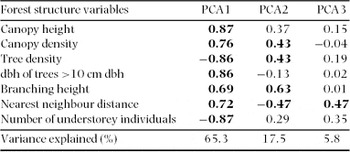
Bray–Curtis multidimensional scaling (MDS) was used to summarize species composition (McCune & Mefford Reference MCCUNE and MEFFORD1999). To determine the relative significance of succession in explaining the variation in species composition, results of multiple linear regression of the MDS scores on the succession index were compared against those on slope and tree leaning following the method of McCoy et al. (Reference MCCOY, JAFFRÉ, RIGAULT and ASH1999). The succession index was obtained from ordination by principal components analysis (PCA) between tree density, canopy density, canopy height, average dbh of trees with dbh > 10 cm, nearest neighbour distance, branching height and number of trees under the canopy. The PCA site scores on axis 1 were interpreted as the succession index. Axis 1 explained 65.3% of the total variation and was positively correlated (r2 = 0.73, P < 0.001) with the dbh of trees with dbh > 10 cm (Table 1). Because the age of different forest stands represented by plots in this analysis was not known, the dbh of trees with dbh > 10 cm was used as a proxy. Trees with a large dbh were considered as being older than those with a small dbh. Old trees indicate a long period of little or no disturbance.
Loadings of the first three PCA components on forest structural variables. Loadings > 0.40 are shown in bold.

Where repeated measurements in permanent plots are not available, analyses of stand structure are the most important means of obtaining information on succession (Mueller-Dombois & Ellenberg Reference MUELLER-DOMBOIS and ELLENBERG1974). The dbh of all trees was significantly correlated with the dbh of Mimusops caffra trees (r2 = 0.40, P < 0.001). Since M. caffra persists through successional stages from dune scrub to forest (Moll Reference MOLL1972, Venter Reference VENTER1976), its size is a proxy of time since effective disturbance level dropped enough to allow tree growth and development to large size. Greater size of individuals of a given species accompanied by paucity in small size classes suggests a decline in regeneration, which indicates that succession is occurring (McCoy et al. Reference MCCOY, JAFFRÉ, RIGAULT and ASH1999, Mueller-Dombois & Ellenberg Reference MUELLER-DOMBOIS and ELLENBERG1974, Silvertown Reference SILVERTOWN1982). In addition to change in stem size, changes in stem architecture and structure through time indicate forest re-organization when time between disturbances increases or when communities are dominated by tree species with long life spans (Gracia & Retana Reference GRACIA and RETANA2004, Koop Reference KOOP1989, Oldeman Reference OLDEMAN1990, Oliver & Larson Reference OLIVER and LARSON1990). Under such circumstances, succession is expressed as progressive change in relative dominance of species (Donnegan & Rebertus Reference DONNEGAN and REBERTUS1999).
Following McCoy et al. (Reference MCCOY, JAFFRÉ, RIGAULT and ASH1999), a constant (2.77) was added to the succession index such that it ranged up from a minimum of one. Species were then ordinated according to a species index (I) calculated as the mean of the product of their abundance (i.e. number of stems per plot) and the succession index (SI) at each plot where they were present. A low species index value indicates both that a species is most abundant early in the succession sequence and that its overall abundance is low, and vice versa (McCoy et al. Reference MCCOY, JAFFRÉ, RIGAULT and ASH1999).
Sample sites were categorized into two classes using the median of the succession index as the cut-off point. The two categories represented two stages of succession: the early short open forest dominated by multi-stemmed trees and the late tall closed forest dominated by single-stemmed trees. Each category comprised 21 samples and a total area of 0.84 ha (20 × 20 × 21 = 8400 m2). Diameter class frequency distributions for the top ten species were analysed for each of the two categories to reveal patterns of regeneration.
Species diversity in terms of richness (calculated using Fisher's alpha diversity index) and evenness (calculated using equitability J) (Hammer et al. Reference HAMMER, HARPER and RYAN2001, Magurran Reference MAGURRAN1988) were regressed against the succession index and incidence of sprouting. Furthermore, regression analysis was used to analyse the relationship between the succession index and the number of stems and basal and trunk sprouts per individual. Nomenclature follows Coates-Palgrave (Reference COATES-PLAGRAVE2002).
RESULTS
Succession and species composition
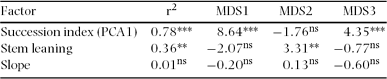
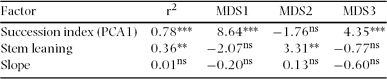
There was a strong positive relationship between succession index and the MDS scores (Table 2). Hence, succession explained a considerable amount of variation in species composition. Stem leaning was also related to the MDS scores, although the amount of variation explained was lower than that explained by succession index (Table 2). Thus succession was more important in explaining vegetation composition than stem leaning. The relationship between slope and the MDS scores was not significant and thus species composition did not depend on slope.
Multiple linear regression analysis of succession and site factors in relation to three MDS axis scores. Figures show r2 and t-values. Superscript indicates significance, ns = P > 0.05; * = P < 0.05; ** = P < 0.01; *** = P < 0.001.
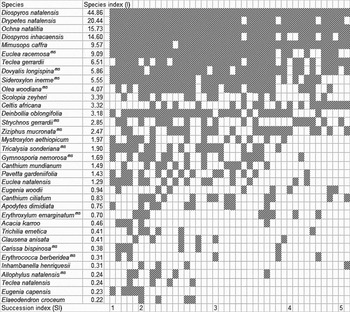
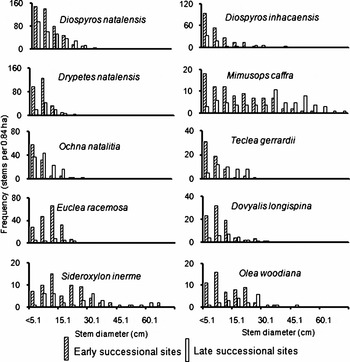
Species lower on the species index were concentrated on sites lower on the succession index as suggested by the wedge-shaped pattern (Figure 1). For the 10 most abundant species whose dbh distribution was analysed, the frequency of individuals of the smallest dbh class (< 5.1 cm) was higher in early-successional sites than in late-successional sites (Figure 2; t = 1.82, P = 0.043, n = 10). This indicates more regeneration in early-successional sites than in late-successional sites. Strong basal sprouters (e.g. Euclea racemosa and Sideroxylon inerme) showed a pattern of dbh distribution that indicates that they had declining regeneration especially on late-successional sites (Figure 2).
Distribution of species by abundance and location on successional gradient. Species index was calculated as the average of the product of number of individuals of a species and succession index of a plot. Succession index is the value of the first axis of Principal Components Analysis of forest structure variables. Shading shows species presence. ms = Strong multi-stemmed basal sprouter.

Diameter distribution of species in early- and late-successional sites. Sample sites were categorized into the two classes using the median of the succession index as the cut-off point. Each category comprised 21 sites and a total area of 0.84 ha (20 m × 20 m × 21 sites = 8400 m2).

Sprouting, succession and species diversity
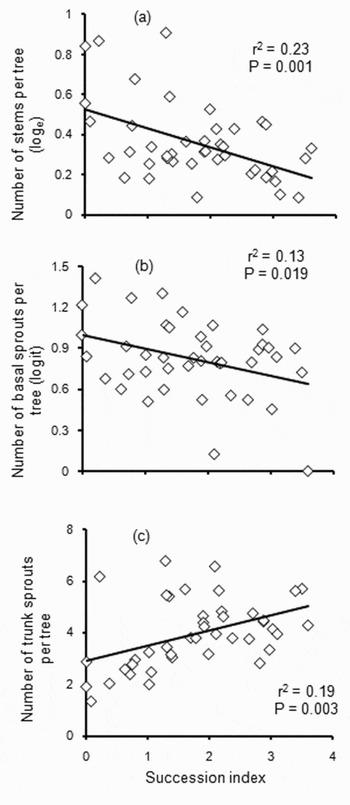
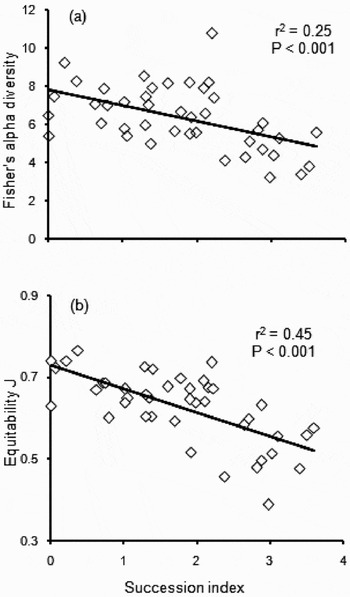
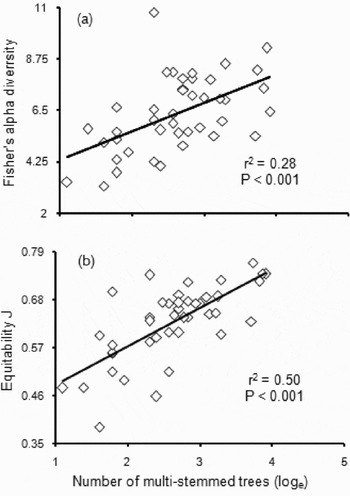
Number of stems per individual and number of basal sprouts per individual decreased with advancement of succession while number of trunk sprouts per individual increased with advancement of succession (Figure 3). Both species richness and evenness decreased with advancement of succession (Figure 4). Number of multi-stemmed individuals was positively related to species richness and evenness (Figure 5). There was a weak positive relationship between number of stems per individual and species richness (r2 = 0.12, P = 0.023). Number of basal and trunk sprouts per individual had no significant relationship with either species richness or evenness (r2 < 0.10, P > 0.05).
Relationship between sprouting and succession. Number of stems per tree (a) and number of basal sprouts per tree (b) decreased with advancement of succession whereas number of trunk sprouts per tree increased with advancement of succession (c).

Relationship between succession and species diversity. Both Fisher's alpha diversity (a) and equitability J (b) decreased with advancement of succession.

Relationship between sprouting and species diversity. Both Fisher's alpha diversity (a) and equitability J (b) increased with number of multi-stemmed trees.

DISCUSSION
The sampled sites represent succession from short, open-canopy, forest stands dominated by multi-stemmed trees to tall, dense-canopy, forest stands dominated by single-stemmed trees. The pattern is in agreement with literature on the relationship between forest structure and sprouting (Bellingham & Sparrow Reference BELLINGHAM and SPARROW2000, Kruger et al. Reference KRUGER, MIDGLEY and COWLING1997, Midgley Reference MIDGLEY1996). The decline in basal sprouting is related to the decrease in the abundance of strong basal sprouters (e.g. Euclea racemosa, Dovyalis longispina, Sideroxylon inerme and Olea woodiana) as succession advances. Basal sprouters are supposed to persist on site through a process of stem replacement (Bond & Midgley Reference BOND and MIDGLEY2001, Kruger et al. Reference KRUGER, MIDGLEY and COWLING1997, Ohkubo Reference OHKUBO1992). However, sprouting and successful development of sprouts to replacement stems depends on canopy openness, which determines light availability (Bellingham & Sparrow Reference BELLINGHAM and SPARROW2000, Del Tredici Reference DEL TREDICI2001, Karlsson et al. Reference KARLSSON, TENOW, BYLUND, HOOGESTEGER and WEIH2004, Ohkubo et al. Reference OHKUBO, TANIMOTO and PETERS1996). Thus for sprouters to persist, there must be disturbances that either chronically prevent the canopy from becoming taller and denser or episodically open up the canopy. Such is the role of fire (McCoy et al. Reference MCCOY, JAFFRÉ, RIGAULT and ASH1999) and defoliating herbivores (Karlsson et al. Reference KARLSSON, TENOW, BYLUND, HOOGESTEGER and WEIH2004).
In the long-term absence of disturbance, the established stems of sprouters age and die without being replaced by stems developing from sprouts (Karlsson et al. Reference KARLSSON, TENOW, BYLUND, HOOGESTEGER and WEIH2004). In some cases, replacement stems may occupy canopy space left by dying stems of the same stool (Ohkubo Reference OHKUBO1992, Ohkubo et al. Reference OHKUBO, TANIMOTO and PETERS1996). However, this is more likely to be the case for sprouters that are late-successional shade-tolerant species, which maintain sprout banks under closed canopy (Ohkubo et al. Reference OHKUBO, TANIMOTO and PETERS1996). The decrease in number of basal sprouts per tree with advancement of succession has also been reported for holm oak (Quercus ilex) (Gracia & Retana Reference GRACIA and RETANA2004, Retana et al. Reference RETANA, RIBA, CASTELL and ESPELTA1992). Analysis of spatial structure of stools of the most abundant multi-stemmed species in the forest (E. racemosa) has shown that in some cases non-sprouter late-successional species grow in the middle of stools of sprouters in addition to flanking the stools from the sides (Nzunda unpubl. data). This prevents stool expansion as well as stool self-replacement (cf. Ohkubo Reference OHKUBO1992) and hence results in replacement of this sprouter.
Apart from sprouting, other factors that determine the abundance of a species in a given successional stage include shade tolerance, growth rate, maximum size (height and girth) and stem persistence (Faster & Westoby Reference FALSTER and WESTOBY2005, Horn Reference HORN1974). These factors are often correlated with sprouting ability in such a way that strong sprouters have lower shade tolerance, slower seedling growth rate, smaller maximum size and lower stem persistence (Falster & Westoby Reference FALSTER and WESTOBY2005, Kruger et al. Reference KRUGER, MIDGLEY and COWLING1997, Midgley Reference MIDGLEY1996). We can infer shade tolerance from dbh class distribution pattern whereby shade-tolerant species have a distribution pattern that suggests the presence of juvenile individuals under the canopy comprising mature individuals of the same species or other species (Everard et al. Reference EVERARD, MIDGLEY and VAN WYK1995). The distribution patterns of Diospyros natalensis and D. inhacaensis suggest that they are shade tolerant whereas the distribution patterns of E. racemosa, D. longispina, S. inerme and O. woodiana suggest that they are shade intolerant. The former species occur in the forest mainly as single-stemmed individuals whereas the latter are strong multi-stemmed sprouters. For Diospyros natalensis, the present categorization into a shade-tolerant species agrees with what has been reported for the same species using leaf nitrogen concentration as a surrogate of shade tolerance (Midgley et al. Reference MIDGLEY, EVERARD and VAN WYK1995). A pattern of succession whereby shade-intolerant sprouters are replaced by shade-tolerant non-sprouters similar to the one reported here has also been reported in forest succession following fire (Donnegan & Rebertus Reference DONNEGAN and REBERTUS1999, McCoy et al. Reference MCCOY, JAFFRÉ, RIGAULT and ASH1999).
Most of the M. caffra individuals in late-successional sites had a large dbh (Figure 2). Since it takes longer to attain bigger size (Loehle Reference LOEHLE2000), M. caffra must have high stem persistence. Sideroxylon inerme and O. woodiana can also attain a large dbh (Figure 2). However, the low frequency of individuals with a big dbh (Figure 2) suggests that these species have low stem persistence. This agrees with the findings of Falster & Westoby (Reference FALSTER and WESTOBY2005) who reported a trade-off between sprouting ability and stem persistence in a forest succession following fire in Australia.
Trunk sprouts increased with advancement of succession. Trunk sprouts were mostly produced by species that are weak basal sprouters (e.g. M. caffra, Diospyros natalensis and D. inhacaensis). These sprouts are important in late-successional sites where light penetration to tree bases is low. Trunk sprouts are useful as replacements for shoots that are caught under shade where further growth is not possible. This is one advantage of modular growth of plants (Waller Reference WALLER and Crawley1986). Trunk sprouts take the opportunity of small open spaces within the canopy. Because they are attached high on the stem, trunk sprouts result in a smaller proportion of replaced shoots unlike basal sprouts that replace almost all the stem, which is costly (Nzunda et al. Reference NZUNDA, GRIFFITHS and LAWES2007). Mimusops caffra showed a high frequency of replacement of old shoot segments using trunk sprouts as shown by differences in colour and pattern of the bark between old abandoned segment and new growing segment. This strategy could contribute to high stem persistence of M. caffra as discussed above.
The pattern reported here is contrary to the findings of Kruger & Midgley (Reference KRUGER and MIDGLEY2001) who reported decreasing species richness with increasing sprouting in South African southern Cape forests. Of the ten species analysed graphically (Figure 2), only two (Diospyros natalensis and D. inhacaensis) showed a pattern that suggests strong regeneration in late-successional sites. Hence the number of species that are able to regenerate under closed-canopy stands that are dominated by single-stemmed trees is limited. A number of species, particularly small-stature tree species that occupy relatively open sites like Tricalysia sonderiana and Pavetta gardeniifolia, were virtually absent from late-successional sites (Figure 1).
Vertical differentiation of species is one of the factors that enables coexistence of many species in forests with high diversity (Thomas Reference THOMAS1996). Trees that occupy the late-successional sites in the present forest were mainly of the same height category, which is why the number of trees under the canopy decreased with advancement of succession (Table 1). On the early-successional sites, early-successional species coexist with late-successional species. On the late-successional sites, early-successional species have largely been eliminated. Hence the lower species diversity on late-successional sites. The results of this study suggest that for basal sprouting to contribute significantly to forest regeneration (Kruger et al. Reference KRUGER, MIDGLEY and COWLING1997) and maintenance of species diversity, there must be a level of disturbance that allows regeneration and maintenance of species that depend more on basal resprouting for recruitment of new stems that enable persistence of established individuals.
In conclusion, this study has indicated the contrasting role of basal and trunk sprouts. Basal sprouts are important on early successional sites whereas trunk sprouts are important on late successional sites. On early successional sites basal sprouts enable trees to maintain multiple stems and to replace damaged stems. On the other hand, trunk sprouts facilitate persistence of established stems on late successional sites.
ACKNOWLEDGEMENTS
This study was made possible by the auspices of M.J. Lawes who received funds from the National Research Foundation of South Africa, the Andrew W. Mellon Foundation and the Mazda Wildlife Fund. H. Eeley and R. Wethered are thanked for logistical support.