Introduction
Caloric materials show reversible thermal changes in response to field-induced changes of a ferroic order parameter. Specifically, one may achieve magnetocaloric,Reference Pecharsky and Gschneidner1 electrocaloric,Reference Neese, Chu, Lu, Wang, Furman and Zhang2 and mechanocaloricReference Bonnot, Romero, Mañosa, Vives and Planes3,Reference Mañosa, González-Alonso, Planes, Bonnot, Barrio, Tamarit, Aksoy and Acet4 (barocaloric and elastocaloric) effects using magnetic fields, electric fields, and stress fields, respectively. In practice, caloric responses are quantified in two thermal extremes, as either isothermal entropy change or adiabatic temperature change.Reference Fähler, Rößler, Kastner, Eckert, Eggeler, Emmerich, Entel, Müller, Quandt and Albe5–Reference Moya, Kar-Narayan and Mathur7 In recent years, interest has focused on the development of materials that display large caloric effects near room temperature, specifically for application in solid-state refrigeration devices.Reference Kitanovski, Plaznic, Tomc and Poredoš8
Giant caloric responses are expected to occur in the vicinity of phase transitions, where the properties of the materials are strongly temperature dependent.Reference Fähler, Rößler, Kastner, Eckert, Eggeler, Emmerich, Entel, Müller, Quandt and Albe5,Reference Mañosa, Planes and Acet6,Reference Planes, Mañosa and Acet9 Materials that display ferromagnetic, ferroelectric, or ferroelastic phase transitions of the first order Reference Mañosa, Planes and Acet6,Reference Moya, Kar-Narayan and Mathur7 can show particularly large caloric effects because the driving field can access a large latent heat.
Multiferroic materials necessarily display two or more of the aforementioned ferroic orders, and these may be strongly coupledReference Eerenstein, Mathur and Scott10 such that each ferroic order parameter can respond to more than one type of applied field. Consequently, different ferroic properties can emerge at nearby temperatures, or even simultaneously. Large caloric effects can thus be driven by the simultaneous or sequential application of more than one type of external field, in what are known as multicaloric materials.Reference Moya, Kar-Narayan and Mathur7
The main limitation of materials displaying caloric effects near first-order phase transitions is thermal and field hysteresis.Reference Gutfleisch, Gottschall, Fries, Benke, Radulov, Skokov, Wende, Gruner, Acet, Entel and Farle11 While hysteresis typically arises as a consequence of nucleation, in caloric materials it occurs primarily due to domain-wall pinning, which is the net result of long-range elastic strain associated with phase transitions of interest. It was recently shown that hysteresis can be bypassed by exploiting the response of multicaloric materials to more than one type of driving field,Reference Liu, Gottschall, Skokov, Moore and Gutfleisch12 but work must then be done to vary the secondary field.
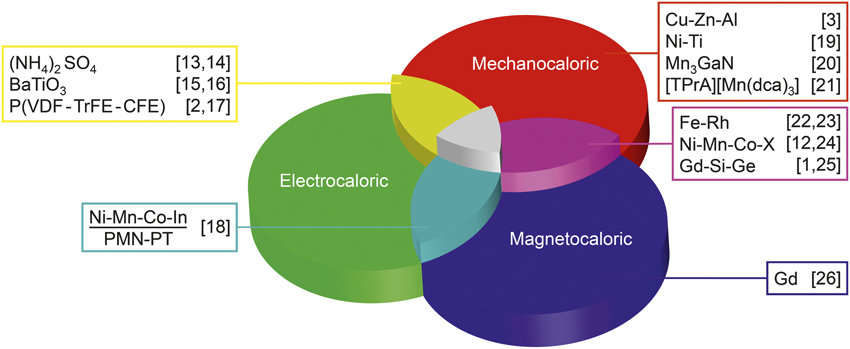
Most giant magnetocaloric and electrocaloric materials (undergoing first-order phase transitions) are expected to also show mechanocaloric effects, as the ferroic order parameter is likely to be strongly coupled to the lattice (Figure 1).Reference Pecharsky and Gschneidner1–Reference Bonnot, Romero, Mañosa, Vives and Planes3,Reference Lloveras, Stern-Taulats, Barrio, Tamarit, Crossley, Li, Pomjakushin, Planes, Mañosa, Mathur and Moya13–Reference Dan’kov, Tishin, Pecharsky and Gschneidner26 Over the last few years, there has been growing interest in studying caloric effects while varying the stress field along with the magnetic or electric field.Reference Planes, Castán and Saxena27–Reference Liu, Scott and Dkhil29 So far, most of this type of work has employed hydrostatic pressure as the primary control parameter. On the other hand, there has been much less research on multicaloric effects that employ magnetic and electric fields, in spite of the ongoing interest in multiferroic materials and the magnetoelectric effects that they display. In this article, we discuss the state of the art in research on multicaloric materials and multicaloric effects, and prospects for future advances.
The relationship between magnetocaloric, electrocaloric, and mechanocaloric materials.Reference Pecharsky and Gschneidner1–Reference Bonnot, Romero, Mañosa, Vives and Planes3,Reference Lloveras, Stern-Taulats, Barrio, Tamarit, Crossley, Li, Pomjakushin, Planes, Mañosa, Mathur and Moya13–Reference Dan’kov, Tishin, Pecharsky and Gschneidner26 Materials lying at the intersections are multicaloric. Selected examples are based on existing measurements of large caloric effects near room temperature. It is likely that all magnetocaloric and electrocaloric materials will show mechanocaloric effects that may or may not be large. Note: PMN-PT, (1–x)Pb(Mg1/3Nb2/3)O3-xPbTiO3; P(VDF-TrFE-CFE), poly(vinylidene fluoride-trifluoroethylene-chlorofluoroethylene); TPrA, tetrapropylammonium; dca, dicyanamide.

Thermodynamics of multicaloric effects
Here, we briefly recall the main thermodynamic relations that are required to understand multicaloric responses in materials that display more than one ferroic property. Let’s assume the likely scenario of two external fields Y 1 and Y 2, which are associated with their two conjugate ferroic variables X 1 and X 2, respectively. For example, a magnetic field μ0H and an electric field E would be associated with sample magnetization M and polarization P, respectively. We will restrict our discussion to isothermal changes of entropy ΔS, and we will assume equilibrium thermodynamics.
Given that entropy is a state function, it will undergo path-independent changes that do not depend on whether the driving fields are applied simultaneously, or in some sequence. We therefore express the entropy change arising due to a change in both applied fields by following any specific path,Reference Planes, Castán and Saxena30 e.g.,:
 $$\Delta S\left[ {\left( {0,0} \right) \to \left( {{Y_1},{Y_2}} \right)} \right] = \Delta S\left[ {(0,0) \to ({Y_1},0)} \right] + \Delta S\left[ {({Y_1},0) \to ({Y_1},{Y_2})} \right].$$
The first term on the right is the monocaloric effect due to the application of field Y 1 at Y 2 = 0, while the second term on the right is the monocaloric effect due to the application of field Y 2 at constant Y 1. One may then express the two terms via the appropriate Maxwell relations to obtain:
 $\Delta S\left[ {\left( {0,0} \right) \to \left( {Y_1 ,Y_2 } \right)} \right] = \mathop \smallint \limits_0^{Y_1 } \left( {{{\partial X_1 } \over {\partial T}}} \right)_{Y_1^\prime ,Y_2 = 0} {\rm{d}}Y_1^\prime + \mathop \smallint \limits_0^{Y_2 } \left( {{{\partial X_2 } \over {\partial T}}} \right)_{Y_1 Y_2^\prime } {\rm{d}}Y_2^\prime .$
Expanding the second term on the right of Equation 2,Reference Planes, Castán and Saxena30,Reference Stern-Taulats31 the expression becomes:
 $\Delta S\left[ {\left( {0,0} \right) \to \left( {Y_1 ,Y_2 } \right)} \right] = \mathop \smallint \limits_0^{Y_1 } \left( {{{\partial X_1 } \over {\partial T}}} \right)_{Y_1^\prime ,Y_2 = 0} {\rm{d}}Y_1^\prime + \mathop \smallint \limits_0^{Y_2 } \left( {{{\partial X_2 } \over {\partial T}}} \right)_{Y_1 = 0,Y_2^\prime } {\rm{d}}Y_2^\prime + \mathop \smallint \limits_0^{Y_1 } \mathop \smallint \limits_0^{Y_2 } {{\partial {\rm{\chi }}_{12} } \over {\partial T}}{\rm{d}}Y_1^\prime {\rm{d}}Y_2^\prime .$
In contrast to Equation 2, the entropy change is now expressed as the sum of two monocaloric responses that are determined while the inactive field is zero, and a cross-coupling term that is significant if the cross-susceptibility,
 $${\rm{\chi }}_{12} = \left( {{{\partial X_1 } \over {\partial Y_2 }}} \right)_{T,Y_1 } = \left( {{{\partial X_2 } \over {\partial Y_1 }}} \right)_{T,Y_2 } ,$$
exhibits a notable temperature dependence. (This cross-susceptibility represents the magnetoelectric coupling coefficientReference Eerenstein, Mathur and Scott10 when applying magnetic and electric fields.)
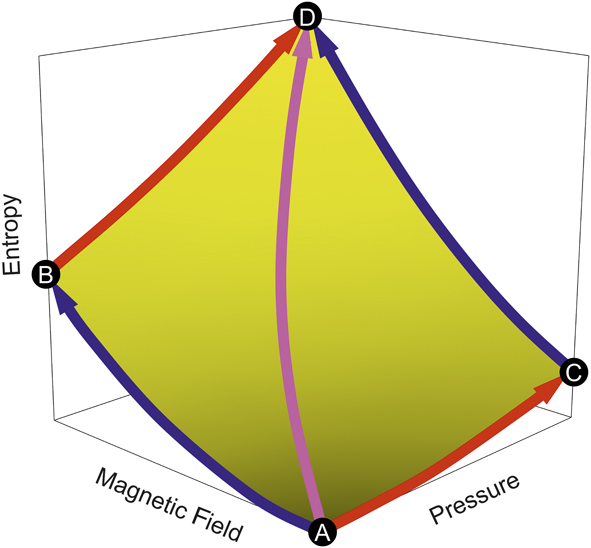
Equation 3 shows that the multicaloric response of a material is not given by the sum of each monocaloric response while the inactive field is zero, unless  $\partial {\chi _{12}}/\partial T = 0$. This may be appreciated by considering the diagram in Figure 2, where the field variables are magnetic field and pressure. First, it is necessary to observe that path independence implies that one may achieve the same entropy change (A → D) either by applying pressure at zero magnetic field (A → C) and then magnetic field at finite pressure (C → D), or by applying magnetic field at zero pressure (A → B) and then pressure at finite magnetic field (B → D). It then follows that the magnitude of a caloric effect driven by one field variable depends on the magnitude of the other field variable, due to the cross-coupling. For example, the magnetocaloric effects are different in magnitude when driven at zero pressure (A → B) or finite pressure (C → D).
Schematic variation of isothermal entropy with pressure and magnetic field (χ12 ≠ 0). Multicaloric entropy changes can be achieved by applying pressure and magnetic field either simultaneously or sequentially. For example, the entropy change associated with pathway A → D can be achieved in either one step, two steps (by applying first pressure [A → C] and then field [C → D], or by applying first field [A → B] and then pressure [B → D]), or multiple steps.

Multicaloric examples
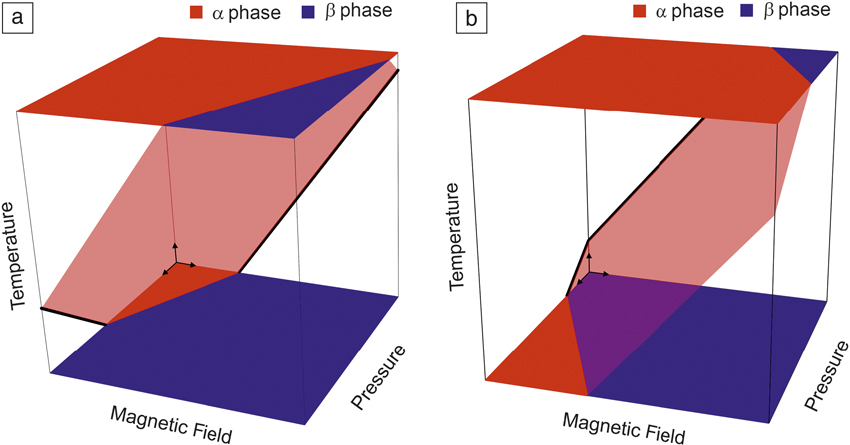
The ability to vary more than one field gives access to a wider range of parameter space, such that a given phase transition may become accessible with lower fields in a broader window of temperatures. This may be appreciated by considering the (anhysteretic) phase diagrams in Figure 3a–b where the field variables are again magnetic field and pressure. For example, finite pressure permits the α → β transition in Figure 3a to be isothermally driven using relatively small magnetic fields. More generally, the signs of both field changes should be chosen in order to drive the transition in the same direction. For example, the α → β transition in Figure 3b is favored by increasing magnetic field and reducing pressure.
Schematic phase diagrams for materials at finite temperatures, in which transitions between a high-temperature α phase and a low-temperature β phase are associated with (a) conventional magnetocaloric effects (dT/dH > 0) and conventional barocaloric effects (dT/dp > 0), and (b) conventional magnetocaloric effects (dT/dH > 0) and inverse barocaloric effects (dT/dp < 0). The sloping pink planes denote the (anhysteretic) phase boundary.

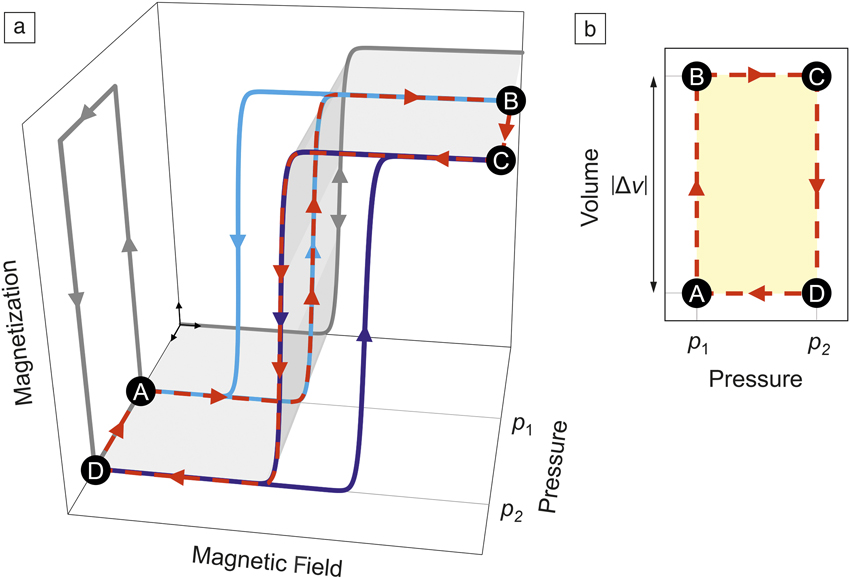
The hysteresis that is, in practice, associated with first-order phase transitions can be manipulated by judiciously using a secondary applied field. This strategy can shift hysteresis from the primary field to the secondary field,Reference Liu, Gottschall, Skokov, Moore and Gutfleisch12 or fully undrive caloric effects that cannot be fully undriven by the removal of the primary field alone. An example of the former scenario is explained in Figure 4, again using magnetic field and pressure as the field variables. The energy dissipated during the multicaloric cycle shown (red dashed line) is given to a good approximation by |∆p∆v|, where ∆p = p 2 – p 1 and ∆v is the difference in specific volumes for the two phases (Figure 4b).Reference Stern-Taulats, Castán, Planes, Lewis, Barua, Pramanick, Majumdar and Mañosa23 Experimentally, these types of multicaloric cycles have been realized using Fe-RhReference Stern-Taulats, Castán, Planes, Lewis, Barua, Pramanick, Majumdar and Mañosa23 and La-Fe-Mn-Si.Reference Lovell, Bez, Boldrin, Nielsen, Smith, Bahl and Cohen32
Multicaloric trajectories. (a) The red dashed line (A → B → C → D → A) includes isobaric magnetization-field legs at pressures p 1 (light blue dashed and solid lines) and p 2 (dark blue dashed and solid lines). Projections of this trajectory along the pressure and field axes (gray solid lines, located for convenience at the plot edge) help understand the hysteresis. The projection along the pressure axis shows that magnetic hysteresis can be traded for pressure hysteresis by increasing the pressure before removing the magnetic field. The resulting dissipation is seen by plotting (b) the corresponding changes of volume versus pressure. For simplicity, we assume that the magnetization and volume do not change when the pressure is varied (B → C and D → A).

The pressure and magnetic field variables were chosen in Figures 2–4 because most multicaloric studies focus on magnetocaloric effects that are modified by hydrostatic pressure.Reference Gama, Coelho, de Campos, Carvalho, Gandra, von Ranke and de Oliveira33–Reference Albertini, Kamarád, Arnold, Pareti, Villa and Righi37 For example, the peak magnetocaloric effects in Mn-Ni-Si-based compoundsReference Samanta, Lepkowski, Saleheen, Shankar, Prestigiacomo, Dubenko, Quetz, Oswald, McCandless, Chan, Adams, Young, Ali and Stadler36 and Mn-rich Ni-Mn-Ga Heusler alloysReference Albertini, Kamarád, Arnold, Pareti, Villa and Righi37 are increased by hydrostatic pressure, whereas there is a decrease in the peak magnetocaloric effects in Gd-Si-GeReference Carvalho, Alves, de Campos, Coelho, Gama, Gandra, von Ranke and Oliveira34 and Ni-Mn-Co-Sb Heusler alloys.Reference Nayak, Suresh, Nigam, Coelho and Gama38 There are also reports on elastocaloric effects that are modified by either magnetic or electric fields.Reference Castillo, Soto-Parra, Matutes-Aquino, Ochoa-Gamboa, Planes, Mañosa, González-Alonso, Stipcich, Romero, Ríos-Jara and Flores-Zúñiga24,Reference Chauhan, Patel and Vaish39 In Heusler alloys, the elastocaloric refrigerant capacity can be increased by ∼20% using magnetic fields of μ0H = 1 T.Reference Castillo, Soto-Parra, Matutes-Aquino, Ochoa-Gamboa, Planes, Mañosa, González-Alonso, Stipcich, Romero, Ríos-Jara and Flores-Zúñiga24 By contrast, the elastocaloric properties of single-crystal ferroelectric oxides are hardly affected by an electric field.Reference Chauhan, Patel and Vaish39
There are still few reports on caloric effects driven by both magnetic and electric fields. However, it should be possible to electrically control the magnetocaloric effect in multiferroic heterostructures via strain.Reference Cong, Wang, Cao, Liu, Liu and Du18,Reference Moya, Hueso, Maccherozzi, Tovstolytkin, Podyalovskii, Ducati, Phillips, Ghidini, Hovorka, Berger, Vickers, Defay, Dhesi and Mathur40–Reference Liu, Phillips, Mattana, Bibes, Barthélémy and Dkhil42 For, example a small multicaloric response has been demonstrated using ribbons of the Heusler material Ni-Co-Mn-In on a ferroelectric substrate of (1–x)Pb(Mg1/3Nb2/3)-xPbTi0.28O3,Reference Cong, Wang, Cao, Liu, Liu and Du18 where an electric field modified the peak temperature of the inverse magnetocaloric effects. Similar results were also obtainedReference Liu, Phillips, Mattana, Bibes, Barthélémy and Dkhil42 in FeRh-films on BaTiO3 substrates.
Outlook
The use of more than one field variable opens up what may be considered to be a new field of research, just as the use of both magnetic and electric fields has opened up the field of magnetoelectrics following the large separate bodies of work on ferromagnetic and ferroelectric materials. The study of multicaloric materials and effects is now particularly timely given the confluence of research in magnetocaloric, electrocaloric, and mechanocaloric effects. This confluence is manifested in both review articlesReference Fähler, Rößler, Kastner, Eckert, Eggeler, Emmerich, Entel, Müller, Quandt and Albe5–Reference Moya, Kar-Narayan and Mathur7,Reference Crossley, Mathur and Moya43 and international conferences. In addition to a cross-fertilization of expertise, one can anticipate a blossoming of multicaloric research itself, yielding both novel science and possible applications. Consequently, we can say with confidence that the field of multicalorics will continue to be greater than the sum of the parts.
Acknowledgments
This work was supported by the Spanish Ministry of Science Project MAT2016-75823-R, the EPSRC Grant No. EP/P031412/1, and the ERC Starting Grant No. 680032. X.M. is grateful for support from The Royal Society.

Enric Stern-Taulats is a postdoctoral research associate in the Department of Materials Science at the University of Cambridge, UK. He obtained his BSc degree in physics at the Universitat de Barcelona, Catalonia, and MSc degree in computational and applied physics at the Universitat Politècnica de Catalunya and Universitat de Barcelona. He received his PhD degree in nanoscience in 2017 from the Universitat de Barcelona. His current research focuses on caloric materials and devices for cooling applications. Stern-Taulats can be reached by email at es749@cam.ac.uk.

Teresa Castán is a full professor in the Departament de Física de la Matèria Condensada and member of the Institut de Nanociencia i Nanotecnologia at the Universitat de Barcelona, Catalonia. She received her PhD degree in physics from the Universitat de Barcelona in 1987. She served as a postdoctoral EECC Fellow in the Physics Department at Risøe National Laboratory, Denmark, and as a visiting scientist in the Laboratory of Atomic and Solid State Physics at Cornell University. In 1991, she was appointed as a professor in condensed-matter physics at the Universitat de Barcelona. Her current research focuses on modeling of phase transitions and multiscale phenomena in ferroic and multiferroic materials, including thermodynamics of caloric and multicaloric effects. Castán can be reached by email at teresa.castan@fmc.ub.edu.

Lluís Mañosa is a full professor of condensed-matter physics at the Universitat de Barcelona, Catalonia, where he received his BSc and PhD degrees in physics. He carried out postdoctoral studies at the Institut National des Sciences Appliquées, France, and at the University of Bath, UK, and he was a visiting professor at Ames Laboratory. His research is devoted to the study of thermal, mechanical, and magnetic properties of solids undergoing ferroic phase transitions. His current research focuses on materials exhibiting functional properties associated with these transitions, with special attention paid to the interplay between different ferroic properties. Mañosa can be reached by email at lluis.manosa@fmc.ub.edu.

Antoni Planes is a full professor in the Departament de Física de la Matèria Condensada at the Universitat de Barcelona, Catalonia. His recent research has focused on the study of phase transitions in systems with interplay between structure and magnetism, with special emphasis on magnetoelastic materials, such as magnetic shape-memory alloys and magnetocaloric effects related to magnetostructural transitions. He has authored and co-authored more than 260 publications and has served as organizer or co-organizer of conferences and symposia. He is a member of the International Advisory Committees for the International Conference on Martensitic Transitions and for the European Symposium on Martensitic Transitions. He is a Fellow of the Reial Acadèmia de Ciències i Arts de Barcelona and a Fellow of the American Physical Society. Planes can be reached by email at antoni.planes@fmc.ub.edu.

Neil D. Mathur has been with the Department of Materials Science at the University of Cambridge, UK, where he began postdoctoral research in 1996. He became a research fellow funded by The Royal Society in 1999, was hired to the faculty in 2005, and became professor of materials physics in 2013. He previously studied physics at the University of Cambridge, where in 1990, he received his BA degree in natural sciences, and in 1996, he received his PhD degree on magnetically mediated superconductivity. His research focuses on the physics of materials and systems with notable electrical and magnetic properties. He was elected a Fellow of the American Physical Society in 2012, and was awarded the Rosenhain Medal and Prize by the Institute of Materials, Minerals and Mining in 2009. Mathur can be reached by email at ndm12@cam.ac.uk.

Xavier Moya is a Royal Society University Research Fellow in the Department of Materials Science at the University of Cambridge, UK. He received his BSc degree in 2003, and his PhD degree in 2008, both in physics, from the University of Barcelona. His research focuses on magnetocaloric materials, electrocaloric materials, and mechanocaloric materials for cooling applications. He has been a Fellow of Churchill College, Cambridge, since 2014. He was awarded the Ramon Margalef Prize in 2009, the Spanish Royal Society of Physics Young Researcher in Experimental Physics Prize in 2015, and the Society of Spanish Researchers in the UK Emerging Talent Award in 2017. Moya can be reached by email at xm212@cam.ac.uk.