INTRODUCTION
Infraorder Brachyura Latreille, Reference Latreille1802–1803, the true crabs, is one of the most diverse decapod groups comprising 93 families, 1271 genera and 6793 species (Ng et al., Reference Ng, Guinot and Davie2008). Recently, section Raninoida was classified into 11 superfamilies and seven families (Van Bakel et al., Reference Van Bakel, Guinot, Artal, Fraaije and Jagt2012; Karasawa et al., Reference Karasawa, Schweitzer, Feldmann and Luque2014). The super family Raninoidea De Haan, Reference De Haan and Von Siebold1833–1850, was previously accredited to a single family, Raninidae De Haan, Reference De Haan and Von Siebold1833–1850, with seven extant subfamilies (Ng et al., Reference Ng, Guinot and Davie2008), but is now considered to comprise two families: Raninidae De Haan, Reference De Haan and Von Siebold1833–1850 (with six subfamilies) and Lyreididae Guinot, Reference Guinot1993 (with five subfamilies) (Van Bakel et al., Reference Van Bakel, Guinot, Artal, Fraaije and Jagt2012; Guinot et al., Reference Guinot, Tavares and Castro2013; Karasawa et al., Reference Karasawa, Schweitzer, Feldmann and Luque2014). Raninoid crabs, also known as ‘frog crabs’, are a group of marine crabs adapted for inhabiting soft and sandy bottoms across a wide bathymetric range and are distributed throughout tropical to low-latitude temperate regions of the world. They form a clade of Brachyura typically characterized by a fusiform carapace (raninid-type), a narrow thoracic sternum, a pleon partially exposed dorsally, and paddle-like limbs, all of which are well suited to their cryptic burying lifestyle (Van Bakel et al., Reference Van Bakel, Guinot, Artal, Fraaije and Jagt2012). The living raninoid fauna consists of only 12 genera and 46 species, while a considerably larger number of fossil taxa, 182 fossil species in 38 genera being known from the late Albian (De Grave et al., Reference De Grave, Pentcheff, Ahyong, Chan, Crandall, Dworschak, Felder, Feldmann, Fransen, Goulding, Lemaitre, Low, Martin, Ng, Schweitzer, Tan, Tshudy and Wetzer2009). Extinct species and families of Raninoidea are reported from fossil specimens collected during palaeontological surveys (Feldmann, Reference Feldmann1992; Karasawa & Ohara, Reference Karasawa and Ohara2009; Van Bakel et al., Reference Van Bakel, Guinot, Artal, Fraaije and Jagt2012). New and rare species also are identified during fishery expeditions all around the world (Kasinathan et al., Reference Kasinathan, Sandhya, Gandhi, Boominathan and Rajamani2007).
Expeditions of Royal Indian Marine Survey Ship ‘Investigator’ carried out extensive surveys on Indian deep-sea brachyurans and 53 species of crabs belonging to 38 genera were described (Alcock, Reference Alcock1899), including two species of raninids. After a century, Fisheries and Oceanographic Research Vessel (FORV), ‘Sagar Sampada’, Government of India has taken over the demersal explorations for living resources for more than 3 decades. From the FORV ‘Sagar Sampada’ cruise 291, we were able to collect one raninid species, Lysirude channeri (Wood-Mason, Reference Wood-Mason1885) from Bay of Bengal which had previously been reported by Wood-Mason (Reference Wood-Mason1885) and Alcock (Reference Alcock1899). During taxonomic confirmation all specimens recorded two pairs of antero-lateral spines as in holotype; but contradicted with the morphology of the specimens collected from off Philippines (Griffin Reference Griffin1970; Goeke, Reference Goeke and Forest1986; Feldmann, Reference Feldmann1992). The present account encompasses re-description of L. channeri, collected from Bay of Bengal in Indian Exclusive Economic Zone (EEZ), part of the north-eastern Indian Ocean.
MATERIALS AND METHODS
Specimens were collected during the deep-sea fishery cruise no. 291 of FORV, ‘Sagar Sampada’ from Bay of Bengal, East coast of India (Figure 1). This cruise was part of the Department of Ocean Development (DOD) – Marine Living Resources (MLR) Project, funded by the Ministry of Earth Sciences (MoES), Government of India and was exclusively designed to undertake studies on ‘Stock assessment and biology of demersal resources and collection of environmental data along the East coast of Indian Exclusive Economic Zone (EEZ)’. Seventeen deep-sea fishing trawl operations were conducted during the 20 days voyage using High Speed Demersal Trawl (HSDT) crustacean version and EXPO Crustacean Version (CV) model bottom trawls. The data on environmental parameters were collected using Conductivity Temperature Depth (CTD) sensors.
Map siting sampling locations of Lysirude channeri (Wood-Mason, Reference Wood-Mason1885).

The cruise covered 10 transects (from 10°35′193′′N, 80°33′143′′E to 20°03′476′′N 87°02′0.861′′E) in which deep-sea trawl operations were conducted after scanning the bottom profile using echo sounder (Simrad CM60). Average towing speed was about 4.50 knots (8.33 km h−1) covering a distance of 18.92 km in 2.27 h. Specimens collected were stored in a −20°C freezer after sorting catch onboard. Some specimens were stored in 95% ethanol for DNA isolation.
Morphometric measurements were taken to the nearest 0.01 cm, by using Mitutoyo CD-8” PSX Digimatic caliper with an accuracy of 0.01 mm. Technical terms and measurements were taken according to Food and Agriculture Organization (FAO) species identification guides. Taxonomic identification keys (Wood-Mason, Reference Wood-Mason1885; Alcock Reference Alcock1896; Griffin, Reference Griffin1970; Goeke, Reference Goeke and Forest1986; Feldmann, Reference Feldmann1992; Guinot & Bouchard, Reference Guinot and Bouchard1998; Tucker, Reference Tucker1998; Bouchard, Reference Bouchard2000; Van Bakel et al., Reference Van Bakel, Guinot, Artal, Fraaije and Jagt2012) were used for identification of specimens at species level. Images were taken using a Leica ICC50 digital stereo microscope camera and Motic SMZ-168. Outline diagrams and map were drawn with the help of vector graphics editor software, Inkscape 0.48.4 and Ocean Data View 4 (Schlitzer, Reference Schlitzer2014) respectively.
Morphology was taken by placing the organism dorso-ventrally and by considering the rostral side as anterior, pleonal side as posterior and their lateral sides as right and left. Spines beside rostrum were considered as post-orbital spines. Lateral spines were counted as antero-lateral spines. The maximum width of the carapace was measured as total width and the length of carapace from rostrum to the posterior margin as total length. The appendages were listed as cephalic, thoracic and pleonal. Cephalic appendages included antennule, antenna, mandible, maxillule and maxilla while first, second and third maxilliped, cheliped (P1), first (P2), second (P3), third (P4) and fourth (P5) pereiopods were taken as thoracic appendages. Pleonal appendages of males and females were mentioned as gonopods and pleopods respectively.
Genotyping
Mitochondrial DNA was extracted from abdominal muscle tissues using DNeasy Blood and Tissue Kit (Qiagen) following the spin column protocol for purification of Total DNA from Animal Tissues. The PCR kit used was Sigma Aldrich ReadyMix™ Taq PCR Reaction Mix with MgCl2. Reagents for PCR included 25 µl 2× ReadyMix Taq PCR Reagent Mix (1.5 units Taq DNA polymerase, 10 MmTris-HCl, 50 MmKCl, 1.5 Mm MgCl2, 0.001% gelatin, 0.2 mMdNTP, stabilizers), 1 µl Forward primer (LCO1490:5′-GGTCAACAAATCATAAAGATATTGG-3′), 1 µl Reverse primer (HCO2198:5′-TAAACTTCAGGGTGACCAAAAAATCA-3′), 8 µl template DNA and 15 µl PCR reagent water. Amplification was performed with 50 µl samples using a Corbett gradient thermal cycler. The temperature profile consisted of an initial step of 60 s at 94°C; 5 cycles of 30 s at 94°C, 90 s at 45°C and 60 s at 72°C; 35 cycles of 30 s at 94°C, 90 s at 51°C and 60 s at 72°C; followed by a final extension of 5 min at 72°C (Costa et al., Reference Costa, deWaard, Boutillier, Ratnasingham, Dooh, Hajibabaei and Hebert2007). PCR products were visualized on 1.2% agarose. Amplified products exhibiting intense bands on agarose gel (1.2%) electrophoresis were selected for purification and sequencing. Sequences were compiled using BioEdit 7.0.9 (Hall, Reference Hall1999). Alignment was performed using Clustal X (Thompson et al., Reference Thompson, Gibson, Plewniak, Jeanmougin and Higgins1997). Different genetic parameters of Lysirude channeri were inferred using DnaSP 5.10 (Rozas & Librado, Reference Rozas and Librado2009) and Arlequin 3.1 (Excoffier et al., Reference Excoffier, Laval and Schneider2005). In order to generate phylogram and genetic distance data, homologous COI sequences (Folmer region) of related individuals were acquired from NCBI (Jose & Harikrishnan, Reference Jose and Harikrishnan2016). Phylogram (using Maximum Likelihood (ML), Neighbour Joining (NJ), Minimum Evolution (ME) and Maximum Parsimony (MP) analyses) and pair wise sequence distance was generated using Kimura 2-Parameter model by MEGA 5 (Tamura et al., Reference Tamura, Peterson, Peterson, Stecher, Nei and Kumar2011).
SYSTEMATICS
Order DECAPODA Latreille, Reference Latreille1802–1803
Infraorder BRACHYURA Latreille, Reference Latreille1802–1803
Superfamily RANINOIDEA De Haan, Reference De Haan and Von Siebold1833–1850
Family LYREIDIDAE Guinot, Reference Guinot1993
Subfamily LYREIDINAE Guinot, Reference Guinot1993
Genus Lysirude Goeke, 1986
Lysirude channeri (Wood-Mason, Reference Wood-Mason1885)
(Figures 2–9)
(A) Lysirude channeri (Wood-Mason, Reference Wood-Mason1885), dorsal surface of carapace. (B) ventral surface of carapace. (C) lateral side.

(A) Lysirude channeri (Wood-Mason, Reference Wood-Mason1885), dorsal surface. (B) ventral surface. (C) first gonopod. (D) second gonopod.

(A) Lysirude channeri (Wood-Mason, Reference Wood-Mason1885), male first and second gonopod; (B) female brood pouch and egg mass. (C) single egg enlarged.

(A) Lysirude hookeri Feldmann, Reference Feldmann1992 fossil holotype – BAS IN 2397 from Seymour Island, peninsular Antarctica; (B) Lysirude channeri (Wood-Mason, Reference Wood-Mason1885), carapace of specimen from Bay of Bengal.

Lysirude channeri (Wood-Mason, Reference Wood-Mason1885), oblique orbital fissure from base of each postorbital spine.

(A) Lysirude channeri (Wood-Mason, Reference Wood-Mason1885), episternite of pleonal locking system of male specimen showing pegs. (B) Episternite of poorly developed pleonal locking system of female specimen.

Lysirude channeri (Wood-Mason, Reference Wood-Mason1885), lower edge of propodus of chela with three sharp, flat and triangular teeth.

Lysirude channeri (Wood-Mason, Reference Wood-Mason1885) P4 – foliaceous spade-shaped dactylus and propodus with an expanded lobe bearing setae only on its inner margin (Photograph).

TYPE MATERIAL
Lyreidus channeri Wood-Mason, Reference Wood-Mason1885
Holotype: male, carapace length 2.5 cm and breadth 1.42 cm. Bay of Bengal, 21°6′30″N 89°20′E, from 405–285 fathoms; bottom temperature of 48–50°F, dredged in trawl; ‘H.M.'s Investigator’ – Indian Museum collections in collections; Zoological Survey of India, Calcutta – reg. no. 8 4 6 8/6. Described by Wood-Mason, 5 August 1885.
COMPARATIVE MATERIAL EXAMINED
Lyreidus channeri Wood-Mason, Reference Wood-Mason1885
Adult female; carapace length 2.65–2.85 cm. Andaman Sea 220–271 fathoms, Bay of Bengal; 200–405 fathoms, both sides of Ceylon 296–406 fathoms, and from off the Malabar coast, 360 fathoms. ‘H.M.'s Investigator’ – Indian Museum collection. Described by Alcock, Reference Alcock1899.
Male; carapace length 3.00 cm. South China Sea; South of Hainan, 16°47.5′N 109°49.5′E, to 16°45′N 109°52′E, 200–290 fathoms. Agassiz trawl, FHK Station 17 (AM P.15787). Collected on 5 March 1965 and described by Griffin, Reference Griffin1970.
Lysirude channeri (Wood-Mason, Reference Wood-Mason1885), n. comb.
75 specimens (38 males and 37 females) Musorstom (1976–1980) and Corindon II (1980) cruise collections off the Philippines; 13°N 120°–122°E (8 stations) and 1°54′6″S 119°13′8″E from depths of 410–1030 m. Collected 8 November – 2 December 1980. Described by Goeke, Reference Goeke and Forest1986.
Lyreidus (Lysirude) hookeri, Feldmann, Reference Feldmann1992.
Holotype: Fossil specimen; carapace length 2.83 cm and breadth 1.85 cm. Collected from the Eocene La Meseta Formation at Cape Wiman, Seymour Island, Antarctica. Collected by Jeremy J. Hooker in 1988 and described by Feldmann, Reference Feldmann1992.
DISTRIBUTION
Type locality of Lysirude channeri (Wood-Mason, Reference Wood-Mason1885) is Bay of Bengal, Indian Ocean at a depth of 405–285 fathoms (Wood-Mason, Reference Wood-Mason1885) and later, Alcock (Reference Alcock1896) gave an account of Lyreidus channeri from the deep-sea specimens of H.M.S. Investigator, collected from Andaman Sea (402–495 m), Bay of Bengal (365–740 m) Ceylon (541–742 m) and off Malabar Coast (658 m) and deposited in the Indian Museum. Kemp & Sewell (Reference Kemp and Sewell1912) reported this species from Arabian Sea, off Trivandrum, 237 fathoms, (‘H.M.'s Investigator’, Station 391). A specimen was collected from South China Sea, 200–290 fathoms by Griffin (Reference Griffin1970). More specimens were collected from depths of 410 to 1030 m off the Philippines (75 specimens: 38 males and 37 females) during the cruises of Musorstom (1976–1980) and Corindon II (1980) (Goeke, Reference Goeke and Forest1986). These reports suggested this species as a native of Indo-west Pacific.
MATERIAL EXAMINED
Trawl collections in two stations i.e. 18°48′708″N 85°21′605″E to 18°54′189″N 85°26′898″E and 18°48′093″N 85°21′201″E to 18°54′742″N 85°26′539″E (Figure 1) were comprised of 76 specimens (42 males and 34 females) of single species of raninid crab weighing a total of 184.6 g. Both these stations (Stations 3 & 5 on 29 & 30 October 2011 respectively) were off Paradip, Orissa, India and had a depth range of 614–655 m with a temperature profile 9.0504 to 8.9141°C. In this transect, deep-sea bottom trawl operations were carried out by using EXPO (CV) model trawl net with cod end mesh size 30 mm. The specimens were preserved in 5% formalin and were deposited in the museum of Zoological Survey of India, Calicut, India (2585 A & B, 2585 C & D) and in the fish museum of School of Industrial Fisheries, Cochin University of Science and Technology, India (SIF, CUSAT 291-1, 291-2).
DIAGNOSIS
Elongate fusiform carapace; not covering abdominal terga. First four abdominal segments visible on dorsal view. Fourth pereopod's propodus lobate without spine. Fifth pereopod on dorsal plane. Fronto-orbital margin tridentate with rostrum. Postorbital spines were as long as rostrum or elongated. Two pairs of long sharp antero-lateral spines; one divides antero-lateral and postero-lateral margins of carapace and one midway along antero-lateral margin. Sternum distinctly widest between sternites 4 and 5. Carapace bears setal pits; antero-lateral margins and its ventral side hirsute.
DESCRIPTIONS
Fresh specimen salmon coloured. Carapace longer than wide, reasonably domed transversely, less so longitudinally. Dorsal side with a medial blunt carina; slowly merging to frontal and posterior regions (Figure 2A). From posterior to middle, carapace convex and from middle to rostrum, slightly concave (Figure 2C). Two orifices located almost at the centre of the carapace. Rostrum flat, sharp and triangular or somewhat bell shaped. Rostral length slightly exceeds its width. No preorbital spines. A pair of acute post-orbital spines on each side of rostrum defines the orbits, these spines parallel or outwardly directed, reaching approximately to rostrum or beyond. Orbits deepest near rostral base. Eyestalks short, somewhat lanceolate and taper to yellow cornea deficient of pigments. An orbital fissure originates oblique to long axis of carapace from the base of each post-orbital spine (Figure 6). Antero-lateral margins with two pairs of acicular spines. The short anterior pair directed forwardly while the longer base pair directed outwardly. All spine tips with darker pigmentation. Fronto-orbital margin and following antero-lateral margins lined with setae. Carapace width maximum at the base of second antero-lateral spine. Carapace margin more or less straight immediately after second antero-lateral spine, postero-lateral margin slightly oblique; posterior border short. Postero-lateral margins with a ridge along their edges, extending almost up to the base of second antero-lateral spine. Dorsal surface of carapace glossy, upper half and mesial regions coarsely punctuate with setal pits, resulting in cruciform appearance (Figure 3A) which demarcates hepatic, gastric and brachial regions. Medial carina has two faint depressions above cardiac region. Dorsal and ventral sides of carapace clearly separated by a lining of setal pits forming a distinct groove, extending from the base of second antero-lateral spine to posterior margin of carapace. On the ventral side, antero-lateral margins of carapace coarsely granulate with setae and pits (Figure 3B).
Sternum with six fused sternites, first being crown shaped followed by broader second and third sternites. Fourth and fifth sternites with obscure borders. Here sternum becomes biconcave with a set of crescentic impressions where chelipeds (P1) are attached (Figure 2B & 3B) and then proceeds to the widest alate processes. Sternum extends and develops a ‘pterygoid process’ (Bourne, Reference Bourne1922) – an abdominal holding system or pleonal locking system (Bouchard, Reference Bouchard2000; Van Bakel et al., Reference Van Bakel, Guinot, Artal, Fraaije and Jagt2012) revealing sexual dimorphism. In males, pleon locked to sternum forming an abdominal holding system of two episternites curved to inside with two pegs; distal one at its tip forming a hook and the other just above it (Figure 7A). Holding system poorly developed in females with episternites lacking pegs; directed outwardly (Figure 7B). Chela compressed; curved dactylus with discontinuous fissures delineating the smooth outer margin and the irregular sinuous (three or four obscure teeth) inner margin. Propodus with an upper carina reaching up to a subterminal denticle. Its lower edge with two to three sharp, flat and triangular teeth (Figure 8); distal ventral tooth is approximately three times of the proximal. Cutting surface with hooked tip and bears five uneven blunt teeth. Usually one or rarely two dorsal acicular carpal spines on carpus, proximal being longer. Merus long, with one dorsal stout spine. Ischium fused to basis; coxa small and ring like. P2 and P3 similar and possess dissimilar, stylized lanceolate dactyli lacking setae. P2, P3 and P4 with carinate carpus having flattened distal ends. Merus long and tubular. Ischium and basis fused. Coxa spherical and thin. P4 broadly paddle like, used for swimming and digging on the bottom. Dactylus foliaceous, spade shaped with setae only on its proximal margin. Propodus oval, due to an expanded lobe bearing setae on its inner margin (Figure 9). Merus is comparatively short and stout. Ischium and basis fused and with a blunt spine pointing posteriorly. P5 smallest and positioned dorsally, over P3. Dactylus partly hooked, propodus and carpus short, bearing setae. Merus long and sturdy. Ischium long and thick, fused to basis.
Six free pleonal segments tucked to sternum ventrally. Sixth segment comparatively longer, tucks to sternum by pleonal locking system. Third and fourth pleonal segments form the distal end of the body and their terga bear anteriorly curved one spine each. Telson small. First two pairs of pleopods of males modified to first and second gonopod (Figure 3C, 3D & 4A). In females, six pairs of pleopods well developed, feather-like to hold the egg mass (Figure 2C & 4B).
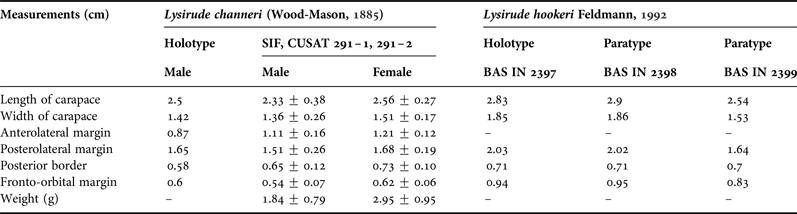
Average carapace length 24.4 ± 0.35 mm and width 1.43 ± 0.23 mm. Maximum width of carapace 0.6 times carapace length and about 2.5 times width of fronto-orbital margin. Fronto-orbital margin wider than posterior margin and measured 0.58 ± 0.07 and 0.52 ± 0.09 mm respectively. Maximum width 2.8 times posterior margin and 1.2 times antero-lateral margin. Posterior margin and fronto-orbital margins 2.2 and 2 times width of antero-lateral margin. Maximum length of carapace was about 2.1 times of antero-lateral margin (Table 1). The smallest and largest females collected measured 1.99 and 3.51 cm carapace length and 1.10 and 2.08 cm carapace width respectively. Majority of females collected were berried, with orange coloured eggs (Figure 4C) clustered within the feather-like pleopods. The absolute fecundity varied from 1729 to 4212 and mean egg diameter was 0.56 ± 0.02 mm.
Comparison of morphometric measurements of Lysirude channeri (Wood-Mason Reference Wood-Mason1885) and Lysirude hookeri Feldmann Reference Feldmann1992.

GENOTYPING RESULTS
Well amplified COI gene sequences of L. channeri were obtained using the mentioned protocols and primer pairs. All these sequences were submitted in NCBI (accession numbers: KC900367–KC900370, KJ569145–KJ569148). Base pair lengths of developed COI sequences ranged from 641 to 651 base pairs (bp) with three haplotypes (Diversity indices (Hd+/−SD) = 0.464+/−0.200) within the eight generated sequences. Nucleotide frequencies were 19.16% for cytosine, 36.92% for thymine, 26.25% for adenine and 17.66% for guanine.
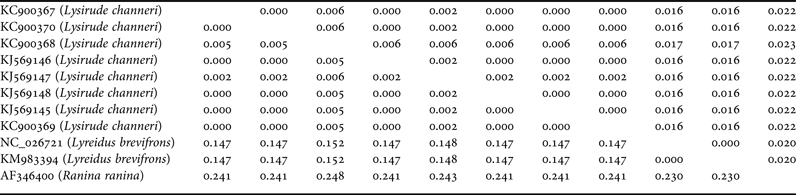
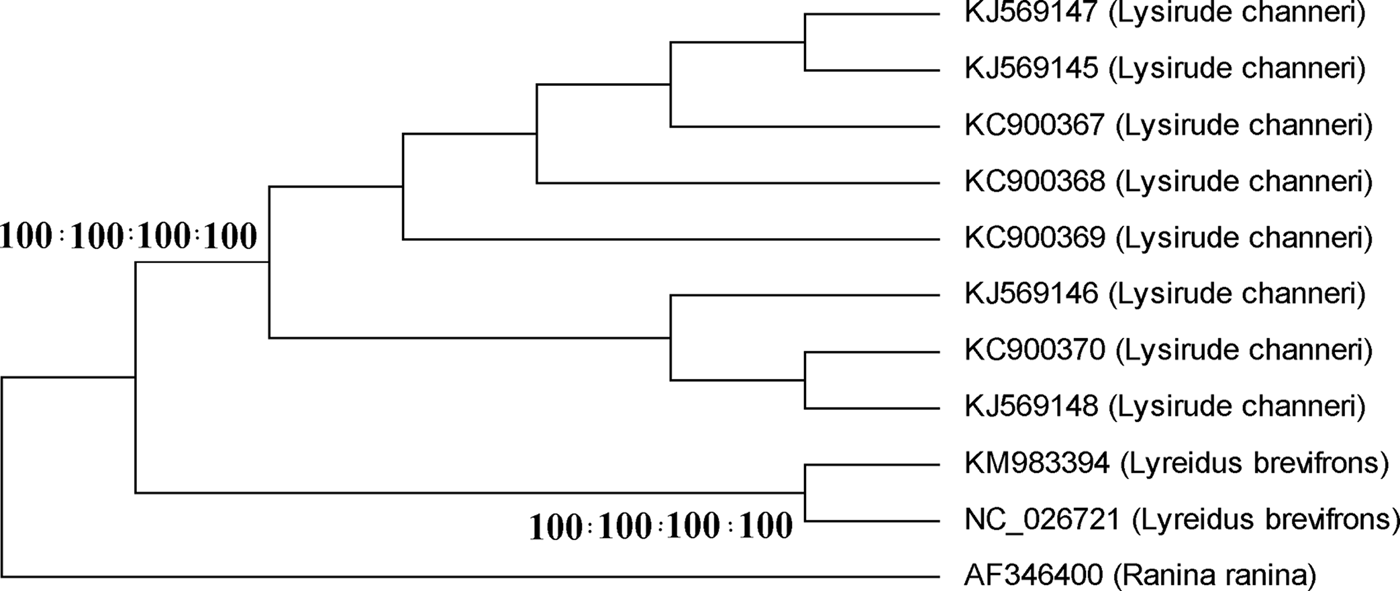
Figure 13 represents the phylogram (1000 bootstraps) based on Kimura 2-parameter substitution model for Lysirude channeri. COI (Folmer) region of Lyreidus brevifrons was trimmed out from its whole mitochondrial genome nucleotide sequence data available from NCBI (accession numbers: KM983394, NC_026721) and incorporated for generating phylogram. In addition, nucleotide sequence of Ranina ranina (Linnaeus, Reference Linnaeus1758) was also selected which represented the outgroup (accession number: AF346400). Phylogram exhibited the independent assemblage of individuals of Lysirude channeri within a major clade with 100% bootstrap support for all the four analyses. COI sequences of Lyreidus brevifrons representing the close relative of Lysirude channeri arrayed next to the former with 100% bootstrap value, since they constituted the neighbouring genus within the family Raninidae. However, there was no bootstrapping between these two species in phylogram which could be accounted for by the higher genetic distance existing between them. As expected, the selected outgroup R. ranina was aligned as the farthest individual. In addition, the intraspecific divergence within the COI sequences of Lysirude channeri ranged from 0.20 to 0.60% which was feeble and contained within the threshold limit of 3% proposed by Hebert et al. (Reference Hebert, Cywinska, Ball and De Waard2003) for confirming and establishing speciation (Table 2). On the contrary, interspecific distance between Lysirude channeri and Lyreidus brevifrons ranged from 14.7 to 15.2%, high enough to justify their divergence up to generic level.
Pairwise sequence distance table with standard errors (upper diagonal) for Lysirude channeri (Wood-Mason, Reference Wood-Mason1885).

DISCUSSION
According to De Haan (Reference De Haan and Von Siebold1841), the genus Lyreidus included crabs with smooth dorsum and carapace longer than wide, having maximum width near mid length. Goeke (Reference Goeke and Forest1986) established a new genus Lysirude, based on tridentate orbital region (also the basis for naming the type species of Lyreidus, Lyreidus tridentatus (De Haan, Reference De Haan and Von Siebold1841), granular with obsolete toothed antero-lateral margin and deeply lobate propodus of P4. Later, Feldmann (Reference Feldmann1992) subdivided Lyreidus in to two subgenera viz., Lyreidus (Lyreidus) and Lyreidus (Lysirude) due to morphological variations on antero-lateral margin and sternum of carapace. Lyreidus (Lysirude) was distinguished from Lyreidus (Lyreidus) by having a carapace with two pairs of antero-lateral spines and with a sternum distinctly widest between fourth and fifth sternites. Tucker (Reference Tucker1998) observed relatively wider fronto-orbital margin and more produced rostrum with orbital spines in Lysirude than Lyreidus. Compiling these observations with Goeke (Reference Goeke and Forest1986), Tucker (Reference Tucker1998) suggested Lysirude and Lyreidus were distinct genera. Van Bakel et al. (Reference Van Bakel, Guinot, Artal, Fraaije and Jagt2012) also considered Lysirude as distinct genus within Lyreididae Guinot, Reference Guinot1993, based on hypertrophied lateral spines, a typical blunt tooth on antero-lateral margin and the abdominal holding structures as described by Guinot & Bouchard (Reference Guinot and Bouchard1998) and Bouchard (Reference Bouchard2000). However, Karasawa et al. (Reference Karasawa, Schweitzer, Feldmann and Luque2014) were unable to discern a means for distinguishing Lysirude convincingly from Lyreidus. This difference in opinion can only be resolved through comprehensive molecular analyses (Van Bakel et al., Reference Van Bakel, Guinot, Artal, Fraaije and Jagt2012).
Holotype of Lysirude channeri (Wood-Mason, Reference Wood-Mason1885) was described from specimens collected during H.M. Indian Marine Surveying (H.M.S.) Steamer ‘Investigator’ expedition in the Bay of Bengal. This specimen suffered breakage and lost its left second antero-lateral spine which remained as a tubercle (Wood-Mason, Reference Wood-Mason1885; Alcock, Reference Alcock1896).
Descriptions of South China Sea specimens by Griffin, Reference Griffin1970 revealed one or two dorsal spines of cheliped merus. However, only single stout spine could be noticed in all specimens collected from Bay of Bengal. Goeke (Reference Goeke and Forest1986) reported morphological variations among L. channeri by pointing out the presence of two pairs of antero-lateral spines, shape of post-orbital spines and spination on cheliped. Individuals with two pairs of antero-lateral spines were reported as atypical in contrast to typical forms with one pair of antero-lateral spines (Figure 10). On the contrary, all specimens reported from Bay of Bengal were characterized with two pairs of well developed, acicular antero-lateral spines (Figure 11) (Wood-Mason, Reference Wood-Mason1885; Alcock, Reference Alcock1896). All specimens collected in the present study also corroborate with the descriptions of Wood-Mason (Reference Wood-Mason1885) and Alcock (Reference Alcock1896) in having two pairs of antero-lateral spines (Figure 2A, 6). However, some specimens collected in the present study showed another morphological variation in having two carpal spines instead of one on chela (P1) (Griffin, Reference Griffin1970) (Figure 12).
Dorsal and ventral views of Lysirude channeri (Wood-Mason, Reference Wood-Mason1885), USNM 216686. Scale bar equals 1 cm. (Photograph from Feldmann, Reference Feldmann1992 (A & B) and Tucker, Reference Tucker1998 (C & D).)

Lysirude channeri (Wood-Mason, Reference Wood-Mason1885). (A) Lysirude channeri natural size; (B) Orbital, antennary and buccal view (original illustration by Wood-Mason, Reference Wood-Mason1885).

Lysirude channeri (Wood-Mason, Reference Wood-Mason1885), atypical carpus of chela (P1) showing morphological variation by having two carpal spines instead of one.

Lysirude channeri (Wood-Mason, Reference Wood-Mason1885), phylogram (1000 bootstraps) based on Kimura two-parameter substitution model.

The type species Lysirude nitidus (A. Milne Edwards, Reference Milne-Edwards1880) has close affinity to L. channeri (Griffin, Reference Griffin1970; Seréne & Umali, Reference Serène and Umali1972), which helped in classifying Lyreidus, Lysirude and Raninoides (Goeke, Reference Goeke and Forest1986). The main features considered for distinguishing Lysirude from Lyreidus were relative width of fronto-orbital margin to posterior border and carapace width, intensely lobate dactylus and propodus of P4, presence of obsolete spine or small tubercles on antero-lateral margin and abdominal holding structures (Bouchard, Reference Bouchard2000). These spines were often reported as distinct, small irregular tubercles or lumps along antero-lateral margin (Goeke, Reference Goeke1980) or well developed spines (Goeke, Reference Goeke and Forest1986) or spinules (Smith, Reference Smith1881). Lysirude nitidus and L. channeri possessed similarity in having a spine at mid length of antero-lateral margin (between post-orbital spine and postero-lateral spine), sternal alate process separating P1 and P2, an expanded lobe on propodus of P4 and the male pleopods (Griffin, Reference Griffin1970). Fronto-orbital margin is tridentate, wider than posterior border and less than or approximately half of carapace width in both species. Juveniles of L. nitidus have wider fronto-orbital margins than adults (Goeke, Reference Goeke1980; Tucker, Reference Tucker1998). Rostral length slightly exceeds its width in L. channeri while it exceeds significantly in L. nitidus. Post-orbital spines reached to the level or beyond rostrum (Goeke, Reference Goeke1980) in both cases. Antero-lateral spines of L. nitidus are corrugated, granular or with small spine at their mid length; typically not straight (Feldmann, Reference Feldmann1992). But L. channeri has two pairs of well developed acicular antero-lateral spines (Wood-Mason, Reference Wood-Mason1885; Alcock, Reference Alcock1896); shorter anterior pair points forwardly and the longer base pair outwardly. Lysirude nitidus represents the only genus in the western North Atlantic and holds the record of species in the genus encountered at shelf depths. In contrast, L. channeri has been reported from deeper habitats and has never been recorded from shelf depths (Feldmann, Reference Feldmann1992). It has been reported from Bay of Bengal, north Indian Ocean (Wood-Mason, Reference Wood-Mason1885; Alcock, Reference Alcock1896) and from the Philippines (Goeke, Reference Goeke and Forest1986). Recently reported Lysirude griffini (Goeke, Reference Goeke and Forest1986) from Philippines was a closely related species to L. nitidus in having a single small postero-lateral spine, raised lateral margin of sternum between bases of P1 and P2 and resemblance of spermatheca of female. Still L. griffini can be easily distinguishable from L. channeri by the short lateral spines and single abdominal spine on third segment (Goeke, Reference Goeke and Forest1986).
The present description also indicates morphological similarity of L. channeri with a fossil raninid species reported from Antarctica (Figure 5A, B). Lysirude hookeri Feldmann, Reference Feldmann1992, was identified from Eocene fossil specimens collected from the La Meseta Formation of Seymour Island, Peninsular Antarctica (Feldmann, Reference Feldmann1992). The fossil specimen was named Lyreidus (Lysirude) hookeri, Feldmann, Reference Feldmann1992 (holotype – BAS IN 2397) after Jeremy Hooker, who collected the first sample. Because of absence of chelipeds and walking legs in the fossil, details regarding appendages were lacking. Therefore, the description was based on compiling morphometric characters of carapace. According to the key provided by Feldmann (Reference Feldmann1992), Lyreidus (Lysirude) hookeri was a moderate sized frog crab characterized by two pairs of long and slender antero-lateral spines, in which, spine pairs at the base were acicular and curved anteriorly. Orbital fissures were oblique to long axis and axial regions of carapace were outlined by coarse setal pits forming a cruciform array. Morphometric comparisons of fossil specimens of L. hookeri and L. channeri (Table 1) revealed only little variation in transverse morphometric measurements which may be because of fossilization.
The COI barcode sequences for Lysirude channeri developed in our present study provided genetic confirmation to the morphologically identified individuals as suggested by Hebert et al. (Reference Hebert, Cywinska, Ball and De Waard2003). The level of genetic congruency persisting within our collected specimens of Lysirude channeri was well inferred from the results of phylogram and genetic distance data. Phylogram generated using multiple approaches like Maximum Likelihood (ML), Neighbour Joining (NJ), Minimum Evolution (ME) and Maximum Parsimony (MP) clearly delineated Lysirude channeri from Lyreidus brevifrons (both representing neighbouring genus within the family Raninidae) as well as from the preferred outgroup Ranina ranina (a distant relative of Lysirude channeri and a member of Raninidae). The inference from the phylogram was further confirmed with the assistance of pairwise sequence distance data in which the genetic distance persisting within all the selected individuals at intraspecific and intergeneric level was clearly specified. The intraspecific genetic distance persisting within the individuals of Lysirude channeri reached up to a maximum of 0.60% which was very low and could be accounted for establishing its speciation. On the contrary, the level of genetic distance persisting at intergeneric level was too high (refer to distance table). Lysirude channeri and Lyreidus brevifrons showed a divergence rate up to 15.2% which could be accounted for delineating them as representatives of two distinct genera as previously suggested (Goeke, Reference Goeke and Forest1986; Feldmann, Reference Feldmann1992; Tucker, Reference Tucker1998; Van Bakel et al., Reference Van Bakel, Guinot, Artal, Fraaije and Jagt2012). Hence, this genetic study adds significant data towards brachyuran classification and could be accounted as a primary reference in further studies oriented towards exploring raninoid relationships (Van Bakel et al., Reference Van Bakel, Guinot, Artal, Fraaije and Jagt2012). Even though, analysis of the COI sequences of Lysirude channeri revealed its genetic congruency; limited information was inferred with respect to its relationship with other brachyuran crabs due to the limited availability of specimens as well as limited sequence results in NCBI/DDBJ/EMBL databases. Hence, we suggest a more detailed study of brachyuran crabs with incorporation of additional species and results from multiple molecular markers so that various questions about the former with respect to their speciation, population, phylogeny, phylogeography and evolutionary history can be answered.
ACKNOWLEDGEMENTS
The authors are grateful to the Director, School of Industrial Fisheries, Cochin University of Science and Technology for providing facilities for the study.
FINANCIAL SUPPORT
This work has been done as part of Department of Ocean Development (DOD) – Marine Living Resources (MLR) Project, funded by Centre for Marine Living Resources & Ecology (CMLRE), Ministry of Earth Sciences (MoES), Government of India is gratefully acknowledged for the financial assistance.