Introduction
Helicobacter pylori infection, caused by a Gram-negative, urease-producing, curved or spiral-shaped rod, is one of the most common human bacterial infections in the world. It affects more than half of the total population.Reference Kariya, Okano and Nishizaki 1 It has been proven that H pylori has a significant influence on the pathogenesis of chronic gastritis, duodenal and gastric peptic ulcer disease, gastric cancer, and gastric mucosa-associated lymphoid tissue lymphoma.Reference Malfertheiner, Megraud, O'Morain, Atherton, Axon and Bazzoli 2 Although the stomach remains the main localisation for this bacterium, recent studies have made an attempt to investigate the role of H pylori in the pathogenesis of various diseases of the upper airway.Reference Kariya, Okano and Nishizaki 1 , Reference Malfertheiner, Megraud, O'Morain, Atherton, Axon and Bazzoli 2 Multiple studies have reported that H pylori can also be found in saliva, oropharyngeal aphthae, nasal and sinus mucosa, tympanic cavity secretions, the larynx, and pharyngeal lymphoid tissue.Reference Kariya, Okano and Nishizaki 1 – Reference Kaptan, Emir, Uzunkulaoğlu, Yücel, Karakoç and Koca 6
Tonsillar tissue is a component of lymphoid tissue, with similarities to mucosa-associated lymphoid tissue of the stomach; therefore, a growing number of researchers have recently investigated the prevalence and the role of H pylori bacterium in the development of diseases of the tonsils.Reference Kariya, Okano and Nishizaki 1 , Reference Yemisen, Mete, Kanbay, Balkan and Ozaras 7 , Reference Kurtaran, Uyar, Kasapoglu, Turkay, Yilmaz and Akcay 8 Several clinical studies suggest that the tonsils may be an important extragastric reservoir for H pylori colonisation.Reference Lukeš, Pavlík, Potuznikova, Nartova, Foltynova and Plzak 5 , Reference Kusano, Inokuchi, Fujimoto, Miyamoto, Tokunaga and Kuratomi 9 – Reference Lin, Wu, Friedman, Chang and Wilson 14 It is suggested that the existence of H pylori in the tonsillar tissue could activate the inflammatory process in the tonsils,Reference Aslan, Yilmaz, Bal, Sener, Butros and Demirhan 15 be responsible for reinfection of the stomach, and serve as an aetiopathogenetic factor for chronic tonsillitis and tonsillar hyperplasia.Reference Nártová, Kraus, Pavlík, Lukeš, Katra and Plzák 16 However, the impact of H pylori infection on the pathogenesis of chronic tonsillitis is still controversial. As mentioned above, some researchers have shown that H pylori may have a role in the infection of tonsillar tissue;Reference Lin, Wu, Friedman, Chang and Wilson 14 – Reference Farivar, Pahlevan, Johari, Safdarian, Mehr and Najafipour 18 others, however, have not found any association between H pylori colonisation and chronic tonsillitis.Reference Bulut, Agacayak, Karlidag, Toraman and Yilmaz 19 – Reference Toros, Toros, Kaya, Deveci, Özel and Naiboğlu 23
One of the reasons for such discrepancies might be difficulties in testing H pylori in the upper airway. Although various methods currently used for the detection of gastric H pylori infection, such as the rapid urease test, histochemical examination of Giemsa stain, and culture and polymerase chain reaction, are highly sensitive to the gastric mucosa, the detection of H pylori in the upper airway has yet to be standardised.Reference Najafipour, Farivar, Pahlevan, Johari, Safdarian and Asefzadeh 24 Positive bacterial culture, which is a ‘golden’ diagnostic standard for gastric infection, cannot serve as a reliable method for the detection of tonsillar H pylori because this bacterium may take a coccoid form that is difficult to culture.Reference Kariya, Okano and Nishizaki 1 , Reference Yemisen, Mete, Kanbay, Balkan and Ozaras 7 , Reference Kusano, Inokuchi, Fujimoto, Miyamoto, Tokunaga and Kuratomi 9 Currently, given that a single method might not be sufficiently reliable to detect H pylori in the tonsils, a combination of the diagnostic methods are recommended to enhance diagnostic reliability.Reference Jabbari Moghaddam, Rafeey and Radfar 10 , Reference Fazaeli 25
Although the oropharynx has been suggested as a reservoir for H pylori infection, the significance of this bacterium for chronic tonsillitis remains unclear. A recent systematic review and meta-analysis of tonsillar H pylori colonisation in chronic tonsillitis, conducted by Hwang et al., emphasised that more studies which included a control group were necessary to draw reliable conclusions related to this problem.Reference Hwang, Forman, Kanter and Friedman 26
One issue related to this bacterium is the exact mode of transmission of H pylori infection to the upper airway. The gastrointestinal route, among others, could play an important role in the transmission of bacteria via gastroesophageal reflux disease or laryngopharyngeal reflux (LPR).Reference Cirak, Ozdek, Yilmaz, Bayiz, Samim and Turet 27 It has been suggested that H pylori contaminated gastric fluid enters the pharynx by pathological reflux and colonises dental plaques, adenoid tissues and tonsils.Reference Yemisen, Mete, Kanbay, Balkan and Ozaras 7 , Reference Kurtaran, Uyar, Kasapoglu, Turkay, Yilmaz and Akcay 8 The infection could spread from these locations to other sites of the upper airway, and may trigger some pathological changes. Systemic immune responses to gastric H pylori virulence factors might also play a causative role in upper airway diseases, but the exact mechanism remains unclear.Reference Yemisen, Mete, Kanbay, Balkan and Ozaras 7 , Reference Kurtaran, Uyar, Kasapoglu, Turkay, Yilmaz and Akcay 8
Unfortunately, there are a lack of studies linking LPR to tonsillar H pylori infection. Thus, the aim of this study was two-fold, as follows: to identify H pylori infection in tonsillar tissue samples from patients undergoing tonsillectomy for chronic tonsillitis versus tonsillar hypertrophy, and to assess possible relationships between H pylori infection identified in the palatine tonsillar tissue and patients’ sociodemographic data and LPR.
Materials and methods
The study was performed at the Lithuanian Health Science University Hospital, Kaunas from September 2010 to June 2011. A total of 97 consecutive patients of both genders, aged 3–63 years (with an average age (± standard deviation (SD)) of 25.4 ± 16.8 years), who underwent tonsillectomy for chronic tonsillitis or tonsillar hypertrophy, agreed to participate in the study. Subjects selected for the study had not taken proton pump inhibitors for at least a week prior to surgery.
The tonsils including a tonsil capsule were dissected in all of the study patients using cold instruments (cold technique). Haemostasis was achieved with the help of a bipolar coagulator.
The chronic tonsillitis group consisted of 62 patients (38 females and 24 males), aged 3–57 years (average age (± SD) = 20.9 ± 14.9 years), who were hospitalised for tonsillectomy because of a history of chronic tonsillitis. Among these 62 patients, 27 (43.5 per cent) were children and 35 (56.5 per cent) were adults. Chronic tonsillitis was diagnosed based on patient history, an otorhinolaryngological examination interpreted according to clinical Paradise criteria for tonsillectomy, and histologically proven chronic inflammation of the removed palatine tonsils.Reference Baugh, Archer, Mitchell, Rosenfeld, Amin and Burns 28
The control group consisted of 35 patients (10 females and 25 males), aged 4–63 years (average age (± SD) = 33.3 ± 17.4 years), who underwent surgery because of tonsillar hypertrophy. Of these 35 patients, 9 (25.7 per cent) were children and 26 (74.3 per cent) were adults. These patients had a history of dysphagia, mouth breathing, snoring or symptoms of obstruction. Sleep studies confirmed obstructive sleep apnoea syndrome (apnoea-hypopnea index = 5 or more episodes per hour) in 10 of 35 (28.5 per cent) of control group patients. The diagnosis of tonsillar hypertrophy was verified clinically and by histological examination of the palatine tonsils.
Adenoidectomy with tonsillectomy was performed according to indications in 8.0 per cent of the chronic tonsillitis group (three children and two adults) and in 8.5 per cent of the control tonsillar hypertrophy group (two children and one adult). Of the remaining seven children in the tonsillar hypertrophy group, five had previously undergone adenoidectomies.
The study was conducted after receiving permission from the Kaunas Regional Biomedical Research Ethics Committee (number P1-86/2011). Informed consent was obtained from all adult patients and from both parents of the paediatric patients.
Patient evaluation questionnaires
Prior to surgery, all patients or parents of the young children were asked to complete a specially designed questionnaire, which assessed demographics, unhealthy habits (alcohol consumption, smoking) and reflux-associated information, including gastroesophageal reflux disease history (regular use of proton pump inhibitors in the anamnesis and/or reflux-related findings in the upper gastrointestinal endoscopy), LPR-related symptoms and reflux-related findings.
Reflux-related symptoms
These were assessed with the reflux symptom index, a standardised validated questionnaire. The reflux symptom index addresses the following nine symptoms common in LPR: hoarseness, throat clearing, excess throat mucus, difficulty in food swallowing, coughing after eating or after lying down, choking episodes, troublesome cough, lump in the throat, heartburn, chest pain, and indigestion or regurgitation.Reference Belafsky, Postma, Amin and Koufman 29 The symptoms were self-rated on a six-point scale, with scores ranging from 0 (no problem) to 5 (a severe problem).
Telescopic videolaryngoscopy
The reflux-related findings were assessed with the help of videolaryngoscopy. This investigation was performed with a 70° rigid endoscope (Kay Elemetrics, Lincoln Park, New Jersey, USA), according to a standard protocol, in the out-patient department. The same examiner used the same equipment for each patient, except for young children aged less than six years who were not able to tolerate this procedure. In four young children, the larynx was assessed during the rhinolaryngoscopy procedure using a flexible 2.4 mm endoscope. In the case of hyperactive pharyngeal reflex, patients were assessed under local anaesthesia using topical 1 per cent lidocaine spray.
For all patients, laryngeal abnormalities were evaluated with a validated reflux finding score scale to determine: subglottic oedema, ventricular obliteration, erythema, vocal fold oedema, diffuse laryngeal oedema, posterior commissure hypertrophy, granuloma and thick endolaryngeal mucus.Reference Belafsky, Postma, Amin and Koufman 29
The video recordings were rated by an observer unaware of the patient's identity. The intra-rater correlation for the video recordings (calculated over a 1-month time interval using 15 patient video recordings randomly selected from the list) was 0.83.
Clinical examinations of the condition of the patients’ ear, nose, throat and larynx were carried out using a specially designed form.
H pylori identification
H pylori infection was identified by histochemical examination and rapid urease tests. The samples from 97 right tonsils were collected using sterile instruments. At the beginning of the surgery, a rapid urease test was immediately performed according to the manufacturer's instruction. The biopsy samples for the histological and histochemical examinations were kept in paraffin blocks until further use.
Regarding the histochemical examination, the biopsy material from the removed palatine tonsils was subjected to Giemsa stain: 2–4-μm thick paraffin-embedded sections were prepared and stained using the modified Giemsa staining methodology (H pylori acquires a dark blue colorReference Jančiauskas 30 (Figure 1)).
Histopathological image of a biopsy specimen taken from the palatine tonsil of a patient with chronic tonsillitis (arrows indicate Helicobacter pylori). (Modified Giemsa stain; ×100)

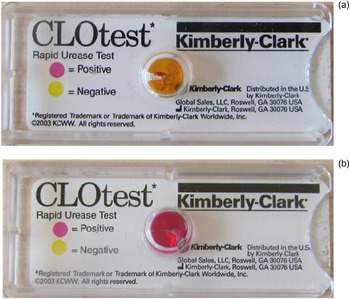
With regard to the rapid urease test, at the beginning of the surgery, the sterile bioptate (minimum 2 × 2 mm pieces) was placed into a medium with urea and a pH indicator. When material contained H pylori, the urease enzyme changed the endogenous urea into ammonia and carbon dioxide. Moreover, the pH was changed by the released ammonia, and the indicator colour shifted from yellow to orange, red or purple. The campylobacter-like organism test (Kimberly-Clark, New Milford, Connecticut, USA) was used. The changes in colour were evaluated after 20 minutes, 1 hour, 3 hours and 24 hours (Figure 2), as per the recommendations.Reference Malfertheiner, Megraud, O'Morain, Atherton, Axon and Bazzoli 2 , Reference Tseng, Wang and Wu 31
(a) Negative and (b) positive rapid urease test results for the diagnosis of Helicobacter pylori in patients with chronic tonsillitis, where the indicator has changed the medium's colour from yellow to purple.

H pylori was considered to be present in the biopsy material of the palatine tonsils (H pylori positive) if the results of the two tests were positive. In a small number of additional adenoidectomy cases (five in the chronic tonsillitis group and three in the tonsillar hypertrophy group), we did not separately check the adenoidal tissue for H pylori.
Statistical methods
Statistical analysis was performed using SPSS software version 17 for Windows software (SPSS, Chicago, Illinois, USA). The differences in the qualitative parameters were calculated using the chi-square or Fisher's exact tests. The unpaired student's t-test (two-tailed) was used to compare the differences between the quantitative data of two groups.
A correlation analysis between H pylori infection in the tonsillar tissue and different variables, such as diagnosis (chronic tonsillitis or tonsillar hypertrophy), demographics (age, gender, body mass index), unhealthy habits (alcohol consumption, smoking), a history of gastroesophageal reflux disease, reflux-related symptoms (assessed by the reflux symptom index) and reflux-related signs (assessed by the reflux finding score), was performed using Pearson's or Spearman's correlation coefficients (r). The variables that showed a significant association were then separately analysed with the help of binary logistic regression to ascertain whether they were predictive of the presence of H pylori in the tonsillar tissue.
Odds ratios were expressed with their 95 per cent confidence intervals. An alpha level of 0.05 was considered statistically significant. The Spearman's correlation coefficient was used for an assessment of intra-rater reliability.
Results
Overall, a significantly higher positive H pylori rate was present in the chronic tonsillitis patients (56.5 per cent; 35 of 62) compared to the control patients with tonsillar hypertrophy (31.4 per cent; 11 of 35) (p = 0.018) (Figure 3).
Distribution of positive Helicobacter pylori results in the biopsy material of removed palatine tonsils (n = 97). *Indicates a statistically significant difference between the groups (p < 0.05)

A similar tendency was observed when the findings from children and adults were analysed separately; that is, the incidence of H pylori infection was significantly higher in the chronic tonsillitis group than in the control group, regardless of age (p < 0.05) (Figure 3). H pylori in the tonsillar tissue was identified in 11 of 27 (40.7 per cent) children with chronic tonsillitis, while it was not detected in any of the control group children with tonsillar hypertrophy (p = 0.02). Similar results were found in adults: H pylori infection was identified in 24 of 35 (68.6 per cent) adults from the chronic tonsillitis group and 11 of 26 (42.3 per cent) adults from the control group. The difference between the subgroups was statistically significant (p = 0.04).
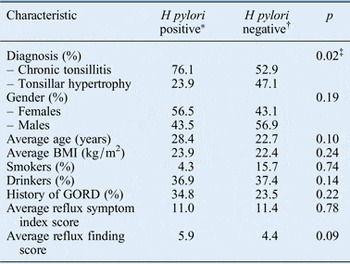
Nine independent factors were considered: diagnosis, gender, age, body mass index, smoking, alcohol consumption, history of gastroesophageal reflux disease, reflux symptom index score and reflux finding score. Patients in whom H pylori was detected in the biopsy specimens of the removed palatine tonsils were identified as H pylori positive, and the patients in which H pylori was not detected were identified as H pylori negative. These patients were compared using univariate, correlation and logistic regression analyses to determine the potential predictors of H pylori in the tonsillar tissue. Univariate analysis data for these main factors are presented in Table I. No statistically significant differences between H pylori positive and negative sets were found with regard to patients’ gender, age, body mass index, habits of smoking and alcohol consumption, history of gastroesophageal reflux disease, and summary of reflux symptom index and reflux finding score scores (p > 0.05). Only the diagnosis of chronic tonsillitis was significantly related to an H pylori positive finding (p = 0.02).
Characteristics of H pylori positive and negative patients

*n = 46; † n = 51. ‡Statistically significant (p < 0.05). BMI = body mass index; GORD = gastroesophageal reflux disease
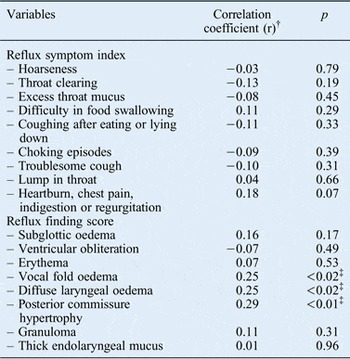
The correlation analysis, which additionally included separate values for reflux symptom index symptoms and reflux finding score signs, revealed similar findings. Specifically, there were no statistically significant relationships between H pylori infection in the palatine tonsils and patients’ demographic data (r = 0.10–0.17, p > 0.05), unhealthy habits (r = 0.03–0.06, p > 0.05) or reflux-related symptoms measured by the reflux symptom index (r = 0.10–0.14, p > 0.05). However, in addition to the diagnosis of chronic tonsillitis (r = 0.25, p = 0.018), there were significant yet weak positive relationships between H pylori infection in the palatine tonsils and three common LPR-related signs (as assessed by reflux finding scores): vocal fold oedema (r = 0.25, p = 0.018), diffuse laryngeal oedema (r = 0.25, p = 0.016) and posterior commissure hypertrophy (r = 0.29, p = 0.005). Thus, the presence of H pylori in the palatine tonsils was related to a manifestation of the aforementioned LPR signs. The data for the correlation analysis between H pylori infection in the tonsillar tissue and the LPR-related symptoms and signs of the patients are presented in Table II.
Correlations between H pylori infection in tonsillar tissue and laryngopharyngeal reflux related symptoms and signs*

* n = 97. †Pearson's correlation coefficient was used for the parametric data and Spearman's correlation coefficient was used for the non-parametric data. ‡Statistically significant (p < 0.05)
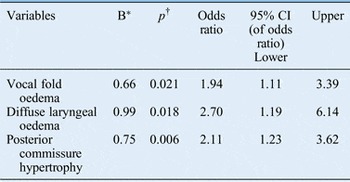
A logistic regression analysis revealed that the three aforementioned LPR-related signs were relevant independent factors predictive of H pylori in the tonsillar tissue (Table III). Higher scores for vocal fold oedema, diffuse laryngeal oedema and posterior commissure hypertrophy increased the odds for the presence of H pylori in the tonsillar tissue by approximately two to three times (odds ratio = 1.94, p = 0.021; odds ratio = 2.70, p = 0.018; and odds ratio = 2.11, p = 0.006, respectively).
Logistic regression analysis: significant risk factors for H pylori in tonsillar tissue

*Logistic regression coefficient. †Significance level = p < 0.05. CI = confidence interval
Discussion
H pylori in palatine tonsillar tissue
Chronic tonsillitis is a common condition characterised by persistent inflammation of the palatine tonsils and frequent bacterial infections. In the aerodigestive tract, tonsillar tissue has established similarities to gastric mucosal lymphoid tissue.Reference Hwang, Forman, Kanter and Friedman 26 Therefore, it is reasonable to assume that colonisation by H pylori may play an important role in infection of the tonsils. Understanding the causes of chronic tonsillitis is important for making clinical decisions concerning this commonly treated disease. Simple tonsillar hypertrophy could be present without the history of an infection, but could lead to sleep-related breathing disorders and dysphagia.Reference Nártová, Kraus, Pavlík, Lukeš, Katra and Plzák 16 Thus, one of our study aims was to determine the prevalence of H pylori in patients with chronic tonsillitis compared to patients in a control group who had simple tonsillar hypertrophy.
In the present study, H pylori was identified in the biopsy material from tonsils, via histological examination, in more than half (56.5 per cent) of all patients who underwent tonsillectomy for chronic tonsillitis. This finding significantly differed (p < 0.05) from the control group (in which H pylori was identified in only 31.4 per cent of patients). Similar results were found in the subgroups differentiated by age. Both children and adult patients with chronic tonsillitis demonstrated a significantly higher rate of positive H pylori results compared to the tonsillar hypertrophy (control) group (children – 40.7 per cent vs 0.0 per cent, respectively; adults – 68.6 per cent vs 42.3 per cent, respectively).
The detection of H pylori in this study was performed using two accepted methods for gastric H pylori identification, namely, the rapid urease test and the modified histochemical Giemsa stain method.Reference Malfertheiner, Megraud, O'Morain, Atherton, Axon and Bazzoli 2 , Reference Jančiauskas 30 , Reference Tseng, Wang and Wu 31 An oral cavity, unlike the stomach, has other urease-producing species, which may result in a higher rate of false-positive rapid urease test results.Reference Fazaeli 25 , Reference Burne and Chen 32 However, data in the literature show that the activeness of the urease produced by other oral micro-organisms (the number of activeness units in 1 mg of protein) is more than 400 times smaller than the activeness produced by H pylori; thus, a substantial impact on the identification of H pylori bacterium is unlikely.Reference Burne and Chen 32
Taking into account the methods used in infection identification, the results of our study correspond to recent controlled research conducted by Lin et al.Reference Lin, Wu, Friedman, Chang and Wilson 14 The data of 94 adult patients (44 patients in the tonsillitis group and 50 patients in the control group) with sleep-related breathing disorders were assessed. The rate of H pylori infection identified by rapid urease test was significantly higher in patients with chronic tonsillitis compared to the control group (48 per cent vs 24 per cent, p < 0.001). Another study involving 285 children using the same diagnostic methods revealed similar results to those of the present study. The bacterium was identified in 39.6 per cent of the chronic tonsillitis cases.Reference Jabbari Moghaddam, Rafeey and Radfar 10 However, in other studies, a relationship between chronic tonsillitis and H pylori could not be found.Reference Bulut, Agacayak, Karlidag, Toraman and Yilmaz 19 – Reference Toros, Toros, Kaya, Deveci, Özel and Naiboğlu 23
The controversial results could be a result of several factors, as follows: the selection of the tested contingent, the biopsy material sampling technique and different H pylori diagnostic methods (currently, there is no uniform standardised system of H pylori identification in the upper airway).
Moreover, recent controlled studies searching for H pylori DNA in the mucosa-associated lymphoid tissue of the pharynx reported that, in the case of chronic tonsillitis, the prevalence of H pylori in the tonsillar tissue could range from as low as 8.3 per centReference Güçlü, Akçalı, Sahin, Tekin, Barutçu and Otkun 21 to as high as 80 per cent.Reference Lukeš, Pavlík, Potuznikova, Nartova, Foltynova and Plzak 5 , Reference Nártová, Kraus, Pavlík, Lukeš, Katra and Plzák 16 The high affinity of the bacterium to lymphoid tissues of the pharynx could suggest that there is a relationship between H pylori infection and chronic tonsillitis.Reference Elsheikh and Mahfouz 33 However, the most recent meta-analysis of tonsillar H pylori colonisation in chronic tonsillitis, which was based on 6 controlled paediatric and adult studies, with the pooled data from 436 subjects, found no difference in the prevalence of H pylori in patients with chronic tonsillitis versus patients with non-infectious hyperplastic tonsils.Reference Hwang, Forman, Kanter and Friedman 26 The authors concluded that H pylori infection does not have a significant impact on the pathogenesis of chronic tonsillitis. However, heterogeneity in the study samples and the different methods used for the identification of H pylori in the tonsillar tissue may have contributed to the non-significant results. Therefore, the authors emphasised that further controlled research is necessary.
In summary of this issue, H pylori may exist in tonsillar tissue, but the significance of this bacterium in the pathogenesis of diseases of the tonsils is not yet completely clear. The results presented in the literature are difficult to compare because of differences in samples, H pylori infection identification methods and comparative aspects. Our study data support the hypothesis that H pylori infection may have a significant role in chronic tonsillitis. Further multicentre investigations are needed to determine whether H pylori infection is related to chronic tonsillitis. Moreover, there is a need for the development of diagnostic standards for the detection of H pylori in the upper airway.
H pylori infection and laryngopharyngeal reflux
Laryngopharyngeal reflux is defined as the retrograde flow of stomach contents to the larynx and pharynx, causing laryngopharyngeal epithelium damage, ciliary dysfunction, inflammation and altered sensitivity.Reference Campagnolo, Priston, Thoen, Medeiros and Assunção 34 Furthermore, gastric juices infected with H pylori and systemic immune responses to gastric H pylori virulence factors might play a causative role in upper airway diseases.Reference Kariya, Okano and Nishizaki 1 , Reference Yemisen, Mete, Kanbay, Balkan and Ozaras 7 , Reference Kurtaran, Uyar, Kasapoglu, Turkay, Yilmaz and Akcay 8 Thus, one of the aims of this study was to assess the possible relationships between H pylori infection identified in the palatine tonsils and LPR, and the patients’ demographic data and their unhealthy habits (alcohol consumption, smoking).
Our study findings showed significant yet weak positive relationships between H pylori positivity and three common LPR signs assessed by the validated reflux finding score, namely, vocal fold oedema, diffuse laryngeal oedema and posterior commissure hypertrophy (r = 0.25–0.29, p < 0.05). This means that H pylori infection in the palatine tonsils has been found more frequently in patients with these LPR-related signs. A logistic regression analysis has revealed that these LPR signs increase the odds for positive H pylori findings in the tonsillar tissue by approximately two to three times (Table III). Meanwhile, no significant relationships have been determined between H pylori infection and patients’ demographics, their unhealthy habits and LPR symptoms including heartburn.
The literature regarding the relationship between LPR and H pylori detected in the pharynx is limited. The role of gastroesophageal reflux and/or LPR in the transmission of H pylori to the pharynx, and the relationship between H pylori and the symptoms and findings of LPR is controversial.Reference Kariya, Okano and Nishizaki 1 Tezer et al. investigated the relationship between reflux finding score and inflammation of the lower part of the oesophagus, as well as reflux finding score and H pylori infection in the stomach.Reference Tezer, Kockar, Koçkar and Celik 35 They concluded that the expression of H pylori and the degree of gastroesophageal reflux disease are more adverse in patients with higher reflux finding scores. However, the detection of H pylori in the upper airway was not part of this study.
With the help of 2 reliable polymerase chain reaction and culture tests to detect H pylori colonisation in mucous membranes of the pharynx, Kaptan et al. examined biopsy material from the pharyngeal mucosa of 70 patients with non-specific chronic pharyngitis and 20 healthy controls.Reference Kaptan, Emir, Uzunkulaoğlu, Yücel, Karakoç and Koca 6 The researchers concluded that non-specific chronic pharyngitis is significantly related to colonisation by H pylori in the pharynx, and the presence of this infection in the stomach increases the frequency of the pharyngeal colonisation. Similar results were found in the study by Zhang et al.Reference Zhang, Peng, Zhang, Zhang and Zheng 36 They reported that H pylori infection in the pharynx was significantly more likely in patients with a history of stomach ailments than in patients without such a history, and they could not detect H pylori in the pharynx of healthy people.
More recently, Katra et al. investigated the association of LPR (proven by a combination of multiple intraluminal impedance and pH monitoring) with H pylori in adenoid hyperplasia (detected with real time polymerase chain reaction) in 30 children.Reference Katra, Kabelka and Jurovcik 37 It was determined that the patients with polymerase chain reaction positivity for H pylori had significantly more episodes of reflux reaching the upper oesophageal sphincter. This finding supports the hypothesis that the episodes of reflux reaching the upper oesophageal sphincter may play an important role in the transmission of H pylori into the lymphoid tissue of the pharynx, and thus may contribute to adenoid hyperplasia in children.
The abovementioned studies support the hypothesis that LPR could predispose one to H pylori colonisation in the pharynx and tonsils. Some studies, however, have established that tonsillar H pylori is different from the predominant strains most commonly found in the stomach by a virulence factor gene possessed by this bacterium.Reference Lukeš, Pavlík, Potuznikova, Nartova, Foltynova and Plzak 5 , Reference Kusano, Inokuchi, Fujimoto, Miyamoto, Tokunaga and Kuratomi 9 The predominance of cytotoxin-associated gene A (CagA)-negative genotypes isolated from the tonsillar tissue in recent investigations may indicate that the main virulence factor in gastric infection, CagA, is not of such importance for an infection of the tonsils.Reference Nártová, Kraus, Pavlík, Lukeš, Katra and Plzák 16 These findings suggest that tonsils do not comprise a reservoir for gastric H pylori infection, and suggest that more than one H pylori strain could exist in the oropharynx and stomach of the same patient.Reference Kariya, Okano and Nishizaki 1
Regardless, the high incidence of H pylori infection in the tonsillar tissue indicate that tonsillectomy might influence gastric infection with this bacterium; however, this issue is quite controversial. Minocha et al. reported a decreased risk of H pylori infection in the gastric mucosa among patients who underwent tonsillectomy, which leads to an argument on whether the tonsils are a reservoir for H pylori and recurrent systemic infection.Reference Minocha, Raczkowski and Richards 38 In contrast, a study by Sezen et al. indicated that tonsillectomy does not significantly affect gastric H pylori eradication; however, a relatively small sample size (n = 46) may have had some influence on the results.Reference Sezen, Kubilay, Erzin, Tuncer and Unver 39 We speculate that the eradication of H pylori infection may prevent future oropharyngeal pathology.
-
• This study assessed the relationship between Helicobacter pylori infection in the tonsillar tissue and chronic tonsillitis and laryngopharyngeal reflux (LPR)
-
• H pylori was more prevalent in chronic tonsillitis cases than in tonsillar hypertrophy cases
-
• H pylori in the tonsillar tissue was associated with LPR-related signs
Limitations
Limitations of our study include its monocentre design and not using the polymerase chain reaction method for the detection of H pylori in the tonsillar tissue, although we followed the recommendations for enhancement of the diagnostic reliability of H pylori and used a combination of two acceptable diagnostic methods.Reference Jabbari Moghaddam, Rafeey and Radfar 10 , Reference Fazaeli 25 Such limitations prevent clear information being obtained about the causal relationship between H pylori in the tonsils and chronic inflammation. Further controlled multicentre studies with uniform diagnostic standards for detecting H pylori in the upper airway are necessary. These studies could support or deny the importance of H pylori infection for the development of different diseases of the tonsils and the impact of bacterial eradication on their course.
Conclusion
The findings of our study have shown that H pylori infection of the upper airway may be related to chronic tonsillitis. H pylori in the biopsy material of the palatine tonsils was identified in more than half of all the patients who underwent tonsillectomy for chronic tonsillitis, and was significantly more frequent in comparison to both children and adult patients with tonsillar hypertrophy. H pylori presence in the tonsillar tissue depends on both the type of tonsillar disease and LPR-related signs, namely, evidence of vocal fold oedema, diffuse laryngeal oedema and posterior commissure hypertrophy. With the presence of these LPR signs, the possibility for H pylori positivity increases by two to three times.